To be honest, I had forgotten that I had this post stored in my ‘drafts’ folder. But when browsing for something easy on the eye for a Sunday, I discovered this.
Despite the item going back to last July, it’s still wonderful and worth sharing.
First Ever Videos of Snow Leopard Mother and Cubs in Dens Recorded in Mongolia
July 12, 2012 — For the first time, the den sites of two female snow leopards and their cubs have been located in Mongolia’s Tost Mountains, with the first known videos taken of a mother and cubs, located and recorded by scientists from Panthera, a wild cat conservation organization, and the Snow Leopard Trust (SLT).
Because of the snow leopard’s secretive and elusive nature, coupled with the extreme and treacherous landscape which they inhabit, dens have been extremely difficult to locate. This is a tremendous discovery and provides invaluable insight into the life story of the snow leopard.
Dr. Tom McCarthy, Executive Director of Panthera’s Snow Leopard Program stated, “We have spent years trying to determine when and where snow leopards give birth, the size of their litters, and the chances a cub has of surviving into adulthood. This is one of those exceptional moments in conservation where after years of effort, we get a rare glimpse into the life of an animal that needs our help in surviving in today’s world. These data will help ensure a future for these incredible animals.“
A short video of the female and her cub who were bedded down in a partially human-made den was recorded from a safe distance by Örjan Johansson, Panthera’s Snow Leopard Field Scientist and Ph.D. student, using a camera fixed to an extended pole.
You think English is easy? Well, we think a retired English teacher was bored and came up with this.
Read all the way to the end and appreciate how much work this took to put it together!
The bandage was wound around the wound.
The farm was used to produce produce.
The dump was so full that it had to refuse more refuse.
We must polish the Polish furniture..
He could lead if he would get the lead out.
The soldier decided to desert his dessert in the desert..
Since there is no time like the present, he thought it was time to present the present.
A bass was painted on the head of the bass drum.
When shot at, the dove dove into the bushes.
I did not object to the object.
The insurance was invalid for the invalid.
There was a row among the oarsmen about how to row.
The buck does funny things when the does are present.
A seamstress and a sewer fell down into a sewer line.
To help with planting, the farmer taught his sow to sow.
The wind was too strong to wind the sail.
Upon seeing the tear in the painting I shed a tear..
I had to subject the subject to a series of tests.
How can I intimate this to my most intimate friend?
Let’s face it – English is a crazy language.
There is no egg in eggplant, nor ham in hamburger; neither apple nor pine in pineapple.
English muffins weren’t invented in England or French fries in France . Sweetmeats are candies while sweetbreads, which aren’t sweet, are meat.
We take English for granted. But if we explore its paradoxes, we find that quicksand can work slowly, boxing rings are square and a guinea pig is neither from Guinea nor is it a pig.
And why is it that writers write but fingers don’t fing, grocers don’t groce and hammers don’t ham?
If the plural of tooth is teeth, why isn’t the plural of booth, beeth? One goose, 2 geese. So one moose, 2 meese? One index, 2 indices?
Doesn’t it seem crazy that you can make amends but not one amend? If you have a bunch of odds and ends and get rid of all but one of them, what do you call it?
If teachers taught, why didn’t preachers praught? If a vegetarian eats vegetables, what does a humanitarian eat?
Sometimes I think all the English speakers should be committed to an asylum for the verbally insane. In what language do people recite at a play and play at a recital? Ship by truck and send cargo by ship? Have noses that run and feet that smell?
How can a slim chance and a fat chance be the same, while a wise man and a wise guy are opposites?
You have to marvel at the unique lunacy of a language in which your house can burn up as it burns down, in which you fill in a form by filling it out and in which, an alarm goes off by going on.
English was invented by people, not computers, and it reflects the creativity of the human race, which, of course, is not a race at all.
That is why, when the stars are out, they are visible, but when the lights are out, they are invisible.
PS. – Why doesn’t ‘Buick’ rhyme with ‘quick’?
You lovers of the English language might enjoy this .
There is a two-letter word that perhaps has more meanings than any other two-letter word, and that is ‘UP.’
It’s easy to understand UP, meaning toward the sky or at the top of the list, but when we awaken in the morning, why do we wake UP?
At a meeting, why does a topic come UP?
Why do we speak UP and why are the officers UP for election and why is it UP to the secretary to write UP a report?
We call UP our friends.
And we use it to brighten UP a room, polish UP the silver; we warm UP the leftovers and clean UP the kitchen.
We lock UP the house and some guys fix UP the old car.
At other times the little word has real special meaning.
People stir UP trouble, line UP for tickets, work UP an appetite, and think UP excuses.
To be dressed is one thing, but to be dressed UP is special.
A drain must be opened UP because it is stopped UP.
We open UP a store in the morning but we close it UP at night.
We seem to be pretty mixed UP about UP!
To be knowledgeable about the proper uses of UP, look the word UP in the dictionary. In a desk-sized dictionary, it takes UP almost 1/4th of the page and can add UP to about thirty definitions.
If you are UP to it, you might try building UP a list of the many ways UP is used.
It will take UP a lot of your time, but if you don’t give UP, you may wind UP with a hundred or more.
When it threatens to rain, we say it is clouding UP. When the sun comes out we say it is clearing UP. When it rains, it wets the earth and often messes things UP. When it doesn’t rain for awhile, things dry UP.
One could go on and on, but I’ll wrap it UP, for now my time is UP, so…….it is time to shut UP!
Now it’s UP to you what you do with this email.
oooOOOooo
What a wonderful exploration with, of course, more beautiful examples yet floating around. A couple come to my mind.
One is if the English language made any sense, lackadaisical would have something to do with a shortage of flowers.
I will close with a quote reputed to have come from Ronald Reagan, who argued that, “The most terrifying words in the English language are: I’m from the government and I’m here to help.“
Apologies, forgot who sent me the link to this video.
Which is a little over 5 minutes of watching Mark Gungor speak about the differences between the brains of men and women. I hadn’t come across Mark Gungor before but his website reveals he is “one of the most sought-after speakers on marriage and family in the country.”
I can remember everything, except the things I forget!
Today’s post is about something that at it’s heart is no laughing matter; loss of memory. But the opportunity to open in a slightly frivolous manner is simply too tempting!
Because I admit to not remembering when I started to lose my memory! 🙂
But somewhere along the way during the last 5 or 6 years others around me, especially Jeannie, started noticing that my mental recall wasn’t so good. In November, I shall be 69 and have been told (I forget by whom!) that the sort of life changes that these last few years have delivered would be classic causes of declining memory in a person in their sixties.
OK, on with the show.
Some time ago, I received an email from a Daniel Strauss. This is what Daniel wrote:
Hi,
I’m a contributor to an education improvement resource and I recently published an article providing many tips about improving your memory I think you would be interested in. I found your site and your item, Let’s do nothing, during my research and would like to invite you to take a look at my published piece.
Please let me know if you would be interested in taking a look and possibly sharing with your readers.
Thanks,
Daniel
My reply was to query Daniel’s motivation before saying ‘yeah’ or ‘nay’. A further email subsequently arrived:
I am one of many contributors on a research project and recently completed work on resource that provides quick and easy tips to keep your mind sharp and be able to remember things you’ve learned. I reached out because I thought you and your readers would be interested in my resource. Here is the link to the resource. Take a look and let me know if you would consider including it among the other resource links that you’ve provided on your site.
Look forward to hearing from you.
Thanks for your help.
I was happy to feature these memory tips.
The 75 tips are on a website that is called the Open Education Database, from which one learns “We’ve compiled the Open Education Database (OEDb) to help ambitious or prospective students find the most convenient, valuable, and relevant education programs to fulfill their academic and career objectives.”
Not entirely sure why a feature on memory is part of the OEdb website, but so what! The tips strike me as fabulous advice.
The memory feature is called The Memory Toolbox: 75 Tips and Resources to Go from Amnesic to Elephantic, and is introduced, thus:
Many people expect increasing memory loss as they age, but this memory loss can be reduced or stalled with some simple memorization techniques, physical exercise, and a reduction of stress. In fact, impaired memory has more to do with chemicals that are released in the brain when an individual suffers from chronic stress. But, you can reduce the obstacles and increase your memory capacity with the seventy-five tips and resources listed below. In fact, you can go from amnesic to elephantic within a few short weeks.
Some of the tips you may already know, but we’ve repeated them because they may have slipped your mind. Other tips are from recent news stories that contained information you may not have heard. The links will take you to those news items and to other resources that you can use to increase your capacity to remember anything you deem important.
The 75 tips and resources are sorted into 10 groupings; here are some of the recommendations:
Be in the Moment
You can’t remember something if you’ve never learned it, so focus on learning.
It only takes about eight seconds to process data through your hippocampus into the appropriate memory center, so it doesn’t take long to absorb information.
To learn how to stay in the moment, don’t focus on the past or worry about the future while you’re learning.
Don’t multitask, as you create a “brain drain” when you focus on more than one activity.
Create a Learning Environment
Create a learning environment at home. This is crucial for adult learners who will be taking online courses, while balancing work, family, and other factors.
Use All Your Senses
If you’re learning something, involve as many senses as possible to help retain the experience.
Drawing and writing includes the use of motor skills that help you to remember information as you stimulate motor pathways.
If you utilize these motor skills in a task, don’t try something new for a few days. Instead, repeat some of the exercises listed immediately below a few times during the first week so that they become ingrained with your learning habits.
Talk with another person about the information you’ve gathered. This action will incorporate more than one sense and it will help you to categorize information as well.
Attach your ideas to an inert object for your learning process. For instance, connect the introduction of a speech to the entrance of the house, move on to the next room to connect the introduction to the next idea, and so on throughout a building.
Use Mnemonic Devices
Mnemonic (the initial “m” is silent) devices can provide clues to help you remember things. For instance, you can use visual images to memorize names, places, and events. If you wanted to remember Tom’s name, think of a tom cat and connect that person to that image. Or, use something more obvious, like Queen Victoria for Victoria. Just place an imaginary crown on Victoria’s head and you might remember that person’s name the next time you meet them.
“Every Good Boy Does Fine” is a sentence that many musicians use to remember the lines in a treble staff (E, G, B, D, and F). Medical students use silly sentences to remember anatomical features. Try this tool when you need to memorize a sequence of difficult words or a series like the biological taxonomy (Kingdom, Phylum, Class, Order, Family, Genus, Species): “Kids Played Cards On Furry Gray Skins.”
Connect new data to information you already know. For example, if you already know how to cook a turkey, use that information to relate to how you might cook a goose. You’re merely building on information you’ve already retained and relating it to a new recipe. The new recipe will be easier to remember.
Organize
Disorganized people report more memory problems than those individuals who are accustomed to organization. This ability to organize is external as well as internal…External organization can free your brain up for more creative endeavors. Internal organization requires a less stressful lifestyle.
Write things down, but write them down in appropriate places. For instance, write addresses in address books, and write grocery lists in a special notebook that you’ve designated for that list. Accordingly, use specific places in the house for certain items. For instance, if you hang the keys on a hook by the door when you enter, you won’t need to sap your time or brain power to find those keys.
Use online or paper calendars to remember important dates. This will help you to be more social, on time, and employed. Plus, you can free up your mind for more creative endeavors.
Keep a pad, pencil and small flashlight by your bed to write down ideas that you have at night. If you forget these tools, just move something out of place so that you’ll remember that idea in the morning (just throw a tissue or book on the floor so you see it in the morning – those items will trigger memories of the previous evening).
Increase your scholarly productivity with tools that will help you stay organized online.
Overlearn
Spend some time with new material a few hours after you’ve been introduced to it. Review notes and try to consolidate the notes into a broad concept or idea.
Review notes and other information at intervals throughout the next few days. This is called “Spaced Rehearsal” or “Spaced Repetition,” and it’s a more effective method for learning than cramming.
When you use overlearning, you improve recall speed.
Retain a Positive Attitude
Tell yourself that you want to learn and that you can learn and remember the information at hand.
A positive outlook and positive mental feedback sets up an expectation for success.
Exercise Regularly
Exercise increases oxygen to the brain, and oxygen is important for brain function.
Physical exercise reduces the risk for many disorders that relate to memory loss, such as dementia and cardiovascular disease.
The hippocampus is especially vulnerable to age-related deterioration that can affect how well you retain information, so it’s important to maintain an exercise routine as you age.
Walking is not strenuous (unless you power walk), so your leg muscles don’t take up extra oxygen and glucose like they do during other forms of exercise. If you find yourself stressed, take a few minutes to oxygenate your brain with a leisurely walk.
Manage stress
Cortisol, the stress hormone secreted under stress by the human adrenal gland, near the kidneys, can damage the hippocampus if stress is unrelieved.
Physical exercise can help to relieve stress. Even a simple walk can help to clear the mind.
Jokes, soothing music, and even a short nap can help to break the stress.
On the other hand, arousing, exciting, momentous occasions, including stressful ones, get filed away very readily. If you can remember your first date, your first job, 9/11, or when Kennedy was shot, these examples prove that some stressful occasions can create vivid memories.
Other Good habits
A good night’s sleep is necessary for memory consolidation. Sleep disorders (especially in aging women) can leave you tired and unable to concentrate during the day.
Quit smoking – smoking constricts arteries that deliver oxygen to the brain. Research has proven this memory loss in smokers.
Relaxation through meditation, tai chi, yoga, or other techniques that slow respiration, slow metabolism, and release muscle tension can make a huge difference in your overall health and stress levels. Invest about ten to fifteen minutes per day with these techniques.
Staying properly hydrated can do more for your body and mind than eating, at times. Drink your recommended 8-10 glasses per day.
So if you, like me, find the loss of one’s memory to be frustrating, or worse, make a note of the Memory Toolbox website and work your way through all 75 excellent tips and recommendations. It’s a fabulous resource.
I’ll shall be adding the link to my ‘blogroll’ – so long as I don’t forget! 😉
A real pleasure and privilege to republish this article from Mr. Monbiot.
For some time now I have subscribed to the articles published by The Permaculture Research Institute of Australia. From time to time references have been made to PRI articles here on Learning from Dogs.
Recently, I read a PRI essay that had been penned by George Monbiot. It was called The Great Unmentionable. It blew me away. So I took a deep breath and dropped George M. an email asking if I might republish it here. George was very gracious in giving me such permission.
Mr. George Monbiot.
First some background to George Monbiot for those who are unfamiliar with his work and his writings. As his website explains:
I had an unhappy time at university, and I now regret having gone to Oxford, even though the zoology course I took – taught, among others, by Richard Dawkins, Bill Hamilton and John Krebs – was excellent. The culture did not suit me, and when I tried to join in I fell flat on my face, sometimes in a drunken stupor. I enjoyed the holidays more: I worked on farms and as a waterkeeper on the River Kennet. I spent much of the last two years planning my escape. There was only one job I wanted, and it did not yet exist: to make investigative environmental programmes for the BBC.
After hammering on its doors for a year, I received a phone call from the head of the BBC’s natural history unit during my final exams. He told me: “you’re so fucking persistent you’ve got the job.” They took me on, in 1985, as a radio producer, to make wildlife programmes. Thanks to a supportive boss, I was soon able to make the programmes I had wanted to produce. We broke some major stories. Our documentary on the sinking of a bulk carrier off the coast of Cork, uncovering evidence that suggested it had been deliberately scuppered, won a Sony award.
We have offshored both our consumption and our perceptions
By George Monbiot
Every society has topics it does not discuss. These are the issues which challenge its comfortable assumptions. They are the ones that remind us of mortality, which threaten the continuity we anticipate, which expose our various beliefs as irreconcilable.
Among them are the facts which sink the cosy assertion, that (in David Cameron’s words) “there need not be a tension between green and growth.”
At a reception in London recently I met an extremely rich woman, who lives, as most people with similar levels of wealth do, in an almost comically unsustainable fashion: jetting between various homes and resorts in one long turbo-charged holiday. When I told her what I did, she responded, “oh I agree, the environment is so important. I’m crazy about recycling.” But the real problem, she explained, was “people breeding too much”.
I agreed that population is an element of the problem, but argued that consumption is rising much faster and – unlike the growth in the number of people – is showing no signs of levelling off. She found this notion deeply offensive: I mean the notion that human population growth is slowing. When I told her that birth rates are dropping almost everywhere, and that the world is undergoing a slow demographic transition, she disagreed violently: she has seen, on her endless travels, how many children “all those people have”.
As so many in her position do, she was using population as a means of disavowing her own impacts. The issue allowed her to transfer responsibility to other people: people at the opposite end of the economic spectrum. It allowed her to pretend that her shopping and flying and endless refurbishments of multiple homes are not a problem. Recycling and population: these are the amulets people clasp in order not to see the clash between protecting the environment and rising consumption.
In a similar way, we have managed, with the help of a misleading global accounting system, to overlook one of the gravest impacts of our consumption. This too has allowed us to blame foreigners – particularly poorer foreigners – for the problem.
When nations negotiate global cuts in greenhouse gas emissions, they are held responsible only for the gases produced within their own borders. Partly as a result of this convention, these tend to be the only ones that countries count. When these “territorial emissions” fall, they congratulate themselves on reducing their carbon footprints. But as markets of all kinds have been globalised, and as manufacturing migrates from rich nations to poorer ones, territorial accounting bears ever less relationship to our real impacts.
While this is an issue which affects all post-industrial countries, it is especially pertinent in the United Kingdom, where the difference between our domestic and international impacts is greater than that of any other major emitter. The last government boasted that this country cut greenhouse gas emissions by 19% between 1990 and 2008. It positioned itself (as the current government does) as a global leader, on course to meet its own targets, and as an example for other nations to follow.
But the cut the UK has celebrated is an artefact of accountancy. When the impact of the goods we buy from other nations is counted, our total greenhouse gases did not fall by 19% between 1990 and 2008. They rose by 20%. This is despite the replacement during that period of many of our coal-fired power stations with natural gas, which produces roughly half as much carbon dioxide for every unit of electricity. When our “consumption emissions”, rather than territorial emissions, are taken into account, our proud record turns into a story of dismal failure.
There are two further impacts of this false accounting. The first is that because many of the goods whose manufacture we commission are now produced in other countries, those places take the blame for our rising consumption. We use China just as we use the population issue: as a means of deflecting responsibility. What’s the point of cutting our own consumption, a thousand voices ask, when China is building a new power station every 10 seconds (or whatever the current rate happens to be)?
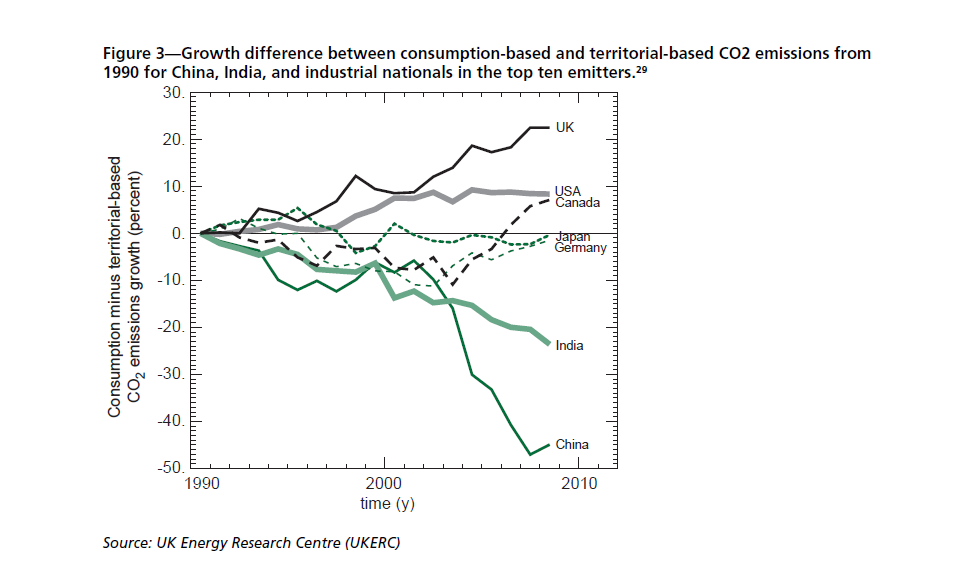
But, just as our position is flattered by the way greenhouse gases are counted, China’s is unfairly maligned. A graph published by the House of Commons Energy and Climate Change Committee shows that consumption accounting would reduce China’s emissions by roughly 45%. Many of those power stations and polluting factories have been built to supply our markets, feeding an apparently insatiable demand in the UK, the US and other rich nations for escalating quantities of stuff.
The second thing the accounting convention has hidden from us is consumerism’s contribution to global warming. Because we consider only our territorial emissions, we tend to emphasise the impact of services – heating, lighting and transport for example – while overlooking the impact of goods. Look at the whole picture, however, and you discover (using the Guardian’s carbon calculator) that manufacturing and consumption is responsible for a remarkable 57% of the greenhouse gas production caused by the UK.
Unsurprisingly, hardly anyone wants to talk about this, as the only meaningful response is a reduction in the volume of stuff we consume. And this is where even the most progressive governments’ climate policies collide with everything else they represent. As Mustapha Mond points out in Brave New World, “industrial civilization is only possible when there’s no self-denial. Self-indulgence up to the very limits imposed by hygiene and economics. Otherwise the wheels stop turning”.
The wheels of the current economic system – which depends on perpetual growth for its survival – certainly. The impossibility of sustaining this system of endless, pointless consumption without the continued erosion of the living planet and the future prospects of humankind, is the conversation we will not have.
By considering only our territorial emissions, we make the impacts of our escalating consumption disappear in a puff of black smoke: we have offshored the problem, and our perceptions of it.
But at least in a couple of places the conjuring trick is beginning to attract some attention.
On April 16th, the Carbon Omissions site will launch a brilliant animation by Leo Murray, neatly sketching out the problem*. The hope is that by explaining the issue simply and engagingly, his animation will reach a much bigger audience than articles like the one you are reading can achieve.
(*Declaration of interest (unpaid): I did the voiceover).
On April 24th, the Committee on Climate Change (a body that advises the UK government) will publish a report on how consumption emissions are likely to rise, and how government policy should respond to the issue.
I hope this is the beginning of a conversation we have been avoiding for much too long. How many of us are prepared fully to consider the implications?
So very difficult to pick out the sentence that carried the most power, for the essay is powerful from start to end. But this one did hit me in the face, “The impossibility of sustaining this system of endless, pointless consumption without the continued erosion of the living planet and the future prospects of humankind, is the conversation we will not have.“
Finally, I can’t resist reminding you, dear reader, of the point made by Prof. Guy McPherson in his book Walking Away from Empire, which I reviewed on March 6th. particularly in the first paragraph of the first chapter; Reason:
At this late juncture in the era of industry, it seems safe to assume we face one of two futures. If we continue to burn fossil fuels, we face imminent environmental collapse. If we cease burning fossil fuels, the industrial economy will collapse. Industrial humans express these futures as a choice between your money or your life, and tell you that, without money, life isn’t worth living. As should be clear by now, industrial humans — or at least our “leaders” — have chosen not door number one (environmental collapse) and not door number two (economic collapse), but both of the above.
Maybe this is why we seem unable to have the conversation because to do so means we have to look at ourselves in the mirror. Each one of us, you and me, has to address something so deeply personal. Back to Prof. McPherson and page 177 of his book (my emphasis):
It’s no longer just the living planet we should be concerned about. It’s us. The moral question, then: What are you going to do about it?
For my money, Mr. Monbiot is yet another voice of reason in the wilderness; another voice that deserves to be followed. I say this because by way of introduction to his philosophy, he opens thus:
My job is to tell people what they don’t want to hear. That is not what I set out to do. I wanted only to cover the subjects I thought were interesting and important. But wherever I turned, I met a brick wall of denial.
Denial is everywhere. I have come to believe that it’s an intrinsic component of our humanity, an essential survival strategy. Unlike other species, we know that we will die. This knowledge could destroy us, were we unable to blot it out. But, unlike other species, we also know how not to know. We employ this unique ability to suppress our knowledge not just of mortality, but of everything we find uncomfortable, until our survival strategy becomes a threat to our survival.
“… until our survival strategy becomes a threat to our survival.”
I sense the growing of this threat to the point where maybe within less than a year the vast majority of open-minded, thinking individuals know the truth of where we are all heading.
In some ways, it is surprising that I haven’t written about my own counselling experiences before. Perhaps it has never felt like the right moment.
But the guest post from Peter Bloch that I had the honour of publishing yesterday so strongly resonated with the ‘Fergus’ inside me that I was compelled to offer my own journey. So if you are not into bouts of personal introspection, look away and come back tomorrow! 😉
The fickle finger of fate
I was born in Acton, North London, just 6 months before the end of World War II. Nothing remarkable about that. Just another one of the millions of soon-to-be post-war babies. My father was an architect; my mother a teacher. Indeed, at the age of 93 my mother is still teaching music!
In 1956 when my father was 55 years-old he developed lung cancer. I and my sister were blissfully unaware of our father’s terminal condition until the evening of December 19th, 1956. That evening Mum came into my bedroom and said that father was very ill and may not live for very much longer. To be honest, it didn’t really register and off I went to sleep. I was 12 and looking forward to Christmas in 5 days time.
My father died in the night hours of December 19th/20th. I had slept through not even wakening when his body was removed from the house. On the morning of the 20th he was just gone!
It was felt by the family doctor, who had been attending my father, that it would be too upsetting for me and my younger sister to attend the funeral. That funeral was a cremation and therefore no grave.
The good and the not so good.
The only obvious effect of the trauma of my father’s death was that I bombed out at school. I had passed my ’11+’ exams at my primary school and in September, 1956, become a pupil at Preston Manor County Grammar School near Preston Road, Wembley where we were living; Wembley Stadium could be seen from the back windows of the 2nd floor of our house.
I struggled with schooling, the victim of much bullying as I recall, sat 8 ‘O-level’ exams, passed 2, struggled to get another couple of ‘O-levels’ but it was clear that a University place was not going to be for me.
From then on, in stark contrast, I enjoyed a wonderfully varied life, working as a business salesman, freelance journalist and ending up starting my own company in Colchester in 1978 which became surprisingly successful.
But when it came to relationships, that wasn’t so successful. If I tell you that Jeannie is my 4th wife, you will get the message!
A little more background.
When running my own business back in the 1980s I had a network of overseas distributors. My US West Coast distributor was Cimarron, a company owned and run by Daniel Gomez out of Los Angeles. Dan and I became good friends and still are some 35 years later. I’ll come back to this highly relevant relationship with Dan.
I sold my business in 1986 and went overseas for 5 years, actually living on a boat based in Larnaca, Cyprus. (The boat was a Tradewind 33 named ‘Songbird of Kent‘.)
In the early 1990s upon returning to England I chose to live in the South Hams area of South Devon, ending up in the small village of Harberton, pop. 300, near Totnes. Once settled I took up business mentoring. In previous years, I had gained Chartered Membership of the Institute of Marketing. In addition, I became a youth mentor with the Prince’s Youth Business Trust, a really fabulous organisation that does so much good for young people.
One of my personal mentees was Jon Lavin, the founder of The People Workshop. (Yes, and Jon is aware that his website is a tad out-of-date!)
Out of sight, but not out of mind.
In time I became married to wife number three. Seemingly happy living in a tranquil part of rural Devon, keeping busy, not thinking too much about life.
Pharaoh became an important part of my life in 2003. At the time, I had no idea how important!
Pharaoh, relaxing in a Devon garden.
On the evening of December 20th, 2006, 50 years to the day that my father died, my wife announced that she had met another man. The implications of this casually delivered bombshell were obvious and catastrophically painful.
I will spare you the details but, trust me, the next few weeks were tough!
High on my priorities were letting close friends know what was happening. Dan, in characteristic Daniel fashion, said over the phone, “Hey, Handover, you get your arse over to Southern California pronto! Like now!” I replied that it was much too difficult to do that now but maybe later on in 2007.
Realising that I might need some psychological support, I spoke with Jon Lavin. However, Jon made it clear that as we already had a working relationship with me as his mentor, he couldn’t now, in turn, be my psychotherapist. I pleaded with Jon. He said he would only work with me on the strict understanding that he would terminate the counselling relationship if our past workings interfered. Of course, I agreed. [See footnote.]
Finding one’s true self after 50 years!
Jon, quite naturally, started into understanding my past experiences. Right back to that fateful day in 1956 when my father died. And, guess what!
Unbeknownst to me, the lack of time to adjust to my father’s cancer, his sudden death, being unable to ‘say goodbye‘; all had been emotionally interpreted as acute and profound emotional rejection. Buried deep within me with both strong positive and negative emotional consequences. Negatively, making me very vulnerable to emotional rejection; positively, causing me to strive for outward success in so many ways. Those sessions with Jon brought it all to the surface bringing with it deep and peaceful calm.
Yet, the true implications of finding myself were still to come.
In the Summer of 2007, I took up Dan’s offer to ‘get my arse to Southern California!‘ I had a fabulous time with Dan and his dear wife, Cynthia. It also included a visit to Dan’s sister, Suzann, and her husband, Don, in their home in Los Osos, California. Su fussed over me restoring my sense of self-worth as Dan and Cynthia had been doing.
One morning over breakfast Suzann said, “Hey Paul, what are you doing for Christmas?”
I replied, “Oh, give me a break, Suzann, it’s the middle of June. Long time before I have to think about dealing with Christmas!”
Su then made the offer that was to change my life irrevocably. “Don and I have a house down in San Carlos, Mexico where we shall be at Christmas. Why don’t you come and have Christmas with us in Mexico?”
And I did. And it was in San Carlos, Mexico that I met Jean. Suzann and Jean were great buddies. Jean had been living there since she and her late husband, Ben, had moved there many years ago. Ben, an American, and Jean had been married for 26 years with Ben, sadly, having died in 2005.
Jean and I spent hundreds of hours chatting and getting to know each other, including the fact that she and I had both been born Londoners within 23 miles of each other. Jean had been rescuing Mexican feral dogs for years and there were 14 dogs in her house in San Carlos. So many of those dogs loved me from the start. It seemed like the most beautiful Christmas I could have wished for. In such stark contrast to just a year ago.
Mexican sunset! San Carlos, 2nd January, 2008.
In September, 2008 after selling the house in Devon, I moved out to San Carlos, Mexico. Just me and Pharaoh who had been such a devoted friend, companion and confidant over the previous months.
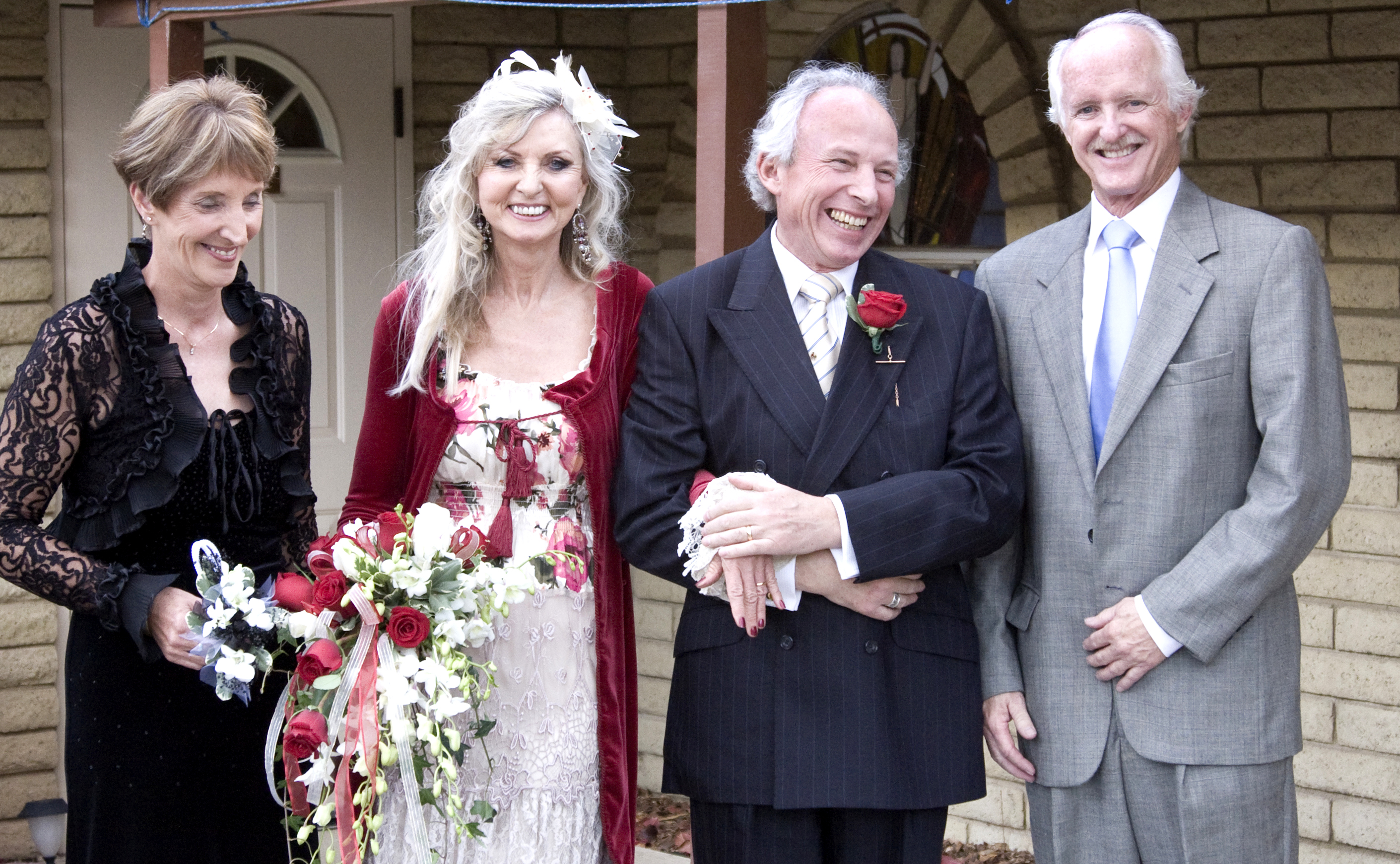
In 2010, we moved to Payson in Arizona, some 80 miles NE of Phoenix. On November 20th, 2010 Jean and I were married.
The marriage of Jean and Paul wonderfully supported by Diane, maid of honour, and best man, Dan Gomez.
Releasing the Fergus in me and all of us.
What Peter Bloch wrote yesterday was so true. A dog can only be a happy, fulfilled dog, if allowed to be the true dog that is in him or her. Despite the fact that humans are primates and dogs are canids like wolves, coyotes, and foxes, it still holds as true for us humans as it did for Fergus.
We can only be happy, to put it in the words of Fergus, “happy, energised, purposeful and fulfilled in every way.” if we are given the freedom to be our self.
So if you find that you, like Fergus, suffer from digestive problems, possibly have skin disorders and sometimes behave a little strangely take note – you need to find your healer!
oooOOOooo
Footnote
Back in 2008 when Jon Lavin was working with me, I would take Pharaoh and he would lay on the floor behind my seat. On one occasion Jon was talking about the findings of Dr. David Hawkins and his Scale of Consciousness; from falsehood to truthfulness. (See here and here for more details.)
Anyway that fateful day, Jon mentioned that Dr. Hawkins had measured dogs as being integrous animals. That notion stayed with me and later I registered the domain name learningfromdogs (dot) com leading to – yes, you guessed it – this blog. Funny old world.
I’m clearly not the only one to believe we really can learn from dogs!
Last Friday, I published a post under the title of The healing power of dogs. This is how that post opened:
How dogs offer us humans health and happiness.
Many months ago, I was contacted by a Peter Bloch offering to write a guest post on the subject of the healing power of dogs. Peter had read a post that I had published in July last year which prompted the email dialogue between us.
Not going to say much more at this stage except that today I am republishing that post from last July. On Monday, I will introduce Peter and his guest post. Then on Tuesday, I will speak of my own experiences both as entrepreneurial mentor and as a ‘customer’ of a wonderful psychotherapist back in Devon during 2007.
So, as promised, here is that guest post from Peter.
oooOOOooo
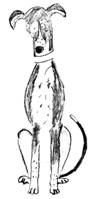
Fergus, the Healing Dog. A sketch by Mrs. Peter Bloch
My dog Fergus is a philosopher, and the nature of health and happiness is his area of special expertise. When he learned about Paul’s blog he became very excited because he has always been convinced that dogs have so much to teach humans about life. As much as anything to have a little peace from his continual philosophical musings, I agreed to set out his theories here for the benefit of everyone who loves dogs.
Fergus would like it to be known that when he is free to pursue the activities to which his particular breed is most naturally attracted then, as a dog, he feels happy, energised, purposeful and fulfilled in every way. Fergus has also observed that when he is able to participate as a co-operating member of his ‘pack’, he feels safe and secure, is clear about how to proceed with his life, and at night he sleeps like a dog.
But Fergus says that when these conditions do not apply, he can be quite remarkably miserable. As a Greyhound, he loves to run very fast, and he is not at all interested in things like retrieving balls, or wallowing in water.
Fergus doing what he loves – running very fast!
However once he was in the care of someone who Fergus thinks we should just call ‘Sarah’. Sarah has a Labrador and thinks that all dogs really ought to be like her dog, resulting in Fergus being put under considerable pressure to enjoy activities that he could not understand.
That lead to Sarah telling Fergus’ owners that he was a difficult dog when in fact he was just a misunderstood dog. He was amazed how, in just one day, he went from sleeping ‘like a dog‘ to ‘living in the doghouse‘!
Indeed, within a week he was suffering from digestive problems and skin disorders, despite an identical diet, and was found to be engaging in several bizarre neurotic behaviours. Fortunately, when more congenial conditions were restored, Fergus returned to feeling safe and secure.
Fergus often expresses surprise that people often do not understand that the freedom to be himself, the true dog that he is, including living in unifying solidarity with his pack, is a fundamental requirement for his health; in all meanings of the word.
For instance, Fergus noticed that Sarah has a son called Henry, who really wanted to be a designer. But his mother thought that it would be better for him to be a lawyer. In fact, Sarah was so certain that in the end Henry became a lawyer. Fergus observes that Henry is always suffering from digestive problems and skin disorders and sometimes behaves a little strangely. Doctors have not been able to find out what is wrong with him, despite all sorts of diets and medicines being tried.
But here’s the rub. When Henry goes out for a walk with Fergus, Fergus always runs as fast as he can and his resulting happiness always makes Henry feel so much better.
Henry is convinced that Fergus is a healer! Who could argue with that?
Fergus, the healing dog.
oooOOOooo
Trust me, when I’m feeling a little down the dogs all know. All of them allow me to come and bury my face in their fur, or rest my face alongside their face. Perhaps one of the most powerful gifts from our dogs is their wonderful, unconditional love for us funny humans.
I have no connection with Peter other than being delighted to have this guest post from him (or was it from Fergus??). Peter offered this brief summary of his work, which I am pleased to include:






 Learning from Dogs