With grateful thanks to John and Janet Z who sent this the other day.
Dear Ma and Pa,
I am well. Hope you are. Tell Brother Walt and Brother Elmer the Marine Corps beats working for old man Minch by a mile. Tell them to join up quick before all of the places are filled.
I was restless at first because you get to stay in bed till nearly 6 a.m. But I am getting so I like to sleep late. Tell Walt and Elmer all you do before breakfast is smooth your cot, and shine some things. No hogs to slop, feed to pitch, mash to mix, wood to split, fire to lay. Practically nothing!
Men got to shave but it is not so bad, there’s warm water. Breakfast is strong on trimmings like fruit juice, cereal, eggs, bacon, etc., but kind of weak on chops, potatoes, ham, steak, fried eggplant, pie and other regular food, but tell Walt and Elmer you can always sit by the two city boys that live on coffee. Their food, plus yours, holds you until noon when you get fed again. It’s no wonder these city boys can’t walk much.
We go on ‘route marches,’ which the platoon sergeant says are long walks to harden us. If he thinks so, it’s not my place to tell him different. A ‘route march’ is about as far as to our mailbox at home. Then the city guys get sore feet and we all ride back in trucks!
The sergeant is like a school teacher. He nags a lot. The Captain is like the school board. Majors and colonels just ride around and frown. They don’t bother you none.
This next will kill Walt and Elmer with laughing. I keep getting medals for shooting. I don’t know why… The bulls-eye is near as big as a chipmunk head and don’t move, and it ain’t shooting at you like the Higgett boys at home. All you got to do is lie there all comfortable and hit it. You don’t even load your own cartridges. They come in boxes!
Then we have what they call hand-to-hand combat training. You get to wrestle with them city boys. I have to be real careful though, they break real easy. It ain’t like fighting with that ole bull at home. I’m about the best they got in this except for that Tug Jordan from over in Silver Lake .. I only beat him once… He joined up the same time as me, but I’m only 5’6′ and 130 pounds and he’s 6’8′ and near 300 pounds dry.
Be sure to tell Walt and Elmer to hurry and join before other fellers get onto this setup and come stampeding in.
Income inequality, when it becomes excessive, is very corrosive to a society.
This is clearly a complex subject because one man’s excess is another man’s just reward for building a successful business that employs his fellow citizens.
Nonetheless, I do want to touch on this sensitive area because, to my mind, they are connected with the tragic story that is the point of this article.
This document presents details on the wealth and income distributions in the United States, and explains how we use these two distributions as power indicators.
Some of the information may come as a surprise to many people. In fact, I know it will be a surprise and then some, because of a recent study (Norton & Ariely, 2010) showing that most Americans (high income or low income, female or male, young or old, Republican or Democrat) have no idea just how concentrated the wealth distribution actually is.
Later on, Prof. Domhoff writes:
The Wealth Distribution
In the United States, wealth is highly concentrated in a relatively few hands. As of 2007, the top 1% of households (the upper class) owned 34.6% of all privately held wealth, and the next 19% (the managerial, professional, and small business stratum) had 50.5%, which means that just 20% of the people owned a remarkable 85%, leaving only 15% of the wealth for the bottom 80% (wage and salary workers). In terms of financial wealth (total net worth minus the value of one’s home), the top 1% of households had an even greater share: 42.7%. Table 1 and Figure 1 present further details drawn from the careful work of economist Edward N. Wolff at New York University (2010).
That table and the whole article is powerful and a well-worth reading. Read it here.
Stay with me a little longer. Here’s an extract from an article from Nicholos Kristof of the New York Times written in November last year.
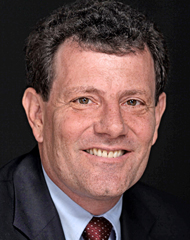
Nicholas Kristof
In my reporting, I regularly travel to banana republics notorious for their inequality. In some of these plutocracies, the richest 1 percent of the population gobbles up 20 percent of the national pie.
But guess what? You no longer need to travel to distant and dangerous countries to observe such rapacious inequality. We now have it right here at home — and in the aftermath of Tuesday’s election, it may get worse.
The richest 1 percent of Americans now take home almost 24 percent of income, up from almost 9 percent in 1976. As Timothy Noah of Slate noted in an excellent series on inequality, the United States now arguably has a more unequal distribution of wealth than traditional banana republics like Nicaragua, Venezuela and Guyana.
C.E.O.’s of the largest American companies earned an average of 42 times as much as the average worker in 1980, but 531 times as much in 2001. Perhaps the most astounding statistic is this: From 1980 to 2005, more than four-fifths of the total increase in American incomes went to the richest 1 percent.
By the way, Kristof has his own blog site and added material from him about this topic and readers’ comments are here.
Now to the core of this article on Learning from Dogs which, I passionately believe, is closely tied in to the background theme already expressed here. It’s from the blogsite Corrente and, once again, I am indebted to Naked Capitalism for having it in a recent set of links.
It concerns Jack, his family and their house.
The House that Jack’s Bank Took
Jack was a friendly man, who always had a pleasant word and a smile and handshake for everyone. The men hung with him at barbeques and discussed sports. He was strong, had a belly, and always wore a baseball cap. He was married to his high school sweetheart, Mary. He was good to his 4 kids and took care of his oldest child when he had a breakdown in his early twenties. He went to all school and family events and encouraged his children in their dreams. He took care of the family needs and finances. He was a small business owner and had invented his product, which a short while ago became outmoded. He always decorated the house with lots of Christmas decorations and candles. They are still up. He lost his house to foreclosure and the family was given 3 days to move out.
He drove into the deep woods and drank poison to make sure he was dead. I knew him. My family knew him; he lived within walking distance of one of us. At his funeral his childhood sweetheart and their children told a lot of Jack stories. The family did their best to resurrect him to our eyes. One of his kids sang and the eldest read a poem he’d written. Mary said she didn’t know what she was going to do and that she would now have to rely on those from town sitting in the packed chapel pews. There are other houses nearby that haven’t been foreclosed on but Jack’s house was nice and had a good view. The bank has now given Mary 3 weeks to move out.
It was written on the 15th February, 2011; you can read it here. Click on the link and read some of the comments expressed – very powerful.
Wish I could think of something apt to say but I can’t. All I can feel is great sadness and a horrible feeling in the pit of my stomach that this ‘Jack’ story is being echoed in many other places.
Interesting release from the Earth Policy Institute.
On the 3rd February I wrote a piece about the above Institute of which I had recently become aware. That was in conjunction with the book World on the Edge that I had started reading. Since then I have been summarising chapters on Learning from Dogs under the general heading of Total, Utter Madness.
So with food prices continuing to reach record levels around the world, with all the implications this carries for millions of families, I was interested to read the following which was emailed to me on the 15th from the EPI.
By Lester R. Brown
Earth Policy Release
Plan B Update
February 15, 2011
Today there are three sources of growing demand for food: population growth; rising affluence and the associated jump in meat, milk, and egg consumption; and the use of grain to produce fuel for cars.
In early January, the U.N. Food and Agriculture Organization (FAO) reported that its Food Price Index had reached an all-time high in December, exceeding the previous record set during the 2007-08 price surge. Even more alarming, on February 3rd, the FAO announced that the December record had been broken in January as prices climbed an additional 3 percent.
Will this rise in food prices continue in the months ahead? In all likelihood we will see further rises that will take the world into uncharted territory in the relationship between food prices and political stability.
Everything now depends on this year’s harvest. Lowering food prices to a more comfortable level will require a bumper grain harvest, one much larger than the record harvest of 2008 that combined with the economic recession to end the 2007-08 grain price climb.
If the world has a poor harvest this year, food prices will rise to previously unimaginable levels. Food riots will multiply, political unrest will spread and governments will fall. The world is now one poor harvest away from chaos in world grain markets.
Over the longer term, expanding food production rapidly is becoming more difficult as food bubbles based on the overpumping of underground water burst, shrinking grain harvests in many countries. Meanwhile, increasing climate volatility, including more frequent, more extreme weather events, will make the expansion of production more erratic.
Some 18 countries have inflated their food production in recent decades by overpumping aquifers to irrigate their crops. Among these are China, India, and the United States, the big three grain producers.
When water-based food bubbles burst in some countries, they will dramatically reduce production. In others, they may only slow production growth. In Saudi Arabia, which was wheat self-sufficient for more than 20 years, the wheat harvest is collapsing and will likely disappear entirely within a year or so as the country’s fossil (nonreplenishable) aquifer, is depleted.
In Syria and Iraq, grain harvests are slowly shrinking as irrigation wells dry up. Yemen is a hydrological basket case, where water tables are falling throughout the country and wells are going dry. These bursting food bubbles make the Arab Middle East the first geographic region where aquifer depletion is shrinking the grain harvest.
While these Middle East declines are dramatic, the largest water-based food bubbles are in India and China. A World Bank study indicates that 175 million people in India are being fed with grain produced by overpumping. In China, overpumping is feeding 130 million people. Spreading water shortages in both of these population giants are making it more difficult to expand their food supplies.
Beyond irrigation wells going dry, farmers must contend with climate change. Crop ecologists have a rule of thumb that for each 1-degree-Celsius rise in temperature during the growing season, grain yields drop 10 percent. Thus it was no surprise that searing temperatures in western Russia last summer shrank the grain harvest by 40 percent.
On the demand side of the food equation, there are now three sources of growth. First is population growth. There will be 219,000 people at the dinner table tonight who were not there last night, many of them with empty plates. Second is rising affluence. Some three billion people are now trying to move up the food chain, consuming more grain-intensive meat, milk, and eggs. And third, massive amounts of grain are being converted into oil, i.e. ethanol, to fuel cars. Roughly 120 million tons of the 400-million-ton 2010 U.S. grain harvest are going to ethanol distilleries.
Encouragingly, President Sarkozy of France vowed to use his term as president of the G-20 in 2011 to stabilize world food prices. Thus far the talk has been about such measures as regulating export restrictions and speculation, but if the G-20 ends up treating the symptoms and not the causes of rising food prices, the effort will be of little avail.
What is needed now is a worldwide effort to raise water productivity, similar to the one launched by the international community a half century ago to raise cropland productivity. This earlier effort tripled the world grain yield per acre between 1950 and 2010.
On the climate front, the goal of cutting carbon emissions 80 percent by 2050—the widely accepted goal by governments—is not sufficient. The challenge now is to cut carbon emissions 80 percent by 2020 with a World War II-type mobilization to raise energy efficiency and to shift from fossil fuels to wind, solar, and geothermal energy.
On the demand side, we need to accelerate the shift to smaller families. There are 215 million women in the world who want to plan their families, but who lack access to family planning services. They and their families represent over a billion of the world’s poorest people. While filling the family planning gap, we need to simultaneously launch an all-out effort to eradicate poverty. Once under way, these two trends reinforce each other.
And in an increasingly hungry world, converting grain into fuel for cars is not the way to go. It is time to remove subsidies for converting grain and other crops into automotive fuel. If President Sarkozy can get the G-20 to focus on the causes of rising food prices, and not just the symptoms, then food prices can be stabilized at a more comfortable level.
On the 9th February, there was a Post on Learning from Dogs about the flower industry. Here’s a small extract.
At flower farms in Ecuador and Colombia — the countries that export the most to the U.S. — two-thirds of the workers are women. These women are routinely subjected to harassment and even rape from their male supervisors. They suffer eye infections and miscarriages from consistent contact with dangerous pesticides.
In the weeks leading up to Valentine’s Day and Mother’s Day, they’re routinely forced to work 80-hour weeks with no overtime pay. Attempts to form a union are met with opposition by police and armed forces.
Apparently some 40% of annual purchases of flowers are purchased for Valentine’s Day in the USA. Anyway, in today’s in-box is this lovely update from Change.org
Dear Paul,
We are blown away by the incredible impact Change.org members have made around the world by starting, joining, and winning dozens of meaningful campaigns over the past few weeks. So we wanted to drop you a quick note to say thank you. And congratulations. And let’s keep fighting.
Here are a few of the top victories and successes we’ve had together:
Late last week, the largest florist in the world, 1-800-Flowers, responded to 54,000 Change.org members and agreed to begin selling Fair Trade flowers and insist on a strong code of conduct for all their suppliers to counteract the deplorable working conditions that thousands of female flower workers face in South America. They’ve promised to offer Fair Trade flowers in time for Mother’s Day, making 1-800-Flowers a leader in the industry. (Click here to write a thank you message on 1-800-Flowers’ Facebook wall.)
Nice one! The website Change.org can be found here.
The third chapter of Lester Brown‘s book, World on the Edge.
This pivotal book is being explore for you, dear reader, chapter by chapter. Chapter One set the background, Chapter Two looked at Falling Water Tables and Shrinking Harvests, this next Chapter looks at the land itself.
Chapter Three, Eroding Soils and Expanding Deserts.
On March 20th, 2010 a huge and suffocating dust storm first affected 250 million people in Eastern China before moving on to
No sustenance here!
South Korea. It was described by the Korean Meteorological Administration (KMA) as the worst dust storm on record.
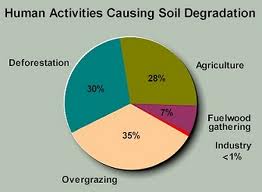
The thin layer of topsoil that covers the earth’s land surface is typically measured in inches and is the foundation of our civilization.
Journalist Stephen Leahy writes in Earth Island Journal that soil erosion is “the silent global crisis.” A gradual, unobserved process that has potentially catastrophic consequences if ignored for too long.
Today, roughly a third of the world’s cropland is losing topsoil at an excessive rate.
Studies on soil erosion in the U.S. shows that for every inch of topsoil lost, wheat and corn crop yields declined by 6 percent.
A U.S. Embassy report entitled, “Desert Mergers and Acquisitions” describes satellite images showing two deserts in north-central China expanding and merging to form a single, larger desert overlapping Inner Mongolia and Gansu Provinces.
India, with scarcely 2 percent of the world’s land area, is struggling to support 17 percent of the world’s people and 18 percent of its cattle.
As countries lose their topsoil, they eventually lose the capacity to feed themselves.
Countries facing this problem include Lesotho, Haiti, Mongolia, and North Korea.
As this chapter concludes, “the health of the people cannot be separated from the health of the land itself.”
Human Activities
OK, another grim chapter covered in this series simply to underscore the grave seriousness that our beautiful planet faces if it is to continue to sustain all our peoples. Lester Brown says that now, not tomorrow or the next day, now is the time to change direction, to stop the wholesale destruction of the very environment that we all, yes ALL OF US, depend on for our existence. It has to be done radically and passionately.
But the book ultimately carries an extremely positive second half. That there is a Plan B that is viable, achievable and cost-effective, and that many countries are committed to making a life-saving difference. So while these posts carry some pretty grim messages, and will for a while, please remain hopeful and positive that you, and I, and all those around us, can make a difference once we know what to do.
Really tight on time at this moment (Sunday afternoon) so all I want to do is to lightly introduce this great thinker to those that haven’t come across him before.
Joseph Campbell died in 1987 but his influence continues to be strong and powerful, positively increasing year by year.
His works, his life and his messages are wonderfully promulgated by the Joseph Campbell Foundation. Becoming a JCF Associate is free!

 Learning from Dogs