Just enjoy watching these dogs – as good as it can ever be!
(With thanks to Charlie and Tracy for this heads up.)

Dogs are animals of integrity. We have much to learn from them.
Year: 2010
Just enjoy watching these dogs – as good as it can ever be!
(With thanks to Charlie and Tracy for this heads up.)
The Loop in North Wales and a neat gag!

The British Royal Air Force frequently train their air crews in and around the valleys of North Wales. Much of that area is designated a Tactical Training Area. One such route is known as The Loop. Here’s a description of that from the website Warplane.co.uk:
Machynlleth Loop
The most appropriate place to start with is the Machynlleth Loop which is usually referred to by aircrews as ‘The Loop’ although the USAF crews refer to it as ‘The Roundabout’. It is literally a roundabout of flowed valleys running counter-clockwise following the A470 north eastwards from Machynlleth in the south to Dinas Mawddwy then heading north west to join the A487 at the Cross Foxes Inn. From here it follows the A487 southwards through Corris to end back at Machynlleth. Ordnance Survey Explorer Map OL23 is recommended for anyone planning a visit.
It is arguably the busiest part of the UK low fly system and although the cold war days of up to 80 plus movements in a day are long gone it is still sometimes possible to see 30 plus aircraft in one day. The usual daily total is usually between 10 and 20 aircraft mainly made up of Hawks with the odd Tornado, Harrier or Hercules thrown in. It is certainly the place to go to practice your panning technique.
It takes about 3 minutes for a jet aircraft to do a circuit of the Loop and multiple passes by aircraft is not an uncommon sight, especially by Hawks. So whenever you see an aircraft it is worth checking to see if it looks like doing a circuit as you may be lucky enough to see it again in 3 minutes.
Do click on the link if only to view some of the fantastic flying photographs.
Anyway, a couple of British newspapers recently published a piece about an RAF Navigator holding up a sign inside the cockpit for the many amateur photographers who frequent this part of the country.
Here’s an extract from the Daily Mail:
A RAF navigator gave plane-spotters a chuckle as he held up a sign reading ‘I’m with stupid’ with an arrow pointing to the pilot.
The pair were on a training mission in a £13million Tornado GR4 aircraft, capable of reaching 1,400mph, when the navigator pulled the prank as they jetted through a valley in Wales.
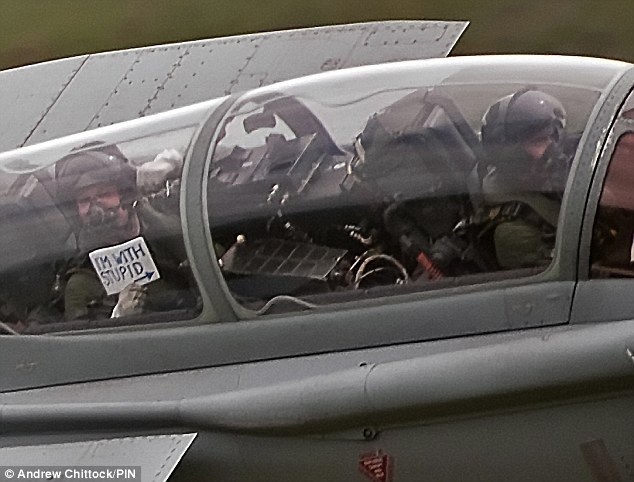
Wonderful prank, and wonderful picture taken by Andy Chittock who clearly is rather used to taking a mean photograph!
By Paul Handover
Any firelighters out there?
I am not sure what the problem is, but I’ve had a difficult time of late finding the passion.
Maybe it’s the continuous stream of bad news that greets us every morning on everything from war and oil spills to lawsuits and unemployment.
Maybe it’s the finger pointing: no one standing up to take responsibility, everyone passing the blame (except for General McChrystal, who likely took the blame for his staff).
Maybe it’s the lack of leadership: we don’t really know where we are headed, and we have no plan for figuring out how we are going to get there, wherever that is.
So what do you do to find your passion? Write in and let us know! Inspire us! We would love to hear what you do to “light your fire!”

by Sherry Jarrell
Incredible outcomes from the dig in 2008
Stonehenge is one of Britain’s most famous historical sites, deservedly so because Stonehenge was one of the most important places in ancient Europe.


But evidence from a dig that was authorised in 2008 has shown that not only is Stonehenge a much older site of human habitation but that it’s purpose is altogether different to what has been assumed. It was, indeed, a healing place, possibly the most important in Europe.
Those living in the UK can watch the Timewatch programme on the BBC iPlayer. But for those living outside the UK then the following web site has reams of wonderfully fascinating information. That site is here.
By Paul Handover
Visualisation of data
I can’t recall how but I came across a web site that focuses on ‘translating’ data into pictures. As they say, a picture is worth a thousand words. The web site is called Information is Beautiful.
Anyhow, they have attempted to graphically portray the scale of the BP oil spill. (A thumbnail is below but please click on the link, or here, to see this as it was meant to be shown.)

But this image is an update of an earlier one here that is really powerful. Because it attempts to put the scale of the oil spill into context with global oil consumption.
If the Purdue University estimate of the oil spill is correct at 48,500 barrels a day (a barrel is approximately the equivalent of two car tankfuls of gas/petrol) and the spill is contained in 90 days then the total oil spilled will be:
That is an enormous quantity.
But have a guess as to how much that would represent in terms of hourly global oil consumption?
Any idea?
Well global oil consumption is 3,500,000 barrels an hour.
So 90 days at 48,500 barrels a day represents just 1 hour 15 minutes worth of global consumption!
If there was ever an argument for the world to wean itself off oil then this would appear to be it.
What has happened so far is tragic – tragic beyond measure. But if it turns out to be a ‘tipping point’ for nations to reconsider how we find and use energy then, perhaps, it will have been a horrible lesson that we all had to take.
And if the USA puts all it’s collective back into leading the world out of our addiction to oil then the damage and hardship will not have been in vain.
By Paul Handover
What do you think of it so far?
The above is a popular catchphrase. It suggests that how we view something now is the product of all our experiences to date. It might apply to a book, play, TV programme or life itself.
But the truth may be very different, how we view the present moment may be more to do with shutting off all those previous experiences and just accepting the present as if we have been blind, dumb and deaf until this perfect moment of now.
That’s why what we have to learn from dogs is so important even though that ‘lesson’ may be just this single, very, very important aspect. Living in the now!
Here’s what is written on our Home Page post:
Dogs have so much to teach us. To an extent that’s difficult for humans to contemplate, they live in the present. Dogs just are!
They make the best of each moment uncluttered by the sorts of complex fears and feelings that we humans have.
Living in the present is not easy. Trust me, I’m only starting to practice this myself and maintaining a few seconds is a challenge!
But try it. Just let everything in your mind be replaced, just for a few moments, by NOW. That’s the sound of your breath woven into the sound of everything going on around you. Let all of those sounds just be a part of your awareness.
Be aware of touch. Feel what you are sitting on standing on. Feel the messages your fingers and hands are sending to your nervous system. Feel the bench, chair, ground or whatever is connecting your body in a physical sense to the world around you.
Hold a rock, a plant, a branch, anything real and be totally aware of the texture and feel of that object.
Smell the aromas entering your nose – just be aware of them.
And see with your eyes. Really see. See through your eyes with the innocence of eyes first opened.
Just hold this place of divine grace for a few moments.
You have just experienced true peace and your world will never be quite the same again.

Oh, how I envy dogs!
By Paul Handover
Safe, as in psychologically as well as physically, has its rewards.

I had a very interesting session recently. I did some coaching work with a client company who managed a small team. The day was split into two – the morning with the client and the afternoon with the whole team.
What struck me about the day was the power of good leadership and the importance of leaders who are aware of how they come across and are capable of forming a relationship with their teams.
My client was struggling with her team because she was unaware how she was communicating, not only with her team but with other people in the organisation.
Unfortunately, becoming aware of how we are in a relationship with others brings us face to face with ourselves and requires a willingness to accept ourselves, warts and all, before trying to change anything.
After we all had lunch together and broke the ice a bit we focused on what was working (not what was not working), what was missing, what inspired and what was possible. By examining these areas and so creating a safe environment, everybody was able to reveal more of themselves and what they needed to have a satisfactory, safe working relationship with each other.
By Jon Lavin
That pre-frontal cortex is at it again.

There’s a fascinating video on the http://www.TED.com website given by Prof Dan Gilbert. Prof Dan is Professor of Psychology at Havard and there’s a good resume on WikiPedia.
Here’s how John Brockman describes Dan Gilbert.
Dan Gilbert doesn’t have an instruction manual that tells you how to be happy in four easy steps and one hard one. Nor is he the kind of thinker who needs Freud, Marx, and Modernism to explain the human condition.
Gilbert, the Director of Harvard’s Hedonic Psychology Laboratory, is a scientist who explores what philosophy, psychology, neuroscience, and behavioral economics have to teach us about how, and how well the human brain can imagine its own future, and about how, and how well it can predict which of those futures it will most enjoy.
There can’t be a human that hasn’t pondered on what makes them happy. Gilbert sets out some fascinating and possibly counter-intuitive ideas. Here’s the video
By Paul Handover
Fiddling with gravity!
Financial crises can be very difficult events to understand. Even for those who have spent a great deal of time studying such areas as finance and economics, comprehension of these disasters can be elusive. However, analyzing shared elements in the recent American and Greek financial crises can help give even the economic layman insight into their common causes.
One word can be used to sum up the basic concept behind both of these crises – overextension. Both the American and Greek governments attempted to take on a much heavier economic load than either could handle. While, in both cases, this has been painted by some as a noble, humanitarian effort to help those in need, methods such as inflationary monetary policy tantamount to theft and the disguising of massive budgetary deficits (in both cases with the help of Goldman Sachs) would not justify the means employed even had these efforts been successful, and certainly should be taken to task considering the disastrous ramifications of these actions.
In both cases, many are citing unrestrained spending as the source of the problem. For example, CNN wrote of the Greek crisis that “years of unrestrained spending, cheap lending and failure to implement financial reforms…whisked away a curtain of partly fiddled statistics to reveal debt levels and deficits that exceeded limits set by the Eurozone.”
Without suggesting that CNN was attempting to be deceptive in this explanation, as the points made certainly are important, it must be noted that things like unrestrained spending, cheap lending, and fiddled statistics are merely symptoms of the deeper disease. Instead of asking the government to spend less, tighten lending laws, and implement financial reform, one should instead ask the deeper question – how does the government even have the power to cause such problems in the first place, and why are the results of such government power so often much more hurtful than helpful?
This deeper problem, whose symptoms we are now dealing with, is central banking. The Federal Reserve System and its Greek counterpart, the Bank of Greece, each had a heavy hand in their respective nations’ financial collapses. This is due to these banks’ attempts at economic manipulation – the Federal Reserve directly sets interest rates, while the Greek system uses more indirect methods to do nearly the same thing. Note that it is due to their attempts at economic manipulation, as attempting to set economic law is about as useful as attempting to set gravity.
Consider this metaphor of setting gravity. A man claims to be able to set the force of gravity on the earth. He tells a stunt biker that he can set gravity to be half as much as normal. So, the biker attempts to jump a distance that is much longer than he normally would attempt. Upon jumping, the biker finds that, obviously, the first man never was able to set the nature of gravity at all, and he falls to the ground long before reaching his destination.
This is exactly what happened due to the actions of central banks in the cases of both the United States and Greece. Interest rates and other natural economic restrictions were said to be more flexible than they truly were. Thus, individuals who based their actions on this information ended up engaging in activities that were far more risky than usual. However, once they had “jumped,” so to speak, they found that, in fact, economic law was as strict as ever, and they “fell.”
However, if the answer is so obvious, why are we not hearing more about it? Each of these financial crises is extremely complicated, and the above described scene is, it must be admitted, an oversimplification. This is not to say that it is not accurate, but rather that this nature of the crises’ root cause is not immediately apparent to all upon examining the situation.
For example, a person who has been educated their entire life in an economic school that praises central banking, deficit spending, and government action in general would certainly seek to find another cause for the crisis, perhaps by blaming business owners for making risky investments or stating that government controls were not strict enough. However, a person who has studied and understands the damage done by central banking and government economic controls will be quick to realize what has occurred.
People with such knowledge are becoming more and more common in both the United States and around the world. “Even today, with an economic crisis raging, the response by our government and the Federal Reserve has been characteristic,” Ron Paul writes in his recent book, End the Fed. “Interest rates are driven to zero and trillions of dollars are pushed into the economy with no evidence that any problems will be solved. The authorities remain oblivious to the fact that they are only making our problems worse in the long run.”
While he may be one of the most popular adversaries of central banking, it is not just Ron Paul, or even Austrian economists, who are calling out government for its role in these financial crises. In an e-mail to supporters, Democratic congressman Dennis Kucinich cited “the 1913 Federal Reserve Act, the banks’ fractional reserve system and our debt-based economic system” as major factors in the American crisis.
Such complex and important issues as economic crises need all the attention we can give them, and it is impossible here to provide the in-depth analysis that these situations merit. It also must be noted that while both the United States and Greece have to an extent both engaged in central banking to their detriments, each country does have a different system. Still, the general principles hold, always returning us to that first word – overextension. As long as nations attempt to manipulate the laws of economics to engage in far grander pursuits than they can sustain, we can expect to see such economic crises as have been seen in the United States and Greece in the future.
By Elliot Engstrom
A foreigner but not a foreigner!
Despite the fact that we have now been living in Payson, Arizona, since the end of February and, therefore, a degree of familiarity exists in both directions, the local Saturday Farmers Market prompted this thought.
Why do I not feel a foreigner here?
There is no question that America, in general, and Arizona, in particular, is very different to England. In many ways the differences are far greater than, say, England and Australia, or England and New Zealand (I’m picking other English speaking countries to avoid to obvious difference between countries of different languages).

I love Farmers Markets. They seem to encapsulate the wholeness of locals growing meat and produce for other locals. They seem to serve as a reminder of the integrity that is needed just as much in food as in all other areas of life.
Of course, I am not so naive to think that we could wind the food revolution back to before the days of supermarket chains – food is wonderful value nowadays especially for those families on tight incomes.
But I can’t be the only one that ponders what the long term effect of all those

E-numbers and other strange ingredients that one reads on most packets of most items, and whether or not fruit is sprayed with anything that we should know about, and so on and so forth.
That’s why that place in my psyche is ‘stroked’ so well by wandering around the Farmers Market.
One would expect if there was going to be any place where yours truly, dressed and sounding like the Englishman that he is, is going to feel foreign, it would be at the Payson Farmers Market. I don’t even try to hide my origins, responding to a “Howdy folks” from the stall-holder with a quintessentially English “Good Morning!”
Inevitably there are reasons why I am made to feel welcome here in Payson, my hunch is that it is much to do with this being a pioneering town for most of the last 100 years, and therefore co-operation, collaboration and a welcoming attitude were key elements of sustaining a way of life, but, in the end, analysis is pointless.
What matters is how we are made to feel, and we are made to feel very welcome.
Indeed, Payson with it’s predominance of right-wing, independent thinking, tough ‘cow-boy’ inhabitants echoing a recent past, may have an important lesson for all of us, across the globe, as the forces of disconcerting change build and build: be local, think local, preserve local.
I’m very proud to be slowly but surely turning into a Payson local.
By Paul Handover
 Learning from Dogs