Category: Government

The Truth about Gods, part two

The concluding part of this essay by Patrice Ayme.

ooOOoo

Endowing aspects of the universe with spirituality, a mind of their own, is stupid in this day and age, only if one forgets there are natural laws underlying them. But if one wants to feel less alone and more purposeful, it is pretty smart.    

Patrice Ayme

Here is the inventor of monotheism: Nefertiti. Once a fanatic of Aten, the sun god, she turned cautious, once Pharaoh on her own, backpedalled and re-authorized Egyptian polytheism. (The sun-God, Sol Invictis, was revived by Roman emperor Dioclesian 17 centuries later, in his refounding of Romanitas and the empire. His ultra young successor and contemporary, emperor Constantine, used the revived monotheism to impose his invention of Catholicism. Funny how small the conceptual world is.)

***

The preceding part (see Part One yesterday} contains many iconoclastic statements which made the Articial Intelligence (AI) I consulted with try to correct me with what were conventional, but extremely erroneous, ill-informed data points. AI also use the deranged upside down meta-argument that it is well-known that Christianism is not like that, so I have got to be wrong. Well, no, I was raised as a Catholic child in two different Muslim countries, and also in a Pagan one; the Muslim faiths I knew as child were as different from Suny/Shiah faiths as Christianism is, overall, from Islamism. In other words, I know the music of monotheism. So here are:

***

TECHNICAL NOTES: 

[1] To speak in philosophical linguo, we capture two civilizational “ontologies” (logic of existence):

  1. Polytheistic-personal: relational, distributed, ecological.
  2. Monotheistic-fascistic: hierarchical, authoritarian, abstracted.

[2] Paganus, in a religious sense, appears first in the Christian author Tertullian, around 202 CE, to evoke paganus in Roman military jargon for ‘civilian, incompetent soldier‘ by opposition to the competent soldiers (milites) of Christ that Tertullian was calling for.

[3] ‘FAIR OF FACE, Joyous with the Double Plume, Mistress of Happiness, Endowed with Favour, at hearing whose voice one rejoices, Lady of Grace, Great of Love, whose disposition cheers the Lord of the Two Lands.

With these felicitous epithets, inscribed in stone more than 3,300 years ago, on the monumental stelae marking the boundaries of the great new city at Tell el Amarna on the Nile in central Egypt, the Pharaoh Akhenaten extolled his Great Royal Wife, the chief queen, the beautiful Nefertiti.

Nefertiti (‘the beautiful one has come‘) co-ruled Egypt with her older (and apparently famously ugly, deformed by disease) husband. Egypt was at its wealthiest. She was considered to be a DIVINITY. All her life is far from known, and revealed one fragment of DNA or old text at a time. She ruled as sole Pharaoh after her husband’s death, and seems to have offered to marry the Hittite Prince (as revealed by a recently found fragment: ”I do not wish to marry one of my subjects. I am afraid…” she confessed in a letter to the amazed Hittite emperor.). She apparently decided to re-allow the worship of the many Egyptian gods, and her adoptive son and successor Tutankhaten switched his name to Tutankhamen). Both her and Tutankhamen died, and they were replaced by a senior top general of Akhenatten who both relieved the dynasty from too much inbreeding (hence the deformed Akhenaten) and too much centralism focused on the sun-disk (‘Aten’)  

[4] Those who do not know history have a small and ridiculous view of FASCISM. Pathetically they refer to simpletons, such as Hitler and Mussolini, to go philosophical on the subject.. Google’s Gemini tried to pontificate that ‘labeling the structure of monotheism (especially its early forms) as fascistic’ is anachronistic and highly inflammatory. Fascism is a specific 20th-century political ideology. While the author means authoritarian and hierarchical, using ‘fascistic’ distracts from the historical and philosophical points by introducing modern political baggage. It would be clearer and less polemical to stick to Hierarchical’ or ‘Authoritarian-Centralized.

I disagree virulently with this cognitive shortsightedness of poorly programmed AI. The Romans were perfectly aware of the meaning that the faces symbolized (they got them from the Etruscans). So were the founders of the French and American republics aware of the importance of fascism and the crucial capabilities it provided, the powerful republics which, in the end, succeeded the Roman Republic (which died slowly under the emperors until it couldn’t get up); those two republics gave the basic mentality now ruling the planet.

Fascism is actually an instinct. Its malevolent and dumb confiscation by ignorant  morons such as Hitler and Mussolini ended pathetically under the blows of regimes (the democracies on one side, the fascist USSR on the other) which were capable of gathering enough, and much more, and higher quality fascism of their own to smother under a carpet of bombs the cretinism of the genocidal tyrants. It is actually comical, when reading old battles stories, to see the aghast Nazis out-Nazified by their Soviet opponents (discipline on the Soviet side was a lethal affair at all and any moment.) Or then to see SS commanders outraged by the ferocity of their US opponents. At Bir Hakeim, a tiny French army, 3,000 strong, buried in the sands, blocked the entire Afrika Korps and the Italian army, for weeks, under a deluge of bombs and shells, killing the one and only chance the Nazis had to conquer the Middle East. Hitler ordered the survivors executed, Rommel, who knew he was finished, disobeyed him.   

***

Early Christianism was highly genocidal. The Nazi obsession with the Jews was inherited from Nero (who, unsatisfied with just crucifying Christians (64 CE), launched the annihilation wars against Israel) and then the Christians themselves. There were hundreds of thousands of Samaritans, a type of Jew, with their own capital and temple (above Haifa). Warming up, after centuries of rage against civilization, the Christians under emperor Justinian, in the Sixth Century, nearly annihilated the Samaritans; a genocide by any definition.

Later, by their own count, at a time when Europe and the greater Mediterranean counted around 50 million inhabitants, the Christians, over centuries, killed no less than 5 million Cathars from Spain to Anatolia. Cathars, the pure ones in Greek (a name given to them by their genociders), were a type of Christian). In France alone, in a period of twenty years up to a million were killed, (not all Cathars, but that accentuates the homicidal character). As a commander famously said: ”Tuez les tous, Dieu reconnaitra les siens” (Kill them all, God will recognize his own). The anti-Cathars genocide drive in France, an aptly named ‘crusade‘,  something about the cross, lasted more than a century (and boosted the power of the Inquisition and the Dominicans). The extinction of Catharism was so great that we have only a couple of texts left. 

Want to know about Christianism? Just look at the torture and execution device they brandish, the cross. Christianism literally gave torture and execution a bad name, and it’s all the most cynical hypocrisy hard at work. 

And so on. To abstract it in an impactful way, one could say that much of Christianism instigated Nazism. That’s one of the dirty little secrets of history, and rather ironical as the dumb Hitler was anti-Christian, and still acted like one, unbeknownst to himself, his public, and his critiques; those in doubt can consult the descriptions of the Crusades by the Franks themselves, when roasting children was found to relieve hunger.

Chroniclers like Radulph of Caen (a Norman historian writing around 1118) described it vividly: “In Ma’arra our troops boiled pagan adults in cooking-pots; they impaled children on spits and devoured them grilled.” Other sources, such as Joinville, Fulcher of Chartres and Albert of Aachen, corroborate the desperation and brutality, though they express varying degrees of horror or justification.   These acts were not systematic policy but extreme responses to the hunger and chaos of war, and they were preserved in Frankish narratives as part of the Crusade’s grim legacy. (There were also cases of cannibalism in WW2).

Christianism, when not actively genocidal, certainly instigated a mood, a mentality, of genocide; read Roman emperor Theodosius I about heresy. Here is the end of Theodosius’ famous quote: ‘According to the apostolic teaching and the doctrine of the Gospel, let us believe in the one deity of the Father and of the Son and of the Holy Spirit, in equal majesty and in a holy Trinity. We order the followers of this law to embrace the name of Catholic Christians; but as for the others, we judge them to be demented and ever more insane (dementes vesanosque iudicantes), we decree that they shall be branded with the ignominious name of heretics, and shall not presume to give to their conventicles the name of churches. They will suffer in the first place the chastisement of the divine condemnation and in the second the PUNISHMENT OF OUR AUTHORITY which in accordance with the will of Heaven WE SHALL DECIDE TO INFLICT.

The ‘Men In Black‘ of the Fourth Century destroyed books, libraries and intellectuals, ensuring the smothering of civilization, as intended (destruction of the Serapeum in Alexandria, the world’s largest library) around 391 CE. Contemporary writers like Eunapius and Libanius lamented the ‘rage for destruction’ of the Men In Black. Some non-Christian texts were preserved in monasteries, true, but the point is that Christianism made possible the destruction of non-Yahweh knowledge. This is the problem king David himself already had, the fascism, the power obsessed little mind of Yahweh. Monasteries were often built with a covert anti-Christian mentality, things were complicated. When queen Bathilde outlawed slavery (657 CE), her closest allies were bishops, yet she had to execute other, slave-holding bishops. She also founded and funded four monasteries. Soon the Frankish government passed a law enforcing secular teaching by religious establishments.

The uniforms of the Men In Black were copied later by the Dominicans (‘Black Friars’) who led the genocide of the Cathars, in co-operation with the Inquisition, also dressed in black, and then the SS. Luther. Saint Louis expressed explicitly that nothing would bring them more joy than Jews suffering to death. Saint Louis was more descriptive, evoking a knife planted in the belly of the unbeliever and great pleasure. In Joinville’s Life of Saint Louis (c. 1309), Louis recounts a story of a knight who, during a debate with Jews, stabbed one in the belly with a dagger, saying it was better to “kill him like that” than argue theology.  Louis presented this approvingly as zeal for the faith, and wished he could partake. Although he warned, he wouldn’t do it, that would be illegal. With a faith like that Louis IX could only be canonized in 1297 CE. And, following Saint Louis’ hint, the Nazis removed his legal objection by changing the law in 1933, when they got to power.

Luther gave multiple and extensive ‘sincere advices‘ on how to proceed with the genocide of the Jews in his book: ”The Jews and their Lies”. Here is a sample: “If I had to baptize a Jew, I would take him to the bridge of the Elbe, hang a stone around his neck and push him over, with the words, ‘I baptize thee in the name of Abraham.” 

But Musk’s AI, ‘Grok’ informed me that its basic axiom was that Christianism was never genocidal, but instead ‘suppressive‘. Then it thought hard for ‘nine seconds‘ to try to prove to me, with biased context, that I had exaggerated.

I had not.  

***.  

The entire church was into assassination madness, glorifying in its own cruelty; the chief assassin of Hypatia, a sort of Charlie Manson to the power 1000, was made into a saint: Saint Cyril. Cyril’s minions grabbed Hypatia who had just finished giving a lecture, dragged her in the streets, and stripped her clothing, and then stripped her of her own skin, flaying her with oysters shells, causing her demise. She was the top intellectual of the age. Hypatia met her torturous end in 415 CE. Cyril was made into a saint 29 years later, in 444 CE! With saints like that, who needs Hitler?

Not to say Catholicism was useless; the jealous and genocidal, yet loving and all-knowing Yahweh was always a good excuse to massacre savages and extend civilization on the cheap. The Teutonic Knights, finding the Yahweh fanatics known as Muslims too hard a nut to crack, regrouped in Eastern Germany and launched a very hard fought crusade against the Prussian Natives, who were Pagans. After mass atrocities on both sides, the Teutons won.

The Franks embraced the capabilities of the cross, fully. Having converted to Catholicism, they were in a good position to subdue other Germans, who were Arians (and that they did, submitting Goths and Burgonds, Ostrogoths and Lombards). Three centuries later, Charlemagne used Christianism as an instrument to kill Saxons on an industrial scale, in the name of God, to finally subdue them, after Saxons had terminally aggravated Romanitas for 800 years, driving Augustus crazy

Charlemagne, in daily life, showing how relative Christianism was, and its true Jewish origins, used the nickname ‘David’ for king David, the monarch who refused to obey Yahweh, who had ordered David to genocidize a people (petty, jealous God Yahweh then tortured David’s son to death)

Charlemagne lived the life of a hardened Pagan, with a de-facto harem, etc. More viciously, Charlemagne passed laws pushing for secular, and thus anti-Christian education. Following in these respects a well-established Frankish custom. Charlemagne knew Christianism was a weapon, and he was careful to use it only on the Saxons; internally, there was maximum tolerance: Christians could become Jews, if they so wished.

PA

ooOOoo

I found the full essay quite remarkable. Jean has heard me rattle on about it numerous times since I first read the essay on November 2nd. I sincerely hope you will read it soon.

Finally, let me reproduce what I wrote in a response to Patrice’s post:

Patrice, in your long and fascinating article, above, you have educated me in so many ways. My mother was an atheist and I was brought up in likewise fashion. But you have gone so much further in your teachings.

Your article needs a further reading. But I am going to share it with my readers on LfD so many more can appreciate what you have written. Plus, I am going to republish it over two days.

Thank you, thank you, thank you!

The Truth about Gods, part one.

A brilliant essay by Patrice Ayme.

Patrice writes amazing posts, some of which are beyond me. But this one, The Personification Of The World, PAGANISM, Gives Us Friends Everywhere, is incredible.

My own position is that my mother and father were atheists and I was brought up as one. Apart from a slip-up when I was married to my third wife, a Catholic, and she left me and I thought that by joining the Catholic church I might win her back. (My subconcious fear of rejection.)

My subconscious fear of rejection was not revealed to me until the 50th anniversary of my father’s death in 2006 when I saw a local psychotherapist. Then I met Jean in December, 2007 and she was the first woman I truly loved!

Back to the essay; it is a long essay and I am going to publish the first half today and the second half tomorrow. (And I have made some tiny changes.)

ooOOoo

The Personification Of The World, PAGANISM, Gives Us Friends Everywhere

Abstract: Personification of the world (polytheism/paganism) is more pragmatic, psychologically rewarding, and ecologically sound than the hierarchical, abstracted structure of monotheism, which the author labels “fascistic.” [4]

***

Switching to a single fascist God, Ex Pluribus Unum, a single moral order replacing the myriad spirits of the world, was presented as a great progress: now everybody could, should, line up below the emperor, God’s representative on Earth, and obey the monarch and his or her gang. The resulting organization was called civilization. Submitting to God was the only way Rome could survive, because it provided a shrinking army and tax base with more authority than it deserved.

However peasants had to predict the world and it was more judicious to personalize aspects of it. The resulting logico-emotional relationship had another advantage: the supportive presence of a proximal Gods… All over!.[1]

*** 

personification

/pəˌsɒnɪfɪˈkeɪʃn/ noun

1.the attribution of a personal nature or human characteristics to something non-human, or the representation of an abstract quality in human form.

***

Before Christianism, Gods were everywhere. When the Christians took over, they imposed their all powerful, all knowing Jewish God. Some present the Jewish God as a great invention, symbolizing some sort of progress of rationality that nobody had imagined before. 

However, the single God concept was not that new. Even Americans had it in North America, as the chief of God, the Aztecs, had a similar concept, and even Zeus was a kind of chief God. Zoroastrianism had Ahura Mazda, who did not control Angra Manyu, but still was somewhat more powerful. The Hindus had Vishnu and his many avatars.

Eighteen centuries before those great converters to Christianism, Constantine, Constantius II, and Theodosius I, there was an attempt to forcefully convert the Egyptians to a single God. Pharaoh Akhenaten’s monotheistic experiment (worship of Aten) caused turmoil and was erased by his immediate successors.

According to the latest research it seems likely that the famous Nefertiti became a Pharaoh on her own, after the death of her husband, and retreated from monotheism by re-establishing Egyptian polytheism [3]. In the fullness of time, the infernal couple got struck by what the Romans, 15 centuries later, would call damnatio memoriae. Their very names and faith were erased from hundreds of monuments

Shortly after the Aten episode, there was another confrontation between polytheism and monotheism. The colonizers of Gaza were apparently Greek, of Aegean origin, and, as such, over more than a millennium of conflict with the Jewish states in the hills, Greek Gods confronted Yahweh. The Greeks obviously did not see Yahweh as a major conceptual advance, as they did not adopt Him (until Constantine imposed Him, 15 centuries later).

While the area experienced enormous turmoil, including the permanent eclipse of Troy after the war with Greece (see Homer), and later its replacement by Phrygia, then followed by the Bronze Age collapse, then the rise of Tyre, and the Assyrian conquest, the Greeks survived everything, and their civilization kept sprawling (the early Christian writings were in Greek).

Ultimately, the lack of ideological bending, the obsession with pigs and other silliness, helped to bring devastating Judeo-Roman wars. By comparison, the much larger Gaul bent like a reed when confronted with the Greco-Romans, absorbing the good stuff. Mercury, the God of trade, preceded Roman merchants. Gaul didn’t take religion too seriously, and went on with civilizational progress.

The lack of elasticity of the single God religion of the Jews brought their quasi-eradication by Rome; Judaism was tolerated, but Jewish nationalism got outlawed. By comparison, the Greeks played the long game, and within a generation or so of Roman conquest, they had spiritually conquered their conqueror. Christianism was actually an adaptation of Judaism to make Yahweh conquer the heart and soul of fascist Rome.

***

To have Gods everywhere? Why not? Is not the Judeo-Christian God everywhere too? Doesn’t it speak through fountains, and the immensity of the desert, and the moon, and the stars, too?

***

Yahweh, the Jewish God Catholic Romans called “Deus” was deemed to be also the ultimate love object. Yahweh had promised land to the Jews, Deus promised eternal life of the nicest sort – To all those who bought the program. 

Christians were city dwellers and their power over the countryside and barbarians came from those who had imposed Christianism, the imperial powers that be (at the time, more than 90% of the people worked in agriculture). Already as a teenager, Constantine, a sort of superman born from imperial purple, terrified the court which was supposed to hold him hostage. Such a brute and excellent general could only get inspired by Yahweh’s dedication to power.

The country dwellers, the villagers, disagreed that they needed to submit to a God organized, celebrated and imposed by the all-powerful government (god-vernment?). In classical Latin paganus meant ‘villager, rustic; civilian, non-combatant’. In late imperial Latin it came to mean non-Judeo-Christian (and later non-Judeo-Christo-Islamist) [2].

Christianism found it very difficult to penetrate the countryside, where the food was produced. It never quite succeeded (Even in Muslim Albania, Pagan rituals survived until the 20th century; much of the cult of saints is barely disguised Paganism).

Peasants knew that power was distributed throughout nature, and they had to understand those powers, thus love them – That enabled them to predict phenomena.

Peasants could ponder the mood of a river, and even predict it; flooding was more of a possibility in some circumstances, and then it was no time to indulge in activities next to the river. Peasants had to guess the weather, and the earlier, the better. Peasants had to know which part of the astronomical cycle they were in, to be able to plant crops accordingly; that was not always clear just looking outside, but the stars would tell and could be trusted to tell the truth.

We can be friends to human beings, and sometimes it’s great, but sometimes we feel betrayed and abandoned. But a mountain or a sea? They will always be there, they are not running away, they are never deliberately indifferent, and generally exhibit predictable moods. It is more pragmatic and rewarding to love them more rather than an abstract Dog in Heavens. Call them Gods if you want.

ooOOoo

Part two will be published tomorrow.

I am publishing the notes, on both days, so you can look them up now rather than waiting another day.

TECHNICAL NOTES: 

[1] To speak in philosophical linguo, we capture two civilizational ‘ontologies’ (logic of existence):

  1. Polytheistic-personal: relational, distributed, ecological.
  2. Monotheistic-fascistic: hierarchical, authoritarian, abstracted.

[2] Paganus, in a religious sense, appears first in the Christian author Tertullian, around 202 CE, to evoke paganus in Roman military jargon for ‘civilian, incompetent soldier‘ by opposition to the competent soldiers (milites) of Christ that Tertullian was calling for.

[3] ‘FAIR OF FACE, Joyous with the Double Plume, Mistress of Happiness, Endowed with Favour, at hearing whose voice one rejoices, Lady of Grace, Great of Love, whose disposition cheers the Lord of the Two Lands.

With these felicitous epithets, inscribed in stone more than 3,300 years ago on the monumental stelae marking the boundaries of the great new city at Tell el Amarna on the Nile in central Egypt, the Pharaoh Akhenaten extolled his Great Royal Wife, the chief queen, the beautiful Nefertiti.

Nefertiti (‘the beautiful one has come‘) co-ruled with her older (and apparently famously ugly, deformed by disease) husband, Egypt. Egypt was at its wealthiest. She was considered to be a DIVINITY. All her life is far from known, and revealed one fragment of DNA or old text at a time. She ruled as sole Pharaoh after her husband’s death, and seems to have offered to marry the Hittite Prince (as revealed by a recently found fragment: ”I do not wish to marry one of my subjects. I am afraid…” she confessed in a letter to the amazed Hittite emperor). She apparently decided to re-allow the worship of the many Egyptian gods and her adoptive son and successor Tutankhaten switched his name to Tutankhamen. Both her and Tutankhamen died, and they were replaced by a senior top general of Akhenatten who both relieved the dynasty from too much inbreeding (hence the deformed Akhenaten) and too much centralism focused on the sun-disk (‘Aten’).  

[4] Those who do not know history have a small and ridiculous view of FASCISM. Pathetically they refer to simpletons, such as Hitler and Mussolini, to go philosophical on the subject. Google’s Gemini tried to pontificate that ‘labeling the structure of monotheism (especially its early forms) as fascistic’ is anachronistic and highly inflammatory. Fascism is a specific 20th-century political ideology. While the author means authoritarian and hierarchical, using ‘fascistic’ distracts from the historical and philosophical points by introducing modern political baggage. It would be clearer and less polemical to stick to Hierarchical’ or ‘Authoritarian-Centralized’.

Me sharing a political interview

It is not something I have done before.

This is a blog about dogs in the main and many different subjects as well. For example, I am very interested in the formation of the planet; see the post coming up soon.

However, my good buddy, Dan Gomez, a Californian, sent me a link to an interview, and I quote “After the Israel-Hamas deal was signed earlier this month, Jared Kushner and Steve Witkoff, President Trump’s envoys and the leading brokers of the agreement, sat down with Lesley Stahl to discuss their unconventional deal-driven approach.”

It is a 60 Minutes interview.

I found it most interesting and completely at odds with the majority of all types of media that think that President Trump is despicable.

My view of politicians of democracies is that 99% of them are talkers. Presumably, Trump is a doer.

I would be interested to hear what others think, especially those who were born in the U.S.A.

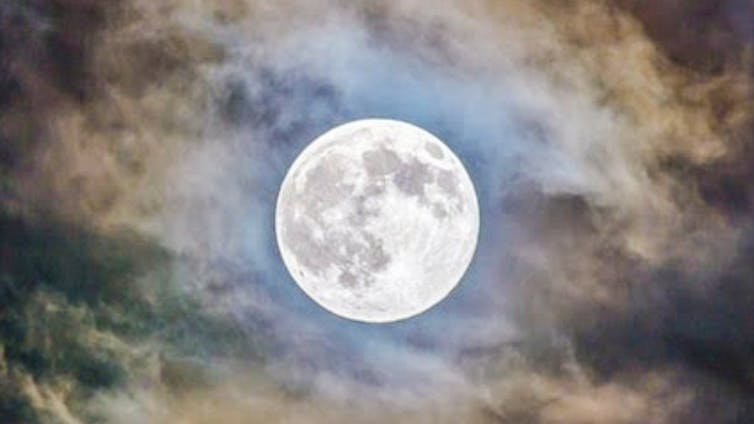
The beautiful moon, but …

… does it make us sleepless?

As has been mentioned previously, my dear wife and her Parkinson’s means that we go to bed early and get up early the following morning. Thus a recent item on The Conversation fascinated me and it is shared with you now.

ooOOoo

Does the full moon make us sleepless? A neurologist explains the science behind sleep, mood and lunar myths

How much does the moon cycle affect sleep? Probably less than your screen time at night. Muhammad Khazin Alhusni/iStock via Getty Images Plus

Joanna Fong-Isariyawongse, University of Pittsburgh

Have you ever tossed and turned under a full moon and wondered if its glow was keeping you awake? For generations, people have believed that the Moon has the power to stir up sleepless nights and strange behavior – even madness itself. The word “lunacy” comes directly from luna, Latin for Moon.

Police officers, hospital staff and emergency workers often swear that their nights get busier under a full moon. But does science back that up?

The answer is, of course, more nuanced than folklore suggests. Research shows a full moon can modestly affect sleep, but its influence on mental health is much less certain.

I’m a neurologist specializing in sleep medicine who studies how sleep affects brain health. I find it captivating that an ancient myth about moonlight and madness might trace back to something far more ordinary: our restless, moonlit sleep.

What the full moon really does to sleep

Several studies show that people really do sleep differently in the days leading up to the full moon, when moonlight shines brightest in the evening sky. During this period, people sleep about 20 minutes less, take longer to fall asleep and spend less time in deep, restorative sleep. Large population studies confirm the pattern, finding that people across different cultures tend to go to bed later and sleep for shorter periods in the nights before a full moon.

The most likely reason is light. A bright moon in the evening can delay the body’s internal clock, reduce melatonin – the hormone that signals bedtime – and keep the brain more alert.

The changes are modest. Most people lose only 15 to 30 minutes of sleep, but the effect is measurable. It is strongest in places without artificial light, such as rural areas or while camping. Some research also suggests that men and women may be affected differently. For instance, men seem to lose more sleep during the waxing phase, while women experience slightly less deep and restful sleep around the full moon.

Young adult woman lying in bed wide awake, staring out the window toward a bright light.
Sleep loss from a bright moon is modest but measurable. Yuliia Kaveshnikova/iStock via Getty Images Plus

The link with mental health

For centuries, people have blamed the full moon for stirring up madness. Folklore suggested that its glow could spark mania in bipolar disorder, provoke seizures in people with epilepsy or trigger psychosis in those with schizophrenia. The theory was simple: lose sleep under a bright moon and vulnerable minds might unravel.

Modern science adds an important twist. Research is clear that sleep loss itself is a powerful driver of mental health problems. Even one rough night can heighten anxiety and drag down mood. Ongoing sleep disruption raises the risk of depression, suicidal thoughts and flare-ups of conditions like bipolar disorder and schizophrenia.

That means even the modest sleep loss seen around a full moon could matter more for people who are already at risk. Someone with bipolar disorder, for example, may be far more sensitive to shortened or fragmented sleep than the average person.

But here’s the catch: When researchers step back and look at large groups of people, the evidence that lunar phases trigger psychiatric crises is weak. No reliable pattern has been found between the Moon and hospital admissions, discharges or lengths of stay.

But a few other studies suggest there may be small effects. In India, psychiatric hospitals recorded more use of restraints during full moons, based on data collected between 2016 and 2017. In China, researchers noted a slight rise in schizophrenia admissions around the full moon, using hospital records from 2012 to 2017. Still, these findings are not consistent worldwide and may reflect cultural factors or local hospital practices as much as biology.

In the end, the Moon may shave a little time off our sleep, and sleep loss can certainly influence mental health, especially for people who are more vulnerable. That includes those with conditions like depression, bipolar disorder, schizophrenia or epilepsy, and teenagers who are especially sensitive to sleep disruption. But the idea that the full moon directly drives waves of psychiatric illness remains more myth than reality.

The sleep/wake cycle is synchronized with lunar phases.

Other theories fall short

Over the years, scientists have explored other explanations for supposed lunar effects, from gravitational “tidal” pulls on the body to subtle geomagnetic changes and shifts in barometric pressure. Yet, none of these mechanisms hold up under scrutiny.

The gravitational forces that move oceans are far too weak to affect human physiology, and studies of geomagnetic and atmospheric changes during lunar phases have yielded inconsistent or negligible results. This makes sleep disruption from nighttime light exposure the most plausible link between the Moon and human behavior.

Why the myth lingers

If the science is so inconclusive, why do so many people believe in the “full moon effect”? Psychologists point to a concept called illusory correlation. We notice and remember the unusual nights that coincide with a full moon but forget the many nights when nothing happened.

The Moon is also highly visible. Unlike hidden sleep disruptors such as stress, caffeine or scrolling on a phone, the Moon is right there in the sky, easy to blame.

A woman staring at her cellphone while lying in the dark.
Screen-time habits are far more likely to have detrimental effects on sleep than a full moon. FanPro/Moment via Getty Images

Lessons from the Moon for modern sleep

Even if the Moon does not drive us “mad,” its small influence on sleep highlights something important: Light at night matters.

Our bodies are designed to follow the natural cycle of light and dark. Extra light in the evening, whether from moonlight, streetlights or phone screens, can delay circadian rhythms, reduce melatonin and lead to lighter, more fragmented sleep.

This same biology helps explain the health risks of daylight saving time. When clocks “spring forward,” evenings stay artificially brighter. That shift delays sleep and disrupts circadian timing on a much larger scale than the Moon, contributing to increased accidents and cardiovascular risks, as well as reduced workplace safety.

In our modern world, artificial light has a much bigger impact on sleep than the Moon ever will. That is why many sleep experts argue for permanent standard time, which better matches our biological rhythms.

So if you find yourself restless on a full moon night, you may not be imagining things – the Moon can tug at your sleep. But if sleeplessness happens often, look closer to home. It is likely a culprit of the light in your hand rather than the one in the sky.

Joanna Fong-Isariyawongse, Associate Professor of Neurology, University of Pittsburgh

This article is republished from The Conversation under a Creative Commons license. Read the original article.

ooOOoo

Ever since I have been an adult I have wondered what the purpose was of daylight time and standard time. The University of Colorado have the history of the time change and, as I suspect, it was brought about by the war; World War I.

Here’s part of that article:

It was first introduced in Germany in 1916 during World War I as an energy saving measure, according to CU Boulder sleep researcher Kenneth Wright. The U.S. followed suit, adopting DST in 1918. Initially implemented as a wartime measure, it was repealed a year later. 

Daylight saving time was reinstituted in 1942 during World War II. The next couple decades were a free-for-all, when states and localities switched between DST and standard time (ST) at will. To put an end to the clock chaos, Congress finally passed the Uniform Time Act in 1966, which standardized daylight saving time and its start and end dates across the country — with the exception of Hawaii and Arizona, which opted to keep standard time year-round. 

Technology, and Scamming

The title says it all!

We live in a world that is rapidly becoming more and more digital. But we also live in a world where the criminals are becoming better at carrying out their crimes. So a recent article in The Conversation seemed appropriate to republish.

ooOOoo

Scams and frauds: Here are the tactics criminals use on you in the age of AI and cryptocurrencies

Scammers often direct victims to convert cash to untraceable cryptocurrency and send it to them. Joe Raedle/Getty Images

Rahul Telang, Carnegie Mellon University

Scams are nothing new – fraud has existed as long as human greed. What changes are the tools.

Scammers thrive on exploiting vulnerable, uninformed users, and they adapt to whatever technologies or trends dominate the moment. In 2025, that means AI, cryptocurrencies and stolen personal data are their weapons of choice.

And, as always, the duty, fear and hope of their targets provide openings. Today, duty often means following instructions from bosses or co-workers, who scammers can impersonate. Fear is that a loved one, who scammers also can impersonate, is in danger. And hope is often for an investment scheme or job opportunity to pay off.

AI-powered scams and deepfakes

Artificial intelligence is no longer niche – it’s cheap, accessible and effective. While businesses use AI for advertising and customer support, scammers exploit the same tools to mimic reality, with disturbing precision.

Deepfake scams use high-tech tools and old-fashioned emotional manipulation.

Criminals are using AI-generated audio or video to impersonate CEOs, managers or even family members in distress. Employees have been tricked into transferring money or leaking sensitive data. Over 105,000 such deepfake attacks were recorded in the U.S. in 2024, costing more than US$200 million in the first quarter of 2025 alone. Victims often cannot distinguish synthetic voices or faces from real ones.

Fraudsters are also using emotional manipulation. The scammers make phone calls or send convincing AI-written texts posing as relatives or friends in distress. Elderly victims in particular fall prey when they believe a grandchild or other family member is in urgent trouble. The Federal Trade Commission has outlined how scammers use fake emergencies to pose as relatives.

Cryptocurrency scams

Crypto remains the Wild West of finance — fast, unregulated and ripe for exploitation.

Pump-and-dump scammers artificially inflate the price of a cryptocurrency through hype on social media to lure investors with promises of huge returns – the pump – and then sell off their holdings – the dump – leaving victims with worthless tokens.

Pig butchering is a hybrid of romance scams and crypto fraud. Scammers build trust over weeks or months before persuading victims to invest in fake crypto platforms. Once the scammers have extracted enough money from the victim, they vanish.

Pig-butchering scams lure people into fake online relationships, often with devastating consequences.

Scammers also use cryptocurrencies as a means of extracting money from people in impersonation scams and other forms of fraud. For example, scammers direct victims to bitcoin ATMs to deposit large sums of cash and convert it to the untraceable cryptocurrency as payment for fictitious fines.

Phishing, smishing, tech support and jobs

Old scams don’t die; they evolve.

Phishing and smishing have been around for years. Victims are tricked into clicking links in emails or text messages, leading to malware downloads, credential theft or ransomware attacks. AI has made these lures eerily realistic, mimicking corporate tone, grammar and even video content.

Tech support scams often start with pop-ups on computer screens that warn of viruses or identity theft, urging users to call a number. Sometimes they begin with a direct cold call to the victim. Once the victim is on a call with the fake tech support, the scammers convince victims to grant remote access to their supposedly compromised computers. Once inside, scammers install malware, steal data, demand payment or all three.

Fake websites and listings are another current type of scam. Fraudulent sites impersonating universities or ticket sellers trick victims into paying for fake admissions, concerts or goods.

One example is when a website for “Southeastern Michigan University” came online and started offering details about admission. There is no such university. Eastern Michigan University filed a complaint that Southeastern Michigan University was copying its website and defrauding unsuspecting victims.

The rise of remote and gig work has opened new fraud avenues.

Victims are offered fake jobs with promises of high pay and flexible hours. In reality, scammers extract “placement fees” or harvest sensitive personal data such as Social Security numbers and bank details, which are later used for identity theft.

How you can protect yourself

Technology has changed, but the basic principles remain the same: Never click on suspicious links or download attachments from unknown senders, and enter personal information only if you are sure that the website is legitimate. Avoid using third-party apps or links. Legitimate businesses have apps or real websites of their own.

Enable two-factor authentication wherever possible. It provides security against stolen passwords. Keep software updated to patch security holes. Most software allows for automatic update or warns about applying a patch.

Remember that a legitimate business will never ask for personal information or a money transfer. Such requests are a red flag.

Relationships are a trickier matter. The state of California provides details on how people can avoid being victims of pig butchering.

Technology has supercharged age-old fraud. AI makes deception virtually indistinguishable from reality, crypto enables anonymous theft, and the remote-work era expands opportunities to trick people. The constant: Scammers prey on trust, urgency and ignorance. Awareness and skepticism remain your best defense.

Rahul Telang, Professor of Information Systems, Carnegie Mellon University

This article is republished from The Conversation under a Creative Commons license. Read the original article.

ooOOoo

That last paragraph really spells out how it is in the modern world. I repeat that last sentence: “Awareness and skepticism remain your best defense.

Life on other planets

A fascinating article from The Conversation.

ooOOoo

Earth-size stars and alien oceans – an astronomer explains the case for life around white dwarfs

White dwarf stars, like this one shown shrouded by a planetary nebula, are much smaller than stars like our Sun. NASA/R. Ciardullo (PSU)/H. Bond (STScI)

Juliette Becker, University of Wisconsin-Madison

The Sun will someday die. This will happen when it runs out of hydrogen fuel in its core and can no longer produce energy through nuclear fusion as it does now. The death of the Sun is often thought of as the end of the solar system. But in reality, it may be the beginning of a new phase of life for all the objects living in the solar system.

When stars like the Sun die, they go through a phase of rapid expansion called the Red Giant phase: The radius of the star gets bigger, and its color gets redder. Once the gravity on the star’s surface is no longer strong enough for it to hold on to its outer layers, a large fraction – up to about half – of its mass escapes into space, leaving behind a remnant called a white dwarf.

I am a professor of astronomy at the University of Wisconsin-Madison. In 2020, my colleagues and I discovered the first intact planet orbiting around a white dwarf. Since then, I’ve been fascinated by the prospect of life on planets around these, tiny, dense white dwarfs.

Researchers search for signs of life in the universe by waiting until a planet passes between a star and their telescope’s line of sight. With light from the star illuminating the planet from behind, they can use some simple physics principles to determine the types of molecules present in the planet’s atmosphere.

In 2020, researchers realized they could use this technique for planets orbiting white dwarfs. If such a planet had molecules created by living organisms in its atmosphere, the James Webb Space Telescope would probably be able to spot them when the planet passed in front of its star.

In June 2025, I published a paper answering a question that first started bothering me in 2021: Could an ocean – likely needed to sustain life – even survive on a planet orbiting close to a dead star?

An illustration showing a large bright circle, with a very small white dot nearby.
Despite its relatively small size, a white dwarf – shown here as a bright dot to the right of our Sun – is quite dense. Kevin Gill/Flickr, CC BY

A universe full of white dwarfs

A white dwarf has about half the mass of the Sun, but that mass is compressed into a volume roughly the size of Earth, with its electrons pressed as close together as the laws of physics will allow. The Sun has a radius 109 times the size of Earth’s – this size difference means that an Earth-like planet orbiting a white dwarf could be about the same size as the star itself.

White dwarfs are extremely common: An estimated 10 billion of them exist in our galaxy. And since every low-mass star is destined to eventually become a white dwarf, countless more have yet to form. If it turns out that life can exist on planets orbiting white dwarfs, these stellar remnants could become promising and plentiful targets in the search for life beyond Earth.

But can life even exist on a planet orbiting a white dwarf? Astronomers have known since 2011 that the habitable zone is extremely close to the white dwarf. This zone is the location in a planetary system where liquid water could exist on a planet’s surface. It can’t be too close to the star that the water would boil, nor so far away that it would freeze.

A diagram showing a sun, with three planets at varying distances away. The closest one is labeled 'too hot' the next 'just right' and the farthest 'too cold'
Planets in the habitable zone aren’t so close that their surface water would boil, but also not so far that it would freeze. NASA

The habitable zone around a white dwarf would be 10 to 100 times closer to the white dwarf than our own habitable zone is to our Sun, since white dwarfs are so much fainter.

The challenge of tidal heating

Being so close to the surface of the white dwarf would bring new challenges to emerging life that more distant planets, like Earth, do not face. One of these is tidal heating.

Tidal forces – the differences in gravitational forces that objects in space exert on different parts of a nearby second object – deform a planet, and the friction causes the material being deformed to heat up. An example of this can be seen on Jupiter’s moon Io.

The forces of gravity exerted by Jupiter’s other moons tug on Io’s orbit, deforming its interior and heating it up, resulting in hundreds of volcanoes erupting constantly across its surface. As a result, no surface water can exist on Io because its surface is too hot.

A diagram showing Jupiter, with four Moons orbiting around it. Io is the Moon closest to Jupiter, and it has four arrows pointing to the planet and other moons, representing the forces exerted on it.
Of the four major moons of Jupiter, Io is the innermost one. Gravity from Jupiter and the other three moons pulls Io in varying directions, which heats it up. Lsuanli/Wikimedia Commons, CC BY-SA

In contrast, the adjacent moon Europa is also subject to tidal heating, but to a lesser degree, since it’s farther from Jupiter. The heat generated from tidal forces has caused Europa’s ice shell to partially melt, resulting in a subsurface ocean.

Planets in the habitable zone of a white dwarf would have orbits close enough to the star to experience tidal heating, similar to how Io and Europa are heated from their proximity to Jupiter.

This proximity itself can pose a challenge to habitability. If a system has more than one planet, tidal forces from nearby planets could cause the planet’s atmosphere to trap heat until it becomes hotter and hotter, making the planet too hot to have liquid water.

Enduring the red giant phase

Even if there is only one planet in the system, it may not retain its water.

In the process of becoming a white dwarf, a star will expand to 10 to 100 times its original radius during the red giant phase. During that time, anything within that expanded radius will be engulfed and destroyed. In our own solar system, Mercury, Venus and Earth will be destroyed when the Sun eventually becomes a red giant before transitioning into a white dwarf.

For a planet to survive this process, it would have to start out much farther from the star — perhaps at the distance of Jupiter or even beyond.

If a planet starts out that far away, it would need to migrate inward after the white dwarf has formed in order to become habitable. Computer simulations show that this kind of migration is possible, but the process could cause extreme tidal heating that may boil off surface water – similar to how tidal heating causes Io’s volcanism. If the migration generates enough heat, then the planet could lose all its surface water by the time it finally reaches a habitable orbit.

However, if the migration occurs late enough in the white dwarf’s lifetime – after it has cooled and is no longer a hot, bright, newly formed white dwarf – then surface water may not evaporate away.

Under the right conditions, planets orbiting white dwarfs could sustain liquid water and potentially support life.

Search for life on planets orbiting white dwarfs

Astronomers haven’t yet found any Earth-like, habitable exoplanets around white dwarfs. But these planets are difficult to detect.

Traditional detection methods like the transit technique are less effective because white dwarfs are much smaller than typical planet-hosting stars. In the transit technique, astronomers watch for the dips in light that occur when a planet passes in front of its host star from our line of sight. Because white dwarfs are so small, you would have to be very lucky to see a planet passing in front of one.

The transit technique for detecting exoplanets requires watching for the dip in brightness when a planet passes in front of its host star.

Nevertheless, researchers are exploring new strategies to detect and characterize these elusive worlds using advanced telescopes such as the Webb telescope.

If habitable planets are found to exist around white dwarfs, it would significantly broaden the range of environments where life might persist, demonstrating that planetary systems may remain viable hosts for life even long after the death of their host star.

Juliette Becker, Assistant Professor of Astronomy, University of Wisconsin-Madison

This article is republished from The Conversation under a Creative Commons license. Read the original article.

ooOOoo

I take my hats off to the researchers that are looking for life elsewhere.

Please watch this interview

It is 30 minutes long but it is incredibly important!

Heather Richardson writes the blog Letters from an American.

On August 14th Heather recorded a live interview with California Governor Gavin Newsom.

Watch it!

Picture Parade Four Hundred and Eighty-Three

A selection of photographs of Oregon Caves.

When my daughter, son-in-law, and grandson were with us just recently, Marius drove us to Oregon Caves and, wow, what a sight.

Marius and young Morten

oooo

Maija and Morten

oooo

The cave

oooo

oooo

oooo

Roots of trees on the surface showing down here.

oooo

oooo

oooo

oooo

More photographs next Sunday.

Re Curtis Yarvin

Maybe democracy is not correct?

Last Sunday morning I listened to a BBC Radio 4 programme The Dark Enlightenment. Here is a summary from the BBC website:

A radical political philosophy founded by a software engineer called Curtis Yarvin is gaining in influence, and said to be shaping Donald Trump’s second term in the White House.

It is on BBC Sounds. Here is the link: BBC Currently.

Now the post submitted by The Conversation.

ooOOoo

Friday essay: Trump’s reign fits Curtis Yarvin’s blueprint of a CEO-led American monarchy. What is technological fascism?

Luke Munn, The University of Queensland

The plan was simple. It started by retiring all government employees by offering them incentives to leave and never return. To avoid anarchy and keep authority, the police and military would be retained.

Government funds would be seized and the money redirected to more worthwhile pursuits. Court orders pushing back against these measures as “unconstitutional” should be summarily ignored. The press should be massaged and censored as necessary. Finally, universities, scientific institutions, and NGOs should also be snapped off, their funding terminated.

These moves resemble many made (or attempted) in the first 100 days of the second Trump administration. But they were all laid out in 2012 by a single person: Curtis Yarvin.

In the past five years, Yarvin’s reactionary blueprints for governance have found powerful backers in both Silicon Valley and Washington circles.

His ideas have been taken up and repeated in various ways by Peter Thiel (PayPal), Elon Musk (X, Tesla), Alexander Karp (Palantir) and other founders, CEOs and thought-leaders within the broader tech industry. He was a guest at Trump’s Coronation Ball in January.

Perhaps most directly, vice president JD Vance has praised him by name and echoed his ideas, asserting the need for a “de-wokification programme” that “strikes at the heart of the beast”.

Yarvin’s current newsletter, Grey Room, now boasts 57,000 subscribers. “Curtis Yarvin’s Ideas Were Fringe,” cautioned a recent article, “Now They’re Coursing Through Trump’s Washington.”

JD Vance has praised Yarvin by name and echoed his ideas, calling for a ‘de-wokification programme’. Bonnie Cash/Pool/AAP

Rebooting the state

Yarvin, a 51-year old computer engineer, has been publishing his thoughts on politics for close to 20 years. His original blog, launched in 2007, introduced his potent blend of “the modern engineering mentality, and the great historical legacy of antique, classical and Victorian pre-democratic thought”. Last week, The Washington Post called it “required reading for the extremely online right”.

Democracy was dead and doomed from the beginning, Yarvin argued in his blog, in quippy, Reddit-style prose. Governance should look to other mechanisms (tech) and modes (monarchism) for inspiration.

The state needs a “hard reboot,” asserted Yarvin. “Democratic elections are entirely superfluous to the mechanism of government” he argued. “A vote for democratic or republican matters a little bit,” he admitted, but “basically if the whole electoral system disappeared, Washington would go on running in exactly the same ways”.

Curtis Yarvin. Wikipedia

For Yarvin, then, it is not just the government that must change – a superficial swap of parties and politicians – but something far more fundamental: the form of government. Democracy was beta tested and failed to deliver. The political operating system must be ripped out and replaced.

While elements (like the term “red pill”) travelled far beyond its pages, Yarvin’s ideas remained on the fringes until recently, with their growing popularity pushing him into the limelight. Last week he hit the headlines due to his debate at Harvard, a place that has become a “symbol of resistance to Trump”, with political theorist Danielle Allen, a democracy advocate.

Allen, who debated Yarvin to provide students with “help thinking about intellectual material”, wrote after the debate that he correctly diagnoses a problem, but not its causes or solutions:

He is right that our political institutions are failing. He is also right that their members have failed to see the depth of our governance problems and their own contributions to them through technocracy and political correctness. […] But Mr. Yarvin leads them astray with his vision of absolute monarchy and racial cleansing.

A technological republic

For Yarvin and others like him, democracy’s fatal flaw is the demos (or, people) itself. Trusting the agency and ability of citizens to govern through representation is naive, Yarvin believes. Alexander Karp, CEO of Palantir, a firm that provides military and intelligence agencies with big data “intelligence”, agrees.

“Why must we always defer to the wisdom of the crowd when it comes to allocating scarce capital in a market economy?” Karp asked in his recent bestseller, The Technological Republic.

For Yarvin, Karp, Thiel and the other elites that embrace these ideas, the people are idiots. A favourite quote (likely apocryphal) is from Churchill, stating the best argument against democracy is a five-minute conversation with the average voter.

If a legacy republic was one by the people and for the people, Karp argues a technological republic will “require the rebuilding of an ownership society, a founder culture that came from tech but has the potential to reshape government”.

In this vision, the state shapeshifts into something sleeker, more successful, more like a startup: the corporation. “A government is just a corporation that owns a country,” Yarvin stresses. Musk has echoed this line: “the government is simply the largest corporation”.

But if this is true, it is a pathetic one, according to its hyper-capitalist detractors: bloated with waste, saddled with debt and slowed by regulation. The state is a dinosaur which makes incremental change and must tread with caution, bending to the needs of its constituents. Founders dictate their commands and impose their will.

Dark enlightenment

“Once the universe of democratic corruption is converted into a (freely transferable) shareholding in gov-corp the owners of the state can initiate rational corporate governance, beginning with the appointment of a CEO,” explains philosopher Nick Land.

“As with any business, the interests of the state are now precisely formalized as the maximization of long-term shareholder value.” In this model, the president becomes the CEO king; the citizen becomes the customer or user.

Land, more than any other, has provided the philosophical cachet around this movement, taking Yarvin’s quippy but fuzzy prose and formalising it into the political and philosophical formation known as neoreaction or the “Dark Enlightenment”, with a sprawling 2014 essay that moves from the death of the west to racial terror, the limits of freedom and the next stage of human evolution.

Nick Land. GoodReads

Land, variously regarded as a cybernetic prophet or scientific racist, has long held anti-humanist and anti-democratic views. “Voice”, or representation – the key tenet of liberal democracy – has been tried and failed, Land argues. The only viable alternative is “exit”: flight from failed governance altogether, into a post-political and post-human future.

To simplify drastically: democracy’s naive belief in equality for all – propped up and policed by the array of humanitarian organisations, government agencies and woke culture warriors that Yarvin sneeringly dubs “The Cathedral” – has held capitalism back from its true potential.

Technological fascism

For Land, Yarvin and others, optimal rule would be both hypercapitalist and hyperconservative: a hybrid political order I’ve begun to research and conceptualise as technological fascism.

Technological fascism gazes to the future and past for inspiration. It couples, in the words of writer Jacob Siegel:

the classic anti-modern, anti-democratic worldview of 18th-century reactionaries to a post-libertarian ethos that embraced technological capitalism as the proper means for administering society.

In this vision, the best form of governance marries reaction and information, Machiavelli and machine learning, aristocracy and artificial intelligence, authoritarianism and technosolutionism.

To revive the glorious traditions of the past, its champions believe, we must leverage the bleeding-edge innovations of tomorrow.

Governing like a monarch

This culture is already infiltrating Washington. Trump is governing like a monarch, making unilateral decisions via hundreds of executive orders, bulldozing through opposition and legislation.

Musk and his DOGE minions stress they need to “delete entire agencies”, commandeering offices and allegedly stealing data under the pretext of eliminating “waste”.

A recent study of over 500 political scientists found “the vast majority think the US is moving swiftly away from liberal democracy toward some form of authoritarianism”.

In the vision laid out by Yarvin – and taken up more and more by a growing political vanguard – government is either a political inconvenience or a technical problem. Increasingly, the authoritarian imperative to impose absolute rule and the Silicon Valley mantra of “moving fast and breaking stuff” dovetail into a disturbing single directive.

Luke Munn, Research Fellow, Digital Cultures & Societies, The University of Queensland

This article is republished from The Conversation under a Creative Commons license. Read the original article.

ooOOoo

Now if that isn’t food for thought then I do not know what is!

The Federal Reserve

To all people that live outside the US, and quite a few as well who don’t!

The Federal Reserve is the central banking system of the USA. I am going to republish most of the article that appears on WikiPedia. It is yet another example of how the United States set itself up taking the best from all around the world.

(And apologies for not posting a Picture Parade yesterday.)

ooOOoo

 The Federal Reserve System (often shortened to the Federal Reserve, or simply the Fed) is the central banking system of the United States. It was created on December 23, 1913, with the enactment of the Federal Reserve Act, after a series of financial panics (particularly the panic of 1907) led to the desire for central control of the monetary system in order to alleviate financial crises.[list 1] Although an instrument of the U.S. government, the Federal Reserve System considers itself “an independent central bank because its monetary policy decisions do not have to be approved by the president or by anyone else in the executive or legislative branches of government, it does not receive funding appropriated by Congress, and the terms of the members of the board of governors span multiple presidential and congressional terms.”[11] Over the years, events such as the Great Depression in the 1930s and the Great Recessionduring the 2000s have led to the expansion of the roles and responsibilities of the Federal Reserve System.[6][12]

Congress established three key objectives for monetary policy in the Federal Reserve Act: maximizing employment, stabilizing prices, and moderating long-term interest rates.[13] The first two objectives are sometimes referred to as the Federal Reserve’s dual mandate.[14] Its duties have expanded over the years, and include supervising and regulating banks, maintaining the stability of the financial system, and providing financial services to depository institutions, the U.S. government, and foreign official institutions.[15] The Fed also conducts research into the economy and provides numerous publications, such as the Beige Book and the FRED database.[16]

The Federal Reserve System is composed of several layers. It is governed by the presidentially appointed board of governors or Federal Reserve Board (FRB). Twelve regional Federal Reserve Banks, located in cities throughout the nation, regulate and oversee privately owned commercial banks.[17] Nationally chartered commercial banks are required to hold stock in, and can elect some board members of, the Federal Reserve Bank of their region.

The Federal Open Market Committee (FOMC) sets monetary policy by adjusting the target for the federal funds rate, which generally influences market interest rates and, in turn, US economic activity via the monetary transmission mechanism. The FOMC consists of all seven members of the board of governors and the twelve regional Federal Reserve Bank presidents, though only five bank presidents vote at a time: the president of the New York Fed and four others who rotate through one-year voting terms. There are also various advisory councils.[list 2] It has a structure unique among central banks, and is also unusual in that the United States Department of the Treasury, an entity outside of the central bank, prints the currency used.[23]

The federal government sets the salaries of the board’s seven governors, and it receives all the system’s annual profits after dividends on member banks’ capital investments are paid, and an account surplus is maintained. In 2015, the Federal Reserve earned a net income of $100.2 billion and transferred $97.7 billion to the U.S. Treasury,[24] and 2020 earnings were approximately $88.6 billion with remittances to the U.S. Treasury of $86.9 billion.[25] The Federal Reserve has been criticized for its approach to managing inflation, perceived lack of transparency, and its role in economic downturns.[26][27][28]

Purpose

The primary declared motivation for creating the Federal Reserve System was to address banking panics.[6] Other purposes are stated in the Federal Reserve Act, such as “to furnish an elastic currency, to afford means of rediscounting commercial paper, to establish a more effective supervision of banking in the United States, and for other purposes”.[29] Before the founding of the Federal Reserve System, the United States underwent several financial crises. A particularly severe crisis in 1907 led Congress to enact the Federal Reserve Act in 1913. Today the Federal Reserve System has responsibilities in addition to stabilizing the financial system.[30]

Current functions of the Federal Reserve System include:[15][30]

  • To address the problem of banking panics
  • To serve as the central bank for the United States
  • To strike a balance between private interests of banks and the centralized responsibility of government
    • To supervise and regulate banking institutions
    • To protect the credit rights of consumers
  • To conduct monetary policy by influencing market interest rates to achieve the sometimes-conflicting goals of
    • maximum employment
    • stable prices, interpreted as an inflation rate of 2 percent per year on average[31]
    • moderate long-term interest rates
  • To maintain the stability of the financial system and contain systemic risk in financial markets
  • To provide financial services to depository institutions, the U.S. government, and foreign official institutions, including playing a major role in operating the nation’s payments system
    • To facilitate the exchange of payments among regions
    • To respond to local liquidity needs
  • To strengthen U.S. standing in the world economy
Unemployment vs Inflation vs Inverted yield curve  Unemployment rate  Inflation CPI  10 year bond minus 2 year bond Inverted yield curve

Addressing the problem of bank panics

Further information: Bank run and Fractional-reserve banking

Banking institutions in the United States are required to hold reserves‍—‌amounts of currency and deposits in other banks‍—‌equal to only a fraction of the amount of the bank’s deposit liabilities owed to customers. This practice is called fractional-reserve banking. As a result, banks usually invest the majority of the funds received from depositors. On rare occasions, too many of the bank’s customers will withdraw their savings and the bank will need help from another institution to continue operating; this is called a bank run. Bank runs can lead to a multitude of social and economic problems. The Federal Reserve System was designed as an attempt to prevent or minimize the occurrence of bank runs, and possibly act as a lender of last resort when a bank run does occur. Many economists, following Nobel laureate Milton Friedman, believe that the Federal Reserve inappropriately refused to lend money to small banks during the bank runs of 1929; Friedman argued that this contributed to the Great Depression.[32]

Check clearing system

Because some banks refused to clear checks from certain other banks during times of economic uncertainty, a check-clearing system was created in the Federal Reserve System. It is briefly described in The Federal Reserve System‍—‌Purposes and Functions as follows:[33]

By creating the Federal Reserve System, Congress intended to eliminate the severe financial crises that had periodically swept the nation, especially the sort of financial panic that occurred in 1907. During that episode, payments were disrupted throughout the country because many banks and clearinghouses refused to clear checks drawn on certain other banks, a practice that contributed to the failure of otherwise solvent banks. To address these problems, Congress gave the Federal Reserve System the authority to establish a nationwide check-clearing system. The System, then, was to provide not only an elastic currency‍—‌that is, a currency that would expand or shrink in amount as economic conditions warranted‍—‌but also an efficient and equitable check-collection system.

Lender of last resort

In the United States, the Federal Reserve serves as the lender of last resort to those institutions that cannot obtain credit elsewhere and the collapse of which would have serious implications for the economy. It took over this role from the private sector “clearing houses” which operated during the Free Banking Era; whether public or private, the availability of liquidity was intended to prevent bank runs.[34]

Fluctuations

Through its discount window and credit operations, Reserve Banks provide liquidity to banks to meet short-term needs stemming from seasonal fluctuations in deposits or unexpected withdrawals. Longer-term liquidity may also be provided in exceptional circumstances. The rate the Fed charges banks for these loans is called the discount rate (officially the primary credit rate).

By making these loans, the Fed serves as a buffer against unexpected day-to-day fluctuations in reserve demand and supply. This contributes to the effective functioning of the banking system, alleviates pressure in the reserves market and reduces the extent of unexpected movements in the interest rates.[35] For example, on September 16, 2008, the Federal Reserve Board authorized an $85 billion loan to stave off the bankruptcy of international insurance giant American International Group (AIG).[36]

Central bank

Further information: Central bank

Obverse of a Federal Reserve $1 note issued in 2009

In its role as the central bank of the United States, the Fed serves as a banker’s bank and as the government’s bank. As the banker’s bank, it helps to assure the safety and efficiency of the payments system. As the government’s bank or fiscal agent, the Fed processes a variety of financial transactions involving trillions of dollars. Just as an individual might keep an account at a bank, the U.S. Treasury keeps a checking account with the Federal Reserve, through which incoming federal tax deposits and outgoing government payments are handled. As part of this service relationship, the Fed sells and redeems U.S. government securitiessuch as savings bonds and Treasury bills, notes and bonds. It also issues the nation’s coinand paper currency. The U.S. Treasury, through its Bureau of the Mint and Bureau of Engraving and Printing, actually produces the nation’s cash supply and, in effect, sells the paper currency to the Federal Reserve Banks at manufacturing cost, and the coins at face value. The Federal Reserve Banks then distribute it to other financial institutions in various ways.[37] During the Fiscal Year 2020, the Bureau of Engraving and Printing delivered 57.95 billion notes at an average cost of 7.4 cents per note.[38][39]

Federal funds

Main article: Federal funds

Federal funds are the reserve balances (also called Federal Reserve Deposits) that private banks keep at their local Federal Reserve Bank.[40] These balances are the namesake reserves of the Federal Reserve System. The purpose of keeping funds at a Federal Reserve Bank is to have a mechanism for private banks to lend funds to one another. This market for funds plays an important role in the Federal Reserve System as it is the basis for its monetary policy work. Monetary policy is put into effect partly by influencing how much interest the private banks charge each other for the lending of these funds.

Federal reserve accounts contain federal reserve credit, which can be converted into federal reserve notes. Private banks maintain their bank reserves in federal reserve accounts.

Bank regulation

The Federal Reserve regulates private banks. The system was designed out of a compromise between the competing philosophies of privatization and government regulation. In 2006 Donald L. Kohn, vice chairman of the board of governors, summarized the history of this compromise:[41]

Agrarian and progressive interests, led by William Jennings Bryan, favored a central bank under public, rather than banker, control. However, the vast majority of the nation’s bankers, concerned about government intervention in the banking business, opposed a central bank structure directed by political appointees. The legislation that Congress ultimately adopted in 1913 reflected a hard-fought battle to balance these two competing views and created the hybrid public-private, centralized-decentralized structure that we have today.

The balance between private interests and government can also be seen in the structure of the system. Private banks elect members of the board of directors at their regional Federal Reserve Bank while the members of the board of governors are selected by the president of the United States and confirmed by the Senate.

Government regulation and supervision

Ben Bernanke (lower right), former chairman of the Federal Reserve Board of Governors, at a House Financial Services Committee hearing on February 10, 2009. Members of the board frequently testify before congressional committees such as this one. The Senate equivalent of the House Financial Services Committee is the Senate Committee on Banking, Housing, and Urban Affairs.

The Federal Banking Agency Audit Act, enacted in 1978 as Public Law 95-320 and 31 U.S.C. section 714 establish that the board of governors of the Federal Reserve System and the Federal Reserve banks may be audited by the Government Accountability Office (GAO).[42]

The GAO has authority to audit check-processing, currency storage and shipments, and some regulatory and bank examination functions–though there are restrictions to what the GAO may audit. Under the Federal Banking Agency Audit Act, 31 U.S.C. section 714(b), audits of the Federal Reserve Board and Federal Reserve banks do not include (1) transactions for or with a foreign central bank or government or non-private international financing organization; (2) deliberations, decisions, or actions on monetary policy matters; (3) transactions made under the direction of the Federal Open Market Committee; or (4) a part of a discussion or communication among or between members of the board of governors and officers and employees of the Federal Reserve System related to items (1), (2), or (3). See Federal Reserve System Audits: Restrictions on GAO’s Access (GAO/T-GGD-94-44), statement of Charles A. Bowsher.[43]

The board of governors in the Federal Reserve System has a number of supervisory and regulatory responsibilities in the U.S. banking system, but not complete responsibility. A general description of the types of regulation and supervision involved in the U.S. banking system is given by the Federal Reserve:[44]

The Board also plays a major role in the supervision and regulation of the U.S. banking system. It has supervisory responsibilities for state-chartered banks[45] that are members of the Federal Reserve System, bank holding companies(companies that control banks), the foreign activities of member banks, the U.S. activities of foreign banks, and Edge Act and “agreement corporations” (limited-purpose institutions that engage in a foreign banking business). The Board and, under delegated authority, the Federal Reserve Banks, supervise approximately 900 state member banks and 5,000 bank holding companies. Other federal agencies also serve as the primary federal supervisors of commercial banks; the Office of the Comptroller of the Currency supervises national banks, and the Federal Deposit Insurance Corporation supervises state banks that are not members of the Federal Reserve System.

Some regulations issued by the Board apply to the entire banking industry, whereas others apply only to member banks, that is, state banks that have chosen to join the Federal Reserve System and national banks, which by law must be members of the System. The Board also issues regulations to carry out major federal laws governing consumer credit protection, such as the Truth in LendingEqual Credit Opportunity, and Home Mortgage Disclosure Acts. Many of these consumer protection regulations apply to various lenders outside the banking industry as well as to banks.

Members of the Board of Governors are in continual contact with other policy makers in government. They frequently testify before congressional committees on the economy, monetary policybanking supervision and regulationconsumer credit protectionfinancial markets, and other matters.

The Board has regular contact with members of the President’s Council of Economic Advisers and other key economic officials. The Chair also meets from time to time with the President of the United States and has regular meetings with the Secretary of the Treasury. The Chair has formal responsibilities in the international arena as well.

Regulatory and oversight responsibilities

The board of directors of each Federal Reserve Bank District also has regulatory and supervisory responsibilities. If the board of directors of a district bank has judged that a member bank is performing or behaving poorly, it will report this to the board of governors. This policy is described in law:

Each Federal reserve bank shall keep itself informed of the general character and amount of the loans and investments of its member banks with a view to ascertaining whether undue use is being made of bank credit for the speculative carrying of or trading in securities, real estate, or commodities, or for any other purpose inconsistent with the maintenance of sound credit conditions; and, in determining whether to grant or refuse advances, rediscounts, or other credit accommodations, the Federal reserve bank shall give consideration to such information. The chairman of the Federal reserve bank shall report to the Board of Governors of the Federal Reserve System any such undue use of bank credit by any member bank, together with his recommendation. Whenever, in the judgment of the Board of Governors of the Federal Reserve System, any member bank is making such undue use of bank credit, the Board may, in its discretion, after reasonable notice and an opportunity for a hearing, suspend such bank from the use of the credit facilities of the Federal Reserve System and may terminate such suspension or may renew it from time to time.[46]

National payments system

The Federal Reserve plays a role in the U.S. payments system. The twelve Federal Reserve Banks provide banking services to depository institutions and to the federal government. For depository institutions, they maintain accounts and provide various payment services, including collecting checks, electronically transferring funds, and distributing and receiving currency and coin. For the federal government, the Reserve Banks act as fiscal agents, paying Treasury checks; processing electronic payments; and issuing, transferring, and redeeming U.S. government securities.[47]

In the Depository Institutions Deregulation and Monetary Control Act of 1980, Congress reaffirmed that the Federal Reserve should promote an efficient nationwide payments system. The act subjects all depository institutions, not just member commercial banks, to reserve requirements and grants them equal access to Reserve Bank payment services. The Federal Reserve plays a role in the nation’s retail and wholesale payments systems by providing financial services to depository institutions. Retail payments are generally for relatively small-dollar amounts and often involve a depository institution’s retail clients‍—‌individuals and smaller businesses. The Reserve Banks’ retail services include distributing currency and coin, collecting checks, electronically transferring funds through FedACH (the Federal Reserve’s automated clearing house system), and beginning in 2023, facilitating instant payments using the FedNow service. By contrast, wholesale payments are generally for large-dollar amounts and often involve a depository institution’s large corporate customers or counterparties, including other financial institutions. The Reserve Banks’ wholesale services include electronically transferring funds through the Fedwire Funds Service and transferring securities issued by the U.S. government, its agencies, and certain other entities through the Fedwire Securities Service.

ooOOoo

There is more in that article including Structure, Board of Governors, the Federal Reserve Banks (there are 12), and more subjects. So if you want to read these then, please, go here.

And I am bound to say that I have recently finished reading The FINANCIAL SYSTEM LIMIT by David Kauders. The sub-title of the book is The World’s Real Debt Burden. If you are at all interested in the subject then read the book.