Tag: The Conversation

That magical night sky

Or more to the point of this article: Dark Matter.

Along with huge numbers of other people, I have long been interested in the Universe. Thus this article from The Conversation seemed a good one to share with you.

ooOOoo

When darkness shines: How dark stars could illuminate the early universe

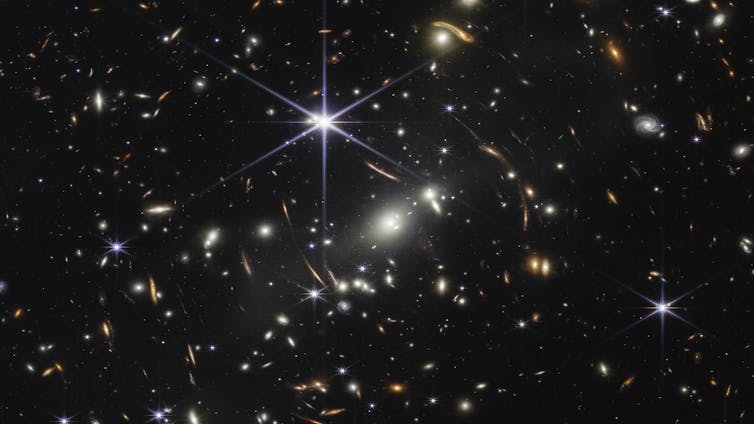
NASA’s James Webb Space Telescope has spotted some potential dark star candidates. NASA, ESA, CSA, and STScI

Alexey A. Petrov, University of South Carolina

Scientists working with the James Webb Space Telescope discovered three unusual astronomical objects in early 2025, which may be examples of dark stars. The concept of dark stars has existed for some time and could alter scientists’ understanding of how ordinary stars form. However, their name is somewhat misleading.

“Dark stars” is one of those unfortunate names that, on the surface, does not accurately describe the objects it represents. Dark stars are not exactly stars, and they are certainly not dark.

Still, the name captures the essence of this phenomenon. The “dark” in the name refers not to how bright these objects are, but to the process that makes them shine — driven by a mysterious substance called dark matter. The sheer size of these objects makes it difficult to classify them as stars.

As a physicist, I’ve been fascinated by dark matter, and I’ve been trying to find a way to see its traces using particle accelerators. I’m curious whether dark stars could provide an alternative method to find dark matter.

What makes dark matter dark?

Dark matter, which makes up approximately 27% of the universe but cannot be directly observed, is a key idea behind the phenomenon of dark stars. Astrophysicists have studied this mysterious substance for nearly a century, yet we haven’t seen any direct evidence of it besides its gravitational effects. So, what makes dark matter dark?

A pie chart showing the composition of the universe. The largest proportion is 'dark energy,' at 68%, while dark matter makes up 27% and normal matter 5%. The rest is neutrinos, free hydrogen and helium and heavy elements.
Despite physicists not knowing much about it, dark matter makes up around 27% of the universe. Visual Capitalist/Science Photo Library via Getty Images

Humans primarily observe the universe by detecting electromagnetic waves emitted by or reflected off various objects. For instance, the Moon is visible to the naked eye because it reflects sunlight. Atoms on the Moon’s surface absorb photons – the particles of light – sent from the Sun, causing electrons within atoms to move and send some of that light toward us.

More advanced telescopes detect electromagnetic waves beyond the visible spectrum, such as ultraviolet, infrared or radio waves. They use the same principle: Electrically charged components of atoms react to these electromagnetic waves. But how can they detect a substance – dark matter – that not only has no electric charge but also has no electrically charged components?

Although scientists don’t know the exact nature of dark matter, many models suggest that it is made up of electrically neutral particles – those without an electric charge. This trait makes it impossible to observe dark matter in the same way that we observe ordinary matter.

Dark matter is thought to be made of particles that are their own antiparticles. Antiparticles are the “mirror” versions of particles. They have the same mass but opposite electric charge and other properties. When a particle encounters its antiparticle, the two annihilate each other in a burst of energy.

If dark matter particles are their own antiparticles, they would annihilate upon colliding with each other, potentially releasing large amounts of energy. Scientists predict that this process plays a key role in the formation of dark stars, as long as the density of dark matter particles inside these stars is sufficiently high. The dark matter density determines how often dark matter particles encounter, and annihilate, each other. If the dark matter density inside dark stars is high, they would annihilate frequently.

What makes a dark star shine?

The concept of dark stars stems from a fundamental yet unresolved question in astrophysics: How do stars form? In the widely accepted view, clouds of primordial hydrogen and helium — the chemical elements formed in the first minutes after the Big Bang, approximately 13.8 billion years ago — collapsed under gravity. They heated up and initiated nuclear fusion, which formed heavier elements from the hydrogen and helium. This process led to the formation of the first generation of stars.

Two bright clouds of gas condensing around a small central region
Stars form when clouds of dust collapse inward and condense around a small, bright, dense core. NASA, ESA, CSA, and STScI, J. DePasquale (STScI), CC BY-ND

In the standard view of star formation, dark matter is seen as a passive element that merely exerts a gravitational pull on everything around it, including primordial hydrogen and helium. But what if dark matter had a more active role in the process? That’s exactly the question a group of astrophysicists raised in 2008.

In the dense environment of the early universe, dark matter particles would collide with, and annihilate, each other, releasing energy in the process. This energy could heat the hydrogen and helium gas, preventing it from further collapse and delaying, or even preventing, the typical ignition of nuclear fusion.

The outcome would be a starlike object — but one powered by dark matter heating instead of fusion. Unlike regular stars, these dark stars might live much longer because they would continue to shine as long as they attracted dark matter. This trait would make them distinct from ordinary stars, as their cooler temperature would result in lower emissions of various particles.

Can we observe dark stars?

Several unique characteristics help astronomers identify potential dark stars. First, these objects must be very old. As the universe expands, the frequency of light coming from objects far away from Earth decreases, shifting toward the infrared end of the electromagnetic spectrum, meaning it gets “redshifted.” The oldest objects appear the most redshifted to observers.

Since dark stars form from primordial hydrogen and helium, they are expected to contain little to no heavier elements, such as oxygen. They would be very large and cooler on the surface, yet highly luminous because their size — and the surface area emitting light — compensates for their lower surface brightness.

They are also expected to be enormous, with radii of about tens of astronomical units — a cosmic distance measurement equal to the average distance between Earth and the Sun. Some supermassive dark stars are theorized to reach masses of roughly 10,000 to 10 million times that of the Sun, depending on how much dark matter and hydrogen or helium gas they can accumulate during their growth.

So, have astronomers observed dark stars? Possibly. Data from the James Webb Space Telescope has revealed some very high-redshift objects that seem brighter — and possibly more massive — than what scientists expect of typical early galaxies or stars. These results have led some researchers to propose that dark stars might explain these objects.

Artist's impression of the James Webb telescope, which has a hexagonal mirror made up of smaller hexagons, and sits on a rhombus-shaped spacecraft.
The James Webb Space Telescope, shown in this illustration, detects light coming from objects in the universe. Northrup Grumman/NASA

In particular, a recent study analyzing James Webb Space Telescope data identified three candidates consistent with supermassive dark star models. Researchers looked at how much helium these objects contained to identify them. Since it is dark matter annihilation that heats up those dark stars, rather than nuclear fusion turning helium into heavier elements, dark stars should have more helium.

The researchers highlight that one of these objects indeed exhibited a potential “smoking gun” helium absorption signature: a far higher helium abundance than one would expect in typical early galaxies.

Dark stars may explain early black holes

What happens when a dark star runs out of dark matter? It depends on the size of the dark star. For the lightest dark stars, the depletion of dark matter would mean gravity compresses the remaining hydrogen, igniting nuclear fusion. In this case, the dark star would eventually become an ordinary star, so some stars may have begun as dark stars.

Supermassive dark stars are even more intriguing. At the end of their lifespan, a dead supermassive dark star would collapse directly into a black hole. This black hole could start the formation of a supermassive black hole, like the kind astronomers observe at the centers of galaxies, including our own Milky Way.

Dark stars might also explain how supermassive black holes formed in the early universe. They could shed light on some unique black holes observed by astronomers. For example, a black hole in the galaxy UHZ-1 has a mass approaching 10 million solar masses, and is very old – it formed just 500 million years after the Big Bang. Traditional models struggle to explain how such massive black holes could form so quickly.

The idea of dark stars is not universally accepted. These dark star candidates might still turn out just to be unusual galaxies. Some astrophysicists argue that matter accretion — a process in which massive objects pull in surrounding matter — alone can produce massive stars, and that studies using observations from the James Webb telescope cannot distinguish between massive ordinary stars and less dense, cooler dark stars.

Researchers emphasize that they will need more observational data and theoretical advancements to solve this mystery.

Alexey A. Petrov, Professor of physics and astronomy, University of South Carolina

This article is republished from The Conversation under a Creative Commons license. Read the original article.

ooOOoo

Alexey Petrov says at the end of the article that more observations are required before we humans know all the answers. I have no doubt that in time we will have the answers.

The DNA of dogs.

What is revealed in most dogs’ genes.

On November 24th this year, The Conversation published an article that spoke of the ancient closeness, as in genetically, of wolves and dogs.

I share it with you. It is a fascinating read.

ooOOoo

Thousands of genomes reveal the wild wolf genes in most dogs’ DNA.

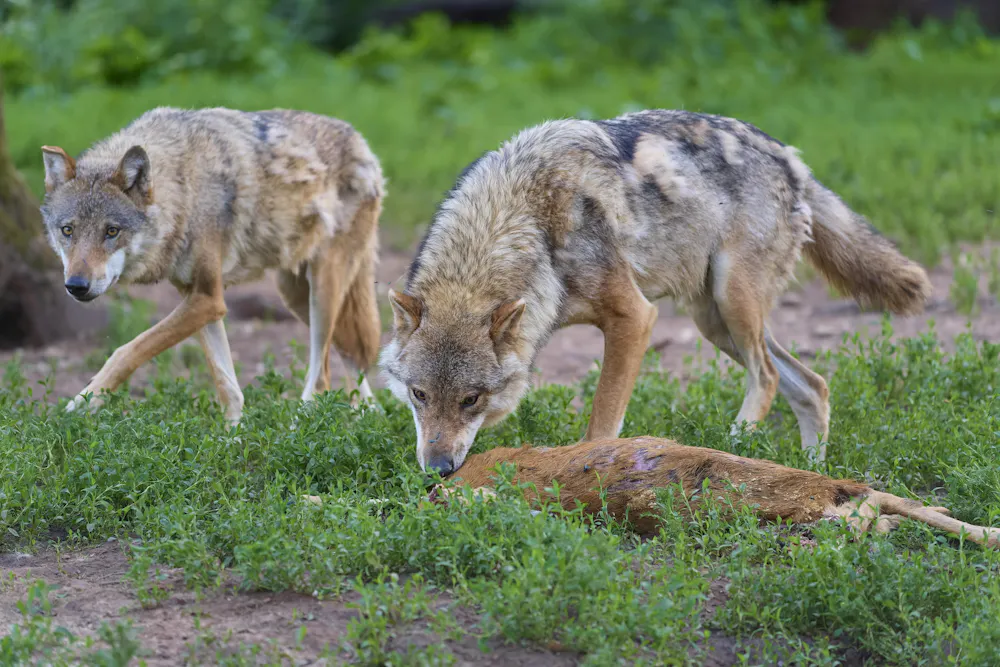
Modern wolves and dogs both descend from an ancient wolf population that lived alongside woolly mammoths and cave bears. Iza Lyson/500px Prime via Getty Images

Audrey T. Lin, Smithsonian Institution and Logan Kistler, Smithsonian Institution

Dogs were the first of any species that people domesticated, and they have been a constant part of human life for millennia. Domesticated species are the plants and animals that have evolved to live alongside humans, providing nearly all of our food and numerous other benefits. Dogs provide protection, hunting assistance, companionship, transportation and even wool for weaving blankets.

Dogs evolved from gray wolves, but scientists debate exactly where, when and how many times dogs were domesticated. Ancient DNA evidence suggests that domestication happened twice, in eastern and western Eurasia, before the groups eventually mixed. That blended population was the ancestor of all dogs living today.

Molecular clock analysis of the DNA from hundreds of modern and ancient dogs suggests they were domesticated between around 20,000 and 22,000 years ago, when large ice sheets covered much of Eurasia and North America. The first dog identified in the archaeological record is a 14,000-year-old pup found in Bonn-Oberkassel, Germany, but it can be difficult to tell based on bones whether an animal was an early domestic dog or a wild wolf.

Despite the shared history of dogs and wolves, scientists have long thought these two species rarely mated and gave birth to hybrid offspring. As an evolutionary biologist and a molecular anthropologist who study domestic plants and animals, we wanted to take a new look at whether dog-wolf hybridization has really been all that uncommon.

Little interbreeding in the wild

Dogs are not exactly descended from modern wolves. Rather, dogs and wolves living today both derive from a shared ancient wolf population that lived alongside woolly mammoths and cave bears.

In most domesticated species, there are often clear, documented patterns of gene flow between the animals that live alongside humans and their wild counterparts. Where wild and domesticated animals’ habitats overlap, they can breed with each other to produce hybrid offspring. In these cases, the genes from wild animals are folded into the genetic variation of the domesticated population.

For example, pigs were domesticated in the Near East over 10,000 years ago. But when early farmers brought them to Europe, they hybridized so frequently with local wild boar that almost all of their Near Eastern DNA was replaced. Similar patterns can be seen in the endangered wild Anatolian and Cypriot mouflon that researchers have found to have high proportions of domestic sheep DNA in their genomes. It’s more common than not to find evidence of wild and domesticated animals interbreeding through time and sharing genetic material.

That wolves and dogs wouldn’t show that typical pattern is surprising, since they live in overlapping ranges and can freely interbreed.

Dog and wolf behavior are completely different, though, with wolves generally organized around a family pack structure and dogs reliant on humans. When hybridization does occur, it tends to be when human activities – such as habitat encroachment and hunting – disrupt pack dynamics, leading female wolves to strike out on their own and breed with male dogs. People intentionally bred a few “wolf dog” hybrid types in the 20th century, but these are considered the exception.

a wolfish looking dog lies on the ground behind a metal fence
Luna Belle, a resident of the Wolf Sanctuary of Pennsylvania, which is home to both wolves and wolf dogs. Audrey Lin.

Tiny but detectable wolf ancestry

To investigate how much gene flow there really has been between dogs and wolves after domestication, we analyzed 2,693 previously published genomes, making use of massive publicly available datasets.

These included 146 ancient dogs and wolves covering about 100,000 years. We also looked at 1,872 modern dogs, including golden retrievers, Chihuahuas, malamutes, basenjis and other well-known breeds, plus more unusual breeds from around the world such as the Caucasian ovcharka and Swedish vallhund.

Finally, we included genomes from about 300 “village dogs.” These are not pets but are free-living animals that are dependent on their close association with human environments.

We traced the evolutionary histories of all of these canids by looking at maternal lineages via their mitochondrial genomes and paternal lineages via their Y chromosomes. We used highly sensitive computational methods to dive into the dogs’ and wolves’ nuclear genomes – that is, the genetic material contained in their cells’ nuclei.

We found the presence of wild wolf genes in most dog genomes and the presence of dog genes in about half of wild wolf genomes. The sign of the wolf was small but it was there, in the form of tiny, almost imperceptible chunks of continuous wolf DNA in dogs’ chromosomes. About two-thirds of breed dogs in our sample had wolf genes from crossbreeding that took place roughly 800 generations ago, on average.

While our results showed that larger, working dogs – such as sled dogs and large guardian dogs that protect livestock – generally have more wolf ancestry, the patterns aren’t universal. Some massive breeds such as the St. Bernard completely lack wolf DNA, but the tiny Chihuahua retains detectable wolf ancestry at 0.2% of its genome. Terriers and scent hounds typically fall at the low end of the spectrum for wolf genes.

a dog curled up on the sidewalk in a town
A street – or free-ranging – dog in Tbilisi, Georgia. Alexkom000/Wikimedia Commons, CC BY

We were surprised that every single village dog we tested had pieces of wolf DNA in their genomes. Why would this be the case? Village dogs are free-living animals that make up about half the world’s dogs. Their lives can be tough, with short life expectancy and high infant mortality. Village dogs are also associated with pathogenic diseases, including rabies and canine distemper, making them a public health concern.

More often than predicted by chance, the stretches of wolf DNA we found in village dog genomes contained genes related to olfactory receptors. We imagine that olfactory abilities influenced by wolf genes may have helped these free-living dogs survive in harsh, volatile environments.

The intertwining of dogs and wolves

Because dogs evolved from wolves, all of dogs’ DNA is originally wolf DNA. So when we’re talking about the small pieces of wolf DNA in dog genomes, we’re not referring to that original wolf gene pool that’s been kicking around over the past 20,000 years, but rather evidence for dogs and wolves continuing to interbreed much later in time.

A wolf-dog hybrid with one of each kind of parent would carry 50% dog and 50% wolf DNA. If that hybrid then lived and mated with dogs, its offspring would be 25% wolf, and so on, until we see only small snippets of wolf DNA present.

The situation is similar to one in human genomes: Neanderthals and humans share a common ancestor around half a million years ago. However, Neanderthals and our species, Homo sapiens, also overlapped and interbred in Eurasia as recently as a few thousand generations ago, shortly before Neanderthals disappeared. Scientists can spot the small pieces of Neanderthal DNA in most living humans in the same way we can see wolf genes within most dogs.

two small tan dogs walking on pavement on a double lead leash
Even tiny Chihuahuas contain a little wolf within their doggy DNA. Westend61 via Getty Images

Our study updates the previously held belief that hybridization between dogs and wolves is rare; interactions between these two species do have visible genetic traces. Hybridization with free-roaming dogs is considered a threat to conservation efforts of endangered wolves, including Iberian, Italian and Himalayan wolves. However, there also is evidence that dog-wolf mixing might confer genetic advantages to wolves as they adapt to environments that are increasingly shaped by humans.

Though dogs evolved as human companions, wolves have served as their genetic lifeline. When dogs encountered evolutionary challenges such as how to survive harsh climates, scavenge for food in the streets or guard livestock, it appears they’ve been able to tap into wolf ancestry as part of their evolutionary survival kit.

Audrey T. Lin, Research Associate in Anthropology, Smithsonian Institution and Logan Kistler, Curator of Archaeobotany and Archaeogenomics, National Museum of Natural History, Smithsonian Institution

This article is republished from The Conversation under a Creative Commons license. Read the original article.

ooOOoo

Well thanks to Audrey Lin and Logan Kistler for this very interesting study. So even modern dogs have visible traces of wolf in their DNA. It is yet another example of the ability of modern science to discover facts that were unknown a few decades ago.

We humans are still evolving.

An article in The Conversation caught my eye.

We must never forget that evolution is always happening.

So without any more from me here is that article.

ooOOoo

If evolution is real, then why isn’t it happening now? An anthropologist explains that humans actually are still evolving

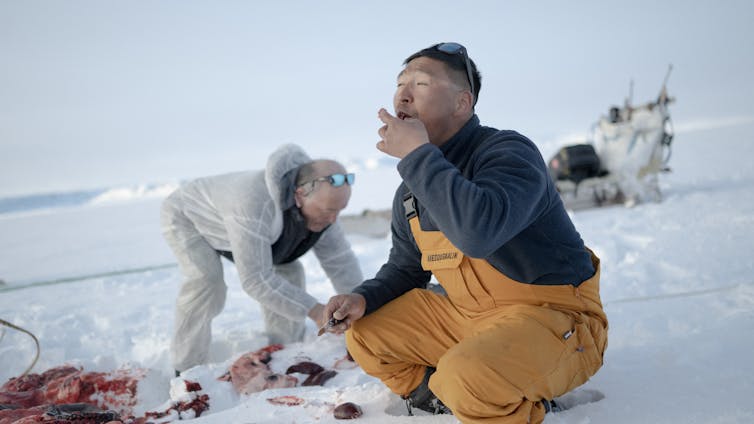
Inuit people such as these Greenlanders have evolved to be able to eat fatty foods with a low risk of getting heart disease. Olivier Morin/AFP via Getty Images

Michael A. Little, Binghamton University, State University of New York


If evolution is real, then why is it not happening now? – Dee, Memphis, Tennessee


Many people believe that we humans have conquered nature through the wonders of civilization and technology. Some also believe that because we are different from other creatures, we have complete control over our destiny and have no need to evolve. Even though lots of people believe this, it’s not true.

Like other living creatures, humans have been shaped by evolution. Over time, we have developed – and continue to develop – the traits that help us survive and flourish in the environments where we live.

I’m an anthropologist. I study how humans adapt to different environments. Adaptation is an important part of evolution. Adaptations are traits that give someone an advantage in their environment. People with those traits are more likely to survive and pass those traits on to their children. Over many generations, those traits become widespread in the population.

The role of culture

We humans have two hands that help us skillfully use tools and other objects. We are able to walk and run on two legs, which frees our hands for these skilled tasks. And we have large brains that let us reason, create ideas and live successfully with other people in social groups.

All of these traits have helped humans develop culture. Culture includes all of our ideas and beliefs and our abilities to plan and think about the present and the future. It also includes our ability to change our environment, for example by making tools and growing food.

Although we humans have changed our environment in many ways during the past few thousand years, we are still changed by evolution. We have not stopped evolving, but we are evolving right now in different ways than our ancient ancestors. Our environments are often changed by our culture.

We usually think of an environment as the weather, plants and animals in a place. But environments include the foods we eat and the infectious diseases we are exposed to.

A very important part of the environment is the climate and what kinds of conditions we can live in. Our culture helps us change our exposure to the climate. For example, we build houses and put furnaces and air conditioners in them. But culture doesn’t fully protect us from extremes of heat, cold and the sun’s rays.

a man runs after one of several goats in a dry, dusty landscape
The Turkana people in Kenya have evolved to survive with less water than other people, which helps them live in a desert environment. Tony Karumba/AFP via Getty Images

Here are some examples of how humans have evolved over the past 10,000 years and how we are continuing to evolve today.

The power of the sun’s rays

While the sun’s rays are important for life on our planet, ultraviolet rays can damage human skin. Those of us with pale skin are in danger of serious sunburn and equally dangerous kinds of skin cancer. In contrast, those of us with a lot of skin pigment, called melanin, have some protection against damaging ultraviolet rays from sunshine.

People in the tropics with dark skin are more likely to thrive under frequent bright sunlight. Yet, when ancient humans moved to cloudy, cooler places, the dark skin was not needed. Dark skin in cloudy places blocked the production of vitamin D in the skin, which is necessary for normal bone growth in children and adults.

The amount of melanin pigment in our skin is controlled by our genes. So in this way, human evolution is driven by the environment – sunny or cloudy – in different parts of the world.

The food that we eat

Ten thousand years ago, our human ancestors began to tame or domesticate animals such as cattle and goats to eat their meat. Then about 2,000 years later, they learned how to milk cows and goats for this rich food. Unfortunately, like most other mammals at that time, human adults back then could not digest milk without feeling ill. Yet a few people were able to digest milk because they had genes that let them do so.

Milk was such an important source of food in these societies that the people who could digest milk were better able to survive and have many children. So the genes that allowed them to digest milk increased in the population until nearly everyone could drink milk as adults.

This process, which occurred and spread thousands of years ago, is an example of what is called cultural and biological co-evolution. It was the cultural practice of milking animals that led to these genetic or biological changes.

Other people, such as the Inuit in Greenland, have genes that enable them to digest fats without suffering from heart diseases. The Turkana people herd livestock in Kenya in a very dry part of Africa. They have a gene that allows them to go for long periods without drinking much water. This practice would cause kidney damage in other people because the kidney regulates water in your body.

These examples show how the remarkable diversity of foods that people eat around the world can affect evolution.

gray scale microscope image of numerous blobs
These bacteria caused a devastating pandemic nearly 700 years ago that led humans to evolve resistance to them.
Image Point FR/NIH/NIAID/BSIP/Universal Images Group via Getty Images

Diseases that threaten us

Like all living creatures, humans have been exposed to many infectious diseases. During the 14th century a deadly disease called the bubonic plague struck and spread rapidly throughout Europe and Asia. It killed about one-third of the population in Europe. Many of those who survived had a specific gene that gave them resistance against the disease. Those people and their descendants were better able to survive epidemics that followed for several centuries.

Some diseases have struck quite recently. COVID-19, for instance, swept the globe in 2020. Vaccinations saved many lives. Some people have a natural resistance to the virus based on their genes. It may be that evolution increases this resistance in the population and helps humans fight future virus epidemics.

As human beings, we are exposed to a variety of changing environments. And so evolution in many human populations continues across generations, including right now.


Michael A. Little, Distinguished Professor Emeritus of Anthropology, Binghamton University, State University of New York

This article is republished from The Conversation under a Creative Commons license. Read the original article.

ooOOoo

This was published for the Curious Kids section of The Conversation.

However, I believe this is relevant for those adults as well who are interested in the subject. I’m in my 80’s and find this deeply interesting.

Death – it comes to all of us!

Irrespective of our believe.

There are only two days in our lives when we live for less than twenty-four hours: the day we are born and the day when we die!

I was born in November, 1944 and that makes me eighty-one. I was born as a result of an affair between my mother and my father. The family genes favour girls over boys, as in seven girls for every boy, and the son is normally the first born. My mother lost her first child, it was a boy. Then my mother had a second baby. Surprise, surprise, it was another son – me!!

I say this as an introduction to a post on The Conversation.

ooOOoo

Americans are unprepared for the expensive and complex process of aging – a geriatrician explains how they can start planning

It’s important for older adults to plan for their care as they age. Maskot/Maskot via Getty Images

Kahli Zietlow, University of Michigan

Hollywood legend Gene Hackman and his wife, Betsy Arakawa, were found dead in their home in February 2025. Hackman had been living with Alzheimer’s and depended on Arakawa as his full-time caregiver.

Disturbingly, postmortem data suggests that Arakawa died of complications from pulmonary Hantavirus several days before her husband passed. The discordant times of death point to a grim scenario: Hackman was left alone and helpless, trapped in his home after his wife’s death.

The couple’s story, while shocking, is not unique. It serves as a warning for our rapidly aging society. The U.S. population is aging, but most Americans are not adequately planning to meet the needs of older adulthood.

As a geriatric physician and medical educator, I care for older adults in both inpatient and outpatient settings. My research and clinical work focus on dementia and surrogate decision-making.

In my experience, regardless of race, education or socioeconomic status, there are some universal challenges that all people face with aging and there are steps everyone can take to prepare.

Aging is inevitable but unpredictable

Aging is an unpredictable, highly individualized process that varies depending on a person’s genetics, medical history, cognitive status and socioeconomic factors.

The majority of older Americans report a strong sense of purpose and self-worth. Many maintain a positive view of their overall health well into their 70s and 80s.

But at some point, the body starts to slow down. Older adults experience gradual sensory impairment, loss of muscle mass and changes in their memory. Chronic diseases are more likely with advancing age.

According to the U.S. Census Bureau, 46% of adults over age 75 live with at least one physical disability, and this proportion grows with age. Even those without major health issues may find that routine tasks like yard work, housekeeping and home repairs become insurmountable as they enter their 80s and 90s.

Some may find that subtle changes in memory make it difficult to manage household finances or keep track of their medications. Others may find that vision loss and slowed reaction time make it harder to safely drive. Still others may struggle with basic activities needed to live independently, such as bathing or using a toilet. All of these changes threaten older adults’ ability to remain independent.

The costs of aging

Nearly 70% of older Americans will require long-term care in their lifetime, whether through paid, in-home help or residence in an assisted living facility or nursing home.

But long-term care is expensive. In 2021, the Federal Long Term Care Insurance Program reported that the average hourly rate for in-home care was US$27. An assisted living apartment averaged $4,800 per month, and a nursing home bed cost nearly double that, at a rate of $276 per day.

Many Americans may be shocked to discover that these costs are not covered by Medicare or other traditional medical insurance. Long-term care insurance covers the cost of long-term care, such as in-home care or nursing home placement. However, what is covered varies from plan to plan. Currently, only a small minority of Americans have long-term care insurance due to high premiums and complex activation rules.

I am not aware of any high-quality, peer-reviewed studies that have demonstrated the cost effectiveness of long-term care insurance. Yet, for many Americans, paying for care out of pocket is simply not an option.

Medicaid can provide financial support for long-term care but only for older adults with very low income and minimal assets – criteria most Americans don’t meet until they have nearly exhausted their savings.

Those receiving Medicaid to cover the costs of long-term care have essentially no funds for anything other than medical care, room and board. And proposed federal financial cuts may further erode the limited support services available. In Michigan, for example, Medicaid-covered nursing home residents keep only $60 per month for personal needs. If individuals receive monthly income greater than $60 – for instance, from Social Security or a pension – the extra money would go toward the cost of nursing home care.

Those who don’t qualify for Medicaid or cannot afford private care often rely on family and friends for unpaid assistance, but not everyone has such support systems.

A nurse helps an older man shave.
Older adults may end up needing help with day-to-day personal care. Klaus Vedfelt/DigitalVision via Getty Images

Planning for the care you want

Beyond financial planning, older adults can make an advance directive. This is a set of legal documents that outlines preferences for medical care and asset management if a person becomes incapacitated. However, only about 25% of Americans over 50 have completed such documentation.

Without medical and financial powers of attorney in place, state laws determine who makes critical decisions, which may or may not align with a person’s wishes. For instance, an estranged child may have more legal authority over an incapacitated parent than their long-term but unmarried partner. Seniors without clear advocates risk being placed under court-appointed guardianship – a restrictive and often irreversible process.

In addition to completing advance directives, it is important that older adults talk about their wishes with their loved ones. Conversations about disability, serious illness and loss of independence can be difficult, but these discussions allow your loved ones to advocate for you in the event of a health crisis.

Who’s going to care for you?

Finding a caregiver is an important step in making arrangements for aging. If you are planning to rely on family or friends for some care, it helps to discuss this with them ahead of time and to have contingency plans in place. As the Hackman case demonstrates, if a caregiver is suddenly incapacitated, the older adult may be left in immediate danger.

Caregivers experience higher rates of stress, depression and physical illness compared with their peers. This is often exacerbated by financial strain and a lack of support. It helps if the people you will be relying on have expectations in place about their role.

For instance, some people may prefer placement in a facility rather than relying on a loved one if they can no longer use the bathroom independently. Others may wish to remain in their homes as long as this is a feasible option.

Connecting with available resources

There are local and federal initiatives designed to help aging adults find and get the help they need. The Centers for Medicare & Medicaid Services recently launched the GUIDE Model to improve care and quality of life for both those suffering from dementia and their caregivers.

This program connects caregivers with local resources and provides a 24-hour support line for crises. While GUIDE, which stands for Guiding an Improved Dementia Experience, is currently in the pilot stage, it is slowly expanding, and I am hopeful that it will eventually expand to provide enhanced coverage for those suffering from dementia nationwide.

The Program for All-Inclusive Care of the Elderly helps dual-eligible Medicare and Medicaid recipients remain at home as they age. This program provides comprehensive services including medical care, a day center and home health services.

Area agencies on aging are regionally located and can connect older adults with local resources, based on availability and income, such as meals, transportation and home modifications that help maintain independence.

Unfortunately, all of these programs and others that support older adults are threatened by recent federal budget cuts. The tax breaks and spending cuts bill, which was signed into law in July 2025, will result in progressive reductions to Medicaid funding over the next 10 years. These cuts will decrease the number of individuals eligible for Medicaid and negatively affect how nursing homes are reimbursed.

The government funding bill passed on Nov. 13 extends current Medicare funding through Jan. 30, 2026, at which point Medicare funding may be reduced.

Even as the future of these programs remains uncertain, it’s important for older adults and their caregivers to be intentional in making plans and to familiarize themselves with the resources available to them.

Kahli Zietlow, Physician and Clinical Associate Professor of Geriatrics & Internal Medicine, University of Michigan

This article is republished from The Conversation under a Creative Commons license. Read the original article.

ooOOoo

This article is a wakeup call for me, because I have no plan in place.

While I think about death more frequently than I used to, the fact that I don’t have plan is naive: I must get myself to a stage where I have a plan, and soon! I guess I am not the only person in their 80s without a plan!

What if we die before our pets?

We love our dogs and can never envisage being without one.

So what happens to them after the last one of us die?

I have just turned 81 and, although I am fit, think more seriously about this matter than I used to. Jean has no children and my son and daughter, from a previous marriage, are living in the U.K.

So an article from The Conversation caught my eye and I wanted to share it with you.

ooOOoo

Diane Keaton’s $5M pet trust would be over the top if reports prove true – here’s how to ensure your beloved pet is safe after you are gone

Allison Anna Tait, University of Richmond

Diane Keaton loved her dog, Reggie.

The award-winning actor, director and real estate entrepreneur frequently posted photos and video clips of the golden retriever on her social media accounts. After she died on Oct. 11, 2025, at 79, some news outlets reported that she left US$5 million of her estimated $100 million estate to her dog.

I’m a law professor who teaches about wills, trusts and other forms of inheritance law. Every semester, I teach my students how they can help clients provide for their pets after death. Because they, like many Americans, love their pets and want to know how to take care of them, this topic always piques their interest. https://www.youtube.com/embed/FYJGCvpJIV0?wmode=transparent&start=0 Diane Keaton was very open about her devotion to her dog, Reggie.

Writing pets into a will

An estimated 66% of all U.S. households include at least one pet. Many Americans consider their cats, dogs, tortoises or other animals to be part of their family, and their spending on those nonhuman relatives is immense. In 2024, they paid a total of about $152 billion for goods and services to feed and otherwise support their pets.

Taking good care of your pets can go beyond buying them treats and sweaters. It can include leaving clear directions to ensure their needs are met once you’re gone. There are several ways that you can do this.

The first is through your will. You can’t give your pet money directly in your will, because the law says that pets are property, like your books or your dishes.

You can, however, leave a bequest, the technical term for a gift to a person or a cause listed in a will, to someone who will be the animal’s caretaker. That bequest can include directions that the money be spent meeting the pet’s needs.

It’s worth it to also name an alternate or contingent caretaker in case the first person you name does not want to or cannot take on that responsibility, or they die before you or the animals you’ve provided for in the will.

Choupette’s life of luxury

German fashion designer, photographer and creative director Karl Lagerfeld, who died in 2019 at 85, was someone who made the mistake of leaving money directly to his fluffy Birman cat, Choupette. It worked out for Choupette, though.

The cat was, according to several reports, still alive in 2025 and eating meals out of the porcelain bowls that Lagerfeld bought for her. Choupette is cared for at great expense and in the utmost luxury by Françoise Caçote, the designer’s former housekeeper. The cat even had a 13th birthday party at Versailles.

Another pet owner who did right by her pet was the comedian, producer and red carpet interviewer Joan Rivers.

Rivers had two rescue dogs in Manhattan and two more dogs in California when she died in 2014 at age 81. Rivers had made provisions for their care in her will.

A petite woman holding a tiny dog stands next to three men on a TV set.
The late Joan Rivers, right, seen on the set of her short-lived talk show in 1987, planned ahead for her dogs’ care. Bettmann via Getty Images

Creating pet trusts

If you’d like an arrangement that’s more secure than a will, then you might want to opt for a pet trust, another celebrity favorite. These kinds of trusts were not possible until the 1990s, because pets were not considered true beneficiaries – meaning they couldn’t sue the trustee.

But in the 1990s, states began to change their rules to allow for pet trusts. Today, pet trusts are valid in the whole country, although the rules vary slightly from state to state.

To establish a pet trust, you or a lawyer must draw up a trust document that names two important people: a trustee and a caretaker. The trustee is the person who will manage the money you leave in trust. They will make distributions to the caretaker that you select.

You must also specify how the money is to be spent meeting the animal’s needs and who would get any money that could be left in the trust when the pet dies. Typically, these trusts take effect at the owner’s death, just like other provisions in a will.

Drafting a pet trust can be free, if you use an online template and get no legal guidance. The same thing might cost around $100 if you use an online service such as Legal Zoom that provides directions. More commonly, however, pet trusts are part of a broader estate plan, and costs range depending on how complicated your estate is.

When the rich go overboard

One of the most over-the-top pet trusts came from Leona Helmsley, the New York hotel and real estate mogul known widely as the “Queen of Mean.” She was famous for her pettiness and tough management style and for landing in prison for tax evasion.

When Helmsley died in 2007, she left her dog, a Maltese named Trouble who had reportedly bitten members of her staff, a $12 million trust fund. Most of Helmsley’s estate went to the Helmsley Charitable Trust, but she made individual gifts to several relatives, and the gift to Trouble was larger than any of those.

The grandchildren, upset that Trouble got more money than they did, took the case to court, where the probate judge was less than impressed by Trouble’s luxury lifestyle and knocked down the amount in trust to $2 million. The other $10 million flowed back to her family’s foundation, where the bulk of the estate went in the first place.

Lesson learned: Your dog can have a trust fund, but don’t go overboard.

Bequests for pets can be challenged – in which case it’s up to courts to determines how much they think is reasonable for the pet’s need. In Helmsley’s case, $12 million was found to be excessive. And maybe with good reason. Trouble still had a nice life with fewer millions. The dog died in December 2010 after several years in Sarasota, Florida, at a Helmsley-owned hotel.

Other pet owners who aren’t celebrities have used pet trusts as well, such as Bill Dorris, a Nashville businessman without any human heirs. He left his dog, Lulu, $5 million.

Pet-loving celebrities who loved all the pets

Finally, there’s a lesson to be learned from British fashion designer and icon Alexander McQueen, who was worth £16 million ($21 million) when he died in 2010 at the age of 40. McQueen left £50,000 ($66,000) in a trust for his two bull terriers so that they would be well cared for during the remainder of their lives.

McQueen also included a bequest of £100,000 ($132,000) to the Battersea Dogs and Cats Home in his will to help fund the care of some of the millions of other animals out there that need the basics of food and shelter.

Animal shelters, in the U.K., the United States and other countries, help rescue and protect animals, and these animals need more help than the Choupettes and Troubles of the world.

So, my advice is that you go ahead and create a pet trust for your cat. But don’t forget to give some money in your will – and ideally while you’re alive – to help the vast majority of the millions of companion animals who need new homes every year. None of them have trust funds.

What becomes of Reggie, Keaton’s golden retriever, and her estate remains to be seen. Keaton, who starred in hit movies such as “Annie Hall,” “Reds” and “The First Wives Club,” isn’t the first celebrity to leave millions of dollars to a pet. And it’s unlikely that she will be the last.

Allison Anna Tait, Professor of Law, University of Richmond

This article is republished from The Conversation under a Creative Commons license. Read the original article.

ooOOoo

Amending our Will to create a pet trust seems like a very good idea! And making sure there is money for the trust as well.

Prehistory

We all live in the Quantenary period. From Wikipedia I quote a small piece:

It follows the Neogene Period and spans from 2.6 million years ago to the present.

I don’t know about you but 2.6 million years ago (Ma) seems like a very long time. But then the prior period was the Neogene that went from 2.6 Ma to 23 Ma.

But if one wants to think ‘old’ then try the Ordovician period:

The Ordovician spans 41.6 million years from the end of the Cambrian Period 486.85 Ma (million years ago) to the start of the Silurian Period 443.1 Ma.

****

Just to put us humans into context, human evolution is very much shorter. I have it from six million years onwards. But here are two videos, courtesy of YouTube. The first one is a short one:

Scientists use fossils to reconstruct the evolutionary history of hominins—the group that includes modern humans, our immediate ancestors, and other extinct relatives. Today, our closest living relatives are chimpanzees, but extinct hominins are even closer. Where and when did they live? What can we learn about their lives? Why did they go extinct? Scientists look to fossils for clues.

 The second video is a 54-minute one from PBS.

They have both been watched thousands of times.

Now on to today’s post.

ooOOoo

Giant ground sloths’ fossilized teeth reveal their unique roles in the prehistoric ecosystem

Harlan’s ground sloth fossil skeleton excavated and displayed at the La Brea Tar Pits in Los Angeles. Larisa DeSantis

Larisa R. G. DeSantis, Vanderbilt University and Aditya Reddy Kurre, University of Pennsylvania

animal hanging from a branch looks upside down at the camera
A two-toed sloth at the Nashville Zoo. Larisa R. G. DeSantis

Imagine a sloth. You probably picture a medium-size, tree-dwelling creature hanging from a branch. Today’s sloths – commonly featured on children’s backpacks, stationery and lunch boxes – are slow-moving creatures, living inconspicuously in Central American and South American rainforests.

But their gigantic Pleistocene ancestors that inhabited the Americas as far back as 35 million years ago were nothing like the sleepy tree huggers we know today. Giant ground sloths – some weighing thousands of pounds and standing taller than a single-story building – played vital and diverse roles in shaping ecosystems across the Americas, roles that vanished with their loss at the end of the Pleistocene.

In our new study, published in the journal Biology Letters, we aimed to reconstruct the diets of two species of giant ground sloths that lived side by side in what’s now Southern California. We analyzed remains recovered from the La Brea Tar Pits of what are colloquially termed the Shasta ground sloth (Nothrotheriops shastensis) and Harlan’s ground sloth (Paramylodon harlani). Our work sheds light on the lives of these fascinating creatures and the consequences their extinction in Southern California 13,700 years ago has had on ecosystems.

Dentin dental challenges

Studying the diets of extinct animals often feels like putting together a jigsaw puzzle with only a portion of the puzzle pieces. Stable isotope analyses have revolutionized how paleoecologists reconstruct the diets of many ancient organisms. By measuring the relative ratios of light and heavy carbon isotopes in tooth enamel, we can figure out what kinds of foods an animal ate – for instance, grasses versus trees or shrubs.

dental drill in hands near an animal jawbone
Drilling teeth provides a sample for stable isotope analyses. Aditya Kurre

But the teeth of giant ground sloths lack enamel, the highly inorganic and hard outer layer on most animal teeth – including our own. Instead, sloth teeth are made primarily of dentin, a more porous and organic-rich tissue that readily changes its chemical composition with fossilization.

Stable isotope analyses are less dependable in sloths because dentin’s chemical composition can be altered postmortem, skewing the isotopic signatures.

Another technique researchers use to glean information about an animal’s diet relies on analyzing the microscopic wear patterns on its teeth. Dental microwear texture analysis can infer whether an animal mostly ate tough foods such as leaves and grass or hard foods such as seeds and fruit pits. This technique is also tricky when it comes to sloths’ fossilized teeth because signs of wear may be preserved differently in the softer dentin than in harder enamel.

Prior to studying fossil sloths, we vetted dental microwear methods in modern xenarthrans, a group of animals that includes sloths, armadillos and anteaters. This study demonstrated that dentin microwear can reveal dietary differences between leaf-eating sloths and insect-consuming armadillos, giving us confidence that these tools could reveal dietary information from ground sloth fossils.

Distinct dietary niches revealed

Previous research suggested that giant ground sloths were either grass-eating grazers or leaf-eating browsers, based on the size and shape of their teeth. However, more direct measures of diet – such as stable isotopes or dental microwear – were often lacking.

Our new analyses revealed contrasting dental wear signatures between the two co-occurring ground sloth species. The Harlan’s ground sloth, the larger of the two, had microwear patterns dominated by deep pitlike textures. This kind of wear is indicative of chewing hard, mechanically challenging foods such as tubers, seeds, fungi and fruit pits. Our new evidence aligns with skeletal adaptations that suggest powerful digging abilities, consistent with foraging foods both above and below ground.

diagram of sloth profiles, tooth outline and magnified surface of two bits of the teeth
The fossil teeth of the Harlan’s ground sloth typically showed deeper pitlike textures, bottom, while the Shasta ground sloth teeth had shallower wear patterns, top. DeSantis and Kurre, Biology Letters 2025

In contrast, the Shasta ground sloth exhibited dental microwear textures more akin to those in leaf-eating and woody plant-eating herbivores. This pattern corroborates previous studies of its fossilized dung, demonstrating a diet rich in desert plants such as yucca, agave and saltbush.

Next we compared the sloths’ microwear textures to those of ungulates such as camels, horses and bison that lived in the same region of Southern California. We confirmed that neither sloth species’ dietary behavior overlapped fully with other herbivores. Giant ground sloths didn’t perform the same ecological functions as the other herbivores that shared their landscape. Instead, both ground sloths partitioned their niches and played complementary ecological roles.

Extinctions brought ecological loss

The Harlan’s ground sloth was a megafaunal ecosystem engineer. It excavated soil and foraged underground, thereby affecting soil structure and nutrient cycling, even dispersing seed and fungal spores over wide areas. Anecdotal evidence suggests that some anachronistic fruits – such as the weird, bumpy-textured and softball-size Osage orange – were dispersed by ancient megafauna such as giant ground sloths. When the Pleistocene megafauna went extinct, the loss contributed to the regional restriction of these plants, since no one was around to spread their seeds.

The broader consequence is clear: Megafaunal extinctions erased critical ecosystem engineers, triggering cascading ecological changes that continue to affect habitat resilience today. Our results resonate with growing evidence that preserving today’s living large herbivores and understanding the diversity of their ecological niches is crucial for conserving functional ecosystems.

Studying the teeth of lost giant ground sloths has illuminated not only their diets but also the enduring ecological legacies of their extinction. Today’s sloths, though charming, only hint at the profound environmental influence of their prehistoric relatives – giants that shaped landscapes in ways we are only beginning to appreciate.

Larisa R. G. DeSantis, Associate Professor of Biological Sciences, Vanderbilt University and Aditya Reddy Kurre, Dental Student, University of Pennsylvania

This article is republished from The Conversation under a Creative Commons license. Read the original article.

ooOOoo

I am going to finish with a link, and a small extract, from a Wikipedia article on the evolution of Homo sapiens

The timeline of human evolution outlines the major events in the evolutionary lineage of the modern human speciesHomo sapiens, throughout the history of life, beginning some 4 billion years ago down to recent evolution within H. sapiens during and since the Last Glacial Period.

The beautiful moon, but …

… does it make us sleepless?

As has been mentioned previously, my dear wife and her Parkinson’s means that we go to bed early and get up early the following morning. Thus a recent item on The Conversation fascinated me and it is shared with you now.

ooOOoo

Does the full moon make us sleepless? A neurologist explains the science behind sleep, mood and lunar myths

How much does the moon cycle affect sleep? Probably less than your screen time at night. Muhammad Khazin Alhusni/iStock via Getty Images Plus

Joanna Fong-Isariyawongse, University of Pittsburgh

Have you ever tossed and turned under a full moon and wondered if its glow was keeping you awake? For generations, people have believed that the Moon has the power to stir up sleepless nights and strange behavior – even madness itself. The word “lunacy” comes directly from luna, Latin for Moon.

Police officers, hospital staff and emergency workers often swear that their nights get busier under a full moon. But does science back that up?

The answer is, of course, more nuanced than folklore suggests. Research shows a full moon can modestly affect sleep, but its influence on mental health is much less certain.

I’m a neurologist specializing in sleep medicine who studies how sleep affects brain health. I find it captivating that an ancient myth about moonlight and madness might trace back to something far more ordinary: our restless, moonlit sleep.

What the full moon really does to sleep

Several studies show that people really do sleep differently in the days leading up to the full moon, when moonlight shines brightest in the evening sky. During this period, people sleep about 20 minutes less, take longer to fall asleep and spend less time in deep, restorative sleep. Large population studies confirm the pattern, finding that people across different cultures tend to go to bed later and sleep for shorter periods in the nights before a full moon.

The most likely reason is light. A bright moon in the evening can delay the body’s internal clock, reduce melatonin – the hormone that signals bedtime – and keep the brain more alert.

The changes are modest. Most people lose only 15 to 30 minutes of sleep, but the effect is measurable. It is strongest in places without artificial light, such as rural areas or while camping. Some research also suggests that men and women may be affected differently. For instance, men seem to lose more sleep during the waxing phase, while women experience slightly less deep and restful sleep around the full moon.

Young adult woman lying in bed wide awake, staring out the window toward a bright light.
Sleep loss from a bright moon is modest but measurable. Yuliia Kaveshnikova/iStock via Getty Images Plus

The link with mental health

For centuries, people have blamed the full moon for stirring up madness. Folklore suggested that its glow could spark mania in bipolar disorder, provoke seizures in people with epilepsy or trigger psychosis in those with schizophrenia. The theory was simple: lose sleep under a bright moon and vulnerable minds might unravel.

Modern science adds an important twist. Research is clear that sleep loss itself is a powerful driver of mental health problems. Even one rough night can heighten anxiety and drag down mood. Ongoing sleep disruption raises the risk of depression, suicidal thoughts and flare-ups of conditions like bipolar disorder and schizophrenia.

That means even the modest sleep loss seen around a full moon could matter more for people who are already at risk. Someone with bipolar disorder, for example, may be far more sensitive to shortened or fragmented sleep than the average person.

But here’s the catch: When researchers step back and look at large groups of people, the evidence that lunar phases trigger psychiatric crises is weak. No reliable pattern has been found between the Moon and hospital admissions, discharges or lengths of stay.

But a few other studies suggest there may be small effects. In India, psychiatric hospitals recorded more use of restraints during full moons, based on data collected between 2016 and 2017. In China, researchers noted a slight rise in schizophrenia admissions around the full moon, using hospital records from 2012 to 2017. Still, these findings are not consistent worldwide and may reflect cultural factors or local hospital practices as much as biology.

In the end, the Moon may shave a little time off our sleep, and sleep loss can certainly influence mental health, especially for people who are more vulnerable. That includes those with conditions like depression, bipolar disorder, schizophrenia or epilepsy, and teenagers who are especially sensitive to sleep disruption. But the idea that the full moon directly drives waves of psychiatric illness remains more myth than reality.

The sleep/wake cycle is synchronized with lunar phases.

Other theories fall short

Over the years, scientists have explored other explanations for supposed lunar effects, from gravitational “tidal” pulls on the body to subtle geomagnetic changes and shifts in barometric pressure. Yet, none of these mechanisms hold up under scrutiny.

The gravitational forces that move oceans are far too weak to affect human physiology, and studies of geomagnetic and atmospheric changes during lunar phases have yielded inconsistent or negligible results. This makes sleep disruption from nighttime light exposure the most plausible link between the Moon and human behavior.

Why the myth lingers

If the science is so inconclusive, why do so many people believe in the “full moon effect”? Psychologists point to a concept called illusory correlation. We notice and remember the unusual nights that coincide with a full moon but forget the many nights when nothing happened.

The Moon is also highly visible. Unlike hidden sleep disruptors such as stress, caffeine or scrolling on a phone, the Moon is right there in the sky, easy to blame.

A woman staring at her cellphone while lying in the dark.
Screen-time habits are far more likely to have detrimental effects on sleep than a full moon. FanPro/Moment via Getty Images

Lessons from the Moon for modern sleep

Even if the Moon does not drive us “mad,” its small influence on sleep highlights something important: Light at night matters.

Our bodies are designed to follow the natural cycle of light and dark. Extra light in the evening, whether from moonlight, streetlights or phone screens, can delay circadian rhythms, reduce melatonin and lead to lighter, more fragmented sleep.

This same biology helps explain the health risks of daylight saving time. When clocks “spring forward,” evenings stay artificially brighter. That shift delays sleep and disrupts circadian timing on a much larger scale than the Moon, contributing to increased accidents and cardiovascular risks, as well as reduced workplace safety.

In our modern world, artificial light has a much bigger impact on sleep than the Moon ever will. That is why many sleep experts argue for permanent standard time, which better matches our biological rhythms.

So if you find yourself restless on a full moon night, you may not be imagining things – the Moon can tug at your sleep. But if sleeplessness happens often, look closer to home. It is likely a culprit of the light in your hand rather than the one in the sky.

Joanna Fong-Isariyawongse, Associate Professor of Neurology, University of Pittsburgh

This article is republished from The Conversation under a Creative Commons license. Read the original article.

ooOOoo

Ever since I have been an adult I have wondered what the purpose was of daylight time and standard time. The University of Colorado have the history of the time change and, as I suspect, it was brought about by the war; World War I.

Here’s part of that article:

It was first introduced in Germany in 1916 during World War I as an energy saving measure, according to CU Boulder sleep researcher Kenneth Wright. The U.S. followed suit, adopting DST in 1918. Initially implemented as a wartime measure, it was repealed a year later. 

Daylight saving time was reinstituted in 1942 during World War II. The next couple decades were a free-for-all, when states and localities switched between DST and standard time (ST) at will. To put an end to the clock chaos, Congress finally passed the Uniform Time Act in 1966, which standardized daylight saving time and its start and end dates across the country — with the exception of Hawaii and Arizona, which opted to keep standard time year-round. 

More about Jane Goodall

An article published by The Conversation is offered today.

ooOOoo

Jane Goodall, the gentle disrupter whose research on chimpanzees redefined what it meant to be human

Jane Goodall appears on stage at 92NY in New York on Oct. 1, 2023.
Charles Sykes/Invision/AP

Mireya Mayor, Florida International University

Anyone proposing to offer a master class on changing the world for the better, without becoming negative, cynical, angry or narrow-minded in the process, could model their advice on the life and work of pioneering animal behavior scholar Jane Goodall.

Goodall’s life journey stretches from marveling at the somewhat unremarkable creatures – though she would never call them that – in her English backyard as a wide-eyed little girl in the 1930s to challenging the very definition of what it means to be human through her research on chimpanzees in Tanzania. From there, she went on to become a global icon and a United Nations Messenger of Peace.

Until her death on Oct. 1, 2025 at age 91, Goodall retained a charm, open-mindedness, optimism and wide-eyed wonder that are more typical of children. I know this because I have been fortunate to spend time with her and to share insights from my own scientific career. To the public, she was a world-renowned scientist and icon. To me, she was Jane – my inspiring mentor and friend.

Despite the massive changes Goodall wrought in the world of science, upending the study of animal behavior, she was always cheerful, encouraging and inspiring. I think of her as a gentle disrupter. One of her greatest gifts was her ability to make everyone, at any age, feel that they have the power to change the world. https://www.youtube.com/embed/rcL4jnGTL1U?wmode=transparent&start=0 Jane Goodall documented that chimpanzees not only used tools but make them – an insight that altered thinking about animals and humans.

Discovering tool use in animals

In her pioneering studies in the lush rainforest of Tanzania’s Gombe Stream Game Reserve, now a national park, Goodall noted that the most successful chimp leaders were gentle, caring and familial. Males that tried to rule by asserting their dominance through violence, tyranny and threat did not last.

I also am a primatologist, and Goodall’s groundbreaking observations of chimpanzees at Gombe were part of my preliminary studies. She famously recorded chimps taking long pieces of grass and inserting them into termite nests to “fish” for the insects to eat, something no one else had previously observed.

It was the first time an animal had been seen using a tool, a discovery that altered how scientists differentiated between humanity and the rest of the animal kingdom.

Renowned anthropologist Louis Leakey chose Goodall to do this work precisely because she was not formally trained. When she turned up in Leakey’s office in Tanzania in 1957, at age 23, Leakey initially hired her as his secretary, but he soon spotted her potential and encouraged her to study chimpanzees. Leakey wanted someone with a completely open mind, something he believed most scientists lost over the course of their formal training.

Because chimps are humans’ closest living relatives, Leakey hoped that understanding the animals would provide insights into early humans. In a predominantly male field, he also thought a woman would be more patient and insightful than a male observer. He wasn’t wrong.

Six months in, when Goodall wrote up her observations of chimps using tools, Leakey wrote, “Now we must redefine tool, redefine Man, or accept chimpanzees as human.”

Goodall spoke of animals as having emotions and cultures, and in the case of chimps, communities that were almost tribal. She also named the chimps she observed, an unheard-of practice at the time, garnering ridicule from scientists who had traditionally numbered their research subjects.

One of her most remarkable observations became known as the Gombe Chimp War. It was a four-year-long conflict in which eight adult males from one community killed all six males of another community, taking over their territory, only to lose it to another, bigger community with even more males.

Confidence in her path

Goodall was persuasive, powerful and determined, and she often advised me not to succumb to people’s criticisms. Her path to groundbreaking discoveries did not involve stepping on people or elbowing competitors aside.

Rather, her journey to Africa was motivated by her wonder, her love of animals and a powerful imagination. As a little girl, she was entranced by Edgar Rice Burroughs’ 1912 story “Tarzan of the Apes,” and she loved to joke that Tarzan married the wrong Jane.

When I was a 23-year-old former NFL cheerleader, with no scientific background at that time, and looked at Goodall’s work, I imagined that I, too, could be like her. In large part because of her, I became a primatologist, co-discovered a new species of lemur in Madagascar and have had an amazing life and career, in science and on TV, as a National Geographic explorer.
When it came time to write my own story, I asked Goodall to contribute the introduction. She wrote:

“Mireya Mayor reminds me a little of myself. Like me she loved being with animals when she was a child. And like me she followed her dream until it became a reality.”

In a 2023 interview, Jane Goodall answers TV host Jimmy Kimmel’s questions about chimpanzee behavior.

Storyteller and teacher

Goodall was an incredible storyteller and saw it as the most successful way to help people understand the true nature of animals. With compelling imagery, she shared extraordinary stories about the intelligence of animals, from apes and dolphins to rats and birds, and, of course, the octopus. She inspired me to become a wildlife correspondent for National Geographic so that I could share the stories and plights of endangered animals around the world.

Goodall inspired and advised world leaders, celebrities, scientists and conservationists. She also touched the lives of millions of children.

Two women face each other, smiling and holding a book
Jane Goodall and primatologist Mireya Mayor with Mayor’s book ‘Just Wild Enough,’ a memoir aimed at young readers. Mireya Mayor, CC BY-ND

Through the Jane Goodall Institute, which works to engage people around the world in conservation, she launched Roots & Shoots, a global youth program that operates in more than 60 countries. The program teaches children about connections between people, animals and the environment, and ways to engage locally to help all three.

Along with Goodall’s warmth, friendship and wonderful stories, I treasure this comment from her: “The greatest danger to our future is our apathy. Each one of us must take responsibility for our own lives, and above all, show respect and love for living things around us, especially each other.”

It’s a radical notion from a one-of-a-kind scientist.

This article has been updated to add the date of Goodall’s death.

Mireya Mayor, Director of Exploration and Science Communication, Florida International University

This article is republished from The Conversation under a Creative Commons license. Read the original article.

ooOOoo

That comment by Jane that was treasured by Mireya is so important. “The greatest danger to our future is our apathy. Each one of us must take responsibility for our own lives, and above all, show respect and love for living things around us, especially each other.

Identifying tracks.

Living in a rural area has a bonus!

Every morning I go outside to feed the wild deer, as I have said before. However this morning, the 1st October, the rain had softened the ground and I saw animal footprints close to where I put out the COB for the deer.

Here’s a photograph albeit it is almost impossible to distinguish.

Anyway, to the post.

ooOOoo

How to identify animal tracks, burrows and other signs of wildlife in your neighborhood

A paw print in baked mud at Joshua Tree National Park, likely from a coyote. Brad Sutton/National Park Service

Steven Sullivan, Miami University

Your neighborhood is home to all sorts of amazing animals, from racoons, squirrels and skunks to birds, bugs and snails. Even if you don’t see them, most of these creatures are leaving evidence of their activities all around you.

Paw prints in different shapes and sizes are clues to the visitors who pass through. The shapes of tunnels and mounds in your yard carry the mark of their builders.

Even the stuff animals leave behind, whether poop or skeletons, tells you something about the wilder side of the neighborhood.

A gray squirrel (Sciurus carolinenensis), nose down in a small hole that it's excavating in the dirt.
Tree squirrels can excavate small holes all over a yard to hide seeds and nuts or when searching for them. Ground squirrels also create burrows. Snowmanradio/Wikimedia Commons, CC BY

I’m a zoologist and director of the Hefner Museum of Natural History at Miami University of Ohio, where we work with all kinds of wildlife specimens. With a little practice, you’ll soon notice a lot more evidence of your neighborhood friends when you step outside.

What makes those animal tracks?

You can learn a lot from a nice, crisp paw print.

The dog family, including coyotes and foxes, can be differentiated from the cat family by the shape of their palm pads — triangular for dogs, two lobes at the peak for cats.

Images of footprints of canid and felid.
Canid tracks, left, are roughly rectangular, with the tips of the middle two toes aligned. They often, but don’t always, show claw marks. The pad has an indentation on the back and a projection on the front, with the space between the pad and the toes forming an X. Felid tracks, right, are roughly circular, with the tip of one toe extending slightly farther than all other toes. They seldom show claw marks. The pad has three lobes on the back and an indentation on the front, with the space between the pad and toes forming a curve. Steven Sullivan, CC BY-NC-ND

Both opossums and raccoons leave prints that look like those of a tiny human, but the opossum thumb is held at nearly right angles to the rest of the fingers.

Illustrations of two tracks. The opposable thumb is evident with the oppossum track.
Opossum, left, and raccoon tracks. Like humans, opossums have opposable thumbs. Steven Sullivan

Not all prints are so clear, however.

Invasive rats and native squirrels have prints that often look pretty similar to each other. Water erosion of a skunk print left in mud might connect the toe tips to the palm, making it look more like a raccoon. And prints left in winter slush by the smallest dog in the neighborhood can grow through freezing and thawing to proportions that make people wonder whether wolves have returned to their former haunts.

There are good reference books where you can learn more about track analysis, and it can be fun to go down the rabbit hole of collecting and studying prints.

Illustrations of animal tracks by typical size, pairs and track pattern.
Examples of many types of animal tracks found in the Northeast and other parts of North America. Massachusetts Division of Fisheries and Wildlife

Clues from holes and other animal excavations

Often, it’s easiest to figure out which animal left a paw print by correlating its tracks with other evidence.

If what look like squirrel prints lead to a hole in the ground, then it wasn’t a tree squirrel. Stuff a handful of leaves or newspaper in the hole. If it gets pushed out during the day, the hole is probably inhabited by a ground squirrel, such as a chipmunk. But if the plug is pushed out at night, you probably have a rat.

I once noticed a faint trail in the soil near my porch. Using the hole-stuffing method, I determined that something spent most days under the wooden stairs that people constantly, and often loudly, traversed. When I was pretty sure my newly discovered neighbor was home, I used a mirror and flashlight to investigate the opening without exposing myself to a protective resident. Sure enough, there was a cute little skunk staring back at me. https://www.youtube.com/embed/6fCFy29aHbY?wmode=transparent&start=0 Animals that excavate in search of food or to create shelter leave different types of holes. Gardening Latest.

Skunks, and many other local animals, often leave obvious excavations in lawns.

Lawns are biological deserts where few species can live, but those that can survive there often reach high numbers. Lawn grubs – the milk-white, C-shaped caterpillars of a few beetle species – particularly love the lack of competition found in a carpet of grass. Polka dots of dead thatch are one sign of these grubs, but if you have a biodiverse neighborhood, many animals will consume this high-calorie treat before you ever notice them.

Skunks and raccoons will dig up each grub individually, leaving a small hole that healthy grass can refill quickly. Moles – fist-size insectivores more closely related to bats than rodents – live underground where they virtually swim through soil, leaving slightly raised trails visible in mowed lawns. In spring and fall, moles make volcano-shaped mounds with no visible opening.

Three small skulls
Left to right, mole, vole and gopher skulls show clear differences: Moles are insectivores with lots of pointy teeth; voles are rodents the size of mice, and gophers are also rodents but bigger. Steven Sullivan

Gophers, on the other hand, are herbivorous rodents – they eat plants rather than grubs. They also leave tunnels and mounds, but the tunnels are usually very visible and their mounds are crescent-shaped, often with a visible opening.

Voles, not to be confused with moles, are also herbivorous rodents. They’re mouse-size, with tiny, furry ears and short tails. They may dig small holes, but more obviously they leave thatch-lined runways on the surface.

Illustration of a mole and a gopher under ground
Gophers, top – long-toothed, long-nailed rodents – tunnel and gnaw their way through soil and roots, creating C-shaped mounds that open on the inside of the C. The opening may be big enough for a golf ball or plugged with soil. Moles, bottom – insectivorous, smooth-furred, nearly eyeless and earless – swim through the soil with paddle-shaped forelimbs, occasionally making a volcano-shaped mound with no obvious opening. Steven Sullivan

Even the cicadas singing loudly in the trees in my yard this summer left pinky-size holes in the ground as they emerged 17 years after hatching. The boom-bust cycle of cicadas has brought more moles, squirrels and birds to my neighborhood this year to munch on the nutrient-rich insects.

The evidence left behind, including poop

Where there is food, there is poop. Though the subject of feces is taboo among polite human society, it’s a fundamental, though understudied, communication method for many mammals.

Think about a dog marking its territory. Sometimes it seems they can’t go for more than a few feet before reading the pee-mail left on every prominent post. Urine, feces and gland oil act like social media posts, conveying each individual’s identity, health, height and reproductive status, the availability and quality of prey, and the extent of their territory. https://www.youtube.com/embed/-3JU_y-uI5E?wmode=transparent&start=0 Different types of animal feces from around the world.

Though most of the smell communication is lost on humans, the contents of the feces can tell a lot about the inhabitants of a neighborhood.

Domestic dog poop is usually just a big, homogeneous lump because they eat processed food, but wild canid feces is often full of bones and fur. Coyote feces is usually lumpy and larger than fox feces, which has pointy ends. Once it has weathered a bit, it’s easy to break open to find identifiable remains such as vole, rat and rabbit. Use care when inspecting feces, since it may transmit parasites.

Depending on time of year, the contents and shape of feces can vary considerably. Raccoon feces lacks the pointy ends and is often filled with seeds, but wild canids may eat lots of seeds, too. Deer feces is usually small, fibrous pellets, but those pellets may form clumps.

If you are lucky, you might find a pellet of bone and fur regurgitated by an owl near the base of a tree. Carefully break it apart and there’s a good chance you’ll find the skull of a vole or rat.

A tiny skull and fur found in an owl pellet
The items inside an owl pellet can tell you something about the smaller animals in the neighborhood, as well as the owls. Andy Reago & Chrissy McClarren, CC BY

Look closely at living and dead trees to find evidence of even smaller neighbors. A fine, uniform, granular sawdust pushed from tiny holes in bark can indicate beetle larvae feces, or “frass.” A large mass of frass at the base of a tree likely indicates carpenter ants.

In contrast to dusty frass, aphids slurp sap so rich in sugar that their feces coats surrounding surfaces in, essentially, maple syrup.

All of these insects attract many species of birds. Woodpeckers are hard to miss as they loudly hammer holes into trees. But don’t blame them for tree decline – they eat the things that are killing the tree.

Look for dead trees

Dead trees are a key feature of wildlife habitat, like a bus stop, and host different occupants throughout the day and over the year.

A woodpecker with a read head on the side of a tree with dozens of holes that have acorns stuffed into them.
Dead and dying trees are useful for many animals, from woodpeckers that excavate holes to eagles, crows and other birds that build nests in them. This acorn woodpecker creates holes to store acorns. Eric Phelps via Wikimedia Commons, CC BY

For example, a tree buzzing with cicadas in my yard this summer is quite healthy but has one big, dead branch that has been an important way station for wildlife over the past 20 years.

A decayed cavity at the base of the branch is polished smooth with the activity of generations of squirrels, while the tip is a favorite perch of all the neighborhood birds. By night, it is visited by a great horned owl, who, I somewhat sadly note, may be scanning for my porch skunk.

Decomposers: The neighborhood cleaning crew

This brings us to the decomposers. Animal carcasses are evidence of the neighborhood’s wild population, too, but they typically don’t last long. Insects make quick work of dead animals, often consuming the soft parts of a carcass before it is even noticed by humans.

Long after most activity around the carcass has ceased, exoskeletons left behind by the decomposers will remain in the soil. Dermestids, including the carpet beetles often found in our homes, leave fuzzy larval exoskeletons. Fly pupae look like brown pills. And sometimes adult carrion beetles keep a home underneath partially buried bones for years.

A box with different types of beetles on display
A collection of beetles found around Austin, Texas. Beetles are common decomposers. VPaleontologist/Wikimedia Commons, CC BY-SA
Two beetles and several flies feeding.
Carrion beetles and flies feeding. Benoit Brummer/Wikimedia Commons, CC BY

Earthworms, feasting on nutrient-soaked soil, may leave a squirt of mud like a string of hot glue, while ants will leave piles of uniformly sorted sand. Snails will visit carcasses periodically to eat the bones, leaving trails that sparkle like thin, impossibly long ribbons in the morning sun.

From snails to skunks, squirrels to cicadas, most of our neighbors are quiet and seldom interact with us, but they play important roles in the world.

As we get to know them better, through their digging, eating and decomposing, and sometimes by watching them in action, we can better understand the animals that make our own lives possible and, maybe, understand ourselves a little better, too.

Steven Sullivan, Director of the Hefner Museum of Natural History, Miami University

This article is republished from The Conversation under a Creative Commons license. Read the original article.

ooOOoo

Another super article from The Conversation.

Steven Sullivan in that last paragraph poses an interesting question “….. and sometimes by watching them in action, we can better understand the animals that make our own lives possible and, maybe, understand ourselves a little better, too.

I wish, I wish, I wish!

Technology, and Scamming

The title says it all!

We live in a world that is rapidly becoming more and more digital. But we also live in a world where the criminals are becoming better at carrying out their crimes. So a recent article in The Conversation seemed appropriate to republish.

ooOOoo

Scams and frauds: Here are the tactics criminals use on you in the age of AI and cryptocurrencies

Scammers often direct victims to convert cash to untraceable cryptocurrency and send it to them. Joe Raedle/Getty Images

Rahul Telang, Carnegie Mellon University

Scams are nothing new – fraud has existed as long as human greed. What changes are the tools.

Scammers thrive on exploiting vulnerable, uninformed users, and they adapt to whatever technologies or trends dominate the moment. In 2025, that means AI, cryptocurrencies and stolen personal data are their weapons of choice.

And, as always, the duty, fear and hope of their targets provide openings. Today, duty often means following instructions from bosses or co-workers, who scammers can impersonate. Fear is that a loved one, who scammers also can impersonate, is in danger. And hope is often for an investment scheme or job opportunity to pay off.

AI-powered scams and deepfakes

Artificial intelligence is no longer niche – it’s cheap, accessible and effective. While businesses use AI for advertising and customer support, scammers exploit the same tools to mimic reality, with disturbing precision.

Deepfake scams use high-tech tools and old-fashioned emotional manipulation.

Criminals are using AI-generated audio or video to impersonate CEOs, managers or even family members in distress. Employees have been tricked into transferring money or leaking sensitive data. Over 105,000 such deepfake attacks were recorded in the U.S. in 2024, costing more than US$200 million in the first quarter of 2025 alone. Victims often cannot distinguish synthetic voices or faces from real ones.

Fraudsters are also using emotional manipulation. The scammers make phone calls or send convincing AI-written texts posing as relatives or friends in distress. Elderly victims in particular fall prey when they believe a grandchild or other family member is in urgent trouble. The Federal Trade Commission has outlined how scammers use fake emergencies to pose as relatives.

Cryptocurrency scams

Crypto remains the Wild West of finance — fast, unregulated and ripe for exploitation.

Pump-and-dump scammers artificially inflate the price of a cryptocurrency through hype on social media to lure investors with promises of huge returns – the pump – and then sell off their holdings – the dump – leaving victims with worthless tokens.

Pig butchering is a hybrid of romance scams and crypto fraud. Scammers build trust over weeks or months before persuading victims to invest in fake crypto platforms. Once the scammers have extracted enough money from the victim, they vanish.

Pig-butchering scams lure people into fake online relationships, often with devastating consequences.

Scammers also use cryptocurrencies as a means of extracting money from people in impersonation scams and other forms of fraud. For example, scammers direct victims to bitcoin ATMs to deposit large sums of cash and convert it to the untraceable cryptocurrency as payment for fictitious fines.

Phishing, smishing, tech support and jobs

Old scams don’t die; they evolve.

Phishing and smishing have been around for years. Victims are tricked into clicking links in emails or text messages, leading to malware downloads, credential theft or ransomware attacks. AI has made these lures eerily realistic, mimicking corporate tone, grammar and even video content.

Tech support scams often start with pop-ups on computer screens that warn of viruses or identity theft, urging users to call a number. Sometimes they begin with a direct cold call to the victim. Once the victim is on a call with the fake tech support, the scammers convince victims to grant remote access to their supposedly compromised computers. Once inside, scammers install malware, steal data, demand payment or all three.

Fake websites and listings are another current type of scam. Fraudulent sites impersonating universities or ticket sellers trick victims into paying for fake admissions, concerts or goods.

One example is when a website for “Southeastern Michigan University” came online and started offering details about admission. There is no such university. Eastern Michigan University filed a complaint that Southeastern Michigan University was copying its website and defrauding unsuspecting victims.

The rise of remote and gig work has opened new fraud avenues.

Victims are offered fake jobs with promises of high pay and flexible hours. In reality, scammers extract “placement fees” or harvest sensitive personal data such as Social Security numbers and bank details, which are later used for identity theft.

How you can protect yourself

Technology has changed, but the basic principles remain the same: Never click on suspicious links or download attachments from unknown senders, and enter personal information only if you are sure that the website is legitimate. Avoid using third-party apps or links. Legitimate businesses have apps or real websites of their own.

Enable two-factor authentication wherever possible. It provides security against stolen passwords. Keep software updated to patch security holes. Most software allows for automatic update or warns about applying a patch.

Remember that a legitimate business will never ask for personal information or a money transfer. Such requests are a red flag.

Relationships are a trickier matter. The state of California provides details on how people can avoid being victims of pig butchering.

Technology has supercharged age-old fraud. AI makes deception virtually indistinguishable from reality, crypto enables anonymous theft, and the remote-work era expands opportunities to trick people. The constant: Scammers prey on trust, urgency and ignorance. Awareness and skepticism remain your best defense.

Rahul Telang, Professor of Information Systems, Carnegie Mellon University

This article is republished from The Conversation under a Creative Commons license. Read the original article.

ooOOoo

That last paragraph really spells out how it is in the modern world. I repeat that last sentence: “Awareness and skepticism remain your best defense.