More dogs from Unsplash.
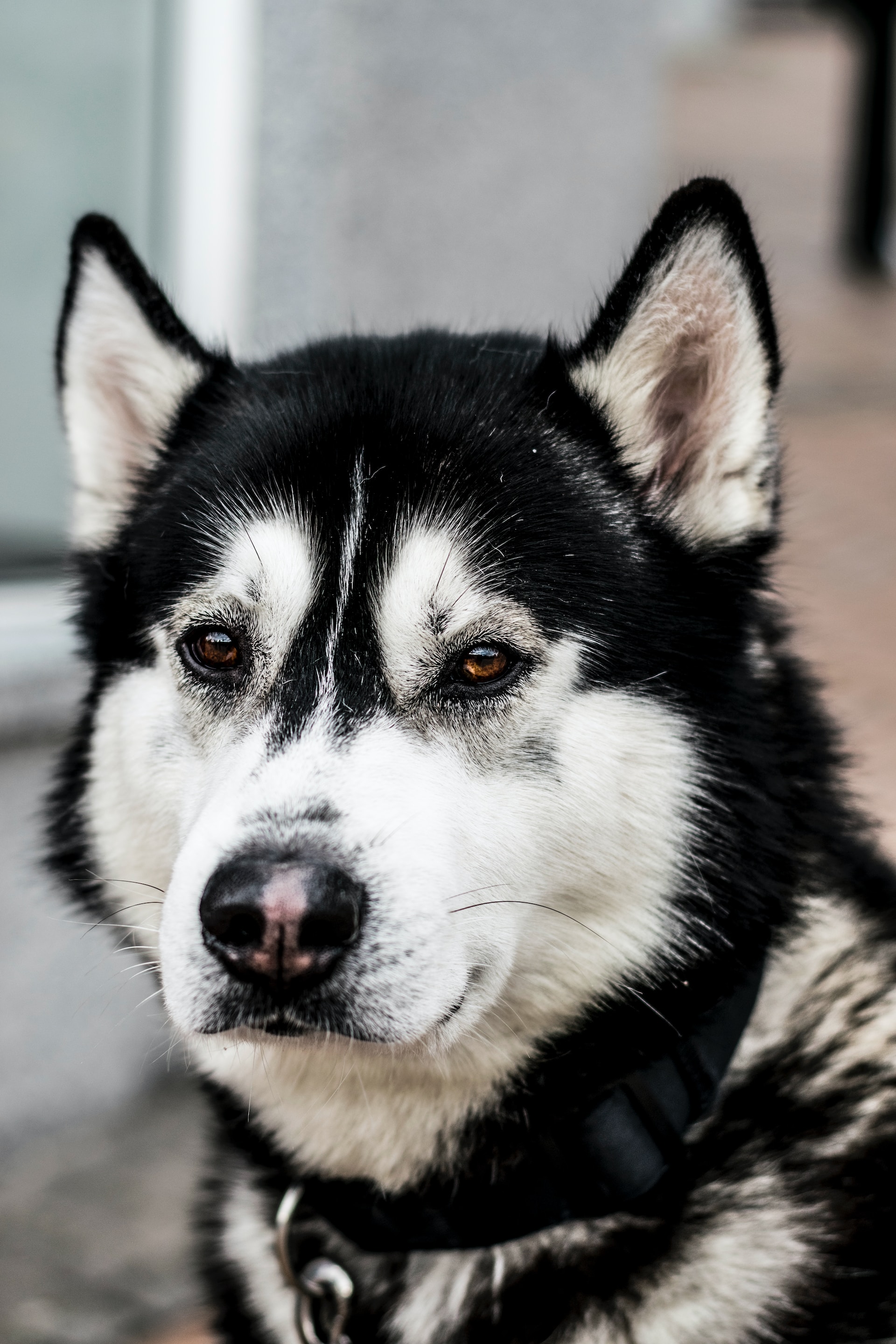
This time Siberian Husky Dogs!
oooo

oooo

oooo

oooo

oooo

oooo

What a fantastic group of photographs; apologies if I have shown these before.
Dogs are animals of integrity. We have much to learn from them.
Tag: Siberian Huskys
More dogs from Unsplash.
This time Siberian Husky Dogs!
oooo
oooo
oooo
oooo
oooo
oooo
What a fantastic group of photographs; apologies if I have shown these before.
More on a recent post from The Dodo.
We watched recently a documentary on Netflix about the special attributes of our pets. It was very good but one thing that we learnt was that dogs have on the tips of their snouts an area that can pick up warmth. Because when dogs are tiny puppies and still blind they find their mothers’ teats by homing in on the warmth of the mother’s body.
Many people are aware of the scenting ability of the dog. To quote: “While humans have about five million olfactory receptors in their noses, dogs are said to have around 300 million.”
(Read that article that I linked above for it is very good.)
ooOOoo
Published on the 6th June, 2022.
One of Hime’s favorite pastimes is a simple one: sit near a nature path and patiently wait for nose boops. The 13-year-old Siberian husky figured out long ago that, eventually, she’ll get what she came for.
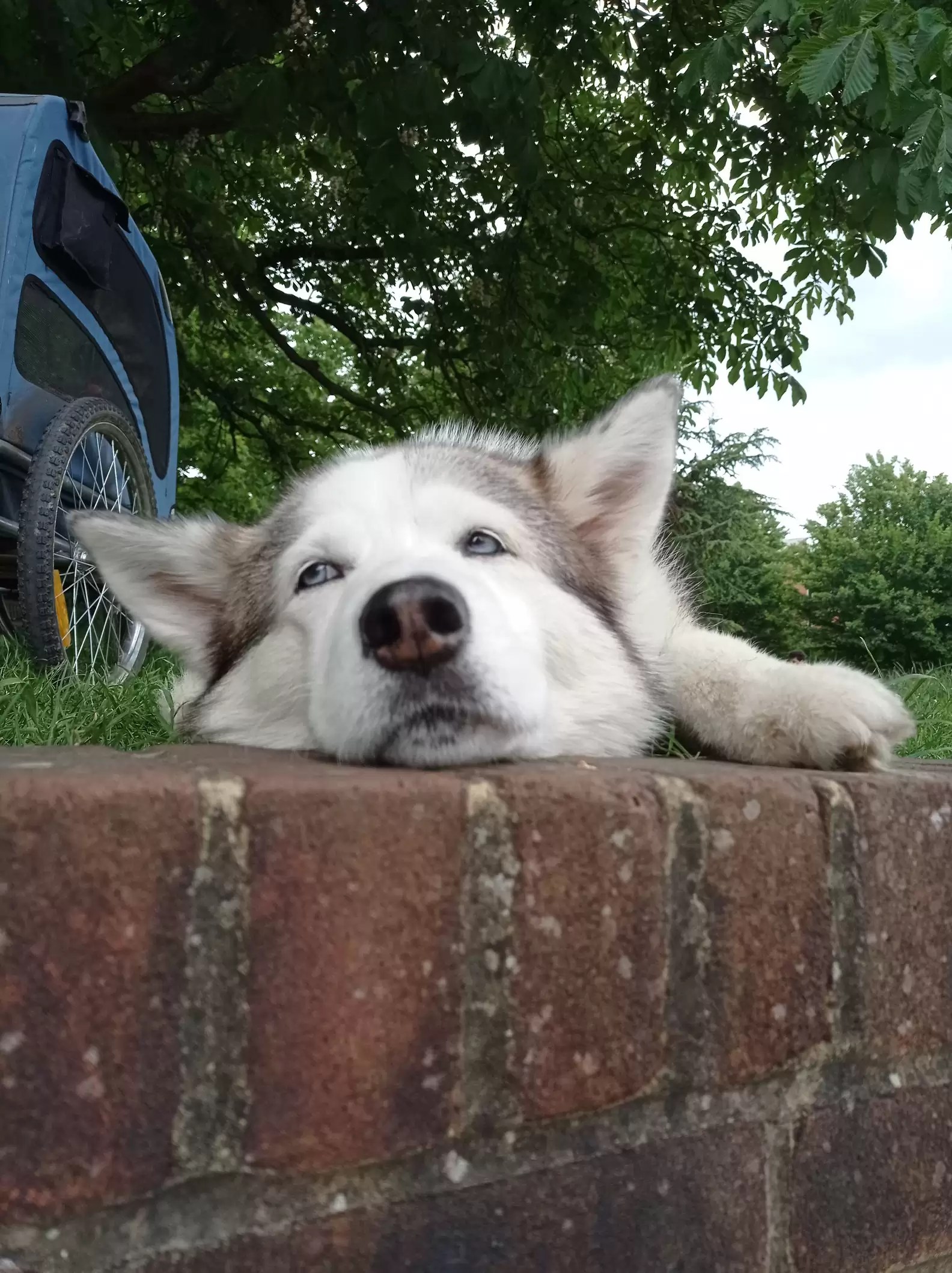
“She likes that spot so she can watch the world go by,” David Nagadhana, Hime’s dad, told The Dodo. “But she has other strategies.”
Hime, who was adopted as a puppy, hitches a ride in Nagadhana’s bike trailer to get to the best petting spots.
“I cycle her because of her arthritis,” Nagadhana said. “Gentle in her old age, [Hime] looks for affection anywhere she can find it.”
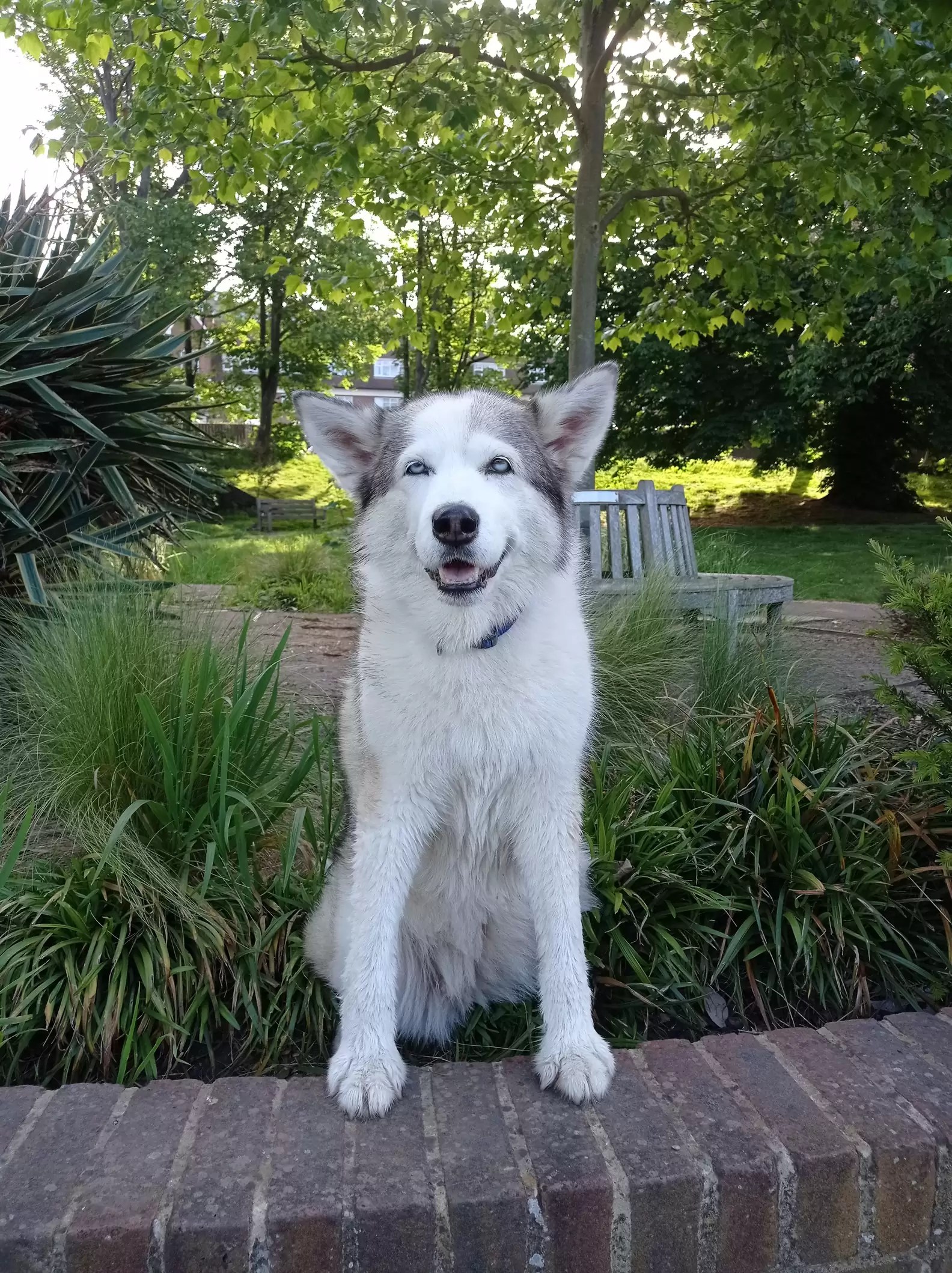
The husky’s place of choice is by the Thames in Richmond, England, but Nagadhana takes her wherever she seems happiest.
“She loves finding new and interesting and exciting locations so that she may proceed to nap in them,” Nagadhana said. “She finds it relaxing enough to nod off on occasion.”
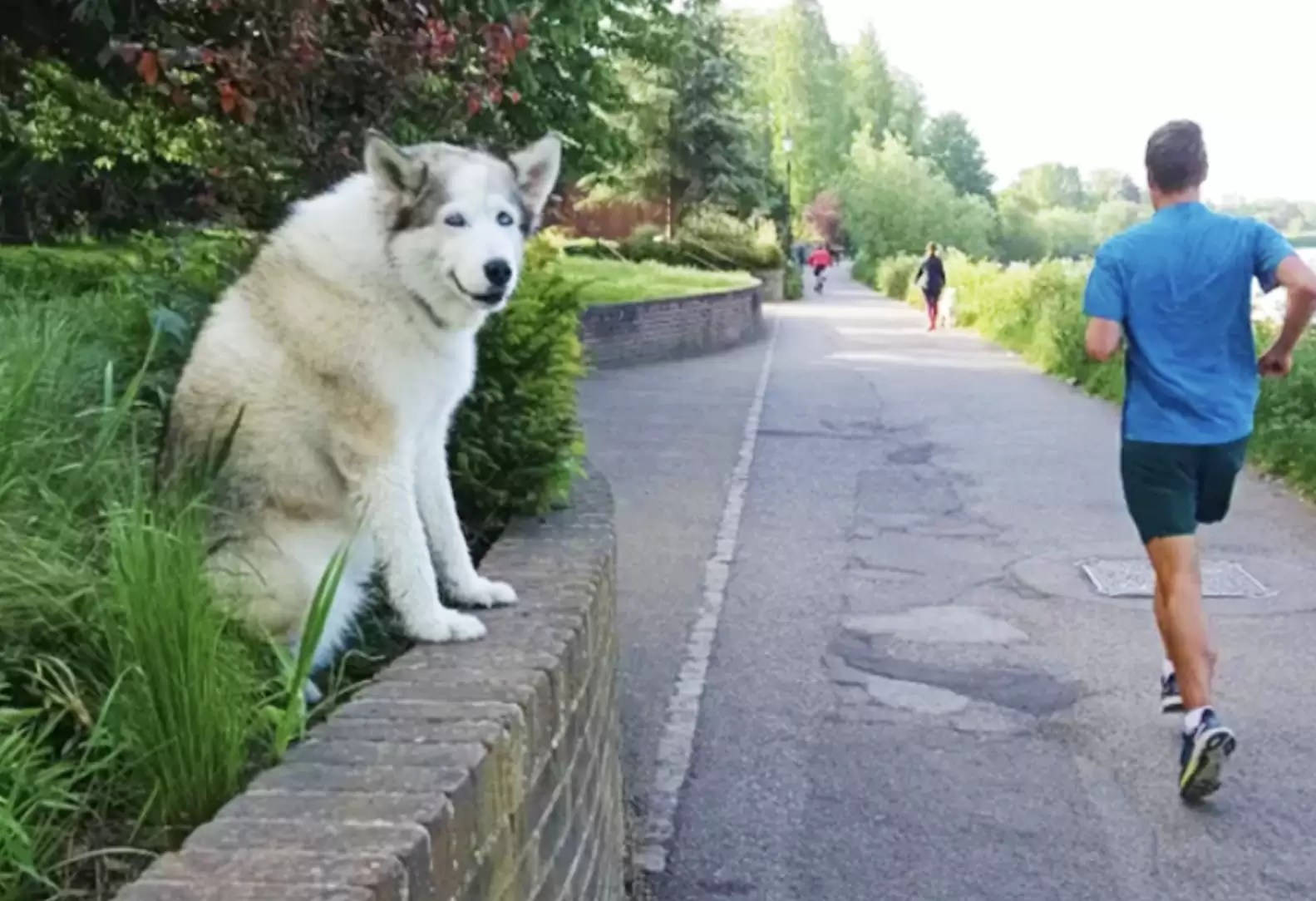
Nagadhana and Hime do everything together, and it won’t stop anytime soon.
“She was there for me when life ground to a halt during the pandemic,” Nagadhana said. “I’ll be there for her until the end. Raising dogs is like a rainbow. Puppies are the joy at one end, old dogs are the treasure at the other.”
Needless to say, Hime gets endless boops from her favorite person: Dad.
(All photographs by DAVID NAGADHANA.)
ooOOoo
One turns to the American Kennel Club for information about the breed, as in the Siberian Husky, and this is what is found:
Siberian Husky, a thickly coated, compact sled dog of medium size and great endurance, was developed to work in packs, pulling light loads at moderate speeds over vast frozen expanses. Sibes are friendly, fastidious, and dignified. The graceful, medium-sized Siberian Husky’s almond-shaped eyes can be either brown or blue ‘and sometimes one of each’, and convey a keen but amiable and even mischievous expression. Quick and nimble-footed, Siberians are known for their powerful but seemingly effortless gait. Tipping the scales at no more than 60 pounds, they are noticeably smaller and lighter than their burly cousin, the Alaskan Malamute. As born pack dogs, they enjoy family life and get on well with other dogs. The Sibe’s innate friendliness render them indifferent watchdogs. These are energetic dogs who can’t resist chasing small animals, so secure running room is a must. An attractive feature of the breed: Sibes are naturally clean, with little doggy odor.
There!
Those eyes!
Of all the dogs that we can look at the Siberian Husky takes the biscuit! I’m talking about those eyes!
Up until reading this article in the Smithsonian I hadn’t really stopped to wonder how those eyes came about.
Read on …
ooOOoo
A new study suggests that the defining trait is linked to a unique genetic mutation
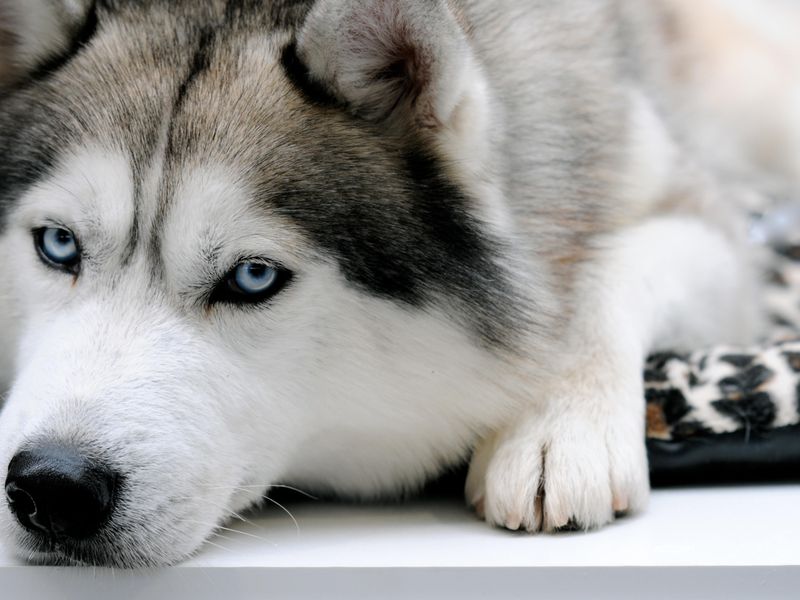
At-home DNA kits have become a popular way to learn more about one’s ancestry and genetic makeup—and the handy tests aren’t just for humans, either. Dog owners who want to delve into their fluffy friends’ family history and uncover the risks of possible diseases can choose from a number of services that screen doggie DNA.
As Kitson Jazynka reports for National Geographic, one of these services, Embark Veterinary, Inc., recently analyzed user data to unlock an enduring canine mystery: How did Siberian huskies get their brilliant blue eyes?
Piercing peepers are a defining trait of this beautiful doggo. According to the new study, published in PLOS Genetics, breeders report that blue eyes are a common and dominant trait among Siberian huskies, but appear to be rare and recessive in other breeds, like Pembroke Welsh corgis, old English sheepdogs and border collies. In some breeds, like Australian shepherds, blue eyes have been linked to patchy coat patterns known as “merle” and “piebald,” which are caused by certain genetic mutations. But it was not clear why other dogs—chief among them the Siberian husky—frequently wind up with blue eyes.
Hoping to crack this genetic conundrum, researchers at Embark studied the DNA of more than 6,000 pooches, whose owners had taken their dogs’ saliva samples and submitted them to the company for testing. The owners also took part in an online survey and uploaded photos of their dogs. According to the study authors, their research marked “the first consumer genomics study ever conducted in a non-human model and the largest canine genome-wide association study to date.”
The expansive analysis revealed that blue eyes in Siberian huskies appear to be associated with a duplication on what is known as canine chromosome 18, which is located near a gene called ALX4. This gene plays an important role in mammalian eye development, leading the researchers to suspect that the duplication “may alter expression of ALX4, which may lead to repression of genes involved in eye pigmentation,” Aaron Sams of Embark tells Inverse’s Sarah Sloat.
The genetic variation was also linked to blue eyes in non-merle Australian shepherds. Just one copy of the mutated sequence was enough to give dogs either two blue eyes, or one blue and one brown eye, a phenomenon known as “heterochromia.” It would seem, however, that duplication on chromosome 18 is not the only factor influencing blue eye color: Some dogs that had the mutation did not have blue eyes.
More research into this topic is needed to understand the genetic mechanisms at work when it comes to blue-eyed dogs. But the study shows how at-home DNA kits can be highly valuable to scientists, providing them with a wealth of genetic samples to study.
“With 6,000 people getting DNA samples from their dogs and mailing them to a centralized location and then filling out a website form detailing all the traits of their dog—that’s a game-changer for how genetics is being done in the 21st century,” Kristopher Irizarry, a geneticist with the College of Veterinary Medicine at Western University of Health Sciences, tells National Geographic’s Jazynka.
The benefits of having access to such huge troves of data go further than uncovering nifty insights into our canine companions. Scientists are also teaming up with at-home DNA test companies to learn more about human genetics and behavior.
ooOOoo
There’s such a wide range of information about our lovely dogs!
Oh, and I had better include the following.
Follow us: @SmithsonianMag on TwitterRead more: https://www.smithsonianmag.com/smart-news/how-siberian-huskies-get-their-piercing-blue-eyes-180970507/#4cO22KfQH7w6qp6B.99
Give the gift of Smithsonian magazine for only $12! http://bit.ly/1cGUiGv
Follow us: @SmithsonianMag on Twitter
See you all tomorrow!
Another beautiful short video.
Examples like this, of the love and compassion seen in our animals, seem to be doubly valuable in these crazy times.
Published on Apr 30, 2015Lilo the Siberian husky is a wonderful surrogate to our new foster, little Rosie❤️ Rosie was really lethargic and unresponsive after the first night. So we decided to let her cuddle extensively with Lilo (the husky). Lilo has always had an innate motherly instinct, but she really surprised us when she went full surrogate mode! Even letting Rosie suckle on her and stimulating her to eliminate! Lilo has never had puppies of her own, and never will. But motherhood may just be her calling 🙂 Like what you see? 🙂 LOOK BELOW!
It would mean the world if you would hit the SUBSCRIBE button to our channel! http://www.youtube.com/c/lilothehusky
Want to see more??
FOLLOW US on our social media networks!
http://www.instagram.com/lilothehusky
http://www.twitter.com/lilothehusky
Thank you so much for your support!! 😀
Have a wonderful weekend.
 Learning from Dogs
