Tag: Reflections

Remarkable people: Warren Buffett

What does Bill Gates admire about Warren Buffet?


On this blog about integrity, and in these difficult economic times, it is particularly poignant to note that Bill Gates cites Warren Buffett’s integrity. This was during a recent event at Columbia Business School in New York City, see below.

While many of the questions from MBA students and the answers from Gates and Buffett are not new, Buffett’s brief witty and topical comments provide considerable insight into his thinking.

It is particularly interesting to get a sense of how the world is viewed by people with their perspective. When asked about the outlook for America, both Gates and Buffett answered that it is very good. Warren Buffett even offered any of the MBA students $100,000 in return for 10% of their future earnings. Later, he increased the offer to $150,000, if they received training in personal communication skills!

Watch them together on CNBC at Columbia Business School, New York City on November 12, 2009.

Maybe you are interested in further information about Warren Buffett, if so you are not alone. The BBC, among others, have taken a strong interest in him recently.

You might like to read and view some recent stories on the “Oracle of Omaha” including:

Despite a setback in 2008, Warren Buffett’s long term investment success is without question.

By John Lewis

The rights of the child

A reminder of the United Nations (UNICEF) Convention and a second view from yours truly.

On November 12th I was the author of a Post called Our next generation featuring the young Jessica Watson from Australia who is on course to try and win the record for the youngest person to sail, solo, unassisted, non-stop around the World.  Here’s a part of what was said:

Jessica Watson2
Jessica Watson

Jessica Watson is a teenager.  She is hoping to break the record for the youngest person to sail solo, non-stop and unassisted around the World.  Whatever modern materials and technology can do to make sailing easier, sailing solo for weeks on end is grindingly tough at any age.  She’s a wonderful example of the next generation!

Jessica left Sydney Harbour on October 18, 2009 sailing her sloop Ella’s Pink Lady. Her course is an estimated 23,000 nautical miles requiring her to be roughly 230 days at sea.

You can see that the tone of the Post was supportive.

However the comments that the Post attracted were critical of the pressures and influences that may have been brought to bear on this child.  For at 16 ‘child’ is what Jessica is.  One of our regular contributors pointed out that under the terms of the UNICEF Convention:

The Convention on the Rights of the Child is the first legally binding international instrument to incorporate the full range of human rights—civil, cultural, economic, political and social rights. In 1989, world leaders decided that children needed a special convention just for them because people under 18 years old often need special care and protection that adults do not.

(My underlining)

Read the rest of this Post

The ageing of the USA, Part Three

Back to the future – a new way of seeing forward

The concluding part of a three-part paper previously published by Professor Sherry Jarrell, Part One is here and Part Two is here.

What kinds of business establishments will thrive in the U.S. city of the future?  To answer this question, we examined the count of the number of establishments per business category listed on yellowpagecity.com, adjusted proportionately to represent a population of 500,000, and found the following results.

Death services. Although the strain on the healthcare system has received much attention in relation to ageing in the United States, the next logical step—death—is rarely mentioned, although it certainly represents many business and professional opportunities.  Our data suggest that the number of funeral facilities and cremations per 500,000 residents might double or even triple by 2025. The same applies to the number of cemeteries and companies listing monuments.

Healthcare. Along with roughly 30% more doctors, our data suggest that a range of medical services and products will be in greater demand by 2025. Nearly all of them relate to age. Consistent with the expectation that mental and self-care disabilities increase with age, listings also jump considerably for alcohol information and treatment, and counseling services. This trend doesn’t occur, however, for mental health services.

Real estate and living arrangements. Real estate listings significantly increase across the six MSAs, along with a substantial growth in listed land surveyors. The number of listings for nursing and convalescent homes moves from an average of 30 for the current MSAs to 50 for the 2020 and 2025 cities. There’s an even larger average rise in the number of retirement communities and homes.

Perhaps the most surprising pattern, at least initially, is the dramatic increase in the number of listings for mobile home dealers and mobile home parks and communities. Insurance studies have shown, however, that the percent of manufactured (mobile) home owners who are age 65 and older has risen from 26% in 1990 to 30% in 2002. Similar percentages are cited for owners who are retired. In addition, over the same period, the amount of owners age 80 and older has changed from 3% to 7%. Therefore, the future might be replete with mobile homes. The data might reflect the strategy of retirees selling larger homes to extract the equity, which is used to help fund retirement and buy a less-expensive manufactured home.

Activities. The data show a marked increase in the number of associations, clubs, churches, and fraternal organizations, which supports the description of mature adults as “joiners.” Bingo games are more popular in the 2020 and 2025 cities. Perhaps most noticeably, more golf is played in the 2020 and 2025 MSAs, requiring many more golf courses and golf-related products and services—not just in Florida, but also in Youngstown, Utica, and Scranton. Residents in the 2020 and 2025 cities also spend more time at the library, at recreation centers and parks, and reading newspapers.

Finance. Services that will be in higher demand as retirees seek assistance in managing their retirement assets include credit and debt counseling services, insurance, loans, mutual funds, and stock and bond brokers.

Products. The number of listings for new and used automobile dealers increases between the 2005 and 2025 cities, as do listings for new and used furniture dealers, health and diet foods, hardware, lawn and garden equipment and supplies, service stations, TV and radio equipment sales and service, and vitamins. But the data also reveal many other rising trends that are likely age-related, such as for antique dealers, arts and crafts, ceramic equipment and supplies, embroidery, gift shops, giftwares, jewelers, and security-related products. The substantial increase in florists is probably related to the number of hospitals, funeral facilities, and crematories in the cities.

Services. The Yellow Pages listings indicate many more business, employment, and investment opportunities in the future. Several categories relate to home improvement, such as contractors for remodeling, landscaping, and swimming pools. Home maintenance also is in greater demand in cities with older populations. Similarly, listings related to servicing and repairing automobiles, furniture, and jewelry rise across the three pairs of cities—along with beauty salons and massage. Pets apparently deserve no less, as pet washing and grooming services are in greater demand in cities with older populations.

Research Implications

This innovative methodology for studying various aspects of the future reveals that many of the detailed trends across the three pairs of cities have significant implications with respect to new product development and marketing. For example, marketers need to begin partnering with development and land use officials to anticipate future growth in demand for golfing facilities, churches, parks, libraries, cemeteries, and mobile home parks. And medical services providers must be prepared to meet the demands for home health services and many other healthcare preferences of older adults in an increasingly competitive environment.

Although it’s true that many factors other than age will shape future spending patterns, such as changing tastes among mature buyers, new technology, and various economic factors, many of these trends are almost entirely age-related. Therefore, it’s unlikely the future will look that different from Lakeland today, where the share of the population age 65 and older is identical to that projected for the nation in 2025.

The United States will not be a nation of Floridas in 2025; it will be a nation of Lakelands.

By Sherry Jarrell

The ageing of the USA, Part Two

Back to the future – a new way of seeing forward

Part Two of a three-part paper previously published by Professor Sherry Jarrell, Part One is here.

In this post, we examine the current income and spending patterns from metropolitan statistical areas (MSAs) with age demographics similar to those projected for the U.S. economy in 2020 and 2025.  Two MSAs are selected for each year to verify that differences in buying patterns across cities are because of differing age distributions, not peculiarities in the cities.

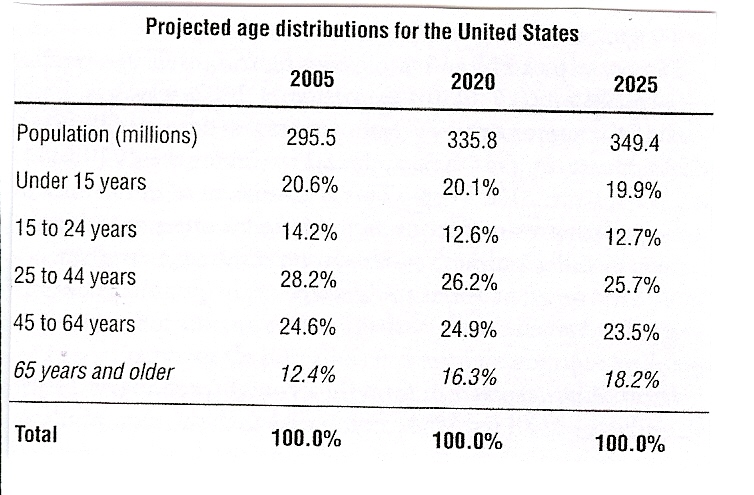
We began with U.S. Bureau of Census data on the percent of total U.S. population expected within five age groups through 2025. The share of U.S. population attributed to people age 65 and older is expected to increase from 12.4% today to 16.3% in 2020 and 18.2% in 2025. By 2025, nearly one out of every four drivers will be age 65 or older, compared with 15.6% today.

Income and Spending Patterns

We find that, although many mature adults are highly mobile, most stay put; this results in the Northeast and Midwest remaining key mature markets.  Three of our four 2020 and 2025 MSAs are in Ohio, New York, and Pennsylvania. We also find that older consumers:

  • spend more of their income: The spending per income ratio rises from .67 today, to .76 for the 2020 MSAs and .77 for the 2025 MSAs.
  • continue to depend on their cars and prefer them to public transportation.
  • spend increasingly larger shares of their income on healthcare.
  • make TV a key element of their lifestyles.
  • remain in their homes and avoid nursing homes.
  • are politically conservative.
  • are civically active and wield growing influence.
  • are joiners.
  • spend heavily on housekeeping supplies, household furnishings and equipment, new vehicles, entertainment, computers, healthcare products, vitamins, healthier foods, and reading materials.
  • spend less on apparel, cosmetics, and fast food.

Retail spending data

We find that the percent of retail spending on necessities such as products at food and beverage stores and the subcategory of grocery stores is generally higher in all six of our MSAs, compared with the nation. The same is true for the general merchandise store category, which includes discount stores.  We also observe generally lower spending shares relative to the nation in the more discretionary categories of clothing and accessories stores, furniture and home furnishings stores, electronics and appliance stores, building materials stores, and garden equipment stores.

The more important observations relate to spending patterns across the three pairs of MSAs. Looking at food and beverage stores, spending as a share of total retail sales declines across the three pairs of MSAs with increasingly older populations. Beginning with an average of 17.2% in the 2005 MSAs, spending at food and beverage stores drops to 14.1% in the 2025 MSAs.

Similarly, the subcategory of grocery stores falls from 15.1% today to 12.2% in the 2025 MSAs. Note that the approximately 3 percentage point declines in these categories are in spending relative to total retail sales, and that within the categories, the decreases in spending are nearly 20%. For example, for every $1,000 in retail spending in the 2005 cities, approximately $151 is spent at grocery stores. That compares with $122 in the 2025 cities. Thus, although spending shares at food and beverage stores are higher than the national average in all six MSAs, the spending shares fall across the three pairs of MSAs as their populations become increasingly older.

The trend also is downward over time for food service and drinking places, from an average of 9.7% in the 2005 MSAs to 7.5% in the 2025 MSAs—with the trend again representing a roughly 20% absolute dollar spending decline per capita within the category. These results support the expectation that older consumers eat healthier and in less quantities (especially in the case of fast food), and also spend fewer dollars at drinking places.

Per capita spending at clothing and accessories stores decreases from an average of 4% of retail sales in the two 2005 cities to 3.2% in the 2025 cities. As before, although the 1% drop appears small, it represents an approximately 20% reduction in per capita spending.

What types of stores benefit from older populations?

Our results indicate increased spending on furniture, automobiles, and homes. Looking at the per capita shares of total retail spending for furniture, home furnishings, and electronics and appliances, spending shares rise from an average of 2% in the 2005 MSAs to 3.9% in the 2020 MSAs and 4.2% in the 2025 MSAs. This suggests a doubling of per capita spending at furniture and related stores. There are similar patterns for the subcategories of furniture and home furnishings stores, and electronics and appliance stores. Spending also generally rises at building materials and garden equipment stores. Upward trends across the six cities additionally are shown for motor vehicles and parts, and healthcare and personal care.

In the third and final installment of this research, we will discuss the specific types of business establishments that will thrive in the U.S. city of the future.

By Sherry Jarrell

Goldman Sachs – doing God’s work!

A fascinating and revealing interview in the Sunday Times.

This article in the British Sunday Times was published on November 8th and I’m sure many will have read it.  But for those that didn’t it really is worth settling down to a reasonably long read.  For you will learn that Goldman Sachs:

It’s the site of the best cash-making machine that global capitalism has ever produced, and, some say, a political force more powerful than governments. The people who work behind the brass-trim glass doors make more money than some countries do. They are the rainmakers’ rainmakers, the biggest swinging dicks in the financial jungle. Their assets total $1 trillion, their annual revenues run into the tens of billions, and their profits are in the billions, which they distribute liberally among themselves. Average pay this recessionary year for the 30,000 staff is expected to be a record $700,000. Top earners will get tens of millions, several hundred thousand times more than a cleaner at the firm. When they have finished getting “filthy rich by 40”, as the company saying goes, these alpha dogs don’t put their feet up. They parachute into some of the most senior political posts in the US and beyond, prompting accusations that they “rule the world”. Number 85 Broad Street is the home of Goldman Sachs.

The world’s most successful investment bank likes to hide behind the tidal wave of money that it generates and sends crashing over Manhattan, the City of London and most of the world’s other financial capitals. But now the dark knights of banking are being forced, blinking, into the cold light of day. The public, politicians and the press blame bankers’ reckless trading for the credit crunch and, as the most successful bank still standing, Goldman is their prime target. Here, politicians and commentators compete to denounce Goldman in ever more robust terms — “robber barons”, “economic vandals”, “vulture capitalists”. Vince Cable, the Lib Dem Treasury spokesman, contrasts the bank’s recent record results — profits of $3.2 billion in the last quarter alone — and its planned bumper bonus payments with what has happened to ordinary people’s jobs and incomes in 2009.

and later on in conversation with the Chairman and CEO, Lloyd Blankfein:

“Is it possible to have too much ambition? Is it possible to be too successful?” Blankfein shoots back. “I don’t want people in this firm to think that they have accomplished as much for themselves as they can and go on vacation. As the guardian of the interests of the shareholders and, by the way, for the purposes of society, I’d like them to continue to do what they are doing. I don’t want to put a cap on their ambition. It’s hard for me to argue for a cap on their compensation.”

So, it’s business as usual, then, regardless of whether it makes most people howl at the moon with rage? Goldman Sachs, this pillar of the free market, breeder of super-citizens, object of envy and awe will go on raking it in, getting richer than God? An impish grin spreads across Blankfein’s face. Call him a fat cat who mocks the public. Call him wicked. Call him what you will. He is, he says, just a banker “doing God’s work”

Indeed!

By Paul Handover

The ageing of the USA, Part One

Back to the future – a new way of seeing forward

Part One of a three-part paper previously published by Professor Sherry Jarrell

Market research on the ageing of the U.S. baby boomer generation has focused on the spending habits of these older consumers. A new approach enables marketing researchers to observe the future now: Examine income and spending patterns from metropolitan statistical areas (MSAs) with age demographics similar to those projected for the U.S. economy in 2020 and 2025. With knowledge of these trends, they can begin preparing to meet the demands for particular products and services.

“Find a comfortable couch, lie back, and close your eyes. … Let your mind wander toward the future. Move, slowly, to the year 2030. Now open your eyes. What do you see? You see a country whose collective population is older than that in Florida today. You see a country where walkers outnumber strollers.” Laurence J. Kotlikoff and Scott Burns in The Coming Generational Storm (The MIT Press, 2004).

Projected Age Distribution, U.S. Bureau of Census data

There has been much speculation regarding the effects of the aging population on the U.S. economy. By the year 2025, more than 18% of the U.S. population is projected to be age 65 or older, greater than the percentage in Florida today. This has led some to describe the future of the United States as “a nation of Floridas.” Furthermore, the aging of the United States is not expected to pass with the demographic bulge produced by baby boomers (those born between 1946 and 1964). The U.S. population also is aging because of increased life expectancy and decreased numbers of offspring. As a result, current research projects that the U.S. age profile soon will transform from the current pyramid shape, with older groups at the top, to more of a barrel shape, with roughly 40% of the population divided fairly evenly between the youngest (under age 15) and oldest (over age 65) groups. This new profile will persist for decades.

Although much has been said about aging baby boomers leading to potential crises in Social Security and Medicare, we are more interested in the economic prospects of their retirement as they relate to consumer spending: in particular, whether they have saved enough to maintain their standards of living in retirement. In this regard, the Congressional Budget Office (CBO) reviewed studies from the past decade on the retirement prospects of aging Americans, and found evidence that varied with the standard used to define “enough.” Some studies defined it as the level that maintained the retiree’s working-age standard of living, whereas others defined it as levels that made the retiree as well off as his or her parents at the same age.

The picture that emerges from the CBO study is that baby boomers, relative to their parents at the same age, have higher real incomes, are preparing for retirement at the same pace, and have accumulated more private wealth. Furthermore, the savings behavior of baby boomers and other future retirees is dependent on their views of the health and stability of government benefit programs. If they believe that they will receive all of the government benefits they have earned, then they will tend to work and save less. If they believe that these programs are in trouble, then they might increase savings and postpone retirement.

What impact will changing age demographics have on future spending patterns? We obtain a more complete picture of future spending by observing aggregate spending patterns in local economies that resemble the future now: those cities where “walkers outnumber strollers” today. This novel research approach is based on actual observed data, rather than on speculation and long-term statistical forecasts, both of which are notorious for inaccuracy.

In the next post, we discuss our sometimes surprising findings on the spending patterns in the U.S. city of the future.

By Sherry Jarrell

WOMD

Mass Destruction?

No, it’s not weapons – I just wanted to get your attention; it’s “Words”. Last week two words of enormous significance crept into the news, and the first of them was the word “fair“.

This is a very interesting and potentially devastating word, but I wonder if the Minister was wise in letting it out of the box? Has he read the story of Pandora?

The word was used in connection with a report by British Schools Adjudicator Ian Craig, who had been asked by the British Labour government to look into the procedures and practice of admissions to secondary schools in Britain.

It seems that many parents, desperate to get their child into a good school, are devising ways to get round the strict allocation procedures put in place to ensure “fairness”. As has been brilliantly explained by Judith Woods in “The Telegraph” these desperate tricks include “using grandparents’ addresses on admissions forms for sought-after schools, renting homes in the catchment area, feigning marriage break-up and then reporting that one parent has moved nearer the school, and swapping houses with friends.”

According to Mr Craig – and the government – this is “cheating” and not “fair”, and the former is asking for local authorities to “use all means open to them to deter parents from cheating the admissions system. This includes removing places from the guilty and pursuing them through the courts, possibly using the Perjury Act.”

My interest here is not so much in the minutiae of the details of this current spat but the concept of “fairness” in society, which strikes me as pretty fundamentally complex.

It is of course a fairly modern concept, not one that much preoccupied Genghis Khan or even the Victorians, who were much happier with the principles outlined in this verse of the hymn “All things bright and beautiful”.

The rich man in his castle,
The poor man at his gate,
God made them, high or lowly,
And order’d their estate.

Interestingly, the concept is also one that is not often explicitly discussed by governments. I wonder if this is because the power and moneyed elite know that they might be on a sticky wicket in any discussion of “fairness”?

As ever, one cannot hope to find the answers until one has clearly posed the questions. So here goes:

Minister, as you have introduced into evidence the concept of fairness and labelled those trying to get round the school admission regulations as “cheats”, could you possibly answer these questions?

  • Is it fair that many families – desperate to provide a good education for their children – cannot afford to move to an area where there are good schools but are stuck through their limited means in an educational ghetto?
  • Is it fair that people can play the religion card and send their kids to a high-quality “faith” school outside of their catchment area, Tony Blair, former British PM, being the best recent example.
  • Is it fair that a substantial minority of parents don’t have to bother about finding a good state school at all since they can go private? (And shockingly, according once more to  Judith Woods: “the advantage of being educated at an independent school is greater in Britain than in almost any other country.”)
  • Is it fair that many of the same substantial minority own multiple dwellings while hundreds of thousands of ordinary families do not own their own home and have to pay rent to someone, a system that seems to me to be a direct descendent of the feudal system where you slaved all day in return for the right to live on some Lord’s property? (Speaking of which – much as I love the Queen – is it fair that the small Royal Family owns vast, multiple dwellings that could house thousands of homeless people?)
  • Is it fair that poor person A should die of some horrible disease or disability while person B of limited means can pay for special treatment and survive?

And of course, the ultimate question: Is it fair that I wasn’t born with the voice of Elvis Presley and the brain of Albert Einstein?

Yes indeed; the concept of “fairness” goes far. Once you introduce it as a premise, then where do you stop? And either you base your government on “fairness” or you don’t. You can’t have your cake and eat it, can you?

I look forward in coming days to hearing more from Ministers – and indeed from readers – on the concept of “fairness”. One thing is sure to me, in a world of rapidly-increasing problems and people we risk hearing the word a lot more often as we struggle to find solutions which are “fair”.  Of course, that assumes we think things should be “fair”.

Looking around, my conclusion is that we pretend to think it’s important but only if it doesn’t affect us too much personally.

Oh, the second Word of Mass Destruction? You’ll have to wait till next time …..

By Chris Snuggs

In the shadow of a rainbow

A truly magical experience between man and bear.

Regular readers of this Blog will know that Naked Capitalism is a daily read for this author.  Yves Smith always includes her ‘antidote du jour’ picture of animals.  How Yves finds these is beyond me but her antidote of the 14th November really was special.  The original author of the piece, Tom Sears, is encouraging the distribution of his story and pictures and it’s a pleasure to do so via Learning from Dogs.

Black bears typically have two cubs; rarely, one or three. In 2007, in northern New Hampshire, a black bear Sow gave birth to five healthy young. There were two or three reports of sows with as many as 4 cubs, but five was, and is, very extraordinary. I learned of them shortly after they emerged from their den and set myself a goal of photographing all five cubs with their mom – no matter how much time and effort was involved. I knew the trail they followed on a fairly regular basis, usually shortly before dark. After spending nearly four hours a day, seven days a week, for more than six weeks, I had that once-in-a-lifetime opportunity and photographed them. I used the equivalent of a very fast film speed on my digital camera. The print is properly focused and well exposed, with all six bears posing as if they were in a studio for a family portrait.

bearfamilyadults

I stayed in touch with other people who saw the bears during the summer and into the fall hunting season. All six bears continued to thrive. As time for hibernation approached, I found still more folks who had seen them, and everything remained OK. I stayed away from the bears as I was concerned that they might become habituated to me, or to people in general, and treat them as `approachable friends’. This could easily become dangerous for both man and animal.

After Halloween, I received no further reports and could only hope the bears survived until they hibernated.

This spring, just before the snow disappeared, all six bears came out of their den and wandered all over the same familiar territory they trekked in the spring of 2007.

I saw them before mid-April and dreamed nightly of taking another family portrait, a highly improbable second once-in-a-lifetime photograph.

On 25 April 2008, I achieved my dream.

bearfamilybabies

When something as magical as this happens between man and animal, Native Americans say, “We have walked together in the shadow of a rainbow”. And so it is with humility and great pleasure that I share these exhilarating photos with you. Do pass them on!

By Paul Handover

Reflecting on insider trading

Time to Reassess Insider Trading Rules?

On the face of it, prohibiting insider trading seems to be fair and reasonable.

US insider trading laws, refined over time in court on a case-by-case basis, define “trading on the basis of inside InsiderTradinginformation” as any time a person trades while aware of material nonpublic information (US Securities and Exchange Commissions Rule 10b5-1, which also creates an affirmative defense for pre-planned trades.) SEC regulation FD (“Fair Disclosure”) also requires that if a company intentionally discloses material non-public information to one person, it must simultaneously disclose that information to the public at large; in an unintentional disclosure, the company must make a public disclosure “promptly.” Lastly, the Williams Act gives the SEC regulatory authority over insider trading in takeovers and tender offers.

Read more about Insider Trading

Single-handed sailing

A personal reflection on this rather strange way of travelling!

The recent Post about young Jessica Watson sailing alone around the world raised a few comments but also reminded me of my own experiences of solo sailing.

Some years ago, having successfully sold my own IT company, I warmed to the idea of being a full-time yachtie! A second-hand Tradewind 33 was discovered on the Island of Corfu.  (Now here’s a surprise!  I was just browsing the web looking for a picture of a Tradewind and came across my old yacht currently up for sale.  Her name is Songbird of Kent! Picture below.)

Songbird of Kent
Tradewind 33 - Songbird of Kent

Anyway, the deal was done and having sold my house in England I flew out to Corfu to collect Songbird of Kent. Inevitably it was a number of months before the boat was ready to head out into the Mediterranean but in early Spring 1988 it was time to explore the long coastlines of Greece and Turkey.

After a fantastic summer cruising from one idyllic anchorage to another mostly with friends or family on board, it was time to find a winter haven.  Many recommended Larnaca Marina in Cyprus.  Thus it was late in the summer of 1988 that I said goodbye to friends and set out on my own to cross from Antalya in Turkey to Cyprus and for Larnaca, on the SE side of the island.

That sea crossing, only a little over 200 nautical miles, was to become a regular solo experience at the start and end of each summer season. Impossible to do in a single day it was always a night at sea and rarely, if things didn’t go well with the weather, a couple of nights. I hated it! Maybe it was the sudden transition from coastal sailing to a deep water crossing, often going from having friends on board to being alone, but whatever it was I never enjoyed my time on my own and knew that long-distance solo sailing was never going to be my scene.

Read more of this Post