Thanks to a small piece on AOPA Online (Aircraft Owners and Pilots Association), a wonderful insight into a hitherto unheard of organisation and a most charming story.
That organisation is Mawson’s Huts Foundation, an Australian organisation that describes itself as:
The Mawson’s Huts Foundation has been established to conserve in perpetuity for the Australian people the unique, historical buildings known as Mawson’s Huts, base for one of the most significant expeditions in Antarctic history. The Foundation’s website provides a variety of resources concerning current and future efforts to conserve the huts and information about the archaeology and heritage of the site.
Sir Douglas Mawson was an Australian Antarctic explorer and geologist born in 1882. More background from the Mawson’s Huts website:
Sir Douglas Mawson, a geologist, who led the Australasian Antarctic Expedition of 1911, landed a party of
Sir Douglas Mawson
18 at Cape Denison on Commonwealth Bay in January, 1912, and remained there until December 1913. The site was not visited again until Mawson returned in 1931 with the British, Australian and New Zealand Antarctic Research Expedition and then not again until the 1950’s. Only a concerted public campaign would save and conserve this historic site for all Australians, and the Mawson’s Huts Foundation was formed in 1996 for this purpose.
For many years it’s been traditional for me and the family to take a walk on New Year’s Day. But this time, without me, my wife and family back in the UK decided to go to Stonehenge for a walk, on a cold crisp day.
Why ‘back in the UK’? Because I was in Sharjah, one of the seven emirates in the UAE.
When here I always stay in one of the original hotels of the country, built on the edge of the corniche. As the day was warm and bright I decided to vary my walk.
Instead of going some 5kms round the lagoon, I made my way towards the area where the shops are mostly run by Indian people. For many years their influence has been very strong, indeed the rupee was used as currency until not long ago.
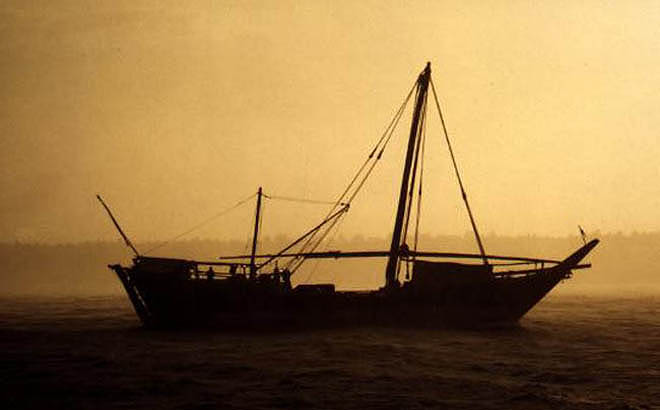
Arab dhow
It didn’t take long to leave the main area that is regularly seen and head down towards the old port where the Dhows are moored. There is an ancient feel to this area, and the water front is full of activity.
There was one man who had been unloading coal from his boat onto the quay side. You could hardly see his features until he smiled. All along there were people onboard their various craft, none of which really looked seaworthy, but which obviously make a regular and long journey to India.
The pathway was broken, and the occasional cat appeared from a rubbish bin. I made my way past the open market where animals are sold. Nothing is hidden here ! It was prayer time, and from many different minarets came the sound of the chanting. There was a lot of dirt and rubbish, uneven walk areas, and tatty shops. All with quite an East African feel. I passed a selection of tents where many plants and flowers were for sale; no garden centre as we have come to expect in England.
I finally worked my way down to the fish market, and was amazed at the white covering to the broken pathway, which turned out to be made up entirely of fish scales.
The next part of the walk was back towards the lagoon where directly in front of me was the Burj Dubai, which has taken
The Burj Dubai
just over 5 years to build, and measures 2684 feet. It is due to open this week, and if you want some office space, the cost is $4000 per square foot. The contrast from such back street filth to the glitter of the world’s tallest building separated by only a few miles brought home the stark contrast of what for most people is reality, and the unreal.
Sadly the amount of rubbish in all its forms is a huge problem, but I did smile when I saw one fisherman improvising, for instead of a float on the end of his line he was using the upturned remains of an old plastic bottle, but it did work!
Nobody bothered me, and I was quite happy taking in the sights and smells, and lost in my own thoughts, amazed that if you smiled and caught somebody’s gaze they would likely wish you Happy New Year.
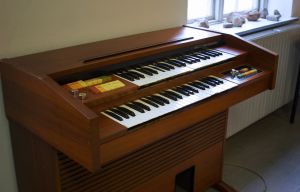
A few years ago I saw an advert for a small piano sized electric organ in our local shop window.
Great I thought, that will be a good way to introduce some music into the home, and see if I can add pedals to the idea of playing the piano.
It didn’t take long to track down the owner, but unfortunately the organ was in a back room, down two sets of stairs, round a corner, in a house which was isolated and difficult to find. Whereas I should have gone along with a team of
Typical electric organ
people, there were only three of us to move the instrument, but we eventually managed to move the thing out of the house, and into a trailer which we used to transport it to our house.
My wife thought I was mad, but I really liked it because it only had the sound of an organ, not a choice of sounds. It even had stops, not buttons to choose the different pipes you wanted to use.
Actually we were undertaking a great deal of building work at the time thus when our local church’s organ came to the end of it’s life, it seemed a good idea to offer them the chance to have this piece. It was ten times better than the original and sounded wonderful: job done!
However, last year some kind soul left money to the church and it was decided that the churcch could afford a new organ.
It duly arrived and our old one was moved to an alcove at the back of the church: I was asked to remove it.
Where was I going to put it? By chance we had acquired an almost new one ourselves and nobody seemed to want this old but wonderful piece.
We tried Ebay – no luck. Adverts – again no interest. The pressure started to grow.
People were asking me to move that old organ of mine. Letters started to arrive. Could I please take it away – I became the bad guy.
Eventually, I made contact with a man in London who would be happy to take it away for free, but he wanted to hear it play. Whoops! It was already loaded on my trailer!
But I managed to position trailer and load near an electric socket and in broad daylight, with the aid of the mobile phone, I stood and played a range of music! Our customer was happy.
He agreed to come at about eight o’clock one Saturday morning, but actually arrived two hours ahead of time at six in the morning!
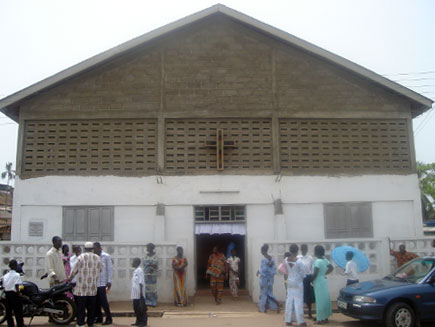
A church in Ghana
The man brought his wife, dressed in her national dress, explaining that they wanted the organ for a church in their village back in Ghana. They had never ventured outside London, so this visit to the country was a major event. They joined us for breakfast and we showed our children a map depicting where the organ would eventually go.
The man was built like an ox and he and his wife together were quite happy to lift the instrument and put it in the back of their vehicle.
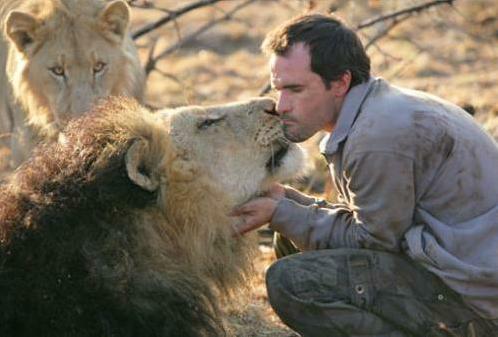
Thanks to Naked Capitalism, we posted an item on the 19th December about an unknown wild-life ranger working in the wildlife refuge area of Lanseria, South Africa. Here was one of the pictures included in that Post:
The Post finished with an appeal to anyone that knew the name of this Ranger. Many of you did and responded; thank you!
I subscribe to Naked Capitalism, as much for the Antidote du Jour, as for the fine economic commentaries. In my inbox of the 16th December was this wonderful antidote. A quick Google search shows that these pictures are spreading like wildfire around the world’s email servers. Not without reason.
Maybe these pictures resonate in all of us when we long for some simpler way of life …..
This Ranger is assigned to prevent poaching around the wildlife refuge area of Lanseria, South Africa. The way these animals interact with him is absolutely stunning! The lions seem to know he’s there to protect them. His charm works with hyenas and cougars too. Hyenas are usually vicious. Check out the pictures taken in the river – amazing because lions hate water.
Yesterday, a Post was published a Post about Greg Craven. It made the point that social media was becoming a very real force in influencing opinions and how that threatened traditional politics. Here’s an extract:
I was doing some research for an earlier Post about Copenhagen and came across a YouTube video created by Greg. More details and links later after making a more fundamental point.
This video of Greg’s has had 2,704,000 viewings! The information on that YouTube ‘page’ has had over 7,500,000 viewings. Greg has now written a book and so on, and so on.
Now I want to return to the core subject of how we deal with very complex issues that have the power to decimate humanity, e.g. global warming.
The fact is that the majority of people who think about such issues as global warming don’t have the skills and knowledge to determine what to do for the best. It comes down to determining risks, which was the theme of an earlier Post acknowledging the work of Peter L Bernstein.
That’s also the theme of Greg Craven’s video on YouTube. It’s a noble effort by a concerned citizen of Planet Earth. Watch it.
For those readers who are not regular BBC television viewers, the Beeb has for many years run an excellent factual/science & nature series under the name of Horizon. Just recently there was a programme with the title of How Many People Can Live on Planet Earth?
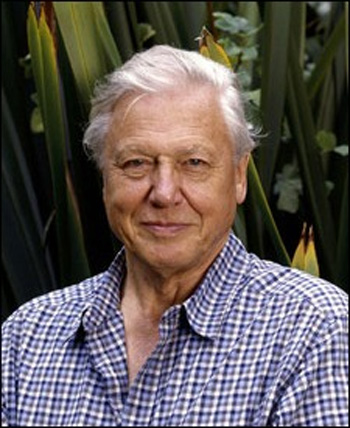
Sir David Attenborough
It was presented by that familiar face on the BBC in terms of the natural world, Sir David Attenborough. It was an appropriate and worthy person to present the information.
But before getting into some of the details underpinning the programme, there seems to been an enormous and unspoken omission at Copenhagen – why no debate about global population trends?
Luckily the media noticed the rather obvious exclusion. Here’s the UK Daily Telegraph newspaper (online version) of the 8th December, 2009. An extract:
Population growth is the one issue accused of causing driving climate change that no one at the Copenhagen climate summit dares to talk about.
The argument is that more people consume more resources, therefore producing more greenhouse gases that cause global warming.
The global population is currently at 6 billion and could rise to 11 billion by 2050 if fertility rates continue, not only threatening the climate, but food shortages and conflict as well.
Organisations like the Optimum Population Trust, that is backed by Sir Jonathan Porritt, Dame Jane Goodall and Sir David Attenborough, advocate birth control as a way of slowing climate change.
As Sir David has said: “I’ve never seen a problem that wouldn’t be easier to solve with fewer people, or harder, and ultimately impossible, with more.”
A study by the London School of Economics found contraception is almost five times cheaper as a means of preventing climate change than conventional green solutions such as investing in green technology.
Will we ever know the truth, the whole truth, and nothing but the truth?
It’s a week since the start of The United Nations Climate Change Conference – Copenhagen, 2009 and it’s clearly been a media success if nothing else.
My instinct has, for many years, been the assumption that mankind behaves in many ways that harm our environment and that, ultimately, harming the very planet upon which our survival depends could happen. Stupid, yes! But in line with some of the more strange behaviours of homo sapiens.
But like millions of people, I do not have either the scientific background or the time available to test the statements made by so many governments and other ‘wise’ bodies as to whether the science of climate change, global warming or whatever, is real and irrefutable. One thinks that would be relatively easy to do and that after all the years and millions of dollars spent on climate research, the proof would be there. Cause and effect were perfectly understood.
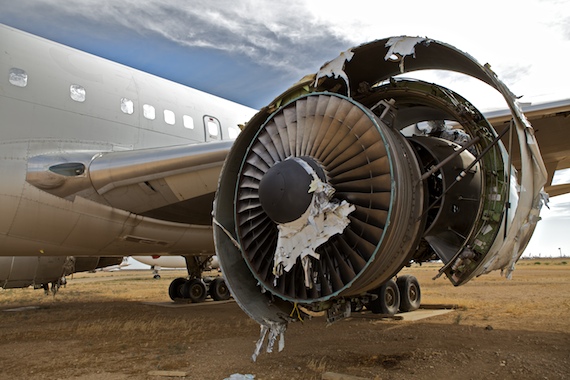
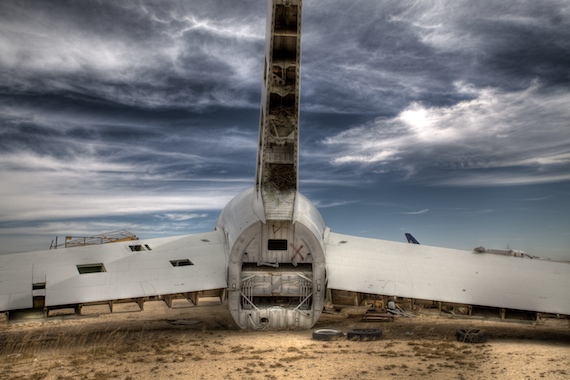
The almost surreal area where aircraft are ‘laid to rest’.
The Mojave Desert is one of the places in the world where aircraft, both military and civil, are placed when they are at the end of their life, whatever that means.
Anyway, came across some nice material and wanted to share it.
In an earlier copy of Mental Floss Magazine (seriously) there’s a very good article about this area. Fabulous pictures, by the way. (Both pics in this Post are from that article.)
Next this is a YouTube video using Google Earth in flyover mode:
A summary of the different collections is listed here, many of them wartime photographs that bring a multitude of emotions to the surface: incredible bravery of the pilots; photographic standards of 70 years ago, man’s inhumanity to man; and so on.
I pondered a bit about writing this Post because, well ….. well…, see what you make of it!
Author's Mum
Being born in England in the early part of November, 1944, World War 2 still resonates within me.
Early home in an industrial part of West London meant that my mother and father had a ring-side view of the German V1 and V2 rockets that were being visited on London at that time.
My mother, 90, still recounts her enormous sense of relief when VE Day was announced (May 8th, 1945) because she then thought that her son’s future life was more or less assured.
So back to these aerial photographs held in those collections.
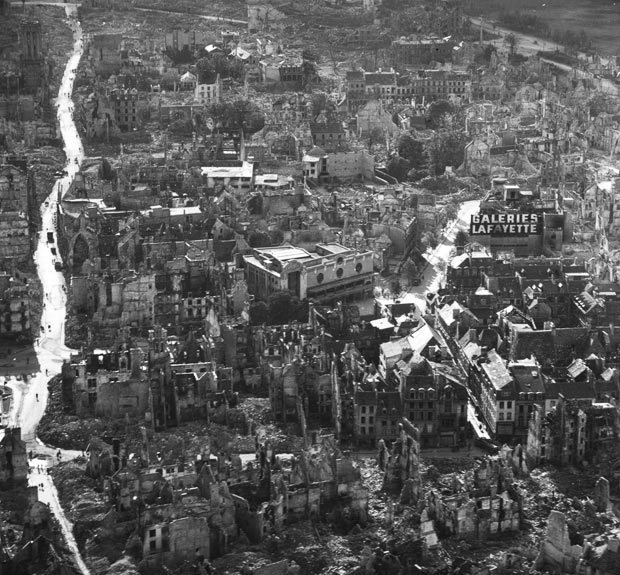
Here’s a picture of the visitation of war on the beautiful French town of Caen.
Linger a while and look at the damage, mostly to private homes. The photograph was taken just slightly more than a month before I was born.




 Learning from Dogs