Tag: Naked Capitalism

The growth of empathy.

As they say in the old country, it’s an ill wind that doesn’t blow anyone any good!

So often when I stare at the screen wondering just what on earth to write about, along comes something to fire me up.

In this case, it was a small clutch of disconnected items that seemed to have a common thread for me.

The first was reading the links in this morning’s Naked Capitalism summary and seeing this:

The REAL Fukushima Danger

Posted on September 14, 2013 by WashingtonsBlog

The Real Problem …

The fact that the Fukushima reactors have been leaking huge amounts of radioactive water ever since the 2011 earthquake is certainly newsworthy.  As are the facts that:

But the real problem is that the idiots who caused this mess are probably about to cause a much biggerproblem.

Specifically, the greatest short-term threat to humanity is from the fuel pools at Fukushima.

If one of the pools collapsed or caught fire, it could have severe adverse impacts not only on Japan … but the rest of the world, including the United States.   Indeed, a Senator called it a national security concern for the U.S.:

The radiation caused by the failure of the spent fuel pools in the event of another earthquake could reach the West Coast within days. That absolutely makes the safe containment and protection of this spent fuel a security issue for the United States.

Nuclear expert Arnie Gundersen and physician Helen Caldicott have both said that people should evacuate the Northern Hemisphere if one of the Fukushima fuel pools collapses. Gundersen said:

Move south of the equator if that ever happened, I think that’s probably the lesson there.

Former U.N. adviser Akio Matsumura calls removing the radioactive materials from the Fukushima fuel pools “an issue of human survival”.

So the stakes in decommissioning the fuel pools are high, indeed.

But in 2 months, Tepco – the knuckleheads who caused the accident – are going to start doing this very difficult operation on their own.

The New York Times reports:

Thousands of workers and a small fleet of cranes are preparing for one of the latest efforts to avoid a deepening environmental disaster that has China and other neighbors increasingly worried: removing spent fuel rods from the damaged No. 4 reactor building and storing them in a safer place.

The Telegraph notes:

Tom Snitch, a senior professor at the University of Maryland and with more than 30 years’ experience in nuclear issues, said  “[Japan officials] need to address the real problems, the spent fuel rods in Unit 4 and the leaking pressure vessels,” he said. “There has been too much work done wiping down walls and duct work in the reactors for any other reason then to do something….  This is a critical global issue and Japan must step up.”

Apologies, that’s more than sufficient to ruin your day!  If you really want to read to the end, the item is here.

However, the next item carries a much more positive thread.  It was an essay that was highlighted on Linked-In back in June.

The Number One Job Skill in 2020

What’s the crucial career strength that employers everywhere are seeking — even though hardly anyone is talking about it? A great way to find out is by studying this list of fast-growing occupations, as compiled by the U.S. Bureau of Labor Statistics.

Sports coaches and fitness trainers. Massage therapists, registered nurses and physical therapists. School psychologists, music tutors, preschool teachers and speech-language pathologists. Personal financial planners, chauffeurs and private detectives. These are among the fields expected to employ at least 20% more people in the U.S. by 2020.

Did you notice the common thread? Every one of these jobs is all about empathy.

In our fast-paced digital world, there’s lots of hand-wringing about the ways that automation and computer technology are taking away the kinds of jobs that kept our parents and grandparents employed. Walk through a modern factory, and you’ll be stunned by how few humans are needed to tend the machines. Similarly, travel agents, video editors and many other white-collar employees have been pushed to the sidelines by the digital revolution’s faster and cheaper methods.

But there’s no substitute for the magic of a face-to-face interaction with someone else who cares. Even the most ingenious machine-based attempts to mimic human conversation (hello, Siri) can’t match the emotional richness of a real conversation with a real person.

Coincidentally, that thought about the ‘magic of a face-to-face interaction’ really echoed in me.  Why?  Because, I was ruminating on the wonderful world of human interaction this world of blogging delivers.  It seems to combine all the benefits of meeting real people with a global consciousness of those same real people spread way beyond our own local domains.

Hence  the reason why I offer the next seemingly unrelated item. The recent post from Sue Dreamwallker that I am republishing in full.

A Big Thank You to you ALL.

by Sue Dreamwalker

many-thanks-to-all_thumb

This is just a short post to say a Big thank you to all of my readers and to those who visit regular and comment upon my posts. You Bring with you such light and encouragement, and I often at a loss to say how much your kind support means.

I logged onto my Blog today and discover that my readership has swelled to 400 followers and so I just want to say a Big thank you for all of my oldest friends who have been with me since my beginnings of Windows Live Spaces days when I started in 2007, My first real post after transferring was called Finding Answers  here on WordPress.  And I remember well spending the best part of a Day getting to know and personalise my header  and  Blog back then as everything was alien that day was in Oct 2010.  A move I am so pleased to have made, as I just love the W.P. Community of friends we have gathered here and whom I have got to know and love.

And I just want to say a big thank you to all of my newest arrivals who have clicked the follow button.. I hope to get around to discovering your blogs as soon as time allows.And to say thank you to my email subscribers also.. And Welcome, I hope you enjoy my thoughts and if not please don’t be shy to air your opinions for that’s how we grow and learn by sharing knowledge and understanding.

Today I just want to post what I have been up to in recent days besides  the ‘Day-job’ in picture format.. So if you click the photos, you should be able to read more in the caption headings.. [Photos available on Sue’s blogsite.]

Take care all of you and I have a busy week a head in my Day Job, so I will catch you when I can…

Love and Blessings

~Sue~

Still the resonances continued.  For Rebecca Solnit published yesterday an incredibly powerful essay over on TomDispatch.  It was called Victories Come in All Sizes.  As always, Tom writes a wonderful introduction.  Let me skip to Rebecca’s opening paragraphs.

Joy Arises, Rules Fall Apart 
Thoughts for the Second Anniversary of Occupy Wall Street 
By Rebecca Solnit

I would have liked to know what the drummer hoped and what she expected. We’ll never know why she decided to take a drum to the central markets of Paris on October 5, 1789, and why, that day, the tinder was so ready to catch fire and a drumbeat was one of the sparks.

To the beat of that drum, the working women of the marketplace marched all the way to the Palace of Versailles, a dozen miles away, occupied the seat of French royal power, forced the king back to Paris, and got the French Revolution rolling. Far more than with the storming of the Bastille almost three months earlier, it was then that the revolution was really launched — though both were mysterious moments when citizens felt impelled to act and acted together, becoming in the process that mystical body, civil society, the colossus who writes history with her feet and crumples governments with her bare hands.

She strode out of the 1985 earthquake in Mexico City during which parts of the central city collapsed, and so did the credibility and power of the Institutional Revolutionary Party, the PRI that had ruled Mexico for 70 years. She woke up almost three years ago in North Africa, in what was called the Arab Spring, and became a succession of revolutions and revolts still unfolding across the region.

Such transformative moments have happened in many times and many places — sometimes as celebratory revolution, sometimes as terrible calamity, sometimes as both, and they are sometimes reenacted as festivals and carnivals. In these moments, the old order is shattered, governments and elites tremble, and in that rupture civil society is born — or reborn.

It really is an essay that you need to read in full.

However, this further extract covering the closing paragraphs explains why it resonated so strongly with me in terms of the rising consciousness of all the millions of ordinary people just trying to leave the world in a better place:

Part of what gave Occupy its particular beauty was the way the movement defined “we” as the 99%.  That (and that contagious meme the 1%) entered our language, offering a way of imagining the world so much more inclusive than just about anything that had preceded it. And what an inclusive movement it was: the usual young white suspects, from really privileged to really desperate, but also a range of participants from World War II to Iraq War veterans to former Black Panthers, from libertarians to liberals to anarchist insurrectionists, from the tenured to the homeless to hip-hop moguls and rock stars.

And there was so much brutality, too, from the young women pepper-sprayed at an early Occupy demonstration and the students infamously pepper-sprayed while sitting peacefully on the campus of the University of California, Davis, to the poet laureate Robert Hass clubbed in the ribs at the Berkeley encampment, 84-year-old Dorli Rainey assaulted by police at Occupy Seattle, and the Iraq War veteran Scott Olsen whose skull was fractured by a projectile fired by the Oakland police. And then, of course, there was the massive police presence and violent way that in a number of cities the movement’s occupiers were finally ejected from their places of “occupation.”

Such overwhelming institutional violence couldn’t have made clearer the degree to which the 1% considered Occupy a genuine threat. At the G-20 economic summit in 2011, the Russian Prime Minister, Dmitry Medvedev, said, “The reward system of shareholders and managers of financial institution[s] should be changed step by step. Otherwise the ‘Occupy Wall Street’ slogan will become fashionable in all developed countries.” That was the voice of fear, because the realized dreams of the 99% are guaranteed to be the 1%’s nightmares.

We’ll never know what that drummer girl in Paris was thinking, but thanks to Schneider’s meticulous and elegant book, we know what one witness-participant was thinking all through the first year of Occupy, and what it was like to be warmed for a few months by that beautiful conflagration that spread across the world, to be part of that huge body that wasn’t exactly civil society, but something akin to it, perhaps in conception even larger than it, as Occupy encampments and general assemblies spread from Auckland to Hong Kong, from Oakland to London in the fall of 2011. Some of them lasted well into 2012, and others spawned things that are still with us: coalitions and alliances and senses of possibility and frameworks for understanding what’s wrong and what could be right. It was a sea-change moment, a watershed movement, a dream realized imperfectly (because only unrealized dreams are perfect), a groundswell that remains ground on which to build.

On the second anniversary of that day in lower Manhattan when people first sat down in outrage and then stayed in dedication and solidarity and hope, remember them, remember how unpredictably the world changes, remember those doing heroic work that you might hear little or nothing about but who are all around you, remember to hope, remember to build. Remember that you are 99% likely to be one of them and take up the burden that is also an invitation to change the world and occupy your dreams.

Rebecca Solnit, author most recently of The Faraway Nearby spent time at Occupy San Francisco, Occupy Oakland, and Occupy Wall Street in 2011 and wrote about Occupy often for TomDispatch in 2011-2012. This essay is adapted from her introduction to Nathan Schneider’s new book, Thank You, Anarchy (University of California Press).

Copyright 2013 Rebecca Solnit

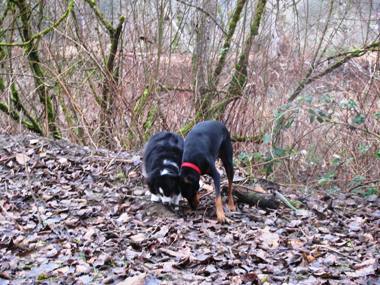
The final element was from an email yesterday in from Chris Snuggs.  Chris has previously written guest posts on Learning from Dogs, the last one being In Defence of Politics back on July 8th.  In that email was the following photograph.
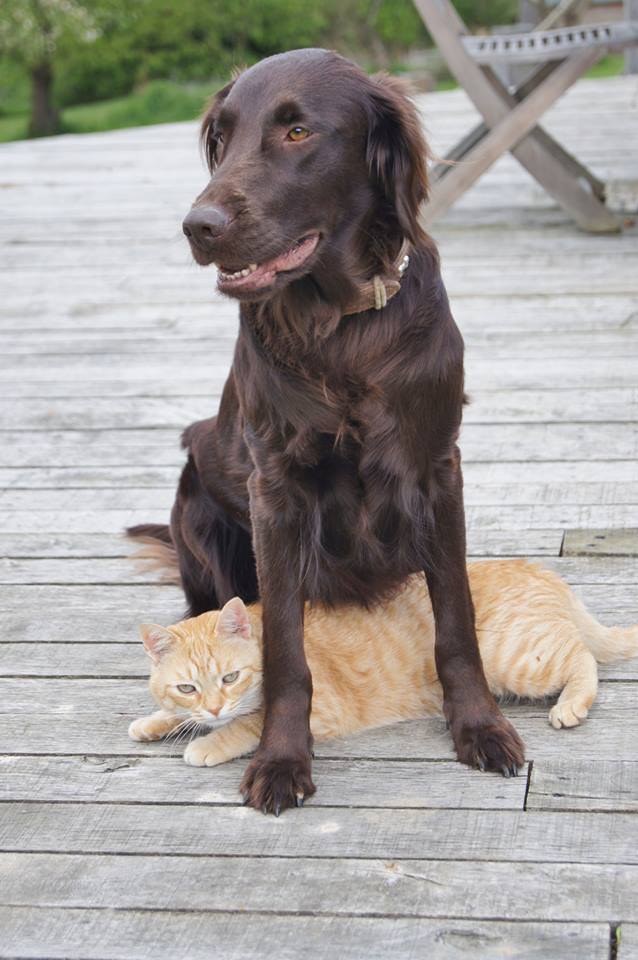
"You touch my mate and I'll have ya."
“You touch my mate and I’ll have ya.”

Let me draw out the thread that I saw in all these items.

That is that the 1% that Rebecca Solnit wrote about are incredibly powerful people, with access to more power, money and control than one can even imagine.  But what that 1% cannot control is the growing consciousness, the growing mindfulness and awareness of millions of people across this planet that something as simple and pure and beautiful as unconditional love will conquer all.

The most fundamental lesson that we can learn from dogs!

Saturday smile

How could we manage without dogs!

Those who follow Naked Capitalism will know that each daily post includes an ‘antidote du jour’ picture.

The picture for the 29th, i.e. last Wednesday, was as below.

Just had to share it with you.

dog with hose
Wonder if he does back-rubs? 😉

Have a great week-end, wherever you are.

The story of carbon, part one.

Looking back enables us to look clearly ahead.

I struggled for a while to decide what to call this post, the first of three.  Explain why in just a moment.

The post is predominantly from the hand of a professional writer who goes under the name of Gaius Publius.  He is described as contributing editor on AMERICAblog from where one also learns that:

Gaius Publius
Gaius Publius

Gaius Publius is a professional writer living on the West Coast of the United States. Gaius has written in a variety of genres and styles. He’s published short stories and poetry, books on education & technology, and is currently working on two book-length projects, including one novel.

In addition to writing, Gaius has been a professional educator and currently manages a small publishing consultancy. He holds a Bachelors degree in Great Books with a side concentration in physics and math, and a Masters in English and Communication.

A web search soon comes across a blog where there is a collection of the gentleman’s works.

OK, back to the theme.

Five days ago I read an essay on Yves Smith’s Naked Capitalism blog that struck me as a fabulously bold and clear presentation of the climate crisis.  The essay, written by Gaius, also derived a positive message from the boldness and clarity of the argument.  I dropped Yves an email asking for permission to republish on Learning from Dogs and not only did I get a quick reply from Yves, that reply included approval for the reposting from Mr. Publius.  Thank you both.

The essay was called: The climate crisis in three easy charts. However, I was uncomfortable that the word ‘crisis’ might be a turn-off in a blog post title, so opted for The story of carbon.  So with that off my chest, let me go straight to the essay as it appeared on Naked Capitalism.

oooOOOooo

 The Climate Crisis in Three Easy Charts

Yves here. This post is the first in a series by Gaius. It starts by looking at the larger climate picture over larger swathes of time and showing what level of temperature changes led to mass extinction events.

By Gaius Publius, who you can follow at Twitter @Gaius_Publius. Cross posted from AmericaBlog

I’m preparing to pivot back to climate crisis, starting with some reformatting of the earlier Climate Series posts — the transition to WordPress wasn’t kind to them — and the organization of this material into book form. (There’s also a climate-themed novel in the works; thriller fans, stay tuned.)

As a result, I’m doing serious study to refine both the concepts (or rather, the explanation of them) and the dating of coming events (the crisis in its various stages).

The first part of that pivot includes two media appearances this week. I’ll be on Virtually Speaking With Jay Ackroyd this Thursday (May 2) at 9 pm ET to discuss climate crisis for a full hour, followed by a Sunday appearance with Avedon Carol as part of the Virtually Speaking Sundays weekly media panel.

It’s the climate discussion I want to focus on here, and I’d like to do it by focusing on three diagrams and a few references back to my earlier climate pieces.

Climate catastrophe will usher in a new geologic era

Long-scale earth history is divided into Eons, then Eras, then Periods. But in fact, prior to the Cambrian Period, when life on earth exploded in number and variety, earth history is the story of non-life or small single- or multi-celled life. And starting with the Cambrian period, there’s just one “eon” anyway. It’s eras and periods we care about.

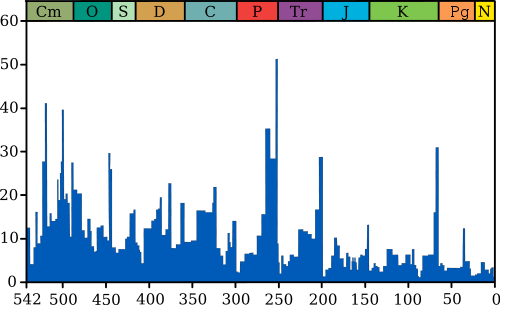
So let’s start there, with the Cambrian Period and the flourishing of life on earth. Consider the chart below:

Mass_Extinction_500px-Extinction_intensity.svg_2

The divisions across the top are geologic periods, starting with the Cambrian (“Cm”), the period of “visible life”‘ — meaning a proliferation of hardshelled species. It’s the big explosion of life on earth. The numbers across the bottom are millions of years ago. The spikes show extinction events, with the percentage of marine species going extinct expressed on the vertical or Y axis.

The chart doesn’t call them out, but starting with the Cambrian period, we’ve had three geologic eras (the larger divisions):

Paleozoic Era — “old life”
Mesozoic Era — “middle life” or the Age of Reptiles (dino days)
Cenozoic Era — “new life” or the Age of Mammals (including us)

The Paleozoic Era runs from the start of the graph to the big spike at 250 million years ago on the X axis. It encompasses six geologic periods and ended in the greatest mass extinction event on the planet — geologists call it the “Great Dying”.

The Mesozoic Era runs from the Great Dying at 250 million years ago to the big spike at 65 million years ago, the event that wiped out the dinosaurs — and every other large species. That cleared the way for mammals to grow big and thrive.

We’re now in the Cenozoic Era. Keep those transitions in mind — when mass extinctions change which groups of species can evolve and rule, it’s the end of an era and the start of another. Now look at the chart again. The whole chart shows 540 million years, and just three geologic eras. The next extinction event on the scale of the one at 250 million years ago, or the one at 65 million years ago, will change the shape of life on earth and usher in a new era. Ready for that?

[Update: For a chart that shows geologic eras, periods and their subdivisions in one place, click here. Opens in a new tab.]

Where does man fit in?

Great question — where does man fit in? Answer: We come in very late.

First, notice the last three geologic “periods” at the top-right in the chart above. The period marked “K” is the Cretaceous, the period at the end of the Mesozoic Era. The next period (“Pg”) is the Paleogene, the one that marks the start of the Cenozoic (new life) Era. The period after that (“N”) is the Neogene, which ended just 2 million years ago. The period after that, not shown, is the Quarternary Period, our current one.

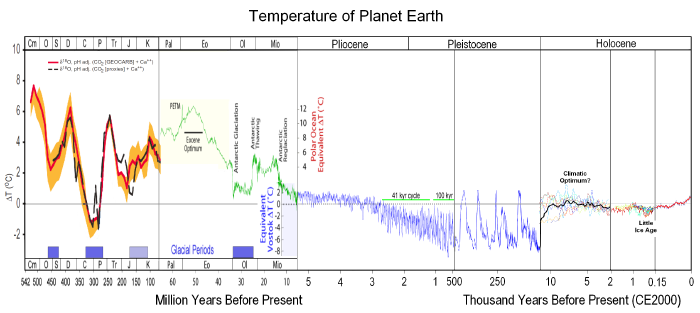
The Neogene-Quarternary boundary is the start of the time of great glaciers, and the best way to show that is with the chart below, showing earth temperatures mapped across the geologic periods (at the left end) and geologic epochs (the rest of the chart).

Earth_tem_All_palaeotemps_700px

Click here to open the full version in another tab. It’s a big, interesting chart. (Source here.)

First, get oriented. On the Y axis is global temperature using change — in °C — from global temperature in the year 1800 as the norm or zero mark. (The global pre–Industrial Revolution temperature is generally the mark from which other global temperatures are measured, unless otherwise noted. To convert from °C to °F, just double the number; you’ll be pretty close.)

On the X axis, the first big division — from 542 million years ago to 65 million years ago — represents the first two geologic eras, the Paleozoic and Mezozoic (which unfortunately aren’t called out on this chart). “K” at the top and bottom is still the Cretaceous Period, and the end of the Cretaceous Period is also the end of the dinos and the end of the Mesozoic Era.

In this respect, both charts are the same. Man hasn’t showed up yet — our mammal ancestors were the equivalent of field mice in that world, small prey with soft shells and hiding skills.

But before we look at the rest of the X axis, notice that in the left-most part of the chart, the Y axis shows a huge change in global temperature relative to pre-Industrial norms. Looks like a monster spike, especially the first one, doesn’t it?

The Cambrian temperature spike is 6–8°C (about 11–14°F) higher than pre-Industrial levels.

It’s also the temperature we’re headed for by 2100.

But let’s not get distracted. Let’s set some markers in this chart in the horizontal (time) dimension. The whole rest of the chart — the part after the period called “K” — shows the Cenozoic Era (“new life” or Age of Mammals). From here to the right, the chart’s subdivisions show Epochs, which are sub-parts of Periods.

[Update: For a chart that shows the relationship between eras, periods and epochs, click here. it will help you stay oriented.]

Jump through the next five divisions — the epochs marked “Pal” through “Pliocene”. That takes you through the Neogene Period (“N” in the first chart) and to the start of the modern Quarternary Period, the one we’re in, and the one we’re interested in.

The epoch of the Pleistocene, which starts the Quarternary Period (again, see the chart), is the great age of glaciers. Homo habilis evolves at this time, a little over 2 million years ago. Homo erectus evolves shortly afterward. Each starts in Africa — now you can probably guess why — and each leaves Africa and spreads across the globe. (Homo erectus, by the way, lasts a long time on this earth. Longer than us by a lot.)

Homo sapiens evolved much later, in the Pleistocene — the age of glaciers, remember — just 250 thousand years ago, almost died out in Africa, but rebuilt our numbers, then spread out of Africa like our cousins. Because that was the glacier age, we’re still hunter-gatherers like the the rest of our cousins. The big beasts of the earth are creatures like woolly mammoths and sabre-tooth tigers, and we’re all alive on a fairly frozen planet with glaciers coming and going.

At the end of the Pleistocene is another extinction event. At the same time that the last glaciers recede (see chart), the big mammoths and tigers (et al) die off. Simultaneous with a noticeable change in climate, what we call “human civilization” begins. You can see that above, around 12–10 thousand years ago as the planetary temperature stabilizes. From then until almost now, planetary temperature is pretty stable. Notice it doesn’t take much of a wobble to mark the “Little Ice Age”.

Just two more points to make in this piece and I’m done.

First the bad news

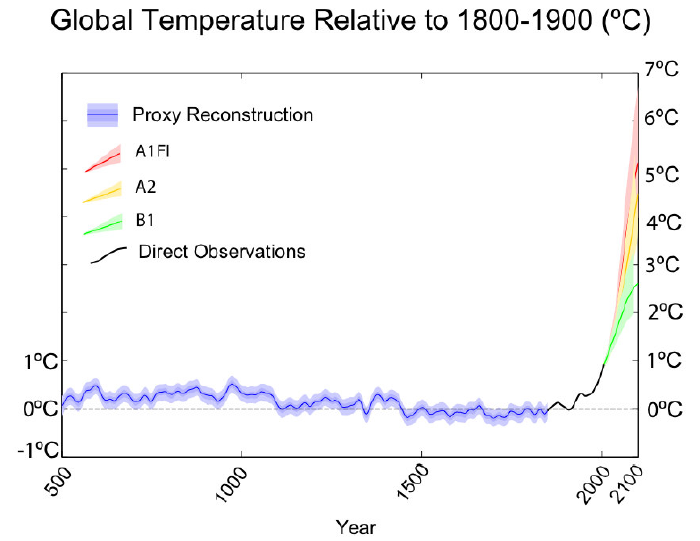
Folks, that little climb in temperature you see near the right end of the graph above is just the beginning. Remember the Cambrian spike at the left end of the graph? Take another look and note the increase — about 7°C. Now here’s Figure 21 from the Copenhagen Diagnosis, a report prepared by … oh … every single one of the world’s top climate scientists for the benefit of our world’s “leaders,” who met in 2009 to discuss how to pass the climate buck one more time:

Copenhagen_Diagnosis_Fig_21_LARGE

What you see is temperatures from 500 AD to about 2000, with a number of prediction scenarios going forward. See the scenario called “A1FI”? It’s the one in red. That’s the one we’re on if we don’t stop spewing carbon. I call it the “do nothing” scenario — otherwise known as the “Keep David Koch Happy” scenario.

All you need to know? We’re on track for about +7°C — the peak temperature in the big Cambrian spike — by the year 2100.

Now the good news

Despite all this doom-and-gloom, it’s not over yet. Truly. By my calculation, we have a 5–10 year window to avoid the catastrophe. It won’t be easy — we’re past the point where any transition will be smooth — but we can make the transition and survive as a civilized species, humans in a recognizable world.

But two things are needed:

  1. This has to be our top priority, which means you and everyone you know has to be fully aware and in full battle gear. (For reference, it’s called “hugging the monster.”)
  2. It’s us vs. David Koch and all of his friends and enablers. Tackling any other enemy is tackling a dummy while the game is being played.

Educate your friends, and put a wrench into the Koch machine. How’s that not a plus?

If the Koch Bros keep getting rich, we move backward. If Barack “Hope & Change” Obama approves Keystone, we move backward. If the U.S. develops “domestic oil” resources, we move backward. For every new car (“carbon-delivery system”) sold, we move backward. People need to know this and think like this. We can stop the crisis, but only if we stop carbon. It’s that simple; and that stark.

But it’s also doable, and we’re the species that’s most equiped for “doable.” It’s what our big brains are for.

I’ll have more in the weeks and months ahead. I haven’t given up, not by a long shot. But you can’t pull out of a tail spin if you don’t admit you’re in one. Me, I think we can pull out.

oooOOOooo

So presumably if you are reading this, you have read the essay above.  I hope so because while at first sight there appears to be much to take in, the story is clear, informed and powerful.  You are unlikely to change the mind of a committed ‘denier’ but if there’s a little part of you that isn’t utterly clear about the risks ahead, then this essay is a fabulous opportunity to embrace clarity – and not to give up hope! Remember those words in the essay:

“By my calculation, we have a 5–10 year window to avoid the catastrophe. It won’t be easy — we’re past the point where any transition will be smooth — but we can make the transition and survive as a civilized species, humans in a recognizable world.”

The unacceptable face of The Daily Mail

The shocking distortions made by The Daily Mail newspaper.

On the 9th January, 2013 The Daily Mail published this item:

The crazy climate change obsession that’s made the Met Office a menace

  • The £200 million-a-year official weather forecaster often gets it wrong
  • This week it has admitted there is no evidence that ‘global warming’ is happening
  • The Met Office quietly readjusted its temperature projections on its website on Christmas Eve

By JAMES DELINGPOLE

PUBLISHED: 19:45 EST, 9 January 2013 | UPDATED: 02:56 EST, 10 January 2013

Was there ever a government quango quite so useless as the Met Office?

From its infamous ‘barbecue summer’ washout of 2009 to the snowbound winter it failed to predict in 2010 and the recent forecast-defying floods, our £200 million-a-year official weather forecaster has become a national joke.

But of all its recent embarrassments, none come close to matching the Met Office’s latest one.

Without fanfare — apparently in the desperate hope no one would notice — it has finally conceded what other scientists have known for ages: there is no evidence that ‘global warming’ is happening.

If you want to read the full article, it’s here.

Needless to say the UK Met Office published a detailed rebuttal.  One of the comments that I spotted following that rebuttal was this lovely one from MD Dalgleish:

The Daily Mail does not let the facts get in the way of a story! Nothing new there, they’ve been doing that since before the war. What baffles me is why so many people buy this paper.

Quite so!

It would all be a bit of a laugh if it were not for what follows.

Last Friday, Naked Capitalism, the fabulous blog run by Yves Smith published in her set of links this item, “Climate change set to make America hotter, drier and more disaster-prone.”  Newly living here in Southern Oregon, that obviously caught my eye!

The item referred to a detailed account in the British Guardian newspaper by Suzanne Goldenberg, the newspaper’s US Environment Correspondent.

Climate change set to make America hotter, drier and more disaster-prone

Draft report from NCA makes clear link between climate change and extreme weather as groups urge Obama to take action

The report says steps taken by Obama to reduce emissions are 'not close to sufficient' to prevent the most severe consequences of climate change. Photo: Saul Loeb/AFP
The report says steps taken by Obama to reduce emissions are ‘not close to sufficient’ to prevent the most severe consequences of climate change. Photo: Saul Loeb/AFP

Future generations of Americans can expect to spend 25 days a year sweltering in temperatures above 100F (38C), with climate change on course to turn the country into a hotter, drier, and more disaster-prone place.

The National Climate Assessment, released in draft form on Friday , provided the fullest picture to date of the real-time effects of climate change on US life, and the most likely consequences for the future.

The 1,000-page report, the work of the more than 300 government scientists and outside experts, was unequivocal on the human causes of climate change, and on the links between climate change and extreme weather.

“Climate change is already affecting the American people,” the draft report said. “Certain types of weather events have become more frequent and/or intense including heat waves, heavy downpours and in some regions floods and drought. Sea level is rising, oceans are becoming more acidic, and glaciers and Arctic sea ice are melting.”

Here’s a pithy question for Mr. James Delingpole of The Daily Mail, “Which part of this sentence are you having trouble with – The 1,000-page report, the work of the more than 300 government scientists and outside experts, was unequivocal on the human causes of climate change, and on the links between climate change and extreme weather.?” [my emphasis]

Suzanne goes on to say:

The report will be open for public comment on Monday.

Environmental groups said they hoped the report would provide Barack Obama with the scientific evidence to push for measures that would slow or halt the rate of climate change – sparing the country some of the worst effects.

The report states clearly that the steps taken by Obama so far to reduce emissions are “not close to sufficient” to prevent the most severe consequences of climate change.

“As climate change and its impacts are becoming more prevalent, Americans face choices,” the report said. “Beyond the next few decades, the amount of climate change will still largely be determined by the choices society makes about emissions. Lower emissions mean less future warming and less severe impacts. Higher emissions would mean more warming and more severe impacts.”

As the report made clear: no place in America had gone untouched by climate change. Nowhere would be entirely immune from the effects of future climate change.

One might argue that it won’t be very long before no sane person on this planet would swallow that crap from The Daily Mail.  But when we get to that stage of every person being aware of the forces at work upon our fair planet it will be a tad too late.

The only home we have.

That’s why this report is to be encouraged, nay embraced.  Of all the nations in the world, the one that should be setting the lead is the United States of America.  As the banner on that globalchange.gov website proclaims: Thirteen Agencies, One Vision: Empower the Nation with Global Change Science

So go and read the report.  For your sake and all our sakes.

Because the more informed you and I are, the better the chances of real political leadership taking place in this fine nation.

Download Chapters of the NCADAC DraftClimate Assessment Report!   
Download the Full Report (warning, 147Mb. Very large file)Between chapters, there are some page numbers that are not used. This is intentional and does not reflect missing pages.or download each chapter separately:

Cover page

Introduction: Letter to the American People

1. Executive Summary

2. Our Changing Climate

Introduction to Sectors

3. Water Resources

4. Energy Supply and Use

5. Transportation

6. Agriculture

7. Forestry

8. Ecosystems, Biodiversity, and Ecosystem Services

9. Human Health

10. Water, Energy, and Land Use

11. Urban Systems, Infrastructure, and Vulnerability

12. Impacts of Climate Change on Tribal, Indigenous, and Native Lands and Resources

13. Land Use and Land Cover Change

14. Rural Communities

15. Interactions of Climate Change and Biogeochemical Cycles

Introduction to Regions

16. Northeast

17. Southeast and Caribbean

18. Midwest

19. Great Plains

20. Southwest

21. Northwest

22. Alaska and the Arctic

23. Hawaii and the U.S. Affiliated Pacific Islands

24. Oceans and Marine Resources

25. Coastal Zone Development and Ecosystems

Introduction to Response Strategies

26. Decision Support: Supporting Policy, Planning, and Resource Management Decisions in a Climate Change Context

27. Mitigation

28. Adaptation

29. Research Agenda for Climate Change Science

30. The NCA Long-Term Process: Vision and Future Development

Appendix I: NCA Climate Science – Addressing Commonly Asked Questions from A to Z

Appendix II: The Science of Climate Change

We are what we eat.

A thought-provoking presentation on the role of food in our society.

The last time I used this title for a post was back on July 20th.  However, the topic then was very different to today’s theme.  Then I wrote about how the genetic modification of our food represents as big a danger to the long-term survival  of man as does the damage to our biosphere.

So this comes as a very pleasant contrast.  I am indebted to Yves Smith’s blog Naked Capitalism for drawing this presentation to my attention. As was written in that NK post,

This is a super presentation by Ray Patel for Michael Pollan’s class at Berkeley, Edible Education 103. The presentation and the question period together come to about an hour.  Ray Patel follows after Michael Pollan handles administrative stuff and then does an introduction.

There are plenty of charts, but I really enjoy the anecdote on Northern Malawi at minute 43:54 — too long for me to transcribe, so I’ll quote Patel’s closing line:

What makes it really sail is not just the democracy, but the joy which comes through people cooking together as equals and eating together as equals.

Bon apetit!

Published on Dec 7, 2012
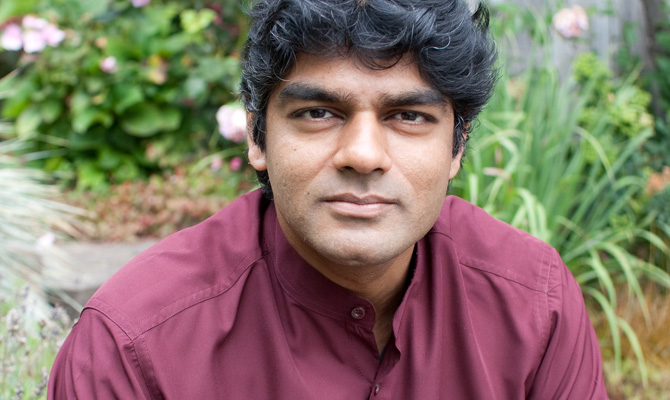
Raj Patel is an award-winning writer, activist, and academic. He has degrees from the University of Oxford, the London School of Economics, and Cornell University, has worked for the World Bank and WTO, and protested against them around the world.

He’s currently a visiting scholar at UC Berkeley’s Center for African Studies, an Honorary Research Fellow at the School of Development Studies at the University of KwaZulu-Natal, and a fellow at The Institute for Food and Development Policy, also known as Food First. He is currently an IATP Food and Community Fellow.

He has testified about the causes of the global food crisis to the U.S. House Financial Services Committee and is an Advisor to the United Nations Special Rapporteur on the Right to Food. In addition to numerous scholarly publications, he regularly writes for The Guardian, and has contributed to the LA Times, NYTimes.com, The San Francisco Chronicle, The Mail on Sunday, and The Observer. His first book was Stuffed and Starved: The Hidden Battle for the World Food System and his latest, The Value of Nothing, is a New York Times best-seller.

raj_patel

Raj Patel’s website is a great reference so do spend a little time wandering through the material.  For example, this item jumped off the page for me.

What I Did This Summer

By Raj on 08/11/2012

The good folk at Canada’s Globe & Mail asked me to write a piece called “What I Did This Summer.” Never having written one before, I thought I’d channel my inner 12 year old.

Cuzco, Peru: This summer I started to write a book and film a documentary with my hero. His name is Steve James. He filmed ‘Hoop Dreams’ which was about basketball and hope and disappointment and race and inequality and America. Our film is called “Generation Food”. It is about how we will eat in the future.

So I went to Japan. People used to live long lives in Okinawa because of the traditional diet. Lots of people lived until 100. Now grandparents are burying their children. They don’t eat as they used to. When the Americans came with their military base, they brought fast food for the GIs. Everybody eats it now. I visited farmers who plant crops on US bases. They did it so often that the Americans gave up and just let them do it. I ate goat sashimi because it would have been rude not to.

Won’t reproduce it in full as I haven’t sought permission.  So do go here to read it.  But I just can’t resist offering you Raj Patel’s closing words.

I have learned that: People are kind. Everyone has contradictions. Raw goat tastes funny, but it’s not as bad as Cuban food. The world is more beautiful than I imagined. There is more hope for the future of food than I dared to believe, against impossible odds. And it comes from unlikely places.

And after the summer, I was never the same again.

What a lovely sentiment to end on.

Three years on, and ….

Nothing much changes.  This post first published on the 4th November, 2009!

Debt stress in Middle Class America – how may this play out?

On Saturday, October 24th Yves Smith of Naked Capitalism ran a Post on her Blog about an anonymous couple who were over their heads in debt.  (Yves has given me written permission to reproduce the Post.) The story of this couple then generated a huge response of comments. Read the comments, each and every one of them.

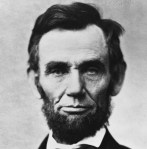
Then ask yourself abraham-lincoln-picturewhere this is all heading?  These comments may, almost certainly are, just be the tip of the iceberg.  Seems a long way from Lincoln’s Gettysburg address in which he was reputed  to have used the words: “… government of the people, by the people, for the people, shall not perish from the earth.”
Some days I worry; worry a lot!

The extract from Yves Post about this couple is reproduced below but far better is to go and read the whole Post and all the comments.

UPDATE: Since writing this Post Yves has published a further Post on the topic again generating a huge volume of comments.  That was Sunday, November 1st.  Then bright and early on November 2nd James Kwak of Baseline Scenario weighs in with his version, Do smart, hard-working people deserve to make more money? 150 comments (at the time of writing) for that one.  Interestingly, as the days have gone on the mood of the commentators has become more reflective and thoughtful thus partly negating the theme behind this Post.

This is the original Post from Naked Capitalism:

Some readers like to demonize those who get in over there heads with debt as people who lived high on the hog and had their day of reckoning come upon them. This story, forwarded from a reader, shows the picture is more complicated.

When I was young, savings of six months of living expenses was considered to be a good cushion against risk. Is that true any more? I doubt it. Although this couple didn’t even have that much stashed away, the sort of buffers that worked a generation ago are insufficient now. People spend longer between jobs than in the past, and if/when they do find new work, it is often at a lower level of pay than before.

Job loss and major illness rather than an overly lavish lifestyle are still the biggest causes of bankruptcy. And now that the average tenure at a job has shrunken considerably, people need to have more in the way of savings, yet the high cost of unemployment means it is even harder than before to build up a big enough kitty.

Via one a correspondent:

Just like most everyone I know, my husband and I are in big debt with our credit card companies. My husband was laid off on New Year’s Eve last year. We were in total shock. I am retired from the USAF and receive a small monthly check, and my husband began collecting a meager unemployment check. He searched all over the US and made several trips out west knocking on doors and handing out his resume. NOTHING. Anyway, we had no saving and a little bit of stock which was cashed in at an all time low. No help there. Then we started living off our credit cards. Without them, we would have not made it, period. Our daughter and her family moved in upstairs and her husband was working of a whopping $8.50 an hour. No help there. So basically we were supporting them as well.

We have a mortgage payment of $1175 and $30,000 equity still in our home, but we are unable to refinance at a lower rate BECAUSE my hubby was unemployed!

Getting back to my B of A card, I have NEVER been late on a payment in 10 years (until last month). I have always paid more than the minimum (until January 1st). BUT, my interest rates have inched up and up in the last few months and then, BOW! I tried to use my card about 3 weeks ago at the grocery store and it was denied. Needless to say, I walked out without the food. We don’t waste anything, not money, not food, not heat or lights, nothing, but we are going down fast. The good news is that my husband got a job this week (at a much, much lower wage) and will finally get a pay next week after almost 10 months. The bad news is that B of A is killing me and will ruin me soon. I sent them a “token” $10 payment on the $450 monthly that I owed. The payment was on time, but the $10 sure didn’t make them happy. They slapped a “LATE FEE” of $39 even though my “payment” was not late AND of course the dreaded overdraft fee of $39. Yesterday I got a statement from them saying that my next payment due 11/11 is $950. I can see the snowball at the top of the hill ready to roll. What do I do? Do I revolt and refuse to pay? Do I keep sending them $10 as a promise to pay? OR do I write Kenneth Lewis and say I want some of their TARP/bonus money back so I can apply it to my B of A account? It’s not fair, although I know we lived off our credits cards and much of what I owe is money that I spent on essentials, BUT, the ultrahigh interests rates combined with their slap-on-every-extra-fee-we-can mentality is outrageous. We have worked all our lives to have and keep our excellent credit ratings and now all that is shot.

What do I do? What do we do? Like I mentioned before, my husband just got a job, but he will be making much, much less than he used to. Our mortgage is behind, the bank is on us about that, our credit cards a behind and they want even MORE blood, our kids and their families aren’t making it even though they work and pinch every penny, no insurance is within reach for them or their babies, so we have been shuffling payments to help our grandchildren, the list goes on and on and on and on…

Please, what do we do? How can we stop the madness that has engulfed us? We are good citizens, worked hard all our lives, paid all our bills on time and paid more than the minimum – until lately -, penny pinch, reheat the reheated leftovers, eat toast, never go out, never hurt anyone, love our family and served our country, and now this.

Please, what do we do?

oooOOOooo

Could have been written yesterday!

The nose of the dog!

The incredible power of smell that dogs have.

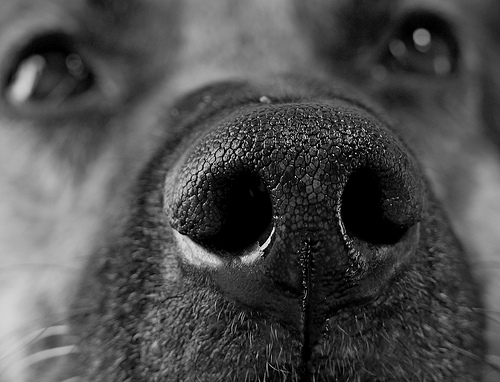
The nose of a German Shepherd dog!

Regular readers will know that I subscribe to the blog Naked Capitalism masterminded by Yves Smith.  Some time ago, there was a link on NK to a story about how a tiny Chihuahua dog rescued some missing girls.  It seemed like a good opportunity to take a closer look at this most magical aspect of a dog’s qualities.

First to that story.

I saw it on the Care2 website, from which I quote the following:

Bell

Hero Chihuahua Finds Missing Girls in the Woods

by  August 2, 2012

A 3-year-old chihuahua named Bell is an unexpected hero after finding three young girls who became lost for hours in the woods in Newnan, Georgia, on Monday.

CBS Atlanta reports that, on Monday, 8-year-old Carlie and 5-year-old Lacey Parga went for a walk with their dog Lucy down a cul-de-sac on trails near their neighborhood.

What started as a casual stroll became an unintended, and at times frightening, experience. As Carlie tells CBS, ‘”We tried to find our way out of the woods. We kept following paths and stuff and we got lost.” Indeed, they became scared that they were only to get more and more lost.

Carlie’s father, David Parga, noted that it wasn’t characteristic of them to wander off and, after searching for them but not hearing them respond, he contacted police and firefighters. Neighbors joined them including Carvin Young who thought to take Bell, who plays with the girls every day and knew their scent. Bell was able to lead searchers to the girls.

The full story on the Care2 website is here and on the CBS website here.

So what is it about the nose of the dog?  A dog has more than 220 million olfactory receptors in its nose, while humans have only five million, making dogs’ sense of smell a thousand times greater.  Frankly, trying to get one’s intellect around precisely what having a sense of smell one thousand times greater than a human means is tough!  So on to another story.

The Bark and Clark blogsite reported an item in February that had been seen in the K9 Magazine.

17 Dogs, 3 Generations, 70 Years.
There’s one constant…
…the family dog.

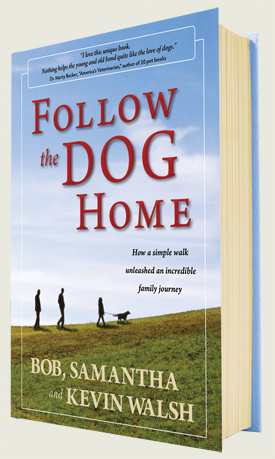
After moving to Wellesley, Massachusetts for an anchor job with a major television sports network, Kevin began taking his German Shepherd, Beverly, for walks in the surrounding neighborhoods. They developed a route that included historic Atwood Street. Beverly kept veering toward one house in particular that had also caught Kevin’s eye previously, thinking it looked familiar but not knowing the reason.

After talking to a close family relative who had also once lived in Wellesley, Kevin was shocked to discover that the memorable house had once been a childhood home to his father, Bob Walsh, before WWII. After digging through old family photos that had been tucked away for years, Kevin uncovered a picture of his father as a toddler with his family on the house’s front porch, complete with their first family dog, Dee Dee.

Kevin’s father had been writing short stories about all of their family dogs through the years, but never knew about the photo. Its discovery was the pivotal moment that offered proof that the Walsh family’s journey with dogs had come back to the exact place where it started.

They’ve turned this story, along with other dog tales, into a book called Follow the Dog Home: How a Simple Walk Unleashed an Incredible Family Journey.

Dog’s nose leads family to back long lost old home, site unseen. German Shepherd, Beverly, is chronicled on WCVB TV’s news magazine show Chronicle. 70 years later, the family goes back “home” for stunning reunion and photograph.

Nature, red in tooth and claw

The Daily Mail newspaper offers an amazing story.

I am indebted to the website Naked Capitalism for including in their ‘links’ on the 25th July, this story from the online version of the Daily Mail UK newspaper.

Locked in combat: Mother lion takes on deadly crocodile to give cubs safe swim across river

Scanning the surface of the water, her amber eyes alight upon a threat to her pride – a deadly crocodile lurking in the river that the family of lions must cross.

The fiercely protective lioness did not hesitate, leaping into the water and grappling with the reptile to allow the rest of the pride to cross the river in safety.

These images show the magnificent big cat fastening her front legs around the crocodile’s jaws and dunking it underneath the water before making a break for the river bank at the Okavanga Delta in Botswana.

The lioness’ brave diversion tactics were witnessed by wildlife photographer Pia Dierickx, who said the creature moved with such incredible speed she did not realise what had happened until she looked back at the pictures on her camera.

The photographer, from Antwerp in Belgium, had been peacefully observing the lioness and her pride going about their business around the river when the sudden clash between the big cat and the crocodile occurred.

The 48-year-old said the struggle took place within one second.

The images are powerful and stunning.  I’m going to take the liberty of reproducing just one, as below, but do go across to the story here and view the full set of photographs taken by Pia Dierickx – you will not be disappointed!

Struggle: The power and strength of the mighty lioness is clear to see, but the crocodile fights back, clamping its teeth around the big cat’s nose. Image is Copyright © Pia Dierickx/BNPS

Finally, to the quote that I used as the title for today’s Post.  The origin of the quotation revealed here.

Funny things us humans!

Ten things we don’t understand about being human, from New Scientist magazine.

Thanks to Naked Capitalism for pointing me towards this fascinating piece in New Scientist.  The article discusses 10 outwardly frivolous behaviours and attributes that have scientists scratching their head.  They are:

  • Blushing
  • Laughter
  • Pubic hair
  • Teenagers’ behavioursNew Scientist skeleton
  • Dreams
  • Altruism
  • Art
  • Superstition
  • Kissing, and
  • Nose-picking

The article links each of the above to a further examination of why it is so strange.  It’s a good read and the accompanying photograph heading up the article, reproduced across, is rather clever.

Reminds me of that lovely English ditty:

The whole world is rather queer,

except thee and me,

and I have my doubts about thee!

The doomsday virus

Take a few moments and read this.

Thanks to Naked Capitalism for including this item in today’s list of links.  One of those links was to an item in today’s Washington Post from which I quote,

Thousands could lose access to the Internet on July 9 due to a virus, DNSChanger, that once infected approximately 4 million computers across the world.

The Federal Bureau of Investigation first gave details about the virus last November, when it announced the arrest of the malware’s authors. The virus, as its name indicates, affected computers’ abilities to correctly access the Internet’s DNS system — essentially, the Internet’s phone book. The virus would redirect Internet users to fake DNS servers, often sending them to fake sites or places that promoted fake products. Once the FBI shut down the operation, it built a safety net of new servers to redirect traffic from those infected with the virus.

But that safety net is going offline next Monday meaning that anyone who is still infected with the virus will lose access to the Internet unless they remove it from their machine.

The Washington Post then goes to say,

To see if you have the virus, you can head to any number of checker Web sites such as the DNS Changer Working Group or the FBI itself to either enter your IP address or simply click a button to run a check against addresses known to have problems. With any luck, you’ll be free and clear and won’t have to worry about the problem any further.

I chose the FBI website that is here https://forms.fbi.gov/check-to-see-if-your-computer-is-using-rogue-DNS as it seemed to have comprehensive instructions on what to do.

Then chose the URL for English, that is this one http://www.dns-ok.us/ that directed me to a website that instantly confirmed that a) it was the correct website – DNS Changer Check-Up, and b) my result.

DNS Resolution = GREEN 

Your computer appears to be looking up IP addresses correctly!

Had your computer been infected with DNS changer malware you would have seen a red background.  Please note, however, that if your ISP is redirecting DNS traffic for its customers you would have reached this site even though you are infected. For additional information regarding the DNS changer malware, please visit the FBI’s website at:
http://www.fbi.gov/news/stories/2011/november/malware_110911

Seems to me to be a message worth circulating as widely as possible.

Footnote: 9th July, 06:40.

Noticed the following article on the BBC News website this morning, from which I quote:

More than 300,000 people, including many in the US and UK, could lose internet access later as the FBI shuts off servers used by cyber thieves.

The FBI seized the servers in November 2011 during raids to break up a gang of criminals who used viruses to infect more than four million victims.

Victims’ web searches were routed through the servers so they saw adverts that led to the gang being paid.

Many machines still harbour the gang’s malicious code.

Global clean up

The gang racked up more than $14m (£9m) by hijacking web searches and forcing victims to see certain adverts. They managed to do this because their servers were taking over a key web function known as domain name look-up.

Domain names are the words humans use, such as bbc.co.uk, for websites. These are converted into the numerical values that computers use by consulting domain name servers (DNS).

When a person types a name into a browser address bar, often their computer will consult a DNS server to find out where that website resides online.

The gang infected computers with malware called DNS Changer because it altered where a PC went to convert domain names to numbers.

Since the FBI raids the gang’s servers have been run by Californian company ISC. Over the last few months, the FBI has worked with many ISPs and security firms to alert victims to the fact that their PC was infected with DNS Changer. Online tools are available that let people check if they are infected.

This has meant the original population of four million infected machines has been whittled down to just over 300,000, according to statistics gathered by the DNS Changer Working Group.

The largest group of machines still harbouring the infection are in the US but many other nations, including Italy, India, the UK and Germany, have substantial numbers still checking in with the ISC servers.

These servers will be shut down on 9 July.

The result could be that some people lose net access because the PCs that are still victims of DNS Changer will suddenly have nowhere to go when they need to look up the location of a particular domain.

It might take some time for the problems to become apparent, said Sean Sullivan, a security researcher at F-Secure.

“Initially some domains will be cached which will mean web access will be spotty,” he said. “People will be confused about why some things work and some do not.”

Other security experts said it might take time for the remaining infected machines to be cleaned up.

“Reaching victims is a very hard problem, and something we have had issues with for years,” said Johannes Ullrich, a researcher with the Sans security institute.

He expected the impact to be “minimal” because many of these systems were no longer used or maintained.

If you have any doubt, do check your DNS as soon as possible.