Some seven days ago, there was an item on Permaculture News about Steve Marsh’s fight with Monsanto. Here is that article in full. I strongly recommend watching the longer video at the end of the post. It’s an incredibly important issue for all lovers of healthy food.
You might not have heard of Steve Marsh yet but this man could lose everything to protect your right to eat GM-free food.
Who is Steve Marsh?
Steve Marsh is an Australian farmer who lost his organic certification when Monsanto’s genetically modified (GM) canola blew onto his farm from a neighbouring property in 2010. Since then, Steve lost most of his income and has been struggling to get his organic certification back.
Monsanto has a no liability agreement with GM farmers that prevent them from being sued. The only avenue Steve had to protect his livelihood was to take his neighbour to court. It is due to start on the 10th February 2014 in the Western Australian Supreme Court and is scheduled to run for three weeks.
This is the world’s first case of an organic farmer using the courts to recover loss and damages from a GM farmer. This case has been described as a landmark case to determine who should take responsibility in case of GM contamination. If Steve wins it will set a precedent to guide the application of common law to GM contamination and will be of interest to lawmakers worldwide.
We don’t want to be part of the global GM experiment underway with barely tested, unlabeled and uncontrolled GM foods infiltrating our food supplies. When people like Steve stand up for their rights in spite of what he may lose, it gives us a chance to stand alongside him.
Take action!
Steve’s neighbour is well supported and well funded by a pro-GM organization and we are helping to raise funds and awareness for Steve’s case.
Have a look at the short video above explaining his story and share it with friends, family and work colleagues. Please make a donation to support this landmark case and protect the future of GM-free food.
Although not my usual type of post here on Learning from Dogs a forthcoming event regarding GMOs seemed worthy of greater promotion, especially as it includes concerns about possible ‘contaminated’ dog food. The event was mentioned on the Permaculture News blog; a blog that I follow.
What was described was a free, 3-day online ‘summit’ about genetically modified organisms. Let me quote from the blog post:
The scary truth about Genetically Modified Organisms (GMOs) is being deliberately kept from you….
Fact: Your food has been unnaturally changed. These changes have very serious consequences.
Your family’s health is at risk and you deserve the truth….
We’re going to share with you the true effects of genetically engineered food on human health and the environment. You’re invited to join our panel of experts, researchers and activists in an inspirational and free, 3-day GMO Summit — October 25-27, 2013.
This is a virtual event you can enjoy at no cost from the comfort and convenience of your own home.
If you want to know the truth about GMOs and the risks Monsanto, the government, their paid advisors and the media are deliberately hiding from you, then join in this unique, free summit.
There’s an impressive line-up of 10 main speakers and another 10 supplementary speakers. And, as the blog post goes on to say:
We didn’t want to overwhelm you in just 3 days, so once the GMO Mini Summit is complete, you’ll get even more empowered by 10 more experts in interviews over the next 5 weeks (2 per week) who will share even more about this crucial topic. When you register for free you will gain access to all 20 speakers!
So you need to go here to sign up, after which you will be directed to a welcome page. There you will learn more about the way that GMOs are affecting so many aspects of our lives and of the lives of our beloved dogs.
So why do we insist of manipulating the genetics of food!
I read somewhere recently, and of course now can’t find the reference, that the genetic modification of our food represents as big a danger to the long-term survival of man as does the damage to our biosphere.
So a recent item on the blog Food Freedom News jumped out at me. This was an item that was introduced as, “The author of Seeds of Destruction (about Monsanto) has a new piece out on pesticides and mass animal deaths… very sobering.”
Clicking on the ‘new piece’ link takes one to here, from which I quote the opening paragraphs,
“A recent study showed that every human tested had the world’s best-selling pesticide, Roundup, detectable in their urine at concentrations between five and twenty times the level considered safe for drinking water.”
Birds and bees are something most of us take for granted as part of nature. The expression “teaching about the birds and the bees” to explain the process of human reproduction to young people is not an accidental expression. Bees and birds contribute to the essence of life on our planet. A study by the US Department of Agriculture estimated that “…perhaps one-third of our total diet is dependent, directly or indirectly, upon insect-pollinated plants.”
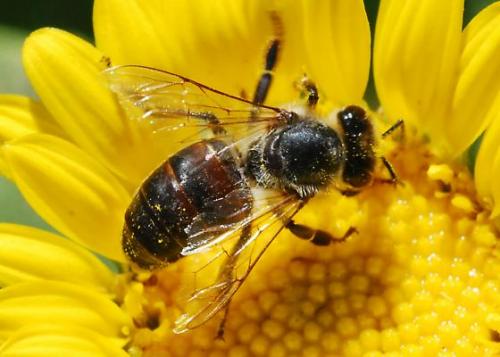
The honey bee, Apis mellifera, is the most important pollinator of agricultural crops. Honey bees pollinate over 70 out of 100 crops that in turn provide 90% of the world’s food. They pollinate most fruits and vegetables–including apples, oranges, strawberries, onions and carrots. But while managed honey bee populations have increased over the last 50 years, bee colony populations have decreased significantly in many European and North American nations. Simultaneously, crops that are dependent on insects for pollination have increased. The phenomenon has received the curious designation of Colony Collapse Disorder (CCD), implying it could be caused by any number of factors. Serious recent scientific studies however point to a major cause: use of new highly toxic systemic pesticides in agriculture since about 2004.
That first paragraph alone made me sit up, “A recent study showed that every human tested had the world’s best-selling pesticide, Roundup, detectable in their urine at concentrations between five and twenty times the level considered safe for drinking water.” What a strange race we are!
Wlliam F. Engdahl
Then it was easy to find out more information about the author of the book Seeds of Destruction, William F. Engdahl, including his website. Mr. Engdahl is clearly no stranger to controversy as this YouTube video illustrates,
Back to that Food Freedom article. Further on, there is evidence of the size of the problem in the UK,
Alarming UK results
A private UK research organization, Buglife and the Soil Association, undertook tests to try to determine cause of the bee death. They found that the decline was caused in part by a group of pesticides called neonicotinoids. Neonicotinoids are “systemic” chemicals that kill insects by getting into the cell of the plant. In Britain it’s widely used for crops like oilseed rape and for production of potted plants.
The neonicotinoids are found in the UK in products including Chinook, used on oilseed rape and Bayer UK 720, used in the production of potted plants which then ends up in gardens and homes around the country. The new study examined in detail the most comprehensive array of peer-reviewed research into possible long-term effects of neonicotinoid use. Their conclusion was that neonicotinoid pesticides damage the health and life cycle of bees over the long term by affecting the nervous system. The report noted, “Neonicotinoids may be a significant factor contributing to current bee declines and could also contribute to declines in other non-target invertebrate species.” The organization called for a total ban on pesticides containing any neonicotinoids.
The president of the UK Soil Association, Peter Melchett, told the press that pesticides were causing a continued decline in pollinating insects, risking a multimillion pound farming industry. “The UK is notorious for taking the most relaxed approach to pesticide safety in the EU; Buglife’s report shows that this puts at risk pollination services vital for UK agriculture,” he said.
Indeed in March 2012 Sir Robert Watson, Chief Scientist at the British Government’s Department of Environment announced that his government was reconsidering its allowance of neonicotinoid use in the UK. Watson told a British newspaper, “We will absolutely look at the University of Stirling work, the French work, and the American work that came out a couple of months ago. We must look at this in real detail to see whether or not the current British position is correct or is incorrect. I want this all reassessed, very, very carefully.” To date no policy change has ensued however. Given the seriousness of the scientific studies and of the claims of danger, a prudent policy would have been to provisionally suspend further uise of neonicotinoids pending further research. No such luck.
And if the harm to bees wasn’t serious enough, try this extract,
Effect on Human Brain?
But most alarming of all is the evidence that exposure to neonicotinides has horrific possible effects on humans as well as on birds and bees.
Professor Henk Tennekes describes the effects:
“Today the major illnesses confronting children in the United States include a number of psychosocial and behavioral conditions. Neurodevelopmental disorders, including learning disabilities, dyslexia, mental retardation, attention deficit disorder, and autism – occurrence is more prevalent than previously thought, affecting 5 percent to 10 percent of the 4 million children born in the United States annually. Beyond childhood, incidence rates of chronic neurodegenerative diseases of adult life such as Parkinson’s disease and dementia have increased markedly. These trends raise the possibility that exposures in early life act as triggers of later illness, perhaps by reducing the numbers of cells in essential regions of the brain to below the level needed to maintain function in the face of advancing age. Prenatal and childhood exposures to pesticides have emerged as a significant risk factor explaining impacts on brain structure and health that can increase the risk of neurological disease later in life.”
There is also growing evidence suggesting persistent exposure to plants sprayed with neonicotinoids could be responsible for damage to the human brain, including the recent sharp rise in incidents of autism in children.
This really is an article that you should read in full, which also includes a full bibliography and notes section. Plus you can leave your responses as a comment – go for it!
Last Friday, the 30th December, I published an hour-long video interview, introduced thus,
Toxic botulism in animals linked to RoundUp
Dr Mercola recently interviewed Dr Don Huber, whose letter to the USDA warning that Monsanto’s RoundUp, a broad-spectrum “herbicide” that has been linked with spontaneous abortion in animals, continues to be ignored by food and environmental safety authorities. In this important hour-long discussion, Huber, a plant pathologist for over 50 years, explains how RoundUp is destroying our healthy soils by killing needed microorganisms.
For those of you who watched that interview, you may like to watch the first few minutes of a documentary made by Journeyman Pictures that shows how right can overcome might!
Percy Schmeiser has his own website here and from there you can go to a section where Percy speaks about his experiences.

 Learning from Dogs