Tag: Mars

Artificial Intelligence and Mars

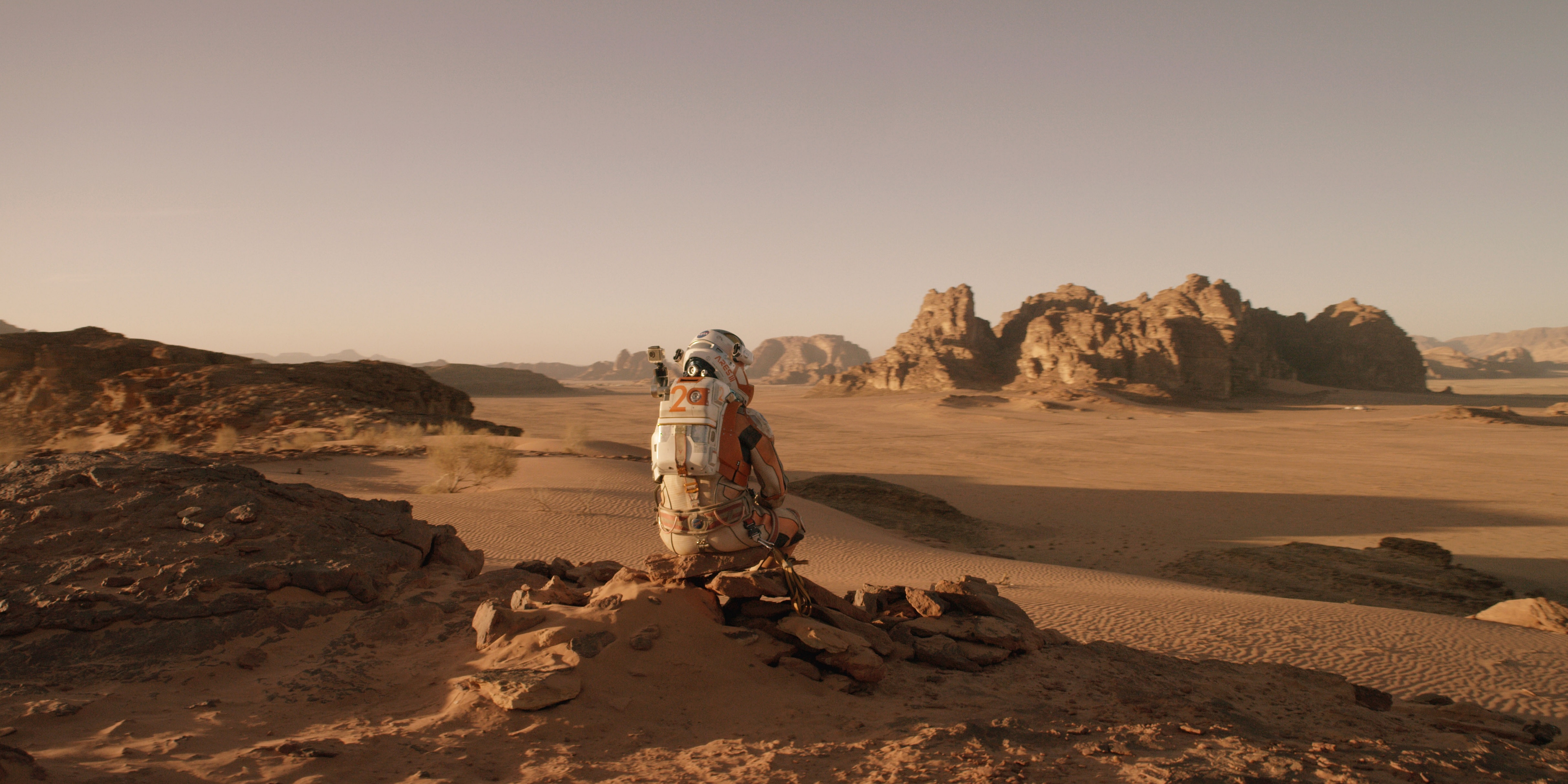
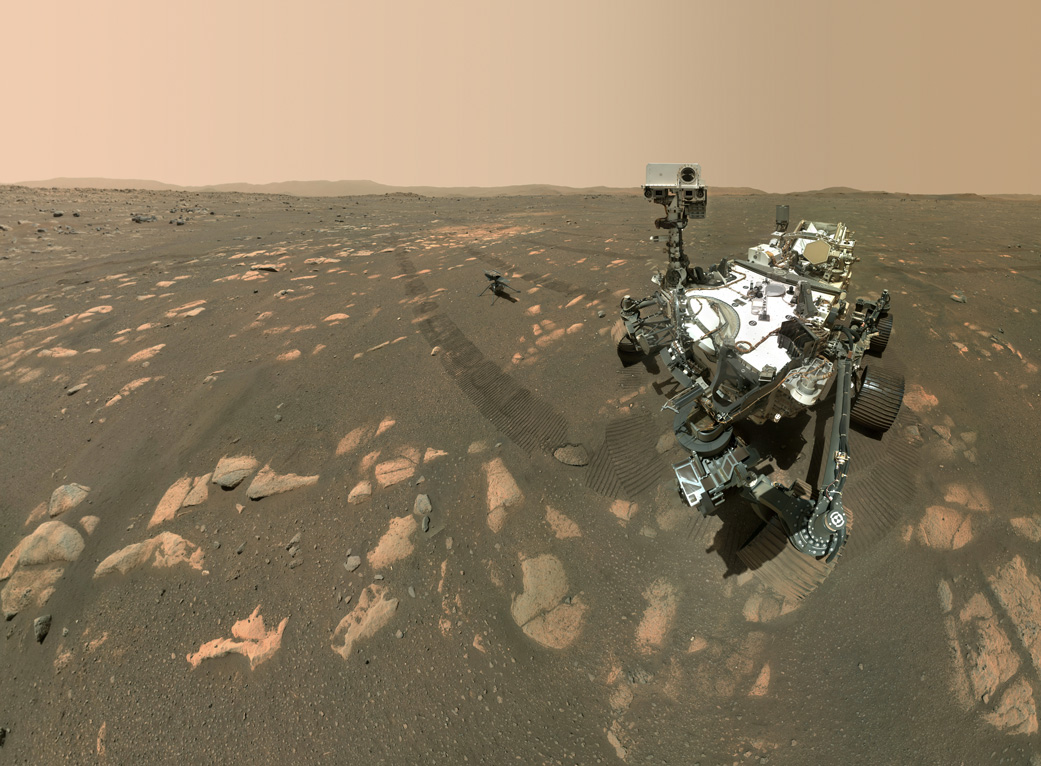
NASA hasn’t landed humans on Mars yet. But thanks to robotic missions, scientists now know more about the planet’s surface than they did when the movie, The Martian, was released.

Our human knowledge is constantly growing. In many, many directions. Here is a fascinating (well it is to me!) article from The Conversation.

ooOOoo

A decade after the release of ‘The Martian’ and a decade out from the world it envisions, a planetary scientist checks in on real-life Mars exploration
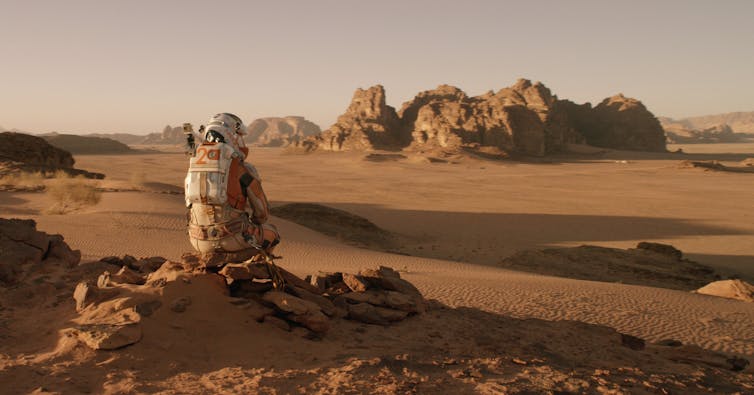
‘The Martian’ protagonist Mark Watney contemplates his ordeal. 20th Century Fox

Ari Koeppel, Dartmouth College

Andy Weir’s bestselling story “The Martian” predicts that by 2035 NASA will have landed humans on Mars three times, perfected return-to-Earth flight systems and collaborated with the China National Space Administration. We are now 10 years past the Hollywood adaptation’s 2015 release and 10 years shy of its fictional timeline. At this midpoint, Mars exploration looks a bit different than how it was portrayed in “The Martian,” with both more discoveries and more controversy.

As a planetary geologist who works with NASA missions to study Mars, I follow exploration science and policy closely. In 2010, the U.S. National Space Policy set goals for human missions to Mars in the 2030s. But in 2017, the White House Space Policy Directive 1 shifted NASA’s focus toward returning first to the Moon under what would become the Artemis program.

Although concepts for crewed missions to Mars have gained popularity, NASA’s actual plans for landing humans on Mars remain fragile. Notably, over the last 10 years, it has been robotic, rather than crewed, missions that have propelled discovery and the human imagination forward.

A diagram showing the steps from lunar missions to Mars missions. The steps in the current scope are labeled 'Human presence on Moon,' 'Practice for Mars Exploration Demo' and 'Demo exploration framework on Mars.' The partial scope step is labeled 'Human presence on Mars.'
NASA’s 2023 Moon to Mars Strategy and Objectives Development document lays out the steps the agency was shooting for at the time, to go first to the Moon, and from there to Mars. NASA

Robotic discoveries

Since 2015, satellites and rovers have reshaped scientists’ understanding of Mars. They have revealed countless insights into how its climate has changed over time.

As Earth’s neighbor, climate shifts on Mars also reflect solar system processes affecting Earth at a time when life was first taking hold. Thus, Mars has become a focal point for investigating the age old questions of “where do we come from?” and “are we alone?

The Opportunity, Curiosity and Perseverance rovers have driven dozens of miles studying layered rock formations that serve as a record of Mars’ past. By studying sedimentary layers – rock formations stacked like layers of a cake – planetary geologists have pieced together a vivid tale of environmental change that dwarfs what Earth is currently experiencing.

Mars was once a world of erupting volcanoes, glaciers, lakes and flowing rivers – an environment not unlike early Earth. Then its core cooled, its magnetic field faltered and its atmosphere drifted away. The planet’s exposed surface has retained signs of those processes ever since in the form of landscape patterns, sequences of layered sediment and mineral mixtures.

Rock shelves layered on top of each other, shown from above.
Layered sedimentary rocks exposed within the craters of Arabia Terra, Mars, recording ancient surface processes. Photo from the Mars Reconnaissance Orbiter High Resolution Imaging Science Experiment. NASA/JPL/University of Arizona

Arabia Terra

One focus of scientific investigation over the last 10 years is particularly relevant to the setting of “The Martian” but fails to receive mention in the story. To reach his best chance of survival, protagonist Mark Watney, played by Matt Damon, must cross a vast, dusty and crater-pocked region of Mars known as Arabia Terra.

In 2022 and 2023, I, along with colleagues at Northern Arizona University and Johns Hopkins University, published detailed analyses of the layered materials there using imagery from the Mars Reconnaissance Orbiter and Mars Odyssey satellites.

By using infrared imagery and measuring the dimensions of surface features, we linked multiple layered deposits to the same episodes of formation and learned more about the widespread crumbling nature of the terrain seen there today. Because water tends to cement rock tightly together, that loose material indicates that around 3.5 billion years ago, that area had a drying climate.

To make the discussions about this area easier, we even worked with the International Astronomical Union to name a few previously unnamed craters that were mentioned in the story. For example, one that Watney would have driven right by is now named Kozova Crater, after a town in Ukraine.

More to explore

Despite rapid advances in Mars science, many unknowns remain. Scientists still aren’t sure of the precise ages, atmospheric conditions and possible signatures of life associated with each of the different rock types observed on the surface.

For instance, the Perseverance rover recently drilled into and analyzed a unique set of rocks hosting organic – that is, carbon-based – compounds. Organic compounds serve as the building blocks of life, but more detailed analysis is required to determine whether these specific rocks once hosted microbial life.

The in-development Mars Sample Return mission aims to address these basic outstanding questions by delivering the first-ever unaltered fragments of another world to Earth. The Perseverance rover is already caching rock and soil samples, including ones hosting organic compounds, in sealed tubes. A future lander will then need to pick up and launch the caches back to Earth.

Sampling Mars rocks could tell scientists more about the red planet’s past, and whether it could have hosted life.

Once home, researchers can examine these materials with instruments orders of magnitude more sensitive than anything that could be flown on a spacecraft. Scientists stand to learn far more about the habitability, geologic history and presence of any signs of life on Mars through the sample return campaign than by sending humans to the surface.

This perspective is why NASA, the European Space Agency and others have invested some US$30 billion in robotic Mars exploration since the 1960s. The payoff has been staggering: That work has triggered rapid technological advances in robotics, telecommunications and materials science. For example, Mars mission technology has led to better sutures for heart surgery and cars that can drive themselves.

It has also bolstered the status of NASA and the U.S. as bastions of modern exploration and technology; and it has inspired millions of students to take an interest in scientific fields.
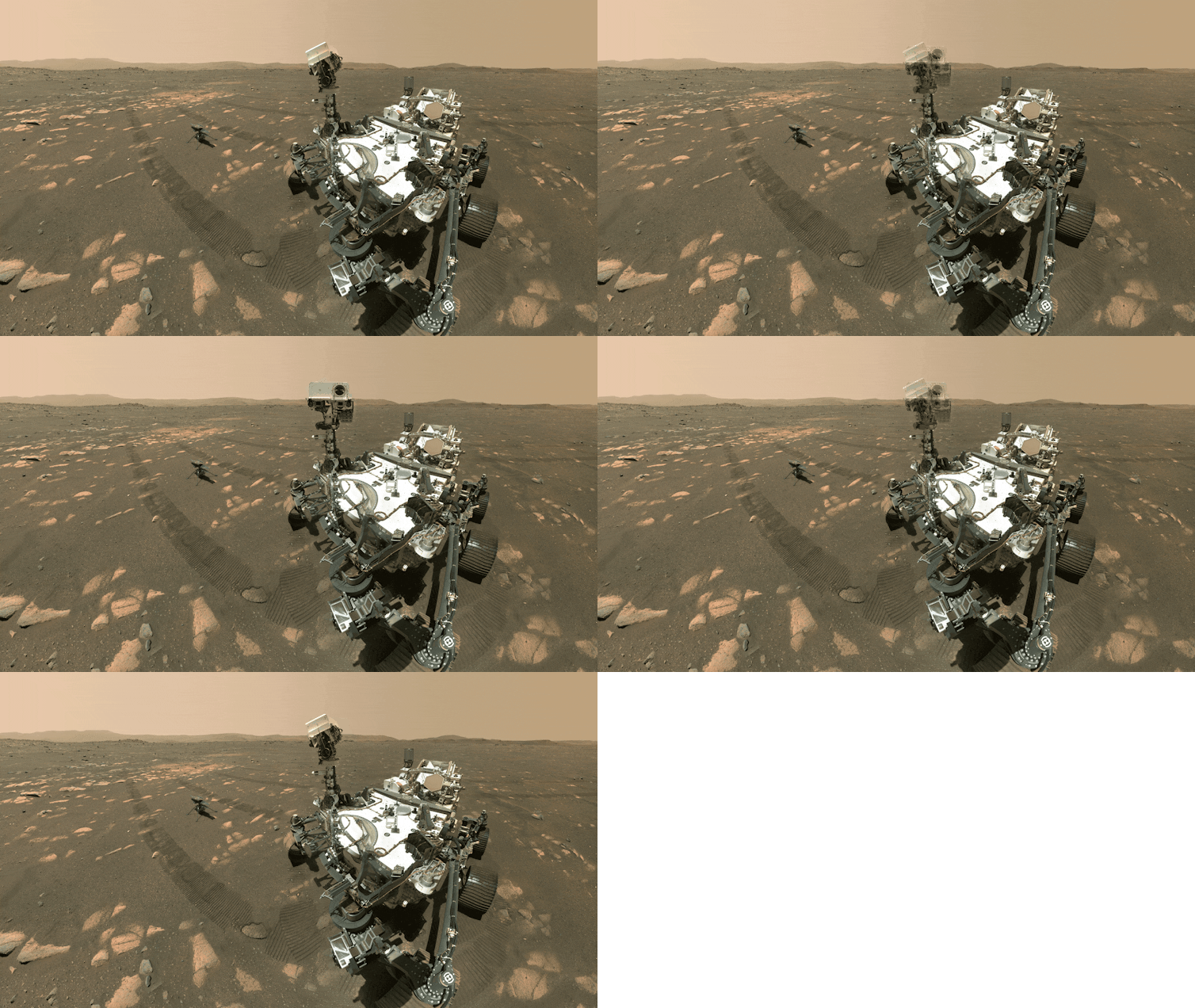
The Perseverance rover and the Ingenuity helicopter on the Martian surface, with the rover's camera moving to look down at Ingenuity.
A selfie from NASA’s Perseverance Mars rover with the Ingenuity helicopter, taken with the rover’s extendable arm on April 6, 2021. NASA/JPL-Caltech/MSSS

Calling the red planet home?

Colonizing Mars has a seductive appeal. It’s hard not to cheer for the indomitable human spirit while watching Watney battle dust storms, oxygen shortages and food scarcity over 140 million miles from rescue.

Much of the momentum toward colonizing Mars is now tied to SpaceX and its CEO Elon Musk, whose stated mission to make humanity a “multi-planetary species” has become a sort of rallying cry. But while Mars colonization is romantic on paper, it is extremely difficult to actually carry out, and many critics have questioned the viability of a Mars habitation as a refuge far from Earth.

Now, with NASA potentially facing a nearly 50% reduction to its science budget, the U.S. risks dissolving its planetary science and robotic operations portfolio altogether, including sample return.

Nonetheless, President Donald Trump and Musk have pushed for human space exploration to somehow continue to progress, despite those proposed cuts – effectively sidelining the robotic, science-driven programs that have underpinned all of Mars exploration to date.

Yet, it is these programs that have yielded humanity’s richest insights into the red planet and given both scientists and storytellers like Andy Weir the foundation to imagine what it must be like to stand on Mars’ surface at all.

Ari Koeppel, Postdoctoral Scientist in Earth and Planetary Science, Dartmouth College

This article is republished from The Conversation under a Creative Commons license. Read the original article.

ooOOoo

Nothing to add from yours truly except to say that this quote is highly relevant: “Challenges are what make life interesting and overcoming them is what makes life meaningful.” – Joshua J. Marine

(And this was the result of me looking online for quotes and coming across 50 quotes from USA Today.)
Artificial intelligence to the rescue

The colonisation of space.

Patrice Ayme is a writer who lives in France and is a person of extreme breadth of knowledge, and very clever to boot.

He writes blog posts on a variety of topics. His latest post is breathtakingly powerful and could be the way we all go over the future years. Read it for yourself online or as follows:

ooOOoo

How Solar System Colonization Will Save Earth

By Patrice Ayme

Saving Earth and colonizing the Solar System are basically the same problem and have the same solution: much more advanced technology [1]. There is no contradiction, far from it. There is complementarity, as technology that will have to be developed for space will be found to be useful for Earth. For psycho-political reasons those technologies won’t be developed directly for Earth. So those who complain about space, while claiming we should focus on Earth, get it only half right.

Colonizing Mars with present technology is not going to happen anymore than the technology of the 1960s enabled to colonize the Moon. A visit from a human crew on Mars with the technology SpaceX wants to develop is imaginable… Barely.  And those will just be visits, multi-year commitments full of lethal radiation and worse living accommodations than the highest maximum security prison: basically what was done on the Moon in the 1960s, but much more daunting.

It’s much more feasible to establish bases on the Moon. First, there is plenty of oxygen and hydrogen (so water) on the Moon, imprisoned in rocks: one only needs energy to extract them, and the Moon has plenty of that (solar panels!) Second, the gravity well of the Moon is also half that of Mars. Third, the Moon is close by and one can go there all the time (whereas Mars can be visited with present fossil fuel tech only every two years, when the planets align; serious commuting of goods and people between Earth and Mars will require nuclear propulsion).Monitoring robots on the Moon is possible, whereas on Mars, with up to twenty minutes delay, one will have to use advanced, autonomous AI. Fixing problems caused by dust in robots on the Moon with roaming human crews… A solution that won’t exist on Mars, for decades. 

Thus AI is the first order solution: AI just needs energy, not shelter, air, water and food. AI colonies on the Moon, and then, later, Mars could build environments that humans could then inhabit. Say pressurized lava tubes… 

Skeptics could object that I didn’t roll out specific techs. But space colonization, especially if robot and AI driven, will require much higher tech. For example solar energy, which works wonderfully, was led by its usage in space… where it has long worked splendidly. The solar cells used in space have an efficiency more than twice that of the ones used on the ground… from using more advanced (but expensive) materials, like Gallium… That has invited researchers and companies to boost the efficiency of the silicon and now perovskites cells used on the ground. SpaceX uses Reliable Reusable Rockets (RRR), lowering the cost of space access… That is revolutionary, but actually follows the tech used to land on the Moon in the first place. But the first landing rockets, the LEMS, were Lunar Exploration Modules… They showed the way…

Technology is impossible without wisdom, and wisdom impossible without technology. One can’t grow without the other. The quest for tech is a quest for wisdom.

We don’t need AI on Earth, at least so many “leaders” will think (and they would be very wrong)… However, for space colonization, clearly, we need AI. Space AI will then bring in the Earth AI we need to solve countless problems, including the ones we didn’t think we had. 

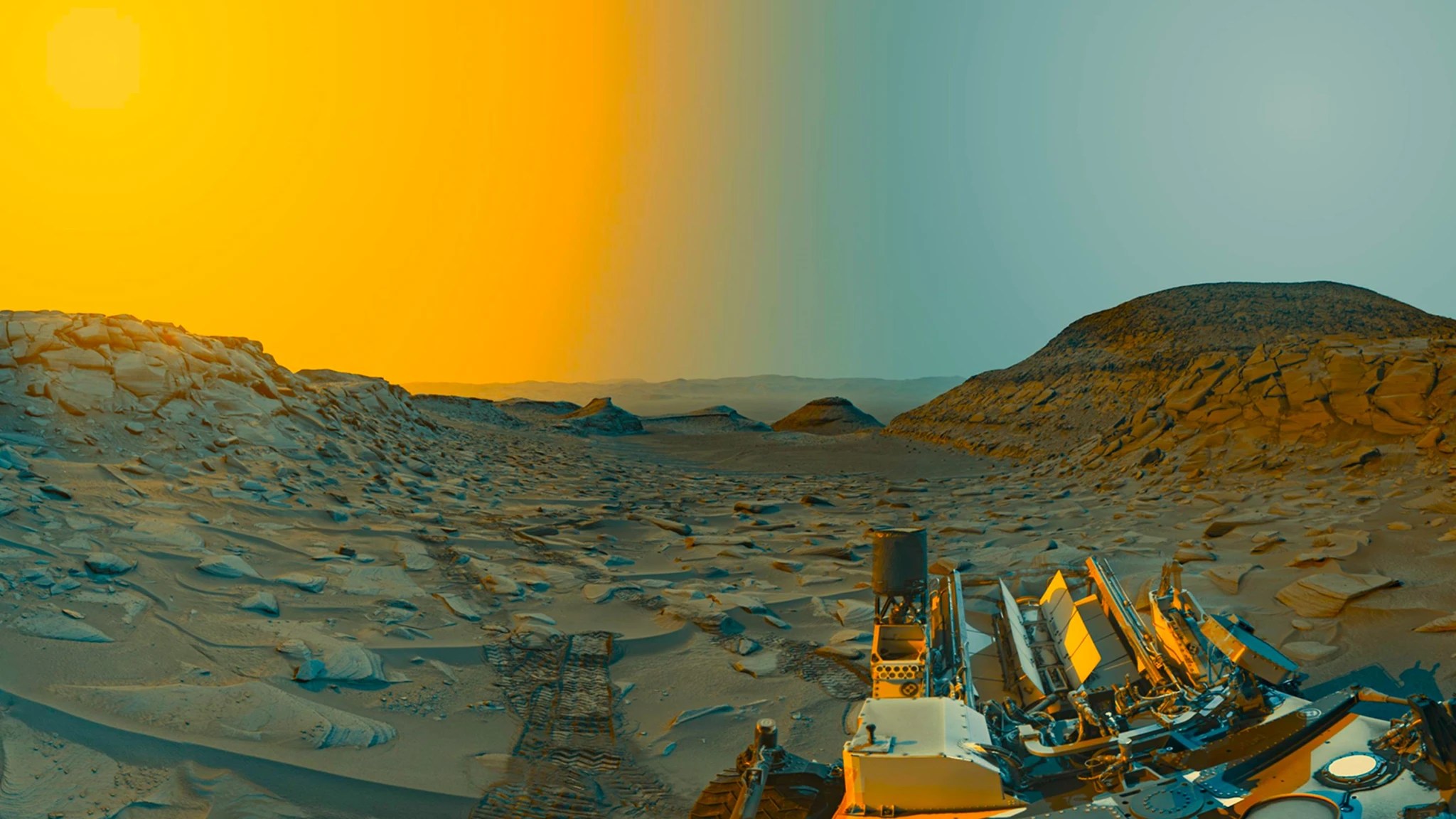
NASA picture from Curiosity rover on a rather barren, poisonous, irradiated, dusty and dry Mars

P/S: Scifi novels are an old genre: The Birds of Aristophanes, making fun of the colonies Athens established everywhere, by establishing one in the sky, preceded the space colonization of Lucian by seven centuries… 

***

[1] The European solution to the Earth Crisis has been Mathusianism: use less energy. This weakens Europe and encourages its dictatorial enemies. Actually the best solution is rather the opposite: to use more ABSOLUTE WORTH ENERGY. Use, much more EFFICIENT energy. In particular, we have to leverage fossil fuels to get out of them… using the energy they provide to invent new science and tech….

ooOOoo

Yet another masterpiece from Mr. Ayme. I cannot add anything to this post except to applaud it.

Well done the team at NASA.

What an outstanding feat.

Many, many congratulations!

On Feb. 18, 2021, NASA’s Mars Perseverance rover makes its final descent to the Red Planet.

A little more information:

Landed: Feb. 18, 2021, 12:55 p.m. PST (3:55 p.m. EST), (20:55 UTC)

Landing Site: Jezero Crater, Mars

Mission Duration: At least one Mars year (about 687 Earth days)

Main Job: The Perseverance rover will seek signs of ancient life and collect rock and soil samples for possible return to Earth.

As someone who watched the television non-stop in 1969 to see man’s remarkable achievement, NASA has been an organisation of considerable interest all my life.

At 10:56 p.m. EDT Armstrong is ready to plant the first human foot on another world. With more than half a billion people watching on television, he climbs down the ladder and proclaims: “That’s one small step for a man, one giant leap for mankind.

What an achievement!

Wow! What a stupendous sight!

Mars!

I’m not going to do anything other than launch straight into this post. Taken from EarthSky.

ooOOoo

Curiosity rover on Mars snags highest-resolution panorama yet

Picture Parade Two Hundred and Ninety-Four

About as far away from dogs as one can get!

ooOOoo

Best photos of the Mercury-Mars conjunction

Posted by in ASTRONOMY ESSENTIALS | TODAY’S IMAGE June 23, 2019

It was the closest conjunction of 2 planets in 2019, between Mercury and Mars. It happened low in the evening twilight – and was best seen from Earth’s Southern Hemisphere. Check out these photos from EarthSky Community members.

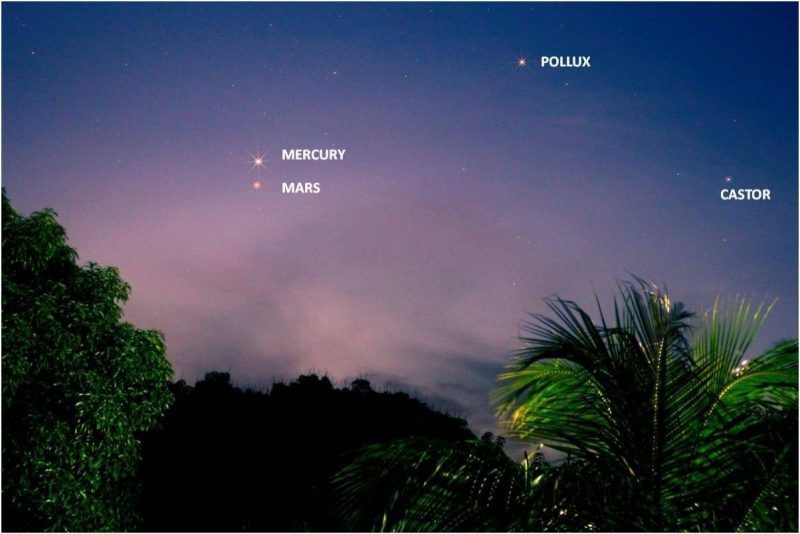
Dr Ski in Valencia, Philippines, caught Mars and Mercury on the day following their conjunction, June 19, 2019. The nearby stars Castor and Pollux in the constellation Gemini are a great comparison. Those 2 stars are noticeable for being bright and close together. Mercury and Mars were much closer! Thanks, Dr Ski!

Wow! You can really see the color difference between red Mars (on the left) and Mercury in this photo from the day of the conjunction – June 18, 2019 – by Peter Lowenstein in Mutare, Zimbabwe. Thanks, Peter!

Here’s a June 17 photo from Jose Lagos in Vaals, Netherlands. He wrote, “This was the last image I could get before June 18, when it was too cloudy near the horizon, but you can see that the conjunction is nearly perfected. It was beautiful to behold even this much of it. Thank you for your time and your great work at Earth Sky.” Thank you for your photo and kind words, Jose!

Gilbert Vancell caught the planets on June 18, too, and wrote: “Mercury (top) and Mars setting behind Comino Tower. Shot from Armier, Malta.”

Helio C. Vital captured in Rio de Janeiro, Brazil, on June 18, 2019. He wrote, “Despite the fact that many clouds were floating over my western horizon this evening, I could get some photos of Mercury and Mars only 14 arcminutes apart over Rio de Janeiro at dusk (from 17:45 to 18:30 UTC-3h, June 18, 2019).Forming a beautiful close pair through binoculars, Mercury was an easy naked-eye target while Mars (4.4 times dimmer) required the use of averted vision to be briefly spotted. Hope my images can help give you an idea of what the interesting event looked like.”

Bottom line: Photos from the night of and around the June 18, 2019, conjunction of Mercury and Mars, closest conjunction of two planets this year.

ooOOoo

I hope a few of you enjoyed today’s Picture Parade.

Here’s to July!

Out of this world!

Literally!

I noticed the other day a series of photographs of the moon and Venus that were included in an item on EarthSky News. All I am going to do is to republish a selection of the photographs so if you would like to read the full item, including all the photographs, then here is the link.

Mohamed Laaïfat Photographies in Normandy, France caught the little planet Mercury, too, along with the moon and Venus, on January 21.

oooo

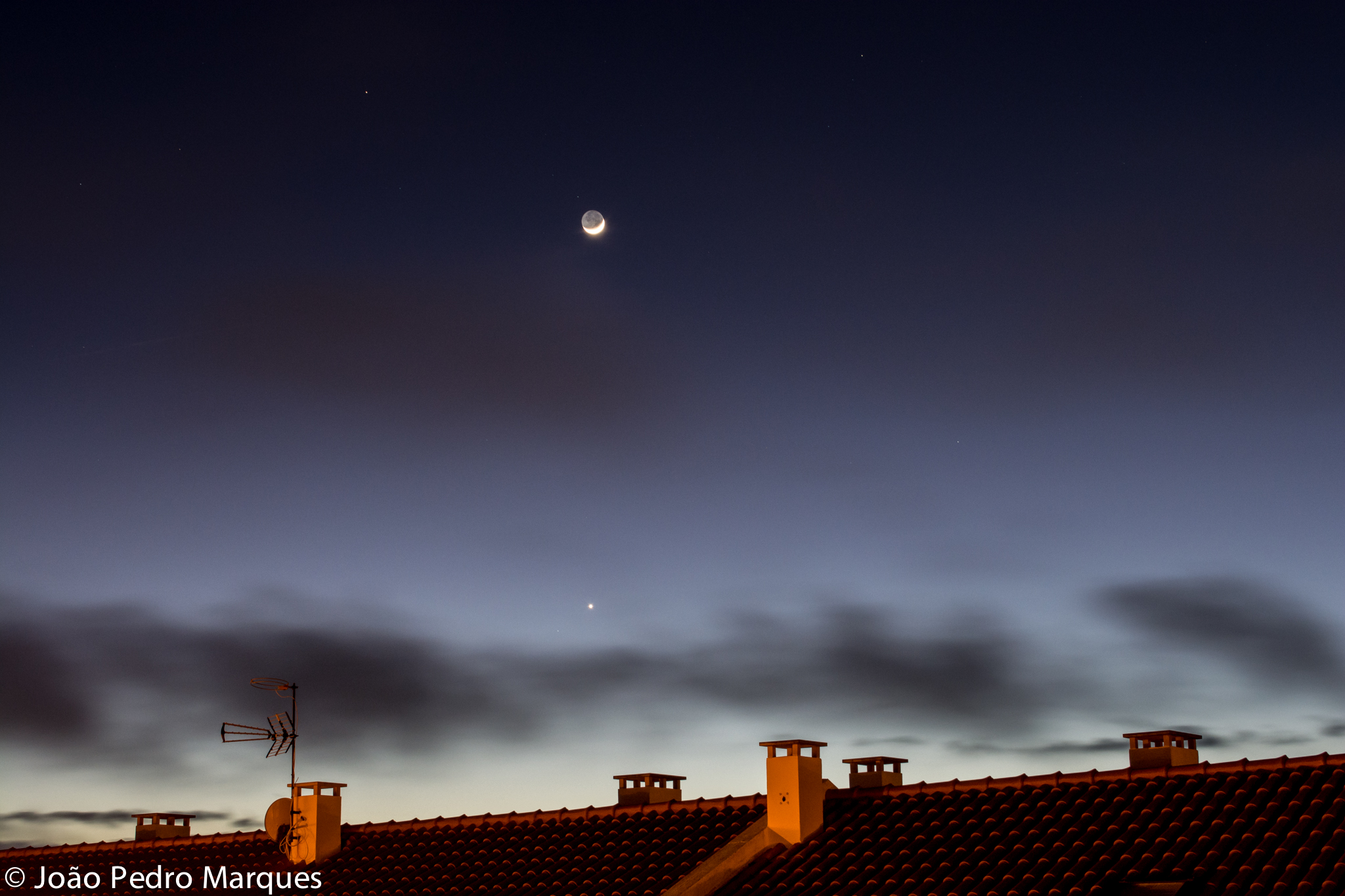
João Pedro Marques caught bright Venus and the waxing moon on the evening of January 22, 2015, from Portugal. The reddish “star” above and to the left of the moon is Mars.

In the above image, Mars may only be seen by viewing a bigger image here.

One Horse Media in Lolo, Montana wrote: “What a cool moon and view of Venus this evening! I was happy to have just enough time to take a few photos as soon as I got home!”

oooo

Hecktor Barrios in Hermosillo, Mexico wrote: “Venus, Moon and Mercury, the latter barely visible."
Hecktor Barrios in Hermosillo, Mexico wrote: “Venus, Moon and Mercury, the latter barely visible.”

oooo

Planet Venus and young moon on January 21, 2015, as captured by Cathy Emmett Palmer in Panama City Beach, Florida.

Won’t add any more thoughts from me because each and every one of you will have your own feelings and responses to these photographs. Don’t want my ideas to get in the way of your own thoughts.

Just all of you have a wonderful and peaceful weekend.

Clouds above, and even farther away.

The second, and last, episode of the BBC Clouds Lab programme offers an intriguing message.

On Monday, I published a post under the title of The clouds above us.  The second episode demonstrated that even in atmospheric conditions of near vacuum, intense cold and very low humidity, conditions that would kill a human in seconds, there was microscopic bacteriological material to be found.

 Exploring the troposphere

The troposphere is a turbulent layer of air that begins at the Earth’s surface and ranges from 23,000-65,000 feet above sea level, depending on the latitude, season and the time of day. Its name originates from the Greek word tropos, meaning change. It’s now known that bacteria actually exists in clouds and scientists believe that it plays a significant part in the creation of rain but little is known about life higher up. Microbiologist Dr Chris Van Tulleken has discovered that living bacteria can exist well above 10,000ft in a hostile environment with low pressure, increased UV radiation, freezing temperatures, high winds and no oxygen or water.

There is an interesting set of clips to be watched on that BBC Cloud Lab website.

What I took away from watching the programme was that the minimum conditions necessary for living bacteria were far more harsh than one might expect.  In other words, finding living bacteria in other solar systems might not be such a science-fiction idea.

With that in mind, I’m republishing an essay that Patrice Ayme wrote in 2013.  I’m grateful for his permission to so do.

ooOOoo

40 Billion Earths? Yes & No.

Up to twenty years ago, a reasonable opinion among scientists was that there might be just one solar system. Ours. Scientists like to project gravitas; having little green men all over didn’t look serious.

However, studying delicately the lights of stars, how they vary, how they doppler-shift, more than 1,000 planets have been found. Solar systems seem ubiquitous. Astronomers reported in 2013 that there could be as many as 40 billion habitable Earth-size planets in the galaxy. However, consider this:

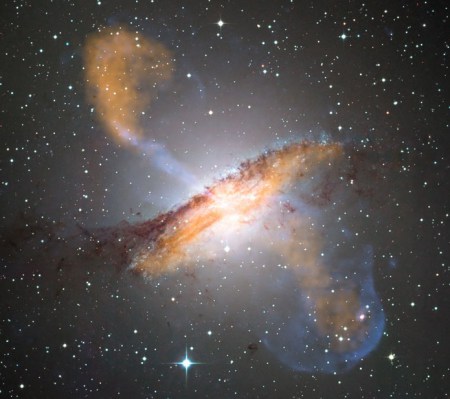
Centaurus A: Lobes Of Tremendous Black Hole Explosion Fully Visible.

Yes, that’s the center of a galaxy, and it has experienced a galactic size explosion from its central black hole.

One out of every five sun-like stars in our galaxy has a planet the size of Earth circling it in the Goldilocks zone, it seems — not too hot, not too cold — with surface temperatures compatible with liquid water. Yet, we have a monster black hole at the center of our giant galaxy, just like the one exploding above.

The Milky Way’s black hole is called Sagittarius A*. It exploded last two million years ago. Early Homo Erectus, down south, saw it. The furious lobes of the explosion are still spreading out, hundreds of thousands of light years away.

We are talking here about explosions potentially stronger than the strongest supernova by many orders of magnitude (depending upon the size of what’s falling into Sagittarius. By the way, a cloud is just heading that way).

Such galactic drama has a potential impact on the presence of advanced life. The richer the galaxy gets in various feature the situation looks, the harder it looks to compute the probability of advanced life.

The profusion of habitable planets is all the more remarkable, as the primitive methods used so far require the planet to pass between us and its star.

(The research, started on the ground in Europe, expanded with dedicated satellites, the French Corot and NASA’s Kepler spacecraft.). Sun-like stars are “yellow dwarves”. They live ten billion years.

From that, confusing “habitable” and “inhabitated”, the New York Times deduced: “The known odds of something — or someone — living far, far away from Earth improved beyond astronomers’ boldest dreams on Monday.

However, it’s not that simple.

Primitive bacterial life is probably frequent. However advanced life (animals) is probably very rare, as many are the potential catastrophes. And one needs billions of years to go from primitive life to animals.

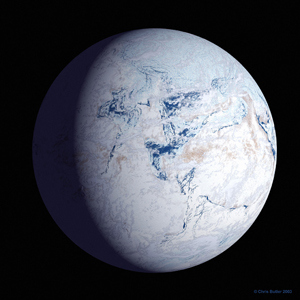
After life forms making oxygen on Earth appeared, the atmosphere went from reducing (full of strong greenhouse methane) to oxidizing (full of oxygen). As methane mostly disappeared, so did the greenhouse. Earth froze, all the way down to the equator:

When Snowball Earth Nearly Killed Life.

Yet volcanoes kept on belching CO2 through the ice. That CO2 built up above the ice, caused a strong greenhouse, and the ice melted. Life had survived. Mighty volcanism has saved the Earth, just in time.

That “snowball Earth” catastrophe repeated a few times before the Earth oxygen based system became stable. Catastrophe had been engaged, several times, but the disappearance of oxygen creating life forms had been avoided, just barely.

Many are the other catastrophes we have become aware of, that could wipe out advanced life: proximal supernovas or gamma ray explosions.

Cataclysmic eruption of the central galactic black hole happen frequently. The lobes from the last one are still visible, perpendicularly high off the galactic plane. The radiation is still making the Magellanic Stream simmer, 200,000 light years away. Such explosions have got to have sterilized a good part of the galaxy.

In 2014 when part of the huge gas cloud known as G2 falls into Sagittarius A*, we will learn better how inhospitable the central galaxy is for advanced life.

Many of the star systems revealed out there have surprising feature: heavy planets (“super Jupiters“) grazing their own stars. It’s unlikely those giants were formed where they are. They probably swept their entire systems, destroying all the rocky planets in their giant way. We don’t understand these cataclysmic dynamics, but they seem frequent.

Solar energy received on Earth fluctuated and changed a lot, maybe from one (long ago) to four (now). But, as it turned out just so that Earthly life could survive. Also the inner nuclear reactor with its convective magma and tectonic plates was able to keep the carbon dioxide up in the air, just so.

The Goldilocks zones astronomers presently consider seem to be all too large to allow life to evolve over billions of years. They have to be much narrower and not just with red dwarves (the most frequent and long living stars).

One of our Goldilocks, Mars, started well, but lost its CO2 and became too cold. The other Goldilocks, Venus, suffered the opposite major technical malfunction: a runaway CO2 greenhouse.

Mars’ axis of rotation tilts on the solar system’s plane enormously: by 60 degrees, over millions of years. So Mars experiences considerable climatic variations over the eons, as it goes through slow super winters and super summers (it’s imaginable that, as the poles melt, Mars is much more habitable during super summers; thus life underground, hibernating is also imaginable there).

Earth’s Moon prevents this sort of crazy hyper seasons. While, differently from Venus, Earth rotates at reasonable clip, homogenizing the temperatures. Venus takes 243 days to rotate.

It is startling that, of the four inner and only rocky planets, just one, Earth has a rotation compatible with the long term evolution of advanced life.

Earth has also two striking characteristics: it has a very large moon that store much of the angular momentum of the Earth-Moon system. Without Moon, the Earth would rotate on itself once every 8 hours (after 5 billion years of braking by Solar tides).

The Moon used to hover at least ten times closer than now, when earth’s days were at most 6 hours long.

The tidal force is the difference between gravitational attraction in two closely separated places, so it’s the differential of said attraction (which is proportional to 1/dd; d being the distance). Hence the tidal force is inversely proportional to the cube of the distance.

Thus on early Earth tides a kilometer high were common, washing back and forth every three hours. a hyper super tsunami every three hours, going deep inside the continents. Not exactly conditions you expect all over the universe.

Hence biological material fabricated on the continental margins in shallow pools would get mixed with the oceans readily. That would guarantee accelerated launch of life (and indeed we know life started on Earth very fast).

The theory of formation of the Moon is wobbly (recent detailed computations of the simplest impact theory do not work). All we know for sure, thanks to the Moon rocks from Apollo, is that the Moon is made of Earth mantle materials.

Somehow the two planets split in two. (Fission. Get it? It maybe a hint.)

Another thing we know for sure is that Earth has, at its core, a giant nuclear fission reactor, keeping Earth’s core hotter than the surface of the sun. An unimaginable liquid ocean of liquid iron deep down inside below our feet undergoes iron weather. Hell itself, the old fashion way, pales in comparison.

Could the Moon and the giant nuclear reactor have the same origin? This is my provocative question of the day. The Moon, our life giver, could well have formed from giant nuclear explosions, of another of our life givers, what became the nuke at the core. I can already hear herds of ecologists yelp in the distance. I present the facts, you pseudo-ecologists don’t decide upon them. It’s clear that nuclear fission is not in Drake equation: if nothing else, it’s too politically incorrect.

All the preceding makes this clear:

Many are the inhabitable planets, yet few will be inhabitated by serious denizens.

This means that the cosmos is all for our taking. The only question is how to get there. The closest stars in the Proxima, Beta and Alpha Centauri system are not attainable, for a human crew, with existing technology.

However, if we mastered clean colossal energy production, of the order of the entire present energy production of humanity, we could get a colony there (only presently imaginable technology would be fusion).

Giordano Bruno, professor, astronomer, and priest suggested that there were many other inhabitated systems around the stars. That insult against Islam meant Christianity was punished the hard way: the Vatican, the famous terrorist organization of god crazies, put a device in Giordano’s mouth that pierced his palate, and having made sure that way that he could not tell the truth, the terrorists then burned him alive. After seven years of torture.

The horror of truth was unbearable to theo-plutocrats.

Now we face something even worse: everywhere out there is very primitive life. It is likely gracing 40 billion worlds. But, if one has to duplicate the succession of miracles and improbabilities that made Earth, to earn advanced life, it may be just here that civilization ever rose to contemplate them.

Congratulations to India for launching yesterday a mission to Mars ostensibly to find out if there is life there (by finding CH4; while life is presently unlikely, Mars has much to teach, including whether it started there). That’s the spirit!

The spirit is to have minds go where even imagination itself did not go before.

If we sit back, and look at the universe we have now, from Dark Matter, to Dark Energy, to Sagittarius, to the nuclear reactor below, to billions of Earths, to a strange Higgs, to Non Aristotelian logic, we see a wealth, an opulence of possibilities inconceivable twenty years ago.

Progress is not just about doing better what was done yesterday. It’s also about previously inconceivable blossoms of entirely new mental universes.

***

Patrice Ayme

ooOOoo

Maybe, we are not alone!

Spices

A fascinating insight and a reminder, courtesy of Alistair Cooke

Jeannie recently gave me the book Alistair Cooke’s America.  The book was published in 1973 and was born out of the scripts that Cooke wrote for the television series America: A Personal History of the United States shown in both countries in 1972.  I can’t recall when I first started listening to the BBC Radio programme Letter from America, broadcast by Cooke, but it was a long time ago considering that the 15-minute programme started to be broadcast on the BBC in March 1946, just 18 months after I was born!


Alistair Cooke Nov 1908 - Mar 2004


Anyway, the motivation to start into the book was born out of a desire to know a lot more about this new country of mine.  But quickly there was a fascinating detour.

Early in Chapter One, The New-found Land, Cooke writes of the consequences of the Turks capturing Constantinople:

In 1453, there was a decisive turn in the centuries of warfare between the Christians of Europe and the Moslems of Asia.  Their common market, bridge, and gateway was Constantinople, our Istanbul.  In 1453, the Turks conquered it, and in so doing shut off the commerce between East and West, the exchange of cloth, leather wines and sword blades of Europe for the silks, jewels, chessmen, and spices of Asia.  All things considered, the stoppage was much harder on the court treasuries of Europe that those of Asia and, in one vital item, harder on all Europeans.  That item was spice.

Cooke then writes about historic change often being caused by the denial of a simple human need.  Shortage of water, total absence of timber for the Egyptians since the time of Solomon, for example.

What I hadn’t realised that for Europeans, spices were regarded as “fundamental to human survival”.  That was simply because in the 15th century spices made food edible.  Cooke writes,

Even in rich houses, the meals came putrid to the table. (Dysentery, by the way, seems to have been considered through most of the last five centuries a hazard as normal as wind and rain.)

Think about that the next time you reach for the pepper!

That led me to think about the enormous benefit that electricity and therefore domestic refrigeration has had on the health and life expectancies of mankind.  It is almost inconceivable to imagine the consequences of a widespread loss of electricity for, say a week, let alone a few months.

Patrice Ayme wrote a guest post for Learning from Dogs that was published on the 26th.  In it he wrote,

But then, after an auspicious start, Mars lost most of most of its atmosphere (probably within a billion years or so). Why? Mars is a bit small, its gravitational attraction is weaker than Earth (it’s only 40%). But, mostly, Mars has not enough a magnetic field. During Coronal Mass Ejections, CMEs, the Sun can throw out billions of tons of material at speeds up to and above 3200 kilometers per seconds. It’s mostly electrons and protons, but helium, oxygen and even iron can be in the mix.

The worst CME known happened during the Nineteenth Century, before the rise of the electromagnetic civilization we presently enjoy. Should one such ejection reoccur now, the electromagnetic aspect of our civilization would be wiped out.It goes without saying that we are totally unprepared, and would be very surprised. Among other things, all transformers would blow up, and they take months to rebuild. we would be left with old books in paper, the old fashion way. A CME can rush to Earth in just one day. (Fortunately the Sun seems to be quieting down presently, a bit as it did during the Little Ice Age.)

So let’s just hope and pray that our continued interest in spices remains a flavouring desire and doesn’t return as a critical need for human survival.

By Paul Handover