Last November, I published a Post on Learning from Dogs under the title of This is rocket science! It included the film Walking on Air shot from the International Space Station.
Anyway, a few days ago, Ginger I. here in Payson, sent me an email with the YouTube version of the film and I decided to include it as the only item in today’s post.
Enjoy.
Time lapse sequences of photographs taken with a 4K-camera by Ron Garan fragileoasis.org/bloggernauts/Astro_Ron and the crew of expedition 28 & 29 onboard the International Space Station from August to October, 2011. All credit goes to them, who to my knowledge shot these pictures at an altitude of around 350 km. I intend to upload a FullHD-version presently.
HD, refurbished, smoothed, retimed, denoised, deflickered, cut, etc. All in all I tried to keep the looks of the material as original as possible, avoided adjusting the colors and the like, since in my opinion the original footage itself already has an almost surreal and aestethical visual nature.
Music: Jan Jelinek | Do Dekor, faitiche back2001 w+p by Jan Jelinek, published by Betke Edition janjelinek.com | faitiche.de
Image Courtesy of the Image Science & Analysis Laboratory, NASA Johnson Space Center, The Gateway to Astronaut Photography of Earth eol.jsc.nasa.gov
1. Aurora Borealis Pass over the United States at Night
2. Aurora Borealis and eastern United States at Night
3. Aurora Australis from Madagascar to southwest of Australia
4. Aurora Australis south of Australia
5. Northwest coast of United States to Central South America at Night
6. Aurora Australis from the Southern to the Northern Pacific Ocean
7. Halfway around the World
8. Night Pass over Central Africa and the Middle East
9. Evening Pass over the Sahara Desert and the Middle East
10. Pass over Canada and Central United States at Night
11. Pass over Southern California to Hudson Bay
12. Islands in the Philippine Sea at Night
13. Pass over Eastern Asia to Philippine Sea and Guam
14. Views of the Mideast at Night
15. Night Pass over Mediterranean Sea
16. Aurora Borealis and the United States at Night
17. Aurora Australis over Indian Ocean
18. Eastern Europe to Southeastern Asia at Night
A timely video from the International Space Station (ISS)
Little did I realise when I posted yesterday’s item that a couple of subsequent actions would make today’s article easy to write (trust me it isn’t always this easy!).
Mike T., a flying buddy from my old days in England, sent me this link to a 5-minute video made up of a series of films shot from the ISS. DO WATCH THE VIDEO IN FULL SCREEN MODE!
The details of how the film was taken and much more interesting information is at the very end of this article.
Then Martin Lack who writes the blog, Lack of Environment, submitted a comment with a link to a piece that he had written on the 19th August that I would like to re-publish in full.
Why are we still waiting for the EU to act?
What can we learn from the fact that the EU has still not stopped buying over 90% of Syria’s oil exports? If nothing else, it tells me that we need fossil fuel too much!
But I think the problem of wrong priorities goes much deeper than that… This is because the Limits to Growth argument (which underlies my concern over AGW) is, even though the protestor-in-the-street may not realise it, the root cause of all the problems we are now seeing in Afghanistan, Bahrain, Cairo, Damascus etc., etc… right through to Zimbabwe: Treating the symptoms of food shortages or corruption (or whatever they may be) will not succeed unless we address the root cause, which is the inevitable consequences of perpetual growth in consumption of resources and/or waste production on a finite planet [see E.F. Schumacher’s Small is Beautiful (1973)].
This 5 minute videomakes sobering viewing, but it also perfectly summarises everything I have learnt in the last 12 months; and all I have posted on my oldMyTelegraph blog in the last 5 months!
It may not be rocket science, but can we reach Escape Velocity?
This stuff is not rocket science, but it is very unwelcome news to people with a vested interest in the continuance of “business as usual”. Unfortunately, we literally cannot go on the way we are; something has got to change…
Extract of paper presented by Dr Myles Allen at 4 Degrees and Beyond Conference (2009)
So a big thank you to Mike T. and Martin Lack for a number of lessons:
how clever man is in terms of space technology besides much more
the beauty of our planet – it’s all we have to live on
the amount of electric light that shines into outer space, as seen by the ISS.
how much of that lighting might be generated by coal and oil!
if we don’t learn to live in harmony, as in sustainably, with this planet of ours, the implications are going to be very serious.
Finally, as mentioned earlier the details of that video on Vimeo.
Time lapse sequences of photographs taken with a 4K-camera by Ron Garan fragileoasis.org/bloggernauts/Astro_Ron and the crew of expedition 28 & 29 onboard the International Space Station from August to October, 2011. All credit goes to them, who to my knowledge shot these pictures at an altitude of around 350 km. I intend to upload a FullHD-version presently.
HD, refurbished, smoothed, retimed, denoised, deflickered, cut, etc. All in all I tried to keep the looks of the material as original as possible, avoided adjusting the colors and the like, since in my opinion the original footage itself already has an almost surreal and aestethical visual nature.
Music: Jan Jelinek | Do Dekor, faitiche back2001 w+p by Jan Jelinek, published by Betke Edition janjelinek.com | faitiche.de
Image Courtesy of the Image Science & Analysis Laboratory, NASA Johnson Space Center, The Gateway to Astronaut Photography of Earth eol.jsc.nasa.gov
1. Aurora Borealis Pass over the United States at Night
2. Aurora Borealis and eastern United States at Night
3. Aurora Australis from Madagascar to southwest of Australia
4. Aurora Australis south of Australia
5. Northwest coast of United States to Central South America at Night
6. Aurora Australis from the Southern to the Northern Pacific Ocean
7. Halfway around the World
8. Night Pass over Central Africa and the Middle East
9. Evening Pass over the Sahara Desert and the Middle East
10. Pass over Canada and Central United States at Night
11. Pass over Southern California to Hudson Bay
12. Islands in the Philippine Sea at Night
13. Pass over Eastern Asia to Philippine Sea and Guam
14. Views of the Mideast at Night
15. Night Pass over Mediterranean Sea
16. Aurora Borealis and the United States at Night
17. Aurora Australis over Indian Ocean
18. Eastern Europe to Southeastern Asia at Night
With great thanks to Dan G. for sending me the link.
Science educator James Drake built this amazing timelapse video from the perspective of the International Space Station as it flew over North and South America. He created this video by downloading a series of 600 photographs that were available online at theGateway to Astronomy Photograph of Earth, and then stitching them together into a complete video. You can see more of James work at his blog: infinity imagined.
A rather poignant moment as the last NASA Space Shuttle is programmed to launch today.
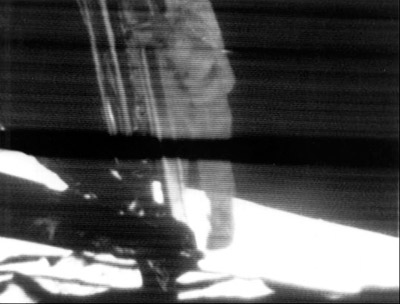
Many of my age will have been fascinated by man’s progress in exploring space, from the Russian Sputnik 1 launched into earth orbit in October, 1957 (I was 12!) through to man first putting a foot on the surface of the moon on 20th July, 1969 on the US Apollo 11 Mission.
Still frame from the video transmission of Neil Armstrong stepping onto the surface of the Moon at 02:56 UTC on 21 July 1969.
Today, the end of an era is being played out. Today, the last Space Shuttle, Atlantis, is due to be launched. From the NASA website,
Date: July 8 Mission: STS-135 Launch Vehicle:Space Shuttle Atlantis Launch Site: Kennedy Space Center – Launch Pad 39A Launch Time: 11:26 a.m. EDT Description: Space shuttle Atlantis will carry the Raffaello multipurpose logistics module to deliver supplies, logistics and spare parts to the International Space Station. Atlantis also will fly a system to investigate the potential for robotically refueling existing spacecraft and return a failed ammonia pump module.
The BBC recently had an interesting news item where all six crew members of Shuttle Discovery were interviewed after that last flight, more details including a video of the interview here.
Astronauts of shuttle Discovery describe ‘amazing’ craft
At almost 27 years old, and with more than 143 million miles on the clock, the space shuttle Discovery returned from her final mission in March.
The crew of Discovery’s final mission, Commander Steve Lindsey, astronauts Eric Boe, Stephen Bowen, Alvin Drew, Michael Barratt and Nicole Stott, spoke to Breakfast News about what it was like to fly the shuttle for the last time.
So where does it go from here?
The current edition of The Economist has a quite a lot to say about that. A leader starts with raising the question of how big the Earth is?
HOW big is the Earth? Any encyclopedia will give you an answer: its equatorial diameter is 12,756km, or, for those who prefer to think that way, 7,926 miles. Ah, but then there is the atmosphere. Should that count? Perhaps the planet’s true diameter is actually nearer 13,000km, including all its air. But even that may no longer be an adequate measure. For the Earth now reaches farther still. The vacuum surrounding it buzzes with artificial satellites, forming a sort of technosphere beyond the atmosphere. Most of these satellites circle only a few hundred kilometres above the planet’s solid surface. Many, though, form a ring like Saturn’s at a distance of 36,000km, the place at which an object takes 24 hours to orbit the Earth and thus hovers continuously over the same point of the planet.
Later, this leader speculates,
The reason for that second objective is also the reason for thinking 2011 might, in the history books of the future, be seen as the year when the space cadets’ dream finally died. It marks the end of America’s space-shuttle programme, whose last mission is planned to launch on July 8th (see article, article). The shuttle was supposed to be a reusable truck that would make the business of putting people into orbit quotidian. Instead, it has been nothing but trouble. Twice, it has killed its crew. If it had been seen as the experimental vehicle it actually is, that would not have been a particular cause for concern; test pilots are killed all the time. But the pretence was maintained that the shuttle was a workaday craft. The technical term used by NASA, “Space Transportation System”, says it all.
But the shuttle is now over. The ISS is due to be de-orbited, in the inelegant jargon of the field, in 2020. Once that happens, the game will be up. There is no appetite to return to the moon, let alone push on to Mars, El Dorado of space exploration. The technology could be there, but the passion has gone—at least in the traditional spacefaring powers, America and Russia.
From STS-1 launched on 12 April 1981 through to today’s planned launch of STS-135, it indeed has been an era for science, for exploration and for adventure.
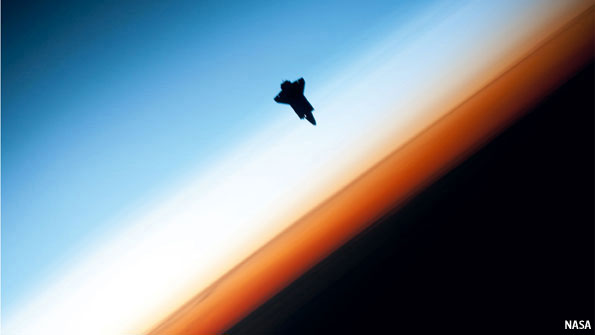
Iconic view of man's urge to explore
UPDATE 10:30 am Mountain Time
Up and safely away!
Still awe-inspiring after all these years. Live BBC feed is here. Travel safely guys!
It is a stunning image and one that is bound to be reproduced over and over again whenever they recall the history of the US space shuttle.
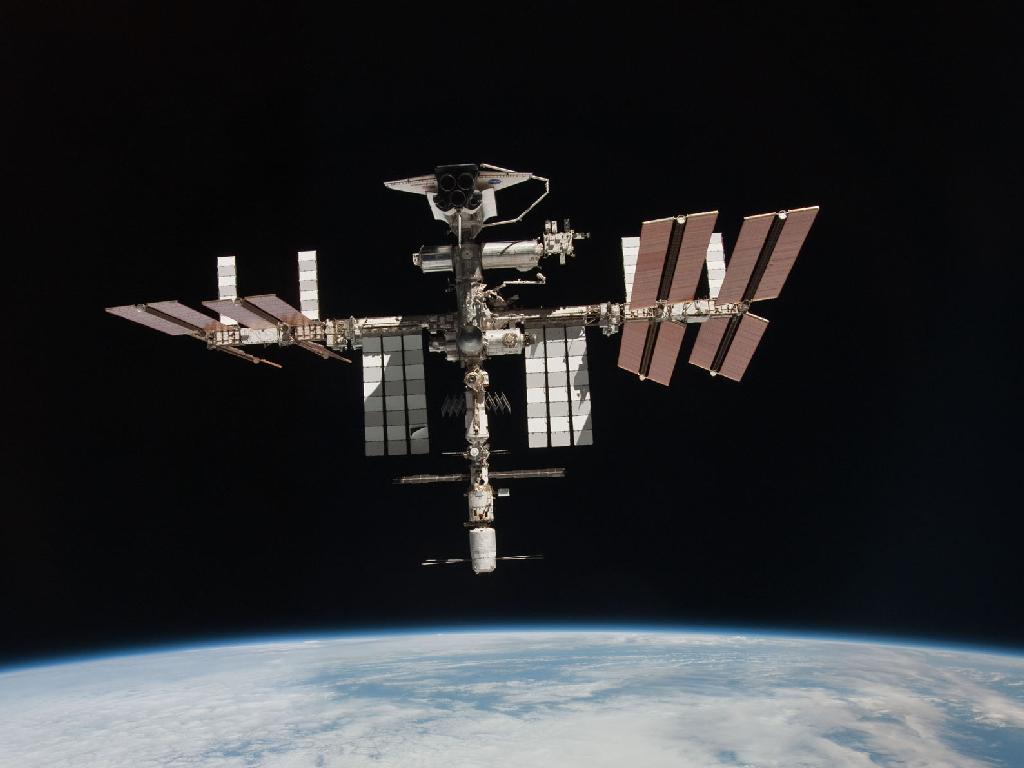
The picture was taken by Italian astronaut Paolo Nespoli as he left the International Space Station in May in a Soyuz capsule to return to Earth.
Safety procedures mean the Russian vehicle would never normally be in transit when a shuttle is present.
It makes this the first-ever image of an American orbiter docked to the ISS.
Endeavour sits firmly on the bow of the station, which is moving across the surface of the Earth at a speed of 27,000km/h (17,000mph) and at an altitude of approximately 355km (220 miles).
Nespoli’s camera is looking along the ISS’s truss, or backbone, which carries the four sets of giant solar wings. The stern is occupied by Europe’s robotic freighter – the Johannes Kepler ship.
The pictures were acquired on 23 May but were only released by the US space agency (Nasa) on Tuesday [7th June, PH]. They had been eagerly awaited by space fans.
Nespoli had spent a lot of time during his 159-day stay at the station taking pictures of Earth and life aboard the international outpost. Many of these images were posted on his mission Flickr account. It was widely expected therefore that the European Space Agency astronaut would get some excellent shots during the unique departure.
Enthusiasts on the ground with telescopes routinely try to snap a shuttle attached to the ISS, and some of the results have been very impressive. But none of these pictures compares to the majestic portrait acquired by Nespoli so close to the orbiting complex.
The timing and subject are also perfect. Endeavour is seen here making her final sortie into orbit, making the last big US assembly item delivery – a $2bn particle physics experiment known as the Alpha Magnetic Spectrometer. The seven-tonne machine now sits on top of the platform.
Endeavour was also the orbiter chosen to take up the first American segment of the platform when the project had just got started in the late 1990s.
The youngest of Nasa’s shuttles returned to Earth on 1 June and will now be prepared for public display at a science museum in California. Sister ship Atlantis stands ready on the launch pad in Florida for a swansong of her own in July. Once her mission is done, no orbiter will ever fly again.
Nespoli’s crewmates in the Soyuz were Russian cosmonaut and Expedition 27 commander Dmitry Kondratyev; and Nasa astronaut Cady Coleman. Apart from the photo opportunity, their departure was a standard ISS crew rotation flight.
Their replacements blasted off from Kazakhstan on Tuesday in another Soyuz vehicle. Nasa astronaut Mike Fossum, Russian cosmonaut Sergei Volkov and Japanese astronaut Satoshi Furukawa are scheduled to arrive at the ISS on Thursday, raising its complement once again to six individuals.
The venerable Soyuz will be the only way for astronauts and cosmonauts to reach the platform in the years following the retirement of the shuttle fleet.
Nasa hopes some US commercial carriers will become available in the middle of the decade.
The NASA weblink attributed above is here, from which can be read,
This image of the International Space Station and the docked space shuttle Endeavour, flying at an altitude of approximately 220 miles, was taken by Expedition 27 crew member Paolo Nespoli from the Soyuz TMA-20 following its undocking on May 23, 2011 (USA time). The pictures taken by Nespoli are the first taken of a shuttle docked to the International Space Station from the perspective of a Russian Soyuz spacecraft. Onboard the Soyuz were Russian cosmonaut and Expedition 27 commander Dmitry Kondratyev; Nespoli, a European Space Agency astronaut; and NASA astronaut Cady Coleman. Coleman and Nespoli were both flight engineers. The three landed in Kazakhstan later that day, completing 159 days in space.
Do go to the NASA website here as there are a total of 40 stunning images.
A wonderful tribute to Yuri Gagarin and all his team.
When I recently wrote of it being 41 years since Swigert on board Apollo 13 transmitted “Okay, Houston, we’ve had a problem here.” I also included a closing reflection as follows,
Finally, this Post is published, not only on the 41st anniversary of that memorable Apollo Flight but the day after the 50th anniversary of Yuri Gagarin’s first flight of a human into space, the 12th April, 1961.
Coincidentally, our favourite documentary film website, Top Documentary Films, featured on April 14th the new film First Orbit. We watched the film that night. It was a most unusual format for a film, yet a most haunting experience. Watching the credits, it then became clear that the film was a co-operative venture made especially for the 50th anniversary of that remarkable, historic flight.
Of course, had I previously been aware of the venture and this remarkable film then it would have been promoted on Learning from Dogs in good time before the anniversary date. However, better late than never!
Indeed, there is a dedicated website in recognition of this First Orbit. Here’s the background to the film,
April 12th 1961 – Yuri Gagarin is about to see what no other person has seen in the history of humanity – the Earth from space. In the next 108 minutes he’ll see more than most people do in a lifetime. What sights awaited the first cosmonaut silently gliding over the world below? What was it like to view the oceans and continents sailing by from such a height?
By matching the orbital path of the Space Station, as closely as possible, to that of Gagarin’s Vostok 1spaceship and filming the same vistas of the Earth through the new giant cupola window, astronaut Paolo Nespoli, and documentary film maker Christopher Riley, have captured a new digital high definition view of the Earth below, half a century after Gagarin first witnessed it.
Weaving these new views together with historic, recordings of Gagarin from the time, (subtitled in Englsih) and an original score by composer Philip Sheppard, we have created a spellbinding film to share with people around the world on this historic anniversary.
The music in the film is most beautiful, quite moving. Here’s the background to the music from the First Orbit website,
First Orbit’s producer Christopher Riley first worked with Philip in 2006 on the Sundance Award winning feature documentary film ‘In the Shadow of the Moon‘ and since then Philip had been working on a new suite of music inspired by spaceflight.
“We’d been working with some of these tracks on another project” says Chris, “and we suddenly realised how perfectly they could compliment ‘First Orbit’ as well. We contacted Philip to ask his permission to use them, only to find that his entire Cloud Song album was already in orbit onboard the International Space Station!”
“NASA astronaut Cady Coleman, had them on her iPod” says Philip. “Her husband Josh Simpson is a friend of mine and they’d listened to a lot of my music together before she left, so I made up a playlist for her!”
Quite by coincidence Cady had been listening to the music in ‘First Orbit’ at one end of the Space Station whilst European Space Agency astronaut Paolo Nespoli was shooting for the film at the other end, without either of them knowing the connection!
Back on Earth Chris and the film’s editor Stephen Slater took Philip’s tracks from Cloud Song and weaved them together with Paolo’s new views of the Earth to create the different moods of the film; from the first views of snowy Siberia to the darkness of night over the Pacific Ocean and the homecoming over Africa, as Gagarin starts to re-enter the atmosphere.
The result is a mesmerising combination of imagary and music which we hope convey the spectrum of emotions which no doubt went through Yuri’s mind as he gazed down upon the Earth.
Finally, here’s the film. It’s an hour and thirty-nine minutes and, as I said, an unconventional film experience. But if any part of you either remembers the event or wonders what it was like, those 50 years ago, then find somewhere out of reach of interruptions and watch the film.



 Learning from Dogs