Tag: Integrity

The Love of a Dog

Pharaoh – from whom I have learnt so much.

German Shepherd, Pharaoh, born June 3rd, 2003

I am your dog and have something I would love to whisper in your ear.

I know that you humans lead very busy lives.  Some have to work, some have children to raise, some have to do this alone.  It always seems like you are running here and there, often too fast, never noticing the truly grand things in life.

Look down at me now.  Stop looking at your computer and look at me.  See the way my dark, brown eyes look at yours.

You smile at me.  I see love in your eyes.

What do you see in mine?  Do you see a spirit?  A soul inside who loves you as no other could in the world? A spirit that would forgive all trespasses of prior wrong doing for just a single moment of your time?  That is all I ask. To slow down, if even for a few minutes, to be with me.

So many times you are saddened by others of my kind passing on.  Sometimes we die young and, oh, so quickly, so suddenly that it wrenches your heart out of your throat.

Sometimes, we age slowly before your eyes that you may not even seem to know until the very end, when we look at you with grizzled muzzles and cataract-clouded eyes.  Still the love is always there even when we must take that last, long sleep dreaming of running free in a distant, open land.

I may not be here tomorrow.  I may not be here next week.  Someday you will shed the water from your eyes, that humans have when grief fills their souls, and you will mourn the loss of just ‘one more day’ with me.

Because I love you so, this future sorrow even now touches my spirit and grieves me.  I read you in so many ways that you cannot even start to contemplate.

We have now together.  So come and sit next to me here on the floor and look deep into my eyes.  What do you see?  Do you see how if you look deeply at me we can talk, you and I, heart to heart.  Come not to me as my owner but as a living soul.  Stroke my fur and let us look deep into the other’s eyes and talk with our hearts.

I may tell you something about the fun of working the scents in the woods where you and I go.  Or I may tell you something profound about myself or how we dogs see life in general.

I know you decided to have me in your life because you wanted a soul to share things with. I know how much you have cared for me and always stood up for me even when others have been against me.  I know how hard you have worked to help me be the teacher that I was born to be.  That gift from you has been very precious to me.  I know too that you have been through troubled times and I have been there to guard you, to protect you and to be there always for you.  I am very different to you but here I am.  I am a dog but just as alive as you.

I feel emotion.  I feel physical senses.  I can revel in the differences of our spirits and souls.  I do not think of you as a dog on two feet; I know what you are.  You are human, in all your quirkiness, and I love you still.

So, come and sit with me.  Enter my world and let time slow down if only for a few minutes.  Look deep into my eyes and whisper in my ears.  Speak with your heart and I will know your true self.  We may not have tomorrow but we do have now.

(Based on an article sent to me, unfortunately from an unknown author, and modified to reflect the special relationship that I have with my 6 year old German Shepherd, Pharaoh.)

By Paul Handover

The Delusions of Leadership

The British ‘silly season’ approaches!

The current British Prime Minister

Well, this is election season in Britain, or as near as it gets ….. no doubt British PM Gordon Brown will wait to the last possible moment in the hope that either oil in vast quantities will be struck  on Salisbury Plain or that David Cameron will be found wandering around near the men’s toilets on Wandsworth Common late one night.

But Gordon-Brown’s procrastination has almost reached its consume-by date and everyone expects an announcement soon for an election on May 6th.

This will be a momentous election. As it seems that British politics has evolved into mammoth-long parliamentary stints – a bit like Japan – the government of the next 15 years could be up for grabs.  Will we stagger along under the camel-breaking weight of turgid bureaucracy, overspending and debt under Labour or emerge post-election into the great entrepreneurial leap forward à la Maggie Thatcher Mark II? (this is a slight over-simplification for newcomers to British politics).

We’ll see, but one of the most fascinating aspects of general elections is always to listen to what politicians say.  On rare occasions we may be inspired and amazed by their vision and rhetoric, but unfortunately one’s reaction is more often one of total disbelief. I had one of the latter yesterday when I read the following in the Guardian:

“I will continue as Labour leader even if I lose election, “Gordon Brown says.

Now nobody pretends being British PM is easy, but one does at least hope that one’s leader – the one with the finger on the nuclear button after all – will not lose touch with reality. And the idea that Brown could soldier on after a defeat is surreal.

He was never actually elected by his party in the first place, nor of course as PM by the British Public. He has already nearly been thrown out a couple of times by his own party so what possible justification could there be for trying to stay on in defeat? Is the following a justification?

“I owe it to people to continue and complete the work we have started of taking this country out of the most difficult global financial recession.” (Reuters)

Does he really think that NOBODY ELSE can save Britain? Megalomaniac delusions, I fear. And IF he loses the election, the Labour Party could face another 15 years in opposition. The idea of Brown staggering on until he drops is rather sobering.

Mr Brown didn’t NEED to say what he did; the usual politician’s deviousness would have sufficed: “no point speculating about hypothetical situations …. ” and so on …. the fact that he cannot seem to imagine NOT being leader after so many years of playing sulky bridesmaid to the slick and charismatic Tony Blair is pathetic in the true sense of the word.

In sport, business, love and politics, there comes a time when you have to give up, and leading your party to defeat at an election is one of them ……..

PS Of course, he could WIN the election! Oh dear …… pass me the Glenfiddich …..

Glenfiddich Caoran Reserve 12 Years Old

By Chris Snuggs

Alan Peters

What is it about wood?

The smell of wood shavings!

When I was a very young boy at Grammar School (aka High School) in Wembley, North West London, one of the subjects taught was wood-working.  I loved the feel of wood, still do, and the smell of a wood shaving fresh off the wood plane is still remembered.  But, for whatever reason, wood and I never got on.

Later on, my first yacht was a pretty little East Coast gaff cutter, built in 1898, with a hull of pitch pine laid on grown oak frames.  Her original name was Mimms but this had been changed to Esterel by the time she was purchased by me. Despite needing a lot of remedial work, the over-riding memory was how the hull ‘spoke’ when she was being sailed.

It’s almost as though wood doesn’t die when the tree is felled, it just passes into another phase depending on the use made of it.

So where’s this all leading?

Alan Peters who died October 11th, 2009

In the issue of The Economist dated November 7th, 2009, there was an obituary about Alan Peters, furniture maker, who died on October 11th, 2009, aged 76.  Like all obits. that appear in The Economist this was well published but something about this particular obituary really stuck in my mind.  I tore out the page so it could be re-read over the coming weeks.

It’s still on my desk even 6 months later and it prompted me to write about Alan Peters on Learning from Dogs.

Here’s an extract of the obituary of Alan Peters as published in the The Times.

In contrast to many of today’s school-leavers, who look for instant success and celebrity, the furniture designer Alan Peters served seven years’ apprenticeship in the workshop of Edward Barnsley, which then operated without power tools. When interviewed last year Peters was still proud that he swept the workshop floor quicker and better than anyone else. His eagerness to share his passion and knowledge of furniture design and furniture making was a theme of his life.

And here’s another reflection from David Savage who studied under Alan Peters:

Damn, Damn, Damn, I am getting fed up writing obituries on dead furniture makers. Why can’t they just go on for ever.

I knew Alan quite well. He was a role model and a mentor when I really needed one. This would be way back in the late 1970s when there were very few people making modern furniture in a barn in Devon which is what I wanted to do. Even fewer making a living doing it. I had all the questions and Alan as far as I could see had all the answers. I spent a short time working with him. I was first in the workshop in the morning and last out in the evening. I’m sure he got fed up with my questions but he patiently answered. He gave and gave and gave. When I was set up he helped me get into the Devon Guild of Craftsmen and much later he would come to my workshop in Bideford to give Saturday seminars showing slides of his work and trips to Japan and Korea. He was an inspiration I know not just to me but to a generation of makers. I miss him.

Question: How many furniture makers does it take to change a light bulb?

Answer: Ten, one to change the bulb and nine to discuss at length how Alan would do it.

By Paul Handover

Let there be markets

Here’s a novel idea – make markets be markets!

I apologise for the rather trite sub-heading but it was a bit of attention grabbing to promote the results of a recent conference called Let Markets Be Markets.  It was published by the Roosevelt Institute and had one very impressive line of speakers.

One of the speakers was Simon Johnson of Baseline Scenario fame, a Blog that Learning from Dogs has followed since our inception.

Here’s 8 minutes of Simon pulling no punches.

If you want to read and watch other presentations, then Mike Konczal’s Blog Rortybomb is the place to go.

As this Blog has repeated from time to time, this present crisis is a long way from being over.

By Paul Handover

The EU and the European Taxpayer

Integrity? Here is your quiz question for today:

Which international, taxpayer-funded organisation has an unelected crony of the British Prime Minister in a high-level post (though not the highest) who earns more than the President of the United States and double the salary of Hillary Clinton?

Clue!

Yes, you’re right. It is the European Union. This is an organisation of member states that in principle is supposed to be

Baroness Ashton

about creating a free, democratic and open market in Europe. It has turned into a proto-state (in the eyes of the Brusselocrats) which – therefore – has to have a “Foreign Minister”, in this case Baroness Ashton.

This is a person with very little knowledge of international affairs sent by Gordon Brown to Brussels because he couldn’t afford to lose Peter Mandelson or David Milliband. This is a person never elected to any public post, yet who receives a vast salary and benefits package higher than that of ANY of the Presidents and/or Prime Ministers of ANY of the member states of the EU.

As “The Daily Mail” points out, in addition to this very large salary the Foreign Minister also enjoys an extraordinary raft of other benefits:

“Her basic pay of £250,000 is double that of her U.S. counterpart, Hillary Clinton (who’s on £124,000). And on top of that, Lady Ashton is entitled to a raft of benefits including a £38,000 yearly accommodation allowance, £10,000 annual entertainment budget, two chauffeurs, plus thousands of pounds more in sundry allowances and – if she survives – a pension of £64,000 pa (three times the average salary in Britain) plus a “golden handshake” of over £450,000.”

All this goes hand-in-hand with billions spent on the new EU “diplomatic service”.

But hang on a minute! The EU is NOT A STATE!

The EU has no army! Baroness Ashton as “Foreign Minister” can decide on practically nothing that the key heads of government do not agree to. So what is going on here? Is all this vast waste of public money in a time of financial crisis either A) the bloated pretention of Brusselcrats who have a delusional idea of their own importance or B) another brick in the wall which one day WILL be a United States of Europe.

One can see how the thinking goes: “We’ll set up a “Foreign Ministry” so big and powerful that one day they will just have to agree to creating a single state to justify it. And of course the more it costs, the more important it obviously is and therefore the more powerful we ourselves will be. And naturally, the more jobs there will be for us to go to on the Brussels merry-go-round.

Of course, it is both A AND B. And how can they afford these humungous salaries? Well, because they can get away with it. In theory they are accountable, but in reality? How many people even know who their European MP is? Once you get onto the Euro Gravy Train it disappears out of sight. Nothing the voter says or does seems to stop the bloated upward creep of salaries, allowances and pretentions.

How ANY Brusselocrat can justify such a ludicrous salary for an unelected and essentially unimportant  “minister” is a mystery. The main justification seems to be “self-interest”. The EU is NOT A STATE. States have Foreign Ministers.

It is dishonest and amounts to theft of public funds. But that is not the WORST of it. The saddest thing is that it damages the morale of those who – like me – used to believe in a Europe united but not “statefied”. I want a free and open market. I do NOT want a United States of Europe. But this is where they want to lead us, and – like a black hole – each year sees a tiny creep in that direction, or in the above-mentioned case, a BIG creep. I also do not want a venal, money-grabbing, bureaucratic elite in Brussels which makes 80% and rising of British law.

Once again, one wonders if delusional pretentions will bring the whole edifice crashing down and the baby go out with the bathwater …

By Chris Snuggs

Shame on you, President Obama

President Obama’s lack of grace.

Shame on you, President Obama.

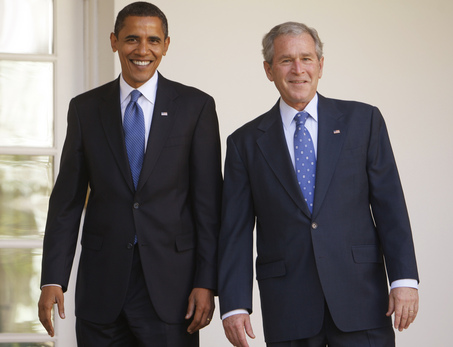
Presidents Obama and Bush

To publicly comment on the singular importance of the Iraqi elections without crediting President Bush for having the courage and fortitude to free those people from a tyrannical leader who threatened the security of the free world – shameful.

Of course, you also failed to acknowledge President Bush’s role in enabling the historic Afghanistan elections of 2009. I just hoped you would have matured a little since then.

The media is not doing much better on this issue.  But then we expect less of our media than our President.

by Sherry Jarrell

Attraction

The difference that makes the difference!

Nature's 'law' of attraction

As a follow-up to my last Post on Learning from Dogs “Managing in a mad world“, I got to thinking about the so called “Law of Attraction“.

I say that because I beginning to believe that this ‘Law’ is more about what we think about and focus our attention on than anything that has a tangible force of attraction.  But it is well known that the brain (to protect our sanity!) filters out on a huge scale so this ‘attraction’ may be our minds remaining receptive or, as it were, allowing us to ‘resonate’ with others sharing our ideas and emotions.

Again, I notice this common ground between my psychotherapy clients and my business clients. Successful people tend to focus on the positive and usually have a strong belief in themselves and their abilities, and unsuccessful people who have suffered any sort of difficulty for an extended time, tend to be preoccupied with focussing on the negative and tend to have a negative self-view.

Naturally, we become orientated around our belief systems. This, I believe is where good, consistent parenting comes in because many of our beliefs are taken on from our parents. Even if the parenting style has been ‘tough’ as long as there’s consistency, balance is maintained and there is a solid reference point for the youngster to come away from.

Management styles resemble parenting styles, and why shouldn’t they, as the higher qualities of facilitating structured learning in a safe environment is exactly what good management is all about. Delegating is about empowering and confidence building. Parenting styles that are loose or have little or no structure or that are overbearing and dictatorial tend to be damaging.

Of course, there are no hard and fast rules here, just tendencies but it’s interesting how these are played out everywhere, in every situation where we are in relationship with others. Even more interesting in a recession where companies are really struggling!

How fascinating to clock the number of companies struggling badly who have an autocratic management style, where staff are told what to do and there is little empowerment, and then compare them to ones where the opposite is true and people are free to interact, communicate, feel they’re reasonably empowered and work together in an environment of mutual trust.

The correlation in this part of the South West UK where I mainly work is significant. It’s as if  when we feel empowered and we’re working together with a group of like-minded people, all problems and challenges are solvable, because our self-belief is high and we visualise success. Also, adversity is seen as a challenge and one that can be mastered.

We certainly are living in interesting times!

By Jon Lavin

Managing in a mad world.

Even in the midst of great pain, we must think through our choices

The last week has been really mad.  I have been working in different companies and organisations and having to be part of redundancies, power struggles and people rebuilding their lives.

For example, I was in a company that had just let its second lot of people go in as many months. It’s gone past losing ‘dead wood’ and now people with valuable skills needed for recovery are going. I’ve noticed previously that good, employable people with key skills start to get concerned and will often take voluntary redundancy rather than hanging around to see how things pan out.

End of job!

It’s the shocking way that it’s done as well that’s unbelievable. No warning, just a phone call to attend a meeting, no hint as to what the meeting is about, then an envelope slid across the table and then a rapid escort off site. All done and dusted in 5 minutes.

Having been through this myself some years ago, it’s not something you forget in a hurry. Lots of feelings of rejection and feeling unvalued and unwanted are what I remember. Perhaps its part of being bought up in a job-for-life culture and then having that illusion shattered.

Working with people in this situation is literally quite shocking and traumatic because it clearly affects them and their lives and the lives of their families, and it affects me because the work we started comes to an abrupt end usually with little or no warning, and so does a source of income to be brutally honest. I don’t even have chance to say good-bye in many cases.

Every Thursday I become a trainee psychotherapist and work with people who mostly struggle to hold down any sort of job. The reasons for this are generally because of upbringings that are awful beyond description. The shock and trauma that is in the air when working with these people is amazing, and so scary for them that the idea of being present in the room with me and is virtually impossible.

So that brings us to managing in a world where lots of mad and non-integrous things happen. I believe that mindfulness can provide a key to these situations; being present for another does more than any instruction manual!

Being present means we make ourselves available at many levels to someone who is suffering. By avoiding the subtle invitation to join someone in their shock and trauma but by being there for them, to the best of our ability and listening to them at depth, we can provide an environment where real reflection can take place. Then options may be chosen which are not born of panic and reaction but come from reflection and response.

I believe that this approach gets us out of the ‘noise machine in our heads‘ (that is forever churning and worrying, in my case) that we have no control over, and creates space for more subtle things to come through the quiet and calm.

Most people I’ve met in my engineering work like to assume that they think their way out of tight situations but I’m not convinced that this process is actually effective. I have heard and practised many times the activity of ‘sleeping on something’ and then being able to decide on a course of action the following morning with relative ease. My psychotherapy clients can’t think their way out the awfulness because thinking about things has got them into a spiral

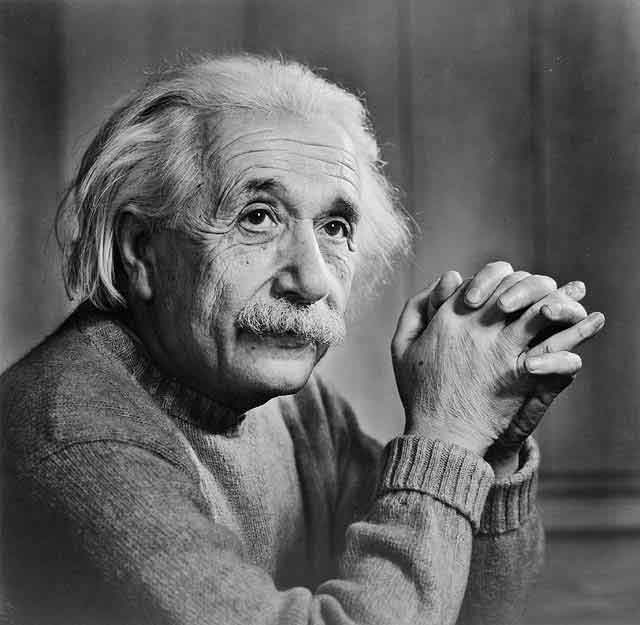
Albert Einstein

process which is highly addictive, predictable and virtually impossible to break without the intervention of a higher level of awareness. I think it was Einstein who said something like, “you can’t use the same intelligence that created a problem to solve it“!  In other words, a different approach or level must be used.

I believe that this different approach or level can be used to solve most problems we have. By bringing a different level of awareness to a challenge, whether it is redundancy or some other sort of deeper problem always gives different results and provides more options. It’s just that initially it needs to be facilitated, until we can do it under our own steam. I am heartened that even in the depths of a recession that there are still companies out there that support this approach and the work I do.

By Jon Lavin [This article from the BBC is worth reading in conjunction with Jon’s excellent Post. Jon may be contacted via learningfromdogs (at) gmail (dot) com]

Free speech!

Hats off to some intrepid commentators

We are going through unprecedented troubled times and the way ahead looks very uncertain.  The whole world could be participating in the ‘lost decade’ that Japan experienced previously.

But this article is not about doom and gloom!  It is about recognising the commitment to open and honest reporting being undertaken by (at least) these three  individuals.  Three commentators that this author follows in admiration and awe.

Learning from Dogs has nothing like the following of James Kwak, Yves Smith and Karl Denninger but the LfD authors do have an inkling of the work involved in writing not one but often several articles each day.  It is a huge commitment.

James Kwak

First James Kwak of Baseline Scenario.  Simon Johnson is, perhaps, the more well-known of this duo that comprise Baseline Scenario but it is James that puts in the leg-work.  Here’s a taste of a recent article from James:

Radio Stories

I spend a lot of time in the car driving to and from school, so I end up listening to a lot of podcasts (mainly This American Life, Radio Lab, Fresh Air, and Planet Money). I was catching up recently and wanted to point out a few highlights.
Last week on Fresh Air, Terry Gross interviewed Scott Patterson, author of The Quants, and Ed Thorp, mathematician,  inventor of blackjack card counting (or, at least, the first person to publish his methods), and, according to the book, also the inventor of the market-neutral hedge fund.

Large chunk snipped ……

I finally got around to listening to Planet Money’s interview with Russ Roberts from December. Russ Roberts and I are pretty sure to disagree on almost any actual policy question. But what I liked about his interview was that he basically admitted that policy questions cannot be settled by looking at the empirical studies. On whether the minimum wage increases or decreases employment for example, he says that he can poke holes in the studies whose conclusions he doesn’t agree with, but other people can poke holes in the studies he agrees with. In Roberts’s view, people’s policy positions are determined by their prior normative commitments.

I don’t completely agree. I don’t think that these questions, like the one about the minimum wage, are inherently unanswerable in the sense that the answer does not exist. But I agree that empirical studies are unlikely to get to the truth, particularly on a politically charged question, because there are so many ways to fudge an empirical study. As one of my professors said, there are a million ways you can screw up a study, and only one way to do it right. But I agree with the general sentiment. We are living in an age of numbers, where people think that statistics can answer any question. Statistics can answer any question, but they can answer it in multiple ways depending on who is sitting at the keyboard.

By James Kwak

Read about Yves Smith & Karl Denninger