Don’t miss the transit of Venus across the Sun.
The full quotation is “This sight…is by far the noblest astronomy affords…” and was reputed to have been made by Sir Edmond Halley of Halley’s Comet fame, see here. But today’s Post is about Venus.

From the NOAA Science on a Sphere website, we can read this about Venus,
Venus has been referred to as the sister or even twin to Earth by many because of its similar chemical composition, density and size. That, however, is where the similarities end. Venus is not only the hottest planet in the solar system, but also the brightest. Both of these characteristics are the result of the atmosphere that surrounds the planet, which is mainly composed of carbon dioxide and some sulfuric acid. This composition allows for the greenhouse effect to be astronomical causing the planet to have a constant temperature of 864°F. The planet is the brightest because the clouds, composed of sulfur dioxide and sulfuric acid, are highly reflective. The pressure of the atmosphere that surrounds Venus is 90 times that of the atmosphere around Earth, crushing any probes that land on Venus in a matter of hours.
Depending on where you live on Planet Earth you will see the transit on the 5th June, the 6th June or not at all!
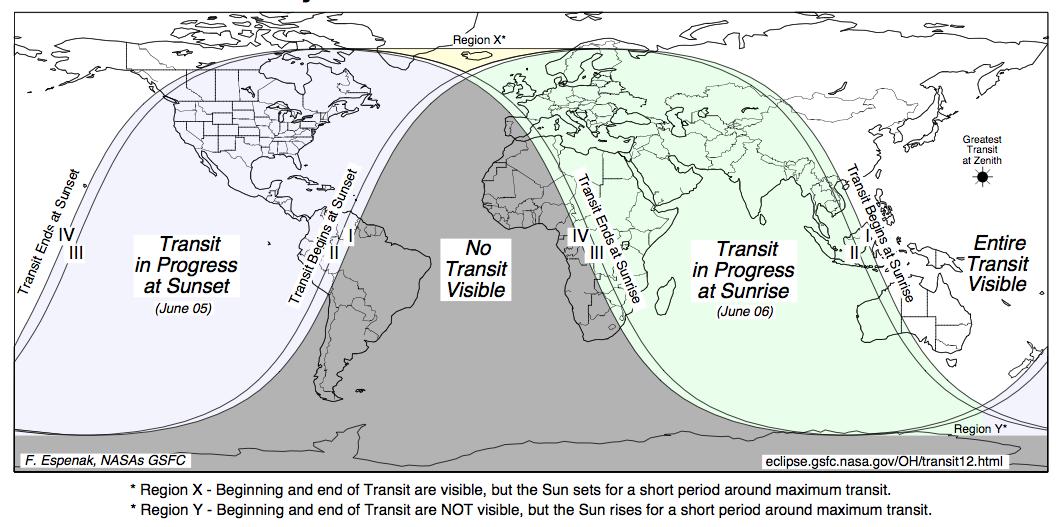
(That additional data referred to above may be found here.)
That transit diagram plus mounds of other interesting stuff is on the Transit of Venus website and on that website this page has the details allowing you to work out what day and time the transit occurs depending on where you are.
To close let me be a little cheeky and reproduce, in full, what appeared on the Science Daily website on the 1st May.
Venus to Appear in Once-In-A-Lifetime Event
ScienceDaily (May 1, 2012) — On 5 and 6 June this year, millions of people around the world will be able to see Venus pass across the face of the Sun in what will be a once-in-a-lifetime experience.
It will take Venus about six hours to complete its transit, appearing as a small black dot on the Sun’s surface, in an event that will not happen again until 2117.
In this month’s Physics World, Jay M Pasachoff, an astronomer at Williams College, Massachusetts, explores the science behind Venus’s transit and gives an account of its fascinating history.
Transits of Venus occur only on the very rare occasions when Venus and Earth are in a line with the Sun. At other times Venus passes below or above the Sun because the two orbits are at a slight angle to each other. Transits occur in pairs separated by eight years, with the gap between pairs of transits alternating between 105.5 and 121.5 years — the last transit was in 2004.
Building on the original theories of Nicolaus Copernicus from 1543, scientists were able to predict and record the transits of both Mercury and Venus in the centuries that followed.
Johannes Kepler successfully predicted that both planets would transit the Sun in 1631, part of which was verified with Mercury’s transit of that year. But the first transit of Venus to actually be viewed was in 1639 — an event that had been predicted by the English astronomer Jeremiah Horrocks. He observed the transit in the village of Much Hoole in Lancashire — the only other person to see it being his correspondent, William Crabtree, in Manchester.
Later, in 1716, Edmond Halley proposed using a transit of Venus to predict the precise distance between Earth and the Sun, known as the astronomical unit. As a result, hundreds of expeditions were sent all over the world to observe the 1761 and 1769 transits. A young James Cook took the Endeavour to the island of Tahiti, where he successfully observed the transit at a site that is still called Point Venus.
Pasachoff expects the transit to confirm his team’s theory about the phenomenon called “the black-drop effect” — a strange, dark band linking Venus’s silhouette with the sky outside the Sun that appears for about a minute starting just as Venus first enters the solar disk.
Pasachoff and his colleagues will concentrate on observing Venus’s atmosphere as it appears when Venus is only half onto the solar disk. He also believes that observations of the transit will help astronomers who are looking for extrasolar planets orbiting stars other than the Sun.
“Doing so verifies that the techniques for studying events on and around other stars hold true in our own backyard.. In other words, by looking up close at transits in our solar system, we may be able to see subtle effects that can help exoplanet hunters explain what they are seeing when they view distant suns,” Pasachoff writes.
Not content with viewing this year’s transit from Earth, scientists in France will be using the Hubble Space Telescope to observe the effect of Venus’s transit very slightly darkening the Moon. Pasachoff and colleagues even hope to use Hubble to watch Venus passing in front of the Sun as seen from Jupiter — an event that will take place on 20 September this year — and will be using NASA’s Cassini spacecraft, which is orbiting Saturn, to see a transit of Venus from Saturn on 21 December.
“We are fortunate in that we are truly living in a golden period of planetary transits and it is one of which I hope astronomers can take full advantage,” he writes.
Editors note: Looking directly at the sun can cause severe and permanent eye damage. Do not look directly at Venus’ transit of the sun.
For more information see Wikipedia article.
Footnote:
I’m going to republish this in full on Monday, 4th June at the usual Learning from Dogs release time of 0700 UTC so to increase the odds of all my readers who would like to see the Transit having the information in good time!

 Learning from Dogs