This is just so beautiful.
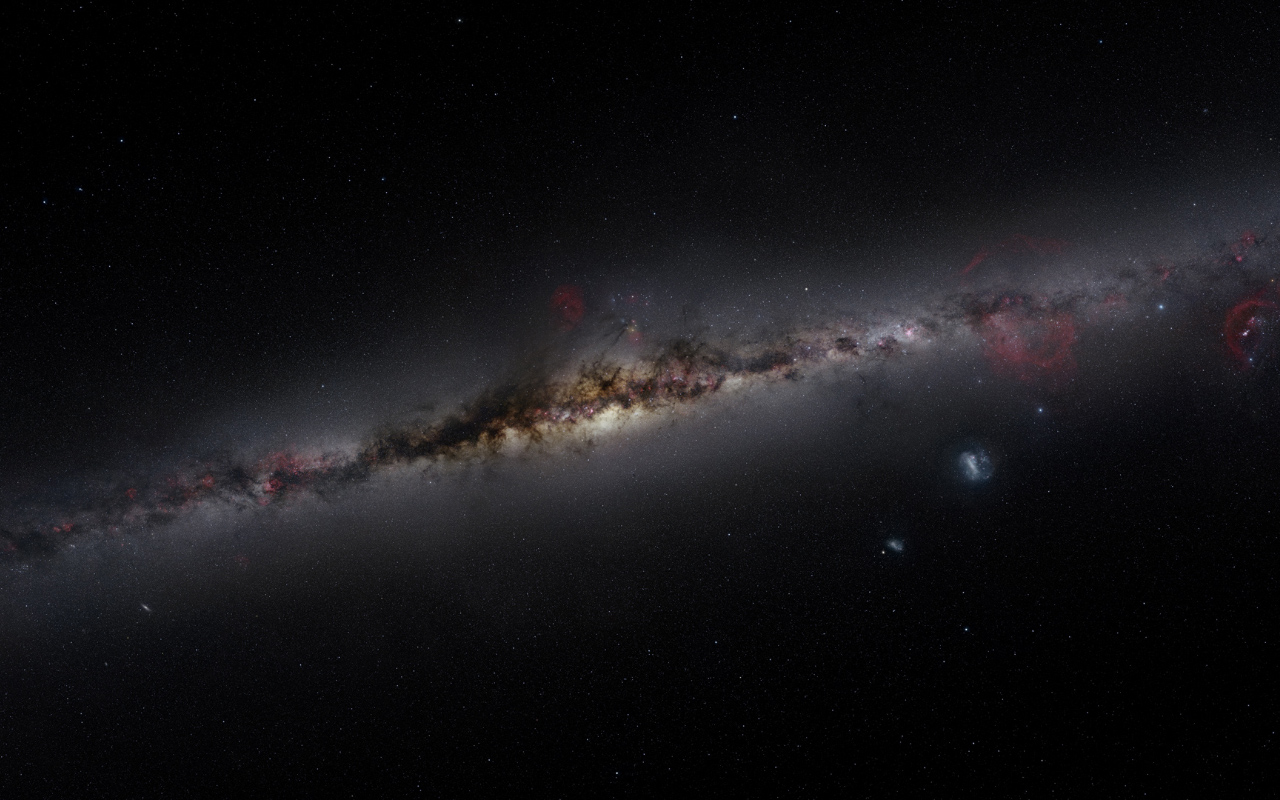
The image is from the Photopic Sky Survey website. From which also comes the following,
What do you see? This was the anthropic question of a year-long photographic project dubbed the Photopic Sky Survey, meant to reveal the entire night sky as if it rivalled the brightness of day. In it we see tens of millions of stars, the glowing factories of newborn ones, and a rich tapestry of dust all floating on a stage of unimaginable proportions. I hope you enjoy this new view of our place in the universe as much as I have enjoyed making it.
The Photopic Sky Survey is a 5,000 megapixel photograph of the entire night sky stitched together from 37,440 exposures. Large in size and scope, it portrays a world far beyond the one beneath our feet and reveals our familiar Milky Way with unfamiliar clarity. When we look upon this image, we are in fact peering back in time, as much of the light—having traveled such vast distances—predates civilization itself.
Well done, Nick Risinger, for all your efforts and for presenting such a magnificent detailed view of the heavens above.
Plus, more or less the same time, this came to my attention, from the BBC News website.
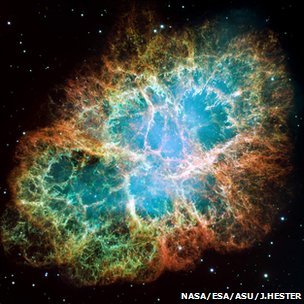
The Crab Nebula has shocked astronomers by emitting an unprecedented blast of gamma rays, the highest-energy light in the Universe.
The cause of the 12 April gamma-ray flare,described at the Third Fermi Symposium in Rome, is a total mystery.
It seems to have come from a small area of the famous nebula, which is the wreckage from an exploded star.
The object has long been considered a steady source of light, but the Fermi telescope hints at greater activity.
The gamma-ray emission lasted for some six days, hitting levels 30 times higher than normal and varying at times from hour to hour.
While the sky abounds with light across all parts of the spectrum, Nasa’s Fermi space observatory is designed to measure only the most energetic light: gamma rays.
These emanate from the Universe’s most extreme environments and violent processes.
The Crab Nebula is composed mainly of the remnant of a supernova, which was seen on Earth to rip itself apart in the year 1054.
At the heart of the brilliantly coloured gas cloud we can see in visible light, there is a pulsar – a rapidly spinning neutron star that emits radio waves which sweep past the Earth 30 times per second. But so far none of the nebula’s known components can explain the signal Fermi sees, said Roger Blandford, director of the Kavli Institute for Particle Astrophysics and Cosmology, US.
 Learning from Dogs