Tag: David Kauders

The Federal Reserve

To all people that live outside the US, and quite a few as well who don’t!

The Federal Reserve is the central banking system of the USA. I am going to republish most of the article that appears on WikiPedia. It is yet another example of how the United States set itself up taking the best from all around the world.

(And apologies for not posting a Picture Parade yesterday.)

ooOOoo

 The Federal Reserve System (often shortened to the Federal Reserve, or simply the Fed) is the central banking system of the United States. It was created on December 23, 1913, with the enactment of the Federal Reserve Act, after a series of financial panics (particularly the panic of 1907) led to the desire for central control of the monetary system in order to alleviate financial crises.[list 1] Although an instrument of the U.S. government, the Federal Reserve System considers itself “an independent central bank because its monetary policy decisions do not have to be approved by the president or by anyone else in the executive or legislative branches of government, it does not receive funding appropriated by Congress, and the terms of the members of the board of governors span multiple presidential and congressional terms.”[11] Over the years, events such as the Great Depression in the 1930s and the Great Recessionduring the 2000s have led to the expansion of the roles and responsibilities of the Federal Reserve System.[6][12]

Congress established three key objectives for monetary policy in the Federal Reserve Act: maximizing employment, stabilizing prices, and moderating long-term interest rates.[13] The first two objectives are sometimes referred to as the Federal Reserve’s dual mandate.[14] Its duties have expanded over the years, and include supervising and regulating banks, maintaining the stability of the financial system, and providing financial services to depository institutions, the U.S. government, and foreign official institutions.[15] The Fed also conducts research into the economy and provides numerous publications, such as the Beige Book and the FRED database.[16]

The Federal Reserve System is composed of several layers. It is governed by the presidentially appointed board of governors or Federal Reserve Board (FRB). Twelve regional Federal Reserve Banks, located in cities throughout the nation, regulate and oversee privately owned commercial banks.[17] Nationally chartered commercial banks are required to hold stock in, and can elect some board members of, the Federal Reserve Bank of their region.

The Federal Open Market Committee (FOMC) sets monetary policy by adjusting the target for the federal funds rate, which generally influences market interest rates and, in turn, US economic activity via the monetary transmission mechanism. The FOMC consists of all seven members of the board of governors and the twelve regional Federal Reserve Bank presidents, though only five bank presidents vote at a time: the president of the New York Fed and four others who rotate through one-year voting terms. There are also various advisory councils.[list 2] It has a structure unique among central banks, and is also unusual in that the United States Department of the Treasury, an entity outside of the central bank, prints the currency used.[23]

The federal government sets the salaries of the board’s seven governors, and it receives all the system’s annual profits after dividends on member banks’ capital investments are paid, and an account surplus is maintained. In 2015, the Federal Reserve earned a net income of $100.2 billion and transferred $97.7 billion to the U.S. Treasury,[24] and 2020 earnings were approximately $88.6 billion with remittances to the U.S. Treasury of $86.9 billion.[25] The Federal Reserve has been criticized for its approach to managing inflation, perceived lack of transparency, and its role in economic downturns.[26][27][28]

Purpose

The primary declared motivation for creating the Federal Reserve System was to address banking panics.[6] Other purposes are stated in the Federal Reserve Act, such as “to furnish an elastic currency, to afford means of rediscounting commercial paper, to establish a more effective supervision of banking in the United States, and for other purposes”.[29] Before the founding of the Federal Reserve System, the United States underwent several financial crises. A particularly severe crisis in 1907 led Congress to enact the Federal Reserve Act in 1913. Today the Federal Reserve System has responsibilities in addition to stabilizing the financial system.[30]

Current functions of the Federal Reserve System include:[15][30]

  • To address the problem of banking panics
  • To serve as the central bank for the United States
  • To strike a balance between private interests of banks and the centralized responsibility of government
    • To supervise and regulate banking institutions
    • To protect the credit rights of consumers
  • To conduct monetary policy by influencing market interest rates to achieve the sometimes-conflicting goals of
    • maximum employment
    • stable prices, interpreted as an inflation rate of 2 percent per year on average[31]
    • moderate long-term interest rates
  • To maintain the stability of the financial system and contain systemic risk in financial markets
  • To provide financial services to depository institutions, the U.S. government, and foreign official institutions, including playing a major role in operating the nation’s payments system
    • To facilitate the exchange of payments among regions
    • To respond to local liquidity needs
  • To strengthen U.S. standing in the world economy
Unemployment vs Inflation vs Inverted yield curve  Unemployment rate  Inflation CPI  10 year bond minus 2 year bond Inverted yield curve

Addressing the problem of bank panics

Further information: Bank run and Fractional-reserve banking

Banking institutions in the United States are required to hold reserves‍—‌amounts of currency and deposits in other banks‍—‌equal to only a fraction of the amount of the bank’s deposit liabilities owed to customers. This practice is called fractional-reserve banking. As a result, banks usually invest the majority of the funds received from depositors. On rare occasions, too many of the bank’s customers will withdraw their savings and the bank will need help from another institution to continue operating; this is called a bank run. Bank runs can lead to a multitude of social and economic problems. The Federal Reserve System was designed as an attempt to prevent or minimize the occurrence of bank runs, and possibly act as a lender of last resort when a bank run does occur. Many economists, following Nobel laureate Milton Friedman, believe that the Federal Reserve inappropriately refused to lend money to small banks during the bank runs of 1929; Friedman argued that this contributed to the Great Depression.[32]

Check clearing system

Because some banks refused to clear checks from certain other banks during times of economic uncertainty, a check-clearing system was created in the Federal Reserve System. It is briefly described in The Federal Reserve System‍—‌Purposes and Functions as follows:[33]

By creating the Federal Reserve System, Congress intended to eliminate the severe financial crises that had periodically swept the nation, especially the sort of financial panic that occurred in 1907. During that episode, payments were disrupted throughout the country because many banks and clearinghouses refused to clear checks drawn on certain other banks, a practice that contributed to the failure of otherwise solvent banks. To address these problems, Congress gave the Federal Reserve System the authority to establish a nationwide check-clearing system. The System, then, was to provide not only an elastic currency‍—‌that is, a currency that would expand or shrink in amount as economic conditions warranted‍—‌but also an efficient and equitable check-collection system.

Lender of last resort

In the United States, the Federal Reserve serves as the lender of last resort to those institutions that cannot obtain credit elsewhere and the collapse of which would have serious implications for the economy. It took over this role from the private sector “clearing houses” which operated during the Free Banking Era; whether public or private, the availability of liquidity was intended to prevent bank runs.[34]

Fluctuations

Through its discount window and credit operations, Reserve Banks provide liquidity to banks to meet short-term needs stemming from seasonal fluctuations in deposits or unexpected withdrawals. Longer-term liquidity may also be provided in exceptional circumstances. The rate the Fed charges banks for these loans is called the discount rate (officially the primary credit rate).

By making these loans, the Fed serves as a buffer against unexpected day-to-day fluctuations in reserve demand and supply. This contributes to the effective functioning of the banking system, alleviates pressure in the reserves market and reduces the extent of unexpected movements in the interest rates.[35] For example, on September 16, 2008, the Federal Reserve Board authorized an $85 billion loan to stave off the bankruptcy of international insurance giant American International Group (AIG).[36]

Central bank

Further information: Central bank

Obverse of a Federal Reserve $1 note issued in 2009

In its role as the central bank of the United States, the Fed serves as a banker’s bank and as the government’s bank. As the banker’s bank, it helps to assure the safety and efficiency of the payments system. As the government’s bank or fiscal agent, the Fed processes a variety of financial transactions involving trillions of dollars. Just as an individual might keep an account at a bank, the U.S. Treasury keeps a checking account with the Federal Reserve, through which incoming federal tax deposits and outgoing government payments are handled. As part of this service relationship, the Fed sells and redeems U.S. government securitiessuch as savings bonds and Treasury bills, notes and bonds. It also issues the nation’s coinand paper currency. The U.S. Treasury, through its Bureau of the Mint and Bureau of Engraving and Printing, actually produces the nation’s cash supply and, in effect, sells the paper currency to the Federal Reserve Banks at manufacturing cost, and the coins at face value. The Federal Reserve Banks then distribute it to other financial institutions in various ways.[37] During the Fiscal Year 2020, the Bureau of Engraving and Printing delivered 57.95 billion notes at an average cost of 7.4 cents per note.[38][39]

Federal funds

Main article: Federal funds

Federal funds are the reserve balances (also called Federal Reserve Deposits) that private banks keep at their local Federal Reserve Bank.[40] These balances are the namesake reserves of the Federal Reserve System. The purpose of keeping funds at a Federal Reserve Bank is to have a mechanism for private banks to lend funds to one another. This market for funds plays an important role in the Federal Reserve System as it is the basis for its monetary policy work. Monetary policy is put into effect partly by influencing how much interest the private banks charge each other for the lending of these funds.

Federal reserve accounts contain federal reserve credit, which can be converted into federal reserve notes. Private banks maintain their bank reserves in federal reserve accounts.

Bank regulation

The Federal Reserve regulates private banks. The system was designed out of a compromise between the competing philosophies of privatization and government regulation. In 2006 Donald L. Kohn, vice chairman of the board of governors, summarized the history of this compromise:[41]

Agrarian and progressive interests, led by William Jennings Bryan, favored a central bank under public, rather than banker, control. However, the vast majority of the nation’s bankers, concerned about government intervention in the banking business, opposed a central bank structure directed by political appointees. The legislation that Congress ultimately adopted in 1913 reflected a hard-fought battle to balance these two competing views and created the hybrid public-private, centralized-decentralized structure that we have today.

The balance between private interests and government can also be seen in the structure of the system. Private banks elect members of the board of directors at their regional Federal Reserve Bank while the members of the board of governors are selected by the president of the United States and confirmed by the Senate.

Government regulation and supervision

Ben Bernanke (lower right), former chairman of the Federal Reserve Board of Governors, at a House Financial Services Committee hearing on February 10, 2009. Members of the board frequently testify before congressional committees such as this one. The Senate equivalent of the House Financial Services Committee is the Senate Committee on Banking, Housing, and Urban Affairs.

The Federal Banking Agency Audit Act, enacted in 1978 as Public Law 95-320 and 31 U.S.C. section 714 establish that the board of governors of the Federal Reserve System and the Federal Reserve banks may be audited by the Government Accountability Office (GAO).[42]

The GAO has authority to audit check-processing, currency storage and shipments, and some regulatory and bank examination functions–though there are restrictions to what the GAO may audit. Under the Federal Banking Agency Audit Act, 31 U.S.C. section 714(b), audits of the Federal Reserve Board and Federal Reserve banks do not include (1) transactions for or with a foreign central bank or government or non-private international financing organization; (2) deliberations, decisions, or actions on monetary policy matters; (3) transactions made under the direction of the Federal Open Market Committee; or (4) a part of a discussion or communication among or between members of the board of governors and officers and employees of the Federal Reserve System related to items (1), (2), or (3). See Federal Reserve System Audits: Restrictions on GAO’s Access (GAO/T-GGD-94-44), statement of Charles A. Bowsher.[43]

The board of governors in the Federal Reserve System has a number of supervisory and regulatory responsibilities in the U.S. banking system, but not complete responsibility. A general description of the types of regulation and supervision involved in the U.S. banking system is given by the Federal Reserve:[44]

The Board also plays a major role in the supervision and regulation of the U.S. banking system. It has supervisory responsibilities for state-chartered banks[45] that are members of the Federal Reserve System, bank holding companies(companies that control banks), the foreign activities of member banks, the U.S. activities of foreign banks, and Edge Act and “agreement corporations” (limited-purpose institutions that engage in a foreign banking business). The Board and, under delegated authority, the Federal Reserve Banks, supervise approximately 900 state member banks and 5,000 bank holding companies. Other federal agencies also serve as the primary federal supervisors of commercial banks; the Office of the Comptroller of the Currency supervises national banks, and the Federal Deposit Insurance Corporation supervises state banks that are not members of the Federal Reserve System.

Some regulations issued by the Board apply to the entire banking industry, whereas others apply only to member banks, that is, state banks that have chosen to join the Federal Reserve System and national banks, which by law must be members of the System. The Board also issues regulations to carry out major federal laws governing consumer credit protection, such as the Truth in LendingEqual Credit Opportunity, and Home Mortgage Disclosure Acts. Many of these consumer protection regulations apply to various lenders outside the banking industry as well as to banks.

Members of the Board of Governors are in continual contact with other policy makers in government. They frequently testify before congressional committees on the economy, monetary policybanking supervision and regulationconsumer credit protectionfinancial markets, and other matters.

The Board has regular contact with members of the President’s Council of Economic Advisers and other key economic officials. The Chair also meets from time to time with the President of the United States and has regular meetings with the Secretary of the Treasury. The Chair has formal responsibilities in the international arena as well.

Regulatory and oversight responsibilities

The board of directors of each Federal Reserve Bank District also has regulatory and supervisory responsibilities. If the board of directors of a district bank has judged that a member bank is performing or behaving poorly, it will report this to the board of governors. This policy is described in law:

Each Federal reserve bank shall keep itself informed of the general character and amount of the loans and investments of its member banks with a view to ascertaining whether undue use is being made of bank credit for the speculative carrying of or trading in securities, real estate, or commodities, or for any other purpose inconsistent with the maintenance of sound credit conditions; and, in determining whether to grant or refuse advances, rediscounts, or other credit accommodations, the Federal reserve bank shall give consideration to such information. The chairman of the Federal reserve bank shall report to the Board of Governors of the Federal Reserve System any such undue use of bank credit by any member bank, together with his recommendation. Whenever, in the judgment of the Board of Governors of the Federal Reserve System, any member bank is making such undue use of bank credit, the Board may, in its discretion, after reasonable notice and an opportunity for a hearing, suspend such bank from the use of the credit facilities of the Federal Reserve System and may terminate such suspension or may renew it from time to time.[46]

National payments system

The Federal Reserve plays a role in the U.S. payments system. The twelve Federal Reserve Banks provide banking services to depository institutions and to the federal government. For depository institutions, they maintain accounts and provide various payment services, including collecting checks, electronically transferring funds, and distributing and receiving currency and coin. For the federal government, the Reserve Banks act as fiscal agents, paying Treasury checks; processing electronic payments; and issuing, transferring, and redeeming U.S. government securities.[47]

In the Depository Institutions Deregulation and Monetary Control Act of 1980, Congress reaffirmed that the Federal Reserve should promote an efficient nationwide payments system. The act subjects all depository institutions, not just member commercial banks, to reserve requirements and grants them equal access to Reserve Bank payment services. The Federal Reserve plays a role in the nation’s retail and wholesale payments systems by providing financial services to depository institutions. Retail payments are generally for relatively small-dollar amounts and often involve a depository institution’s retail clients‍—‌individuals and smaller businesses. The Reserve Banks’ retail services include distributing currency and coin, collecting checks, electronically transferring funds through FedACH (the Federal Reserve’s automated clearing house system), and beginning in 2023, facilitating instant payments using the FedNow service. By contrast, wholesale payments are generally for large-dollar amounts and often involve a depository institution’s large corporate customers or counterparties, including other financial institutions. The Reserve Banks’ wholesale services include electronically transferring funds through the Fedwire Funds Service and transferring securities issued by the U.S. government, its agencies, and certain other entities through the Fedwire Securities Service.

ooOOoo

There is more in that article including Structure, Board of Governors, the Federal Reserve Banks (there are 12), and more subjects. So if you want to read these then, please, go here.

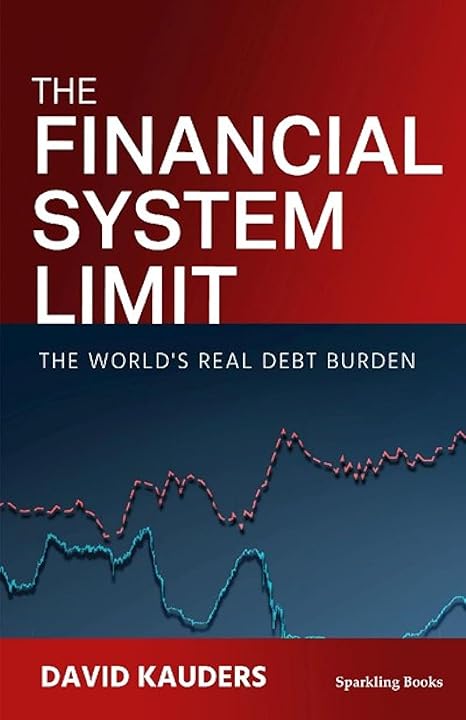
And I am bound to say that I have recently finished reading The FINANCIAL SYSTEM LIMIT by David Kauders. The sub-title of the book is The World’s Real Debt Burden. If you are at all interested in the subject then read the book.

We live in interesting times!

The impending ‘banquet of consequences’.

The Welcome page of this blog includes this:

Dogs ‘teaching’ man to be so successful a hunter enabled evolution, some 20,000 years later, to farming,  thence the long journey to modern man.  But in the last, say 100 years, that farming spirit has become corrupted to the point where we see the planet’s plant and mineral resources as infinite.  Mankind is close to the edge of extinction, literally and spiritually.

I continue that theme in Part Two of my book (Chapter 7: This Twenty-First Century)

Bad news sells! Bad news also causes stress and worry. In my previous explanation, I explained that the last thing you want is a catalogue of all the things that have that power to cause you stress and worry. However, I do see three fundamental aspects of this new century that have their roots in that loss of principles that I referred to in the previous chapter. They are

1. the global financial system,
2. the potential for social disorder, and
3. the process of government.

Because they are at the heart of how the coming years will pan out.

The first aspect, our global financial system, was selected because it underpins all our lives in so many ways. When I was living in southwest England I was a client of Kauders Portfolio Services[1]. The founder of the company, David Kauders, published[2] a book, The Greatest Crash, in 2011. It was an obvious read for me at that time and I still have the book on my shelves here in Oregon.
David explained that whether we like it or not, our lives are inextricably caught up in the twin dependencies of the global financial system: credit and debt. As he wrote in his opening chapter:

Households can barely afford their existing debts, let alone take on more. Since households now prefer not to borrow, indeed some even choose to pay back debt, it follows that those who have already borrowed, as a group, can no longer contribute to economic expansion.
People can be divided into borrowers and savers. With existing borrowers unable to afford or unwilling to take on extra debt, can new borrowers be found instead? Those who do not need to borrow are unlikely to volunteer. Except for the young wishing to buy houses, facing the reality that house prices are beyond their pockets, where are the new borrowers?
Businesses are also under pressure. There has been an inadequate recovery from recession, business prospects are poor as households cut back their spending. Lack of bank lending is a symptom rather than a cause, for if existing businesses were to be given more credit, they would probably be unlikely to find profitable growth opportunities in a world of austerity.

Later on in the book David describes this as “the financial system limit”. In other words, the period of growth and expansion, especially of financial and economic expansion, has come to an end in a structural sense. This was his perspective from 2011.

Recently, I chose to reread The Greatest Crash. What struck me forcibly, reading the book again some four years later on, was how visible this “system limit” appeared in the world today. Everywhere there are signs that the era of growth has come to an end. Many countries are now indebted to a point that reinforces the proposition of there being a financial system limit. The United States is greatly in debt[3] but the only thing mitigating that situation, for the time being anyway, is that the American dollar is the quasi dominant global currency.
The changing nature of the global population is also reinforcing the fact that this is the end of a long period of growth. Even without embracing the question of how much longer we can increase the number of people living on a finite planet, the demographics spell out a greater-than-even chance of a decline in consumption and economic activity. Simply because in all regions of the planet, except for India where there is still a growing youth element in the country, people are ageing. To state the obvious, ageing persons do not consume as much as middle-aged and younger persons.
Thus, the world’s economy that is just around the corner is certainly going to be very different to what it has been in the past. It is not being widely discussed. Worse than that, there is a widespread assumption adopted by many governments that a return to the “normal” economic growth of previous times is a given. Many do not share that assumption.

The second aspect that isn’t being spoken about is the potential for massive, widespread social disorder. All summed up in just three words: greed, inequality, and poverty. Just three words that metaphorically appear to me like a round, wooden lid hiding a very deep, dark well. That lifting this particular lid, the metaphorical one, exposes an almost endless drop into the depths of where our society appears to have fallen.
Even the slightest raising of awareness of where this modern global world is heading is scary. I have in mind the author Thomas Piketty who warned[4] that, “the inequality gap is toxic, dangerous.” Then there was the news in 2015[5] that, “Billionaires control the vast majority of the world’s wealth, 67 billionaires already own half the world’s assets; by 2100 we’ll have 11 trillionaires, while American worker income has stagnated for a generation.”

The third and final aspect that isn’t being widely discussed is the process of government. Not from the viewpoint of “left” or “right”, Labour or Conservative, Democratic or Republican (insert the labels appropriate to your own country), that is being discussed ad nauseum, but from the viewpoint of good government. It might be a terrible generalisation but it is still a fair criticism to say that many peoples of many countries have lost faith in their governments.
There appears to be a chronic absence of open debate about the need for good government, what that good government would look like, and how do societies bring it about.

If we were a dog pack, then our leader, our female mentor dog, would have moved us all to a new, pristine territory!


[1] My relationship was terminated when I became a resident of the United Staes in 2011.
[2] 2011, Sparkling Books.
[3] http://www.usgovernmentdebt.us offers on the 14th November, 2014 that the Federal Debt of the United States was about $18,006,100,032,000.
[4] In his book Capital in the Twenty-First Century (Belknap Press, 2014).
[5] http://www.marketwatch.com/story/capitalism-is-killing-americas-morals-our-future-2015-05-22.

Yes, these are indeed very interesting times!

So, dear reader, you can understand why a recent article over on Naked Capitalism spoke to me. It was penned by Satyajit Das, a former banker and the author of a number of books. Both Satyajit and Yves, of Naked Capitalism, were delighted to offer me permission to republish the full post.

ooOOoo

Satyajit Das: Age of Stagnation or Something Worse?

Yves here. If you’ve read Das regularly, one of the characteristics of his writing is wry detachment. The shift to a sense of foreboding is a big departure.

By Satyajit Das, a former banker and author whose latest book, The Age of Stagnation, is now available. The following is an edited excerpt from Age of Stagnation (published with the permission of Prometheus Books)

If you look for truth, you may find comfort in the end; if you look for comfort you will not get either comfort or truth, only . . . wishful thinking to begin, and in the end, despair. C.S. Lewis

The world is entering a period of stagnation, the new mediocre. The end of growth and fragile, volatile economic conditions are now the sometimes silent background to all social and political debates. For individuals, this is about the destruction of human hopes and dreams.

One Offs

For most of human history, as Thomas Hobbes recognised, life has been ‘solitary, poor, nasty, brutish, and short’. The fortunate coincidence of factors that drove the unprecedented improvement in living standards following the Industrial Revolution, and especially in the period after World War II, may have been unique, an historical aberration. Now, different influences threaten to halt further increases, and even reverse the gains.

Since the early 1980s, economic activity and growth have been increasingly driven by financialisation – the replacement of industrial activity with financial trading and increased levels of borrowing to finance consumption and investment. By 2007, US$5 of new debt was necessary to create an additional US$1 of American economic activity, a fivefold increase from the 1950s. Debt levels had risen beyond the repayment capacity of borrowers, triggering the 2008 crisis and the Great Recession that followed. But the world shows little sign of shaking off its addiction to borrowing. Ever-increasing amounts of debt now act as a brake on growth.

Growth in international trade and capital flows is slowing. Emerging markets that have benefited from and, in recent times, supported growth are slowing.

Rising inequality and economic exclusion also impacts negatively upon activity.

Financial problems are compounded by lower population growth and ageing populations; slower increases in productivity and innovation; looming shortages of critical resources, such as water, food and energy; and manmade climate change and extreme weather conditions.

The world requires an additional 64 billion cubic metres of water a year, equivalent to the annual water flow through Germany’s Rhine River. Agronomists estimate that production will need to increase by 60–100 percent by 2050 to feed the population of the world. While the world’s supply of energy will not be exhausted any time soon, the human race is on track to exhaust the energy content of hundreds of millions years’ worth of sunlight stored in the form of coal, oil and natural gas in a few hundred years. 10 tons of pre-historic buried plant and organic matter converted by pressure and heat over millennia was needed to create a single gallon (4.5 litres) of gasoline.

Europe is currently struggling to deal with a few million refugees fleeing conflicts in the Middle East. How will the world deal with hundreds of millions of people at risk of displacement as a resulting of rising sea levels?

Extend and Pretend

The official response to the 2008 crisis was a policy of ‘extend and pretend’, whereby authorities chose to ignore the underlying problem, cover it up, or devise deferral strategies to ‘kick the can down the road’. The assumption was that government spending, lower interest rates, and the supply of liquidity or cash to money markets would create growth. It would also increase inflation to help reduce the level of debt, by decreasing its value.

It was the grifter’s long con, a confidence trick with a potentially large payoff but difficult to pull off. Houses prices and stock markets have risen, but growth, employment, income and investment have barely recovered to pre-crisis levels in most advanced economies. Inflation for the most part remains stubbornly low.

In countries that have ‘recovered’, financial markets are, in many cases, at or above pre-crisis prices. But conditions in the real economy have not returned to normal. Must-have latest electronic gadgets cannot obscure the fact that living standards for most people are stagnant. Job insecurity has risen. Wages are static, where they are not falling. Accepted perquisites of life in developed countries, such as education, houses, health services, aged care, savings and retirement, are increasingly unattainable.

In more severely affected countries, conditions are worse. Despite talk of a return to growth, the Greek economy has shrunk by a quarter. Spending by Greeks has fallen by 40 percent, reflecting reduced wages and pensions. Reported unemployment is 26 percent of the labour force. Youth unemployment is over 50 percent. One commentator observed that the government could save money on education, as it was unnecessary to prepare people for jobs that did not exist.

Future generations may have fewer opportunities and lower living standards than their parents. A 2013 Pew Research Centre survey conducted in thirty-nine countries asked whether people believed that their children would enjoy better living standards: 33 percent of Americans believed so, as did 28 percent of Germans, 17 percent of British and 14 percent of Italians. Just 9 percent of French people thought their children would be better off than previous generations.

The Deadly Cure

Authorities have been increasingly forced to resort to untested policies including QE forever and negative interest rates. It was an attempt to buy time, to let economies achieve a self-sustaining recovery, as they had done before. Unfortunately the policies have not succeeded. The expensively purchased time has been wasted. The necessary changes have not been made.

There are toxic side effects. Global debt has increased, not decreased, in response to low rates and government spending. Banks, considered dangerously large after the events of 2008, have increased in size and market power since then. In the US the six largest banks now control nearly 70 percent of all the assets in the US financial system, having increased their share by around 40 percent.

Individual countries have sought to export their troubles, abandoning international cooperation for beggar-thy-neighbour strategies. Destructive retaliation, in the form of tit-for-tat interest rate cuts, currency wars, and restrictions on trade, limits the ability of any nation to gain a decisive advantage.

The policies have also set the stage for a new financial crisis. Easy money has artificially boosted prices of financial assets beyond their real value. A significant amount of this capital has flowed into and destabilised emerging markets. Addicted to government and central bank support, the world economy may not be able to survive without low rates and excessive liquidity.

Authorities increasingly find themselves trapped, with little room for manoeuvre and unable to discontinue support for the economy. Central bankers know, even if they are unwilling to publicly acknowledge it, that their tools are inadequate or exhausted, now possessing the potency of shamanic rain dances. More than two decades of trying similar measures in Japan highlight their ineffectiveness in avoiding stagnation.

Heart of the Matter

Conscious that the social compact requires growth and prosperity, politicians, irrespective of ideology, are unwilling to openly discuss the real issues. They claim crisis fatigue, arguing that the problems are too far into the future to require immediate action. Fearing electoral oblivion, they have succumbed to populist demands for faux certainty and placebo policies. But in so doing they are merely piling up the problems.

Policymakers interrogate their models and torture data, failing to grasp that ‘many of the things you can count don’t count [while] many of the things you can’t count really count’. The possibility of a historical shift does not inform current thinking.

It is not in the interest of bankers and financial advisers to tell their clients about the real outlook. Bad news is bad for business. The media and commentariat, for the most part, accentuate the positive. Facts, they argue, are too depressing. The priority is to maintain the appearance of normality, to engender confidence.

Ordinary people refuse to acknowledge that maybe you cannot have it all. But there is increasingly a visceral unease about the present and a fear of the future. Everyone senses that the ultimate cost of the inevitable adjustments will be large. It is not simply the threat of economic hardship; it is fear of a loss of dignity and pride. It is a pervasive sense of powerlessness.

For the moment, the world hopes for the best of times but is afraid of the worst. People everywhere resemble Dory, the Royal Blue Tang fish in the animated film Finding Nemo. Suffering from short-term memory loss, she just tells herself to keep on swimming. Her direction is entirely random and without purpose.

Reckoning Postponed

The world has postponed, indefinitely, dealing decisively with the challenges, choosing instead to risk stagnation or collapse. But reality cannot be deferred forever. Kicking the can down the road only shifts the responsibility for dealing with it onto others, especially future generations.

A slow, controlled correction of the financial, economic, resource and environmental excesses now would be serious but manageable. If changes are not made, then the forced correction will be dramatic and violent, with unknown consequences.

During the last half-century each successive economic crisis has increased in severity, requiring progressively larger measures to ameliorate its effects. Over time, the policies have distorted the economy. The effectiveness of instruments has diminished. With public finances weakened and interest rates at historic lows, there is now little room for manoeuvre. Geo-political risks have risen. Trust and faith in institutions and policy makers has weakened.

Economic problems are feeding social and political discontent, opening the way for extremism. In the Great Depression the fear and disaffection of ordinary people who had lost their jobs and savings gave rise to fascism. Writing of the period, historian A.J.P. Taylor noted: ‘[the] middle class, everywhere the pillar of stability and respectability . . . was now utterly destroyed . . . they became resentful . . . violent and irresponsible . . . ready to follow the first demagogic saviour . . .’

The new crisis that is now approaching or may already be with us will be like a virulent infection attacking a body whose immune system is already compromised.

As Robert Louis Stevenson knew, sooner or later we all have to sit down to a banquet of consequences.

ooOOoo

henrifredericamiel148210Very interesting times indeed!

The Greatest Crash – footnote

The story that could run for an awfully long time!

I rather revealed my newness as a US resident by posting my review of David Kauders’ book The Greatest Crash over 2 days last week,  one of them being Thanksgiving Day.  Despite that 1,895 people viewed my review which was entitled The end of an era.

A week has now passed since that review.  I was curious to see what sorts of headlines had been making the news in the last 7 days.  It’s just a random trawl through those items that have captured my attention.

Let’s start with the Financial Times, November 27th,

The eurozone really has only days to avoid collapse

By Wolfgang Münchau

In virtually all the debates about the eurozone I have been engaged in, someone usually makes the point that it is only when things get bad enough, the politicians finally act – eurobond, debt monetisation, quantitative easing, whatever. I am not so sure. The argument ignores the problem of acute collective action.

Last week, the crisis reached a new qualitative stage. With the spectacular flop of the German bond auction and the alarming rise in short-term rates in Spain and Italy, the government bond market across the eurozone has ceased to function.

Wolfgang concludes his article thus,

Italy’s disastrous bond auction on Friday tells us time is running out. The eurozone has 10 days at most.

Then my print copy of The Economist that arrived on the 26th had this lurid cover page,

Unless Germany and the ECB move quickly, the single currency’s collapse is looming

The leader article contains this paragraph,

Past financial crises show that this downward spiral can be arrested only by bold policies to regain market confidence. But Europe’s policymakers seem unable or unwilling to be bold enough. The much-ballyhooed leveraging of the euro-zone rescue fund agreed on in October is going nowhere. Euro-zone leaders have become adept at talking up grand long-term plans to safeguard their currency—more intrusive fiscal supervision, new treaties to advance political integration. But they offer almost no ideas for containing today’s conflagration.

and a few paragraphs later, this,

This cannot go on for much longer. Without a dramatic change of heart by the ECB and by European leaders, the single currency could break up within weeks. Any number of events, from the failure of a big bank to the collapse of a government to more dud bond auctions, could cause its demise. In the last week of January, Italy must refinance more than €30 billion ($40 billion) of bonds. If the markets balk, and the ECB refuses to blink, the world’s third-biggest sovereign borrower could be pushed into default.

Then on Sunday, 27th, MISH’s Trend Analysis blogsite reveals,

ICAP Plc, the world’s largest inter-dealer broker (one that carries out transactions for financial institutions rather than private individuals), is now Testing Trades In Greek Drachma Against Dollar, Euro

ICAP Plc is preparing its electronic trading platforms for Greece’s potential exit from the euro and a return to the drachma, senior executives at the inter-dealer broker said Sunday.

ICAP is the latest firm to disclose such preparations, joining the growing ranks of banks, governments and other key players in the global financial system whose officials are worried enough about the stability of the common currency to be making contingency plans for a possible break-up.

Then Bloomberg published an article by Peter Boone and Simon Johnson, the latter of Baseline Scenario fame, that opened as follows,

Investors sent Europe’s politicians a painful message last week whenGermany had a seriously disappointing government bond auction. It was unable to sell more than a third of the benchmark 10-year bonds it had sought to auction off on Nov. 23, and interest rates on 30-year German debt rose from 2.61 percent to 2.83 percent. The message? Germany is no longer a safe haven.

and concluded,

Ultimately, an integrated currency area may remain in Europe, albeit with fewer countries and more fiscal centralization. The Germans will force the weaker countries out of the euro area or, more likely, Germany and some others will leave the euro to form their own currency. The euro zone could be expanded again later, but only after much deeper political, economic and fiscal integration.

Tragedy awaits. European politicians are likely to stall until markets force a chaotic end upon them. Let’s hope they are planning quietly to keep disorder from turning into chaos.

Finally, on the 29th the BBC News website carried details of the Autumn Statement made by British Chancellor, George Osborne, to Parliament.

Osborne confirms pay and jobs pain as growth slows

Chancellor George Osborne has said public sector pay rises will be capped at 1% for two years, as he lowered growth forecasts for the UK economy.

The number of public sector jobs set to be lost by 2017 has also been revised up from 400,000 to 710,000.

Borrowing and unemployment are set to be higher than forecast and spending cuts to carry on to 2017, he admitted.

Just look at that figure of public sector job losses – 710,000!

Well that’s more than enough from me but it does surely endorse the opening views that David Kauders expounded in his book, as carried in my review, and reproduced here,

Starting with the first sentence, David sets out the core problem;

This book argues that it is impossible to expand the financial system much further.

expanding this a few paragraphs later,

This is the financial system limit: lack of new borrowing plus excessive weight of debt obligations from past borrowing combine to slow economies down. This is the barrier whichever way policy makers turn. It is like the lid on a boiling kettle. Enough steam can lift it for a while but it always snaps back into place. The financial system limit is a roadblock preventing growth.

A few pages later in this opening chapter ‘The roadblock preventing growth‘ this limit is explained thus,

Policy contradictions also show us that the financial system has reached a roadblock. The glaring conflict between bailout and austerity is at the core. Each bailout or stimulus requires creation of more credit, leading to false financial speculation, and for a short while markets recover their poise. The threat of inflation returns. Later, bad debts rise, the markets tumble again and a new crisis emerges. Austerity, the alternative policy, cuts spending thereby cutting the immediate level of economic activity and bringing economic decline more quickly than the stimulus alternative. Whichever way they turn, the authorities are damned.

You can understand why I called this Post a ‘footnote’ not an endnote.

Our economic outlook – where to?

The fundamentals always win, in the end!

Those that know me or have followed Learning from Dogs for the last year (and thank you!) know that I am pretty pessimistic about the economic future for North America and Europe (at least!).  I speak not as an economist, far from it, but as someone sufficiently old to think that many millions of individuals and their countries have been living on borrowed time for decades.

David Kauders

Twenty years ago I didn’t really do anything than feel uncomfortable when friends announced another new house with mortgages far in excess of the old ‘rule’ of 1.5 to 2.0 times one’s annual income.

Then I came across David Kauders of Kauders Portfolio Management who explained in fundamental ways why this was all going to end in tears, so to speak.  Wasn’t he right!

Thanks to David, I am moderately more well-off than I would have been – without a doubt.  Not only did David manage my private pension, he greatly influenced my modest personal investments outside his portfolio.

Where’s this heading?  This Blog is an attempt to show that integrity in all that we all do is not only the best personal strategy, it is the only viable course for mankind in bringing us back from the brink of global disaster.  So a couple of recent items about economic matters from people of great integrity underlined the value of mentioning them in this Blog.

The first is a talk given by Elizabeth Warren two years ago, in January 2008, entitled The Coming Collapse of the Middle Class.  It’s nearly an hour long but very well worth watching especially in the way that Ms. Warren shows how counter-intuitive is our understanding of how family costs have risen over the last 30 years.  Although it applies to the US, it certainly has relevance for British viewers.  Do watch it.

Here’s how the video is described:

Distinguished law scholar Elizabeth Warren teaches contract law, bankruptcy, and commercial law at Harvard Law School. She is an outspoken critic of America’s credit economy, which she has linked to the continuing rise in bankruptcy among the middle-class.

Next is that stalwart Karl Denninger.  How he finds the energy and enthusiasm for publishing his Market Ticker is beyond me.  He’s not subtle but his personal integrity is beyond reproach in my opinion.

Karl was recently interviewed by Bill Still (Bill produced the highly acclaimed film The Money Masters) and despite the videos being heavily edited Karl says “and for the most part accurately captures my views on the topics covered.”

Again these interviews are not short but, again, if you want to understand how dangerous the fundamentals still are – then watch them.

Karl Denninger, author of Market Ticker and winner of the 2008 Reed Irvine Accuracy in Media Award explains the roots of the current crisis and why real economic growth is impossible. He explains why the stock market rebounded in 2009 and why that can’t continue. He explains what needs to be done with the banks and predicts that all the big banks will fail.

Part One:

Part Two:

Finally back to David Kauders.  He also publishes an opinion website Contrary View. Here’s what David wrote in February 2010.

No. 73 22nd February 2010 Predicting lost decades

There is plenty of evidence from Japan about lost decades for investments. Japan has now lost two decades in equity and property investment, during which time only Government Bonds provided any sanctuary. All policy options failed, because none tackled the real problem, which is that there is already too much debt. What lessons can be drawn for Britain?

Shares here have certainly had a lost decade. On the Japanese evidence, they may well suffer another lost decade. Property has only hit minor bumps, so the Japanese experience suggests that property may suffer a long decline for two decades. In the UK, the Bank of England’s support for mortgages will be withdrawn over the next two years, which itself threatens prices. Why, though, the hysteria about Government debt?

It is questionable whether pundits appreciate the extent of the private sector debt problem, which explains why two groups of economists can offer totally contradictory remedies. In a world with no Gold standard and therefore no anchor to the monetary system, Government debt is relatively safe. The global economy is perched on a knife edge, with a permanent loss of output that must cause income loss and therefore restrict the capacity of households to service their debts. Seeing the commercial risks, banks are still restricting lending, which means there can be no sustained recovery.

There is a misconceived demographic argument being touted at present, which completely ignores the real driver of the post-1945 expansion, namely increased credit. That credit growth has simply gone too far and now brings its own problems. For those people who neither saw the credit crunch nor the long fall in interest rates and inflation coming, to now be credible in predicting a lost decade for bonds, is itself unbelievable.

You see how it all makes sense – the fundamentals are in charge, and always will be!

You be safe out there!

By Paul Handover