Tag: dark matter

That magical night sky

Or more to the point of this article: Dark Matter.

Along with huge numbers of other people, I have long been interested in the Universe. Thus this article from The Conversation seemed a good one to share with you.

ooOOoo

When darkness shines: How dark stars could illuminate the early universe
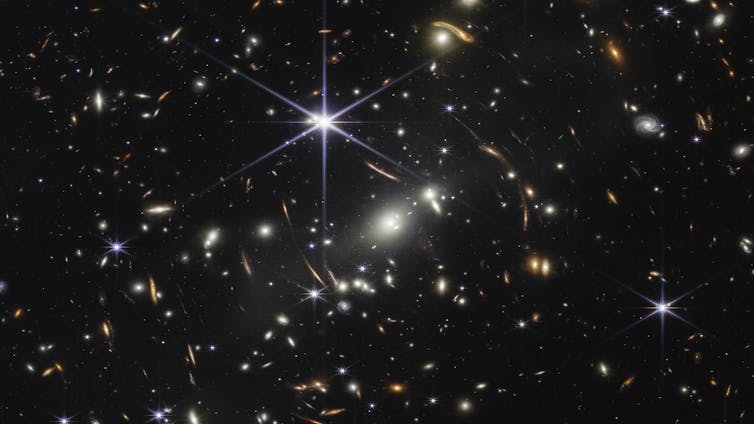
NASA’s James Webb Space Telescope has spotted some potential dark star candidates. NASA, ESA, CSA, and STScI

Alexey A. Petrov, University of South Carolina

Scientists working with the James Webb Space Telescope discovered three unusual astronomical objects in early 2025, which may be examples of dark stars. The concept of dark stars has existed for some time and could alter scientists’ understanding of how ordinary stars form. However, their name is somewhat misleading.

“Dark stars” is one of those unfortunate names that, on the surface, does not accurately describe the objects it represents. Dark stars are not exactly stars, and they are certainly not dark.

Still, the name captures the essence of this phenomenon. The “dark” in the name refers not to how bright these objects are, but to the process that makes them shine — driven by a mysterious substance called dark matter. The sheer size of these objects makes it difficult to classify them as stars.

As a physicist, I’ve been fascinated by dark matter, and I’ve been trying to find a way to see its traces using particle accelerators. I’m curious whether dark stars could provide an alternative method to find dark matter.

What makes dark matter dark?

Dark matter, which makes up approximately 27% of the universe but cannot be directly observed, is a key idea behind the phenomenon of dark stars. Astrophysicists have studied this mysterious substance for nearly a century, yet we haven’t seen any direct evidence of it besides its gravitational effects. So, what makes dark matter dark?

A pie chart showing the composition of the universe. The largest proportion is 'dark energy,' at 68%, while dark matter makes up 27% and normal matter 5%. The rest is neutrinos, free hydrogen and helium and heavy elements.
Despite physicists not knowing much about it, dark matter makes up around 27% of the universe. Visual Capitalist/Science Photo Library via Getty Images

Humans primarily observe the universe by detecting electromagnetic waves emitted by or reflected off various objects. For instance, the Moon is visible to the naked eye because it reflects sunlight. Atoms on the Moon’s surface absorb photons – the particles of light – sent from the Sun, causing electrons within atoms to move and send some of that light toward us.

More advanced telescopes detect electromagnetic waves beyond the visible spectrum, such as ultraviolet, infrared or radio waves. They use the same principle: Electrically charged components of atoms react to these electromagnetic waves. But how can they detect a substance – dark matter – that not only has no electric charge but also has no electrically charged components?

Although scientists don’t know the exact nature of dark matter, many models suggest that it is made up of electrically neutral particles – those without an electric charge. This trait makes it impossible to observe dark matter in the same way that we observe ordinary matter.

Dark matter is thought to be made of particles that are their own antiparticles. Antiparticles are the “mirror” versions of particles. They have the same mass but opposite electric charge and other properties. When a particle encounters its antiparticle, the two annihilate each other in a burst of energy.

If dark matter particles are their own antiparticles, they would annihilate upon colliding with each other, potentially releasing large amounts of energy. Scientists predict that this process plays a key role in the formation of dark stars, as long as the density of dark matter particles inside these stars is sufficiently high. The dark matter density determines how often dark matter particles encounter, and annihilate, each other. If the dark matter density inside dark stars is high, they would annihilate frequently.

What makes a dark star shine?

The concept of dark stars stems from a fundamental yet unresolved question in astrophysics: How do stars form? In the widely accepted view, clouds of primordial hydrogen and helium — the chemical elements formed in the first minutes after the Big Bang, approximately 13.8 billion years ago — collapsed under gravity. They heated up and initiated nuclear fusion, which formed heavier elements from the hydrogen and helium. This process led to the formation of the first generation of stars.

Two bright clouds of gas condensing around a small central region
Stars form when clouds of dust collapse inward and condense around a small, bright, dense core. NASA, ESA, CSA, and STScI, J. DePasquale (STScI), CC BY-ND

In the standard view of star formation, dark matter is seen as a passive element that merely exerts a gravitational pull on everything around it, including primordial hydrogen and helium. But what if dark matter had a more active role in the process? That’s exactly the question a group of astrophysicists raised in 2008.

In the dense environment of the early universe, dark matter particles would collide with, and annihilate, each other, releasing energy in the process. This energy could heat the hydrogen and helium gas, preventing it from further collapse and delaying, or even preventing, the typical ignition of nuclear fusion.

The outcome would be a starlike object — but one powered by dark matter heating instead of fusion. Unlike regular stars, these dark stars might live much longer because they would continue to shine as long as they attracted dark matter. This trait would make them distinct from ordinary stars, as their cooler temperature would result in lower emissions of various particles.

Can we observe dark stars?

Several unique characteristics help astronomers identify potential dark stars. First, these objects must be very old. As the universe expands, the frequency of light coming from objects far away from Earth decreases, shifting toward the infrared end of the electromagnetic spectrum, meaning it gets “redshifted.” The oldest objects appear the most redshifted to observers.

Since dark stars form from primordial hydrogen and helium, they are expected to contain little to no heavier elements, such as oxygen. They would be very large and cooler on the surface, yet highly luminous because their size — and the surface area emitting light — compensates for their lower surface brightness.

They are also expected to be enormous, with radii of about tens of astronomical units — a cosmic distance measurement equal to the average distance between Earth and the Sun. Some supermassive dark stars are theorized to reach masses of roughly 10,000 to 10 million times that of the Sun, depending on how much dark matter and hydrogen or helium gas they can accumulate during their growth.

So, have astronomers observed dark stars? Possibly. Data from the James Webb Space Telescope has revealed some very high-redshift objects that seem brighter — and possibly more massive — than what scientists expect of typical early galaxies or stars. These results have led some researchers to propose that dark stars might explain these objects.

Artist's impression of the James Webb telescope, which has a hexagonal mirror made up of smaller hexagons, and sits on a rhombus-shaped spacecraft.
The James Webb Space Telescope, shown in this illustration, detects light coming from objects in the universe. Northrup Grumman/NASA

In particular, a recent study analyzing James Webb Space Telescope data identified three candidates consistent with supermassive dark star models. Researchers looked at how much helium these objects contained to identify them. Since it is dark matter annihilation that heats up those dark stars, rather than nuclear fusion turning helium into heavier elements, dark stars should have more helium.

The researchers highlight that one of these objects indeed exhibited a potential “smoking gun” helium absorption signature: a far higher helium abundance than one would expect in typical early galaxies.

Dark stars may explain early black holes

What happens when a dark star runs out of dark matter? It depends on the size of the dark star. For the lightest dark stars, the depletion of dark matter would mean gravity compresses the remaining hydrogen, igniting nuclear fusion. In this case, the dark star would eventually become an ordinary star, so some stars may have begun as dark stars.

Supermassive dark stars are even more intriguing. At the end of their lifespan, a dead supermassive dark star would collapse directly into a black hole. This black hole could start the formation of a supermassive black hole, like the kind astronomers observe at the centers of galaxies, including our own Milky Way.

Dark stars might also explain how supermassive black holes formed in the early universe. They could shed light on some unique black holes observed by astronomers. For example, a black hole in the galaxy UHZ-1 has a mass approaching 10 million solar masses, and is very old – it formed just 500 million years after the Big Bang. Traditional models struggle to explain how such massive black holes could form so quickly.

The idea of dark stars is not universally accepted. These dark star candidates might still turn out just to be unusual galaxies. Some astrophysicists argue that matter accretion — a process in which massive objects pull in surrounding matter — alone can produce massive stars, and that studies using observations from the James Webb telescope cannot distinguish between massive ordinary stars and less dense, cooler dark stars.

Researchers emphasize that they will need more observational data and theoretical advancements to solve this mystery.

Alexey A. Petrov, Professor of physics and astronomy, University of South Carolina

This article is republished from The Conversation under a Creative Commons license. Read the original article.

ooOOoo

Alexey Petrov says at the end of the article that more observations are required before we humans know all the answers. I have no doubt that in time we will have the answers.

The mystery of Dark Matter

This very interesting article is worth a read.

Patrice Ayme published a post on Wednesday, 25th June, 2025 that is deeply conected to the following post from The Conversation.

His post was called: ‘How Does The Universe Expand? The Way Cosmologists Decided That It Does, FLRW Metric! A Causal Loop Is At The Heart Of Modern ΛCDM Cosmology!’

Thus I recommend that you read that article and then the one that is republished by me, with permission, from The Conversation.

ooOOoo

The Vera C. Rubin Observatory will help astronomers investigate dark matter, continuing the legacy of its pioneering namesake

The Rubin Observatory is scheduled to release its first images in 2025. RubinObs/NOIRLab/SLAC/NSF/DOE/AURA/B. Quint

Samantha Thompson, Smithsonian Institution

Everything in space – from the Earth and Sun to black holes – accounts for just 15% of all matter in the universe. The rest of the cosmos seems to be made of an invisible material astronomers call dark matter.

Astronomers know dark matter exists because its gravity affects other things, such as light. But understanding what dark matter is remains an active area of research.

With the release of its first images this month, the Vera C. Rubin Observatory has begun a 10-year mission to help unravel the mystery of dark matter. The observatory will continue the legacy of its namesake, a trailblazing astronomer who advanced our understanding of the other 85% of the universe.

As a historian of astronomy, I’ve studied how Vera Rubin’s contributions have shaped astrophysics. The observatory’s name is fitting, given that its data will soon provide scientists with a way to build on her work and shed more light on dark matter.

Wide view of the universe

From its vantage point in the Chilean Andes mountains, the Rubin Observatory will document everything visible in the southern sky. Every three nights, the observatory and its 3,200 megapixel camera will make a record of the sky.

This camera, about the size of a small car, is the largest digital camera ever built. Images will capture an area of the sky roughly 45 times the size of the full Moon. With a big camera with a wide field of view, Rubin will produce about five petabytes of data every year. That’s roughly 5,000 years’ worth of MP3 songs.

After weeks, months and years of observations, astronomers will have a time-lapse record revealing anything that explodes, flashes or moves – such as supernovas, variable stars or asteroids. They’ll also have the largest survey of galaxies ever made. These galactic views are key to investigating dark matter.

Galaxies are the key

Deep field images from the Hubble Space Telescope, the James Webb Space Telescope and others have visually revealed the abundance of galaxies in the universe. These images are taken with a long exposure time to collect the most light, so that even very faint objects show up.

Researchers now know that those galaxies aren’t randomly distributed. Gravity and dark matter pull and guide them into a structure that resembles a spider’s web or a tub of bubbles. The Rubin Observatory will expand upon these previous galactic surveys, increasing the precision of the data and capturing billions more galaxies.

In addition to helping structure galaxies throughout the universe, dark matter also distorts the appearance of galaxies through an effect referred to as gravitational lensing.

Light travels through space in a straight line − unless it gets close to something massive. Gravity bends light’s path, which distorts the way we see it. This gravitational lensing effect provides clues that could help astronomers locate dark matter. The stronger the gravity, the bigger the bend in light’s path.

Many galaxies, represented as bright dots, some blurred, against a dark background.
The white galaxies seen here are bound in a cluster. The gravity from the galaxies and the dark matter bends the light from the more distant galaxies, creating contorted and magnified images of them. NASA, ESA, CSA and STScI

Discovering dark matter

For centuries, astronomers tracked and measured the motion of planets in the solar system. They found that all the planets followed the path predicted by Newton’s laws of motion, except for Uranus. Astronomers and mathematicians reasoned that if Newton’s laws are true, there must be some missing matter – another massive object – out there tugging on Uranus. From this hypothesis, they discovered Neptune, confirming Newton’s laws.

With the ability to see fainter objects in the 1930s, astronomers began tracking the motions of galaxies.

California Institute of Technology astronomer Fritz Zwicky coined the term dark matter in 1933, after observing galaxies in the Coma Cluster. He calculated the mass of the galaxies based on their speeds, which did not match their mass based on the number of stars he observed.

He suspected that the cluster could contain an invisible, missing matter that kept the galaxies from flying apart. But for several decades he lacked enough observational evidence to support his theory.

A woman adjusting a large piece of equipment.
Vera Rubin operates the Carnegie spectrograph at Kitt Peak National Observatory in Tucson. Carnegie Institution for Science, CC BY

Enter Vera Rubin

In 1965, Vera Rubin became the first women hired onto the scientific staff at the Carnegie Institution’s Department of Terrestrial Magnetism in Washington, D.C.

She worked with Kent Ford, who had built an extremely sensitive spectrograph and was looking to apply it to a scientific research project. Rubin and Ford used the spectrograph to measure how fast stars orbit around the center of their galaxies.

In the solar system, where most of the mass is within the Sun at the center, the closest planet, Mercury, moves faster than the farthest planet, Neptune.

“We had expected that as stars got farther and farther from the center of their galaxy, they would orbit slower and slower,” Rubin said in 1992.

What they found in galaxies surprised them. Stars far from the galaxy’s center were moving just as fast as stars closer in.

“And that really leads to only two possibilities,” Rubin explained. “Either Newton’s laws don’t hold, and physicists and astronomers are woefully afraid of that … (or) stars are responding to the gravitational field of matter which we don’t see.”

Data piled up as Rubin created plot after plot. Her colleagues didn’t doubt her observations, but the interpretation remained a debate. Many people were reluctant to accept that dark matter was necessary to account for the findings in Rubin’s data.

Rubin continued studying galaxies, measuring how fast stars moved within them. She wasn’t interested in investigating dark matter itself, but she carried on with documenting its effects on the motion of galaxies.

A quarter with a woman looking upwards engraved onto it.
A U.S quarter honors Vera Rubin’s contributions to our understanding of dark matter. United States Mint, CC BY

Vera Rubin’s legacy

Today, more people are aware of Rubin’s observations and contributions to our understanding of dark matter. In 2019, a congressional bill was introduced to rename the former Large Synoptic Survey Telescope to the Vera C. Rubin Observatory. In June 2025, the U.S. Mint released a quarter featuring Vera Rubin.

Rubin continued to accumulate data about the motions of galaxies throughout her career. Others picked up where she left off and have helped advance dark matter research over the past 50 years.

In the 1970s, physicist James Peebles and astronomers Jeremiah Ostriker and Amos Yahil created computer simulations of individual galaxies. They concluded, similarly to Zwicky, that there was not enough visible matter in galaxies to keep them from flying apart.

They suggested that whatever dark matter is − be it cold stars, black holes or some unknown particle − there could be as much as 10 times the amount of dark matter than ordinary matter in galaxies.

Throughout its 10-year run, the Rubin Observatory should give even more researchers the opportunity to add to our understanding of dark matter.

Samantha Thompson, Astronomy Curator, National Air and Space Museum, Smithsonian Institution

This article is republished from The Conversation under a Creative Commons license. Read the original article.

ooOOoo

It is difficult to say anything more as my comment will mean practically nothing compared to Patrice Ayme and Samantha Thompson.

I am just grateful that these fine people publish their research with permission for it to be republished elsewhere. Thank you!

Dark Matter

Not really understanding but knowing it’s important!

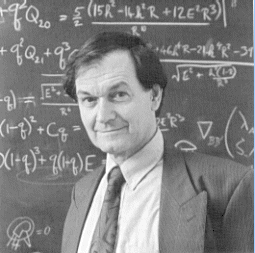
I recently read a glowing review of the latest book by Sir Roger Penrose, the eminent mathematical physicist, called The Road To Reality. Having previously read his book The Emperors’ New Mind and just understanding it, I thought

Roger Penrose

his next one would be a welcome companion for long winter evenings.  Wrong!

I managed to the bottom of the third page of the preface before “According to the mathematician’s “equivalence class” notion …..” had me grasping for meaning.  Well over a 1,000 pages of content was destined to gather dust on the bookshelf.

But wrong again!

The idea of matter out there in the universe that is essential to the universe as we know it but is unseen has been sufficiently fascinating for the popular media to refer to it from time to time.  Most people are familiar with the term even if like me don’t really have a clue as to what dark matter is all about.

So a recent press release in a popular English newspaper suggesting that dark matter has been ‘discovered’, if discover is the appropriate term, had me reaching out for Penrose’s book again.  There under the chapter headed Speculative theories of the early universe was, on page 773, a few sentences that almost made sense.  Let me quote them:

For many years, it had become clear that the dynamics of stars within galaxies does not make sense, according to standard theory unless there is a good deal of more material in the neighbourhood of the galaxy than is directly seen in stars.  A similar comment applies to the dynamics of individual galaxies within clusters.  Overall, there seems to be about 10 times more matter than is perceived in ordinary baryonic form.  This is the mysterious dark matter whose actual nature is still not agreed upon by astronomers, and which may even be of some material different from any that is definitely known to particle physicists – though there is much speculation about this at the present time.

Read more about Dark Matter