More musings on how this present civilisation is going to change, as change it must.
I have a sense that this article is going to spread across a number of posts. Regular readers of Learning from Dogs will be aware that I am summarising Lester Brown’s excellent book, World on the Edge. If you have missed those summaries, the last one, Part 4, was here. (Part 3 here, Part 2 here, Part 1 here.)
Details of this excellent book are on the Earth Policy Institute website including the opportunity to download the book for free.
OK, back to the theme of this article, very much connected with the mission of the EPI.
Jean and I watched a video last night from the website Top Documentary Films; great site by the way. It was called 2210: The Collapse. This was how the film was described on that website.
Imagine if hundreds of years from now, scientists excavated the abandoned ruins of some of our largest cities, what conclusions would they come to?
It happened to the Romans, the Anasazi, and the Mayans and, inevitably, one day our own modern civilization will also fall. In this two hour special discover how a future civilization might be baffled as to why the population of these once-great cities would suddenly abandon their technology and architecture, and turn their homes into ghost towns.
Some experts believe that there is a very real risk this could happen, and the collapse of the world as we know it is closer than we think.
Examining the parallels between cultures separated by hundreds of years, explore whether the key to preventing such a global collapse today could lie in finding renewable alternatives to our dwindling energy supplies and sustainable resources. Can we learn from the mistakes of the past before it’s too late?
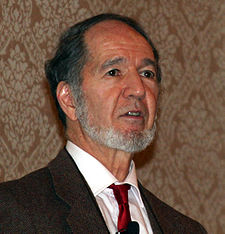
In some ways the film didn’t cover any new ground despite it being an interesting way of approaching the subject of the future of our present civilisation. But what was really worthwhile were the clips from three experts in their various fields. They were the author Jared Diamond, Daniel Gilbert who is Professor of Psychology at Havard, and Joseph Tainter also an author. There is much material around from these three gentlemen.
So I am going to start with Jared Diamond. WikiPedia has Jared’s details. The following is a video going back to 2003 which is no less relevant in terms of where we are in 2011. (If you want more of Jared’s ideas, just let me know and they will be included in a future Post.)
“I’ve set myself the modest task of trying to explain the broad pattern of human history, on all the continents, for the last 13,000 years. Why did history take such different evolutionary courses for peoples of different continents? This problem has fascinated me for a long time, but it’s now ripe for a new synthesis because of recent advances in many fields seemingly remote from history, including molecular biology, plant and animal genetics and biogeography, archaeology, and linguistics.”
JARED DIAMOND is Professor of Geography at the University of California, Los Angeles. Until recently he was Professor of Physiology at the UCLA School of Medicine. He is the author of the recently published Collapse: How Societies Choose to Fail or Succeed, and the Pulitzer Prize-winning author of the widely acclaimed Guns, Germs, and Steel: the Fates of Human Societies, which also is the winner of Britain’s 1998 Rhone-Poulenc Science Book Prize. (From here)
 Learning from Dogs