Sometimes looking down the other end of the telescope reveals more, much more!
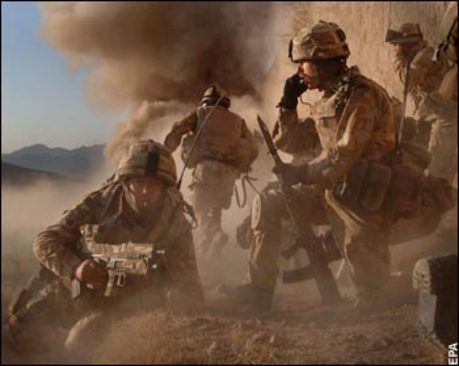
Now that coalition forces have just recently suffered their deadliest month yet in the conflict in Afghanistan, it now has become more crucial than ever to rethink the strategy of the United States and its allies in the region. Currently, the cornerstone of this strategy rests upon two key factors – winning over the local peoples of the region, and training local forces to carry the burden when, and if, coalition forces leave the region.
At least on the exterior, these goals in Afghanistan do make some sense. The only possible way to succeed via a continued military occupation of Afghanistan is to attain and bank on the support of the local peoples. Also, if western powers are ever to withdraw from the region, local forces will have to be able to maintain whatever structure these forces leave in their wake.
However, while this strategy is not completely outlandish and does show some merit on the part of military strategists in that they are leaning more towards localized models that entail comprehension of diverse local factors, the question still must be asked – is this strategy actually possible to carry out and have the sought-after effects in the region? Can the United States and its allies actually win over the peoples of Afghanistan and western Pakistan, and can these same powers possibly train forces that will remain peacekeepers in the years to come?
Despite the fact that I admire the intentions of the military’s current strategy in this region, I do not think that their plan is in fact possible. It seems to me that rather we are fighting an unwinnable war to win over a people that we do not and cannot understand, and that by funding the Afghani security forces of today, we are inevitably funding our enemy of tomorrow, just as our nation has mistakenly done so many times in the past in this very region.
I cannot foretell the future. Nor can anyone else. However, I can comment on what is likely to occur. And, in constructing such a model, two of the most important subjects to understand are history and praxeology, or human behavior.
An attempt by the United States to make Afghanistan a stable, western-friendly state is by no means a new happening. The date of the beginnings of our intervention in the region could be debated, but a decent starting point is the late 1970’s when President Carter put forth the Carter Doctrine, which stated that the United States would defend its interests in the Middle East.
This doctrine just barely preceded the Soviet invasion of Afghanistan, and it was this invasion that saw the beginnings of American forces, at this point being mostly CIA and other such agencies, which were attempting to hamper the Soviet forces by funding the Afghani resistance.
Now, there is no room here for a history of American involvement in Afghanistan. However, what must be noted is that during the 1980’s and 1990’s, a pattern developed in the Middle East – the United States would fund a group in the hope of combating some common enemy, and then in later years the group funded with American taxpayer money would inevitably end up turning against the United States.
A few prominent examples of this are Al Qaeda, who received $6 billion from the United States from 1989 to 1992, the Afghani Taliban, who was receiving US foreign aid up to the very minute American forces entered their country (and continues to receive US foreign aid through Pakistani backchannels) and Saddam Hussein, who received chemical weapons from the US during the Iraq-Iran War of the 1980’s, weapons he later used to kill American soldiers.
This, though briefly put, is the history, or the “what.” So now must come an examination of the “why,” or the element of praxeology. For obviously, our attempts to forge friendships in the region in the past have failed. Our friends have become our enemies, in fact our worst enemies.
There are several possible explanations for why this occurs. However, mine is quite simple – we do not understand these people, we do not understand this region, we do not understand Islamic culture, and, to be quite blunt, we never will. It is not a wrongdoing by the West to look at the Middle East through Western eyes. Rather, it is the only way that a westerner possibly can look at the Middle East.
On top of this extremely problematic misunderstanding of the Middle East by Western peoples then comes another layer of problems, these being the base problems of intervention in any context, amplified by the extreme foreignness and instability of the Middle East as a whole. The consequences of intervention in any scenario are so unpredictable, so many, and so far-reaching that no one can possibly intervene and successfully fulfil their objectives without in the process creating a dozen new problems. This is seen with the federal government intervening in states in their own country – how much greater then are the problems when intervening in a region like the Middle East?
All this now brings us back to the point on considering the future. As I mentioned previously, I cannot say what the future holds. However, I can make an educated guess. And, based on analyses of both history and human behavior, it is safe to say that by both indirectly and directly funding the training of a new military force in Afghanistan, we very likely are creating our enemy of tomorrow. For when these people that we are now training realize that the United States is not leaving, that they are not in fact a free state, that they have become a part of the American empire, and that if they want to live culturally independent of western influence they will have to forcibly remove Western elements within their borders, it seems extremely probable that they will do exactly that.
To say that we are creating a force that will do what we expect it to do in the future is a wish at best. The reality is that we do not and cannot understand what is truly a foreign mindset, and our best course of action would be to distance ourselves from what is and will be for many years of region of perpetual conflict.
By Elliot Engstrom

 Learning from Dogs