In the days when I lived in South Devon in England and had cause to travel, as in drive, to London one of the route options was to take the M5 motorway (Freeway in American speak) up to Bristol and then follow the M4 motorway that ran from Bristol all the way into the outskirts of London.
One of the benefits of this was that half-way, give or take, was at the Swindon exit and a further ten-minute drive took one to the delightful car-park at the White Horse at Uffington. No, it wasn’t a pub despite numerous pubs in England being called The White Horse; it was something much more special.
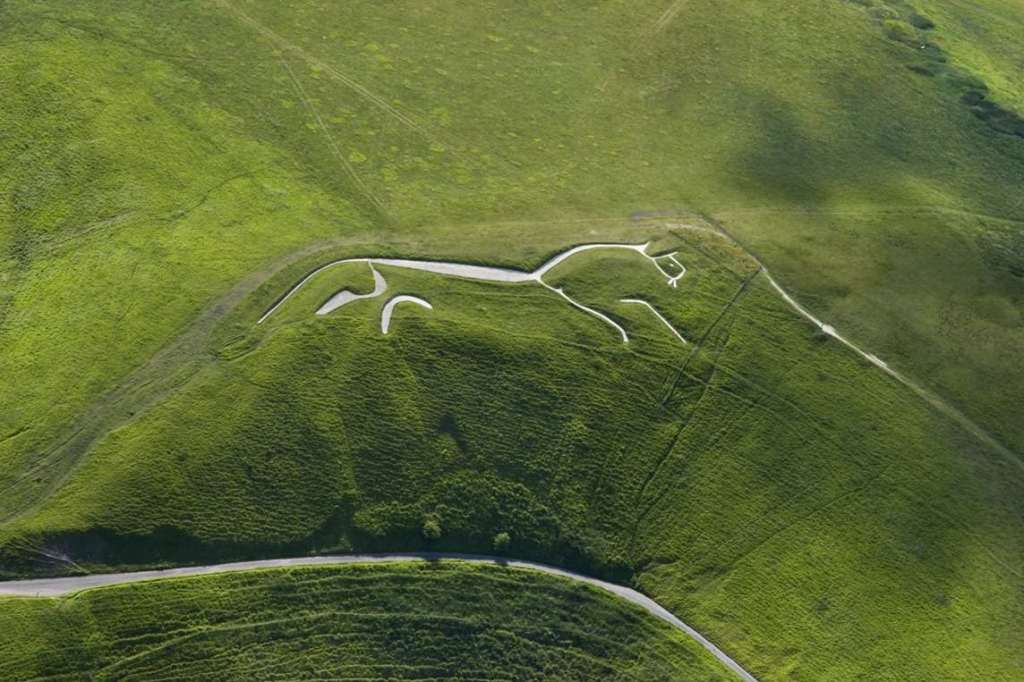
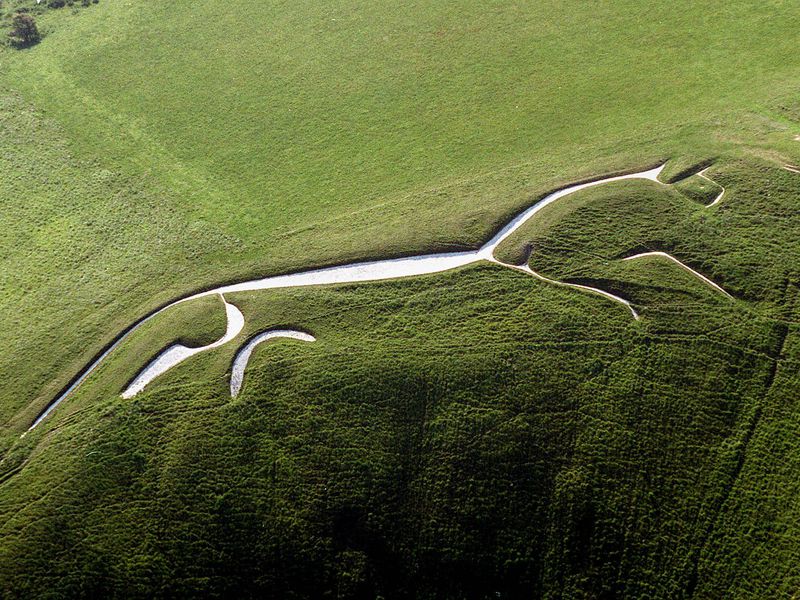
The Uffington White Horse is a highly stylisedprehistorichill figure, 110 m (360 ft) long, formed from deep trenches filled with crushed white chalk. The figure is situated on the upper slopes of White Horse Hill in the Englishcivil parish of Uffington (in the county of Oxfordshire, historically Berkshire), some 8 km (5 mi) south of the town of Faringdon and a similar distance west of the town of Wantage; or 2.5 km (1.6 mi) south of Uffington. The hill forms a part of the scarp of the Berkshire Downs and overlooks the Vale of White Horse to the north. The best views of the figure are obtained from the air, or from directly across the Vale, particularly around the villages of Great Coxwell, Longcot and Fernham. The site is owned and managed by the National Trust and is a Scheduled Ancient Monument. The Guardian stated in 2003 that “for more than 3,000 years, the Uffington White Horse has been jealously guarded as a masterpiece of minimalist art.” It has also inspired the creation of other white horse hill figures.
Against All Odds, England’s Massive Chalk Horse Has Survived 3,000 Years
Cleaning up the Uffington Horse is the neigh-borly thing to do
The White Horse at Uffington, Oxfordshire (AP Photo)
Emily Cleaver smithsonian.com July 6, 2017
If you stand in the valley near the village of Uffington in Oxfordshire, England, and look up at the high curve of chalk grassland above you, one thing dominates the view. Across the flank of the hill runs an enormous white, abstract stick figure horse cut from the chalk itself. It has a thin, sweeping body, stubby legs, a curiously long tail and a round eye set in a square head.
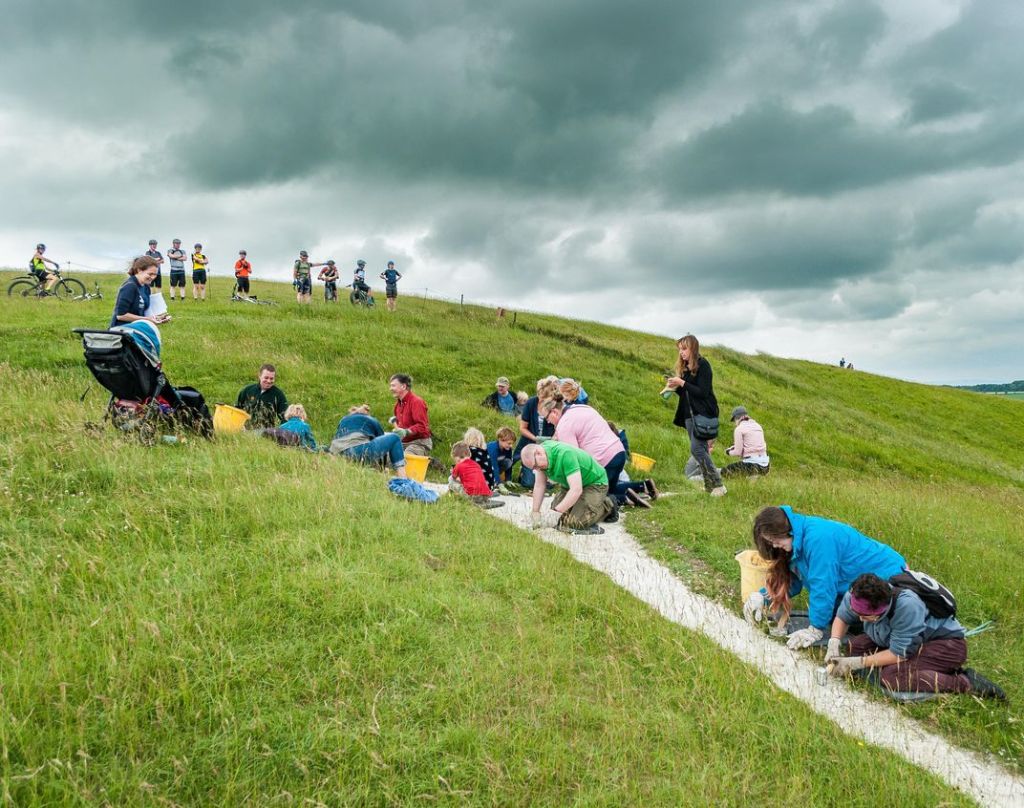
This is the Uffington White Horse, the oldest of the English hill figures. It’s a 3,000-year-old pictogram the size of a football field and visible from 20 miles away. On this July morning black specks dot the lower slopes as small groups of people trudge slowly upwards. They’re coming to clean the horse.
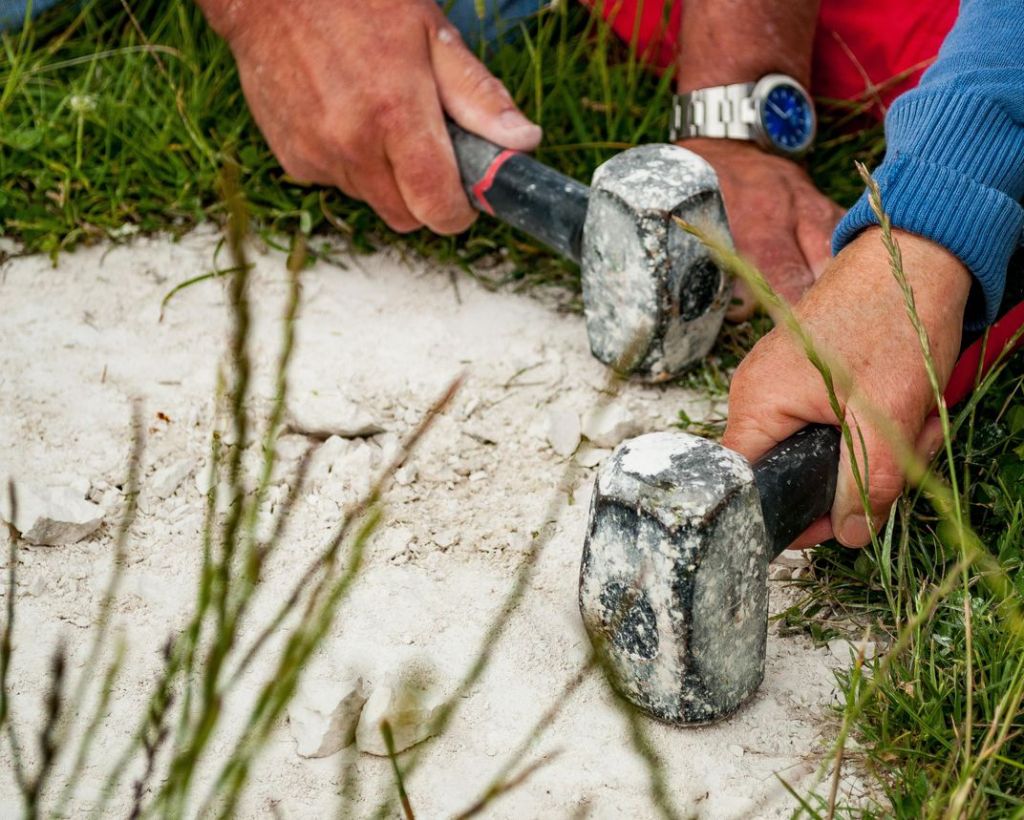
It’s chalking day, a cleaning ritual that has happened here regularly for three millennia. Hammers, buckets of chalk and kneepads are handed out and everyone is allocated an area. The chalkers kneel and smash the chalk to a paste, whitening the stony pathways in the grass inch by inch. “It’s the world’s largest coloring between the lines,” says George Buce, one of the participants.
Chalking or “scouring” the horse was already an ancient custom when antiquarian Francis Wise wrote about it in 1736. “The ceremony of scouring the Horse, from time immemorial, has been solemnized by a numerous concourse of people from all the villages roundabout,” he wrote.
In the past, thousands of people would come for the scouring, holding a fair in the circle of a prehistoric fort nearby. These days it’s a quieter event. The only sounds are the wind, distant birdsong and the thumping of hammers on the chalk that can be felt through the feet.
Conservation organization the National Trust oversees the chalking, making sure the original shape of the horse is maintained. But the work is done by anyone who wants to come along. Lynda Miller is working on the eye, a circle the size of a car wheel. “The horse has always been part of our lives,” she says. “We’re really excited that we’re cleaning the eye today. When I was a little girl and I came here with my mother and father, the eye was a special spot. We used to make a wish on it.”
National Trust ranger Andy Foley hands out hammers. “It must have happened in this way since it was put on the hillside,” he says. “If people didn’t look after it the horse would be gone within 20 to 30 years; overgrown and eroded. We’re following in the footsteps of the ancients, doing exactly what they did 3,000 years ago.”
“There is something very special about this landscape that attracts people,” says archaeologist David Miles. In the 1990s, he led an excavation of the site that established the prehistoric date for the horse. Before the excavation, it was thought that the design was only scratched into the chalk surface, and therefore un-datable, but Miles’ team discovered the figure was actually cut into the hill up to a meter deep. That meant it was possible to use a technique called optical stimulated luminescence to date layers of quartz in the trench.
Emily Cleaver
Emily Cleaver
Up on the hill it’s not possible to view the whole horse at once; the curve of the slope gets in the way, the sheer scale of it confuses the eye. It is only from the valley below that the whole picture can be taken in. From this long distance, the horse is a tiny white figure prancing timelessly across the brow of the hill. But to the people who live near and tend the horse, it’s a monumental reminder of Britain’s ancient past.
“It was older than I’d been expecting,” Miles remembers. “We already knew it must be ancient, because it’s mentioned in the 12th-century manuscript The Wonders of Britain, so it was obviously old then. And the abstract shape of the horse is very similar to horses on ancient British coins just over 2,000 years old. But our dating showed it was even older than that. It came out as the beginning of the Iron Age, perhaps even the end of the Bronze Age, nearly 3,000 years ago.”
The trenches would have been dug out using antler picks and wooden spades: tough, labor-intensive work. How the builders planned and executed such a large figure when the full effect can only be taken in from several miles away is still a mystery.
Nobody knows for certain why the horse was made. “It’s a beautiful shape, very elegant,” says Miles. “It looks like it’s bounding across the hillside. If you look at it from below, the sun rises from behind it and crosses over it. In Celtic art, horses are often shown pulling the chariot of the sun, so that may be what they were thinking of here.”
From the start the horse would have required regular upkeep to stay visible. It might seem strange that the horse’s creators chose such an unstable form for their monument, but archaeologists believe this could have been intentional. A chalk hill figure requires a social group to maintain it, and it could be that today’s cleaning is an echo of an early ritual gathering that was part of the horse’s original function.
The Berkshire Downs where the horse lies are scattered with prehistoric remains. The Ridgeway, Britain’s oldest road, runs nearby. This is the heart of rural England and the horse is one of the country’s most recognizable landmarks, an identity badge stamped into the landscape. During World War II, it was covered over with turf and hedge trimmings so Luftwaffe bombers couldn’t use it for navigation. (Oxford is about a 30-minute drive and London about an hour-and-a-half.)
For locals, it’s part of the backdrop of daily life. Residents in the village reportedly arrange their rooms so that they sit facing the horse. Offerings, flowers, coins and candles are left on the site.
The people who come to the chalking have a variety of motivations. Martha Buckley is chalking the horse’s neck. ” I’m a neo-Pagan and I feel it connects me to the land. It’s of great spiritual significance,” she says. Lucy Bartholomew has brought her children. “It’s good to be able to explain to them why it’s here.” For Geoff Weaver, it’s the imperative to preserve history. “If we don’t do it, it would disappear, and the world would be a sorrier place,” he says.
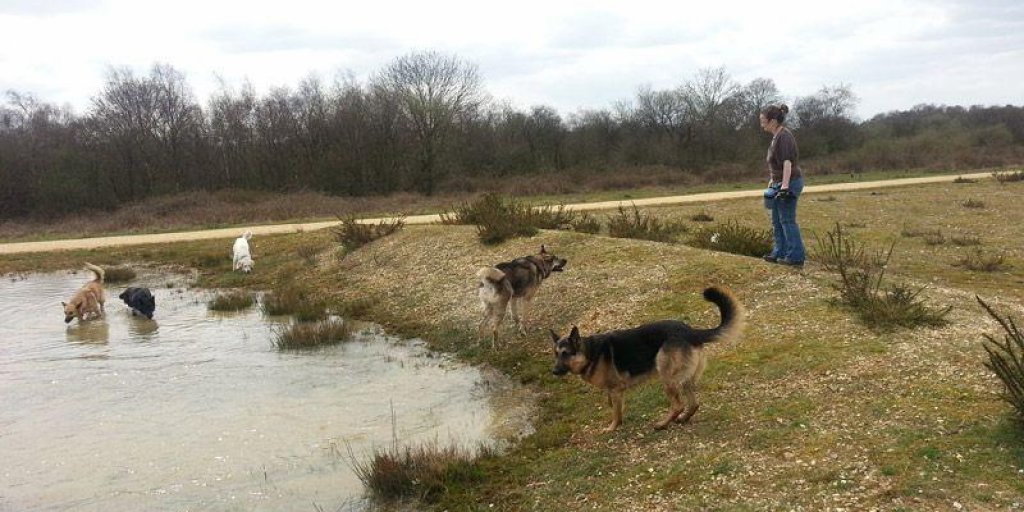
Speaking of Berkshire, as in the Berkshire Downs, the only way to close today’s post is with a link to a dog walk on Greenham Common in Berkshire. That includes the following photograph.
A repeat posting of a wonderful joke from earlier times.
Good friend from my English days, Bob Derham, a few days ago sent me the well-known joke about the dog for sale. At first, I had forgotten that I had posted a slightly modified version back in April, 2012. When I re-read it, I had to repost it today. It’s wonderful.
oooo
DOG FOR SALE
New home needed for this wonderful animal.
A guy is driving around the back streets of Bristol, England.
He sees a sign in front of an unkempt terraced house: ‘Talking Dog For Sale‘, so he rings the bell and the owner appears and tells him the dog is in the garden.
The guy goes into the backyard and sees a nice looking Labrador retriever sitting there.
‘You talk?‘ he asks.
‘Yep,’ the Lab replies.
After the guy recovers from the shock of hearing a dog talk, he says ‘So, what’s your story?‘
The Lab looks up and says, ‘Well, I discovered that I could talk when I was pretty young.. I wanted to help the government, so I told the SAS. [Special Air Service or SAS is a corps of the British Army]
In no time at all they had me jetting from country to country, sitting in rooms with spies and world leaders, because no one figured a dog would be eavesdropping.‘
‘I was one of their most valuable spies for eight years running…
But the jetting around really tired me out,and I knew I wasn’t getting any younger so I decided to settle down. I signed up for a job at the airport here in Bristol to do some undercover security. You know, wandering near suspicious characters and listening in, that sort of thing. I uncovered some incredible dealings and was awarded a batch of medals.’
‘Then I got married, had a load of puppies, and now I’m just retired.‘
The guy is amazed. He goes back in and asks the owner what he wants for the dog.
‘Ten quid,’ the guy says.
‘Ten quid? This dog is amazing! Why on earth are you selling him so cheap?‘
‘Because he’s a liar. He’s never been out of the garden all his life!’
It’s the way I tell ’em!
oooo
Really hope that many of you haven’t come across this wonderful joke before!
With grateful thanks to Alanna B. for sending me the details of this tragic case!
DOG FOR SALE:
New home needed for this wonderful animal.
A guy is driving around the back streets of Bristol, England.
He sees a sign in front of an unkempt terraced house: ‘Talking Dog For Sale‘, so he rings the bell and the owner appears and tells him the dog is in the garden.
The guy goes into the backyard and sees a nice looking Labrador retriever sitting there.
‘You talk?‘ he asks.
‘Yep,’ the Lab replies.
After the guy recovers from the shock of hearing a dog talk, he says ‘So, what’s your story?‘
The Lab looks up and says, ‘Well, I discovered that I could talk when I was pretty young.. I wanted to help the government, so I told the SAS. [Special Air Service or SAS is a corps of the British Army, Ed.]
In no time at all they had me jetting from country to country, sitting in rooms with spies and world leaders, because no one figured a dog would be eavesdropping.‘
‘I was one of their most valuable spies for eight years running…
But the jetting around really tired me out,and I knew I wasn’t getting any younger so I decided to settle down. I signed up for a job at the airport to do some undercover security, wandering near suspicious characters and listening in. I uncovered some incredible dealings and was awarded a batch of medals.’
‘Then I got married, had a load of puppies, and now I’m just retired.‘
The guy is amazed. He goes back in and asks the owner what he wants for the dog.
‘Ten quid,’ the guy says.
‘Ten quid? This dog is amazing! Why on earth are you selling him so cheap?‘
‘Because he’s a liar. He’s never been out of the garden all his life!’
Continuing the advice you might offer to the next generation?
On the 1st December I published the first message. It had been inspired by a conversation with Peter McCarthy, who lives and works in Bristol, England. Here’s a little of what I wrote,
Anyway, Peter and I were talking about the sorts of qualities that enable some young people to take a risk-based entrepreneurial approach to life. Peter gave me the links to three videos that he thought were especially relevant to the notion of achieving success in life. So over the next few days I want to share those videos with you, dear reader. To me, these videos are, indeed, the essence of the messages that any person, especially those the wrong side of 60, would wish to leave in a bottle floating down the river of life.
So to the second message which is a recording of the talk that Sir Ken Robinson gave to the TED Talks conference in Monterey in February, 2006. It has been widely seen for all the right reasons; Sir Ken offers some powerful common-sense and a wonderful message for all the young people out there. As Sir Ken’s website says,
Sir Ken Robinson, PhD is an internationally recognized leader in the development of education, creativity and innovation. He is also one of the world’s leading speakers with a profound impact on audiences everywhere. The videos of his famous 2006 and 2010 talks to the prestigious TED Conference have been seen by an estimated 200 million people in over 150 countries.



 Learning from Dogs