Tag: Barack Obama

Tell President Obama: Stop the Keystone XL Pipeline

This is so important.

Regular readers will know that I wrote about the XL Pipeline on the 29th August setting out the arguments of those who know much more of the detail as to why the tar sands of Canada are just the worst possible way to continue the madness of using oil.  If you didn’t read that then it’s here, and please do so.

The rest of this Post is taken from the Credo Action website.  Please do participate. Sign the petition NOW.

Do something, please!

Tell President Obama: Stop the Keystone XL Pipeline

“Essentially game over” for the climate.

That’s what climate scientist James Hansen calls the proposed Keystone XL pipeline — which would carry oil out of Canada’s vast tar sands oil fields to Texas, where it will be refined, then burned across the globe, dealing a catastrophic blow to our chance of returning earth to a stable climate.

This project requires a presidential permit to start building — and it is President Obama’s decision alone to grant or deny that permit. He will make the decision as soon as September.

Tell President Obama: Stop the Keystone XL pipeline.

The Alberta tar sands are a carbon bomb. The 3rd largest oil field in the world, the difficult extraction and transportation of the tar sands oil ultimately produces up to three times the carbon emissions of traditional oil. (And extreme environmental devastation along the way.)1

The Keystone XL pipeline is the fuse to this bomb – a highway to swift consumption of this dirty, dangerous crude. As if that wasn’t enough, it poses a massive spill risk in the six states along the pipeline route, including over the Ogallala Aquifer which provides up to 30% of our nation’s agricultural water.

We. Must. Stop. This.

Tell President Obama: Stop the Keystone XL pipeline.

Twenty leading climate scientists have just sent a letter to President Obama urging him to deny the permit.

And from August 20th to September 3rd, there will be a massive, historic, daily sit-in outside the White House where more than 1500 people, including CREDO staff, have already signed up to risk arrest in peaceful protest. (For more about the sit in, see below.)

The administration’s previous decisions on climate do not inspire confidence that they will deny the permit. Recently the administration has opened new areas to offshore drilling and coal mining, and late last year, Secretary of State Hillary Clinton even said she was “inclined” to approve Keystone XL.

But President Obama still has the final word. He does not have to negotiate with Congress or industry. As his State Department reviews the permit, the decision — which could have a devastating impact on the livability of our nation, and our world — is entirely in his hands.

We’ve lost too many climate fights already. We need a massive, historic show of pressure to make sure we don’t lose this one. Please sign the petition and read below for other ways to get involved.

Tell President Obama: Stop the Keystone XL pipeline.

1. “Keystone XL Pipeline,” Friends of the Earth

————————————————————-

Because this fight is so important, leading climate activists including Bill McKibben, Naomi Klein and climate scientist James Hansen are organizing a historic, daily series of peaceful protests between August 20th and Sept. 3rd. The CEO’s and Directors of nearly 30 leading Environmental Organizations, including CREDO’s Michael Kieschnick and Laura Scher, are urging people to participate.

More than 1500 people from across the country, including CREDO staff, have already signed up to join the sit-in outside the White House and risk arrest.

Please read the invitation letter below for more information. If you would like to sign up to join the protest, and possibly be arrested, click here.

Dear Friends,

This will be a slightly longer letter than common for the internet age–it’s serious stuff.

The short version is we want you to consider doing something hard: coming to Washington in the hottest and stickiest weeks of the summer and engaging in civil disobedience that will quite possibly get you arrested.

The full version goes like this:

As you know, the planet is steadily warming: 2010 was the warmest year on record, and we’ve seen the resulting chaos in almost every corner of the earth.

And as you also know, our democracy is increasingly controlled by special interests interested only in their short-term profit.

These two trends collide this summer in Washington, where the State Department and the White House have to decide whether to grant a certificate of ‘national interest’ to some of the biggest fossil fuel players on earth. These corporations want to build the so-called ‘Keystone XL Pipeline’ from Canada’s tar sands to Texas refineries.

To call this project a horror is serious understatement. The tar sands have wrecked huge parts of Alberta, disrupting ways of life in indigenous communities–First Nations communities in Canada, and tribes along the pipeline route in the U.S. have demanded the destruction cease. The pipeline crosses crucial areas like the Oglalla Aquifer where a spill would be disastrous–and though the pipeline companies insist they are using ‘state of the art’ technologies that should leak only once every 7 years, the precursor pipeline and its pumping stations have leaked a dozen times in the past year. These local impacts alone would be cause enough to block such a plan. But the Keystone Pipeline would also be a fifteen hundred mile fuse to the biggest carbon bomb on the continent, a way to make it easier and faster to trigger the final overheating of our planet, the one place to which we are all indigenous.

As the climatologist Jim Hansen (one of the signatories to this letter) explained, if we have any chance of getting back to a stable climate “the principal requirement is that coal emissions must be phased out by 2030 and unconventional fossil fuels, such as tar sands, must be left in the ground.” In other words, he added, “if the tar sands are thrown into the mix it is essentially game over.” The Keystone pipeline is an essential part of the game. “Unless we get increased market access, like with Keystone XL, we’re going to be stuck,” said Ralph Glass, an economist and vice-president at AJM Petroleum Consultants in Calgary, told a Canadian newspaper last week.

Given all that, you’d suspect that there’s no way the Obama administration would ever permit this pipeline. But in the last few months the administration has signed pieces of paper opening much of Alaska to oil drilling, and permitting coal-mining on federal land in Wyoming that will produce as much CO2 as 300 powerplants operating at full bore.

And Secretary of State Clinton has already said she’s ‘inclined’ to recommend the pipeline go forward. Partly it’s because of the political commotion over high gas prices, though more tar sands oil would do nothing to change that picture. But it’s also because of intense pressure from industry. The US Chamber of Commerce–a bigger funder of political campaigns than the RNC and DNC combined–has demanded that the administration “move quickly to approve the Keystone XL pipeline,” which is not so surprising–they’ve also told the U.S. EPA that if the planet warms that will be okay because humans can ‘adapt their physiology’ to cope. The Koch Brothers, needless to say, are also backing the plan, and may reap huge profits from it.

So we’re pretty sure that without serious pressure the Keystone Pipeline will get its permit from Washington. A wonderful coalition of environmental groups has built a strong campaign across the continent–from Cree and Dene indigenous leaders to Nebraska farmers, they’ve spoken out strongly against the destruction of their land. We need to join them, and to say even if our own homes won’t be crossed by this pipeline, our joint home–the earth–will be wrecked by the carbon that pours down it.

And we need to say something else, too: it’s time to stop letting corporate power make the most important decisions our planet faces. We don’t have the money to compete with those corporations, but we do have our bodies, and beginning in mid August many of us will use them. We will, each day, march on the White House, risking arrest with our trespass. We will do it in dignified fashion, demonstrating that in this case we are the conservatives, and that our foes–who would change the composition of the atmosphere are dangerous radicals. Come dressed as if for a business meeting–this is, in fact, serious business.

And another sartorial tip–if you wore an Obama button during the 2008 campaign, why not wear it again? We very much still want to believe in the promise of that young Senator who told us that with his election the ‘rise of the oceans would begin to slow and the planet start to heal.’ We don’t understand what combination of bureaucratic obstinacy and insider dealing has derailed those efforts, but we remember his request that his supporters continue on after the election to pressure his government for change. We’ll do what we can.

And one more thing: we don’t just want college kids to be the participants in this fight. They’ve led the way so far on climate change–10,000 came to DC for the Powershift gathering earlier this spring. They’ve marched this month in West Virginia to protest mountaintop removal; a young man named Tim DeChristopher faces sentencing this summer in Utah for his creative protest.

Now it’s time for people who’ve spent their lives pouring carbon into the atmosphere to step up too, just as many of us did in earlier battles for civil rights or for peace. Most of us signing this letter are veterans of this work, and we think it’s past time for elders to behave like elders. One thing we don’t want is a smash up: if you can’t control your passions, this action is not for you.

This won’t be a one-shot day of action. We plan for it to continue for several weeks, till the administration understands we won’t go away. Not all of us can actually get arrested–half the signatories to this letter live in Canada, and might well find our entry into the U.S. barred. But we will be making plans for sympathy demonstrations outside Canadian consulates in the U.S., and U.S. consulates in Canada–the decision-makers need to know they’re being watched.

Twenty years of patiently explaining the climate crisis to our leaders hasn’t worked. Maybe moral witness will help. You have to start somewhere, and we choose here and now.

If you think you might want to be a part of this action, we need you to sign up here.

As plans solidify in the next few weeks we’ll be in touch with you to arrange nonviolence training; our colleagues at a variety of environmental and democracy campaigns will be coordinating the actual arrangements.

We know we’re asking a lot. You should think long and hard on it, and pray if you’re the praying type. But to us, it’s as much privilege as burden to get to join this fight in the most serious possible way. We hope you’ll join us.

Maude Barlow — Chair, Council of Canadians
Wendell Berry — Author and Farmer
Tom Goldtooth — Director, Indigenous Environmental Network
Danny Glover — Actor
James Hansen — Climate Scientist
Wes Jackson — Agronomist, President of the Land Insitute
Naomi Klein — Author and Journalist
Bill McKibben — Writer and Environmentalist
George Poitras — Mikisew Cree Indigenous First Nation
Gus Speth — Environmental Lawyer and Activist
David Suzuki — Scientist, Environmentalist and Broadcaster
Joseph B. Uehlein — Labor organizer and environmentalist

‘Big Oil’ will kill us all!

The powerful anti-democratic forces that will threaten civilisation.

In one sense this post today carries an underlying political message – and in another sense, it does not.  It does in the sense that if every American voter truly understood the risks of a continued relationship with oil then the tar-sands projects wouldn’t have a prayer of a chance of being allowed.

In the other sense, it does not.  Because the influence and power of ‘behind-the-scenes’ oil and money is beyond imagination and, just possibly, outside the reach of democracy.

So what’s got me so agitated?

Well first is that I have been quietly reading The Transition Handbook by Rob Hopkins, he of Transition Totnes fame.  Most readers will be aware that Totnes was the first Transition Town in the world and started what is becoming the greatest social movement of the 21st century.

In Rob’s book, on page 51, there is a diagram showing the relative energy returns from the energy invested to produce that energy – hope that makes sense!  Let me explain further.  For example, for every unit of energy invested in building tidal-range generators, there are eighty-seven units of energy returned.  I.e. this is a great investment for mankind in terms of the net benefit.

If we look at the generation of electricity from solar photo-voltaic (PV) panels then the return is about eight units from every unit invested.

The worst return of them all is from Tar sands: just one unit returned from every unit invested.  Investment and humanitarian madness!

Then next I came across this item about Tar sands on The Ecologist magazine website,

Emissions from tar sands seriously underestimated

Governments and companies making no effort to quantify the real climate impacts

Greenhouse gas emissions from tar sands operations are being significantly under-reported according to new research by Global Forest Watch Canada.

The report, ‘Bitumen and Biocarbon‘, says oil companies and governments are not accounting for emissions from deforestation. It says that when boreal forest is destroyed for tar sands development, significant amounts of greenhouse gases are emitted.

‘Governments and companies are working hard to downplay the impacts of tar sands operations, but it turns out that they don’t even know the full extent of the problem,’ said Christy Ferguson, Greenpeace climate and energy coordinator.

‘What’s worse, they’re doing nothing to find out. Denial is not a climate strategy.’

In addition, the report shows that biological carbon stored in living and decaying plants is lost when natural ecosystems are disturbed or destroyed through mining of bitumen and construction of roads, pipelines or facilities.

‘Peatlands are one of the world’s most important storehouses of soil carbon. Industrial activity in the tar sands is destroying peatlands, releasing carbon and eliminating a crucial natural mechanism.

‘Even if peatlands are reclaimed, the carbon released through industrialisation won’t be replaced for thousands of years,’ said Ferguson.

Finally, today (25th) I received in my in-box the latest TomDispatch offering.  (I am indebted to Tom Engelhardt for, once again, giving me permission to reproduce in full this TomGram.)

Tom’s latest piece is written by Bill McKibben (with an introduction by Tom) and I strongly urge you to read it – the implications are global.  If you read an earlier TomDispatch article by Bill re-published on Learning from Dogs on the 18th July, The Great American Carbon Bomb, today’s piece will surely make you sit up and fume; as it did me!  Here it is in full.

Tomgram: Bill McKibben, Jailed Over Big Oil’s Attempt to Wreck the Planet

What might have happened if John McCain had won the presidency in 2008?  One thing is certain: there would have been a lot more protest from Democrats, progressives, and the left.  Take it as an irony of his election, but Barack Obama has proved remarkably effective in disarming the antiwar movement, even as the use of war in American policy in the Greater Middle East has only grown.  That Obama, the supposed anti-warrior of the 2008 campaign, has paid less than no attention to his antiwar critics is no news at all.   It’s now practically a cliché as well that he seems to feel no need to feed his political “base” and that, generally speaking (and explain it as you will), his base has not yet pushed back.

This has been particularly true of Obama’s wars, especially the disastrous, never-ending one in Afghanistan.  Had Afghanistan been “McCain’s war,” you would surely have seen growing waves of protest, despite the way 9/11 ensured that the Afghan War, unlike the Iraq one, would long be the unassailable “good war.”  Still, as American treasure surged into the ill-starred enterprise in Afghanistan, while funds for so much that mattered disappeared at home, I think the streets of Washington would have been filling.  What protest there has been, as John Hanrahan of the Nieman Watchdog website reported recently, tends to be remarkably ill-covered in the mainstream media.

Obama, only two points ahead of Ron Paul in the latest Gallup Poll in the race for 2012, is a beyond-vulnerable candidate.  (Somewhere there must be some Democratic pol doing the obvious math and considering a challenge, mustn’t there?)  Fortunately, in another area at least as crucial as our wars, demonstrators against a Big Oil tar-sands pipeline from Canada that will help despoil the planet are now out in front of the White House — you can follow them here — and they haven’t been shy about aiming their nonviolent protests directly at Obama.  Will he or won’t he act like the climate-change president that, on coming into office, he swore he would be?  Time will tell.  Meanwhile, let Bill McKibben, TomDispatch regular, an organizer of the protests, and just out of a jail cell, fill you in.  Tom

Arrested at the White House
Acting as a Living Tribute to Martin Luther King 

By Bill McKibben

I didn’t think it was possible, but my admiration for Martin Luther King, Jr., grew even stronger these past days.

As I headed to jail as part of the first wave of what is turning into the biggest civil disobedience action in the environmental movement for many years, I had the vague idea that I would write something. Not an epic like King’s “Letter from a Birmingham Jail,” but at least, you know, a blog post. Or a tweet.

Heros

But frankly, I wasn’t up to it. The police, surprised by how many people turned out on the first day of two weeks of protests at the White House, decided to teach us a lesson. As they told our legal team, they wanted to deter anyone else from coming — and so with our first crew they were… kind of harsh.

We spent three days in D.C.’s Central Cell Block, which is exactly as much fun as it sounds like it might be. You lie on a metal rack with no mattress or bedding and sweat in the high heat; the din is incessant; there’s one baloney sandwich with a cup of water every 12 hours.

I didn’t have a pencil — they wouldn’t even let me keep my wedding ring — but more important, I didn’t have the peace of mind to write something. It’s only now, out 12 hours and with a good night’s sleep under my belt, that I’m able to think straight. And so, as I said, I’ll go to this weekend’s big celebrations for the openingof the Martin Luther King Jr. National Memorial on the Washington Mall with even more respect for his calm power.

Preacher, speaker, writer under fire, but also tactician. He really understood the power of nonviolence, a power we’ve experienced in the last few days. When the police cracked down on us, the publicity it produced cemented two of the main purposes of our protest:

Eaarth

First, it made Keystone XL — the new, 1,700-mile-long pipeline we’re trying to block that will vastly increase the flow of “dirty” tar sands oil from Alberta, Canada, to the Gulf of Mexico — into a national issue. A few months ago, it was mainly people along the route of the prospective pipeline who were organizing against it. (And with good reason: tar sands mining has already wrecked huge swaths of native land in Alberta, and endangers farms, wild areas, and aquifers all along its prospective route.)

Now, however, people are coming to understand — as we hoped our demonstrations would highlight — that it poses a danger to the whole planet as well.  After all, it’s the Earth’s second largest pool of carbon, and hence the second-largest potential source of global warming gases after the oil fields of Saudi Arabia. We’ve already plumbed those Saudi deserts.  Now the question is: Will we do the same to the boreal forests of Canada. As NASA climatologist James Hansen has made all too clear, if we do so it’s “essentially game over for the climate.” That message is getting through.  Witness the incredibly strong New York Times editorial opposing the building of the pipeline that I was handed on our release from jail.

Second, being arrested in front of the White House helped make it clearer that President Obama should be the focus of anti-pipeline activism. For once Congress isn’t in the picture.  The situation couldn’t be simpler: the president, and the president alone, has the power either to sign the permit that would take the pipeline through the Midwest and down to Texas (with the usual set of disastrous oil spills to come) or block it.

Barack Obama has the power to stop it and no one in Congress or elsewhere can prevent him from doing so.  That means — and again, it couldn’t be simpler — that the Keystone XL decision is the biggest environmental test for him between now and the next election. If he decides to stand up to the power of big oil, it will send a jolt through his political base, reminding the presently discouraged exactly why they were so enthused in 2008.

That’s why many of us were wearing our old campaign buttons when we went into the paddy wagon.  We’d like to remember — and like the White House to remember, too — just why we knocked on all those doors.

But as Dr. King might have predicted, the message went deeper. As people gather in Washington for this weekend’s dedication of his monument, most will be talking about him as a great orator, a great moral leader. And of course he was that, but it’s easily forgotten what a great strategist he was as well, because he understood just how powerful a weapon nonviolence can be.

The police, who trust the logic of force, never quite seem to get this. When they arrested our group of 70 or so on the first day of our demonstrations, they decided to teach us a lesson by keeping us locked up extra long — strong treatment for a group of people peacefully standing on a sidewalk.

No surprise, it didn’t work.  The next day an even bigger crowd showed up — and now, there are throngs of people who have signed up to be arrested every day until the protests end on September 3rd.  Not only that, a judge threw out the charges against our first group, and so the police have backed off.  For the moment, anyway, they’re not actually sending more protesters to jail, just booking and fining them.

And so the busload of ranchers coming from Nebraska, and the bio-fueled RV with the giant logo heading in from East Texas, and the flight of grandmothers arriving from Montana, and the tribal chiefs, and union leaders, and everyone else will keep pouring into D.C. We’ll all, I imagine, stop and pay tribute to Dr. King before or after we get arrested; it’s his lead, after all, that we’re following.

Our part in the weekend’s celebration is to act as a kind of living tribute. While people are up on the mall at the monument, we’ll be in the front of the White House, wearing handcuffs, making clear that civil disobedience is not just history in America.

We may not be facing the same dangers Dr. King did, but we’re getting some small sense of the kind of courage he and the rest of the civil rights movement had to display in their day — the courage to put your body where your beliefs are. It feels good.

Bill McKibben is Schumann Distinguished Scholar at Middlebury College, founder of 350.org, and a TomDispatch regular. His most recent book, just out in paperback, is Eaarth: Making a Life on a Tough New Planet.

Copyright 2011 Bill McKibben

So perhaps you understand why every American reading this should make sure your voice is heard.  And in the last few minutes –  1.30pm MT 25th August – Reuters have just put out this news release,

Nation’s Leading Environmental NGOs Unified Against Tar Sands Pipeline

Update on Day 5 of Tar Sand Pipeline Protest at the White House

See past update and background.

275 people have been arrested so far and many have been released. Today, the largest environmental groups in the US joined to send a letter to President Obama voicing their unified opposition to the Keystone pipeline and asking him to block it.

Why is this important? “For those of us out there in front of the White House, the best thing about this ringing statement is that the administration won’t be able to play one group off against another by making small concessions here and there”; says protest organizer Bill McKibben.

“There’s only one way to demonstrate to the environmental base the rhetoric of Obama’s 2008 campaign is still meaningful – and that’s to veto this pipeline. Since he can do it without even consulting Congress, this is one case where we’ll be able to see exactly how willing he is to match the rhetoric of his 2008 campaign.”

The letter says:

Dear President Obama,

Many of the organizations we head do not engage in civil disobedience; some do. Regardless, speaking as individuals, we want to let you know that there is not an inch of daylight between our policy position on the Keystone Pipeline and those of the very civil protesters being arrested daily outside the White House.

This is a terrible project – many of the country’s leading climate scientists have explained why in their letter last month to you. It risks many of our national treasures to leaks and spills. And it reduces incentives to make the transition to job-creating clean fuels.

You have a clear shot to deny the permit, without any interference from Congress. It’s perhaps the biggest climate test you face between now and the election.

If you block it, you will trigger a surge of enthusiasm from the green base that supported you so strongly in the last election. We expect nothing less.

Sincerely,

Fred Krupp, Environmental Defense Fund

Michael Brune, Sierra Club

Frances Beinecke, Natural Resources Defense Council

Phil Radford, Greenpeace

Larry Schweiger, National Wildlife Federation Erich Pica, Friends of the Earth

Rebecca Tarbotton, Rainforest Action Network

May Boeve, 350.org

Gene Karpinski, League of Conservation Voters

Margie Alt, Environment America

New York Times Also Opposes Pipeline

In an August 21 editorial, the NY Times took a opposition against the pipeline, citing two main concerns: the risk of oil spills along the pipeline, which would traverse highly sensitive terrain, and the fact that the extraction of petroleum from tar sands creates far more greenhouse emissions than conventional production does.

Building the pipeline would clear the way for Canada to double tar sands production over the next decade to more than 1.8 million barrels a day. To do that, some 740,000 acres of boreal forest – a natural carbon reservoir – would be destroyed.

In addition to the emissions produced by tar sands extraction, would be emissions from the loss of this vast, crucial carbon sink, [editor’s note: not to mention the biodiversity it harbors.] Read the editorial:

Website: here with permission from Sustainable Business

Way to go, Bill.

Let me leave you with this picture.

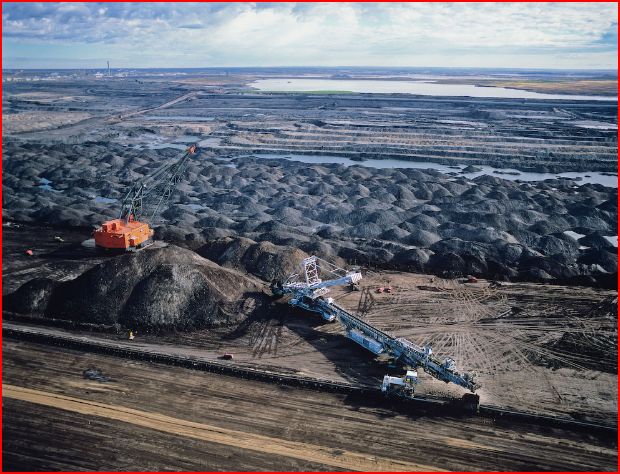
Tar sands workings

50 years; just like that!

A memorable event fifty years ago, this day!

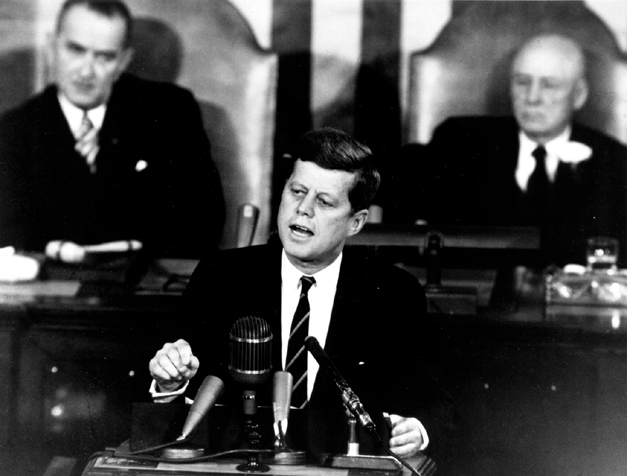
President John F. Kennedy's May 25, 1961 Speech before a Joint Session of Congress

On the 25th May, 1961, President John Kennedy summoned a joint session of Congress and asked America to commit itself to a goal – that of landing a man on the moon and returning him safely to Earth before the decade was out.

There’s a good link on the NASA site to the speech.

Plus a very good analysis of these 50 years in the Lexington column in last week’s The Economist.  As Lexington’s Notebook blog puts it,

That Kennedy speech plus 50

May 19th 2011, 15:47 by Lexington

MY print column this week notes that it is half a century next week since John Kennedy called for sending a man to the moon and returning him safely to Earth. The bottom line, I think:

If we can send a man to the moon, people ask, why can’t we [fill in the blank]? Lyndon Johnson tried to build a “great society”, but America is better at aeronautical engineering than social engineering. Mr Obama, pointing to competition from China, invokes a new “Sputnik moment” to justify bigger public investment in technology and infrastructure. It should not be a surprise that his appeals have gone unheeded. Putting a man on the moon was a brilliant achievement. But in some ways it was peculiarly un-American—almost, you might say, an aberration born out of the unique circumstances of the cold war. It is a reason to look back with pride, but not a pointer to the future.

A fascinating period!

In humble recognition of great writers

The technology of the Internet will prove to be of huge democratic value.

Those who know me know a disquieted man.  Someone, who despite being more at peace with himself than ever before, nonetheless senses that we, as in the mankind of Planet Earth, are already deep in the ‘no mans land’ of change between the last, say, forty years and a very different future just around the corner.

In the past opinion and commentary has been in the hands, more or less, of the giant media moguls.  But technology has changed that.  Now more than ever a huge people have access to the Internet.  Indeed, a quick Google search reveals that of a world population of 6.85 billion people, just under 2 billion (29%) have internet access.  In North America that percentage is 77.4% (226 million) and in Europe the percentage is 58.4% (475 million).  I.e. nearly a billion people in just North America and Europe!

My point is that, in a manner never before experienced in human history, the vast majority of us have the ability to read, learn and muse about the critically important issues facing us today, coming to conclusions that carry political weight.  We have almost infinite choice as to where and how we form opinions.

Thus having access, via the internet, to the scribblings of so many wise people may end up giving democracy the boost it really needs in the face of overwhelming powerful plutocratic forces.

Here are just a couple of those wise voices.

Simon Johnson

I first came across him in an article in The Atlantic Magazine back in May 2009.  That article was called The Quiet Coup.  If you haven’t read it, go here.  It is introduced thus:

The crash has laid bare many unpleasant truths about the United States. One of the most alarming, says a former chief economist of the International Monetary Fund, is that the finance industry has effectively captured our government—a state of affairs that more typically describes emerging markets, and is at the center of many emerging-market crises. If the IMF’s staff could speak freely about the U.S., it would tell us what it tells all countries in this situation: recovery will fail unless we break the financial oligarchy that is blocking essential reform. And if we are to prevent a true depression, we’re running out of time.

Simon is also one of the lead writers for the Blog Baseline Scenario.  Have a read of a recent article about the appointment of Bill Daley as President Obama’s new chief of staff.  That article concludes thus:

Top executives at big U.S. banks want to be left alone during relatively good times – allowed to take whatever excessive risks they want, to juice their return on equity through massive leverage, to thus boost their pay and enhance their status around the world.  But at a moment of severe financial crisis, they also want someone in the White House who will whisper at just the right moment: “Mr. President, if you let this bank fail, it will trigger a worldwide financial panic and another Great Depression.  This will be worse than what happened after Lehman Brothers failed.”

Let’s be honest.  With the appointment of Bill Daley, the big banks have won completely this round of boom-bust-bailout.  The risk inherent to our financial system is now higher than it was in the early/mid-2000s.  We are set up for another illusory financial expansion and another debilitating crisis.

Bill Daley will get it done.

Now let’s turn to that other writer, Patrice Ayme.

That name is a nom-de-plume but so what!  Having read Patrice for some time now and corresponded via email from time to time, I have to tell you this is one giant of an intellectual thinker.  Take this Post from example: Pluto Lie #1: Glass Beads Matter More It’s a beautifully written article but not something that you should try a skim read through; it deserves a really focussed mind on the words and the meanings expressed. Here’s a flavour:

Abstract: An American historian paid by the hyper rich, exhumed again the old fallacy that material riches matter more than anything else. He points at recent electronic gadgetry, and attributes it to Reagan. This article of faith in Reagan and American plutocracy amusingly gives, obviously without knowing, prominence to recent French and German governmental research, which allowed to make such gadgets.

I skewer this lamentable, not to say corrupt, piece of dismal propaganda which was published all over the American media, for Christmas. I use the occasion to give a new metric to evaluate riches over the last 100,000 years, explain why the USA does not use the metric system, and what European kings were really about.

Too great a disparity of riches is another name for plutocracy.  Indeed, money is power, and thus, too much money is too much power.

Here is how Patrice’s article closes (but it would be so much better if you read the article in its entirety):

Morality? Europeans Kings of old could live long, and lived strong.The best of them were working relentlessly, brandishing whatever it took to stabilize the situation ethically, politically, and civilizationally. They were incredibly brutal. They would die, and kill, just over the length of hair (kings and prospective kings wore it long, religious wore it nought). Even small children, if viewed as potential kings, would be presented with the scissors and the sword (if they did not go for the former, they would get the later).

So of course, kings of old would have made it to today’s highest class. Kings were often the richest people around, and they got there, or stayed there, by killing, in the name of new, and higher principles. This only happened because their subordinates agreed to strive towards the same new and higher principles. Hanson misses completely the spiritual dimension of the kings of old. Kings of old led an ethical revolution, which was their reason for being in power, and why people elected them (or elected to follow them).

Kings of old lived very comfortably by their metrics, with residences all around Europe, and wives, concubines, nobles under oaths to serve them (to death). Some, such as Charlemagne, were very healthy into old age. What’s more fun than to make war for decades, mostly winning, as Charlemagne did?

Dr. Victor Davis Hanson, a classicist and military historian, is a senior fellow at the Hoover Institution and a recipient of the 2007 National Humanities Medal.

That appurtenance, too, tells volumes. Hanson has tales to tell, and they sing of American plutocracy. It remains to be seen if history will sing along. Two things, though: history does not tell lies, and human beings are not reducible to gadget loving midgets.

So to repeat my point.  Whether or not one choses to agree with the likes of Simon Johnson and Patrice Ayme there is no doubt that in my mind it will be writers like these that, through the better education of millions of citizens, will not only preserve democracy in so many countries but will ensure that the age before us will be fairer and more just.

Change can be achieved by the threat of tomorrow being the same

even quicker than by the hope of tomorrow being different! C. Graham-Leigh.