From the Hubble website. Here’s the description of the image:
“Starry Night”, Vincent van Gogh‘s famous painting, is renowned for its bold whorls of light sweeping across a raging night sky. Although this image of the heavens came only from the artist’s restless imagination, a new picture from the NASA/ESA Hubble Space Telescope bears remarkable similarities to the van Gogh work, complete with never-before-seen spirals of dust swirling across trillions of kilometres of interstellar space.
This image, obtained with the Advanced Camera for Surveys on February 8, 2004, is Hubble’s latest view of an expanding halo of light around a distant star, named V838 Monocerotis (V838 Mon).
The illumination of interstellar dust comes from the red supergiant star at the middle of the image, which gave off a flashbulb-like pulse of light two years ago. V838 Mon is located about 20,000 light-years away from Earth in the direction of the constellation Monoceros, placing the star at the outer edge of our Milky Way galaxy.
A single light-year is approximately 6 trillion miles, or 9,460,730,472,580.8 kms for the metric brigade! Thus 20,000 light-years is 120,000 trillion miles, or 120,000,000,000,000,000 miles.
It is beyond imagination – yet it is real!
It humbles one beyond measure that in this short lifetime on mine, science has reached out so far. And then one looks more closely to home and remains appalled that we have learnt so little about living in peace and with integrity on this funny third rock from the Sun.
The BBC have been started a series on how things are made! The first episode was on the making of a nuclear submarine – perhaps not something that touches most of us!
Trent 900 on the A380
But the second episode was much more the ‘touch of the common man’ as it was about the building of a commercial jet engine, the Trent engine built by Rolls Royce of Derby, England.
Anyway, I’m not going to natter on other than to say that not all regulatory bodies are bad in this world. Indeed, the aviation industry has shown how splendid both engineering and the certification processes can be in giving us a incredibly safe form of transport.
There are plenty of YouTube videos on the Trent engine but here are two that I found of great interest. (Thanks to Simon H for the pointers.)
I subscribe to a Blog that comes with the rather intriguing name of The Gospel According to Rhys. It’s a bit ‘geeky’ for my tastes but it offers sufficiently good advice on Blogging and other Social Media systems that it is a worthwhile entry in to my email in-box.
Learning from Dogs is, of course, a WordPress driven Blog and thus is an example of the power of this wonderful software. I trust that Rhys will forgive me if I quote at length from his article – I can’t better it.
Recently it was WordPress’ 7th Birthday. On the 27th of May in 2003, Matt Mullenweg released a fork of b2/cafelog, called WordPress. From the 0.72 release, it’s become the defacto blogging solution for thousands of publishers.I love it, I think it’s great, and although I’m probably preaching to the converted, here’s 7 reasons why I think your blog should be on WordPress.
It’s Free
For what it does, and for amount it costs, it is amazing that it costs nothing. Sure there’s hosting costs & domain names, but there’s nothing stopping you playing with the software for nothing.
It’s Open Source
Fancy yourself as a bit of a coder? Well WordPress is entirely free to see the code. In fact, I recommend playing with WordPress to learn the basics of PHP. There is great documentation (again, open source wiki) to help you with the WordPress framework, itself a great introduction into advanced PHP programming & working with API’s & frameworks.
Furthermore, with it being open source, if a bug is discovered, it’s fixed relatively quickly.
It Is Quick & Easy To Use
WordPress is famous for it’s five minute installation, and when you get good, it should take you half of that time. Logging in you can write a post within a minute, and it’s ridiculously easy to use. Changing design & adding plugins is easy as well.
As CMS’s Goes, It’s Pretty Good for SEO
Out of the box, f0r search engine optimisation, it’s okay. However, with a few tweaks, WordPress becomes a solid SEO platform. It’s certainly one of the better CMS’ out there.
It’s Well Supported
I’m not sure if there’s been a “state of the wordpress community” post ever done, but WordPress itself hosts nearly 10,000 plugins, and there must be tens of thousands of themes available online (WordPress itself only holds about 1 and a half thousand). Each one has a programmer or designer behind it, and although support varies (the official wordpress forum is average at best), enough people know what they are doing, both paid or free, to help you out.
It Can Make You A Rich Man (or Woman)
Whilst I’m not a rich man, running this blog & a few websites on WordPress have allowed me to make some money, and anybody can do this. As well as ebooks, adsense, affiliate marketing & god knows what else, you can make a fortune carrying out WordPress related services for other people.
It’s Never Going To Disappear Overnight
WordPress has some huge sites supporting it, a company fully dedicated to it’s production, and a thriving community. It’s not here today, and gone tomorrow.
So happy birthday WordPress, here’s to the next 7 years!
“An ethic of kindness, benevolence and sympathy extended universally and impartially to all human beings.”WikiPedia
Introduction
Friedrich Nietzsche
I do not in any of this mean to say that humanitarianism is a negative thing, I am merely attempting to describe why humanitarianism exists in the world today in much larger proportion than it has in the past.
I hope also in some of this to disagree, hopefully intelligently, with Nietzsche’s claim that humanitarianism decreases the overall strength of the human race, or at least its higher echelons.
Self-interest
Human beings are either entirely or nearly entirely driven by self-interest, this much has been made clear by both ancient and modern philosophy.
Different philosophers have realized this point in different ways.
Mises said that all people are rational maximizers.
Nietzsche said that the natural human being attempts to exert his force upon the world surrounding him.
Plato said that all men desire good things, but each man has his own subjective opinion of the “good” which he came to via his own experiences (both during and before “life”.)
I highly doubt that human nature has changed a great deal in 100 years.
However, 100 years ago it was very common for European nations to do just about whatever they wanted to the rest of the world. In fact, human nature is in all likelihood not very different now than it was in the days of the early church, when Christians were wrapped in lambskin, covered in oil, and burned alive in order to serve as torches.
Some videos are just fun to watch. Whether you are interested in aviation or not, this blast through the making of an aircraft by Boeing makes it all look quite easy really:
The Hubble Space Telescope (HST) has been in space for 20 years!
This week, twenty years ago, the HST was launched into orbit. There’s much online if you want to read about it both on WikiPedia and on the Hubble web site so this post is going to offer just two items.
A beautiful picture
Nucleus of Galaxy Centaurus A
And an interesting audio slideshow tribute from the BBC – click here, introduced thus:
Take a look at some of the sights it has seen in that time with Professor Alec Boksenberg from the Institute of Astronomy in Cambridge – who was on the European team that helped build Hubble.
By Paul Handover (in awe of what is beyond our skies)
Wow, the big picture of the IT world seems to be crumbling with increasing rapidity! Many people are at risk of getting hurt if they continue to hold traditional attitudes.
Plenty of seismic shifts have rocked and reshaped IT in the past. Some big rumblings’ epicenters had origins in an unstoppable technology shift; other fissures had nothing to do with PCs and servers. Consider the recent shocks: the Internet revolution and dotcom bust; Y2K and 9/11; the consumerization of IT; and the unstoppable broadband and mobile explosion.
However, the latest shock–the global financial meltdown–is like the recent 8.8 earthquake that shook Chile and knocked the earth off its axis. And for IT leaders today, it’s important to realize that the aftershocks are still coming.
Thomas Wailgum provides an insightful description of the challenges facing the important operational aspects of IT in many organizations. Many of the symptoms and some of the causes that he describes are undoubtedly true and have been adversely affecting the performance of many people for a long time!
But, who really cares?
I suggest that the people who really care are the people who are trying to serve the customers of the business. Consequently they will decide what they do and how they do it, including what services and products they use, including those that involve IT (almost all of them these days).
It seems to me interesting to describe this, as he has done, from the perspective of IT and IT people (of whom I am also, broadly, one!) .. but it is only interesting to IT people.
The people who require services are getting them from wherever they can and wherever they like and will continue, increasingly, to do so.
Many of the points that he makes are valid and accurate, including his list of “recent shocks”. Two of those struck me as particularly poignant and relevant.
One is “the unstoppable broadband and mobile explosion”, which seems to be a strange way to describe it. My reading of this is that IT people would like to “stop” it; but why? The availability of communication services with increasing bandwidth and location-independence is enabling greater sharing of information and understanding; many people, especially those in the “third world”, are benefitting enormously from this. I hope that I have understood his meaning incorrectly because, surely, the task of people who understand IT is to help others to take full advantage of the opportunities, not to try to stop them!
The other is “the consumerization of IT”, which is one way of looking at it but, again, seems to carry a subtextual bias. I detect a sense that this is seen to be the use, in business applications, of lower quality facilities intended for individuals who do not know the implications. There is some truth in this, but this has been a trend for decades and, so far, the roof has not fallen in! I suggest that this is misunderstanding of the bigger picture and, in a sense, does not go far enough
This is not simply consumerization, this is the commoditization of IT. This happens in every industry as bespoke products become more generally available, the nature of the competition changes. What was custom becomes standard and the action moves up a layer!
Much of Thomas Wailgum’s account of the situation is accurate and, potentially, very useful; but, by viewing it from the perspective of the providers of IT services rather than that of the consumers of IT services, the nature of the solutions seems to be pointing in the wrong direction!
Better navigational accuracy in the air may be approaching its limits.
For passengers travelling with scheduled airlines, times have changed, sadly, and no longer can you visit the flight deck, and see from there the views that pilots get.
New meaning to the term 'on track'.
It was not so long ago, that aircraft navigation was carried out using beacons on the ground, either on VHF, or Medium wavebands.
For longer trips with no ground aids a Navigator would plot your route using Astro (sun or the stars) navigation, until companies like Decca produced other radio systems to give you a position, but these from my memory had their problems.
Today in the modern aircraft we have Inertial Navigation Systems using laser gyros together with radio VHF back up, taking cross cuts from beacons, coupled with Distance measuring equipment to pinpoint your position, and now the magic Global Positioning System (GPS) with it`s startling accuracy.
Often with only 1000 feet between, you can see aircraft either above, or below you, often on the same track. This picture of an Emirates airline Airbus A380 was taken northbound over Turkey. The trails left behind are ice crystals which are left by the water vapour that passes through the engine, and freezes immediately at temperatures of some minus 60 degrees C.
The vortex from the wings causes the rotating trail from each engine to be disturbed, and if you pass through such disturbed air following the wake of another aircraft you often get a bump as your aircraft will be travelling at 500 MPH, some 7 miles per minute, a closing speed of 1000MPH if heading towards each other.
As the accuracy is so good these days, airlines have taken to introducing an offset of one or two miles to the left or right of track, just in case there is an error of timing, or in severe turbulence an aircraft could lose or gain the amount of separation which is between machines.
I think we get the best seats in the house!
By Bob Derham
[Bob is a Captain on a privately operated Airbus A319. Ed.]
I was excited to see details of a lecture held recently in Glasgow, recounting the Struggle to Break the Sound Barrier. [Nice history on WikiPedia, Ed]
FA-18 breaking sound barrier
How easy it is today to jump into an aircraft, and expect to fly safely round the world in the luxury of an arm chair 7 miles or more above the surface of the earth, or know that the modern aircraft of our Air Forces can fly on every limit known, in the knowledge that all the aerodynamic tests and trials have been carried out.
Eric Brown is now 92. He gave up his wings at 70, but still 22 years later is lecturing on a subject which was at the time uncharted territory, a race to fly faster than Mach1, the Speed of Sound. Chuck Yeager got there first, but now ponder the following.
Captain “Winkle” Brown was with the Royal Navy for 31 years, much of it as an outstanding test pilot.
He flew 487 different types, (not variants) and made 2407 Aircraft Carrier landings, both World records.
At University he studied German, so at the end of the war as a linguist he interrogated many leading German aviation personalities such as Willy Messerschmitt, Ernst Heinkel, and Hanna Reitsch..
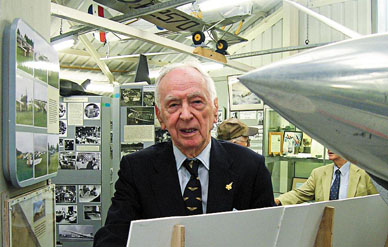
Capt. Eric Brown
What an interesting life, and still with stories to tell, and knowledge to pass on. There’s a lovely interview with Capt. Brown here.
Flying an SR-71 Blackbird must have been one of the more extreme forms of aviation at the best of times.
Surviving the breakup up of one at Mach 3.18 and 78,800 feet is unlikely beyond all measure, but not impossible, as this story describes.
The severity of this incident is captured many times over in this story. Can you even imagine thinking:
I had no idea how this could have happened; I hadn’t initiated an ejection.
And the scale of the navigational issues are extreme too:
Before the breakup, we’d started a turn in the New Mexico-Colorado-Oklahoma-Texas border region. The SR-71 had a turning radius of about 100 miles at that speed and altitude, so I wasn’t even sure what state we were going to land in.
Above all, for me, the matter-of-fact way that stories like this are told is testament to the professionalism of these pilots.
[In fact this is such an amazing story that the full account will be published tomorrow, Ed.]









 Learning from Dogs