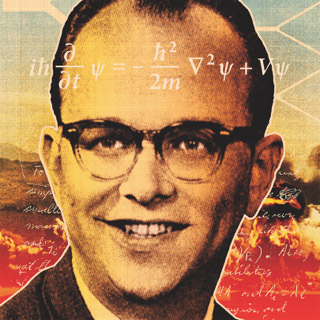
A documentary on PBS entitled Parallel World, Parallel Lives traces in a deeply personal way, the efforts of the son of Hugh Everett, Mark Oliver Everett, to find out more about his father, who died in 1982, just 51 years old. Mark Everett is an accomplished musician and much of his music makes it onto the soundtrack of the film. Here’s a brief extract from an article from Scientific American.
Hugh Everett III
Hugh Everett III was a brilliant mathematician, an iconoclastic quantum theorist and, later, a successful defense contractor with access to the nation’s most sensitive military secrets. He introduced a new conception of reality to physics and influenced the course of world history at a time when nuclear Armageddon loomed large. To science-fiction aficionados, he remains a folk hero: the man who invented a quantum theory of multiple universes. To his children, he was someone else again: an emotionally unavailable father; “a lump of furniture sitting at the dining room table,” cigarette in hand.
A fascinating programme and one which shows great courage and bravery from Mark Everett in dealing with his memories and emotions about a brilliant but emotionally flawed father.
Please forgive me but this week-end I am taking things easy. Jean and I want to savour the beautiful weather here in Payson and just enjoy the special life up here at 5,000 feet in Arizona.
Here’s something to reflect upon; another one tomorrow. Normal service returns on Monday 😉
“A Native American Elder once described his own inner struggles in this manner: Inside of me there are two dogs. One of the dogs is mean and evil. The other dog is good. The mean dog fights the good dog all the time. When asked which dog wins, he reflected for a moment and replied, ‘the one I feed the most.'” – — George Bernard Shaw
On April 12th, I introduced to you, dear reader, the philosopher, Alain de Botton. I promised that I would soon give you more.
On Top Documentary Films, there are links to all six parts of a series on philosophy presented by this popular British philosopher featuring six thinkers who have influenced history, and their ideas about the pursuit of the happy life.
The first part is about Socrates; Socrates and self-confidence. But before linking to that specific programme, a little about this enigmatic man, Socrates, who lived about 2,500 years ago (469–399 B.C.E). Here’s an extract from the Stanford Encyclopaedia of Philosophy.
The philosopher Socrates remains, as he was in his lifetime (469–399 B.C.E.),an enigma, an inscrutable individual who, despite having written nothing, is considered one of the handful of philosophers who forever changed how philosophy itself was to be conceived. All our information about him is second-hand and most of it vigorously disputed, but his trial and death at the hands of the Athenian democracy is nevertheless the founding myth of the academic discipline of philosophy, and his influence has been felt far beyond philosophy itself, and in every age. Because his life is widely considered paradigmatic for the philosophic life and, more generally, for how anyone ought to live, Socrates has been encumbered with the admiration and emulation normally reserved for founders of religious sects—Jesus or Buddha—strange for someone who tried so hard to make others do their own thinking, and for someone convicted and executed on the charge of irreverence toward the gods. Certainly he was impressive, so impressive that many others were moved to write about him, all of whom found him strange by the conventions of fifth-century Athens: in his appearance, personality, and behavior, as well as in his views and methods.
Full entry may be read here, and very interesting it is, by the way.
Anyway, back to the programme from Alain de Botton. The part on Socrates is introduced thus,
Why do so many people go along with the crowd and fail to stand up for what they truly believe? Partly because they are too easily swayed by other people’s opinions and partly because they don’t know when to have confidence in their own.
You can either watch the video by clicking here, or view it as three sections from YouTube, as follows.
Things do not change; we change.Henry David Thoreau
To a great extent, my thoughts in this article will make less sense if one hasn’t watched the Rupert Sheldrake video included in the Post on the 10th January, 2011. It’s 1 hour 20 minutes long but every minute will captivate you, trust me.
But if, for whatever reason, you don’t watch that video then the following YouTube videos are offered where Sheldrake speaks of the evidence supporting telepathy between cats and dogs and humans. The demonstration of a dog knowing when their owner is coming home is enthralling.
The science behind this link between, for example, the dog and its owner, is what Dr. Sheldrake calls an example of Morphic Fields.
I must confess that if someone had said to me, say 10 or even 5 years ago, that some form of energy field links the brains of dogs and their owners, or of cats and their owners, I would have been at least confused, at best very skeptical. Then comes the evidence, statistically valid, that being rung on the ‘phone by someone close to you can be anticipated frequently before the phone is picked up creates even more uncertainty.
Settle down and listen to these videos (they are sound recordings only but nonetheless fascinating),
I had not heard of Alain de Botton before coming across a series of his TV programmes via Top Documentary Films. But, clearly, that has been my loss because he appears to have quite a following. So over the next 10 days or so, I’m going to include some of his material in upcoming articles in the hope that you enjoy them as much as we have.
But first, an introduction to Alain de Botton from a TED Talks video from July 2009. Enjoy.
 Learning from Dogs