(With thanks to Dan Gomez for forwarding the email from Bill Wells)
A quick Google search will find lots of links to stories about how stray dogs in Moscow are learning new ways of looking after themselves. My quotes and pictures have been taken from the English-Russia web site.
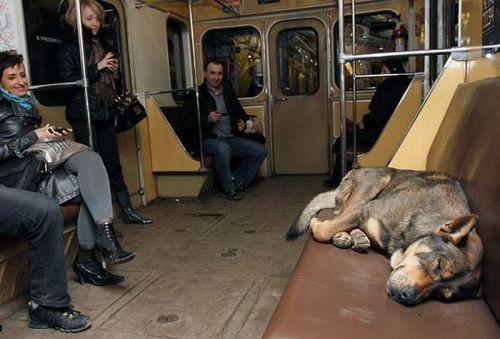
Russian scientists say that Moscow stray dogs became much smarter. The four legged oldest human’s friends demonstrate real smartness such as riding the Moscow metro every morning to get from their suburban places of living to the fat regions of Moscow center. Once they arrive to the downtown they demonstrate different new, previously unseen for the dog skills. Those skills can include “the hunt for shawarma” for example, the popular among Muscovites eastern cuisine dish. This hunt scene can be seen as this:
Regular Moscow busy street with some small food kiosks. A middle-aged man buys himself a piece of hot fast food and walks aside chewing it without a rush. Then just in a second he jumps up frightened – some doggy has sneaked up on him and barked out loudly. His tasty snack falls out from his hands down to the ground and the dog gets it. Just ten minutes later, on the same place, the teen youngster loses his dinner in exactly the same manner. The modern Russian dogs are on their urban hunt.
“This method of ambushing people from their back is widely exercised by Moscow dogs”, saying A. Poiarkov, working in Ecology and Evolution Institute of Moscow. “The main point here is to define who would drop the food scared and who won’t, but the dogs are great psychologists they can do it better than us”.
Cheap travelling!
Moscow ecologists think that dogs started acquiring this habits in 1990s, when the Soviet union collapsed and Moscow has fell into the hands of new class of Russian capitalists. They understood the true value of the downtown realty underestimated by previous Communist owners and became removing all the industrial complexes Moscow had in its centre to its outskirts. Those places were used by homeless dogs as a shelter often, so the dogs had to move together with their houses, so they had to learn how to travel Moscow subway – first to get to the centre in the morning then back home in the evening, just as us people.
The commercial revolution of Moscow made their usual feeding places like trash bins out of direct reach, so they had to get to know new ways of getting their piece of food. That’s how appeared those “Shawarma hunts”. Sometimes though they use more gentle methods. Young girl sits on the bench to eat her hot dog – a big cute looking dog appears from the surrounding bushes and puts her head on her knees. The girl can’t help herself sharing the hotdog with a dog.
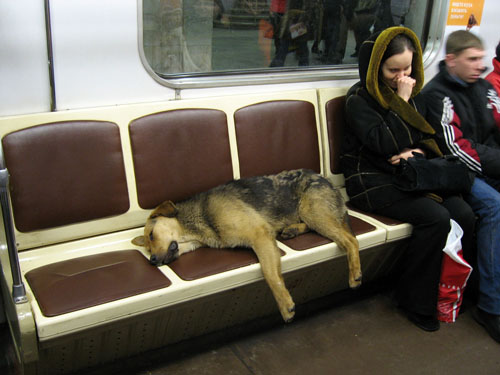
Among some more amazing skill those Moscow dogs are the ability not to miss their stop while going on the subway train. Biologists say dogs have very nice sense of time which helps them not to miss their destination. Another skill they have is to cross the road on the green traffic light. “They don’t react on color, but on the picture they see on the traffic light”, Moscow scientist tells. Also they choose often the last or the first metro car – those are less crowded usually.
It’s funny but the ecologists studying Moscow stray dogs also tell the dogs don’t miss a chance to get some play while on their travel in the subway. They are fond of jumping in the train just seconds before the doors shut closed risking their tails be jammed. “They do it for fun, just they have enough food”, they conclude.
"Wake me up at the next stop, please!"
Here’s a video from YouTube courtesy of the Wall Street Journal – wet eye warning!
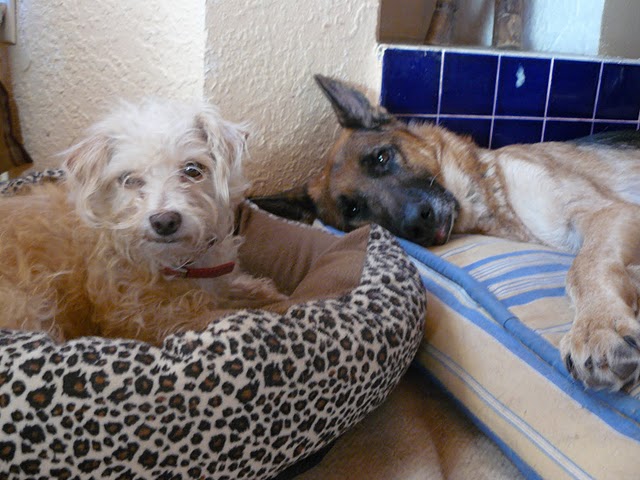
Jeannie and I would be helpless in Moscow! Reason? We have 12 ex-stray Mexican dogs living with us in Payson plus my beautiful German Shepherd dog, Pharaoh, that came with me when I left the UK in 2008. We can’t resist helping these wonderful creatures.
Pharaoh with little Poppy, a stray found on a Mexican building site
See more pictures from that English-Russia web site here.
Some remarkable recent achievements in aeronautics
Just happened that a few items crossed my inbox more or less in the same time-frame that made me reflect on the ingenuity and persistence of inventors and explorers.
Here’s the first item that I came across in The Register.
Canadian enthusiasts have finally achieved a feat that has eluded humanity’s finest engineers since the time of Leonardo da Vinci – to build a machine, powered by a human pilot’s muscles, which flies by flapping its wings: an ornithopter.
Then Klaus Ohlmann is recorded on the FAI website as submitting a world record claim for flying a solar powered glider a total of 375.7 km (233.4 miles) around three turning points. Oh, and not forgetting a claim by Jan BÈM and Olga ZALUSKÁ from the Czech Republic for a world record altitude by a weight-shift microlight – 8,188 metres no less (26,864 feet!) – or the claim by Richard Young of the USA for a world record of flying an aircraft between 300 to 500 kg around a closed circuit of 100 km at a speed of 390 km/h (242 mph). What is it with these guys – have they not got proper jobs to go to? 😉
Anyway, here’s Klaus on a nice video.
Finally, my dear friend of many years, Dan Gomez, reminded me in a recent email of this very brave pushing back of the boundaries.
I had been in a bit of a rant mood and contributed a comment to that Post. I wrote:
I don’t have the knowledge to respond to Simon’s excellent Post in detail but his comments reinforce what feels like a constant throbbing in my mind – how can the citizens of so many countries have abdicated so much interest and concern in how they/we are governed. Wish I had even a clue as to the answer to that question.
Significant social unrest would be very scary – the ‘law’ of unintended consequences and all that – but there are times when I wonder if this, in the end, might be the only form of real progress for the hard-working, tax-paying majority.
End of rant! 😉
Interestingly, that stimulated some replies which were, in my opinion, worth sharing with you; kind reader of Learning from Dogs that you are!
Sir, you raise a sad but true point when you ask how a majority of us citizens, on a worldwide basis, could have lost true “by the people” control of our own governments.
For most of us the loss of healthy economic functioning has been the main consequence of this, something that has been very painful. But I also find myself reflecting on the unspeakable genocides in our collective human history. One gets an awful sense of how such things were permitted to arise…ZeroInMyOnes
And
Well spoken Paul Handover. The system cannot and will not be changed politically or judicially because the malevolent forces who conjured the system own and control both the political and judicial operations and operators. Those operators work to advance the interests of the predatorclass whose operations, operators, and structures are malevolent.
The people are the abused victims of predatorclass criminal enterprises bent on total control of the earths wealth and resources, and the enslavement or eradication of the rest of the population.
The peoples only hope for implementing the changes necessary to form a more perfect union is best described here:
(“We hold these truths to be self-evident, that all men are created equal, that they are endowed by their Creator with certain unalienable rights, that among these are life, liberty and the pursuit of happiness. That to secure these rights, governments are instituted among men, deriving their just powers from the consent of the governed. That whenever any form of government becomes destructive to these ends, it is the right of the people to alter or to abolish it, and to institute new government, laying its foundation on such principles and organizing its powers in such form, as to them shall seem most likely to effect their safety and happiness.”) TonyForesta
And
Paul Handover, that was not a rant. You are simply talking common sense.
Scary is right. And it’s scarier by the day.
We have to try to work constructively for change. I keep urging people to check out the potential for an economy based not on constant growth, which is impossible on a finite planet, but on some sane principles of equity and sustainability.
If you go to http://www.steadystate.org and look at their position statement, you can see that people from all over the world are signing on–yes, just three or four people a day–but they are from every continent and just about every country.
Now, can you help this “go viral”? Carla
These are strong, powerful views. I have joined Casse, the organisation referred to in Carla’s comment – see second Post from me today – and Tony’s comment motivated me to look up the history of the United States Declaration of Independence, the subject of a separate article on this Blog.
“You’ve got to do your own growing, no matter how tall your grandfather was.” Irish quotation.
In England, inexplicable happenings are commonly ascribed to being ‘Irish’! It’s meant in a loving way; there is a great deal of warmth towards the different ways that Irish people appear to see the world. But what is facing Ireland (and other countries) as a result of some distinctly unfunny goings-on in the USA is potentially hugely damaging.
To many the way that the world has descended into a dark, economic abyss, which is likely to affect us all in so many ways, and in which we are going to remain for a long time (a la Japan?), is also inexplicable.
Thus a chance comment from Norm Cimon to a recent post on Baseline Scenario set off a chain of discovery that for me has been very interesting. Here’s how it ran.
I have subscribed to Baseline Scenario for some time. It describes itself thus:
The Baseline Scenario is dedicated to explaining some of the key issues in the global economy and developing concrete policy proposals. Since it was launched in September 2008, this blog has been cited by virtually every major newspaper, Internet site, and blog covering economic and financial issues.
It’s a great resource.
A recent Post on Baseline Scenario, Irish Worries For The Global Economy, had already attracted 135 comments at the time of writing this post. A recent one was from a Norm Cimon, who is described in Linked In as the owner of Info Synchronicity LLC. This is what he said:
That is the other side of the coin. William Black has been lucid on this topic, and clear on the morality of the current age and how to fix it. Put people in jail and let everyone know why they were sent there. If you want to change perceptions then change the reality. The anger of the general public and the disdain of Wall Street are tied to that one issue. No one has paid for the crime of the millenium and everybody knows it.
And included was this recording of Bill Moyers interviewing Bill Black, the author of The Best Way to Own a Bank is to Rob One.
Here’s the interview:
However, there’s more to this discovery than the YouTube video. If one clicks on the link behind Norm Cimon’s name on that Baseline post, then one is taken here. It’s a pdf of a paper written by Norm Cimon entitled, “Computing Power and Human Greed.” It seems to me to explain the tools, for want of a better word, that enabled the American banking system to behave in the way that Bill Black so roundly condemns in the Bill Moyer interview. Here’s how Cimon ends his paper:
With networked computers now cast by all organizations, including the financial sector, into the role of wizard-behind-the-curtain, we all live in Oz. It’s long past time we pull back the veil and call a halt to the mindless application of this supreme and supremely dangerous creation before the damage gets any greater.
Unfortunately, there isn’t a date to the paper but my guess was that it was written late in 2009. Whatever the date, it is a very apt observation.
There has been much written and published about these two heros who enabled the stricken Airbus A-320 to ditch on the Hudson River with no loss of life. That was Flight 1549 on the 15th January, 2009.
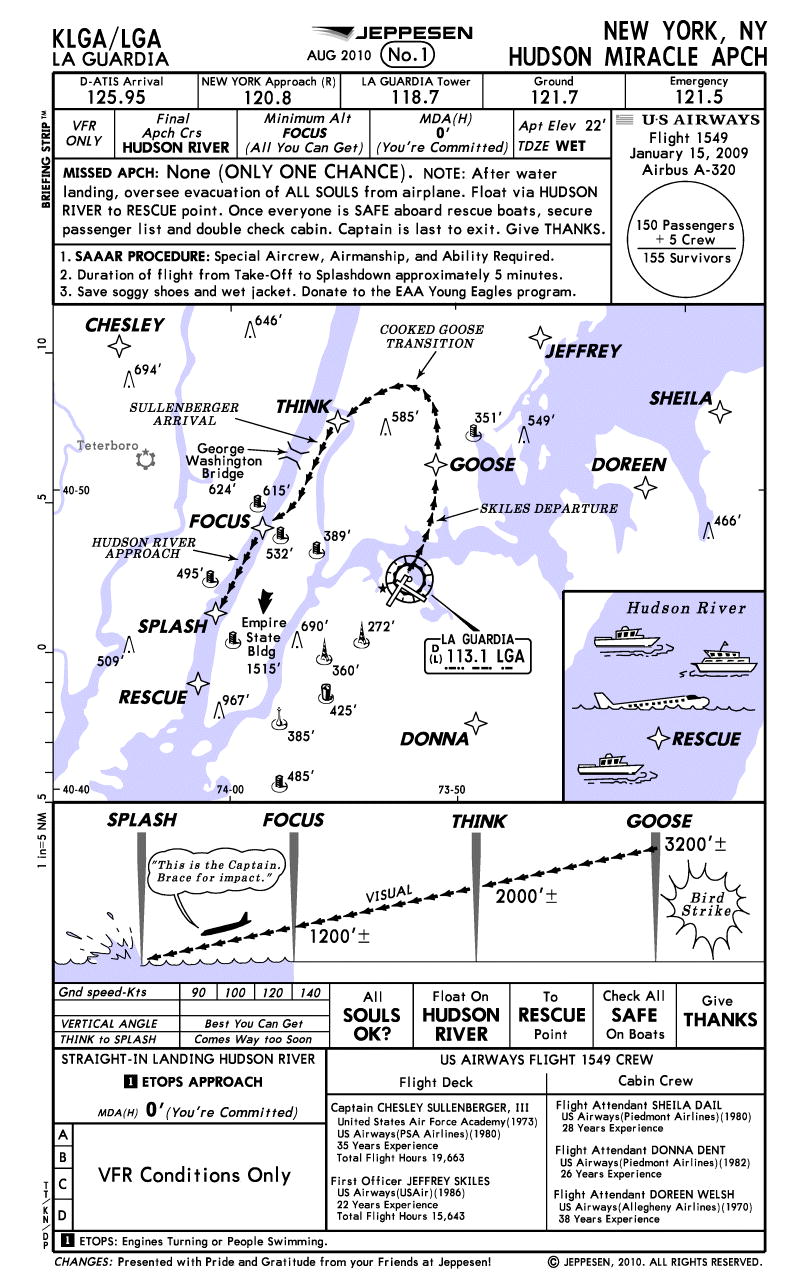
However, at this year’s Oshkosh, Sullenberger and Skiles were presented with a wonderful memento from Jeppesen who publish among other products instrument approach charts for aircraft. They did something very creative in producing the following.
Jeppesen, known in the aviation industry as the worldwide leader in navigation and charting services, recently presented “Miracle on the Hudson” pilots captain Chesley Sullenberger and first-officer Jeffrey Skiles with a specially designed approach chart and engraved Jeppesen chart binders to commemorate the remarkable ditching of US Airways flight 1549 in the Hudson River in New York in January 2009.
Entitled “Hudson Miracle APCH,” the one-of-a-kind chart includes several light-hearted notations that honor the famous water landing that saved the lives of 155 passengers and crew on board the flight disabled by bird strikes. In the “briefing strip” section of the chart, instructions include: “After water landing, oversee evacuation of ALL SOULS from airplane. Float via HUDSON RIVER to RESCUE point. Once everyone is SAFE aboard rescue boats, secure passenger list and double check cabin. Captain is last to exit. Give THANKS.”
The chart documents the historic five minute flight with a unique graphic, beginning with departure from LaGuardia Airport, followed by a “Cooked Goose Transition” point and “Hudson River Approach,” which is then followed by “Splash” and “Rescue” points on the water. The humorous chart also salutes the career achievements of the crew of flight 1549, including Sullenberger, Skiles, and veteran flight attendants Sheila Dail, Donna Dent and Doreen Welsh.
Along with the commemorative chart, the pilots were presented with a special Jeppesen chart binder, engraved with the famous fortune cookie advice kept in Sullenberger’s flight bag: “A delay is better than a disaster.” The items were presented by Mark Van Tine, Jeppesen president and CEO, during the 2010 Gathering of Eagles fundraiser dinner and auction held during the EAA AirVenture fly-in and air show in Oshkosh, Wisc. The EAA Young Eagles event raises funds and awareness for youth involvement in aviation.
To view the commemorative US Airways flight 1549 chart, please visit this page.
A fellow pilot, Martin Thorpe, sent me the chart shortly after the Oshkosh event but it seemed appropriate to let some water flow under the bridge, so to speak, before I mentioned it on Learning from Dogs.
Yesterday, I posted an article based on a lecture given by Dr Helen Fisher presented to the TED Conference in 2006. It included some fascinating evidence about the nature of love and why it is such a powerful human emotion.
Then in 2008, Dr Fisher gave a second lecture, again at the TED Conference, that continued to reveal more amazing findings about how the brain functions when in love. As the presentation summary says:
Why do we crave love so much, even to the point that we would die for it? To learn more about our very real, very physical need for romantic love, Helen Fisher and her research team took MRIs of people in love — and people who had just been dumped.
Included in the lecture is something that I had wondered about and was delighted to see confirmed – animals fall in love as well. Here’s the extract from that part of the presentation (min:sec 50:50):
I would also like to tell the world that animals love. There’s not an animal on this planet that will copulate with anything that comes along. Too old, too young, too scruffy, too stupid, and they won’t do it. Unless you’re stuck in a laboratory cage –and you know, if you spend your entire life in a little box,you’re not going to be as picky about who you have sex with –but I’ve looked in a hundred species,and everywhere in the wild, animals have favorites.
As a matter of fact ethologists know this. There’s over eight words for what they call animal favoritism: selective proceptivity, mate choice, female choice, sexual choice. And indeed, there are three academic articlesin which they’ve looked at this attraction, which may only last for a second, but it’s a definite attraction, and either this same brain region, this reward system, or the chemicals of that reward system are involved. In fact, I think animal attraction can be instant — you can see an elephant instantly go for another elephant. And I think that this is really the origins of what you and I call, “love at first sight.”
Do watch it.
And a quote to conclude this post.
True happiness and a fullness of joy can be found only in the tender and intimate relationships of the family. However earnestly we may seek success and happiness outside the home through work, leisure activities, or large bank accounts, we will never be fully satisfied emotionally until we develop deep and loving relationships.
~ by James J. Jones Ph.D. ~
Watch the video to the end to make sense of the title!
The digitally connected world that is now so much a part of our lives brings lots of new issues, dangers and irritations. But it also brings us a great number of tremendous opportunities. TED is one of them.
For those that haven’t come across the TED website it offers a wonderful range of “Riveting talks by remarkable people, free to the world” as summarised here.
Dr Fisher
Thus it was via the TED website that I came across a fascinating talk by Dr Helen Fisher who is a Biological Anthropologist who has specialised on romantic love and connected areas.
Anyway, without any more waffle from me, if you want to be surprised by a number of Dr Fisher’s findings then do watch the TED video that may be found here.
And the reference to the rickshaw driver? Watch the video to the end (23 minutes) to find out.
P.S. since writing the above, I found a YouTube copy of the TED video, which is below. I haven’t watched it to the end to see if the reference to the rickshaw is in it, but I suspect it is.
One of the problems of our modern media is that there is so much competition for news that old stories frequently just seem to disappear.
So it was delightful to find in last Saturday’s Daily Telegraph news that the rescue shaft had achieved a very important milestone – the pilot shaft, 12 inches in diameter, had broken through to the chamber where the miners patiently wait for their rescue.
Rescuers working to release 33 trapped Chilean miners have achieved a pivotal breakthrough by drilling an escape shaft through to the underground chamber occupied by the men.
I say that not because I have sufficient financial knowledge to evaluate his writings from a technical point of view but because he puts in huge effort, I mean hundreds of hours a month, to support his perspective.
An article published on the 10th demonstrates both Denninger’s commitment to his audience and some very specific dangers potentially coming out of Europe. Called “A Round-Up Of Current Idiocy” it includes this conclusion:
Since we keep drinking more as an economy (debt and deficits) the violence and incidence of these “undesirable outcomes” is going to continue to increase. We had one nasty in 2000, and then again in 2007. From the so-called “recovery” (2003) to the onset of the last mess was about four years. We’re now about two years in from the so-called “bottom” of this latest train wreck (Lehman), and if we keep on-path, and we are as the below chart shows, our fuse should go inside the box for this next mess somewhere between now and the end of 2011.
I hope you’re ready, because this next one, coming with no real recovery having taken place in employment or private economic activity, may be the one that takes us well beyond the misery we suffered in the 1930s.
And if it does, it will be our – that’s right – our – fault, since we simply will not accept that there is no such thing as a free lunch.
Note the copyright please.
Despite it being quite a technical piece with some aspects that weren’t clear to me, no surprise!, it’s still got many important messages for all those concerned about our savings and assets. Do read it.




 Learning from Dogs