Category: Military

Practice makes perfect

A personal musing about the value of training.

A good friend here in Payson, himself a former ‘lamplighter’ forwarded me an email with a link to a video taken using the Head-Up-Display (HUD) camera which  also has a voice recorder.

F-16 fighter/attack aircraft

This is the email,

Here’s the F-16 dead stick into Elizabeth City, NC: A fairly short  RWY for jets, (about 6000 ft long), but qualifies for an  “Emergency landing field” in the grand scheme of US  aviation.

You’ll probably have to watch the video several times to appreciate  how intense the situation and how busy the pilot was all the way to  stopping on the runway.  Very apparently, the pilot was one-of-four  F-16s in a flight returning to their base, (most probably from  the Navy Dare bombing range south of Manteo), and the F-16  in question had already reported a “Ruff-Running Engine” to his flight  leader before the start of the video.
A few comments not readily apparent are:

  • The whole episode, from start-to-finish only takes about 3 1/2  minutes!
  • The video begins as the flight is being followed on radar.
The flight leader asks for the Elizabeth City tower UHF freq which  is repeated as 355.6 and the entire flight switches to that freq: Just  one-more-task for the pilot to execute in the cockpit as he reports that  his engine has QUIT.  He has to activate the Emergency Unit to  maintain electric and hydraulic power.  This unit is powered by  Hydrazine:  (the caustic fuel that Germany created in WW II to  power their V-2 Rockets and their ME-163 rocket fighters among  others.) Thus, the last call about requesting fire support after the  jet is safe on deck, and pilot breathing easy.

Meanwhile, back in the cockpit, the pilot is busily attempting to  “Re-light” his engine: (Unsuccessfully, of course) while tending to  everything else.  The video is taken using the Head-Up-Display (HUD) camera which  also has a voice recorder.

The HUD is a very busy instrument, but among things to notice  are the ‘circle’ in the middle which represents the nose of the aircraft  and where it is ‘pointed’: “The velocity Vector”.

The flight leader reports they are 7-miles out from the airport and  at 9000 ft altitude.  Since the weather is clear and the airport is  in sight, this allows for adequate “Gliding distance” to reach a  runway with the engine OFF.  Rest assured, jet fighters glide sorta like a rock.  They don’t enjoy the higher lift design of an airliner like that which allowed Sullenburger to land in the  NY river.

Coming down 9000 ft in only 7-miles requires a helluva rate of  descent, so the pilot’s nose remains well below the “Horizon” until just  prior to touching down on the runway.  The HUD horizon is a solid,  lateral bar, and below the horizon, the horizontal lines appear as dashes.  You’ll see a “10” on the second dashed line below the horizon which =  10-degrees nose low.

Radio chatter includes the flight leader calling the  tower and the tower stating runway 10 with wind 070 @ 5 mph with the altimeter setting of 30.13, yet  another step for the pilot to consider.
The flight leader calls for the pilot to jettison his external fuel  tanks and askes another pilot in the flight to “Mark” where they  dropped.  The tower later tells the pilot to land on any runway he  chooses.
Pilot reports “Three in the green” indicating all three gear  indicate down and locked which the flight leader acknowledges.
You will hear the computer voice of “Bitchin’-Betty” calling out  “Warnings”.  More confusing chatter when none is welcome or even  necessary.  (That’s “Hi-Tech” for ya.)

The pilot has only ONE CHANCE to get this right and must also slow  to an acceptable landing speed in order to stop on the short runway.   You’ll see Black rubber on the rwy where “The rubber meets the road” in  the touchdown area.  Note that during rollout, he gets all the way to the far end which you can see by all the black skid marks where planes have landed heading in the opposite direction.

OK: That’s more than ya probably wanted to know, but you have to  appreciate the fine job this guy did in calmly managing this emergency  situation.  He is a “USAF Reserve” pilot and those guys generally have plenty of experience.  That really pays off.

Please scroll down for the link  + Enjoy.

The pilot just saved  about $20+m at his own  risk…….Great job!  Note  the breathing rate on the hot mic and also the sink rate  (airspeed  tape on the left side of the heads up  display.)

Pretty  cool guy!!!

See  if you can keep all of the radio transmissions  straight.

Probably  the coolest sounding voice in the whole mix is the pilot of the  engine out aircraft.

Just  a reminder an F-16 has only one engine.  When  it goes, you are coming down. It  is just a matter of figuring out where the airplane will come to  rest on terra firma.

(Cut N Paste if a click doesn’t open this link )

http://www.patricksaviation.com/videos/SUPERGT/3384/

Note: For  those not familiar, the EPU (Electrical Power Unit) provides  hydraulic and electrical power in event of failure of the engine,  electrical or hydraulics.  The  EPU is powered by Hydrazine which decomposes into hot gasses as it  passes across a catalyst bed or engine bleed air (if  available).  The  hot air passes through a turbine which drives the emergency  hydraulic pump and generator through a gear  box.

The video is also on YouTube, as below,

Most people are aware of the value of training and experience that saved, in this case, the US taxpayer a large pile of money.

Now onto a much more tragic case, the loss of Air France Flight AF 447 that went down on 1 June 2009 after running into an intense high-altitude thunderstorm, four hours into a flight from Rio de Janeiro in Brazil to Paris.  AF 447 was an Airbus A330-203 aircraft registered F-GZCP.

Many will recall that earlier on in May the second of the ‘black boxes’ or flight recorders was found.  Here’s how Bloomberg reported that,

Air crash investigators retrieved the second of two black boxes from the Air France jet that plunged into the Atlantic in 2009, which may help them unlock the mysteries of the crash after two years.

“They appear to be in a good state,” said Jean-Paul Troadec, head of the BEA, the French air crash investigator that has been probing the accident that killed all 228 people aboard a flight from Rio de Janeiro to Paris. “The first thing is to dry them, prepare them, which needs about a day.” Once the boxes arrive in BEA’s offices, in about 10 days, “the reading of information would be pretty fast,” he said.

Full article is here.

Those who wish to read the report issued by the French Authorities may find it here.  The summary from the report concludes,

NEW FINDINGS

At this stage of the investigation, as an addition to the BEA interim reports of 2 July and 17 December 2009, the following new facts have been established:

  • ˆ The composition of the crew was in accordance with the operator’s procedures.
  • ˆ At the time of the event, the weight and balance of the airplane were within the operational limits.
  • ˆ At the time of the event, the two co-pilots were seated in the cockpit and the Captain was resting. The latter returned to the cockpit about 1 min 30 after the disengagement of the autopilot.
  • ˆ There was an inconsistency between the speeds displayed on the left side and the integrated standby instrument system (ISIS). This lasted for less than one minute.
  • ˆ After the autopilot disengagement:
    • „ the airplane climbed to 38,000 ft,
    • „ the stall warning was triggered and the airplane stalled,
    • „ the inputs made by the PF were mainly nose-up,
    • „ the descent lasted 3 min 30, during which the airplane remained stalled. The angle of
    • attack increased and remained above 35 degrees,
    • „ the engines were operating and always responded to crew commands.
  • ˆ The last recorded values were a pitch attitude of 16.2 degrees nose-up, a roll angle of 5.3 degrees left and a vertical speed of -10,912 ft/min.

If my maths is correct a descent speed of 10,912 feet per minute is the equivalent of 124 miles per hour!

Anyway, I am advised by someone who is a very experienced Airbus captain that the odds of a stall in the cruise for a commercial airliner are extremely low, sufficiently so that it is not something that is regular covered during crew recurrent training sessions.

Here’s a short news video from ABC News.
50 years; just like that!

A memorable event fifty years ago, this day!

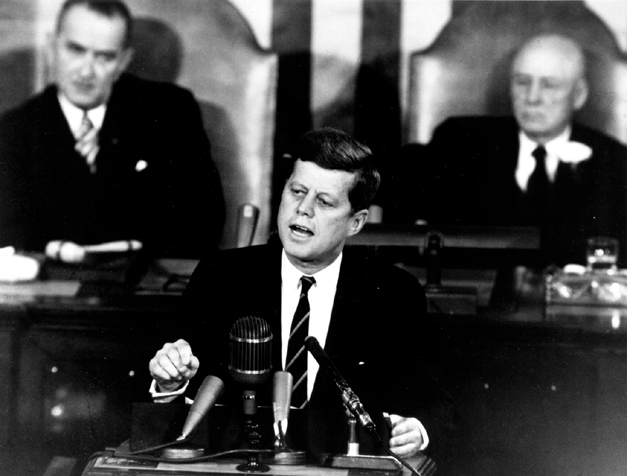
President John F. Kennedy's May 25, 1961 Speech before a Joint Session of Congress

On the 25th May, 1961, President John Kennedy summoned a joint session of Congress and asked America to commit itself to a goal – that of landing a man on the moon and returning him safely to Earth before the decade was out.

There’s a good link on the NASA site to the speech.

Plus a very good analysis of these 50 years in the Lexington column in last week’s The Economist.  As Lexington’s Notebook blog puts it,

That Kennedy speech plus 50

May 19th 2011, 15:47 by Lexington

MY print column this week notes that it is half a century next week since John Kennedy called for sending a man to the moon and returning him safely to Earth. The bottom line, I think:

If we can send a man to the moon, people ask, why can’t we [fill in the blank]? Lyndon Johnson tried to build a “great society”, but America is better at aeronautical engineering than social engineering. Mr Obama, pointing to competition from China, invokes a new “Sputnik moment” to justify bigger public investment in technology and infrastructure. It should not be a surprise that his appeals have gone unheeded. Putting a man on the moon was a brilliant achievement. But in some ways it was peculiarly un-American—almost, you might say, an aberration born out of the unique circumstances of the cold war. It is a reason to look back with pride, but not a pointer to the future.

A fascinating period!

Until Tuesday, a book review

But a review with a difference.

The background.  My fellow author, Jon Lavin, received an email on the 6th May, as follows,

Dear Jon,

Hello, I am writing from Headline publishers to ask whether you might like to review the book Until Tuesday by Luis Carlos Montalvan on your blog Learning From Dogs. I understand that the title of your blog is a metaphor, but in this case it is particularly apt, as the book details a very special relationship between a man and his dog. The book is written by a retired U.S. Army captain, Captain Luis Carlos Montalvan, and it describes the way in which the Captain’s participation in the army and in Iraq in particular, left him suffering from an extreme case of Post Traumatic Stress Disorder, so much so that even performing small daily tasks were almost impossible for him. That is, until service dog Tuesday was brought into his life. Tuesday truly taught the Captain how to function again, and furthermore, how to enjoy life again. I believe that the blog’s posts such as ‘Dogs and integrity’ and, indeed, the blog’s opening statement, indicate that this book might be of interest to you.

Well Jon, at that time, still wasn’t clear of the last hurdles of his MA, so I offered to do the review and contacted Headline and, as a consequence, Montalvan’s book arrived here in Payson yesterday.  Frankly, although flattered by the nice words written about Learning from Dogs and the invite to review the book, I didn’t have a clue as how to approach the job in hand.  To be honest, I still don’t!

So I am not going to study how other book reviews are put together, I’m just going to give you my feelings and reactions as they happen.

It was a busy day so I did no more than open the envelope, read the front and back covers of the book, plus the single page ‘flyer’ from Headline Publishing included in the envelope.

This is the front cover of the book (slightly different layout to the American version, by the way) which for any dog lover (we have 12 dogs here in Payson) is obviously eye-catching.

Then idly, I opened the book completely at random, it was page 243, and read from the start of the first paragraph on that page.  Here’s what I read,

A few days later, Tuesday quietly crossed our apartment as I read a book and, after a nudge against my arm, put his head on my lap.  As always, I immediately checked my mental state, trying to assess what was wrong.  I knew a change in my biorhythms had brought Tuesday over, because he was always monitoring me, but I couldn’t figure out what it was.  Breathing? Okay. Pulse? Normal. Was I glazed or distracted? Was I lost in Iraq?  Was a dark period descending?  I didn’t think so, but I knew something must be wrong, and I was starting to worry … until I looked into Tuesday’s eyes.  They were staring at me softly from under those big eyebrows, and there was nothing in them but love.

When I put my hand on his head, he stepped on to the couch and raised his face to my own.  We stared at each other for a few seconds and then, slowly, Tuesday licked me.  Yes, on the lips … and the chin … and the nose … slobbering all over my face with that big slow-moving tongue.  That’s the moment when Tuesday, after all his caution, stopped being just my service dog, and my emotional support, and my conversation piece.  That’s when he became my friend.

I closed the book.  There were wet corners to my eyes, my voice was unsteady as I said to Jeannie, “Well I better get on with some stuff.” and left the room.

I was transported back to the start of 2007 when I had my own share of crap to deal with and having my friend Pharaoh, my German Shepherd (that’s him on the home page of Learning from Dogs) with me was my salvation, and the key to him and me finding this beautiful woman, my wife Jean, a dog lover extraordinaire, and a life that I couldn’t even have dreamt about.  Funny old world!

So, yes, I will enjoy reading Until Tuesday over the coming days and, dear reader, will report back from time to time.  The British publishers, Headline, have a synopsis on their website.  It reads thus,

UNTIL TUESDAY is the story of how Tuesday, a service dog, helps to heal a shattered soldier.

Luis Carlos Montalván is a 17-year veteran and retired captain of the US Army. Even after suffering stab wounds, a traumatic brain injury and three broken vertebrae, Captain Luis chose to remain at his post on the Iraq-Syria border. In his mind, he had come this far, now wasn’t the time to abandon his comrades.

However, when Luis returned home, the pressures and injuries proved too much to bear. Physical disabilities,agoraphobia and crippling PTSD drove him to the brink of suicide. And that’s when he met Tuesday.

UNTIL TUESDAY entwines Luis’ story of courage and bravery with that of his trusted dog, Tuesday, and shows how a brave soldier who fought tirelessly for his country, found a way back from the devastation of being injured in action, with the help of his canine friend.

Blood and Oil

Continuing the thoughts of Michael Klare.

(My apologies, this is a difficult week for me as I prepare for a course that starts on the 11th May.  So posts may be a little thinner than usual.)

Yesterday, I wrote about an article by Michael Klare on the theme of the avenging planet.  While researching for that piece, I came across a film that Klare has produced called Blood and Oil.  It seemed worth mentioning it on Learning from Dogs.

Here’s the synopsis,

The notion that oil motivates America’s military engagements in the Middle East has long been dismissed as nonsense or mere conspiracy theory. Blood and Oil, a new documentary based on the critically-acclaimed work of Nation magazine defense correspondent Michael T. Klare, challenges this conventional wisdom to correct the historical record. The film unearths declassified documents and highlights forgotten passages in prominent presidential doctrines to show how concerns about oil have been at the core of American foreign policy for more than 60 years – rendering our contemporary energy and military policies virtually indistinguishable. In the end, Blood and Oil calls for a radical re-thinking of US energy policy, warning that unless we change direction, we stand to be drawn into one oil war after another as the global hunt for diminishing world petroleum supplies accelerates.

Here’s a trailer for the film.

Man’s first orbit around Planet Earth.

A wonderful tribute to Yuri Gagarin and all his team.

When I recently wrote of it being 41 years since Swigert on board Apollo 13 transmitted “Okay, Houston, we’ve had a problem here.” I also included a closing reflection as follows,

Finally, this Post is published, not only on the 41st anniversary of that memorable Apollo Flight but the day after the 50th anniversary of Yuri Gagarin’s first flight of a human into space, the 12th April, 1961.

Coincidentally, our favourite documentary film website, Top Documentary Films, featured on April 14th the new film First Orbit.  We watched the film that night.  It was a most unusual format for a film, yet a most haunting experience.  Watching the credits, it then became clear that the film was a co-operative venture made especially for the 50th anniversary of that remarkable, historic flight.

Of course, had I previously been aware of the venture and this remarkable film then it would have been promoted on Learning from Dogs in good time before the anniversary date.  However, better late than never!

Indeed, there is a dedicated website in recognition of this First Orbit.  Here’s the background to the film,

April 12th 1961 – Yuri Gagarin is about to see what no other person has seen in the history of humanity – the Earth from space. In the next 108 minutes he’ll see more than most people do in a lifetime. What sights awaited the first cosmonaut silently gliding over the world below? What was it like to view the oceans and continents sailing by from such a height?

In a unique collaboration with the European Space Agency, and the Expedition 26/27 crew of theInternational Space Station, we have created a new film of what Gagarin first witnessed fifty years ago.

By matching the orbital path of the Space Station, as closely as possible, to that of Gagarin’s Vostok 1spaceship and filming the same vistas of the Earth through the new giant cupola window, astronaut Paolo Nespoli, and documentary film maker Christopher Riley, have captured a new digital high definition view of the Earth below, half a century after Gagarin first witnessed it.

Weaving these new views together with historic, recordings of Gagarin from the time, (subtitled in Englsih) and an original score by composer Philip Sheppard, we have created a spellbinding film to share with people around the world on this historic anniversary.

The music in the film is most beautiful, quite moving.  Here’s the background to the music from the First Orbit website,

The music in our film is all composed by Philip Sheppard and comes from his album Cloud Songs.

First Orbit’s producer Christopher Riley first worked with Philip in 2006 on the Sundance Award winning feature documentary film ‘In the Shadow of the Moon‘ and since then Philip had been working on a new suite of music inspired by spaceflight.

“We’d been working with some of these tracks on another project” says Chris, “and we suddenly realised how perfectly they could compliment ‘First Orbit’ as well. We contacted Philip to ask his permission to use them, only to find that his entire Cloud Song album was already in orbit onboard the International Space Station!”

“NASA astronaut Cady Coleman, had them on her iPod” says Philip. “Her husband Josh Simpson is a friend of mine and they’d listened to a lot of my music together before she left, so I made up a playlist for her!”

Quite by coincidence Cady had been listening to the music in ‘First Orbit’ at one end of the Space Station whilst European Space Agency astronaut Paolo Nespoli was shooting for the film at the other end, without either of them knowing the connection!

Back on Earth Chris and the film’s editor Stephen Slater took Philip’s tracks from Cloud Song and weaved them together with Paolo’s new views of the Earth to create the different moods of the film; from the first views of snowy Siberia to the darkness of night over the Pacific Ocean and the homecoming over Africa, as Gagarin starts to re-enter the atmosphere.

The result is a mesmerising combination of imagary and music which we hope convey the spectrum of emotions which no doubt went through Yuri’s mind as he gazed down upon the Earth.

Finally, here’s the film. It’s an hour and thirty-nine minutes and, as I said, an unconventional film experience.  But if any part of you either remembers the event or wonders what it was like, those 50 years ago, then find somewhere out of reach of interruptions and watch the film.

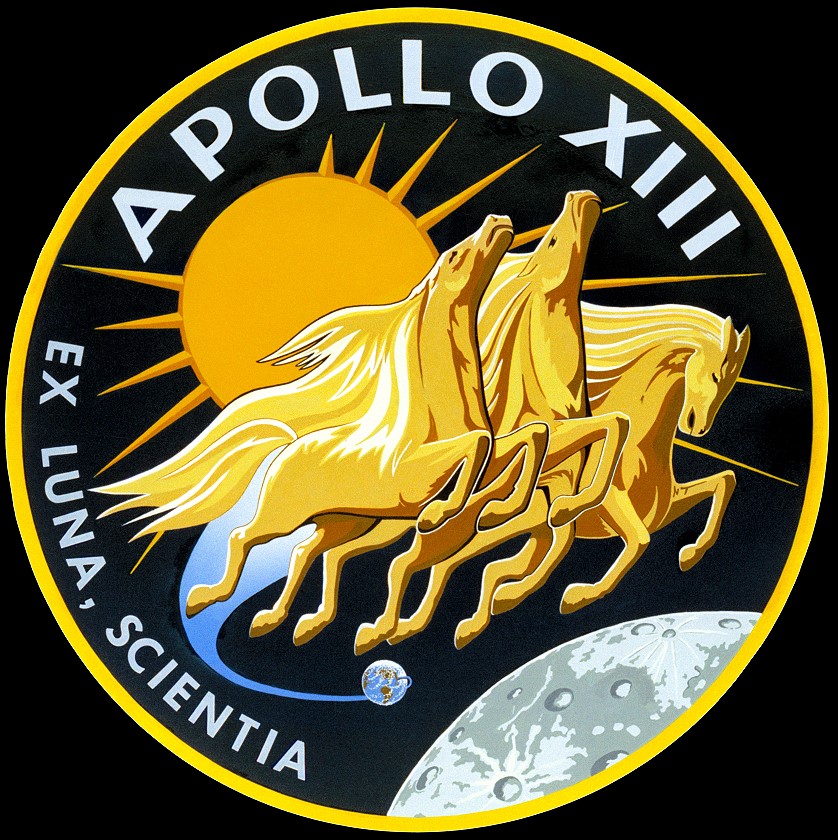
Apollo 13 – who remembers?

55:55:20 – Swigert: “Okay, Houston, we’ve had a problem here.”

Apollo 13

Probably one of the most famous phrases from the whole Apollo program, these immortal words were uttered shortly before 10.10 PM EST on April 13th, 1970.

There is so much material around that it would be pointless covering too much ground in this Post.  So why the Post today?

Because today, too, is the 13th April.  So on this day, 41 years ago, the world came together held its collective breath and prayed for a successful outcome to this scary disaster.

There are some wonderful archives around from NASA.  Here’s one that covers the chronology of events of that famous accident.

The following includes events from 2.5 minutes before the accident to about 5 minutes after. Times given are in Ground Elapsed Time (G.E.T.), that is, the time elapsed since liftoff of Apollo 13 on April 11, 1970, at 2:13 PM Eastern Standard Time (EST). 55:52:00 G.E.T. is equal to 10:05 PM EST on April 13, 1970.

Also, those who want more information, may wish to go here, here and here

And 41 years ago, this coming Sunday, i.e. April 17th 1970, with the whole world praying for their safe return, Apollo 13 splashed down near Samoa.

Four hours before landing, the crew shed the service module; Mission Control had insisted on retaining it until then because everyone feared what the cold of space might do to the unsheltered CM heat shield. Photos of the Service Module showed one whole panel missing, and wreckage hanging out, it was a sorry mess as it drifted away. Three hours later the crew left the Lunar Module Aquarius and then splashed down gently in the Pacific Ocean near Samoa. From here.

In a very real sense, Apollo 13, like a number of the other historic Apollo flights, is a wonderful reminder of something that this Planet needs right now.  A coming together of all the peoples of this beautiful planet, a unity of mankind, to remind us in these fragile and difficult times of the saying, ‘United we stand, divided we fall.’

Finally, this Post is published, not only on the 41st anniversary of that memorable Apollo Flight but the day after the 50th anniversary of Yuri Gagarin’s first flight of a human into space, the 12th April, 1961.

Remembering Lance Corporal Liam Tasker and Theo

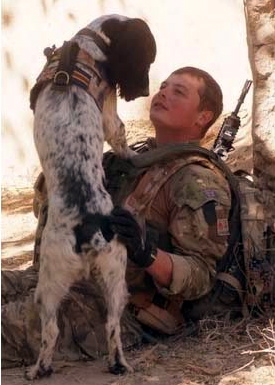
The body of a soldier who died along with his dog in Afghanistan last week has returned home to the UK.

Most days when I’m sitting in front of my PC I tend to drop in on the BBC New website.  Today (last Thursday) was no exception.  However I did not expect to be so moved by a story of the death of a British soldier in Afghanistan together with his sniffer dog.  Here’s how the BBC reported it.

Liam and Theo, RIP

The body of a soldier who died along with his record breaking sniffer dog in Afghanistan last week has returned home to the UK.

Lance Corporal Liam Tasker, from Kirkcaldy in Fife, was shot dead while on patrol in Helmand province.

The ashes of the 26-year-old’s dog Theo were flown home on the same plane.

L/Cpl Tasker, who was called a “rising star” by Army chiefs, was shot by Taliban snipers and Theo died of a seizure shortly after his master.

The soldier and his 22-month-old dog had made 14 finds in five months while on the frontline.

The pair’s successes at uncovering so many explosions and weapons had resulted in their tour of Afghanistan being extended by a month.

Just three weeks ago, springer spaniel Theo was praised as a record breaking Army sniffer dog.

The body of L/Cpl Tasker and the ashes of Theo were flown to RAF Lyneham in Wiltshire at lunchtime, before a cortege passed through Wootton Bassett, the Wiltshire town which has built up a tradition of welcoming back fallen heroes.

But what the BBC report doesn’t make clear is that Theo, L/Cpl Tasker’s dog, did not die in the action that killed Liam but of a seizure just three hours later.  Here’s how the British newspaper The Daily Telegraph reported the sad event.

Hundreds of mourners lined the main street through the Wiltshire town to honour Lance Corporal Liam Tasker, of the Royal Army Veterinary Corps, who was shot while on patrol in Helmand province, Afghanistan on March 1.

The crowds were swelled by family pets and a dozen police and Prison Service dogs at the repatriation ceremony for the 26-year-old soldier, whose dog Theo died from a seizure three hours after his master was killed.

L/Cpl Tasker’s family said they believe the dog died from a broken heart.

The body of L/Cpl Tasker, from Kirkcaldy, Fife, and the ashes of Theo had earlier been flown back to RAF Lyneham in the same aircraft.

L/Cpl Tasker was the subject of the repatriation ceremony but Theo’s ashes will be presented in private to his family.

So a silent prayer this Sunday for Liam and Theo and for all those who knew them both.  Finally, if anyone wants to share a thought on the UK Forces in Afghanistan Blog then here’s the link to the Post that mentions the death of these two brave soldiers.

Afghanistan and truth!

“But better to be hurt by the truth than comforted with a lie.”

The quote is from the film, The Kite Runner, which was based on the book  of the same name written by Khaled Hosseini.

This Post is not about taking a position, at any level, about the West’s involvement in the war in Afghanistan – far too dangerous territory!  But it is a reflection on what truth means.

At first that proposition might appear bizarre, of course we know what truth means. My Thesaurus offers three meanings: Correspondence with fact or truth; Freedom from deceit or falseness; The quality of being actual or factual.  Clear?  H’mmm not really in this instance.

OK, to the motivation behind this article.

Last Sunday two outwardly disconnected actions came together, as often seems to happen, to cause me to ponder on how my opinions are formed.  The actions concerned Afghanistan.

The first was that a friend from the congregation gave me his copy of TIME Magazine for January 17th.  In it was an article about a Black Hawk Medevac unit in Afghanistan.  From the TIME website:

The Birds Of Hope: With A Black Hawk Medevac Unit In Afghanistan

By James Nachtwey Monday, Jan. 17, 2011

General William Tecumseh Sherman got it right. War is hell. But even within the cruelty of war, there exists mercy.

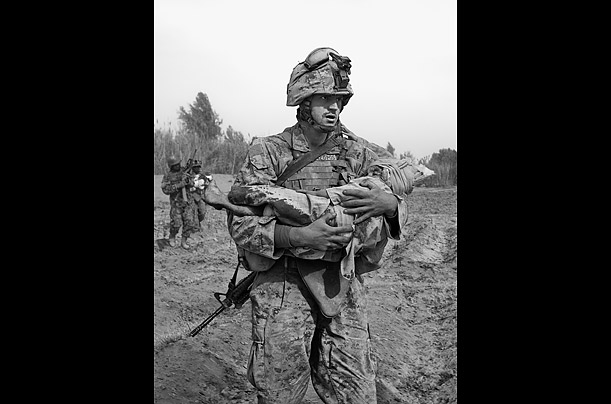
Across a dusty field, two U.S. Marines walk toward a helicopter, each carrying a bloodied and bandaged child. They hold the children as if they were their own. Although at this moment they appear as saviors, a few minutes earlier, they had called in air support in response to enemy fire. The shooter was among children, however (a fact that I have to believe was not known to the Marines), and two were seriously wounded by fragments from machine-gun rounds.

Innocent people are caught in the cross fire in all wars. That’s reality. The two Marines never signed up to hurt kids, and in the shock and confusion, their default reaction was to be protective of the children they indirectly had a hand in wounding. The kids were not left to die, as they might have been in another time and another place by other armies. Instead, a U.S. Army air-ambulance medevac crew was dispatched to fly them to the same medical facility that treats American casualties. If the shooter had survived, he too would have been helped.

Read more: http://www.time.com/time/magazine/article/0,9171,2041191,00.html#ixzz1Byu1S0xj

The article in TIME Magazine contained some emotionally powerful pictures, such as the one below.


A Marine carries an Afghan child.

The full description of the photograph, taken by James Nachtwey for TIME , is Helping Hand
A Marine carries an Afghan child, one of two wounded by coalition aircraft during an air support mission.

My reaction on reading the gruelling story was confused and difficult to articulate clearly but certainly not complimentary! Something along the lines of big and powerful nations, such as the USA, Russia and the United Kingdom, playing out their global strategies with no real insight into the pain and suffering caused by their big ‘war games’.

The second action was that Jean had returned a rental film to the local Blockbuster store and returned with another one that had caught her eye for us to watch on Sunday evening.  That film was The Kite Runner based on the book of the same name by Khaled Hosseini.

There’s a good summary of the plot of the film at WikiPedia.  Here’s a flavour.

In Kabul, prior to the Soviet invasion of Afghanistan, well-to-do young boy Amir and his loyal young Hazara servant Hassan are best of friends. Amir enjoys writing and literature, reading stories to the eager but illiterate Hassan. Amir’s Baba (father), is contemptuous of Amir’s writing and privately regards him as a weakling for letting Hassan protect him from bullies. Baba’s friend Rahim Khan demonstrates interest and encouragement to Amir. Assef, a bully with rancor towards Hazaras, and two accomplices confront Hassan and Amir, but Hassan prevents the attack with a slingshot, a birthday gift from Amir. Assef swears revenge, ridiculing their relationship as mere master and servant. .

Soon the Soviets invade Afghanistan; forcing Baba, a known anti-communist, to flee the country leaving Rahim Khan as property caretaker. En route to Pakistan, Baba bravely risks his life defending a female refugee from a Soviet soldier who demands to rape her in return for safe passage for all. Baba and Amir eventually reach the United States as humble refugees in Fremont, California. Baba tends a gas station while Amir attends community college and vends at a weekly flea market. There, Amir meets Soraya Taheri; Soraya is interested in Amir’s writing although her father, the ex-General Taheri, a proud traditional Pashtun, is contemptuous. Baba is stricken mortally ill but manages to obtain General Taheri’s permission for Amir to marry Soraya. Although Soraya feels bound to confess her previous relationships, they are happily married despite an inability to conceive children. As foreshadowed in the movie’s first scene, Amir’s debut novel is published, dedicated to Rahim Khan who encouraged his writing.

It was a fabulous film, one of the more thought-provoking films seen in many years.  If you haven’t seen it, do so.

So to the point of this article.

The film demonstrated to me that my rather black-and-white opinion of the West’s involvement in Afghanistan was based much more on my instincts that ‘war is bad’ and that the USA tends to throw its military weight around, than having a clue as to the enormous complexities, both at the level of a family and of the nation, that these conflicts entail.

The film showed a much more compassionate aspect to the activities of the USA, specifically in getting involved in Afghanistan and, more generally, in a policy of offering a new home and new hope to those from afar.

And for me, the realisation that while it may be said, ‘There is only one truth’, knowing what that truth is is something very much more challenging!

The first casualty when war comes is truth“. (Hiram W Johnson, senator for California, 1917)

Battle of Britain, postscript

Living it day-by-day, 70 years ago.

Just a quick follow-on from the Post yesterday to say that the BBC have published an excellent graphic that allows one to review the events of the Battle of Britain day-by-day.

The link is here – well worth looking at.  If only because it shows that the week of the 23rd August 1940 was one of the more bloody weeks in the whole battle.  From that BBC web page:

The defence of Britain by RAF Fighter Command against extensive air raids by the German Luftwaffe in 1940 ensured Britain’s survival and blocked the possibility of invasion. Roll over the graphic to see the daily toll inflicted on men and machine in the Battle of Britain and read James Holland’s commentary on why Germany lost.

Very sombering.

By Paul Handover

Battle of Britain, memories

Seventy years on – many still remember.

Many of the English readers of Learning from Dogs will comfortably skip this Post as already much of the news has been reporting the fact that we are 70 years after the Battle of Britain in 1940.

But for those that are from other places, where the BoB is not in the psyche of their national bloodstream, these links may be of interest.

The BBC has been doing well in presenting material.

Here’s a good piece setting the scene:

While memories of the Battle of Britain remain fresh in the minds of The Few who flew, and the staff who supported them, veterans fear its significance could soon be forgotten by others.

A Messerschmitt ME-110 bomber is shot down by a Hurricane The Luftwaffe lost 1,733 aircraft and the RAF 915 in the Battle of Britain

Seventy years ago the RAF was locked in a life and death struggle with the Luftwaffe in the skies over England.

The three weeks between mid-August and early September in 1940 were decisive for the Battle of Britain.

The bravery of the RAF pilots was captured in Winston Churchill’s speech on 20 August when he said “never in the field of human conflict was so much owed by so many to so few”.

Those left of The Few, as those pilots became known, are now in their 90s. Some of them fear they will soon not be around to remind people of the events that summer.

And if you want a flavour of what it was like to fly a Spitfire, then click here – excellent piece from Evan Davis of the BBC.

Seventy years on from the Battle of Britain, can the current generation comprehend what it is like to fly a Spitfire?

To find out, BBC Radio 4 Today programme presenter Evan Davis took a flight with The Aircraft Restoration Company’s chief engineer and test pilot John Romain.

See more on the Today website.

Well done, lads. And thank you!

And a thank-you to my Uncle who, despite being rather ill, is still alive.  He was in the RAF and stationed at Biggin Hill during those demanding months in 1940.

By Paul Handover