Category: Mathematics

Dogs and the mathematics of calculus.

A remarkable story about two very clever men and an equally clever dog!

Five days ago, I received an email from a Richard Hake quite out of the blue!  This is what it said,

Dear Paul Handover,

I’m taking the liberty of cc’ing this to Tim Pennings since he may be interested in your blog “Learning from Dogs.”
As founding author of the great blog “Learning from Dogs”, I thought you might be interested in the work of Tim Pennings.
Paraphrasing from the Hope College website:

*~*~*~*~*~*~*~*~*~*~*~*~*~*~*~*~*~*~*~*~*~*
Tim Pennings is a professor of mathematics at Hope College and owner of a famous Welsh Corgi dog, Elvis, who knows calculus. He has given over a hundred talks – including several speaking tours – based on his papers “Do Dogs Know Calculus?” [Pennings (2003)] and “Do Dogs Know Bifurcations?” [Minton & Pennings (2007)]. Articles about Elvis are easily found on Google and Youtube. For example:
1. “A Dog, a Ball, and Calculus” Ivars Peterson’s MathTrek,
2. “Calculating Dogs” Ivars Peterson’s MathTrek ,
3. “Dog Plays Fetch With Calculus” YouTube (see below)
4. “Elvis The Calculus Dog at Roanoke College” Vime0 Videos.
*~*~*~*~*~*~*~*~*~*~*~*~*~*~*~*~*~*~*~*~*~*

Regards,

Richard Hake, Emeritus Professor of Physics, Indiana University
Honorary Member, Curmudgeon Lodge of Deventer, The Netherlands
President, PEdants for Definitive Academic References which Recognize the Invention of the Internet (PEDARRII)

Well what fun!

Let me start with that YouTube video mentioned above:

Tim Pennings of Hope College in Madison, Wisconsin takes a look at the mathematics his dog Elvis uses to play fetch.

And here are a number of wonderful pictures of Elvis from which comes this one:

Elvis: Professor Tim Pennings' dog.

More may be learnt about Tim Pennings from here, from which I quote:

I am a professor of mathematics at Hope College. My areas of research and writing include dynamical systems (the shadowing property in particular), mathematical modeling, and the infinite. I have directed the Mathematics REU Site since 1995 and have mentored research students almost every year since 1990. A complete list of published papers, talks, and other professional activity is included in my vitae.

My interest in infinity stems from my intrigue with the rich stuff that lies in the confluence of mathematics, physics, philosophy, and theology. My paper, “Infinity and the Absolute: Insights into Our World, Our Faith, and Ourselves” is the backbone of my senior seminar course, Pondering the Big Questions. Several other math-theology papers, published in Perspectives include “A Life Lesson from Calculus” and “Haggai, Mathematical Dynamics, and the Nature of Good and Evil”.

I have a famous Welsh Corgi dog, Elvis, who knows calculus. Here are some pictures of us. We have given over a hundred talks – including several speaking tours – based on our papers “Do Dogs Know Calculus?” and “Do Dogs Know Bifurcations?” (written with Roland Minton) both published in the The College Mathematics Journal of the MAA. Articles about Elvis are easily found on Google and Youtube.

Finally, the author of the email, Richard Hake, is no slouch!  Here’s Richard’s Blog Hake’sEdStuff and information on his academic background.

Thanks, Richard, for getting in touch!

The only certainty is uncertainty.

The fascinating aspects of chaos.

I must immediately volunteer the fact that the thrust of this article is the result of a programme that we watched last Thursday night.  It was a programme originally featured on the UK BBC 4 channel in 2008.  Called High Anxieties, The Mathematics of Chaos, it is a fascinating examination into the way that mathematicians have fundamentally adjusted their views, from the certainty of Newtonian principles to the certain uncertainty offered by mathematicians such as Henri Poincare and Alexander Lyapunov.  The 60-minute documentary, directed by David Malone, is wonderfully interesting and much more relevant to the uncertainty surrounding all our lives than one might anticipate from any references to mathematicians!  It puts the collapse of Lehman Brothers, some 2 years ago, last Thursday, into an interesting perspective.

Here’s the first 9 minutes as offered on YouTube, introduced thus,

David Malone http://golemxiv-credo.blogspot.com author of The Debt Generation, directs and presents this film, It is the first part of a documentary first shown on BBC4 Television in the UK in September 2008. The film was first broadcast 2 days after the collapse of Lehman brothers at the start of the financial crisis. It looks at the discoveries in mathematics during the 20th Century which have challenged the view that the world is an essentially knowable and therefore controllable place. The film focuses on the economy and the environment and suggests that ideas about unpredictability, the butterfly effect and tipping points, stemming from mathematics, are part of what underlie some modern anxieties about the world we live in.

If this first part grabs your attention then finding the other 8 parts is easy on YouTube.  Alternatively, the complete set of videos is linked together as one film on Top Documentary Films, click  High Anxieties: The Mathematics of Chaos. where it is described as follows,

The documentary looks at the modern advances in mathematics and how they affect our understanding of physics, economics, environmental issues and human psychology.

The film looks at how developments in 20th Century mathematics have affected our view of the world, and particularly how the financial economy and earth’s environment are now seen as inherently unpredictable.

The film looks at the influence the work of Henri Poincare and Alexander Lyapunov had on later developments in mathematics. It includes interviews with David Ruelle, about chaos theory and turbulence, the economist Paul Ormerod about the unpredictability of economic systems, and James Lovelock the founder of Gaia theory about climate change and tipping points in the environment.

As we approach tipping points in both the economy and the climate, the film examines the mathematics we have been reluctant to face up to and asks if, even now, we would rather bury our heads in the sand rather than face harsh truths.

Very, very interesting and rather puts the pictures of the Petermann Glacier shown here into context.

The mystery of telepathy

Just a bit more science about that sixth sense.

Yesterday, I wrote about how science was coming up with some pretty strong evidence that humans do have the ability to communicate in a way that might be called ‘telepathic’.

If (and that’s a big ‘if’) I have any understanding of the science, I believe it has much to do with quantum physics.  So I thought it fun to take a small diversion in today’s Post and give you some material on this very strange world of the very, very small.

From A Lazyman’s Guide to Quantum Physics,

What is Quantum Physics?

That’s an easy one: it’s the science of things so small that the quantum nature of reality has an effect. Quantum means ‘discrete amount’ or ‘portion’. Max Planck discovered in 1900 that you couldn’t get smaller than a certain minimum amount of anything. This minimum amount is now called the Planck unit.

Why is it weird?

Niels Bohr, the father of the orthodox ‘Copenhagen Interpretation’ of quantum physics once said, “Anyone who is not shocked by quantum theory has not understood it“.

To understand the weirdness completely, you just need to know about three experiments: Light Bulb, Two Slits, Schroedinger’s Cat.

Two Slits

The simplest experiment to demonstrate quantum weirdness involves shining a light through two parallel slits and looking at the screen. It can be shown that a single photon (particle of light) can interfere with itself, as if it travelled through both slits at once.

Light Bulb

Imagine a light bulb filament gives out a photon, seemingly in a random direction. Erwin Schroedinger came up with a nine-letter-long equation that correctly predicts the chances of finding that photon at any given point. He envisaged a kind of wave, like a ripple from a pebble dropped into a pond, spreading out from the filament. Once you look at the photon, this ‘wavefunction’ collapses into the single point at which the photon really is.

Schroedinger’s Cat

In this experiment, we take your pet cat and put it in a box with a bottle of cyanide. We rig it up so that a detector looks at an isolated electron and determines whether it is ‘spin up’ or ‘spin down’ (it can have either characteristic, seemingly at random). If it is ‘spin up’, then the bottle is opened and the cat gets it. Ten minutes later we open the box and see if the cat is alive or dead. The question is: what state is the cat in between the detector being activated and you opening the box. Nobody has actually done this experiment (to my knowledge) but it does show up a paradox that arises in certain interpretations.

To conclude I will offer this quotation reputed to be from the great master himself, Albert Einstein,

The more success the quantum theory has, the sillier it looks.

Mandelbrot and fractals

Concluding article on the great Benoit Mandelbrot.

Yesterday, I wrote about Benoit Mandelbrot but wanted to save some additional information for today.

There’s a very comprehensive review of Benoit’s life on a website called NNDB.  In that review, it mentions his association with the IBM Thomas J. Watson Research Center where he worked for 32 years.  It was while working for IBM that he published the paper that established his credentials world-wide.  Taken from the IBM website is this extract,

The father of fractals, Dr. Benoit Mandelbrot, passed away from pancreatic cancer on October 16, 2010. He was 85.

Benoit, IBM Fellow Emeritus, joined the IBM Thomas J. Watson Research Center in 1958 where he worked for 32 years. His 1967 article published in Science, How Long Is the Coast of Britain? Statistical Self-Similarity and Fractional Dimension, introduced the concept that a geometric shape can be split into pieces that are smaller copies of the whole. It wasn’t until 1975 that he defined the mathematical shapes as fractals.

Here is another website that has fractal images taken from the Mandelbrot set.  An example.

Just stunningly beautiful!

Finally, if you go to this website there is a slideshow of stunning images of fractals in honour of the great man.

Benoit Mandelbrot and the roughness of life.

There is so much about the lives of humans that is astoundingly beautiful.

Before I get started on this article, a few words about the Blog in general.  In recent times, the readership of Learning from Dogs has increased, frankly, to quite amazing levels.  Not really sure why but grateful, nonetheless.

Readers will recognize that articles written specifically about dogs are in the minority.  Even using dogs as a metaphor would still limit what could be published.  But as is written elsewhere on the Blog, ‘The underlying theme of Learning from Dogs is about truth, integrity, honesty and trust in every way.’  Dogs are integrous creatures; that’s all the example required.

We are at a point in the history of man where truth, integrity, honesty and trust are critically important (they have always been important but the economic and ecological pressures bearing down on us all make these values critical to mankind’s survival).  Thus the aspiration of Learning from Dogs is to offer insights on truth from as many perspectives as possible – and to make your experience as a reader sufficiently enjoyable that you will wish to return!

OK!  On to the topic for today!

There are many aspects of the world in which we live that are mysterious beyond our imagination.  Take the circle.  Practically everyone is aware that to calculate either the area or the circumference of a circle one needs to use a mathematical constant π or ‘pi’.  As a mathematician would put it,  π (sometimes written pi) is a mathematical constant whose value is the ratio of any circle’s circumference to its diameter; this is the same value as the ratio of a circle’s area to the square of its radius. π is approximately equal to 3.14159.

Note the word ‘approximately’!  Now read this,

(PhysOrg.com) — A computer scientist in France has broken all previous records for calculating Pi, using only a personal computer. The previous record was approximately 2.6 trillion digits, but the new record, set by Fabrice Bellard, now stands at almost 2.7 trillion decimal places.

Bellard, of Paris Telecom Tech, made and checked the calculation by running his own software algorithms for 131 days. The previous record calculation, set by Daisuke Takahashi at the University of Tsukuba in Japan in August 2009, took only 29 hours to complete, but used a super-computer costing millions of dollars, and running 2000 times faster than Bellard’s PC.

Full article is here.

Apart from the wonderful aspect of the need of a human being to go on determining the n’th value of π there is a deeper and more beautiful aspect (well to me there is!) and that is the acknowledgement that something as simple as, say, that round coin in your hand is an expression of the infinite.

Now to Benoit Mandelbrot, who died a little over six months ago, but in his lifetime also explored the wonder and magic of the infinite.

Here’s a video of Mandelbrot recorded in February 2010 in what would be his last year of his life on earth.

If you found that video fascinating then try this series of six videos presented by the one and only Arthur C. Clarke.

Benoit Mandelbrot died on the 14th October, 2010, a little over a month before his eighty-sixth birthday (born 20th November, 1924).  Here’s a nice tribute from the The New York Times.

Tomorrow, some more insights into the mysterious beauty of fractals.

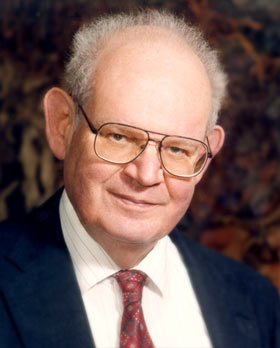
Benoit Mandelbrot

Amazing man!