Category: Mathematics

Of paradoxes, and headaches!

The interconnectedness of everything – even beyond our wildest imagination.

A while ago John Zande signed up to follow Learning from Dogs. Naturally, I went across to John’s blog to thank him. There I discovered that John is an animal lover and an author. For he states, referring to his book, that, “BUY IT. ALL PROCEEDS GO TO ANIMAL RESCUE AND SHELTER IN BRAZIL”. Fabulous!

John Zande cover_zpsz7wuq9cc

(I did buy the book, am about 20% through it and finding it very stimulating, – if you would like to buy it then click the image of the book on John’s home page.)

Anyway, a few days later we watched the BBC Horizon programme on multiple universes. Here’s how the BBC introduced the programme:

Which Universe Are We In?

Horizon, 2014-2015 Episode 17 of 19

Imagine a world where dinosaurs still walk the earth. A world where the Germans won World War II and you are president of the United States. Imagine a world where the laws of physics no longer apply and where infinite copies of you are playing out every storyline of your life.

It sounds like a plot stolen straight from Hollywood, but far from it. This is the multiverse.

Until very recently the whole idea of the multiverse was dismissed as a fantasy, but now this strangest of ideas is at the cutting edge of science.

And for a growing number of scientists, the multiverse is the only way we will ever truly make sense of the world we are in.

Horizon asks the question: Do multiple universes exist? And if so, which one are we actually in?

Horizon is always great to watch but this episode was incredibly stimulating and interesting. Later, in a exchange of comments to one of John’s posts, where I referred to that programme, John wrote:

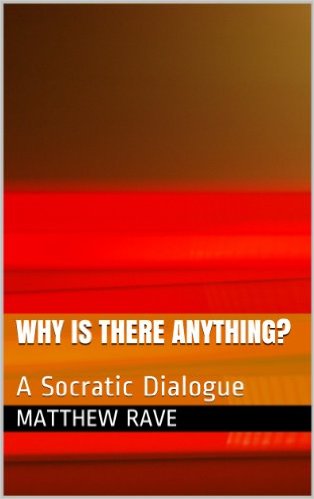
The mulitverse is actually the more reasonable explanation for why there is something, and although I don’t understand the maths, the people who do say its simplistically beautiful. Matt Rave is an associate professor of physics and comments here regularly. He has a great book on it all, Why is There Anything?
rave

That lead me to purchasing Matthew Rave’s book that, likewise, is a most fascinating and unusual approach to this topic. His Amazon author’s page reveals that, “Dr. Matthew Rave is an assistant professor of physics at Western Carolina University, in the mountains of North Carolina. His research interests include interpretations of quantum mechanics, the geometric phase, solid state physics, and physics education.” Matthew Rave’s blogsite is here.

Matthew Rave’s book further illustrates the paradox, to my mind, that comes from thinking about why are we here, are we here and, if so, how do we know we are here?

So if that isn’t enough for you and me, then very recently The Conversation blogsite published the following from Geraint Lewis who is Professor of Astrophysics at the University of Sydney. It is republished here within the terms of The Conversation. Did I mention paradoxes and headaches!

ooOOoo

We are lucky to live in a universe made for us

Geraint Lewis, University of Sydney

To a human, the universe might seem like a very inhospitable place. In the vacuum of space, you would rapidly suffocate, while on the surface of a star you would be burnt to a crisp. As far as we know, all life is confined to a sliver of an atmosphere surrounding the rocky planet we inhabit.

But while the origin of life on Earth remains mysterious, there are bigger questions to answer. Namely: why do the laws of physics permit any life at all?

Hang on, the laws of physics? Surely they are a universal given and life just gets on with it?

But remember that the universe is built of fundamental pieces, particles and forces, which are the building blocks of everything we see around us. And we simply don’t know why these pieces have the properties they do.

There are many observational facts about our universe, such as electrons weighing almost nothing, while some of their quark cousins are thousands of times more massive. And gravity being incredibly weak compared to the immense forces that hold atomic nuclei together.

Why is our universe built this way? We just don’t know.

But what if…?

This means we can ask “what if” questions. What if the electron was massive and quarks were fleeting? What if electromagnetism was stronger than the nuclear strong force? If so, what would that universe be like?

Let’s consider carbon, an element forged in the hearts of massive stars, and an element essential to life as we know it.

Initial calculations of such stellar furnaces showed that they were apparently inefficient in making carbon. Then the British astronomer Fred Hoyle realised the carbon nucleus possesses a special property, a resonance, that enhanced the efficiency.

But if the strength of the strong nuclear force was only fractionally different, it would wipe out this property and leave the universe relatively devoid of carbon – and, thus, life.

The story doesn’t end there. Once carbon is made, it is ripe to be transmuted into heavier elements, particularly oxygen. It turns out that oxygen, due to the strength of the strong nuclear force, lacks the particular resonance properties that enhanced the efficiency of carbon creation.

This prevents all of the carbon being quickly consumed. The specific strength of the strong force has thus resulted in a universe with an almost equal mix of carbon and oxygen, a bonus for life on Earth.

Death of a universe

This is but a single example. We can play “what if” games with the properties of all of the fundamental bits of the universe. With each change we can ask, “What would the universe be like?”

The answers are quite stark. Straying just a little from the convivial conditions that we experience in our universe typically leads to a sterile cosmos.

This might be a bland universe, without the complexity required to store and process the information central to life. Or a universe that expands too quickly for matter to condense into stars, galaxies and planets. Or one that completely re-collapses again in a matter of moments after being born. Any complex life would be impossible!

The questions do not end there. In our universe, we live with the comfort of a certain mix of space and time, and a seemingly understandable mathematical framework that underpins science as we know it. Why is the universe so predictable and understandable? Would we be able to ask such a question if it wasn’t?

Our universe appears to balance on a knife-edge of stability. But why?

We appear to be very lucky to live in a universe that accommodates life. Zdenko Zivkovic/Flickr, CC BY

One of a multiverse

To some, science will simply fix it all. Perhaps, if we discover the “Theory of Everything”, uniting quantum mechanics with Einstein’s relativity, all of the relative masses and strengths of the fundamental pieces will be absolutely defined, with no mysteries remaining. To others, this is little more than wishful thinking.

Some seek solace in a creator, an omnipotent being that finely-tuned the properties of the universe to allow us to be here. But the move from the scientific into the supernatural leaves many uncomfortable.

There is, however, another possible solution, one guided by the murky and confused musings at the edge of science. Super-strings or M-theory (or whatever these will evolve into) suggest that the fundamental properties of the universe are not unique, but are somehow chosen by some cosmic roll of the dice when it was born.

This gives us a possible explanation of the seemingly special properties of the universe in which we live.

We are not the only universe, but just one in a semi-infinite sea of universes, each with their own peculiar set of physical properties, laws and particles, lifetimes and ultimately mathematical frameworks. As we have seen, the vast majority of these other universes in the overall multiverse are dead and sterile.

They only way we can exist to ask the question “why are we here?” is that we happen to find ourselves in a universe conducive to our very existence. In any other universe, we simply wouldn’t be around to wonder why we didn’t exist.

If the multiverse picture is correct, we have to accept that the fundamental properties of the universe were ultimately dished out in a game of cosmic roulette, a spin of the wheel that we appear to have won.

Thus we truly live in a fortunate universe.

The ConversationGeraint Lewis, Professor of Astrophysics, University of Sydney

This article was originally published on The Conversation. Read the original article.

ooOOoo

12963392-An-image-of-a-man-with-a-headache--Stock-Vector-headache-earache-cartoon

Clouds above, and even farther away.

The second, and last, episode of the BBC Clouds Lab programme offers an intriguing message.

On Monday, I published a post under the title of The clouds above us.  The second episode demonstrated that even in atmospheric conditions of near vacuum, intense cold and very low humidity, conditions that would kill a human in seconds, there was microscopic bacteriological material to be found.

 Exploring the troposphere

The troposphere is a turbulent layer of air that begins at the Earth’s surface and ranges from 23,000-65,000 feet above sea level, depending on the latitude, season and the time of day. Its name originates from the Greek word tropos, meaning change. It’s now known that bacteria actually exists in clouds and scientists believe that it plays a significant part in the creation of rain but little is known about life higher up. Microbiologist Dr Chris Van Tulleken has discovered that living bacteria can exist well above 10,000ft in a hostile environment with low pressure, increased UV radiation, freezing temperatures, high winds and no oxygen or water.

There is an interesting set of clips to be watched on that BBC Cloud Lab website.

What I took away from watching the programme was that the minimum conditions necessary for living bacteria were far more harsh than one might expect.  In other words, finding living bacteria in other solar systems might not be such a science-fiction idea.

With that in mind, I’m republishing an essay that Patrice Ayme wrote in 2013.  I’m grateful for his permission to so do.

ooOOoo

40 Billion Earths? Yes & No.

Up to twenty years ago, a reasonable opinion among scientists was that there might be just one solar system. Ours. Scientists like to project gravitas; having little green men all over didn’t look serious.

However, studying delicately the lights of stars, how they vary, how they doppler-shift, more than 1,000 planets have been found. Solar systems seem ubiquitous. Astronomers reported in 2013 that there could be as many as 40 billion habitable Earth-size planets in the galaxy. However, consider this:

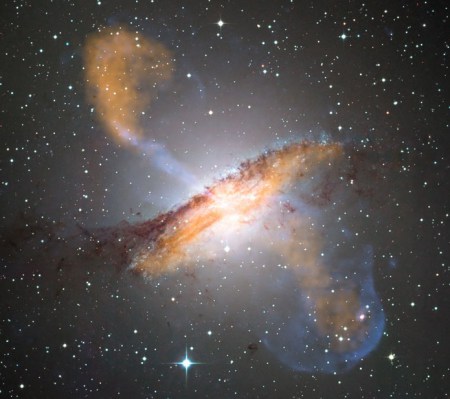
Centaurus A: Lobes Of Tremendous Black Hole Explosion Fully Visible.

Yes, that’s the center of a galaxy, and it has experienced a galactic size explosion from its central black hole.

One out of every five sun-like stars in our galaxy has a planet the size of Earth circling it in the Goldilocks zone, it seems — not too hot, not too cold — with surface temperatures compatible with liquid water. Yet, we have a monster black hole at the center of our giant galaxy, just like the one exploding above.

The Milky Way’s black hole is called Sagittarius A*. It exploded last two million years ago. Early Homo Erectus, down south, saw it. The furious lobes of the explosion are still spreading out, hundreds of thousands of light years away.

We are talking here about explosions potentially stronger than the strongest supernova by many orders of magnitude (depending upon the size of what’s falling into Sagittarius. By the way, a cloud is just heading that way).

Such galactic drama has a potential impact on the presence of advanced life. The richer the galaxy gets in various feature the situation looks, the harder it looks to compute the probability of advanced life.

The profusion of habitable planets is all the more remarkable, as the primitive methods used so far require the planet to pass between us and its star.

(The research, started on the ground in Europe, expanded with dedicated satellites, the French Corot and NASA’s Kepler spacecraft.). Sun-like stars are “yellow dwarves”. They live ten billion years.

From that, confusing “habitable” and “inhabitated”, the New York Times deduced: “The known odds of something — or someone — living far, far away from Earth improved beyond astronomers’ boldest dreams on Monday.

However, it’s not that simple.

Primitive bacterial life is probably frequent. However advanced life (animals) is probably very rare, as many are the potential catastrophes. And one needs billions of years to go from primitive life to animals.

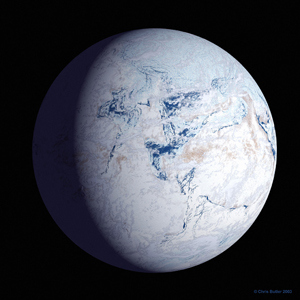
After life forms making oxygen on Earth appeared, the atmosphere went from reducing (full of strong greenhouse methane) to oxidizing (full of oxygen). As methane mostly disappeared, so did the greenhouse. Earth froze, all the way down to the equator:

When Snowball Earth Nearly Killed Life.

Yet volcanoes kept on belching CO2 through the ice. That CO2 built up above the ice, caused a strong greenhouse, and the ice melted. Life had survived. Mighty volcanism has saved the Earth, just in time.

That “snowball Earth” catastrophe repeated a few times before the Earth oxygen based system became stable. Catastrophe had been engaged, several times, but the disappearance of oxygen creating life forms had been avoided, just barely.

Many are the other catastrophes we have become aware of, that could wipe out advanced life: proximal supernovas or gamma ray explosions.

Cataclysmic eruption of the central galactic black hole happen frequently. The lobes from the last one are still visible, perpendicularly high off the galactic plane. The radiation is still making the Magellanic Stream simmer, 200,000 light years away. Such explosions have got to have sterilized a good part of the galaxy.

In 2014 when part of the huge gas cloud known as G2 falls into Sagittarius A*, we will learn better how inhospitable the central galaxy is for advanced life.

Many of the star systems revealed out there have surprising feature: heavy planets (“super Jupiters“) grazing their own stars. It’s unlikely those giants were formed where they are. They probably swept their entire systems, destroying all the rocky planets in their giant way. We don’t understand these cataclysmic dynamics, but they seem frequent.

Solar energy received on Earth fluctuated and changed a lot, maybe from one (long ago) to four (now). But, as it turned out just so that Earthly life could survive. Also the inner nuclear reactor with its convective magma and tectonic plates was able to keep the carbon dioxide up in the air, just so.

The Goldilocks zones astronomers presently consider seem to be all too large to allow life to evolve over billions of years. They have to be much narrower and not just with red dwarves (the most frequent and long living stars).

One of our Goldilocks, Mars, started well, but lost its CO2 and became too cold. The other Goldilocks, Venus, suffered the opposite major technical malfunction: a runaway CO2 greenhouse.

Mars’ axis of rotation tilts on the solar system’s plane enormously: by 60 degrees, over millions of years. So Mars experiences considerable climatic variations over the eons, as it goes through slow super winters and super summers (it’s imaginable that, as the poles melt, Mars is much more habitable during super summers; thus life underground, hibernating is also imaginable there).

Earth’s Moon prevents this sort of crazy hyper seasons. While, differently from Venus, Earth rotates at reasonable clip, homogenizing the temperatures. Venus takes 243 days to rotate.

It is startling that, of the four inner and only rocky planets, just one, Earth has a rotation compatible with the long term evolution of advanced life.

Earth has also two striking characteristics: it has a very large moon that store much of the angular momentum of the Earth-Moon system. Without Moon, the Earth would rotate on itself once every 8 hours (after 5 billion years of braking by Solar tides).

The Moon used to hover at least ten times closer than now, when earth’s days were at most 6 hours long.

The tidal force is the difference between gravitational attraction in two closely separated places, so it’s the differential of said attraction (which is proportional to 1/dd; d being the distance). Hence the tidal force is inversely proportional to the cube of the distance.

Thus on early Earth tides a kilometer high were common, washing back and forth every three hours. a hyper super tsunami every three hours, going deep inside the continents. Not exactly conditions you expect all over the universe.

Hence biological material fabricated on the continental margins in shallow pools would get mixed with the oceans readily. That would guarantee accelerated launch of life (and indeed we know life started on Earth very fast).

The theory of formation of the Moon is wobbly (recent detailed computations of the simplest impact theory do not work). All we know for sure, thanks to the Moon rocks from Apollo, is that the Moon is made of Earth mantle materials.

Somehow the two planets split in two. (Fission. Get it? It maybe a hint.)

Another thing we know for sure is that Earth has, at its core, a giant nuclear fission reactor, keeping Earth’s core hotter than the surface of the sun. An unimaginable liquid ocean of liquid iron deep down inside below our feet undergoes iron weather. Hell itself, the old fashion way, pales in comparison.

Could the Moon and the giant nuclear reactor have the same origin? This is my provocative question of the day. The Moon, our life giver, could well have formed from giant nuclear explosions, of another of our life givers, what became the nuke at the core. I can already hear herds of ecologists yelp in the distance. I present the facts, you pseudo-ecologists don’t decide upon them. It’s clear that nuclear fission is not in Drake equation: if nothing else, it’s too politically incorrect.

All the preceding makes this clear:

Many are the inhabitable planets, yet few will be inhabitated by serious denizens.

This means that the cosmos is all for our taking. The only question is how to get there. The closest stars in the Proxima, Beta and Alpha Centauri system are not attainable, for a human crew, with existing technology.

However, if we mastered clean colossal energy production, of the order of the entire present energy production of humanity, we could get a colony there (only presently imaginable technology would be fusion).

Giordano Bruno, professor, astronomer, and priest suggested that there were many other inhabitated systems around the stars. That insult against Islam meant Christianity was punished the hard way: the Vatican, the famous terrorist organization of god crazies, put a device in Giordano’s mouth that pierced his palate, and having made sure that way that he could not tell the truth, the terrorists then burned him alive. After seven years of torture.

The horror of truth was unbearable to theo-plutocrats.

Now we face something even worse: everywhere out there is very primitive life. It is likely gracing 40 billion worlds. But, if one has to duplicate the succession of miracles and improbabilities that made Earth, to earn advanced life, it may be just here that civilization ever rose to contemplate them.

Congratulations to India for launching yesterday a mission to Mars ostensibly to find out if there is life there (by finding CH4; while life is presently unlikely, Mars has much to teach, including whether it started there). That’s the spirit!

The spirit is to have minds go where even imagination itself did not go before.

If we sit back, and look at the universe we have now, from Dark Matter, to Dark Energy, to Sagittarius, to the nuclear reactor below, to billions of Earths, to a strange Higgs, to Non Aristotelian logic, we see a wealth, an opulence of possibilities inconceivable twenty years ago.

Progress is not just about doing better what was done yesterday. It’s also about previously inconceivable blossoms of entirely new mental universes.

***

Patrice Ayme

ooOOoo

Maybe, we are not alone!

Is it just me?

Some days, one just wonders about a world that appears to be stark, raving mad!

One of the fundamental things that mankind is not learning from dogs, or from other animals for that fact, is having a sensitivity to danger.

Even happy, domesticated dogs, as with cats, are incredibly quick to pick up on something that just doesn’t ‘feel right’!

For example, take what was written here last Wednesday. About the extreme madness of our dependency on oil for our food!

Why is there no outcry?

Just recently, NOAA reported that “April 2014 was tied with April of 2010 as being the warmest April on record globally for land and ocean surface combined. NOAA also said that – globally – the January 2014 to April 2014 period was the 6th warmest Jan-Apr period on record.”

Why is there no outcry?

Just ten days ago, I wrote a post under the title of The nature of delusions. Included in that post was an essay from George Monbiot he called Are We Bothered? His proposition being, “The more we consume, the less we care about the living planet.

Part of me hates the way that this blog often touches on pain and negativity but my motivation is simply that doing nothing, ignoring what is so wrong in the world, would be the height of irresponsibility.

All of which is a preamble to another George Monbiot essay. Mr. Monbiot is a powerful writer as his many essays demonstrate. But this latest one from him is one of the most powerful essays in a very long time.

It’s not a comfortable read. But sure as hell, it’s a must read!

ooOOoo

The Impossibility of Growth

May 27, 2014

Why collapse and salvation are hard to distinguish from each other.

By George Monbiot, published in the Guardian 28th May 2014

Let us imagine that in 3030BC the total possessions of the people of Egypt filled one cubic metre. Let us propose that these possessions grew by 4.5% a year. How big would that stash have been by the Battle of Actium in 30BC? This is the calculation performed by the investment banker Jeremy Grantham (1).

Go on, take a guess. Ten times the size of the pyramids? All the sand in the Sahara? The Atlantic ocean? The volume of the planet? A little more? It’s 2.5 billion billion solar systems (2). It does not take you long, pondering this outcome, to reach the paradoxical position that salvation lies in collapse.

To succeed is to destroy ourselves. To fail is to destroy ourselves. That is the bind we have created. Ignore if you must climate change, biodiversity collapse, the depletion of water, soil, minerals, oil; even if all these issues were miraculously to vanish, the mathematics of compound growth make continuity impossible.

Economic growth is an artefact of the use of fossil fuels. Before large amounts of coal were extracted, every upswing in industrial production would be met with a downswing in agricultural production, as the charcoal or horse power required by industry reduced the land available for growing food. Every prior industrial revolution collapsed, as growth could not be sustained (3). But coal broke this cycle and enabled – for a few hundred years – the phenomenon we now call sustained growth.

It was neither capitalism nor communism that made possible the progress and the pathologies (total war, the unprecedented concentration of global wealth, planetary destruction) of the modern age. It was coal, followed by oil and gas. The meta-trend, the mother narrative, is carbon-fuelled expansion. Our ideologies are mere subplots. Now, as the most accessible reserves have been exhausted, we must ransack the hidden corners of the planet to sustain our impossible proposition.

On Friday, a few days after scientists announced that the collapse of the West Antarctic ice sheet is now inevitable (4), the Ecuadorean government decided that oil drilling would go ahead in the heart of the Yasuni national park (5). It had made an offer to other governments: if they gave it half the value of the oil in that part of the park, it would leave the stuff in the ground. You could see this as blackmail or you could see it as fair trade. Ecuador is poor, its oil deposits are rich: why, the government argued, should it leave them untouched without compensation when everyone else is drilling down to the inner circle of hell? It asked for $3.6bn and received $13m. The result is that Petroamazonas, a company with a colourful record of destruction and spills (6), will now enter one of the most biodiverse places on the planet, in which a hectare of rainforest is said to contain more species than exist in the entire continent of North America (7).

The UK oil company Soco is now hoping to penetrate Africa’s oldest national park, Virunga, in the Democratic Republic of Congo (8); one of the last strongholds of the mountain gorilla and the okapi, of chimpanzees and forest elephants. In Britain, where a possible 4.4 billion barrels of shale oil has just been identified in the south-east (9), the government fantasises about turning the leafy suburbs into a new Niger delta. To this end it’s changing the trespass laws to enable drilling without consent and offering lavish bribes to local people (10,11). These new reserves solve nothing. They do not end our hunger for resources; they exacerbate it.

The trajectory of compound growth shows that the scouring of the planet has only just begun. As the volume of the global economy expands, everywhere that contains something concentrated, unusual, precious will be sought out and exploited, its resources extracted and dispersed, the world’s diverse and differentiated marvels reduced to the same grey stubble.

Some people try to solve the impossible equation with the myth of dematerialisation: the claim that as processes become more efficient and gadgets are miniaturised, we use, in aggregate, fewer materials. There is no sign that this is happening. Iron ore production has risen 180% in ten years (12). The trade body Forest Industries tell us that “global paper consumption is at a record high level and it will continue to grow.” (13) If, in the digital age, we won’t reduce even our consumption of paper, what hope is there for other commodities?

Look at the lives of the super-rich, who set the pace for global consumption. Are their yachts getting smaller? Their houses? Their artworks? Their purchase of rare woods, rare fish, rare stone? Those with the means buy ever bigger houses to store the growing stash of stuff they will not live long enough to use. By unremarked accretions, ever more of the surface of the planet is used to extract, manufacture and store things we don’t need. Perhaps it’s unsurprising that fantasies about the colonisation of space – which tell us we can export our problems instead of solving them – have resurfaced (14).

As the philosopher Michael Rowan points out, the inevitabilities of compound growth mean that if last year’s predicted global growth rate for 2014 (3.1%) is sustained, even if we were miraculously to reduce the consumption of raw materials by 90% we delay the inevitable by just 75 years(15). Efficiency solves nothing while growth continues.

The inescapable failure of a society built upon growth and its destruction of the Earth’s living systems are the overwhelming facts of our existence. As a result they are mentioned almost nowhere. They are the 21st Century’s great taboo, the subjects guaranteed to alienate your friends and neighbours. We live as if trapped inside a Sunday supplement: obsessed with fame, fashion and the three dreary staples of middle class conversation: recipes, renovations and resorts. Anything but the topic that demands our attention.

Statements of the bleeding obvious, the outcomes of basic arithmetic, are treated as exotic and unpardonable distractions, while the impossible proposition by which we live is regarded as so sane and normal and unremarkable that it isn’t worthy of mention. That’s how you measure the depth of this problem: by our inability even to discuss it.

http://www.monbiot.com

References:

1. http://www.theoildrum.com/node/7853

2. Grantham expressed this volume as 1057 cubic metres. In his paper We Need To Talk About Growth, Michael Rowan translated this as 2.5 billion billion solar systems. (http://persuademe.com.au/need-talk-growth-need-sums-well/). This source gives the volume of the solar system (if it is treated as a sphere) at 39,629,013,196,241.7 cubic kilometres, which is roughly 40 x 1021 cubic metres. Multiplied by 2.5 billion billion, this gives 1041 cubic metres.

Since posting this, I’ve received the following clarifications:

From Jacob Bayless:

“… about the volume of the solar system — there is no agreed-upon definition of its diameter, which is why the figures vary wildly. (There are also two definitions of ‘a billion’, which adds to the confusion). Using the radius of Neptune’s orbit, as the farthest ‘planet’ from the sun, gives the 2.5 billion billion figure:

The orbit of Neptune is 4.5 x 10^12 m radius, which yields a 4 x 10^38 cubic m sphere. Multiplying this by 2.5 x 10^18, or “2.5 billion billion”, gives 10^57 cubic m. So that calculation checks out.

The heliopause radius would be another possible way to measure the solar system radius; it’s 4 times as far and thus 64 times the volume.”

From Geoff Briggs:

“Michael Rowan has taken the size of the solar system to be the orbit of Neptune, which is kind of understandable, but the sun’s influence extends a LOT further than that, so his estimate is correspondingly significantly overstated (ie the extra billion).

The 39,629,… cubic km figure from yahoo answers is based on a correct calculation in light years, but then a massive cock-up in the conversion to cubic km. The author seems to have assumed that a light year is about 21,000,000m, which is off by about eight orders of magnitude. 4.2 cubic light years is about 3.6 x 10^39 cubic km (and hence about 3.6 x 10^48 cubic metres).”

From Andrew Bryce:

“Starting volume of Egyptian possessions = 1 m3

after 3000 years volume = 1 x (1.045)^3000

= 2.23 x 10^57 m3

Assume the radius of the solar system is 50 AU (the distance to the Kuiper belt)

1 AU = 1.496 x 10^11 m

radius of the solar system = 50 AU = 7.48 x 10^12 m

volume of solar system = 4/3 x pi x r^3

= 1.75 x 10^39 m3

so the Egyptian possessions would require 2.23 x 10^57 / 1.75 x 10^39 solar systems

= 1.27 x 10^18

= about 1.27 billion billion solar systems

If you consider the radius of the solar system to be 40 AU (about the mid point of the orbit of Pluto), then you would get a figure of about 2.5 billion solar systems.”

But: “if you round off the volume of possessions to exactly 10^57 m3, and you assume the radius of the solar system to be 30 AU (the orbit of Neptune), then you would also get a figure of around 2.5 billion billion solar systems (well, 2.64 billion billion), which might be where the calculation came from. That would be a better definition for the size of the solar system, because it has a neatly defined edge.”

3. EA Wrigley, 2010. Energy and the English Industrial Revolution. Cambridge University Press.

4. http://www.theguardian.com/environment/2014/may/12/western-antarctic-ice-sheet-collapse-has-already-begun-scientists-warn

5. http://www.theguardian.com/environment/2014/may/23/ecuador-amazon-yasuni-national-park-oil-drill

6. http://www.entornointeligente.com/articulo/2559574/ECUADOR-Gobierno-concede-licencia-para-la-explotacion-de-dos-campos-del-ITT-23052014

7. http://www.theguardian.com/world/2013/aug/16/ecuador-approves-yasuni-amazon-oil-drilling

8. http://www.wwf.org.uk/how_you_can_help/virunga/

9. http://www.theguardian.com/environment/2014/may/23/fracking-report-billions-barrels-oil-government-cynicism

10. http://www.telegraph.co.uk/earth/energy/fracking/10598473/Fracking-could-be-allowed-under-homes-without-owners-permission.html

11. http://www.theguardian.com/environment/2014/may/23/fracking-report-billions-barrels-oil-government-cynicism

12. Philippe Sibaud, 2012. Opening Pandora’s Box: The New Wave of Land Grabbing by the Extractive Industries and the Devastating Impact on Earth. The Gaia Foundation. http://www.gaiafoundation.org/opening-pandoras-box

13. http://www.forestindustries.fi/industry/paper_cardboard_converted/paper_pulp/Global-paper-consumption-is-growing-1287.html

14. https://www.globalonenessproject.org/library/articles/space-race-over

15. Michael Rowan, 2014. We Need To Talk About Growth (And we need to do the sums as well.) http://persuademe.com.au/need-talk-growth-need-sums-well/

ooOOoo

Why is there no outcry!


Magic!

The old and the new.

Like thousands of others, Jean and I are regular viewers of the TED Talks.

So first the old. Here’s a reminder of the inspiring nature of mathematics; in this case Fibonacci numbers.

Published on Nov 8, 2013

Math is logical, functional and just … awesome. Mathemagician Arthur Benjamin explores hidden properties of that weird and wonderful set of numbers, the Fibonacci series. (And reminds you that mathematics can be inspiring, too!)

Now to the new. Innovation at its very best.

Published on Jul 11, 2013

The development of new medicine is problematic because laboratories cannot replicate the human body’s environment, making it difficult to determine how patients will respond to treatment. At TEDxBoston, Geraldine Hamilton demonstrates how scientists can implant living human cells into microchips that mimic the body’s conditions. These “organs-on-a-chip” can be used to study drug toxicity, identify potential new therapies, and could lead to safer clinical trials.

Mathematics in action!

You will be amazed – guaranteed!

The TED Talk link was sent to me by friend, Lee Crampton.

Published on Jun 11, 2013

In a robot lab at TEDGlobal, Raffaello D’Andrea demos his flying quadcopters: robots that think like athletes, solving physical problems with algorithms that help them learn. In a series of nifty demos, D’Andrea show drones that play catch, balance and make decisions together — and watch out for an I-want-this-now demo of Kinect-controlled quads.

There’s more on Raffaello here where you can read this:

My work is focused on the creation of systems that leverage technological innovations, scientific principles, advanced mathematics, algorithms, and the art of design in unprecedented ways, with an emphasis on advanced motion control.

By their very nature, these creations require a team to realize. Many are enabled by the research I conduct with my graduate students. Many are also the fruit of collaborations with architects, entrepreneurs, and artists.

My hope is that these creations inspire us to rethink what role technology should have in shaping our future.

Raffaello D’Andrea

and where you can also find this further video – Zurich Minds – doubly fascinating.

Raffaello D’Andrea is interviewed by Rolf Dobelli

Makes me want to lie down in a darkened room! 😉

Modelling the future.

Can we trust the predictive output of computer modelling?

I would be the first to admit that this is not an area where I have anything more than general knowledge.  However, what prompted me to think about this topic was a chance conversation with someone here in Payson.  We were chatting over the phone and this person admitted to being less than fully convinced of the ’cause and effect’ of man’s influence on the global biosphere.

When I queried that, what was raised was the idea that all modelling algorithms used in climate change predictions must incorporate mathematical constants.  I continued to listen as it was explained that, by definition, all constants were, to some degree, approximations.  Take, for example, the obvious one of the constant π, that Wikipedia describes as: a mathematical constant that is the ratio of a circle’s circumference to its diameter. Pi, of course, would have to be rounded if it was to be used in any equation.  Even taking it to thirty decimal places, as in 3.14159 26535 89793 23846 26433 83279, would mean rounding it to 3.14159 26535 89793 23846 26433 83280 (50288 being the 30th to 35th decimal places).

OK, so I must admit that I was leaning to the viewpoint that this person had a valid perspective.  I then asked Martin Lack, he of Lack of Environment and a scientifically trained person, for his thoughts.  The rest of this post is based on the information that Martin promptly sent me.

One of the links that Martin sent was to this post on the Skeptical Science blogsite.  That post sets out the common skeptics view, namely:

Models are unreliable
“[Models] are full of fudge factors that are fitted to the existing climate, so the models more or less agree with the observed data. But there is no reason to believe that the same fudge factors would give the right behaviour in a world with different chemistry, for example in a world with increased CO2 in the atmosphere.”  (Freeman Dyson)

The author of the Skeptical Science posting responds,

Climate models are mathematical representations of the interactions between the atmosphere, oceans, land surface, ice – and the sun. This is clearly a very complex task, so models are built to estimate trends rather than events. For example, a climate model can tell you it will be cold in winter, but it can’t tell you what the temperature will be on a specific day – that’s weather forecasting. Climate trends are weather, averaged out over time – usually 30 years. Trends are important because they eliminate – or “smooth out” – single events that may be extreme, but quite rare.

Climate models have to be tested to find out if they work. We can’t wait for 30 years to see if a model is any good or not; models are tested against the past, against what we know happened. If a model can correctly predict trends from a starting point somewhere in the past, we could expect it to predict with reasonable certainty what might happen in the future.

So all models are first tested in a process called Hindcasting. The models used to predict future global warming can accurately map past climate changes. If they get the past right, there is no reason to think their predictions would be wrong. Testing models against the existing instrumental record suggested CO2 must cause global warming, because the models could not simulate what had already happened unless the extra CO2 was added to the model. All other known forcings are adequate in explaining temperature variations prior to the rise in temperature over the last thirty years, while none of them are capable of explaining the rise in the past thirty years.  CO2 does explain that rise, and explains it completely without any need for additional, as yet unknown forcings.

I strongly recommend you read the full article here.  But I will republish this graph that, for me at least, is a ‘slam dunk’ in favour for modelling accuracy.

Sea level change. Tide gauge data are indicated in red and satellite data in blue. The grey band shows the projections of the IPCC Third Assessment report (Copenhagen Diagnosis 2009).

Not only does this show that the data is within the range of projections of the modelled output, more seriously the data is right at the top end of the model’s predictions.  The article closes with this statement:

Climate models have already predicted many of the phenomena for which we now have empirical evidence. Climate models form a reliable guide to potential climate change.

There is a more detailed version of the above article available here.  Do read that if you want to dig further down into this important topic.  All I will do is to republish this,

There are two major questions in climate modeling – can they accurately reproduce the past (hindcasting) and can they successfully predict the future? To answer the first question, here is a summary of the IPCC model results of surface temperature from the 1800’s – both with and without man-made forcings. All the models are unable to predict recent warming without taking rising CO2 levels into account. Noone has created a general circulation model that can explain climate’s behaviour over the past century without CO2 warming. [my emphasis, Ed.]

Finally, back to Lack of Environment.  On the 6th February, 2012, Martin wrote an essay Climate science in a nut fragment.  Here’s how that essay closed:

Footnote:
If I were to attempt to go even further and summarise, in one single paragraph, why everyone on Earth should be concerned about ongoing anthropogenic climate disruption, it would read something like this:

Concern over anthropogenic climate disruption (ACD) is not based on computer modelling; it is based on the study of palaeoclimatology. Computer modelling is based on physics we have understood for over 100 years and is used to predict what will happen to the atmosphere for a range of projections for CO2 reductions. As such, the range of predictions is due to uncertainty in those projections; and not uncertainties in climate science. Furthermore, when one goes back 20 years and chooses to look at the projection scenario that most-closely reflects what has since happened to emissions, one finds that the modelled prediction matches reality very closely indeed.

In his email, Martin included these bullet points.

  • Concern over anthropogenic climate disruption (ACD) is not based on computer modelling.
  • It is based on our understanding of atmospheric physics (and how the Earth regulates its temperature).
  • Computer modelling is based on this physics (which we have understood for over 100 years).
  • Models have been used to predict temperature and sea level rise for a range of projections for CO2 emissions. 
  • The wide range of predictions was due to uncertainty in those emissions projections not uncertainties in climate science. 
  • This can be demonstrated by looking at predictions made over 20 years ago in light of what actually happened to emissions.
  • The model predictions for both temperature and sea level rise are very accurate (if not slightly under-estimating what has happened).

Sort of makes the point in spades!  The sooner all human beings understand the truth of what’s happening to our planet, the sooner we can amend our behaviours.  I’m going to pick up the theme of behaviours in tomorrow’s post on Learning from Dogs.

Finally, take a look at this graph and reflect!  This will be the topic that I write about on Thursday.

Thinking outside the box

Strange theory reveals secrets of the universe, the logic of sycamore leaves and why even smart people struggle with new ideas.

A guest post from Pete Aleshire, Editor, Payson Roundup.

Introduction

The Payson Roundup is our local newspaper here in Payson, AZ.  I first saw this article by Pete a couple of weeks ago and was just utterly engrossed by it.  Not just the tantalising peek into a physics I know so little about but the beautiful prose.  The latter is not surprising because as well as being editor of the paper, Pete also teaches the creative writing course at our local college.  Jean and I had the benefit of attending the course, I guess about a year ago, and therefore can speak from experience.

So settle down and enjoy.

oooOOOooo

I finally got Drake Larson together with both sycamore leaves and Payson Mayor Kenny Evans. Moreover, I have been entrusted with a formula that may win me an invitation to Oslo if Drake gets a Nobel Prize.

But even if that don’t work out, I did get to eavesdrop on Drake and Evans. Quite the event, from my bemused point of view, since it shed light on dangerous delights of outside-the-box thinking and the Nature of the Universe.

But wait. You look confused.

Let me back up — and start somewhere closer to the beginning. Be patient with me — by the time we’re done, you’ll realize why God’s a math nerd, one surprising secret of Dark Energy, why farmers become original thinkers and what sycamore leaves tell us about the universe.

But first, I have to explain about Drake.

We grew up together, getting into (and mostly out of) various varieties of trouble. Very early on, I realized that he was much (much) smarter than me. This initially really irritated me, as I was previously inclined to vanity about my intelligence. Turns out, I love learning stuff other people have discovered, but Drake only gets truly excited when he has hold of a completely new idea that no one else can quite grasp. This prepared me, as it turns out, for meeting Kenny Evans — but that’s getting ahead of the story.

Drake and I grew up doing math homework together, before I wandered off into a career in newspapers. He got his degree in mathematics, turned down a job with the RAND Corporation and took up growing table grapes.

But he never quit picking at the lock of the universe.

Years ago when I was the science writer for the Oakland Tribune, he came to me all excited about a set of formulas he had. I did my best to follow the two pages of calculations, but all I can tell you is that they described instabilities of any sphere with uniform density. He predicted that when the Voyager spacecraft reached Jupiter, it would report inexplicable turbulence at a certain depth in the atmosphere. I ran his numbers past various top-level physicists and mathematicians who couldn’t find a flaw in his formulas — but concluded that it had to be wrong since it led to a violation of the keystone laws of conservation of mass and energy.

But I took note some months later when the Voyager spacecraft reported mysterious levels of turbulence deep within the atmosphere of Jupiter.

The years passed. Drake kept growing grapes, flowers, dates and vegetables — and working on his calculations. He wrote a book, “The Cults of Relativity,” in which he described a few of his theories, delighted in the conundrums of mathematics and pondered the curious resistance of even smart people to unconventional ideas.

We got together again recently. I took him down to Fossil Creek, all overhung with sycamores with the rustle of floppy, five-pointed leaves. Drake was his old self on our Fossil Creek tour as he tried to show me math’s beauty around us, although I was but a blind man clutching the tail of his mathematical elephant.

He had now connected his formulas to dark energy, a still hypothetical form of energy invoked by desperate cosmologists to explain the startling observation that the expansion of the universe is actually accelerating. To explain this seeming impossibility, they invented “dark energy” — which they figure pervades the universe and at certain densities creates a repulsive force stronger than the attractive force of gravity.

Anyhow, here’s the point: Drake was in awe that his mathematical wanderings offered a way to calculate dark energy’s cap within earth — it happened to be an “inside is now outside” inversion of Isaac Newton’s simplest integral. No. Please. Don’t ask me to explain that. But earth’s dark energy cannot exceed 17 pounds per square inch at a depth of about 1,500 miles. He’s been working with University of Southern California computer crunching guru professor Barry Boehm, and the University of California at Riverside geophysics professor Shawn Biehler on its implications. Among other things, it could explain the perplexing observation that major earthquakes increase the earth’s rotation rate.

No one knows how to measure such a quantity at present. Someday they will. If it turns out that 17 pounds per square inch is a relevant benchmark for earth’s dark energy, then this column will maybe win Drake the Nobel — and I’ll get to dress up and attend the ceremony.

So Drake and I spent the day wandering along the banks of Fossil Creek as he kept trying to come up with metaphors so I could grasp math’s secret within the beauty of Fossil Creek’s sycamore leaves. The well-designed sycamore leaves adhere to the Fibonacci sequence, a mysterious progression of numbers that crops up throughout nature — from the spiral of a nautilus shell to the layout of the ruins of Chaco Canyon.

So I figured I’d just write this — and get earth’s 17 PSI cap for dark energy out there in the time/date/ stamped world.

Oh, yeah: And about Kenny Evans.

So that night, I took Drake to the Payson council meeting. Turns out, Drake’s family was growing grapes in the Coachella Valley at the same time Evans was farming 10,000 acres in Yuma. They both managed to survive that tempestuous time when the United Farm Workers union organized agriculture workers.

I introduced them and listened as they recalled events and figured out whom they knew in common.

It was then that I decided to blame Drake for my faith in Evans’ ridiculous conviction that a university will build a campus here in this itty bitty tourist town — complete with a research center and convention hotel. No sensible small-town mayor would risk public ridicule while spending thousands of hours on such an outside-the-box notion … unless he’d learned to gamble on dreams and hard work during all those years as a farmer.

Evans’ notion is almost as silly as a farmer who calculates the amount of dark energy emanating from earth, while credentialed experts scratch their collective heads.

Still, I’m thinking maybe I’ll get a nice suit jacket — something I can wear to both the university’s groundbreaking and the ceremonies in Oslo.

Hey, never hurts to be prepared.

oooOOOooo

A big thank-you for the permission to republish this on Learning from Dogs. I have no doubt that many LfD readers enjoyed it as much as I did!  Stay with me for tomorrow when the theme of thinking, innovation and craziness is explored a touch more.

The Higgs boson

Clarity of thought courtesy of The Economist

Like many people I had been aware of the hunt for this strange particle, the Higgs boson.  Like many people as well, I suspect, I really didn’t comprehend what it was all about.

Then in The Economist print edition of the July 7th the newspaper’s primary story and leader were about the discovery of the Higgs announced on the 4th July.  The leader, in particular, was both clear and compelling.  I held my breath and asked for permission to republish that leader in Learning from Dogs.

Well the good people from the relevant department at The Economist promptly gave written permission for their leader to be available here for a period of one year.  Thanks team!

oooOOOooo

The Higgs boson

Science’s great leap forward

After decades of searching, physicists have solved one of the mysteries of the universe

Jul 7th 2012 | from the print edition

HISTORICAL events recede in importance with every passing decade. Crises, political and financial, can be seen for the blips on the path of progress that they usually are. Even the horrors of war acquire a patina of unreality. The laws of physics, though, are eternal and universal. Elucidating them is one of the triumphs of mankind. And this week has seen just such a triumphant elucidation.

On July 4th physicists working in Geneva at CERN, the world’s biggest particle-physics laboratory, announced that they had found the Higgs boson. Broadly, particle physics is to the universe what DNA is to life: the hidden principle underlying so much else. Like the uncovering of DNA’s structure by Francis Crick and James Watson in 1953, the discovery of the Higgs makes sense of what would otherwise be incomprehensible. Its significance is massive. Literally. Without the Higgs there would be no mass. And without mass, there would be no stars, no planets and no atoms. And certainly no human beings. Indeed, there would be no history. Massless particles are doomed by Einstein’s theory of relativity to travel at the speed of light. That means, for them, that the past, the present and the future are the same thing.

Deus et CERN

Such power to affect the whole universe has led some to dub the Higgs “the God particle”. That, it is not. It does not explain creation itself. But it is nevertheless the most fundamental discovery in physics for decades.

Unlike the structure of DNA, which came as a surprise, the Higgs is a long-expected guest. It was predicted in 1964 by Peter Higgs, a British physicist who was trying to fix a niggle in quantum theory, and independently, in various guises, by five other researchers. And if the Higgs—or something similar—did not exist, then a lot of what physicists think they know about the universe would be wrong.

Physics has two working models of reality. One is Einstein’s general relativity, which deals with space, time and gravity. This is an elegant assembly of interlocking equations that poured out of a single mind a century ago. The other, known as the Standard Model, deals with everything else more messily.

The Standard Model, a product of many minds, incorporates the three fundamental forces that are not gravity (electromagnetism, and the strong and weak nuclear forces), and also a menagerie of apparently indivisible particles: quarks, of which protons and neutrons, and thus atomic nuclei, are made; electrons that orbit those nuclei; and more rarefied beasts such as muons and neutrinos. Without the Higgs, the maths which holds this edifice together would disintegrate.

Finding the Higgs, though, made looking for needles in haystacks seem simple. The discovery eventually came about using the Large Hadron Collider (LHC), a machine at CERN that sends bunches of protons round a ring 27km in circumference, in opposite directions, at close to the speed of light, so that they collide head on. The faster the protons are moving, the more energy they have. When they collide, this energy is converted into other particles (Einstein’s E=mc2), which then decay into yet more particles. What these decay particles are depends on what was created in the original collision, but unfortunately there is no unique pattern that shouts “Higgs!” The search, therefore, has been for small deviations from what would be seen if there were no Higgs. That is one reason it took so long.

Another was that no one knew how much the Higgs would weigh, and therefore how fast the protons needed to be travelling to make it. Finding the Higgs was thus a question of looking at lots of different energy levels, and ruling each out in turn until the seekers found what they were looking for.

Queerer than we can suppose?

For physicists, the Higgs is merely the LHC’s aperitif. They hope the machine will now produce other particles—ones that the Standard Model does not predict, and which might account for some strange stuff called “dark matter”.

Astronomers know dark matter abounds in the universe, but cannot yet explain it. Both theory and observation suggest that “normal” matter (the atom-making particles described by the Standard Model) is only about 4% of the total stuff of creation. Almost three-quarters of the universe is something completely obscure, dubbed “dark energy”. The rest, 22% or so, is matter of some sort, but a sort that can be detected only from its gravity. It forms a giant lattice that permeates space and controls the position of galaxies made of visible matter (see article). It also stops those galaxies spinning themselves apart. Physicists hope that it is the product of one of the post-Standard Model theories they have dreamed up while waiting for the Higgs. Now, they will be able to find out.

For non-physicists, the importance of finding the Higgs belongs to the realm of understanding rather than utility. It adds to the sum of human knowledge—but it may never change lives as DNA or relativity have. Within 40 years, Einstein’s theories paved the way for the Manhattan Project and the scourge of nuclear weapons. The deciphering of DNA has led directly to many of the benefits of modern medicine and agriculture. The last really useful subatomic particle to be discovered, though, was the neutron in 1932. Particles found subsequently are too hard to make, and too short-lived to be useful.

This helps explain why, even at this moment of triumph, particle physics is a fragile endeavour. Gone are the days when physicists, having given politicians the atom bomb, strode confidently around the corridors of power. Today they are supplicants in a world where money is tight. The LHC, sustained by a consortium that was originally European but is now global, cost about $10 billion to build.

That is still a relatively small amount, though, to pay for knowing how things really work, and no form of science reaches deeper into reality than particle physics. As J.B.S. Haldane, a polymathic British scientist, once put it, the universe may be not only queerer than we suppose, but queerer than we can suppose. Yet given the chance, particle physicists will give it a run for its money.

Copyright © The Economist Newspaper Limited 2012. All rights reserved.

oooOOOooo

Before signing off on this very important step forward for physics, here are a couple of footnotes.

First, here’s a video of the announcement that was widely shown on the 4th.

Secondly, the BBC News website had a really good piece on the 12th July written by their science correspondent, Quentin Cooper, called Higgs: What was left unsaid. Here’s a flavour taken from the early part of the article,

So that’s it, search over, Higgs boson found. Almost 50 years after physicist Peter Higgs first theorised it was out there, public elementary number one has finally been captured in the data from two detectors at the Large Hadron Collider at Cern. Case closed. Champagne popped. Boson nova danced.

If only. That handily simplified and heavily fictionalised telling of the tale has helped transform a spectacular scientific success story into one that is also global front page news. Without it the 4 July announcement might not have generated such a frenzy of coverage and so many claims about it being a historic milestone for our species. One particle physicist only half jokingly told me that in future the date may come to be celebrated as Higgs Day, rather than anything to do with American independence.

Don’t get me wrong. What has happened at Cern represents a magnificent accomplishment; big science at its biggest and boldest. And it’s fantastic that it has been perceived and received as being of such importance. It’s just that there is more to the story from the very beginning right through to the, probably false, ending.

For starters, as Peter Higgs himself acknowledges, he was just one of several scientists who came up with the mechanism which predicted the particle which bears his name, but the others rarely get a mention*. As to the finish – well, as small children are fond of saying, are we there yet? There is very strong evidence that the LHC teams have found a new elementary particle, but while this is exciting it is far less clear that what they’ve detected is the fabled Higgs. If it is, it seems curiously lighter than expected and more work is needed to explain away the discrepancy. If it’s not, then the experimentalists and theorists are going to be even busier trying to see if it can be shoehorned into the current Standard Model of particle physics. Either way, it’s not exactly conclusive.

Do take the simple step of clicking here and read the BBC piece in full.

Well done, Mr. Peter Higgs and all those very persistent scientists associated with the Large Hadron Collider; I suspect we haven’t heard the last of this!

And ‘thank you’ to The Economist.

One smart brain!

Talking physics with your dog!

Not as silly as one might think!

Back on the 25th April I ran a Post called Dogs and the Mathematics of Calculus that had been prompted by a lovely email from Richard Hake who is Emeritus Professor of Physics at Indiana University.  (Now here’s a question for yours truly; what does it mean for a Professor to be an Emeritus Professor? Answers as comments please.)

It was very well received.  Then just a few days ago Professor Hake, who admits to being a dedicated lurker of this blogsite, sent me another email with a number of fascinating links.  So here goes with one of those links.

Talking to Your Dog About Physics

A conversation with Chad Orzel

So, why do you talk to your dog about physics?

Lots of reasons, but the main one is that I’m a physics professor. Talking about physics is what I do. Sooner or later I talk to everybody about physics.

I bet that’s a big hit at parties.

You might be surprised. I mean, sure, I get a lot of people making faces and saying how much they hated physics when they took it in college. But some of those same people turn right around and start asking interested questions about the subject.

OK, but why the dog?

Talking to the dog about physics is worthwhile because it can help me see how to explain physics to my human students. Humans all come at the subject with the same set of preconceptions about how the world works, and what “should” happen, and it can be very hard to shake those off. That’s a big barrier to understanding something like quantum physics.

Dogs look at the world in a very different way. To a dog, the world is a neverending source of wonder and amazement. You can walk your dog past the same rock every morning, and every morning, she’ll sniff that rock like she’s never sniffed it before. Dogs are surprised by things we take for granted, and they take in stride things that would leave us completely baffled.

Can you give an example?

Well, take the dog’s bowl, for example. Every now and then, we put scraps from dinner in the bowl when she’s not looking, and she’s become convinced that her bowl is magic– that tasty food just appears in it out of nowhere. She’ll wander over a couple of times a day, and look just to see if anything good has turned up, even when we haven’t been anywhere near the bowl in hours.

This puts her in a better position to understand quantum electrodynamics than many humans.

It does?

Sure. One of the most surprising features of QED, in Feynman’s formulation, is the idea of “virtual particles.” You have an electron that’s moving along, minding its own business, and every now and then, particle-antiparticle pairs just pop into existence for a very short time. They don’t stick around very long, but they have a real and measurable influence on the way electrons interact with each other, and with other particles.

You’re making this up, right?

No, not at all. One set of these interactions is described by a number called the “g-factor” of the electron, and this has been measured to something like fifteen decimal places, and the experimental measurement agrees perfectly with the theoretical prediction. If there weren’t electrons and positrons popping out of nowhere, there’s no way you could get that sort of agreement.

So, what’s this have to do with the dog?

Well, like I said, the dog is perfectly comfortable with the idea of stuff popping into existence out of nowhere. If a great big steak were to suddenly appear on your dining room table, you’d probably be a little perturbed. The dog, on the other hand, would feel it was nothing more than her due.

So she’s perfectly ok with the idea of virtual particles, unlike most humans, who tend to say things like “You’re making this up, right?” She was already convinced that there were bunnies made of cheese popping in and out of the backyard, and just regards QED as a solid theoretical justification for her beliefs.

And this helps humans, how, exactly?

Physics has a reputation as a difficult and unapproachable subject, especially in fields like quantum mechanics, where the predictions of the theory confound our human preconceptions. If you can put aside a few of your usual notions of how the world works, and think about how things look to a dog, some aspects of physics that seem absolutely impossible to accept become a lot more approachable.

Why does this matter, though? Isn’t this all stuff that you need a billion-dollar particle accelerator to see?

Actually, no. It’s a common misconception, but most of the really cool aspects of quantum mechanics that we talk about in the book are experiments that are done on a table-top scale. One of them, the “quantum eraser,” you can even do yourself with a laser pointer and a couple of pairs of polarized sunglasses.

OK, but what is it good for, in a practical sense?

Lots of things. It’s not an exaggeration to say that modern life as we know it would be impossible without an understanding of quantum phyiscs. You need to understand quantum ideas to build the lasers we use in modern telecommunications, and the transistors that are the basis of all modern electronics. The computer I’m typing this on wouldn’t exist without quantum physics.

And there are a whole host of future technologies that are based on quantum ideas. There are exotic applications like quantum computers that can do calculations that would be impossible with any normal computer, and quantum cryptography systems that allow us to make unbreakable codes. But even relatively mundane “green” technologies like more efficient light bulbs, batteries, and solar panels rely on quantum ideas to work.

Quantum physics is everywhere, and drives a huge amount of modern science and technology.

So that’s why people should teach quantum physics to their dogs?

Exactly. Also, it’s just about the coolest thing ever.

How to Teach Physics to Your Dog is published by Scribner can be ordered from Amazon.comIndieBound,Barnes and Noble, and Powell’s.

How to Teach Relativity to Your Dog is published by Basic Books and can be ordered from AmazonBarnes & NoblePowell’s.


Talking or sleeping about physics?

OK, two thoughts to close this off.  The first is to remind you of an early sentence that Chad Orzel wrote, “Talking to the dog about physics is worthwhile because it can help me see how to explain physics to my human students.” and to add that in my next life, I wouldn’t mind coming back as one of Chads dogs!

The second thought is that Chad’s talks with his dogs are pretty relaxed affairs, as the picture above bears out!

Thank you, Professor Hake!


The last 484 feet!

Some milestones on the age of the solar system.

Forgive me, dear readers, but something light and simple for today.  I don’t mean in the sense of the content, far from it, just easy for me to put the post together as it is from a presentation that I gave a year ago.

Here’s a picture of our solar system.

Most of us are reasonably familiar with this visual concept of our solar system, but what of it’s age?  That’s much more difficult to embrace in a way that we can relate to.

So let’s use something to represent the age of our solar system, the distance from Phoenix to Payson.

In round terms, Payson is 80 miles North-East from Phoenix.  Put another way, that’s 422,400 feet!

So if those 80 miles represented the age of our solar system, what would be the significant milestones on this metaphorical journey?

Phoenix represents the start, the ‘start’ of our solar system some 4.54 billion years ago

It was 1,075,000,000 years before Blue-green algae appeared.  That is the equivalent of travelling 18.94 miles from Phoenix North-East along Highway 87.  Or looking back, those algae appeared some 3.465 billion years ago.

But on we travel, metaphorically an unimaginable 3,459,800,000 years after the arrival of Blue-green algae until the next milestone; the earliest hominids.  In terms of our Highway that’s a further 60.97 miles.  Again, looking back that was 5,200,000 years ago.

The sharp-eyed among you will see that 18.94 miles added to 60.97 miles is 79.91 miles.  Goodness that’s awfully close to the total distance of 80 miles between Phoenix and Payson!  In fact, the 0.09 miles to run is the equivalent of 484 feet!

So let’s look at those last 484 feet.

The first 465.20 feet represents the approximately 5 million years after the earliest hominids appeared before H. sapiens arrived, some 200,000 years ago.

The appearance of Homo sapiens brings us to just 18.6 feet from Payson.

But first, we travel 9.3 feet and see the arrival of dogs, generally regarded to have separated, in DNA terms, from the Grey Wolf 100,000 years ago.

And are you 60 years old?  You were born just 0.0669 inches or 7/100ths of an inch from Payson!  If my maths is correct (someone please check!) 0.0669 inches is about 34 times the thickness of the human hair!  That’s very close to Payson!

Don’t know about you but it puts the age of our solar system into a perspective one might be able to get one’s arms around.

On the scale used above, one inch represents 895.68 years, one foot the equivalent of 10,748.11 years and a mile represents 56,750,000 years.

Anybody want to hazard a guess as to the state of our planet in one further inch?

The difference an inch makes! 895.68 years!

OK, let me stay more or less on topic and just round things off.

EarthSky website seems to have some great items, including this one.

Ten things you may not know about the solar system

9 ) Pluto is smaller than the USA
The greatest distance across the contiguous United States is nearly 2,900 miles (from Northern California to Maine). By the best current estimates, Pluto is just over 1400 miles across, less than half the width of the U.S. Certainly in size it is much smaller than any major planet, perhaps making it a bit easier to understand why a few years ago it was “demoted” from full planet status. It is now known as a “dwarf planet.”

Go here for the full list of ten items.

Finally, just how far does it all go?

How far do the stars stretch out into space? And what’s beyond them? In modern times, we built giant telescopes that have allowed us to cast our gaze deep into the universe. Astronomers have been able to look back to near the time of its birth. They’ve reconstructed the course of cosmic history in astonishing detail.

From intensive computer modeling, and myriad close observations, they’ve uncovered important clues to its ongoing evolution. Many now conclude that what we can see, the stars and galaxies that stretch out to the limits of our vision, represent only a small fraction of all there is.

Does the universe go on forever? Where do we fit within it? And how would the great thinkers have wrapped their brains around the far-out ideas on today’s cutting edge?

For those who find infinity hard to grasp, even troubling, you’re not alone. It’s a concept that has long tormented even the best minds.

Over two thousand years ago, the Greek mathematician Pythagoras and his followers saw numerical relationships as the key to understanding the world around them.

But in their investigation of geometric shapes, they discovered that some important ratios could not be expressed in simple numbers.

Take the circumference of a circle to its diameter, called Pi.

Computer scientists recently calculated Pi to 5 trillion digits, confirming what the Greeks learned: there are no repeating patterns and no ending in sight.

The discovery of the so-called irrational numbers like Pi was so disturbing, legend has it, that one member of the Pythagorian cult, Hippassus, was drowned at sea for divulging their existence.

A century later, the philosopher Zeno brought infinity into the open with a series of paradoxes: situations that are true, but strongly counter-intuitive.

In this modern update of one of Zeno’s paradoxes, say you have arrived at an intersection. But you are only allowed to cross the street in increments of half the distance to the other side. So to cross this finite distance, you must take an infinite number of steps.

In math today, it’s a given that you can subdivide any length an infinite number of times, or find an infinity of points along a line.

What made the idea of infinity so troubling to the Greeks is that it clashed with their goal of using numbers to explain the workings of the real world.

To the philosopher Aristotle, a century after Zeno, infinity evoked the formless chaos from which the world was thought to have emerged: a primordial state with no natural laws or limits, devoid of all form and content.

But if the universe is finite, what would happen if a warrior traveled to the edge and tossed a spear? Where would it go?

It would not fly off on an infinite journey, Aristotle said. Rather, it would join the motion of the stars in a crystalline sphere that encircled the Earth. To preserve the idea of a limited universe, Aristotle would craft an historic distinction.

On the one hand, Aristotle pointed to the irrational numbers such as Pi. Each new calculation results in an additional digit, but the final, final number in the string can never be specified. So Aristotle called it “potentially” infinite.

Then there’s the “actually infinite,” like the total number of points or subdivisions along a line. It’s literally uncountable. Aristotle reserved the status of “actually infinite” for the so-called “prime mover” that created the world and is beyond our capacity to understand. This became the basis for what’s called the Cosmological, or First Cause, argument for the existence of God.

Think I need to lie down now!