A reminder of the United Nations (UNICEF) Convention and a second view from yours truly.
On November 12th I was the author of a Post called Our next generation featuring the young Jessica Watson from Australia who is on course to try and win the record for the youngest person to sail, solo, unassisted, non-stop around the World. Here’s a part of what was said:
Jessica Watson
Jessica Watson is a teenager. She is hoping to break the record for the youngest person to sail solo, non-stop and unassisted around the World. Whatever modern materials and technology can do to make sailing easier, sailing solo for weeks on end is grindingly tough at any age. She’s a wonderful example of the next generation!
Jessica left Sydney Harbour on October 18, 2009 sailing her sloop Ella’s Pink Lady. Her course is an estimated 23,000 nautical miles requiring her to be roughly 230 days at sea.
You can see that the tone of the Post was supportive.
However the comments that the Post attracted were critical of the pressures and influences that may have been brought to bear on this child. For at 16 ‘child’ is what Jessica is. One of our regular contributors pointed out that under the terms of the UNICEF Convention:
The Convention on the Rights of the Child is the first legally binding international instrument to incorporate the full range of human rights—civil, cultural, economic, political and social rights. In 1989, world leaders decided that children needed a special convention just for them because people under 18 years old often need special care and protection that adults do not.
[I owe Chris an apology as this Post was prepared for publication on the 20th August and somehow got lost in the works. I believe it is still a relevant and important topic and has not lost any impact from this unintentional delay. Ed.]
The swine flu “pandemic” is to me a very interesting phenomenon. Sadly, it seems typical of the sort of combination of marketing hype and hysteria that is all too common.
I am principally interested in seeing beyond all the media lies and spin to know the TRUTH about what is going on. From what I have so far read the following seems to be true, but if anyone is able to correct me on some issues I would be most grateful.
The Internet has produced many changes to the way we all behave. One of them is the ease by which all sorts of material may be circulated rapidly. Much of it is tittle-tattle but a recent one caught my eye. I was in two minds to publish it but having seen ahead of time Paul’s forthcoming Post about Access Journalism (visible from the 19th onwards) convinced me I should. Make of it what you will.
These are hard times for millions – transformation is the only practical option.
I’ve been working with most of my clients recently through painful transformation brought about by the recession.
An interesting metaphor really because, since the first wave of uncertainty in the UK banking system triggered panic, I have been picking up on that uncertainty.
That uncertainty feels like it’s stalking the globe at the moment; one has been aware of an underlying fear that was difficult to name and source in me. It has been rather like a deep river in that whilst the surface feels slow moving, currents are moving things powerfully below. Read more of this Post
How do we complete a journey? The easy answer is one step at a time; it turns out that that is also the hard answer!
The aspect of integrity that is related to “wholeness” is well illustrated by individuals who show a dedication to something over a long period. By continually taking small steps, the contributions of those steps accumulate to create substantial achievements.
Explorers seem to know a lot about this. They perform some extraordinary feats; and among explorers, one of the most outstanding is Sir Ranulph Fiennes.
When asked about his approach to climbing Everest at the third attempt in May 2009 and, at age 65, the oldest Briton to do so, he captured the full spirit of separating actions from goals when he said:
Plod forever! Don’t expect to get there. Don’t think there is going to be a top to this mountain. Just plod forever!
His record of exploration is quite staggering, and he also the man who ran seven marathons on seven continents in seven days, shortly after having a heart bypass operation!
Oh, and as there is a faint geographical thread on this blog, he lives in the south west of England. [not far from John, Ed]
Being clear about the terms Care and Insurance when it comes to US health.
The issue for the day is the distinction between health CARE and health INSURANCE.
As we all know, they are not the same thing. But, as we all have noticed, the two are often confused and the distinctions ignored by many, if not most, in the media, Congress, and the White House.
Health Care and Health Insurance are certainly interdependent. But it helps first to separate the two and take each in turn.
Let’s start with health insurance. And let’s think of it first as just any “insurance,” like a policy on your house or car.
What is insurance? It’s a contract that you buy to limit your losses if a bad event happens, even though the likelihood of the bad event occurring is usually very low.
Passion may be the key to many, many areas of success.
Following John’s Post on Sunday about passion, two other items passed my virtual desk that seemed to resonate with the theme.
The first was my regular Sunday ‘newsletter’ from Philip Humbert. Sometime it comes across as a bit too good to be true but that may be a little bit of cultural mismatch from an Englishman’s eyes. Philip describes himself as a “Personal Success Coach!” and offers a free weekly newsletter that is worth trying out.
Speaking to Paul on the phone and reading his comments about Hurricane Jimena, it’s clear that we all take basic things
Georgia Horsley - see text
in life very much for granted. The following was passed to me by a fellow commercial pilot who, like me, as you will probably appreciate, requires regular medicals to be passed fit to fly. It serves as a reminder to all of us that we should value frequently our health.
The journey into inner space is just as fascinating as the one into outer space.
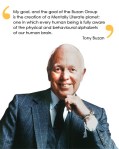
Many, many years ago, 1973 to be precise, an English author, Tony Buzan, was involved in presenting a series on BBC
Tony Buzan
television called Use Your Head. Tony released a book to accompany the television series. There is not a lot that I remember about that book but one thing I never forgot. That was the number of neurons in the brain, 10 to the power 200, give or take. I will return to this aspect in a later Post but now to the main point of this, my introductory Post.

 However the comments that the Post attracted were critical of the pressures and influences that may have been brought to bear on this child. For at 16 ‘child’ is what Jessica is. One of our regular contributors pointed out that under the terms of the UNICEF Convention:
 have been picking up on that uncertainty.
 most outstanding is Sir Ranulph Fiennes.
 Learning from Dogs