Category: Flying

The mystery of nature.

Spellbinding!

English starling

Ginger I. who works at the Payson branch of the Humane Society of Central Arizona recently sent me the following video on the magic of a flock of starlings.  It’s … well, you watch it and fill in the rest of the sentence; I ran out of words.

A short film that follows the journey of two girls in a canoe on the River Shannon and how they stumble across one of nature’s greatest phenomenons; a murmuration of starlings.

A murmuration is a…

/merr’meuh ray”sheuhn/, n.

1. an act or instance of murmuring.

2. a flock of starlings.

Ginger also included the following in her email,

A mystery of nature:

No one knows why they do it. Yet each fall, thousands of starlings dance in the twilight above England and Scotland. The birds gather in shape-shifting flocks called murmurations, having migrated in the millions from Russia and Scandinavia to escape winter’s frigid bite.

Scientists aren’t sure how they do it, either. The starlings’ murmurations are manifestations of swarm intelligence, which in different contexts is practised by schools of fish, swarms of bees and colonies of ants. As far as I am aware, even complex algorithmic models haven’t yet explained the starlings’ aerobatics, which rely on the tiny birds’ quicksilver reaction time of under 100 milliseconds to avoid aerial collisions—and predators—in the giant flock.

Despite their tour de force in the dusky sky, starlings have declined significantly in the UK in recent years, perhaps because of a decline in suitable nesting sites. The birds still roost in several of Britain’s rural pastures, however, settling down to sleep (and chatter) after their evening ballet.

Two young ladies were out for a late afternoon canoe ride and fortunately one of them remembered to bring her video camera. What they saw was a wonderful murmuration display, caught in the short video above. Watch the variation of colour and intensity of the patterns that the birds make in close proximity to one other.

I also quickly found a second video on YouTube that seemed worthy of including in this Post.

This astonishing sequence was filmed by wild life cameraman and travel journalist Dylan Winter who is currently sailing around the UK in an 18 foot boat. You can follow his journey and see more of his work at www.keepturningleft.co.uk.

Now I know that as I get older I seem to be turning into an emotional mess!  But a very happy mess!  I mention this because both films had me in tears.  Why?  Not really sure.  But I sense that when one looks at such beauty, such real pure magical beauty, and then reflects on the stupidity, greed and shortsightedness of mankind the contrast is almost too much to handle!

Poetry in motion in the form of the Eagle Owl

A gentle change from yesterday’s topic!

My post yesterday generated quite a lot of heat so here’s a respite.

I saw the following video on Naked Capitalism but was sure that previously I had included it on Learning from Dogs.  So if you have seen it before, apologies, and if not, enjoy.  Here’s a comment left on YouTube to give you a flavour.

It’s so moving to see how everything we humans think we know about flight and took so long to learn completely and flawlessly executed by such a majestic bird as this owl. Note the fact that the head never moves, only the body. Note the adjustments made in each wingstroke, then compare the end of the flight to what a pilot must do to facilitate a landing. Humans deploy the plane’s flaps; the owl does everything with the subtlest of adjustments. Absolutely gorgeous!

The only way to fly!

London Airport this isn’t!

(For my regular readers, indeed, for all of you, just a reminder that I’m giving the Blog a small rest until later this week – just filling in with silly things!)

Dear friend, senior airline Captain, Bob D., sent me this video to demonstrate that not all flying is from one enormous hub to another.

Background information on the aircraft is here.

Be entranced

Our beautiful planet home; the only one we have.

With great thanks to Dan G. for sending me the link.

Science educator James Drake built this amazing timelapse video from the perspective of the International Space Station as it flew over North and South America. He created this video by downloading a series of 600 photographs that were available online at theGateway to Astronomy Photograph of Earth, and then stitching them together into a complete video. You can see more of James work at his blog: infinity imagined.

Free as a bird!

The wonderful combination of paragliding and flying with hawks.

Thanks to Dan Gomez for passing me a short video about this amazing activity.  It was a matter of moments to find out the background.  But first a picture.

Copyright Scott Mason

There’s a full description of the history of parahawking, as it is called, on WikiPedia.

Parahawking is a unique activity combining paragliding with elements of falconry. Birds of prey are trained to fly with paragliders, guiding them to thermals for in-flight rewards and performing aerobatic maneouvres.

Parahawking was developed by British falconer Scott Mason in 2001. Mason began a round-the-world trip in PokharaNepal, where many birds of prey – such as the griffon vulturesteppe eagle andblack kite – can be found. While taking a tandem paragliding flight with British paraglider Adam Hill, he had the opportunity to see raptors in flight, and realized that combining the sport of paragliding with his skills as a falconer could offer others the same experience. He has been based in Pokhara ever since, training and flying birds during the dry season between September and March.

The team started by training two black kites, but have since added an Egyptian vulture and a Mountain hawk-eagle to the team. Only rescued birds are used – none of the birds has been taken from the wild.

There’s an interesting website for those that want to take a closer including more details about Scott Mason and his team here.

Now watch this!

Space, where to now?

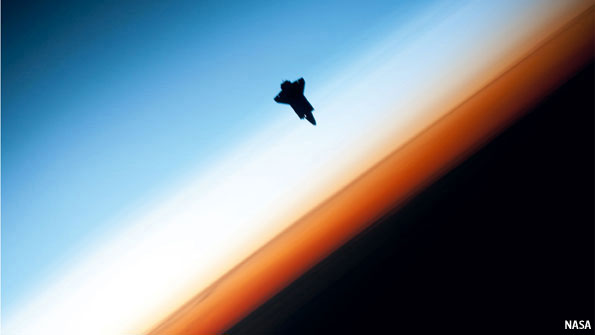
A rather poignant moment as the last NASA Space Shuttle is programmed to launch today.

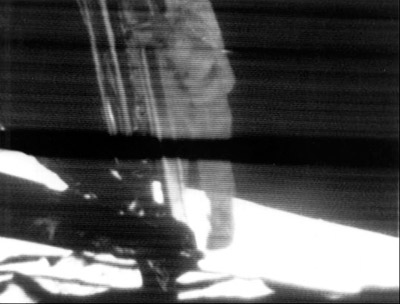
Many of my age will have been fascinated by man’s progress in exploring space, from the Russian Sputnik 1 launched into earth orbit in October, 1957 (I was 12!) through to man first putting a foot on the surface of the moon on 20th July, 1969 on the US Apollo 11 Mission.

Still frame from the video transmission of Neil Armstrong stepping onto the surface of the Moon at 02:56 UTC on 21 July 1969.

Today, the end of an era is being played out.  Today, the last Space Shuttle, Atlantis, is due to be launched.  From the NASA website,

Date: July 8 
Mission: STS-135
Launch Vehicle: Space Shuttle Atlantis
Launch Site: Kennedy Space Center – Launch Pad 39A
Launch Time: 11:26 a.m. EDT
Description: Space shuttle Atlantis will carry the Raffaello multipurpose logistics module to deliver supplies, logistics and spare parts to the International Space Station. Atlantis also will fly a system to investigate the potential for robotically refueling existing spacecraft and return a failed ammonia pump module.

The BBC recently had an interesting news item where all six crew members of Shuttle Discovery were interviewed after that last flight, more details including a video of the interview here.

Astronauts of shuttle Discovery describe ‘amazing’ craft

At almost 27 years old, and with more than 143 million miles on the clock, the space shuttle Discovery returned from her final mission in March.

The crew of Discovery’s final mission, Commander Steve Lindsey, astronauts Eric Boe, Stephen Bowen, Alvin Drew, Michael Barratt and Nicole Stott, spoke to Breakfast News about what it was like to fly the shuttle for the last time.

So where does it go from here?

The current edition of The Economist has a quite a lot to say about that.  A leader starts with raising the question of how big the Earth is?

HOW big is the Earth? Any encyclopedia will give you an answer: its equatorial diameter is 12,756km, or, for those who prefer to think that way, 7,926 miles. Ah, but then there is the atmosphere. Should that count? Perhaps the planet’s true diameter is actually nearer 13,000km, including all its air. But even that may no longer be an adequate measure. For the Earth now reaches farther still. The vacuum surrounding it buzzes with artificial satellites, forming a sort of technosphere beyond the atmosphere. Most of these satellites circle only a few hundred kilometres above the planet’s solid surface. Many, though, form a ring like Saturn’s at a distance of 36,000km, the place at which an object takes 24 hours to orbit the Earth and thus hovers continuously over the same point of the planet.

Later, this leader speculates,

The reason for that second objective is also the reason for thinking 2011 might, in the history books of the future, be seen as the year when the space cadets’ dream finally died. It marks the end of America’s space-shuttle programme, whose last mission is planned to launch on July 8th (see articlearticle). The shuttle was supposed to be a reusable truck that would make the business of putting people into orbit quotidian. Instead, it has been nothing but trouble. Twice, it has killed its crew. If it had been seen as the experimental vehicle it actually is, that would not have been a particular cause for concern; test pilots are killed all the time. But the pretence was maintained that the shuttle was a workaday craft. The technical term used by NASA, “Space Transportation System”, says it all.

But the shuttle is now over. The ISS is due to be de-orbited, in the inelegant jargon of the field, in 2020. Once that happens, the game will be up. There is no appetite to return to the moon, let alone push on to Mars, El Dorado of space exploration. The technology could be there, but the passion has gone—at least in the traditional spacefaring powers, America and Russia.

From STS-1  launched on 12 April 1981 through to today’s planned launch of STS-135, it indeed has been an era for science, for exploration and for adventure.

Iconic view of man's urge to explore

UPDATE 10:30 am Mountain Time

Up and safely away!

Still awe-inspiring after all these years.  Live BBC feed is here. Travel safely guys!

Practice makes perfect

A personal musing about the value of training.

A good friend here in Payson, himself a former ‘lamplighter’ forwarded me an email with a link to a video taken using the Head-Up-Display (HUD) camera which  also has a voice recorder.

F-16 fighter/attack aircraft

This is the email,

Here’s the F-16 dead stick into Elizabeth City, NC: A fairly short  RWY for jets, (about 6000 ft long), but qualifies for an  “Emergency landing field” in the grand scheme of US  aviation.

You’ll probably have to watch the video several times to appreciate  how intense the situation and how busy the pilot was all the way to  stopping on the runway.  Very apparently, the pilot was one-of-four  F-16s in a flight returning to their base, (most probably from  the Navy Dare bombing range south of Manteo), and the F-16  in question had already reported a “Ruff-Running Engine” to his flight  leader before the start of the video.
A few comments not readily apparent are:

  • The whole episode, from start-to-finish only takes about 3 1/2  minutes!
  • The video begins as the flight is being followed on radar.
The flight leader asks for the Elizabeth City tower UHF freq which  is repeated as 355.6 and the entire flight switches to that freq: Just  one-more-task for the pilot to execute in the cockpit as he reports that  his engine has QUIT.  He has to activate the Emergency Unit to  maintain electric and hydraulic power.  This unit is powered by  Hydrazine:  (the caustic fuel that Germany created in WW II to  power their V-2 Rockets and their ME-163 rocket fighters among  others.) Thus, the last call about requesting fire support after the  jet is safe on deck, and pilot breathing easy.

Meanwhile, back in the cockpit, the pilot is busily attempting to  “Re-light” his engine: (Unsuccessfully, of course) while tending to  everything else.  The video is taken using the Head-Up-Display (HUD) camera which  also has a voice recorder.

The HUD is a very busy instrument, but among things to notice  are the ‘circle’ in the middle which represents the nose of the aircraft  and where it is ‘pointed’: “The velocity Vector”.

The flight leader reports they are 7-miles out from the airport and  at 9000 ft altitude.  Since the weather is clear and the airport is  in sight, this allows for adequate “Gliding distance” to reach a  runway with the engine OFF.  Rest assured, jet fighters glide sorta like a rock.  They don’t enjoy the higher lift design of an airliner like that which allowed Sullenburger to land in the  NY river.

Coming down 9000 ft in only 7-miles requires a helluva rate of  descent, so the pilot’s nose remains well below the “Horizon” until just  prior to touching down on the runway.  The HUD horizon is a solid,  lateral bar, and below the horizon, the horizontal lines appear as dashes.  You’ll see a “10” on the second dashed line below the horizon which =  10-degrees nose low.

Radio chatter includes the flight leader calling the  tower and the tower stating runway 10 with wind 070 @ 5 mph with the altimeter setting of 30.13, yet  another step for the pilot to consider.
The flight leader calls for the pilot to jettison his external fuel  tanks and askes another pilot in the flight to “Mark” where they  dropped.  The tower later tells the pilot to land on any runway he  chooses.
Pilot reports “Three in the green” indicating all three gear  indicate down and locked which the flight leader acknowledges.
You will hear the computer voice of “Bitchin’-Betty” calling out  “Warnings”.  More confusing chatter when none is welcome or even  necessary.  (That’s “Hi-Tech” for ya.)

The pilot has only ONE CHANCE to get this right and must also slow  to an acceptable landing speed in order to stop on the short runway.   You’ll see Black rubber on the rwy where “The rubber meets the road” in  the touchdown area.  Note that during rollout, he gets all the way to the far end which you can see by all the black skid marks where planes have landed heading in the opposite direction.

OK: That’s more than ya probably wanted to know, but you have to  appreciate the fine job this guy did in calmly managing this emergency  situation.  He is a “USAF Reserve” pilot and those guys generally have plenty of experience.  That really pays off.

Please scroll down for the link  + Enjoy.

The pilot just saved  about $20+m at his own  risk…….Great job!  Note  the breathing rate on the hot mic and also the sink rate  (airspeed  tape on the left side of the heads up  display.)

Pretty  cool guy!!!

See  if you can keep all of the radio transmissions  straight.

Probably  the coolest sounding voice in the whole mix is the pilot of the  engine out aircraft.

Just  a reminder an F-16 has only one engine.  When  it goes, you are coming down. It  is just a matter of figuring out where the airplane will come to  rest on terra firma.

(Cut N Paste if a click doesn’t open this link )

http://www.patricksaviation.com/videos/SUPERGT/3384/

Note: For  those not familiar, the EPU (Electrical Power Unit) provides  hydraulic and electrical power in event of failure of the engine,  electrical or hydraulics.  The  EPU is powered by Hydrazine which decomposes into hot gasses as it  passes across a catalyst bed or engine bleed air (if  available).  The  hot air passes through a turbine which drives the emergency  hydraulic pump and generator through a gear  box.

The video is also on YouTube, as below,

Most people are aware of the value of training and experience that saved, in this case, the US taxpayer a large pile of money.

Now onto a much more tragic case, the loss of Air France Flight AF 447 that went down on 1 June 2009 after running into an intense high-altitude thunderstorm, four hours into a flight from Rio de Janeiro in Brazil to Paris.  AF 447 was an Airbus A330-203 aircraft registered F-GZCP.

Many will recall that earlier on in May the second of the ‘black boxes’ or flight recorders was found.  Here’s how Bloomberg reported that,

Air crash investigators retrieved the second of two black boxes from the Air France jet that plunged into the Atlantic in 2009, which may help them unlock the mysteries of the crash after two years.

“They appear to be in a good state,” said Jean-Paul Troadec, head of the BEA, the French air crash investigator that has been probing the accident that killed all 228 people aboard a flight from Rio de Janeiro to Paris. “The first thing is to dry them, prepare them, which needs about a day.” Once the boxes arrive in BEA’s offices, in about 10 days, “the reading of information would be pretty fast,” he said.

Full article is here.

Those who wish to read the report issued by the French Authorities may find it here.  The summary from the report concludes,

NEW FINDINGS

At this stage of the investigation, as an addition to the BEA interim reports of 2 July and 17 December 2009, the following new facts have been established:

  • ˆ The composition of the crew was in accordance with the operator’s procedures.
  • ˆ At the time of the event, the weight and balance of the airplane were within the operational limits.
  • ˆ At the time of the event, the two co-pilots were seated in the cockpit and the Captain was resting. The latter returned to the cockpit about 1 min 30 after the disengagement of the autopilot.
  • ˆ There was an inconsistency between the speeds displayed on the left side and the integrated standby instrument system (ISIS). This lasted for less than one minute.
  • ˆ After the autopilot disengagement:
    • „ the airplane climbed to 38,000 ft,
    • „ the stall warning was triggered and the airplane stalled,
    • „ the inputs made by the PF were mainly nose-up,
    • „ the descent lasted 3 min 30, during which the airplane remained stalled. The angle of
    • attack increased and remained above 35 degrees,
    • „ the engines were operating and always responded to crew commands.
  • ˆ The last recorded values were a pitch attitude of 16.2 degrees nose-up, a roll angle of 5.3 degrees left and a vertical speed of -10,912 ft/min.

If my maths is correct a descent speed of 10,912 feet per minute is the equivalent of 124 miles per hour!

Anyway, I am advised by someone who is a very experienced Airbus captain that the odds of a stall in the cruise for a commercial airliner are extremely low, sufficiently so that it is not something that is regular covered during crew recurrent training sessions.

Here’s a short news video from ABC News.

Solar Impulse

Just enjoy this.

Solar Impulse

From Wired Magazine,

“In a world dependent on fossil energies, Solar Impulse is a paradox, almost a provocation.”

Press release gobbledygook? Absolutely. But you’ve got to give it up for any company with the guts to try designing and building a true solar airplane.

We’ve written about Solar Impulse — it’s a consortium of European financial and technology parters led by the Federal Institute of Technology in Lausanne, Switzerland. The group is working on a solar-powered plane that can take off under its own power without generating any emissions at all. The general idea is that sunlight would not only power the plane during the day but would also charge its lithium batteries, allowing it to fly around the clock pollution free.

That was written May 12th, 2008.  This is now!  Landing at Brussels International Airport, May 2011.

And here’s the Solar Impulse website.

Man’s first orbit around Planet Earth.

A wonderful tribute to Yuri Gagarin and all his team.

When I recently wrote of it being 41 years since Swigert on board Apollo 13 transmitted “Okay, Houston, we’ve had a problem here.” I also included a closing reflection as follows,

Finally, this Post is published, not only on the 41st anniversary of that memorable Apollo Flight but the day after the 50th anniversary of Yuri Gagarin’s first flight of a human into space, the 12th April, 1961.

Coincidentally, our favourite documentary film website, Top Documentary Films, featured on April 14th the new film First Orbit.  We watched the film that night.  It was a most unusual format for a film, yet a most haunting experience.  Watching the credits, it then became clear that the film was a co-operative venture made especially for the 50th anniversary of that remarkable, historic flight.

Of course, had I previously been aware of the venture and this remarkable film then it would have been promoted on Learning from Dogs in good time before the anniversary date.  However, better late than never!

Indeed, there is a dedicated website in recognition of this First Orbit.  Here’s the background to the film,

April 12th 1961 – Yuri Gagarin is about to see what no other person has seen in the history of humanity – the Earth from space. In the next 108 minutes he’ll see more than most people do in a lifetime. What sights awaited the first cosmonaut silently gliding over the world below? What was it like to view the oceans and continents sailing by from such a height?

In a unique collaboration with the European Space Agency, and the Expedition 26/27 crew of theInternational Space Station, we have created a new film of what Gagarin first witnessed fifty years ago.

By matching the orbital path of the Space Station, as closely as possible, to that of Gagarin’s Vostok 1spaceship and filming the same vistas of the Earth through the new giant cupola window, astronaut Paolo Nespoli, and documentary film maker Christopher Riley, have captured a new digital high definition view of the Earth below, half a century after Gagarin first witnessed it.

Weaving these new views together with historic, recordings of Gagarin from the time, (subtitled in Englsih) and an original score by composer Philip Sheppard, we have created a spellbinding film to share with people around the world on this historic anniversary.

The music in the film is most beautiful, quite moving.  Here’s the background to the music from the First Orbit website,

The music in our film is all composed by Philip Sheppard and comes from his album Cloud Songs.

First Orbit’s producer Christopher Riley first worked with Philip in 2006 on the Sundance Award winning feature documentary film ‘In the Shadow of the Moon‘ and since then Philip had been working on a new suite of music inspired by spaceflight.

“We’d been working with some of these tracks on another project” says Chris, “and we suddenly realised how perfectly they could compliment ‘First Orbit’ as well. We contacted Philip to ask his permission to use them, only to find that his entire Cloud Song album was already in orbit onboard the International Space Station!”

“NASA astronaut Cady Coleman, had them on her iPod” says Philip. “Her husband Josh Simpson is a friend of mine and they’d listened to a lot of my music together before she left, so I made up a playlist for her!”

Quite by coincidence Cady had been listening to the music in ‘First Orbit’ at one end of the Space Station whilst European Space Agency astronaut Paolo Nespoli was shooting for the film at the other end, without either of them knowing the connection!

Back on Earth Chris and the film’s editor Stephen Slater took Philip’s tracks from Cloud Song and weaved them together with Paolo’s new views of the Earth to create the different moods of the film; from the first views of snowy Siberia to the darkness of night over the Pacific Ocean and the homecoming over Africa, as Gagarin starts to re-enter the atmosphere.

The result is a mesmerising combination of imagary and music which we hope convey the spectrum of emotions which no doubt went through Yuri’s mind as he gazed down upon the Earth.

Finally, here’s the film. It’s an hour and thirty-nine minutes and, as I said, an unconventional film experience.  But if any part of you either remembers the event or wonders what it was like, those 50 years ago, then find somewhere out of reach of interruptions and watch the film.

Faith and Flight

Luke 17:5 – 10

Faith will move mountains,

pull up trees and plant them in the sea.

We have your word on this, Lord.

So, increase our faith.

Let us say yes to this power

that dwells in our minds

and in our hearts.


Put faith to work.

Move mountains.

Send us.

More information here.

(Yet another thanks to Dan G for sending me the YouTube link.)