Category: Economics

Weep for this fish

And maybe weep for the planet

The New York Times recently published a thought-provoking article on the development of farming for the Atlantic bluefin, the world’s largest tuna.

Bluefin Tuna

This is a magnificent fish, as a National Geographic website details:

The Atlantic bluefin tuna is one of the largest, fastest, and most gorgeously colored of all the world’s fishes. Their torpedo-shaped, streamlined bodies are built for speed and endurance. Their coloring—metallic blue on top and shimmering silver-white on the bottom—helps camouflage them from above and below. And their voracious appetite and varied diet pushes their average size to a whopping 6.5 feet (2 meters) in length and 550 pounds (250 kilograms), although much larger specimens are not uncommon.

The NYT article was written by Paul Greenberg who is the author of “Four Fish: The Future of the Last Wild Food.”  See his website.

Here’s some of what was written in that NYT article:

IN the wide expanse of the wild ocean, there is perhaps nothing more wild than the world’s largest tuna — the giant Atlantic bluefin. Equipped with a kind of natural GPS system that biologists have yet to decode, the bluefin can cross and recross the Atlantic’s breadth multiple times in the course of its life. Its furious metabolism enables the fish to sprint at more than 40 miles an hour, heat its muscles 20 degrees above ambient, and hunt relentlessly at frigid depths in excess of 1,500 feet.

I didn’t realise that these fish are warm-blooded, a rare trait among fish, but the more important fact is that a bluefin tuna is likely to eat between 5 lbs (2 kg) and 15 lbs (6 kg) of wildfish for every pound of body.  Thus a fully grown bluefin of around 550 lbs (250 kg) represents a diet of anywhere between 2,750 and 8,250 lbs (340 -3,750 kgs) of wildfish. Back to the Greenberg article:

The Stanford economist Rosamond Naylor pointed out in a recent paper in The Proceedings of the National Academy of Sciences, that there was not too much room for adding species to the world’s aquaculture portfolio.

“Most forage fisheries,” Ms. Naylor wrote “are either fully exploited to overexploited or are in the process of recovering from overexploitation.”

If she is right — and if bluefin tuna farming is ramped up to the level of salmon farming, which produces more than two billion pounds a year — the effect on forage fish, the foundation of the oceanic food chain, could be devastating. A worldwide overharvest of forage fish could damage not just bluefin tuna populations but other important commercial species that also rely on these fish for sustenance.

In other words Rosamond Naylor is warning us, all of us that eat fish, that we could put at risk the entire ocean’s food chain.  And what scares me is that humans have shown a real propensity to put their short-term needs totally above any long-term protection of the planet we all live on.  How crazy is that!

The NYT article closes thus:

If Atlantic bluefin is not farmed, it will most likely become an even more scarce luxury item. Global fishing moratoriums on the species have been proposed (and then rejected by the many nations that catch bluefin). But other options being discussed include drastically reducing fishing quotas in the next few years and closing spawning grounds in the Mediterranean and the Gulf of Mexico to fishing entirely.

Perhaps, in the end, this is what the Atlantic bluefin tuna might really need. Not human intervention to make them spawn in captivity. But rather human restraint, to allow them to spawn in the wild, in peace.

Amen to that.

By Paul Handover

I salute this guy!

Karl Denninger of Market Ticker is brilliant

Karl D

I say that not because I have sufficient financial knowledge to evaluate his writings from a technical point of view but because he puts in huge effort, I mean hundreds of hours a month, to support his perspective.

Anyway, do bookmark his website/blog – it’s here.

An article published on the 10th demonstrates both Denninger’s commitment to his audience and some very specific dangers potentially coming out of Europe.  Called “A Round-Up Of Current Idiocy” it includes this conclusion:

Since we keep drinking more as an economy (debt and deficits) the violence and incidence of these “undesirable outcomes” is going to continue to increase.  We had one nasty in 2000, and then again in 2007.  From the so-called “recovery” (2003) to the onset of the last mess was about four years.  We’re now about two years in from the so-called “bottom” of this latest train wreck (Lehman), and if we keep on-path, and we are as the below chart shows, our fuse should go inside the box for this next mess somewhere between now and the end of 2011.

I hope you’re ready, because this next one, coming with no real recovery having taken place in employment or private economic activity, may be the one that takes us well beyond the misery we suffered in the 1930s.

And if it does, it will be our – that’s right – our – fault, since we simply will not accept that there is no such thing as a free lunch.

Note the copyright please.

Despite it being quite a technical piece with some aspects that weren’t clear to me, no surprise!, it’s still got many important messages for all those concerned about our savings and assets.  Do read it.

Well done, Karl.

By Paul Handover

It’s all Irish!

But this time it’s NOT Irish humour.

Brits will be well aware that the Irish have been the source of many funny stories and ‘Irish’ humour is still a favourite with the English.

But this piece from Baseline Scenario is very troubling, and that’s putting it mildly.

The excellent article, as they all are from Baseline, is here.

I stole a small extract to underline the import of what BS are writing about.

However, let’s be clear: Europe’s headache remains large, and this should concern all of us – just look at Ireland to see how misunderstood and immediate the remaining dangers are. Ireland’s difficulties arose because of a massive property boom financed by cheap credit from Irish banks. Ireland’s three main banks built up loans and investments by 2008 that were three times the size of the national economy; these big banks (relative to the economy) pushed the frontier in terms of reckless lending. The banks got the upside, and then came the global crash in fall 2008: property prices fell more than 50 percent, construction and development stopped, and people stopped repaying loans. Today roughly one-third of the loans on the balance sheets of major banks are nonperforming or “under surveillance”; that’s an astonishing 100 percent of gross national product, in terms of potentially bad debts.

(That’s my italics, by the way.)

Anyway, do read it in full – it’s got important implications.

And then give yourself a proper laugh at the wonderful sense of humour that comes across from the Irish Sea ….

By Paul Handover

Colbert Good, Keynes Not So Smart

Another hugely interesting article from Patrice Ayme

Patrice is a good friend of this Blog so it pleases me very much to point you towards a recent article on Patrice’s own Blog.  Here’s the abstract:

Obama is well on his way to become one of the most unaccomplished presidents of the USA, ever. This is made worse, because we are at a crucial juncture of history, and the USA is in leadership position. When the car is travelling fast, and the leader is asleep at the wheel, it will not just end in the ditch.

The little smoke and mirrors Obama threw up, will be easily reversed by the republicans, as planned. So, in the end, Obama will turn up as just an extension of Bush, without the smirk… nor the originality. By choosing the same ideological, Goldman Sachs team, that implemented plutocracy under Clinton, Obama asked those who put the car in the ditch, to get it out, not understanding that they were still drunk in their quest to selfish profit.

This story presently unfolding has been seen before; it was Great Depression II, the great depression of the 1930s. It was the stall after the deliberately engineered bubble of the 1920s.

The West got out of it by massive state enforced job programs, started under president Hoover (Hoover dam, Empire State building, etc,) and pursued by FD Roosevelt (Grand Coulee dam, etc.) and Hitler (Autobahn system, copied by Eisenhower in the 1950s, and everybody else since).

Millions got employed directly by the government and the massive mobilization of WWII did the rest, followed by the GI Bill in 1945. Europe had massive state organized and financed economic activity, led by the US Marshall plan (Marshall was the US chief of staff during WWII, and Secretary of State of Truman). Europe, traumatized by what had happened also made important institutional changes, oriented towards welfare, such as free health care. Sully’s plan of circa 1600 for a “Very Christian Council of Europewas also implemented.

clip_image002

(Labeling used on aid packages.)

The Marshall Plan (officially the European Recovery Program,ERP) was the primary program of the USA for rebuilding and creating a stronger economic foundation for the countries of Europe (1947–51). Efforts focused on modernizing European industrial and business practices using high-efficiency American models (themselves learned from French industrialists to implement American production of the 75mm gun, the mainstay of French artillery in WWI).

All this help and investment, in the USA and Europe, was paid bymarginal tax rates on income as high as 90% in the USA (under US president Ike).

Right, now, instead, the richest Americans pay the lowest tax rate (15%), and wealth has not been so concentrated in a century (a century ago, great spaces and freedom were another form of wealth, at least in the USA, which have now disappeared).

Starting in 1996, a succession of ever larger bubbles, following part of Keynes’s ideas, has injected more and more money in the economy, money which came neither from savings nor production, but mostly borrowed from aliens, and, increasingly, the Chinese.

Robert Reich (UC Berkeley), who lost to Robert Rubin (Goldman Sachs) the debate on the economic strategy to pursue in the Clinton administration, wrote an essay in the New York Times, “How to End The Great Recession”, reflecting the approach that wealth needs to be redistributed. Reich mentioned what I have long observed: the real (inflation adjusted) median income has been going down for thirty years now. This is worse than what happened during Great Depression II. So this is Great Depression III, not just another recession.

I approve of Reich’s anti plutocratic approach, of course. As he says: “The Great Depression and its aftermath demonstrate that there is only one way back to full recovery: through more widely shared prosperity.”… However, this is not the whole story.Redistribution is good, however production is necessary.Keynes, as we will see, is about throwing money to the people, as the Roman emperors invented. That is not about meaningful employment.

Obama’s ineptitude is not all his fault. The economic advice he got, even from his opponents, has been terrible. For example, Krugman, whom I approve a lot of, wanted, like Romer (the ex-chair of economic advisers) a bigger stimulus. And so did I.

But stimulating what? How? To which aim? Most of Obama’s stimulus was wasted on short term alleviation of long term structural defects, exactly the sort of trap one does not want to fall into (French socialists fell into that very trap in the recent past, with the result that the income tax started to fully go to paying the interest on the French national debt).

The USA stimulus ought to have targeted to jump start a big energy infrastructure first, followed by a massively innovative scientific industry, modeled after the military industrial complex (the only thing the USA does really well nowadays, besides plenty of hot air). Instead, the debate in economic theory has been pretty much Keynes (somewhat of a neo-stupid, see below) versus Hayek (a pro-plutocratic neo-fascist who influenced the Chicago school’s meta principle that GREED, AND ONLY GREED, MAKES GOOD).

However, the military-industrial complex of the USA, by now, by far, the most competitive part of its economy, is not run according to Hayek, or Keynes. It is run along the lines defined by Jean Baptiste Colbert. That ought to be a hint, but no main stream American economist has picked it up.

American economists in good standing do not know who Colbert was, perhaps because he thrived when Indians were outnumbering European colonists in North America, and studying history is not as important than learning sports, and to learn to agree with one’s peers, in American schools.

Colbert started his career, and this is overlooked, overlooking the military, at the grand old age of 21. Colbert branched off into economy and finance much later, after helping to send the hyper rich “superintendent of finances”, Fouquet, to jail, for life.

The American economist Paul Kennedy, in a book about The Rise And Fall Of The Great Powers, basically expounded, as his theory, what was pretty much Colbert’s theory and practice(unsurprisingly, Kennedy does not talk about Colbert too much, and got rewarded with a prize for his depth and originality).

Colbert had perfectly understood that Great Power status necessitated a Great Economy. Thus Colbertism could be viewed as the highest form of militarism. Just like the USA is itself the highest form of militarism which ever was. Notice the rapprochement. Not to make fun of it: the position of Europe and the USA is unstable, just as the entire world economy, society and military situations are all simultaneously unstable, and military superiority is what keeps thing together, right now (unfortunately it is courting defeat in Afghanistan).

Colbert was actually following the model implemented, with spectacular success, by Henri IV and his economy and finance minister, Sully, a protestant military engineer, around 1600 CE, with state financed canals, silk factories and free markets.

Why are great powers great powers? Because they have achieved a technological superiority gradient, and have enough numbers to sit on top of it. Numbers are not everything: the Mongols carved the world’s largest empire in a few years, and with 200,000 warriors. “Technology” here is meant in the full etymological sense: any specialized discourse.

If we want to keep a superior lifestyle in the empire of the West, and a stable planet, it is high time to recover such a gradient, which is, basically, an intelligence gradient. Thus it is high time to redistribute the sort of economy which makes the military industrial complex of the USA so superior, namely COLBERTISM MODERNIZED.

***

The full article is here

Well worth reading.

By Paul Handover

Deregulation – an expert’s view.

Once again, not everything is as it seems!

Focus warning!  This is a longer piece that usual but also a more important piece than usual.  Please find the time to read it and explore the links.  Thank you.

Many, many years ago I lived in Tamarama Bay, just East of Sydney,

Bronte Beach, Australia

Australia.  It was a very short walk to Bronte Beach which was much better experience than the famous Bondi Beach about half a mile North of where we lived.

Thus when I saw the name Bronte Capital it caught my eye because of old resonances from the word “Bronte”.

OK, to the point!

John Hempton is a principle at Bronte Capital, an Australian fund manager.  John is no slouch having been in his past a Chief Analyst for the New Zealand Treasury and Executive Assistant to the CEO of ANZ Bank in New Zealand.  John’s CV is here.

Bronte Capital have a Blog – well who doesn’t – and it was a link to that Blog from Naked Capitalism that caused me to read a recent article from John about deregulation.

Despite me not understanding many of the technical aspects, it struck me with some force, so much so that I wanted to reproduce chunks of it on Learning from Dogs.  John was gracious enough to give me written permission to so do!  Thanks John.

The article is called A Deregulation Conundrum.

John opens by writing:

I have just read Daniel Amman’s excellent biography of Marc Rich – the oil trader notoriously pardoned by Bill Clinton.  I don’t want to get into the politics and ethics of the pardon other than to note that few things in it are black-and-white when you finished reading the book.

and a couple of paragraphs later explains that Marc Rich has a rather appropriate surname – well this is how John writes:

Marc Rich exploited price fixing/import/export controls to make simply unbelievable profits trading oil.  Marc Rich & Co (the Swiss vehicle) was started with just over $1 million in capital and a couple of years later was making in excess of $200 million in profit.  This level of profitability exceeds – by far – any other trading operation I have ever seen – and was probably the most profitable trading operation in history.  Marc Rich & Co (since renamed Glencore) is possibly the most valuable business in Switzerland within the lifetime of its founder.

Just stop here for a moment.

This man, Rich, goes from one million dollars in capital to two hundred million dollars in profits in 2 years, give or take!  Read on:

A typical Marc Rich & Co trade involved Iran (under the Shah), Israel, Communist Albania and Fascist Spain.  The Shah needed a path to export oil probably produced in excess of OPEC quotas and one which was unaudited and hence could be skimmed to support the Shah’s personal fortune.  Israel – a pariah state in the Middle East – wanted oil.  Spain had rising oil demand and limited foreign currency but was happy to buy oil (slightly) on the cheap.  Spain however did not recognise Israel and hence would not buy oil from Israel – so it needed to be washed through a third country.  Albania openly traded with both Israel and Spain.  Oh, and there is an old oil pipeline which goes from Iran through Israel to the sea.

So what is the deal?  The Shah sells his non-quota oil down the pipeline through Israel and skims his take of the proceeds.  Israel skim their take of the oil.  Someone doing lading and unlading in Albania gets their take and hence make it – from the Spanish perspective – Albanian, not Israeli oil.  The Spanish ask few questions.  The margins are mouth-watering – and they all come from giving people what they really want rather than what they say they want.  We know what the Shah wanted (folding stuff).  We know what Israel wanted (oil).  We know what Spain wanted (cheap oil).  Who cares that Spain was publicly spouting anti-Israel rhetoric.  [Similar trades allowed South Africa to break the anti-Apartheid trade embargoes.]

John explains:

It also helped that Marc Rich & Co was a (highly) multilingual firm.  Rich is fluent in Spanish (it is the language he talks to his children in).  He speaks English, German, Yiddish and presumably Hebrew.  His business partner (Pincus Green – pardoned the same day as Rich) speaks Farsi amongst many other languages.  They could do this deal because they could negotiate it and – deep in their heart they hold the Ayn Rand view that trade is a moral virtue and hence they do not need to be concerned with other morality. [The only line that matters is the law – and then it might not be the law of his adopted country – Switzerland – rather than the United States where he was resident.]

My italics, by the way.  Just stay with me for a short while longer to ‘get’ John’s important message.  Here’s John again:

The regulatory regime for domestic American oil was also perverse.  Old oil (meaning wells drilled before the first oil crisis) received one price.  New oil (wells drilled after the crisis) received a higher price.  Squeeze oil (oil that was extracted from wells that ran less than 10 barrels per day) received a higher price still.  The oil could be chemically identical and the price difference over $20 per barrel.  Obviously a trader with a method (any method) of changing the oil source could make a fortune.  Again I am not commenting on legality or morality.  That was just plain fact.  Ayn Rand applies – you give a value and you receive a value.

What all this regulation did was that it allowed people to make simply grotesque profits by thwarting regulation.  The regulation thus worked less well and it was socially unfair.  Pincus Green was good at negotiating in Farsi.  He was astoundingly brave going to Iran immediately after the Shah fell.  He was good at organising shipping.  He worked really hard – but he did not invent something that changed the world and he wound up a billionaire.   Traders make money by intermediating real business solutions – but these were real business solutions to problems made by legislation.  Bad regulation, moral indignation about “trading with the enemy” or “trading with Israel” or with racists in South Africa made people with Ayn Rand morals exceedingly wealthy because you could arbitrage your way around any of these regulations.

OK, you are probably getting the drift of this important article from John.  If any of this ruffles your hair, then read it all – it’s a very important message.  This is what John is saying:

As a plea then I want a debate about the right form of regulation – a regulation that controls agency problems but does not allow arbitrage opportunities to people with “Ayn Rand morals”.

We are not going to get that from the current Tea Party Republicans.  They simply argue that regulation (they say but do not mean all regulation) impinges on “freedom” (something that is clearly a good but hard to define).  However many of the same people want planning regulations to ban a mosque in downtown New York because it is an insult to the victims of 9/11 (and banning mosques is not a restriction on “freedom”).

If that is the level of debate we are not going to get good re-regulation – we are just going to get pandering to whichever lobby group manages to garner most support.  And that is a real risk because we will leave agency problems in place (they benefit the rich and powerful) and we will introduce the same sort of (dumb) regulation that made Marc Rich and Pincus Green astoundingly wealthy.  That sort of regulation also benefits the rich and powerful – especially those with “Ayn Rand morals”.  [The rich and powerful – if you have not noticed – are good lobbyists.  Unless we are careful many amongst them will get their way.]

You didn’t rush those last three paragraphs, did you?

John concludes thus:

I don’t know how to do this well – but I thought I would state the obvious.  The most obvious things that need regulation are things with a government guarantee (implicit or explicit).  If you have an implicit guarantee (as we now know almost all large financial institutions have) then regulation really matters.  If there are large agency problems (small shareholders, large management) then regulation should be deliberately biased to put power in the hands of shareholders not managers (eg banning staggered board elections).

Likewise other agency problems should be strongly policed and the regulation should be of the form that allows that policing.  When Elliot Spitzer found that Marsh – a large insurance broker – was participating in bid rigging against schools buying insurance that was shocking – and is precisely the sort of thing in financial markets that should be policed strongly.  But it took Elliot considerable effort to find and prove his case.  The rules should be established so that sort of behaviour is really difficult to hide.

And I do not think that I need to explain to anyone how much mortgage brokers contributed to the crisis by (a) deliberately misleading borrowers about conditions on their mortgage and (b) participating in the faking of borrowers income/assets/education level when they on-sold the loans to Wall Street.  Agency problems were at the core of the crisis.

On the other side if there is no agency problem then deregulation should remain the order of the day.  Trade restrictions create arbitrageurs – and the arbitrageurs ensure the trade restrictions don’t work anyway.

There are obviously going to be extensions to this rough rule – and this post is really to garner discussion.  But for a start I expect agents who benefit from their agency (and the abuse of their agency) to join the Tea Party.

It is difficult to get policy right.  And when and if the policy is got right we are in for a very long fight to implement it.

I take my hat off to Mr John Hempton. He’s in the ‘finance’ industry, probably doing well, and yet he has the courage to hold a mirror up to the desperately immoral happenings going on around him.

It’s a real pleasure and honour to publish this Post.

Let me close with a short piece from the Sydney Morning Herald of the 2nd January, 2010.

John Hempton ... blog locally, act globally. Photo: Domino Postiglione

WHEN John Hempton started a blog as he recovered from pneumonia, he did not expect to send shockwaves through the finance industry.

But that is exactly what the 42-year-old fund manager did through his Bronte Capital blog. His exposé of an unrelated US hedge fund would eventually lead to $426 million in investments being frozen and authorities seizing control of the Albury fund manager Trio Capital shortly before Christmas.

Fabulous! I salute you, Sir.

By Paul Handover

House prices!

A spotlight on some tough truths

I have long subscribed to Baseline Scenario and the latest article from James Kwak is a great example of why.

On August 23rd James published a Post with the compelling title of, “Housing in Ten Words”.  Here’s a flavour:

By James Kwak

“Housing Fades as a Means to Build Wealth, Analysts Say.” That’s the title of a New York Times article by David Streitfeld. Here’s most of the lead:

“Many real estate experts now believe that home ownership will never again yield rewards like those enjoyed in the second half of the 20th century, when houses not only provided shelter but also a plump nest egg.

“The wealth generated by housing in those decades, particularly on the coasts, did more than assure the owners a comfortable retirement. It powered the economy, paying for the education of children and grandchildren, keeping the cruise ships and golf courses full and the restaurants humming.

“More than likely, that era is gone for good.”

I’ve been telling my friends for a decade that housing is a bad investment. These are real housing prices over the past century, based on data collected by Robert Shiller:

Robert Schiller is, of course, the well-known Yale University professor who wrote the book, Irrational Exuberance.   From Wikipedia:

Irrational Exuberance is a March 2000 book written by Yale University professor Robert Shiller, named after Alan Greenspan‘s “irrational exuberance” quote. Published at the height of the dot-com boom, it put forth several arguments demonstrating how the stock markets were overvalued at the time. Shiller was soon proven right when the Nasdaq peaked on the very month of the book’s publication, and the stock markets collapsed right after.

The second edition of Irrational Exuberance published in 2005 is updated to cover the housing bubble, especially in the United States. Shiller writes that the real estate bubble may soon burst, and he supports his claim by showing that median home prices are now six to nine times greater than median income in some areas of the country. He also shows that home prices, when adjusted for inflation, have produced very modest returns of less than 1%/year.

Shiller proved right again as witnessed by the fall of the housing bubble which was in part responsible for the Worldwide recession of 2008-2009.

Anyway, do read the full article from James on Baseline Scenario as it has plenty of messages that are still critically important for those trying to work out where it’s all still heading, economically.

For my money, I still think that slowly but steadily we are reverting to the old mean of home prices being about 2 to 2.5 times average annual salaries. With the added proviso that I think that it is more than likely that average salaries will slowly decline on both sides of the Atlantic over the next few years.  Tough times indeed!

By Paul Handover

Statistical impressions!

Or as I would prefer to call it: Lies, Damn Lies and Statistics!

From time to time, I have mentioned David Kauders of Kauders Portfolio Services

I was a client for many years but had to terminate that client relationship when residence in the USA became highly likely!  Very happy with the service and advice provided – extremely so!  (I have no relationship at any level with that firm now!).

Anyway, David publishes what he calls Contrary View from time to time.  His latest is reproduced with his permission.

No. 074 9th August 2010 A statistical impression

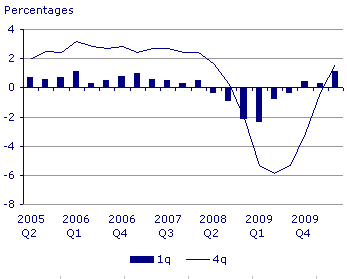
Over the last few weeks a number of graphs have appeared showing how the economy has apparently picked up to where it was before the credit crunch started. Such graphs invariably show a ‘U’ shaped curve demonstrating perfect recovery. This is the impression easily formed by a glance at such a graph, but it is the wrong assumption to make.

National Statistics reports Gross Domestic Product (GDP) as two different measures, both estimates showing a decline in GDP.  Here are the latest figures (estimated), taken from their website last week:

3rd Qtr 2008 Index 102.6

2nd Qtr 2010 Index  99.0

This GDP index shows a permanent loss of output.

Detailed figures are also available (Table 1.02 of the UK economic accounts) and on the same estimating basis, seasonally adjusted, report:

3rd Qtr 2008 GDP £340,780 million

2nd Qtr 2010 GDP £328,766 million

No matter how you look at these figures, there has been a permanent loss of output of just over 3.5% in this period.

This loss of output means less work, so debts are more difficult to service.  Why do the press produce graphs showing an apparently perfect recovery? The answer is that the graphs are taken from the National Statistics press release, for example on 23rd July 2010. The graph that is offered is a rate of change, not the level of output, and may simply have been copied without consideration of the impression formed.

The graph mentioned in the text. Ed.

http://www.contraryview.co.uk, published by Kauders Portfolio Management

WARNING: The firm can only be responsible for action taken on our advice given personally and specifically to be suitable for each individual. Statements on this site do not, on their own, constitute advice. Please note that UK regulatory requirements prevent us commenting on your existing investments or giving specific advice, unless you first sign one of our portfolio service agreements.

As I mentioned in a comment to a regular reader of Learning from Dogs:

To me, sufficiently old to have watched Governments for some decades now, the most striking thing about the present circumstances is the terrible decline in political integrity.

By Paul Handover

Romer’s Resignation

Christina Romer

Christina Romer

I don’t know Ms. Romer personally but I certainly know her work both in and out of the White House. I can only hope that the inconsistency between her work as a truth-seeking academic and as an Obama apologist finally got to her and is, at least in part, one of the reasons she resigned as chair of the White House Council of Economic Advisers.

It will be very interesting to see how her writings progress from here.

by Sherry Jarrell

More bending!

More on those revised US GDP figures

On the 2nd August there was a Post that highlighted the way that officialdom was changing figures that painted a very different picture to that promoted at the time the figures were released.

I linked to a recent article from Karl Denninger showing how previous US GDP figures had been significantly revised downwards.

Well Karl has now published a smart chart showing what happened in a way that makes it very easy to understand.

The chart is below, but please support Karl by going to the article which is here.

Revised US GDP figures

Do read the original article at Karl’s Blog site simply because he sets out in his usual clear (and forthright) manner just what this all means.  And it isn’t just affecting the US – this ripples across the pond!

Finally, another perspective on this issue is here – with the same implications being presented.  It’s gloomy ahead!

By Paul Handover

Of the people, for the people – huh!

It’s enough to make one weep!

Gettysburg Address

Just a couple of items from disparate sources came together last Friday to demonstrate just how possibly corrupt it has been over the last so many years!  But there is a golden lining to this stuff.

That is the ever increasing spread and reach of all forms of digital communications, from the humble email through to Wikileaks, is making it increasingly difficult for those that wish to cheat and lie their way through their lives, at the expense of others, to do so without detection.

Anyway, back to the theme of the Post.

The first item is from here (thanks to Naked Capitalism for the link):

Under the article title of – The Wages of Sin: Former Citi Execs Pay Token Fines for Lying to Investors

A news story today provides further confirmation of the rule by the banking classes in the US, with only token gestures to the rule of law.
(and after an in-depth review closes with:)
The message seems pretty clear. Sarbox [Sarbanes-Oxley Act. Ed]was intended to curtail phony corporate accounting in the wake of Enron. But why resort to complicated transactions like the energy company’s famed Raptors when Citi shows that mere lying will produce the same results with much less fuss?

The second from Karl Denninger, from which closes with these words are offered: GDP Report: Liar Liar Pants on Fire:

All three years of the revision period were revised down. Again, if a mistake or inaccuracy (as opposed to intentional falsehood) is responsible for errors, one would expect them to be normally distributed – that is, some would be positive, some negative.  This is obviously not the case.

Is there any good news in the report?  Well, yes – there was a material uptick in non-residential fixed investment, centered around equipment and software.  How much of this is a normal replacement cycle (deferred last year) and how much signifies real expansion is an open question and one not easily answered.  However, I wouldn’t call this particularly “robust”, despite the pump monkey characterization this morning in the media.

The drops in some of the previously-published numbers were, however, simply stunning.  For example, PCE (personal consumption) was previously reported for Q1/2010 as 2.13.  The revision is 1.33, a thirty percent downward revision.  That’s not an error, it was a falsehood.

Worse was the services false report.  The previous reported number for Q1/2010 was 0.69.  Revised was 0.03, a downward revision of ninety-five percent.

The services revision backward was truly sickening – the entirety of 2009 was negative with the exception of the fourth quarter, where all but the first was previously reported positive, and the changes were ridiculous.  First quarter was revised down from -0.13% to -0.75%, second from +0.09% to -0.79%, and so on.  Again, that’s not an error, it’s a lie.

Needless to say when I get all my graph source data updated, it’s going to look worse than it did – including my “government ponzi support” graph, one of my favorites.

The futures are diving on the report, as well they should.  Not because it’s bad – but because the entirety of the 2009 data set was a bald-faced lie.

Frankly, I’m much less interested in what is happening to Western economies – my views have been regularly reported on Learning from Dogs.

What appals me is how far we seem from those famous words in the Gettysburg Address given by President Abraham Lincoln on the afternoon of Thursday, November 19, 1863 (my emphasis):

It is rather for us to be here dedicated to the great task remaining before us—that from these honored dead we take increased devotion to that cause for which they gave the last full measure of devotion—that we here highly resolve that these dead shall not have died in vain—that this nation, under God, shall have a new birth of freedom—and that government of the people, by the people, for the people, shall not perish from the earth.

Pres. Lincoln's words

P.S. As it happens, after finishing this article last Friday, Jean and I watched the film The Verdict in the evening.  The words used by the lawyer Frank Galvin (Paul Newman) in his summation struck me so powerfully that I have made them a separate Post for tomorrow.
By Paul Handover