“It is better to travel well than to arrive.” Buddhist quote.
Those of you who are regular readers of Learning from Dogs, and I am flattered at how many there are now, will recall that on March 8th I posted an announcement of the Rev. Terry Hershey coming to Payson to give a couple of seminars based around his best-selling book, Soul Gardening. Jean and I had the honour of having Terry stay with us for a couple of nights.
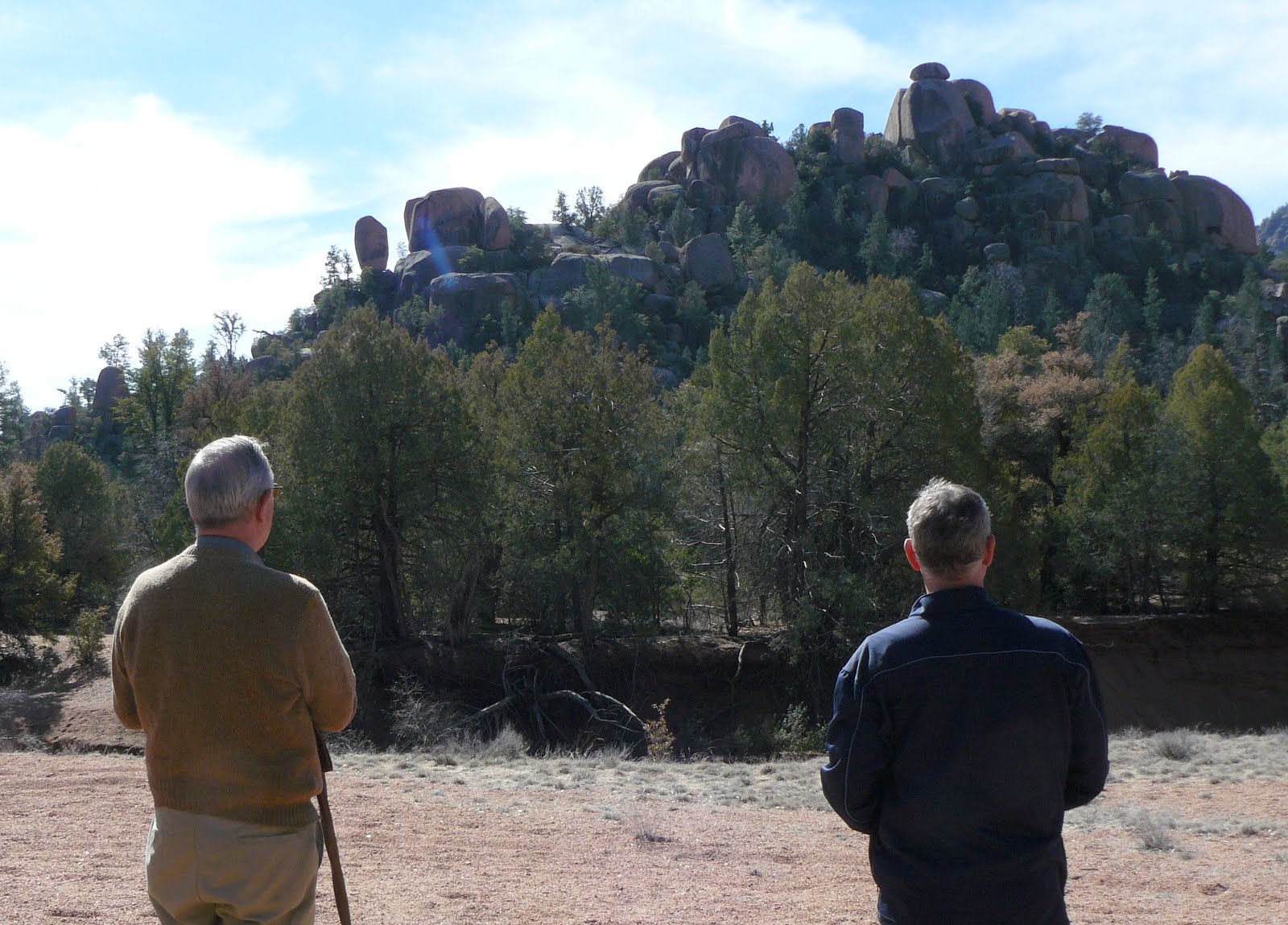
Anyway, on Monday morning, the day Terry was to give his talks, four of us took a couple of hours off in the morning to take a walk around the majestic granite boulders, a couple of miles on from our house. These great boulders give rise to the name of the road that we live on; Granite Dells Rd. Most afternoons, Jean and I take Pharaoh and his little pack of dogs for this three-mile walk so today was no different other than the walk being in the morning.
John H and Terry admiring the granite dells.
However, one of the benefits of having Terry with us on the walk was that he pointed out something really obvious that, so far, Jean and I had just taken for granted, i.e. missed!
It’s this. That dogs, when out for a walk off-leash, never travel the same journey, however many times they go on the same walk. All dog-owners will be aware of this.
Dogs are all over the place, scurrying here and there, following sweet scents, totally absorbed in the intimacy of their relationship with their immediate experience. There’s no ‘purpose’ to their behaviour, there’s no ‘clock’ running in their head as to what time it is and when they have to be somewhere else. It is the epitome of travelling well, as from the quote at the start of this article.
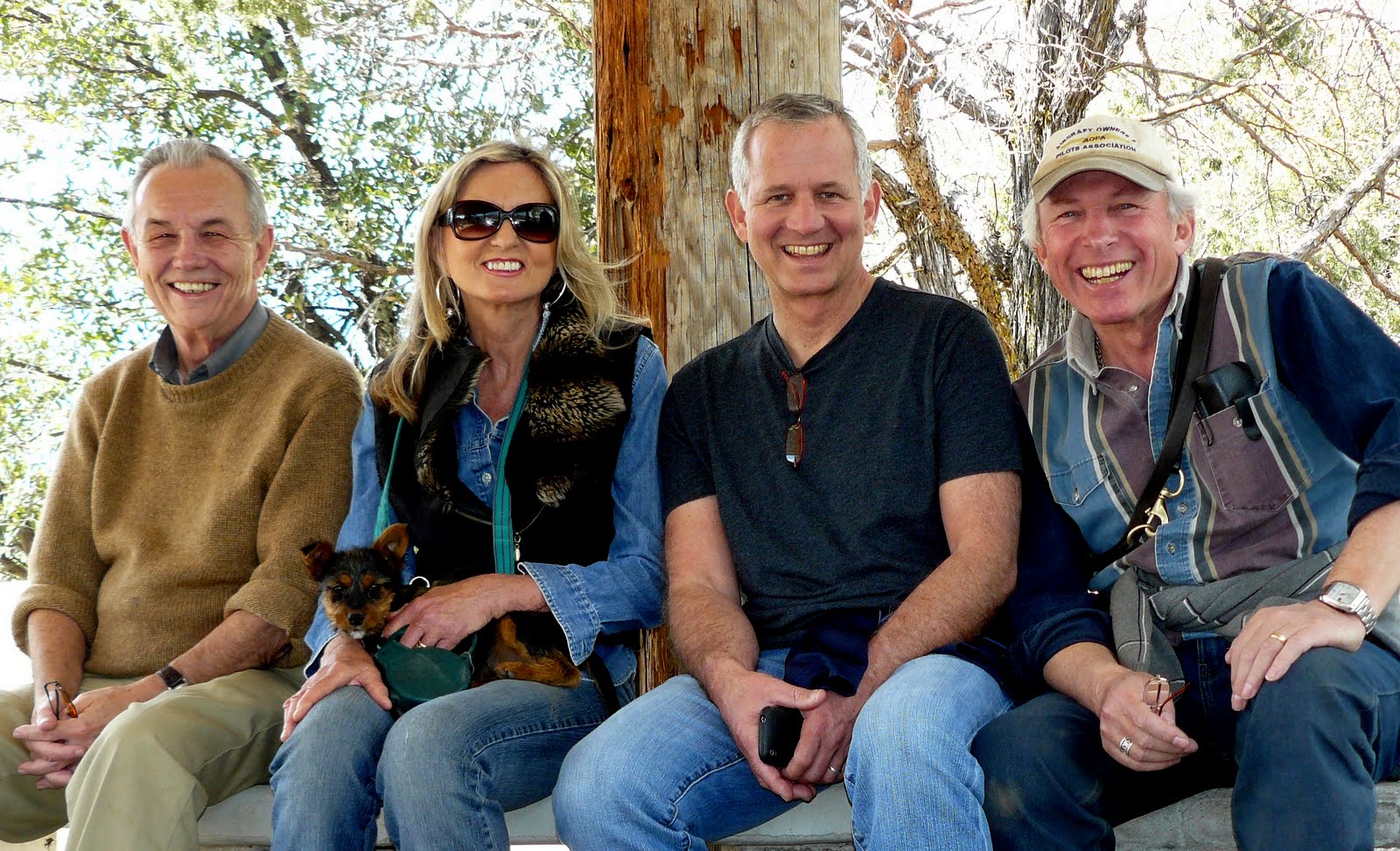
The metaphor of how dogs journey as a comparison to how so many of us humans travel with eyes closed, never stopping to smell the roses, was mentioned by Terry when we stopped for group photo towards the end of the walk. Terry also touched on the importance of living in the present, as dogs do so very, very well, many times during his later talks.
As soon as we make our happiness conditional on ‘getting’ somewhere in the future, our journey rather becomes pointless.
John, Jean, Terry, Paul - being happy in the moment.
An interesting companion to the World on the Edge book
Regular readers of the Blog will know that yesterday an article was published, the first of a series, looking more closely at the book by Lester Brown of EPI called World on the Edge. That article followed on from this Post, Group Human Insanity, and yesterday’s Post, Total, Utter Madness, Pt 1.
Today, if you will forgive the emotional battering that the book and this film create, I want to draw your attention to a film that was produced in 2007, called What A Way To Go: Life at the End of Empire.
It was lent to us by John Hulburt, who lives in Payson, and holds many views that are close to the views of the founders of Learning from Dogs. John has offered to write the odd guest article for the Blog, which is fantastic.
Anyway, back to the film. Here are a couple of trailers.
A 2-minute trailer giving an overview of the film ..
and another one dipping into more detail.
And if you still want more, then here’s an interview of the two behind the film, Producer Sally Erickson and Writer/Director Tim Bennett. Twenty-seven minutes long but so what. Watch it!
We really do have so much to learn from dogs! (Before it’s too late!)
“In individuals, insanity is rare; but in groups, parties, nations, and epochs it is the rule.” Friedrich Nietzsche
I was minded to select this quote because an item in the UK Independent newspaper brought to light a new book from Lester R Brown, founder and President of Earth Policy Institute, called World on the Edge. Here’s what The Independent wrote (selected extracts by me, the full article is here ):
Like many environmentalists, Lester Brown is worried.
In his new book “World on the Edge,” released this week, Brown says mankind has pushed civilization to the brink of collapse by bleeding aquifers dry and overplowing land to feed an ever-growing population, while overloading the atmosphere with carbon dioxide.
If we continue to sap Earth’s natural resources, “civilizational collapse is no longer a matter of whether but when,” Brown, the founder of Worldwatch and the Earth Policy Institute, which both seek to create a sustainable society, told AFP.
“We’ve got to get our act together quickly. We don’t have generations or even decades – we’re one poor harvest away from chaos,” he said.
Global warming is also impacting the global supply of grain, which Brown calls the foundation of the world food economy.
Every one-degree-Celsius rise above the normal temperature results in a 10 percent fall in grain yields, something that was painfully visible in Russia last year, where a seven-week heatwave killed tens of thousands and caused the grain harvest to shrink by 40 percent.
Food prices soared in Russia as a result of the poor harvest, and Russia – which is one of the top wheat exporters in the world – cut off grain exports.
Different grains are staple foods in most of the world, and foods like meat and dairy products are “grain-intensive.”
It takes seven pounds (3.2 kilograms) of grain fed to a cow to produce a pound of beef, and around four pounds (1.8 kilograms) of grain to produce a pound of cheese, Brown told AFP.
In “World on the Edge”, Brown paints a grim picture of how a failed harvest could spark a grain shortage that would send food prices sky-rocketing, cause hunger to spread, governments to collapse and states to fail.
Regular readers of Learning from Dogs will understand, because I bang on about it, how the behaviour of dogs over thousands and thousands of years gives us so many metaphors that we can use to rethink how we live, before it’s too late.
(Of course, it’s not just dogs, there are many ‘higher order’ pack animals such as horses, lions and dolphins. to name but a few, that instinctively live in harmony with their surroundings and also we shouldn’t forget some of the earlier human inhabitants of this planet; Eskimos, native North American Indians, Australian Aborigines, that lived similarly in balance with their environment.)
Anyway, back to the theme of this article.
Read a little about Lester, his biography is here. It starts:
Lester Brown
The Washington Post called Lester Brown “one of the world’s most influential thinkers.” The Telegraph of Calcutta refers to him as “the guru of the environmental movement.” In 1986, the Library of Congress requested his personal papers noting that his writings “have already strongly affected thinking about problems of world population and resources.”
Brown started his career as a farmer, growing tomatoes in southern New Jersey with his younger brother during high school and college. Shortly after earning a degree in agricultural science from Rutgers University in 1955, he spent six months living in rural India where he became intimately familiar with the food/population issue. In 1959 Brown joined the U.S. Department of Agriculture’s Foreign Agricultural Service as an international agricultural analyst.
Brown earned masters degrees in agricultural economics from the University of Maryland and in public administration from Harvard. In 1964, he became an adviser to Secretary of Agriculture Orville Freeman on foreign agricultural policy. In 1966, the Secretary appointed him Administrator of the department’s International Agricultural Development Service. In early 1969, he left government to help establish the Overseas Development Council.
As I said, that was just the start; read the full biography here.
Having recently signed up to the EPI mailing list, this morning an email arrived talking further about Lester Brown’s latest book, World on the Edge. Here’s what was in that email.
World on the Edge: Quick Facts
JANUARY 25, 2011
We are facing issues of near-overwhelming complexity and unprecedented urgency. Can we think systemically and fashion policies accordingly? Can we change direction before we go over the edge? Here are a few of the many facts from the book to consider:
Winter temperatures in the Arctic, including Alaska, western Canada, and eastern Russia, have climbed by 4–7 degrees Fahrenheit over the last half-century. This record rise in temperature in the Arctic region could lead to changes in climate patterns that will affect the entire planet.
Half the world’s people live in countries where water tables are falling as aquifers are being depleted. Since 70 percent of world water use is for irrigation, water shortages translate into food shortages.
In Sana’a, the capital of Yemen—home to 2 million people—water tables are falling fast. Tap water is available only once every 4 days; in Taiz, a smaller city to the south, it is once every 20 days.
The indirect costs of gasoline, including climate change, treatment of respiratory illnesses, and military protection, add up to $12 per gallon. Adding this to the U.S. average of $3 per gallon brings the true market price closer to $15 per gallon.
Between 2007 and 2010, U.S. coal use dropped 8 percent. During the same period,300 new wind farms came online, adding 21,000 megawatts of U.S. wind-generating capacity.
“We can get rid of hunger, illiteracy, disease, and poverty, and we can restore the earth’s soils, forests, and fisheries. We can build a global community where the basic needs of all people are satisfied—a world that will allow us to think of ourselves as civilized.” –Lester R. Brown
In a very real sense it’s a book we should all be reading and if so minded you can buy it directly from the EPI here. But there is a health warning, so to speak. That is that each and every one of us has to take a stand to protect the world we live on, to preserve it for our children’s children, and to start the long haul towards sustainability.
Think about one small thing you can do this week to make a positive difference, and do it!
“By the inch it’s a cinch, by the yard it’s hard!”
A fascinating talk by Rupert Sheldrake on Morphic Fields, Morphic Resonance and ESP
In 1981 Rupert Sheldrake outraged the scientific establishment with his hypothesis of morphic resonance. A morphogenetic field is a hypothetical biological field that contains the information necessary to shape the exact form of a living thing. A presentation at the Biology of Transformation Conference in 2007.
If the sub-heading means as little to you as it did to me when I was introduced to this speaker and his ideas, then hang on for a small while. But thanks to Peter N, I have had my eyes opened big time about a number of concepts. Such as have you ever wondered how at times you ‘sense’ who is ringing you before you answer the phone? Or how your pet cat or dog, especially your dog, knows when you are returning home even outside a normal pattern of your behaviour?
Rupert Sheldrake is a serious scientist, indeed a Fellow of Clare College, Cambridge University. He is a Research Fellow of the Royal Institute.
So if you trust what is presented on Learning from Dogs, then trust this one and settle down and watch the video. It will truly open your eyes in a way that you won’t anticipate. The video is 1 hour 20 minutes long but within 10 minutes you’ll be hooked!
think about dogs, whether you have one, or not, whether you like them or not; think what we learn!
Much of it best described in the words and poetry of others.
Take this, for example:
If you can resist treating a rich friend better than a poor friend,
If you can face the world without lies and deceit,
If you can say honestly that deep in your heart you have no prejudice against creed, color, religion or politics,
Then, my friend, you are almost as good as your dog.
On 15th February 1858, in the city of Edinburgh, a man named John Gray died of tuberculosis.Gray was better known as Auld Jock, and on his death he was buried in old Greyfriars Churchyard.
Bobby, a wee Skye Terrier, belonged to John, who had worked for the Edinburgh City Police as a night watchman, and the two were virtually inseparable for approximately two years.
Bobby led his master’s funeral procession to the grave at Greyfriars Cemetery, and later, when he tried to stay at the graveside, he was sent away by the caretaker.
But the little dog returned and refused to leave, whatever the weatherconditions. Despite the efforts of the keeper of the kirkyard, John’s familyand the local people, Bobby refused to be enticed away from the grave for any length of time, and he touched the hearts of the local residents.
Although dogs were not allowed in the graveyard, the people rallied round and built a shelter for Bobby and there he stayed, guarding Auld Jock.
For fourteen years Bobby lay on the grave, leaving only for food.
Here’s another well-known saying from an unknown author.
“He is your friend, your partner, your defender, your dog. You are his life, his love, his leader. He will be yours, faithful and true, to the last beat of his heart. You owe it to him to be worthy of such devotion.”
I could go on and on but let me close with this eulogy for the dog, delivered at the Old Courthouse in Warrensburg by Attorney, George C Vest sometime around 1870:
The best friend man has in the world may turn against him and become his enemy. His son, or daughter, that he has reared with loving care, may prove ungrateful. Those who are nearest and dearest to us, those whom we trust with our happiness and good name may become traitors to their faith. The money a man has he may lose. It flies away from him, perhaps when he needs it most. A man’s reputation may be sacrificed in a moment of ill-considered action. The people who are prone to fall on their knees when success is with us may be the first to throw the stone of malice when failure settles its cloud upon our head.
The one absolutely unselfish friend that man can have in this selfish world, the one that never deserts him, the one that never proves ungrateful or treacherous, is his dog. A man’s dog stands by him in prosperity and poverty, in health and in sickness. He will sleep on the cold ground when the wintry winds blow and the snow drives fiercely, if only to be near his master’s side. He will kiss the hand that has no food to offer, he will lick the wounds and sores that come in encounters with the roughness of the world. He guards the sleep of his pauper master as if he were a prince.
When all other friends desert, he remains. When riches take wing, and reputation falls to pieces, he is as constant in his love as the sun in its journey through the heavens.
If fortune drives his master forth, an outcast in the world, friendless and homeless, the faithful dog asks no higher privilege than that of accompanying him, to guard him against danger, to fight against his enemies. And when that last scene of all comes, and death takes his master in its embrace and his body is laid away in the cold ground, no matter if all other friends pursue their way, there, by the graveside will the noble dog be found, his head between his paws, his eyes sad, but open in alert watchfulness, faithful and true, even in death.
Senator George Graham Vest, speaking to a jury about Old Drum, shot in 1869
One of the many lessons that we can learn from dogs is the ability to be still. On the 2nd November, I wrote a
Eckhart Tolle
piece on Learning from Dogs about the critically important role of silence in our lives.
Eckhart Tolle is a very interesting person. He had a challenging background but has used his life experiences to gain a much deeper awareness of the world. Indeed, he measures around 600 on the Hawkin’s scale of consciousness.
Anyway, I reproduce in full an item from Tolle’s November Newsletter. It is called Eckhart on Manifestation.
Often people ask questions about manifesting and the power of intention, and how that relates to the power of Now. One person asked me about the difference between the continuous wanting that I write about in A New Earth and intention – the intention to create something. What is the importance of manifesting things in your life, or creating, or is that counter-productive?
There are many exciting books these days about creating and manifesting: The Secret, the teachings of Abraham, and so on. Often people ask, how does that relate to Stillness and inner peace? And acceptance of what is? And surrender to the Present Moment? And living in alignment with Now? Is there conflict, is one wrong? Or misleading?
This is an important question for almost everybody. Your own life is a microcosm of the macrocosm. If you look at the Universe, the first thing you will see is that it likes to create, and it likes to manifest. On this planet alone, the Universe is continuously creating and manifesting countless life forms. And in outer space, we can only assume – we don’t know what exactly is there – but there is a vastness of life out there, and probably many more life forms than we have on this planet. The life forms, both in the sea, and on land, including humans, they seem to enjoy a dance of coming into being and destruction. It’s a transformational process.By just looking at life, you can see that the Universe loves to manifest. Also it seems to be the case that life forms, over periods of time, become more differentiated. Many more come. And even human societies become more complex. We have had ancient civilizations that were very complex, but our present civilization is the most complex. This of course includes problem-ridden. That goes with complexity. Every individual who is part of this civilization has a life that is full of problems. But complexity cannot go on forever.
The Universe likes to create, to manifest, to experience the play of form. That’s one movement. And you can see it in yourself, at some level. There is something else in humans, you can only really see in yourself, an inner phenomenon. The Universe wants not only to experience that manifested life, it also wants to experience peace and something that is not touched by the continuously fluctuating forms. It wants to know itself deeply, directly, in its essence. That really is the root of spirituality. The Universe not only wants the outward movement, but it also wants the inward – the return movement to the One. Every human being also embodies these two movements. It seems that you are torn sometimes between the outward movement into form, and the inward return movement to the Source where it all started. The Source that was never really lost, it is always there because it is timeless, and it is within you. You feel drawn back to that, and that is the pull toward spirituality, peace, Stillness.
Not one or the other is right or wrong. It’s only perhaps if you totally lose yourself in one or the other – maybe that’s not quite it. Perhaps this is the challenge of the Universe here on this planet, and perhaps on other planets. The challenge to reconcile the two movements, rather than to have them be separate. Is it possible to reconcile the inner movement toward Stillness and Being, and the outer toward action, and doing? I would say it is, and that is our challenge at this time.
Traditionally, it’s been very unconscious what humans have manifested in this world. They have been identified with doing, and identified with form. That has been going on for as long as anyone can remember – since recorded history and beyond. And we call that ‘ego’. The One consciousness that underlies everything moves into form, assumes forms, and enjoys the play of form but it’s not enough for the one consciousness to enjoy the play of form, it needs to completely believe in it to make it seem ‘real’. You need to lose yourself in that dream of form.
Every human believes that they have a life of their own, and that means they are identified with the form of that life. This particular physical body, this particular psychological life form, the accumulation of thoughts and the emotions that go with these thoughts; it all becomes part of that form-identity.
Consciousness is trapped, or believes itself to be trapped in that. We could say that in that state, the Universe or Consciousness has entered a “dream-like” state. It wants to do that, it must enjoy that dream, up to a point. Consciousness has entered that “dream-like” state where it is completely identified with form. It doesn’t realize that every other form is an aspect of itself. Of course, then you are just an isolated entity. It becomes quite unpleasant after a while. So you have to get together with other entities and instead of having an “I” form, you have a “We” form, an “Us”.
For a while, the Universe seems to be okay with that, to have Consciousness identified completely with form. Then the “movie” goes on. Reading through history, you can see what happens when Consciousness is identified completely with form. Then it comes time for another stage to arise, when Consciousness is beginning to awaken from complete identification with form. This is beginning to happen at many stages, this is why human beings are drawn to spiritual teachings. It is the awakening from the dream of form.
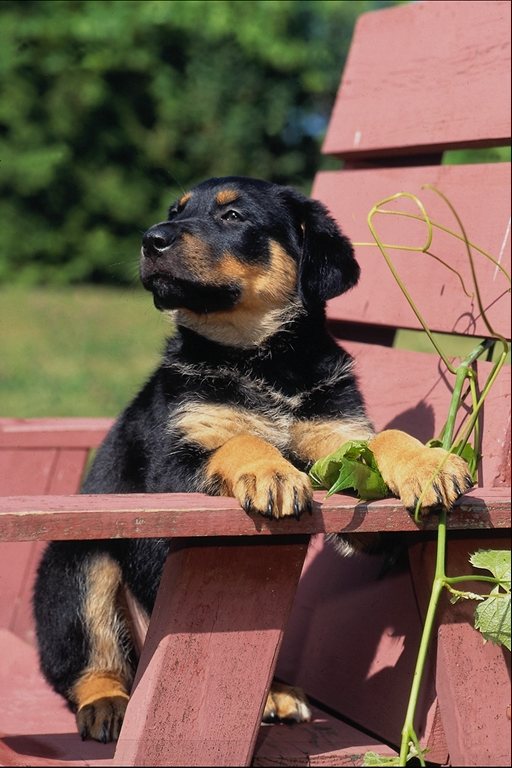
SUPER-FIT and ATTRACTIVE SINGLE BLACK FEMALE seeks male companionship, ethnicity unimportant. I’m a very good girl who LOVES to play. I love long walks in the woods, riding in your pickup truck, hunting, camping and fishing trips, cozy winter nights lying by the fire. Candlelight dinners will have me eating out of your hand. I’ll be at the front door when you get home from work, wearing only what nature gave me … Call 01272-6420 and ask for Annie, I’ll be waiting …..
Luckily, we were later able to obtain a photo of this georgeous prospect, enough to make any man slaver ….



 Learning from Dogs