Category: Communication

A skeptic’s view

Dan Gomez offers up an alternative view.

Many of you read the post I called Please help! that came out exactly a week ago.  If you were one of those readers you will have read how Dan and I go back 33 years.  In many ways we see eye-to-eye but not over mankind’s influence over the climate of our Planet.  To be clear, my own view is that we are very close, if not already past, the point of preventing a massive collapse of the biosphere.  Dan believes that we are living through possibly the biggest hoax in history.

Dan, however, has been willing to provide evidence that supports his view and has given me permission to reproduce some of his emails to me.  That’s generous of him – thanks Dan.

Let’s start with Dan’s reply to my offer to buy him the book Betrayal of Science and Reason by Paul & Anne Ehrlich.  This is what Dan sent to me,

PH – I guess I could write all day and provide numerous scientific papers and positioning that would repudiate a lot of the popular press on “Global Warming” or “Climate Change”, if that is more PC.  Read a little from the good Senator below and then I’ll buy you HIS book.

This is all about money and power, not weather. As the Senator points out, when he saw that the “Cap and Trade” bill was shot down, he stopped commenting. Then, more and more regulation from the UN and EPA Agency provoked this new book.

Once again, the science is at best moot and at worst fraudulent. Each of us must make up his own mind. Global climate cooling or heating will continue operating under geological time rules and, oh yeah, the Sun, Oceans and Regional Oscillations contribute a little.

As long as world governments don’t take public money or redistribute public money for their own “climate control” self-interests, I don’t really care. If there was no public money at stake, there would be no controversy.

People will continue to build houses below sea level in New Orleans. Another, bigger hurricane will flood them out again. Apparently, we can’t even stop this kind of nonsense through more legislation and then expensive emergency re-routing of public funds. This is part of the reason that the public sector is broke.

If private agencies wish to donate money to stop the rising seas or just support related studies, tant mieux. Just don’t add yet another set of agencies and regulations as another layer of big government. This only results in an ever higher tax structure and declining standards of living.

Book Description

Publication Date: February 28, 2012

Americans are over-regulated and over-taxed. When regulation escalates, the result is an increase in regulators. In other words, bigger government is required to enforce the greater degree of regulation. Bigger government means bigger budgets and higher taxes. “More” simply doesn’t mean “better.” A perfect example is the entire global warming, climate-change issue, which is an effort to dramatically and hugely increase regulation of each of our lives and business, and to raise our cost of living and taxes. In The Greatest Hoax, Senator James Inhofe will reveal the reasons behind those perpetuating the Hoax of global warming, who is benefitting from the general acceptance of the Hoax and why the premise statements are blatantly and categorically false.

In another couple of emails, Dan wrote,

There are two questions to answer: Whose science do you want to believe and who profits? My source of direction stems from a natural skepticism of big science when big money is involved. One of the definitions of science is that it is never completely understood and new discoveries as well as new methods of collecting data are ever changing. As we know, new evidence pops up everyday. So, to assume that “my science or your science” is irrefutable relevant to global warming, is not “good science”. Taking billions of global dollars out of private enterprise as well as higher public sector tax in order to “change the world- maybe” is irresponsible and dangerous.

Oh yeah, and I forgot, the world’s broke. Ask a Greek plumber or, for that matter, a Greek apparatchik, where global warming fits into his budget decisions……?

Then Dan wrote in another email,

 Emotionalism aside, I can’t argue the science issues except by contributing relevant articles by other scientists with opposing views. There are many.  I can comment on the political power and self-interest motivations of many proponents and that’s always fun……

Finally, Dan sent me the full copy of a recent article published by Roy Spencer, Ph. D. called Ten Years after The Warming.  He introduced it thus,

Before spending trillions that the world does not have, let’s see if we can get the conversation a little more firmed up…..  We need to really find out how sensitive the atmosphere, lithosphere and hydrosphere really are –  without assumptions.  Pretty hard thing to do even with advanced mainframes, GIGO…..

and then offered the article,

Ten Years After the Warming

February 26th, 2012 by Roy W. Spencer, Ph. D.

The version of global warming theory being pushed by the IPCC is that anthropogenic emissions of greenhouse gases are causing a radiative energy imbalance of the climate system, leading to warming.

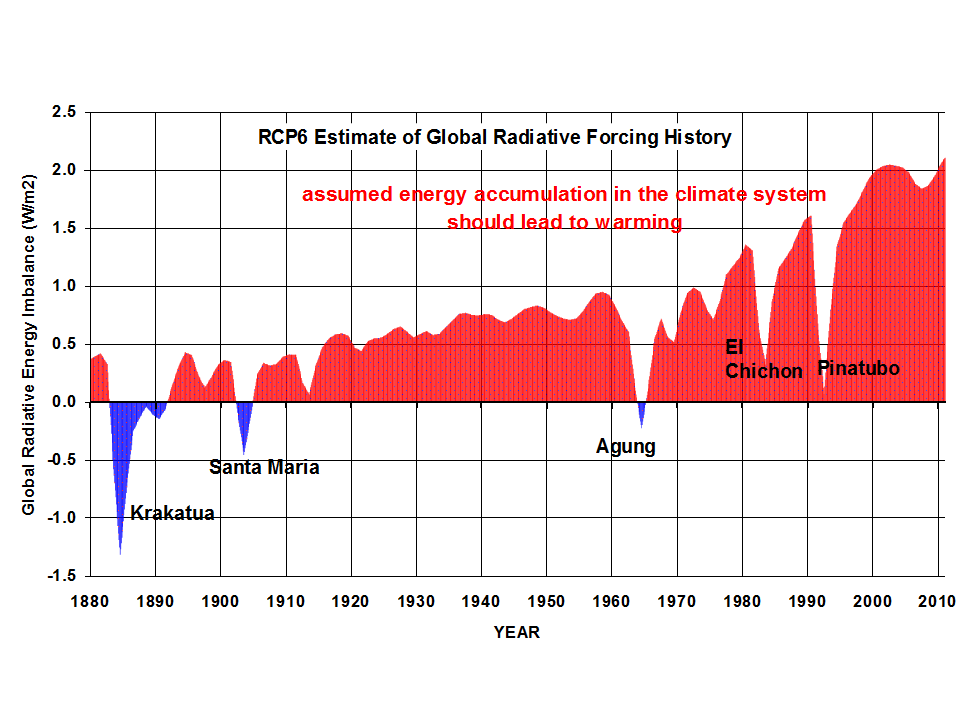
The radiative forcing history being used in the latest IPCC climate models looks something like the following, with red areas representing times when the climate system’s “stove is turned up”, that is, with heat accumulating in the system.

(Actually, the correct analogy would be that the stove setting remains the same, but the lid partially covering the pot is covering it a little more over time…but that’s too hard to explain.)

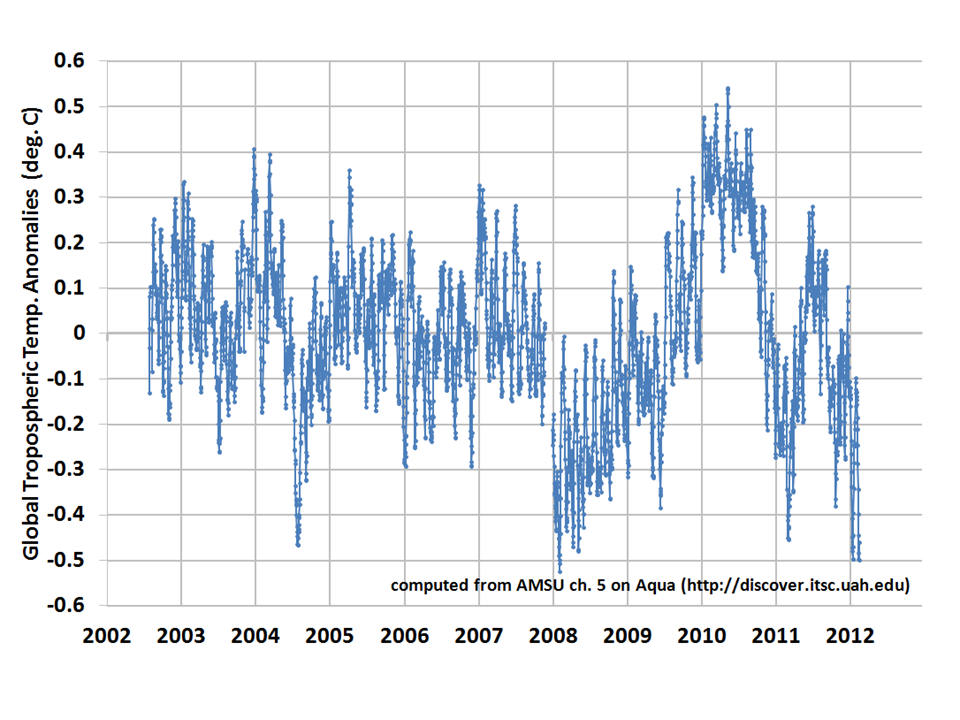
As can be seen, in the last 10 years the estimated forcing has been the strongest. Yet, most if not all temperature datasets show little or no global-average warming recently, either in the atmosphere, at the surface, or in the upper 700 meters of the ocean. For example, here are the tropospheric temperatures up though a few days ago:

So what is happening? You cannot simply say a lack of warming in 10 years is not that unusual, and that there have been previous 10-year periods without warming, too. No, we are supposedly in uncharted territory with a maximum in radiative forcing of the climate system. One cannot compare on an equal basis the last 10 years with any previous decades without warming.

There are 5 possibilities for the recent cessation of warming which are most discussed:

1) cooling from anthropogenic aerosols has been cancelling out warming from more greenhouse gases

2) natural cooling from internal climate fluctuations or the sun is cancelling out the GHG warming

3) increased ocean mixing is causing the extra energy to be distributed into the deep ocean

4) the temperature ’sensitivity’ of the climate system is not as large as the IPCC assumes.

5) there is something fundamentally wrong with the GHG warming theoryitself

Of course, some combination of the above 5 explanations is also possible.

The 1st possibility (aerosol cooling is cancelling out GHG forcing) is one of the more popular explanations with the climate modelers, and especially with NASA’s James Hansen. The uncertain strength (and even sign) of aerosol forcing allows the climate modelers to use aerosols as a tuning knob (aka fudge factor) in making their models produce warming more-or-less consistent with past observations. Using an assumed large aerosol cooling to cancel out the GHG warming allows the modelers to retain high climate sensitivity, and thus the fear of strong future warming if those aerosols ever dissipate.

The 2nd possibility (natural cooling) is a much less desirable explanation for the IPCC crowd because it opens the door to Mother Nature having as much or more influence on the climate system than do humans. We can’t have that, you know. Then you would have to consider the possibility that most of the warming in the last 50 years was natural, too. Goodbye, AGW funding.

The 3rd possibility (increased ocean mixing) is one of the more legitimate possibilities, at least theoretically. It’s popular with NCAR’s Kevin Trenberth. But one would need more observational evidence this is happening before embracing the idea. Unfortunately, how vertical mixing in the ocean naturally varies over time is poorly understood; the different IPCC models have widely varying strengths of mixing, and so ocean mixing is a huge wild card in the global warming debate, as is aerosol cooling. I believe much of past climate change on time scales of decades to many centuries might be due to such variations in ocean mixing, along with their likely influence on global cloud cover changing the amount of solar input into the climate system.

The 4th possibility (the climate system is relatively insensitive to forcing) is the top contender in the opinion of myself, Dick Lindzen, and a few other climate researchers who work in this field.

The 5th possibility (increasing GHGs don’t really cause warming) is total anathema to the IPCC. Without GHG warming, the whole AGW movement collapses. This kind of scientific finding would normally be Nobel Prize territory…except that the Nobel Prize has become more of a socio-political award in recent years, with only politically correct recipients. The self-flagellating elites don’t like the idea humans might not be destroying the Earth.

The longer we go without significant warming, the more obvious it will become that there is something seriously wrong with current AGW theory. I don’t think there is a certain number of years – 5, 10, 20, etc. – which will disprove the science of AGW….unless the climate system cools for the next 10 years. Eek! But I personally doubt that will happen.

As long as strong warming does not resume, the heat-hiding-in-the-deep-ocean explanation will provide refuge for many years to come, and will be difficult to convincingly rule out as an explanation since it takes so long for the deep ocean to warm by even a tiny amount.

Instead, there probably will be a tipping point (sooner than later) in popular perception when the public and Congress decide the jig is up, and they are no longer interested in hearing how we ‘might’ be headed for Armageddon.

The public already knows how awful scientists are at forecasting the future…especially a future of doom, which curiously seems to be the only future scientists know how to predict.
Now the challenge in this Post is not to make it so long that it becomes tiresome on the eyes, irrespective of the content.

So I’m going to leave it at this point and, perhaps, next time include some of Dan’s other points and comments in the light of how readers respond to this Post.

Payson, Arizona

A Sunday interlude

Despite the fact that Jean and I and our animals have lived in Payson for a little over two years, it never crossed my mind to give all you readers a glimpse of this part of the world.

So to remedy that, here’s the Town of Payson tourism website.

The photograph below is a view from the Mogollon Rim that overlooks Payson.

A view to die for!

The WikiPedia entry for Payson is here.

And to close, here’s a short video of the Tonto Natural Bridge that is a short distance from Payson.

The collapse of the biosphere.

Further to my Please help! post.

On Monday of this week, I posted an item called Please help!  It was to demonstrate how easily two people, with a long-standing friendship, both interested in the world around them, can differ over something so fundamental as man’s affect on our Planet.

I hoped that it would attract those who see things more clearly, and I was not mistaken.  Not only did the item receive 1,334 readings on that day, there were a number of focused comments, plus emails to me personally.  One of those comments was from Patrice Ayme, a long-standing friend of this Blog, who referred me to an article he had written in 2009, called BIOSPHERE COLLAPSE.  I gratefully republish that article with the written permission of Patrice.

BIOSPHERE COLLAPSE, not “Climate Change”.

by Patrice Ayme.

It is a curious thing to observe how far some humans will go to make themselves the center of attention. Maybe it’s out of cowardice. After all, to become the center of something, however illusory, however silly, allows one to forget the fragility of the human condition.

A handful of top notch elite scientists can be found, who are among those who are skeptical about the fact that burning the fossil fuel accumulated in the last 400 million years is causing a dangerous warming of the climate. Those who belong to the elite are generally not climate scientists, but, unsurprisingly geologists or geophysicists (that means, paid by the burning of fossil fuels).

Moreover, when one looks at their arguments, or even their graphs, one generally find obvious bias. I have explained before that denial is big business, and that the sun itself has conspired with the giant fossil fuel business (the ultimate conspiracy theory!)

But this streak of solar cooling is not enough for the partisans of atmospheric poisoning. It seems as if they were hell bound not only to poison the air and the oceans, but reason itself. (I have explained in other essays that reason itself is the preferred target of the plutocrats and their agents.)

A preferred trick of those tricksters is to cut the graph depicting the concentration of CO2 at, say, 360 parts per million (ppm), when we are actually at 390 ppm! This has the undeniable advantage of masking the exponential growth of atmospheric CO2 in the last few years…

image

What we see in this graph is a basically flat line, followed by an exponential (the famous “hockey stick”, as a climate scientist dubbed it).

From studying ocean sea shells, we now know that the CO2 concentration did not exceed 300 ppm for the last 25 million years. That means that the basically flat line in the graph above extends considerably to the left. The basically flat line actually extends 2 kilometers to the left, at the scale of the graph above. Yes, more than a mile!

So there is no doubt that the recent CO2 exponential climb is man-made, and tied up to industry.

A related trick of the deniers is to “forget” that man has generated a lot of other gases than CO2. Those artifical, man-made gases can be up to 10,000 times better than CO2 at blocking infrared light.

A greenhouse consists of allowing visible light in, while blocking the exit of the light that heat makes, the infrared light. Three large greenhouses are Mars, Earth and Venus. All planets are greenhouses, and earth-like planets in other solar systems will have water, thus water vapor and CO2, two most powerful and natural greenhouse gases: these gases allow light in, but tend to block infrared.

Thus the heat gets trapped close to the ground, and the high atmosphere, now less warmed by infrared light on its way to space, cools down. Some ignorant fools have heard of that cooling, and screamed that it proved that there was no greenhouse, because a cooling has been demonstrated. Whereas, in truth, that high altitude cooling is expected, and proves the exact opposite, namely a greenhouse next to the ground!

When one is considering the man-made greenhouse, one has therefore to also include these exotic industrial gases and evaluate their contribution to the greenhouse. For example, the Greenhouse Warming Potential (GWP) for methane over 100 years is 25 and for nitrous oxide it is 298. This means that emissions of 1 million metric tons of methane and nitrous oxide respectively warm up the lower atmosphere as much as the emissions of 25 millions and 298 millions metric tons of carbon dioxide, respectively, over the following century.

Perfluorocarbons (CFCs) are the worst. They are used in refrigeration. The most frequent is tetrafluoromethane. Its GWP is 6,500 times that of CO2. The GWP of hexafluoroethane is 9,200 times that of carbon dioxide. Over ten years, the GWP of methane is higher than what it is over a century, because methane oxydizes quickly. Over ten years the GWP of methane is 100 times that of CO2. This means that a “methane burp“  would have a tremendous warming effect. There are reasons to believe that such “methane burps” have happened, and could happen again. They are catatastrophically violent events, complete with giant tsunamis, I know you wanted to know…

In any case we are around 450 ppm in CO2 equivalent (the exact number is fiercely debated, and irrelevant, because the yearly augmentation is so fast).  We started from 280 ppm of CO2 equivalent in 1850 and at this rate we will pass a DOUBLING within twenty years.

Recent research on marine fossils has allowed us to find out the CO2 concentration over the last 25 million years: it never exceeded 300 ppm durably. (There were short spikes due to occasional major volcanic activity, but that’s always accompanied by marked and brutal drops in temperature, so Antarctic records show the two contrary effects wash each other out!)

I would go as far as saying that many papers in Nature and Science, when they deal about the climate, systematically underemphasize the planetary danger we seem to be getting in. Typically the authors’ research reveals an ominous evolution, but, then, rather meek conclusions are modestly drawn. There is no doubt an implicit pressure from the powers that be to not disrupt big business as usual, and climate scientists prefer to not bite the hand that feeds them (considering where the money, hence power, goes, that would be Goldman Sachs, or, at least, the fossil fuel/pollution establishment, which is somewhere near Goldman Sachs in the Pantheon that rules over us).

The IPCC, the world panel on “Climate Change” is the number one exhibit of meekness, and lack of common sense as far as viewing a “small” global temperature rise as tolerable. In its computations, the IPCC has refused to enter the melting of the polar ice shields, and the possibility of methane clathrate  eruptions. Yet, it is known, from computing the sea level rise, and its acceleration, that the giant ice shields at the poles are melting.

It is also known that the methane (CH4) density in the atmosphere has doubled, or, maybe, quadrupled. During the last significant warm-up, methane eruption occured, causing a giant tsunami in the North Atlantic (in places, water went an incredible 80 kilometers inland!) The IPCC ignores all this superbly, preferring naively to stick to proven, observed and incontrovertible facts, and scrupulously rejecting inchoating, or probable events.

The IPCC claims to believe that limiting the global temperature rise at 2 degrees Celsius would be fine. Instead, it would be a dangerous stupidity to approach a two-degree Celsius of global temperature rise (yes, I thought carefully before using the word “stupidity“: all alternatives were found wanting).

Indeed the whole problem is not to warm up the poles too much. The global temperature rise is irrelevant. Two degrees more in Texas or Australia would just lead the offending natives to crank the air conditioning higher, and pour more prehistoric aquifer water on their greens.

Whereas the frozen poles constitute the planet’s air conditioning system. The frozen poles reflect light out into space, and make the atmosphere in a Carnot engine, with a warm source (the tropics) and a cold sink (the frozen poles). Heat is transported from warm to cold, from tropics to poles, by enormous oceanic currents, such as the Gulf Stream. Melt the poles, remove the heat reflectors, and shut down the currents.

But most of the warming, so far, is at the poles, and it has already reached nearly 5 degrees Celsius in parts (the Antarctica peninsula, for example). Yet, the global temperature rise, so far, is roughly ONLY one tenth of that. Scaling up, on present evidence, a global planetary rise of two degrees Celsius may mean a rise of twenty degrees Celsius in many glaciated polar areas (yes, a rise of 40 degrees Fahrenheit). So the poles would melt, and the Earth would lose its reflectors. Tipping points would tip, and things would get worse from there. Oceanic currents would stop. Europe would freeze in winter. Golbal temperatures would shoot up. Oxygen would disappear from huge parts of the tropical oceans, which would die. (Several of the preliminaries of these effects are tentatively observed.)

Many people reading this will scoff and say that this will not happen, because it did not happen before. Paleontologically, this is not true.  Although there was no human industry to start a CO2 bubble, they have happened before (they can be generated by continental drift or super giant volcanic eruptions known as “supertraps”).

When dinosaurs flourished, the poles were warm. Dinosaurs were roaming the forests of Antarctica. Crocodiles terrorized Northern Greenland. However, the world had dozens of millions of years to adapt. Polar dinosaurs saw with the lights of the stars for months on end. Right now, we are going to hit the biosphere with the heat shock from hell.

Besides, it’s not all about “climate change”. Half of the CO2 is presently dissolving in the oceans, so a rise of two degrees Celsius means extremely acid oceans (CO2 turns into carbonic acid after it reacts with water). At the present rate of acidification, marine life will dissolve big time by 2100. That’s how a lot of the oxygen is produced, by photosynthesizing unicellular animals, with acid sensitive skeletons. Atmospheric poisoning deniers do not want just to warm us up.

Ah, also, just a reminder, some gigantic, and deep, parts of the oceans got too warm to contain enough oxygen to support life, and they have already died.

And yes, the oceans are rising, and the icecaps are melting, both in Greenland, and Antarctica.  The rise of sea level is itself augmenting at the rate of 5% a year (as many of the facts in this post, published in summer or fall of 2009). It’s an exponential!

When something augments at a rate proportional to its own value, it’s an exponential. The exponential is the most important function in analysis, if not mathematics. The exponential augments extremely fast, because the bigger it is, the faster it becomes bigger. Peons who know the exponential not, have no idea the danger we are in! They have no mathematical understanding of the danger we are in. They need to take those mathematic classes they never took, to realize how immoral their ignorance is.

Figure 1

Accelerating down. The trend line of Greenland ice mass (green) curves downward with time, suggesting that ice losses have been accelerating.

[Credit: Isabella Velicogna, geophysical research letters.]

The more fossil fuels burned, the more hot air, the less oxygen. But not to worry!  American politicians will be pleased to inform you that their super private, super bank, the one which advises the White House always, and pays bonuses with taxpayer money, Goldman Sachs, will make a future oxygen market, and will sell it short. Trust American capitalism, White House style, to adapt. Down to the last gulp of air.

On a slightly more serious note, the expression “climate change” is thus a misnomer.

In truth, we are facing a man-made collapse of the biosphere, just because full grown men want to keep on playing with fire. There ought to be an IPCB: Intergovernmental Panel on the Collapse of the Biosphere.

Atmospheric poisoning deniers want to heat us up in acid, while cutting our air supply. By 2100 CE. Of course, when that apocalypse has become the future no one can deny, there will be only one solution: nuke the coal plants. More seriously, Asia plans an enormous augmentation of its CO2 production, and that may very well become a casus belli, when the runaway exponential nature of the man-made greenhouse becomes blatant.

Patrice Ayme

http://patriceayme.wordpress.com/

***

Technical annex 1: To calculate the radiative forcing for a 1998 gas mixture, the IPCC in 2001 gave the radiative forcing (relative to 1750 CE) of various gases as: CO2=1.46 (corresponding to a concentration of 365 ppm), CH4=0.48, N2O=0.15 and other minor gases =0.01 W/m2. The sum of these is 2.10 W/m2. One obtains COequivalent = 412 ppm. That was in 2001, we are in 2010 (about). CO2 concentration is now 290 ppm, which means that CO2 equivalent is above 440 ppm.

***

Technical annex 2: Quoting straight from Science:

“Climate Change: Fixing a Critical Climate Accounting Error.

The accounting now used for assessing compliance with carbonlimits in the Kyoto Protocol and in climate legislation contains a far-reaching but fixable flaw that will severely undermine greenhouse gas reduction goals (1). It does not count CO2 emittedfrom tailpipes and smokestacks when bioenergy is being used,but it also does not count changes in emissions from land use when biomass for energy is harvested or grown. This accounting erroneously treats all bioenergy as carbon neutral regardlessof the source of the biomass, which may cause large differences in net emissions. For example, the clearing of long-established forests to burn wood or to grow energy crops is counted as a 100% reduction in energy emissions despite causing large releases of carbon.”

[Science 23 October 2009: Vol. 326. no. 5952, pp. 527 – 528.]

It is hard to believe that errors of such magnitude, committed by scientists (and implemented by the European Union and the US Congress) are not deliberate.

***

Please help!

A plea to those who understand climate science so much better than I do!

Background to this Post.

Among my friends, two go way back.  One of them, Dan Gomez, a lively, ebullient Californian, was indirectly responsible for me and Jean meeting in Mexico back on December 17th, 2007.  I first met Dan at a dealers’ conference in Boston way back in the early days of Commodore Computers.  That was the Spring of 1979 and I had flown to Boston as the owner of the 8th Commodore Computer dealership to be appointed in the UK, based in Colchester, Essex.  Later, I became the global distributor of an English word processing program known as Wordcraft, written by Pete Dowson in the UK, and appointed Dan as my US West Coast Wordcraft distributor.  It gave me a wonderful reason to come out to Southern California several times a year; on business, of course!

Dan and I therefore go back 33 years!  Dan’s sister Suzann has a house down in San Carlos, Mexico.  Suzann invited me out to Mexico for Christmas 2007 which is where I first met Jean and, bingo, Jean and I then fell in love with each other!  How life flows!  (Two years ago yesterday, Jean and I moved into our house in Payson with our, then, 13 dogs and 6 cats!)

Paul & Dan Jan. 15th 2008

OK, to the Post!

Dan has been a climate change skeptic, as in caused by man, for many years.  Regular readers of Learning from Dogs will know I see things very differently.  But Dan and I agree fundamentally on getting to the truth.  This Blog proudly claims to seek “The underlying theme of Learning from Dogs is about truth, integrity, honesty and trust in every way.”

So when the other day Dan sent me a number of links supporting his view that “My point remains that climate change is an enormous, complex process that no computer model is going to predict and no human activity modify significantly. Big money is now at stake here and as the article shows, even trusted scientists will produce fraudulent information to further their goals as well as fill politician’s coffers.” I found my faith in my own views slighted dented.  Dan is a smart guy, a good thinker and not beholden to any firm or organisation with a vested interest in denying anthropogenic global warming.

Here are some of the items that Dan referred to,

From Newsbusters,

IPCC Scientist Admits Fake Data Used To Pressure World Leaders

A scientist responsible for a key 2007 United Nations Intergovernmental Panel on Climate Change report warning Himalayan glaciers would be completely melted by 2035 has admitted that the claim was made to put political pressure on world leaders.

Such was revealed by the British Daily Mail Sunday in an article destined to further reduce the credibility of the world’s so-called leading authority on manmade global warming.

As NewsBusters reported Saturday, the IPCC acknowledged earlier this week that its claim concerning these glaciers was based on junk science.

Read it in full here.

Then there was this,

Oregon Chapter American Meteorological Society

Anthropogenic (Human Caused) Global Warming – Is This The Greatest Scientific Myth of our Generation?”
January 25th, 2012, Portland, Oregon

First Speaker – Gordon Fulks, PhD Physics, University of Chicago

[Extract]

Dr. Fulks said: “My thesis tonight is simple: virtually ALL of what climate alarmists put forth as science is not. Some is half correct, some is incorrect, and too much is just plain nonsense or worse.”

This led him into what he called “one of the central problems with Anthropogenic Global Warming,” “the integrity of the data.” He discussed a variety of temperature data from land surface data that shows various manipulations and biases to the best global data from NASA satellites to the excellent ice core temperature proxies going back 450,000 years.

Second Speaker – Chuck Wiese, Meteorologist – Oregon State University

[Extract]

Mr. Wiese finished his presentation with the following conclusions:

1. There is nothing in the REAL atmospheric record that supports the recent temperature rise of the last century to carbon dioxide induced anthropogenic warming.

2. The tropospheric water vapor optical depth is remarkably stable but has declined recently over the last 70 years of record as carbon dioxide rose substantially in the atmosphere during the same period. This is a consistent outcome as expected by the first principle founding physics and inconsistent with atmospheric climate models.

3. Without water vapor acting as a positive feedback ( growth pattern ) to increasing carbon dioxide concentrations, the projected radiative forcing on the earth’s surface is but a grossly exaggerated calculation of what the earth’s temperature will actually do in response to carbon dioxide.

4. The earth’s “greenhouse effect” is NOT controlled by atmospheric carbon dioxide. It is modulated and governed by atmospheric water vapor and clouds, where the warming modulation is controlled by the amount of vapor and optical depth. Clouds with the hydrological cycle act to trim out water vapor into a hydrostatic, convective equilibrium. The stable atmospheric optical depth likes the earth mean temperature of 59 deg F without further solar or planetary modulation.

5. The Anthropogenic warming hypothesis by atmospheric CO2 is falsified by the real record and radiation physics.

Third Speaker – George Taylor, former Oregon State Climatologist

[Extract]

His presentation finished with his conclusions:

1. Human activities DO affect climate, in a variety of ways. Greenhouse gases are just one parameter.

2. Natural variations affect climate. I believe that they have been more significant influences on climate because they do a much better job of explaining observed variations.

3. Effects of future changes in CO2 are likely to be modest and manageable.

4. Many aspects of climate remain poorly understood.

The full transcripts and supporting materials may be seen here.

Then, in stark contrast, this week’s edition of The Economist has a leader about the problem of overfishing. “Of all the sea’s many problems, overfishing should be the most fixable. ”  What jumped off the page at me was how that leader article started,

ACIDIFICATION, warming, the destruction of coral reefs: the biggest problems facing the sea are as vast, deep and seemingly intractable as the oceans themselves. So long as the world fails to cut its emissions of greenhouse gases, cause of the global warming behind these troubles, they will grow.

So a newspaper of the standing of The Economist is clear, “So long as the world fails to cut its emissions of greenhouse gases, cause of the global warming behind these troubles

So if, dear reader, you can offer good supporting evidence as to why the Oregon Chapter of the American Meteorological Society seems to contradict what so many now believe, that mankind is changing the Earth’s climate, please comment or, better still, consider writing a guest post.

Thank you!

Nature’s relationships.

Sent in my Diane M. – three and a half minutes of exquisiteness.

(and the music’s pretty cool as well!)

Dr. Michael Mann

A review of Michael Mann’s new book The Hockey Stick and the Climate Wars: Dispatches from the Front Lines.

I’m republishing in full a recent Post on Kate’s fabulous blogsite Climate Change.  As a degree student, Kate is a fantastic representative of the generation that is going to have to deal in full with all the crap that my generation (born 1944) has brought about!  Learn more about her here.  Anything that can spread the word to those, especially in my age group, that are climate change denialists is no bad thing.

The Hockey Stick and the Climate Wars

February 22, 2012 by climatesight

Available from Columbia Press

Throughout all the years of public disputes about climate change, arguably no scientist has taken as much flak as Dr. Michael Mann. This mild-mannered paleoclimatologist is frequently accused of fraud, incompetence, scientific malpractice, Communism, and orchestrating a New World Order. These charges have been proven baseless time and time again, but the accusations continue. Dr. Mann’s research on climate change is inconvenient for those who wish to deny that current global temperatures are unusual, so he has become the bulls-eye target in a fierce game of “shoot the messenger”. In “The Hockey Stick and the Climate Wars: Dispatches from the Front Lines”, a memoir of his experiences, Michael Mann finally speaks out.

The story begins quite harmlessly: an account of how he became a scientist, from childhood curiosity to graduate work in theoretical physics to choosing climate science on a whim out of the university course calendar. For those who have followed Dr. Mann’s research over the years, there is some great backstory – how he met his coauthors Ray Bradley and Malcolm Hughes, the formation of the IPCC TAR chapter about paleoclimate, and how the RealClimate blog operates. This book also filled in some more technical gaps in my understanding with a reasonably accessible explanation of principal component ananlysis, a summary of millennial paleoclimate research before 1998, and an explanation of exactly how Mann, Bradley and Hughes’ 2008 paper built on their previous work.

Dr. Mann’s 1998 paper – the “hockey stick” – was a breakthrough because it was the first millennial reconstruction of temperature that had global coverage and an annual resolution. He considered the recent dramatic rise in temperatures to be the least interesting part of their work, because it was already known from instrumental data, but that part of the paper got the most public attention.

It seems odd for a scientist to downplay the importance of his own work, but that’s what Dr. Mann does: he stresses that, without the hockey stick, the case for climate change wouldn’t be any weaker. Unfortunately, his work was overemphasized on all sides. It was never his idea to display the hockey stick graph so prominently in the IPCC TAR, or for activists to publicize his results the way they did. Soon the hockey stick became the holy grail of graphs for contrarians to destroy. As Ben Santer says, “There are people who believe that if they can bring down Mike Mann, they can bring down the IPCC,” and the entire field of climate science as a result.

Michael Mann is an eloquent writer, and does a fabulous job of building up tension. Most readers will know that he was the target of countless attacks from climate change deniers, but he withholds these experiences until halfway through the book, choosing instead to present more context to the story. The narrative keeps you on your toes, though, with frequent allusions to future events.

Then, when the full story comes out, it hits hard. Death threats, and a letter full of suspicious white powder. Lobby groups organizing student rallies against Mann on his own campus, and publishing daily attack ads in the campus newspaper. Discovering that his photo was posted as a “target” on a neo-Nazi website that insisted climate change was a Jewish conspiracy. A state politician from the education committee threatening to cut off funding to the entire university until they fired Mann.

Throughout these attacks, Dr. Mann consistently found trails to the energy industry-funded Scaife Foundation. However, I think he needs to be a bit more careful when he talks about the links between oil companies and climate change denial – the relationship is well-known, but it’s easy to come off sounding like a conspiracy theorist. Naomi Oreskes does a better job of communicating this area, in my opinion.

Despite his experiences, Michael Mann seems optimistic, and manages to end the book on a hopeful note about improvements in climate science communication. He is remarkably well-adjusted to the attacks against him, and seems willing to sacrifice his reputation for the greater good. “I can continue to live with the cynical assaults against my integrity and character by the corporate-funded denial machine,” he writes. “What I could not live with is knowing that I stood by silently as my fellow human beings, confused and misled by industry-funded propaganda, were unwittingly led down a tragic path that would mortgage future generations.”

“The Hockey Stick and the Climate Wars” leaves me with a tremendous empathy for Dr. Mann and all that he has gone through, as well as a far better understanding of the shouting match that dominates certain areas of the Internet and the media. It is among the best-written books on climate science I have read, and I would highly recommend it to all scientists and science enthusiasts.

“The Hockey Stick and the Climate Wars” will be released on March 6th, and the Kindle version is already available.

The Kiss!

A short story by Jean Handover.

As I mentioned on February 14th, Jean and I are attending a creative writing class at our local extension college and on that day I published a story from me called Messages from the Night.  Now it’s Jean’s turn.

The Kiss
by
Jean Handover

She sat at the end of the bar.  Her misery was palpable.  An invisible shroud that hunched her shoulders and bent her head over the glass of wine.  She peered into the pale liquid like it were a pool to drown in.

She was pretty in a faded way.  Trying hard; skirt a little too short, blouse a little too low and blood red lipstick.  Dark for a pinched mouth.  A slim body the way I liked it!  All around were drunken revellers whilst she remained in a bubble.  I wanted to take her in my arms and crush her to my body and burst that bubble.

Hoisting my beer, I ambled to the stool beside her.  She didn’t stir.  Seemed unaware of my presence.  I looked at our reflections in the mirror opposite.  Then at Rose the barmaid.  Rose of the buzzcut and tattoos.  The tattoo on her neck.  Then a small voice, “Why would anyone have lips tattooed on their neck?”

“Guess that’s where Rose likes to be kissed,” I said, taking a gulp of my beer and casting a glance in her direction.

“Yeah, that is a nice place for a kiss.”

She turned and a small smile twitched her lips.  “I shouldn’t have come here.  I’m not used to this scene,” she said.

“How long have you been divorced?” I asked.

“How can you tell I’m divorced?” she replied.

“Your ring finger has a wide indent.”

She fanned her fingers and looked.  “Dead giveaway, isn’t it,” she wanely replied.

“What happened?” I asked.

“He came home one night and said he’d found someone else!”

“Younger woman?” I asked.

“No worse, a younger man!”

“Oops!” I said.

She swivelled in the stool and faced the crowd.  The shroud was slipping perceptively.  I finished my beer and beckoned for Rose to bring us another round.  The divorcee was prettier that I thought at first.  Her hand pushed a lock of hair behind an ear and trailed down her neck, then smoothing her skirt rested on a rounded knee.  A fluid sensuous motion.  I wanted to touch that hand.

“Oh God, no,” she gasped.  Eyes large and face suddenly flushed.  “It’s him with the boyfriend.  They’ve just come in.”

“Don’t worry, Babe.  Let’s just walk right past and get out of here.”

I took her hand and as we strolled past the two men I gently leaned over and kissed her on the neck.  On the same place as Rose’s tattoo.

My lips lingered and with my arm around her waist, we drifted out into the night.

“That felt so good, what’s your name?” I asked.

“Elizabeth.  What’s yours?” she asked.

“Melissa.”

Copyright © 2012, Jean Susan Handover

Facing the fear.

A guest post from Amy Johnson.

Introduction

About a week ago, via the blogsite Paleo Works, a couple of comments brought me into contact with Amy.  Of course being an Englishman any woman with the name of Amy Johnson is going to cause a double-take on the name.  This Amy shared the same name as the English pioneering aviator Amy Johnson, albeit from an earlier era, the aviator that is!

An exchange of emails between Amy and myself revealed an experience that Amy had when she was very young, and I asked Amy if she would like to write a guest post.  This, then, is Amy’s story about overcoming a fear of dogs.

Amy J.

I have a cousin who is about the same age as me.  My cousin’s mom, my aunt, used to babysit me and the dog in question, a big female, reddish golden retriever was always around and like any retriever was a loving, and lovable, happy-go-lucky dog.

The event goes back to when both my cousin and I were about four-years-old, maybe just five.  For some inexplicable reason the dog attacked my cousin.  I grew up believing the dog may have been frightened, startled, but I don’t think it was provoked.  Certainly, the dog didn’t have any history of biting.

Anyway, that attack on my cousin caused a ton of stitches, 15 or 17, and scarred us both.  Physical scars for my cousin and emotional scars for me.  As an aside, I don’t remember the dog ever being around again so am fairly confident the dog was put to sleep.

Thus ever since that event, I’ve moved through life with this crippling fear of dogs.  Throughout the remainder of my childhood and into my teen years I masked my fear pretending not to be afraid of dogs.  It seemed like the whole world loved dogs, and my fear made me feel oddly isolated.

Of course, dogs always sensed my fear and they would usually bark like crazy around me – or jump.  I ended up equating dog barking as screaming or yelling, and it was quite disturbing.  I would tense up frozen in fear.

Dogs, like humans, come with all kinds of personalities, from one extreme where they are so calm and laid back you wonder whether they even have a pulse to the another extreme of being so ferocious sounding with snarly barky faces and totally tensed bodies.

When a dog was approaching me on the sidewalk, just minding his own business and ignoring me, I would walk far away into the street or grass to be at a safe distance.  I avoided dogs at all costs, because like any human, I tried my best to avoid negative emotions; anxiety, fear, worry.

Thus I avoided dogs my whole life, that is, until my niece Emma came into the world.  Emma loves dogs, all dogs.  Barky dogs, jumpy dogs, big dogs, little dogs, scrappy dogs, arrogant dogs.  If you had a dog, Emma would literally stalk you until you allowed her to pet and offer love to your dog.

Barking and jumping dogs never ever deterred Emma; she lights up with love and openness to all dogs.  And via her openness and pure love, compassion and joy for dogs Emma has helped me understand that most dogs are a-ok.  They aren’t barking screaming, they are barking excitement!  They aren’t jumping to chomp my cheek, they are jumping to lick my lips – eewww, but oh what a light bulb that was turned on in me!   I feel immense gratitude for Emma helping me move beyond this debilitating fear and for me being open to accepting her help.

It is so true that we can learn from dogs, indeed we can learn from everyone and everything, if we are open to learning and absorbing new information, open to reflection and inner stillness, open to course-corrections along our way.

Thank you Amy, I have no doubt that will reach out to many readers.

Rob Hopkins and ‘engaged optimism’.

A wonderful enlightened approach to the challenges facing our beautiful planet.

Rob Hopkins is a remarkable fellow.  In so many ways he is the most unlikely person to have kicked off almost single-handedly, a gathering world-wide revolution.

Rob Hopkins

There’s a very good description of the man on his Transition Culture website, from which I have republished this segment,

He is the co-founder of Transition Town Totnes and of the Transition Network. This grew out of many years experience in education, teaching permaculture and natural building, and setting up the first 2 year full-time permaculture course in the world, at Kinsale Further Education College in Ireland, as well as co-ordinating the first eco-village development in Ireland to be granted planning permission.

He is author of ‘The Transition Handbook: from oil dependence to local resilience’, which has been published in a number of languages, and which was voted the 5th most popular book taken on holiday by MPs during the summer of 2008, and more recently of ‘The Transition Companion: making your community more resilient in uncertain times’, published in October 2011.  He publishes the blog www.transitionculture.org, recently voted ‘the 4th best green blog in the UK’(!).  He tweets as @robintransition, and and recently came 11th in the PeerIndex-driven Sustainability Drivers List.

I am as guilty as the next person in promoting ‘doom and gloom’ when it comes to what mankind is doing to this planet.  I devoted a couple of thousand words to that theme in a guest sermon that appeared on Learning from Dogs a week ago.  That’s not to say that unless mankind, in the millions, changes in significant ways then avoiding a catastrophy to our species, and many others, is going to be hugely difficult.

But motivating us all to change is far better undertaken from a position of positive guidance and inspiration, than out of fear!

So when Jean and I listened to a recent BBC radio broadcast by Rob as part of the BBC Radio 4 Four Thought series we were blown away by the guidance and inspiration that Rob presented.

It’s 15 minutes of hope, and you too can listen to it from anywhere in the world by going here or by going here.

This is how the BBC introduces the programme,

Rob Hopkins, co-founder of the Transition Culture movement, believes that “engaged optimism” is the best way to face the global challenges of the future, be it climate change, oil supplies running out or the economic downturn. He believes initiatives enabling people to produce their own goods and services locally – from solar powered bottled beer to micro currencies like the Brixton pound – are the best way to build community resilience. Four Thought is a series of talks in which speakers give a personal viewpoint recorded in front of an audience at the RSA in London.
Producer: Sheila Cook.

So do listen to the programme and then click across to the Transition Culture website where Rob has posted a transcript of his talk.  Please, whatever your plans today find time to listen to the programme and read the transcript.  Here’s how Rob closes his talk,

I often end talks I give with Arundhati Roy’s quote “another world is not only possible, she is on her way.  On a quiet day I can hear her breathing”.  I think we might adapt her quote, so that, in the context of this bottom-up drive for more resilient communities, communities better prepared for uncertain times, it is not only a case of hearing another world breathing, but being able to see her around us, already setting up local businesses, reviving her local economy, setting up bakeries, breweries, food hubs, mentoring scores of young people with business ideas, attracting inward social investment finance, creating the models whereby people can invest in their communities and see them being strengthened and supported.

That’s why I get out of bed in the morning, because I feel that the potential in our getting this right is so exquisite that it’s all I can do, and because the grim predictability of what will happen if we do nothing is just unthinkable, especially in relation to the challenge of climate change.  If we are able to turn things around on the scale we need to turn them around on, to replace vulnerability, carbon intensity and fragility with resilience, it will be an achievement our children will tell tales about, sing songs about.  I hope I am there to hear them.  Thank you.

Another world is on her way!

Another beautiful world is on her way!

Night messages, conclusion.

Part Two of the story Messages from the Night, part one was yesterday.

Part One closed thus,

Miracle of miracles, the granite gently emitted the warmth absorbed from the day’s sun. He slowly settled himself to the ground, eased his back against the rock-face and pulled his knees up to his chest. He felt so much less vulnerable than he had laying on the forest floor. Paul let out a long sigh, then burst into tears, huge heart-rending sobs coming from somewhere deep within him.

Gradually the tears washed away his fear, restored a calmer part of his brain. That calmer brain brought the realisation that he hadn’t considered, well not up until now, what Jeannie must be going through. At least he knew he was alive. Jeannie, not knowing, would be in despair. He bet she would remember that time when out walking here in the Dells they had lost little Poppy, an adorable 10 lb poodle mix, never to be found again despite ages spent combing the area, calling out her name. A year later and Jeannie still said from time to time, “I so miss Poppy!”. First Poppy and now him! No question, he had to get through this in one piece, mentally as much as physically.

Presumably, Jeannie would have called 911 and been connected to the local search and rescue unit. Would they search for him in the dark? He thought unlikely.

Thinking about her further eased his state of mind and his shivering stopped. Thank goodness for that! Paul fought to retain this new perspective. He would make it through, even treasure this night under the sky, this wonderful, awesome, night sky. Even the many pine tree crowns that soared way up above him couldn’t mask a sky that just glittered with starlight. Payson, at 5,000 feet, had

A heavenly clock.

beautifully clear skies and tonight offered a magical example.

Often during his life the night skies had spoken to him, presented a reminder of the continuum of the universe. On this night, however, he felt more humbled by the hundred, million stars surrounding him than ever before.

Time slipped by, his watch in darkness. However, above his head that vast stellar clock. He scanned the heavens, seeking out familiar pinpoints of light, companions over so much of his lifetime. Ah, there! The Big Dipper, Ursa Major, and, yes, there the North Pole star, Polaris. Great! Now the rotation of the planet became his watch, The Big Dipper sliding around Polaris, fifteen degrees for each hour.

What a situation he had got himself into. As with other challenging times in his life, lost in the Australian bush, at sea hunkering down through a severe storm, never a choice other than to work it out. Paul felt a gush of emotion from the release this changed perspective gave him.

Far away, a group of coyotes started up a howl. What a timeless sound, how long had coyotes been on the planet? He sank into those inner places of his mind noting how the intense darkness raised deep thoughts. What if this night heralded the end of his life, the last few hours of the life of Paul Handover? What parting message would he give to those that he loved?

Jeannie would know beyond any doubt how much he had adored her, how her love had created an emotional paradise for him beyond measure. But his son and daughter, dear Alex and Maija? Oh, the complexities he had created in their lives by leaving their mother so many years ago. He knew that they still harboured raw edges, and quite reasonably so. He still possessed raw edges from his father’s death, way back in 1956. That sudden death, 5 days before Christmas, so soon after he had turned 12, that had fed a life-long feeling of emotional rejection. That feeling that lasted for 51 years until, coincidentally also 5 days before Christmas, he had met Jean in 2007.

His thoughts returned to Alex and Maija. Did they know, without a scintilla of doubt, that he loved them. Maybe his thoughts would find them. Romantic nonsense? Who knows? Dogs had the ability to read the minds of humans, often from far out of visual range. He knew Pharaoh, his devoted German Shepherd, skilfully read his mind.

Paul struggled to remember that saying from James Thurber. What was it now? Something about men striving to understand themselves before they die. Would that be his parting message for Alex and Maija? Blast, he wished he could remember stuff more clearly these days and let go of worrying about the quote. Perhaps his subconscious might carry the memory back to him.

He looked back up into the heavens. The Big Dipper indicated at least an hour had slipped by. Gracious, what a sky in which to lose one’s mind. Lost in that great cathedral of stars. Then, as if through some passing of consciousness, the Thurber saying did come back to him: All men should strive to learn before they die, what they are running from, and to, and why. As last words they would most certainly do for Alex and Maija!

Paul reflected on those who, incarcerated in solitary confinement, had their minds play many tricks, especially when it came to gauging time. What a bizarre oddment of information; where had that come from? Possibly because he hadn’t a clue about his present time. It felt later than 11pm and earlier than 4am, but any closer guess seemed impossible. Nevertheless, from out of those terrible, heart-wrenching hours of being alone he had found calm, had found something within him. He slept.

Suddenly, a sound slammed him awake. Something out there in the dark had made a sound, caused his whole body to become totally alert, every nerve straining to recognise what it might be. It sounded like animal feet moving through the autumn fall of dead leaves. He prayed it wasn’t a mountain lion. Surely such a wild cat preparing to attack him would be silent. Now the unknown creature had definitely paused, no sound, just him knowing that out there something waited. Now what, the creature had started sniffing. He hoped not a wild pig. Javelinas, those pig-like creatures that always moved in groups, could make trouble – they had no qualms at attacking a decent-sized dog.

Poised to run, he considered rising but chose to stay still and closed his right-hand around a small rock. The sniffing stopped. Nothing now, save the sound of Paul’s rapid, beating heart. He sensed, sensed strongly, the creature looking at him. It seemed very close, 10 or 20 feet away. The adrenalin hammered through his veins.

He tried to focus on the spot where he sensed the animal waited; waited for what? He pushed that idea out of his head. His ears then picked up a weird, bizarre sound. Surely not! Had he lost his senses? It sounded like a dog wagging its tail; flap, flap, flapping against a tree-trunk.

A dog? If a dog, it had to be Dhalia!

Then came that small, shy bark! A bark he knew so well. My God, it is Dhalia. He softly called, “Dhalia, Dhalia, come here, there’s a good girl.”

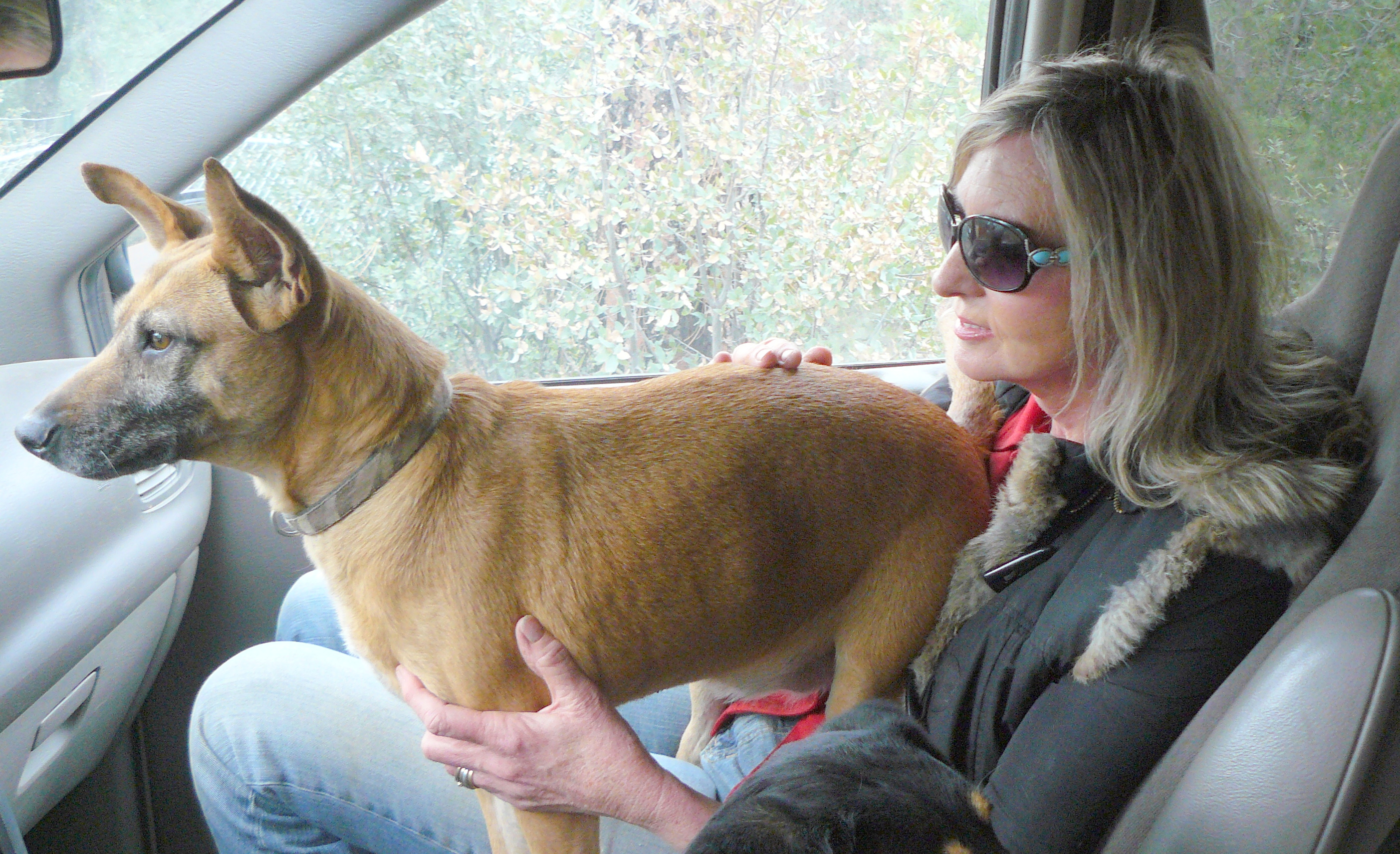
With a quick rustle of feet Dhalia leapt upon him, tail wagging furiously, her head quickly burrowing into Paul’s body warmth. He hugged her and, once more, tears ran down his face. Despite the darkness, he could see her perfectly in his mind. Her tight, short-haired coat of light-brown hair, her aquiline face, her bright inquisitive eyes and those wonderful head-dominating ears. Lovely large ears that seemed to listen to the world. A shy, loving dog when Jean had rescued her in 2005 and these years later still a shy, loving dog.

Dhalia licked his tears, her gentle tongue soft and sweet on his skin. He shuffled more onto his back which allowed her to curl up on his chest, still enveloped by his arms. His mind drifted away to an era long time ago, back to an earlier ancient man, likewise wrapped around his dog under a dome of stars, bonded in a thousand mysterious ways.

The morning sun arrived as imperceptibly as an angel’s sigh. Dhalia sensed the dawn before Paul, brought him out of his dreams by the slight stirring of her warm, gentle body.

Yes, there it came, the end of this night. The ancient sun galloping towards them across ancient lands, another beat of the planet’s heart. Dhalia slid off his chest, stretched herself from nose to tail, yawned and looked at him, as much to say time to go home! He could just make out the face of his watch; 4.55am. He, too, raised himself, slapped his arms around his body to get some circulation going. The cold air stung his face, yet it couldn’t even scratch the inner warmth of his body, the gift from the loving bond he and Dhalia had shared.

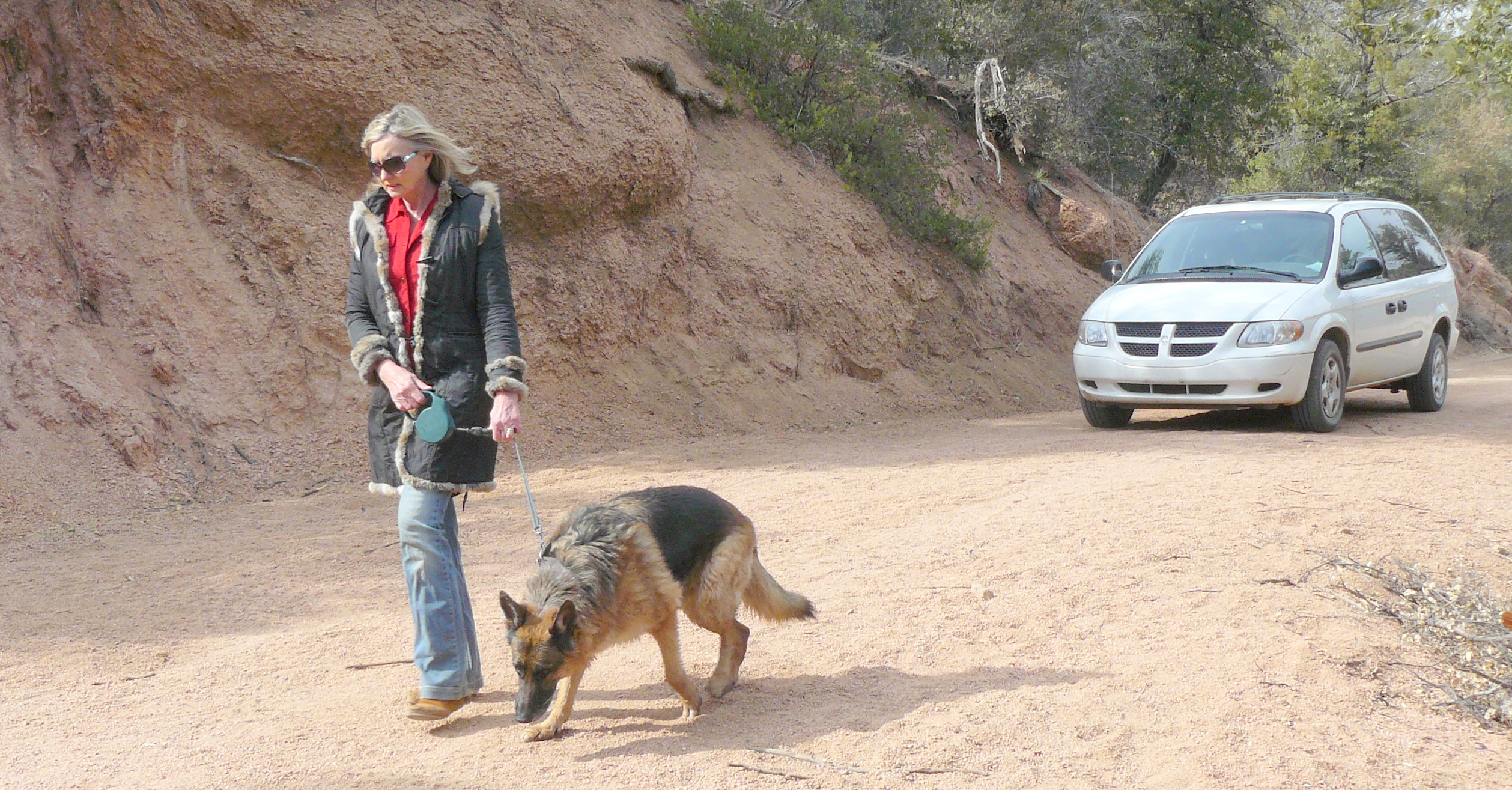
They set off and quickly crested the first ridge. Ahead, about a mile away, they saw the forest road busy with arriving search and rescue trucks. Paul noticed Jean’s Dodge parked ahead of the trucks and instinctively knew she and Pharaoh had already disappeared into the forest, Pharaoh leading the way to them.

Pharaoh and Jean heading up the search.

They set off down the slope, Dhalia’s tail wagging with unbounded excitement, Paul ready to start shouting for attention from the next ridge. They were about to wade through a small stream when, across from them, Pharaoh raced out of the trees. He tore through the water, barking at the top of his voice in clear dog speak, ‘I’ve found them, they’re here, they’re safe’.  Paul crouched down to receive his second huge face lick in less than 6 hours.

Later, safely home, it came to Paul. When they had set off in that early morning light, Dhalia had stayed pinned to him. So unusual for her not to run off. Let’s face it, that’s what got them into the mess in the first place. Dhalia had stayed with him as if she had known that during that long, dark night, it had been he who had been the lost soul.

The message from the night, as clear as the rays of this new day’s sun, the message to pass to all those he loved. If you don’t get lost, there’s a chance you may never be found.

Lost and found!

Copyright © 2011, Paul Handover