There have been a couple of hard-hitting posts this week, first about the implications of climate, with respect to the massive drought across the USA this year, and the efforts of Polly Higgins of the Eradicating Ecocide movement to make ecocide a crime against humanity.
This short but very compelling video shows why the planet is so worth protecting. Enjoy!
This was sent to me recently. It has been doing the rounds big time, and rightly so!
oooOOOooo
Before going on to today’s post, I feel the need to explain something. That is that over the last week or so I have been republishing many more items rather than writing my own creative stuff. This is an unfortunate consequence of us having our house here in Payson up for sale, which is generating more work than usual. Plus we are packing. All this to do with us moving from Arizona to Oregon in the first week of November.
oooOOOooo
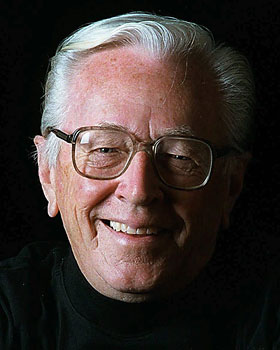
Charles Schulz
The following is the philosophy of Charles Schulz, the creator of the ‘Peanuts’ comic strip.
You don’t have to actually answer the questions. Just ponder on them. It will make very good sense!
Here’s A Little Quiz
You don’t have to actually answer the questions. Just read them straight through, ponder a tad, and you’ll get the point.
Name the five wealthiest people in the world.
Name the last five Heisman trophy winners.
Name the last five winners of the Miss America pageant.
Name ten people who have won the Nobel or Pulitzer Prize.
Name the last half dozen Academy Award winners for best actor and actress.
Name the last decade’s worth of World Series Winners.
How did you do?
The point is, none of us remember the headliners of yesterday. These are no second-rate achievers. They were the best in their fields.
But the applause dies. Awards tarnish over time. Achievements are forgotten and accolades and certificates are buried with their owners.
Here’s another quiz. See how you do on this one:
List a few teachers who aided your journey through school.
Name three friends who have helped you through a difficult time.
Name five people who have taught you something worthwhile.
Think of a few people who have made you feel appreciated and special!
Think of five people you enjoy spending time with.
Did you find that Easier? Of course you did!
So here’s the lesson!
The people who make a difference in your life are not the ones with the most credentials, or the most money…or the most awards…they simply are the ones who care the most.
“You don’t stop laughing when you grow old, you grow old when you stop laughing.” George Bernard Shaw.
Recently sent to me by Lindy C. from Devon, England.
This is dedicated to all of us who are seniors, to all of you who know seniors, and to all of you who will become seniors.
“WHERE is my SUNDAY paper?” The irate customer calling the newspaper office, loudly demanded to know where her Sunday edition was.
“Madam“, said the newspaper employee, “today is Saturday. The Sunday paper is not delivered until tomorrow, on SUNDAY.”
There was quite a long pause on the other end of the phone, followed by a ray of recognition as Madam was heard to mutter under her breath, “Well, shit, that explains why there was no one at church either!”
oooOOOooo
As British comedian Bob Monkhouse is reputed to have said, “Growing old is compulsory; growing up is optional.” (NB. More fabulous quotations from this naturally very funny man may be found here.)
On the subject of Bob Monkhouse, let me close with this video of Norman Wisdom appearing on the Bob Monkhouse Show back in 1983. As one of the YouTube commentators put it, “Two of Britains funniest men; we will never seek their likes again.“
I admit to being too free with my silly clichés including, “I can predict anything unless it involves the future!” So now that millions of informed people have the benefit of “20:20 hindsight“, why is it years since the banking crisis first erupted and we are still without a root and branch overhaul of the governance of the industry?
Did you see Per Kurowski’s interview with a leading regulator on Learning from Dogs yesterday? Aren’t we so slow to learn!
Anyway, I waffle on! Let me get to the point of today’s post.
Back on the 1st September, there was a post called Understanding Europe. One of the resulting commentators was Pendantry who is author of a blog called Wibble. He included a link to a poem that he wrote on the 28th February, 2009! The fact that the poem is still so relevant (and when we see what’s happening in Europe perhaps even more relevant now!) is truly shocking. I wanted to republish it which I do with the kind permission of Pendantry. Here it is.
oooOOOooo
House of cards
When the inevitable strikes,
when the house falls down,
do you patch up the walls,
fix the holes in the roof,
shore it all up,
splash it with paint?
No.
You learn from the mistakes.
You start from scratch.
You call in the architects.
You rebuild the foundations.
You use new materials;
replace wattle and daub
with a sounder design.
Unless:
Because you’re lost outside the box,
and your mates demand
to regain their riches (and, now!):
You set up the same as before,
perhaps with a few bells and whistles
(spun to persuade that they’ll work).
And… in the end, we’ll believe
that your clothing is not invisible.
“Who is more foolish?
The fool, or the fool who follows him?”
oooOOOooo
Written over three years and five months ago. Shame on us all!
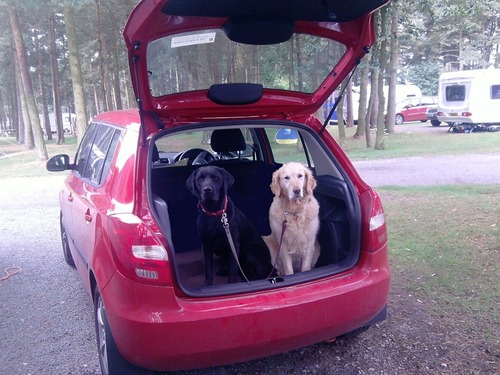
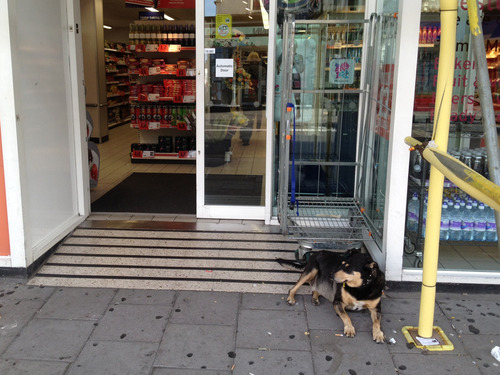
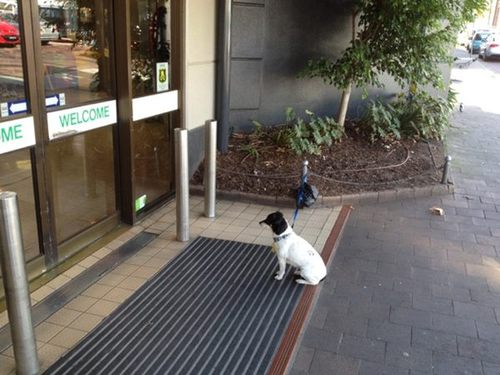
Patience, yet something else we can learn from dogs!
My friend, Neil, of many years back in South Devon, England, recently sent me a link to a website called Patient Dogs. From where one can view the following.
As I said, more lovely examples to be seen here. Thanks Neil!
Remaining with the theme of love, love lost and new love.
John Hurlburt sent me the following last week and it is so perfect as a sequel to the writings of the last two days. That was John’s poetry last Saturday on Learning from Dogs, by the way.
oooOOOooo
Two lost souls
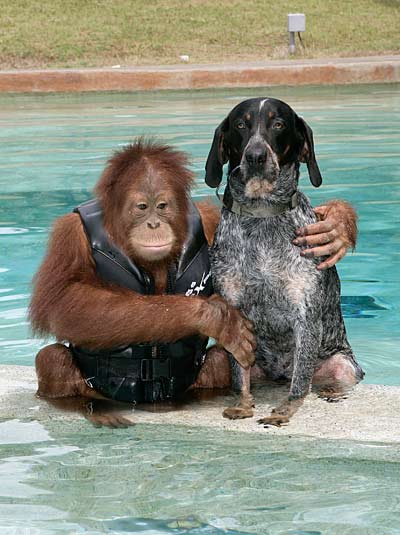
After losing his parents, this three year old orangutan was so depressed he wouldn’t eat and didn’t respond to any medical treatments. The veterinarians thought he would surely die from sadness.
The zoo keepers found an old sick dog on the grounds in the park at the zoo where the orangutan lived and took the dog to the animal treatment center. The dog arrived at the same time the orangutan was there being treated.
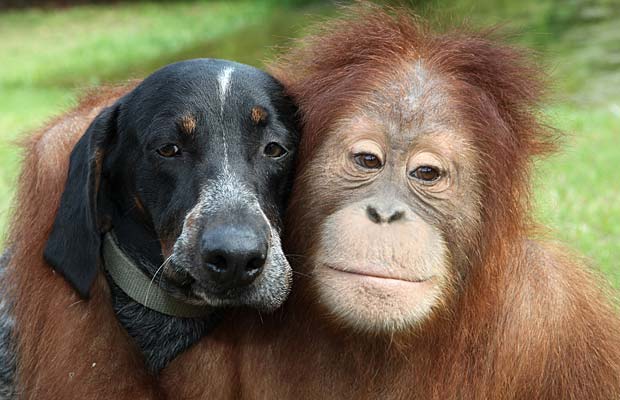
The two lost souls met and have been inseparable ever since. The orangutan found a new reason to live and each always tries his best to be a good companion to his new found friend. They are together 24 hours a day in all their activities.
They live in Northern California where swimming is their favorite past-time, although Roscoe (the orangutan) is a little afraid of the water and needs his friend’s help to swim.
Together they have discovered the joy and laughter in life and the value of friendship.
They have found more than a friendly shoulder to lean on.
Long Live Friendship!
I don’t know, but some say life is too short, others say it is too long, but I know that nothing that we do makes sense if we don’t touch the hearts of others. While it lasts!
May you always have love to share, health to spare, and friends who care…..even if they are a little hairy at times.
oooOOOooo
I must say that the generosity of so many of my readers in sending me these beautiful examples of what is really important in this world of ours touches me deeply. Thank you, John. Thank you, one and all.
A most beautiful conclusion to this reflection on animals and love.
Yesterday, I took a personal journey through the subject of love. I closed that post by saying, “So let me close this essay by asking you to come back here and read the guest post tomorrow from author Eleanore MacDonald, where Eleanore writes of the loss of their dog Djuna. You will read the most precious and heart-rending words about love.”
So an enormous thank-you for being granted permission to republish the tribute Eleanore MacDonald wrote upon the loss of their dear dog Djuna. I guarantee you will need a handkerchief or tissue close to hand!
oooOOOooo
one of the seven great dogs
“Until one has loved an animal, a part of one’s soul remains unawakened.” Anatole France
Djuna Cupcake, my heart of hearts, photo by Breelyn MacDonald
A great squall came upon us here on our farmlet a week ago. I saw it first from a distance, in that dawning of the morning when Djuna usually announced the coming day with his gentle, breathy ‘woooof’, his polite plea to join us on the bed. Mysteriously disturbing, it surely was a sign of things to come, but we didn’t know how dangerous it really was until it was upon us.
And when it was suddenly there, a Great Joy was sucked from our world and an overwhelming sadness took its place … a raging stillness, hot and stifling, no breath, no heartbeat.
My springs of Joy are dry … (a sentiment stolen in part from that great old song, Long Time Traveler)
Djuna Cupcake was one of the Seven Great Dogs. If you’ve seen the film ‘Dean Spanley’, you will know what I mean. If you have loved and been loved by a dog of pure heart … one who was a great teacher of presence, of patience, one who was the dispenser of unconditional love and the blessings of an incomparable joy … one who was a great listener, guardian, and the embodiment of Buddha, Coyote, the Goddesses Eleos and Kuan Yin all in one soft coated body … one who was your loving shadow because he or she felt that it was their job to see you safe at all times … you will know what I mean.
He died quite suddenly. Like that squall, his death came with no warning and for days after Paul and I were sucked deep into that great black hole of grief. The dread attacked us at every turn, where we would always see him but now only a glaring emptiness stood. I felt as though my heart and soul had a raw, oozing, gaping, searingly painful wound where he had been torn away from me. Stolen. We cried a lot.
Some people will never understand. I try to feel compassion for them, rather than issuing the big ‘EFF YOU”, but I am only human. What is this BS about a ‘three day’ rule? What? Because he was ‘just a dog’ we should be over it all in 3 days? Djuna was surely a better person than most Humans and I will never stop missing him. I feel so deeply sorry for those people who have overlooked having such grace and beauty bless their lives –– the companionship of a great dog (or cat or horse, or human person) –– so that, when the monumental end comes and they’ve come through the great fires of sorrow, and have been washed by the flush of a million tears, they come through to the other side where they are able to see the remarkable love, joys and lessons they’d been gifted by that companionship. I can only hope now to ‘be’ the person Djuna thought me to be.
3 days and 3 more and 3 million more and even then more just won’t do it.
Paul and I were with Djuna on our bedroom floor when he died. I lay with him next to my heart, whispering love, my arm draped over his neck … and as he was leaving us, I saw him standing just beyond Paul. Alert, ears akimbo, head cocked, eyes bright, a wad of socks in mouth, standing in his particularly great exuberance, as he did each morning when the time for chores presented itself – “Come on! It’s time to go! Get with it you silly humans! There’s work to be done, there’s a barn to clean and a day to sniff, there’s delight to be found!” And then he left.
My ‘joyometer’, my daily dispenser of mirth, and my constant reminder of the importance of presence, has gone missing – his lessons of ‘Be Here Now’ measured in doses of ’Oh, sense the beauty in the music of the wind!’, ‘Let’s just run in circles and laugh’, ‘I love, love, love you!’ … gone. It is wholly up to me now to remember to stay in each moment, to just be a nice person, cry whenever I must, to laugh as much as possible and dance for the sheer joy of it. And when the cacophony of the deafening silence has quieted and the colors of sorrow have muted and gone transparent and I’ve had some time to let the Aegean clean up those bloodied wounds in my heart and soul, there will be room again here for another one of the Seven Great Dogs. And the cycles will continue on.
Almost every evening Djuna and I took an evening stroll down our quiet lane. I loved watching him dance his great joy, nose to the ground scenting all of the news of the day or nose to the sky, sensing what was coming on the breeze. On our walks I watched the seasons change, the rising of the full moon, the greening of the new spring and the evening skies, like snowflakes, no one ever alike … I watched the Canadian geese come and go, the Red Tail hawks courting in the air above me, and let the build up of my day fall away as I tread softly with my gentle friend. It took me several days after Djuna’s death for me to realize that here was yet again another gift he had left for me in his wake, and one I should continue to enjoy. The sky was black to the West, we’d had heavy winds and rain all day, but when there was a break I set off on ‘our’ walk. Wrapped tightly in sadness and hardly breathing with the missing of him, I shuffled along about a 1/2 mile and turned for home before the rains started up and the chill wind began to blow, fierce again, from the south. That wind battered and bashed me until it freed the tears from my eyes, and the freezing rain lashed my face until I grew numb. As though suddenly realizing I was about to drown, I surfaced, taking in great gulps of air as though I’d not been breathing for several days, and began to climb free of the suffocating bonds of my sadness.
Part of our family
My Djuna, my Cupcake … My Heart of Hearts who knew my soul, my every thought; great lover of Paul and I, and of Breelyn; great lover of his mare and his pony, of socks and his furry toys and his GWBush chew doll; great lover of his evening walkies and of riding in the car, and feeding the birds; great lover of sofa naps and sleeping in late with us on the bed and chasing BALL and rolling on the grass and of eating horse poop; bountiful bestower of stealthy kisses; joyful jokester, Greek scholar (he knew about 15 words and understood several phrases spoken to him in Greek; something we did only after he’d begun to understand words and phrases *spelled out* in English! ‘Car’, ‘dinner?’, ‘play with the ball?’, ‘feed the birds’, water, pony, get the goat, etc!); Djuna, beloved Honorary Cat, our timekeeper, our guardian angel, our boss, our playfully dignified friend (thanks for that Marija) and family member, and one of the Seven Great Dogs – we will love and miss you forever.
But now – there’s work to be done, there’s a barn to clean and a new day to sniff, there’s delight to be found!
love – photo by Breelyn MacDonald
Copyright (c) 2012 Eleanore MacDonald
oooOOOooo
When I originally read this, I left a comment, “Achingly beautiful words. One of the most precious pieces of prose about a dog that I can ever remember reading.” Few will disagree!
As I replied in a recent email to Pat Shipman in response to Eleanore’s words above, “That really does endorse the proposition that, in a very real sense, our humanity is the product of our ancient relationship with animals.“
Dear Eleanore, thank you so much for allowing me to republish your beautiful thoughts.
How the relationship that we have with domesticated animals taught us the meaning of love.
This exploration into the most fundamental emotion of all, love, was stimulated by me just finishing Pat Shipman’s book The Animal Connection. Sturdy followers of Learning from Dogs (what a hardy lot you are!) will recall that about 5 weeks ago I wrote a post entitled The Woof at the Door which included an essay from Pat, republished with her permission, that set out how “Dogs may have been man’s best friend for thousands of years longer than we realized“.
The following day, I wrote a further piece introducing the book and then commenced reading it myself. Please go there and read about the praise that the book has received.
What I want to do is to take a personal journey through love. I should add immediately that I have no specialist or professional background with regard to ‘love’ just, like millions of others, a collection of experiences that have tapped me on the shoulder these last 67 years.
I would imagine that there are almost as many ideas about the meaning of love as there are people on this planet. Dictionary.com produces this in answer to the search on the word ‘love’.
love
[luhv] noun, verb, loved, lov·ing. noun
a profoundly tender, passionate affection for another person.
a feeling of warm personal attachment or deep affection, as for a parent, child, or friend.
sexual passion or desire.
a person toward whom love is felt; beloved person;sweetheart.
(used in direct address as a term of endearment, affection,or the like): Would you like to see a movie, love?
But, I don’t know about you, those definitions leave something missing for me. Here’s my take on what love is, and it’s only by having so many dogs in my life that I have found this clarity of thought.
Love is trust, love is pure openness, love is knowing that you offer yourself without any barriers. Think how you dream of giving yourself outwardly in the total surrender of love. Reflect on that surrender that you experience when deeply connecting, nay loving, with your dog.
Here’s how Pat Shipman expressed it in her book:
Clearly, part of the basis of our intimacy with tame or domesticated animals involves physical contact. People who work with animals touch them. It doesn’t matter if you are a horse breeder, a farmer raising pigs, a pet owner, a zoo keeper, or a veterinarian, we touch them, stroke them, hug them. Many of us kiss our animals and many allow them to sleep with us. We touch animals because this is a crucial aspect of the nonverbal communication that we have evolved over millennia. We touch animals because it raises our oxytocin levels – and the animal’s oxytocin levels. We touch animals because we and they enjoy it. (p.274)
Pat soon after writes,
From the first stone tool to the origin of language and the most recent living tools, our involvement with animals has directed our course.
Thus it is not beyond reason to presume that tens of thousands of years of physical and emotional closeness between humans and their animals have developed the emotion of love in us humans, so eloquently expressed in art and life.
There’s another aspect of what we may have learned from dogs. In Alexandra Horowitz’s book Inside of a Dog, she writes of the way that dogs look at us,
Having been folded into the world of humans, dogs no longer needed some of the skills that they would to survive on their own. As we’ll see, what dogs lack in physical skills, they make up for in people skills.
AND THEN OUR EYES MET ….
There is one final, seemingly minor difference between the two species. This one small behavioral variation between wolves and dogs has remarkable consequences. The difference is this: dogs look at our eyes.
Dogs make eye contact and look to us for information – about the location of food, about our emotions, about what is happening. Wolves avoid eye contact. In both species, eye contact can be a threat: to stare is to assert authority. So too is it with humans. In one of my undergraduate psychology classes, I have my students do a simple field experiment wherein they try to make and hold eye contact with everyone they pass on campus. Both they and those on the receiving end of their stares behave remarkably consistently: everyone can’t wait to break eye contact. It’s stressful for the students, a great number of whom suddenly claim to be shy: they report their hearts begin to race and they start sweating when simply holding someone’s gaze for a few seconds. They concoct elaborate stories on the spot to explain why someone looked away, or held their gaze for a half second longer. For the most part, their staring is met with deflected gazes from those they eyeball.
Then a few sentences later, Alexandra continues to write,
Dogs look, too. Though they have inherited some aversion to staring too long at eyes, dogs seem to be predisposed to inspect our faces for information, for reassurance, for guidance. Not only is this pleasing to us – there is a certain satisfaction in gazing deep into a dog’s eyes gazing back at you – it is also perfectly suited to getting along with humans. (pps 45-46)
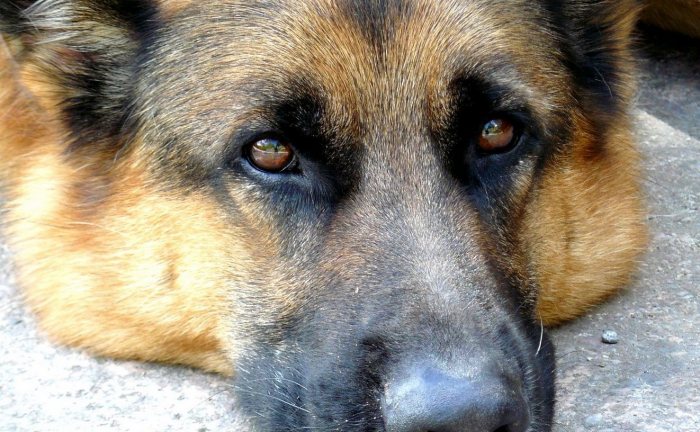
No apologies for now inserting the photograph of Pharaoh that adorns the Welcome page of Learning from Dogs. Underlines what Alexandra wrote above in spades.
Now that is a gaze!
OK, time to start bringing this to a close.
The Toronto Star ran a great review of Pat Shipman’s book from which I will just take this snippet,
“But understanding animals and empathizing with them also triggered other changes in humanity’s evolution, Shipman said.
All those things allow people to live with people. Once people have domesticated animals, they start to live in stable groups. They have fields, crops and more permanent dwellings.”
In other words, we can see that living with animals took us from nomadic hunter-gatherers to living with other people in stable groups; the birth of farming. It is my contention that the evolution of communities and the resulting more stable relationships elevated love leading to love becoming a higher order emotion than just associated with the ‘grunt’ of reproduction.
I started by saying that it was Pat Shipman’s book that stimulated me to wander through my own consciousness and realise that when I bury my face in the side of one of the dogs, say on the bed, it resonates with the most ancient memories in my human consciousness. Indeed, I am of no doubt that my openness and emotional surrender to that dog enables me to be a better, as in more loving, person for Jean.
So let me close this essay by asking you to return here and read the guest post tomorrow from author Eleanore MacDonald, where Eleanore writes of the loss of their dog Djuna. You will read the most precious and heart-rending words about love. Thank you.
Do you remember the beautiful pictures of the horse and mare from Saturday, 4th August? Well many did and loved that Post as was recorded by the number of ‘Likes’. That was sent to me by Cynthia.
Here’s another one from Cynthia; a beautiful insight into the world of nature, seen over 20 million times!
Normally my week-end posts are lighthearted. But I do hope you will forgive the departure for today.
Regular readers of Learning from Dogs will recall that on the 2nd August I published a piece under the title of Changing the person: Me. It offered several examples of how personal change or transition is tough but that the rewards that come from understanding the personal and emotional consequences of big life changes are immense. As I wrote then,
The most important thing to note, and this is why so many ‘change’ ambitions fail, is that change is deeply unsettling at first. When change happens for the majority of us, often ‘forced’ on us as a result of unplanned life events, we are left deeply unsettled; a strong feeling of being lost, of being in unfamiliar surroundings. Think divorce or, worse, the death of a partner or child, reflect on how many sign up for bereavement counselling in such circumstances. Big-time change is big-time tough (apologies for the grammar!).
Then I came across the story of how Eric Clapton coped when his four-year-old son fell from the window of the 53rd-floor window of his mother’s friend’s New York City apartment. Here’s an extract from the WikiPedia entry:
The years following 1990 were extremely turbulent for Clapton. In August 1990, his manager and two of his roadies (along with fellow musician Stevie Ray Vaughan) were killed in a helicopter accident. Seven months later, on March 20, 1991, Clapton’s four-year-old son Conor died after falling from the 53rd-floor window of his mother’s friend’s New York City apartment. He landed on the roof of an adjacent four-story building. After isolating himself for a period, Clapton began working again, writing music for a movie about drug addiction called Rush. Clapton dealt with the grief of his son’s death by co-writing “Tears in Heaven” with Will Jennings.
Here’s Tears in Heaven. Please stop whatever you are doing now and play this video. In under 5 minutes it demonstrates the power of the saying from Henry David Thoreau, the American author and poet – “Not until we are lost do we begin to understand ourselves”.
In an interview with Daphne Barak, Clapton stated, “I almost subconsciously used music for myself as a healing agent, and lo and behold, it worked… I have got a great deal of happiness and a great deal of healing from music“.
Eric Clapton
Let me close with another saying, this time from George Moore, the novelist, “A man travels the world over in search of what he needs and returns home to find it.”










 Learning from Dogs