Regular readers will know that one of my joys of this blog writing game is the wonderful connections that are made across this funny old virtual world. Trish Iles is one of those wonderful connections.
In fact, Trish is based at our local insurance firm, Crabdree Insurance, right here in Payson but until we ‘chit-chatted’ about writing a guest post for Learning from Dogs I had no idea there is much more to this lady.
To underline that, anyone who has their own blog called Contemplating Happiness will inevitably generate some curiosity. That curiosity increases as one learns more about Trish and discovers that she is a published author.
Anyway, that’s enough from me, here is Trish Iles writing What the dog knew!
oooOOOooo
The wisdom of Chloe
I was pondering the eternal question: why does two weeks of relaxing vacation seem like so much more time than two weeks of working like my pants are on fire, here at my desk? My sweet husband and I talked about it a little bit, but came to no definitive answer. I chatted with friends about it. No insights. Google had no opinion, either.
Chloe came to us from a rescue organization. I think sometimes about what her experiences have been in her young life. She started out as an abandoned puppy on a reservation in New Mexico and was soon in the pound where she was on the euthanasia list. A kind woman rescued her and took care of her until she found us: just when Chloe was becoming at home with the rescue lady, she was uprooted again and sent home with two new people. What must she have been thinking?
Chloe didn’t close her heart to us, though. She watched for a few days. When she decided we weren’t going to make dinner out of her and that she was really staying with us, she threw her whole being into becoming one of the family. She let herself trust us.
I’m not sure I would have had the courage to trust a new set of people again. I’m doubly not sure that I give a rat’s patootie what those new people thought of or wanted from me. Chloe was willing not only to trust us, but to love us. She forgave us immediately for ripping her from the home she knew, and she adopted us right back.
Chloe was born knowing. She knows about joy. She knows about living a life in balance. She knows about forgiveness, trust, exuberance, a passion for learning and the power of a good nap. I think that when I grow up, I want to be just like her.
oooOOOooo
Don’t know about you dear reader but I just loved that story from Patricia. Deep messages about what we can learn from our wonderful canine friends.
Indeed, I’m going to stay with the theme with tomorrow’s Post.
Is it me or are we all totally mad? Only if we don’t take action!
I’ve quoted this expression before so forgive me for using it again. That’s the old Devon expression, “All the world’s a little queer, ‘cept thee and me, and I ha’ me doubts about thee!” It really does seem as if most of us are ‘a little queer!’
Yesterday, I expressed the tip of much frustration, nay incredulity, in a rant about why society showed such complacency towards the impending crisis of our civilisation. As I wrote,
Why isn’t there such a huge outpouring of anger at the complacency of the world’s leaders? How far does the collapse of the conditions, both social and physical, as in biosphere, have to go before we get real, urgent change?
Well today’s Post is taking a selection of recent items that have been published to show why I feel as I do. I make no apologies for this being a longish Post but that doesn’t make it anything other than incredibly important; personal opinion, of course!
Let’s start with our love affair with carbon-based fuels, in this case natural gas (that’s methane you know). Over on Lack of Environment Martin Lack recently published a piece on Fracking. Here’s an extract,
Burning fossil fuels just because they are there is insane
For a long time, I have told anyone that would listen that we should leave unconventional hydrocarbons in the ground because of the extremely high probability that James Hansen is right; if we burn them all the runaway greenhouse effect is a “dead certainty” (i.e. on page 236 of Storms of My Grandchildren). However, thanks to the persistence of my many friends in the blogosphere, I have now also woken up to the reality that unconventional fossil fuel extraction – and hydraulic fracturing (known as fracking) in particular – is having significant immediate adverse environmental impacts. Pendantry has described this as humanity “fouling its own nest”; but I think my own description of it as “defecating in our own pig pen” conveys a more appropriate image.
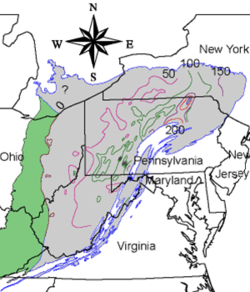
Martin also included a 17-minute feature from Link TV on the use, and dangers, of extracting natural gas from the Marcellus Shale in the US North-East. It’s a sobering reminder of how we are playing with fire with the planet, both literally and metaphorically. This is the video:
My next reference is an article published in the latest issue of Nature. Only a summary is available freely online, but here it is anyway,
Approaching a state shift in Earth’s biosphere
Localized ecological systems are known to shift abruptly and irreversibly from one state to another when they are forced across critical thresholds. Here we review evidence that the global ecosystem as a whole can react in the same way and is approaching a planetary-scale critical transition as a result of human influence. The plausibility of a planetary-scale ‘tipping point’ highlights the need to improve biological forecasting by detecting early warning signs of critical transitions on global as well as local scales, and by detecting feedbacks that promote such transitions. It is also necessary to address root causes of how humans are forcing biological changes.
The overall theme of this issue of Nature is shown in their leading story, again taking the liberty of republishing an extract. First how the article opens,
Return to Rio: Second chance for the planet
Twenty years ago, when the world’s leaders pledged to protect Earth’s climate and biodiversity at the Rio Earth Summit, they knew it would not be easy. But few could have guessed how much worse the situation would get. In 1992, the atmosphere held fewer than 360 parts per million (p.p.m.) of carbon dioxide; the concentration is now nearing 400 p.p.m. and surging upwards. At the same time, species are disappearing at an accelerating rate.
On the eve of the second Rio Earth Summit, Nature explores the causes and consequence of those changes, as well as the efforts that are being made to avert the worst outcomes. Our assessment shows how little progress nations have made towards honouring the commitments they made in 1992.
Then how that article closes,
Anthony Barnosky and his colleagues argue that the global ecosystem could eventually pass a tipping point and shift into a new state, the likes of which are hard for science to predict. But there are ways to avoid that fate, say Paul Ehrlich and his colleagues (page 68), who suggest techniques to make societies more sustainable and to head off many of the world’s chronic environmental problems.
Earth and its inhabitants have a second chance in Rio. They may not get many more.
There’s more and more of this but, yes, I know, one can only take so much. So let me head for the close with a message of what you and I, and all of us, can do.
The United Nations Environment Programme recently released a video showing how inadequate have been our leaders. Watch it first and then I’ll offer a solution.
The fifth edition of the Global Environmental Outlook (GEO-5), launched on the eve of the Rio+20 Summit, assessed 90 of the most-important environmental goals and objectives and found that significant progress had only been made in four.
As concerned global citizens, we urge you to honour your previous commitments to end taxpayer handouts to the fossil fuel industry. To save our planet we need a game-changer now — we call on you to first lead by example, and then make ending all polluter payments the top global priority for the Rio Earth Summit.
Or should that be ‘quacks’? A delightful duck story from San Antonia, Texas.
With big thanks to Merci O. for sending me the story.
A True Duck Storyfrom San Antonio , Texas
Something really cute happened in downtown San Antonio this week. Michael R. is an accounting clerk at Frost Bank and works there in a second story office. Several weeks ago, he watched a mother duck choose the concrete awning outside his window as the unlikely place to build a nest above the sidewalk. The mallard laid ten eggs in a nest in the corner of the planter that is perched over 10 feet in the air. She dutifully kept the eggs warm for weeks, and Monday afternoon all of her ten ducklings hatched.
Michael worried all night how the momma duck was going to get those babies safely off their perch in a busy, downtown, urban environment to take them to water, which typically happens in the first 48 hours of a duck hatching.
Tuesday morning, Michael watched the mother duck encourage her babies to the edge of the perch with the intent to show them how to jump off. Office work came to a standstill as everyone gathered to watch.
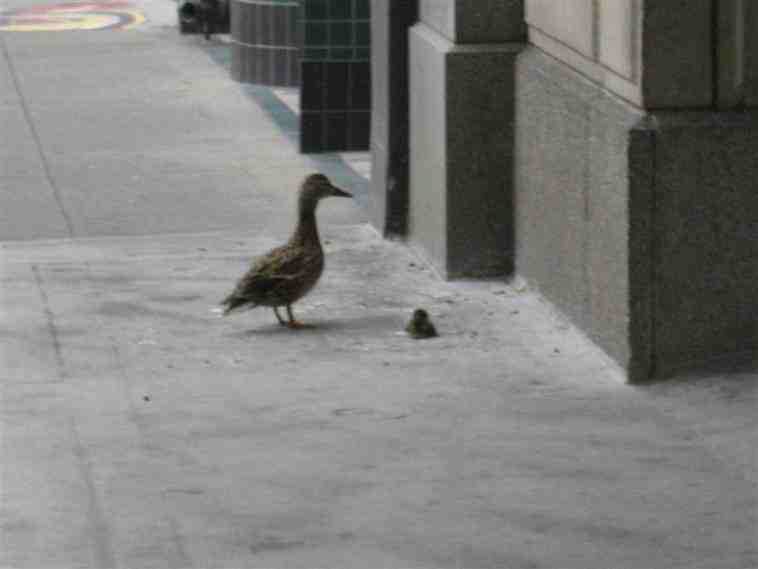
The mother flew down below and started quacking to her babies above. In disbelief Michael watched as the first fuzzy newborn trustingly toddled to the edge and astonishingly leapt into thin air, crashing onto the cement below. Michael couldn’t stand to watch this risky effort nine more times! He dashed out of his office and ran down the stairs to the sidewalk where the first obedient duckling, near its mother, was resting in a stupor after the near-fatal fall. Michael stood out of sight under the awning-planter, ready to help.
As the second one took the plunge, Michael jumped forward and caught it with his bare hands before it hit the concrete. Safe and sound, he set it down it by its momma and the other stunned sibling, still recovering from that painful leap. (The momma must have sensed that Michael was trying to help her babies.)
One by one the babies continued to jump.. Each time Michael hid under the awning just to reach out in the nick of time as the duckling made its free fall. At the scene the busy downtown sidewalk traffic came to a standstill. Time after time, Michael was able to catch the remaining eight and set them by their approving mother.
At this point Michael realized the duck family had only made part of its dangerous journey. They had two full blocks to walk across traffic, crosswalks, curbs and past pedestrians to get to the closest open water, the San Antonio River, site of the famed “RiverWalk.”
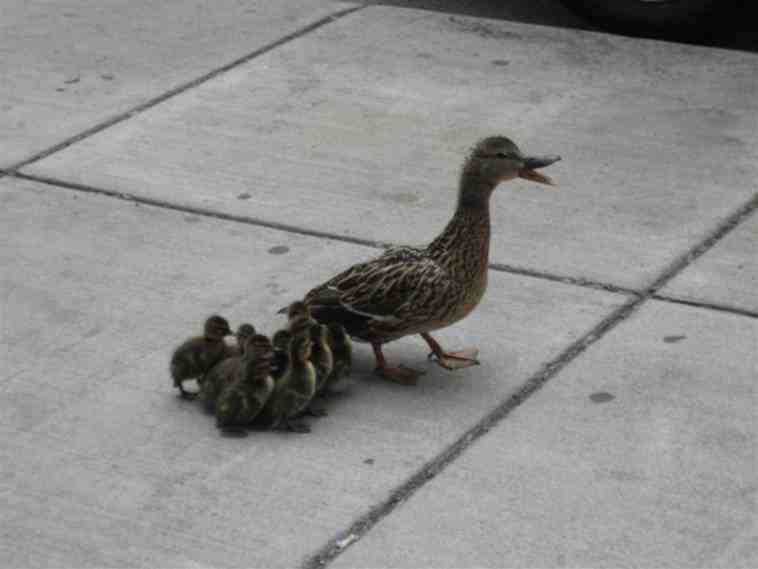
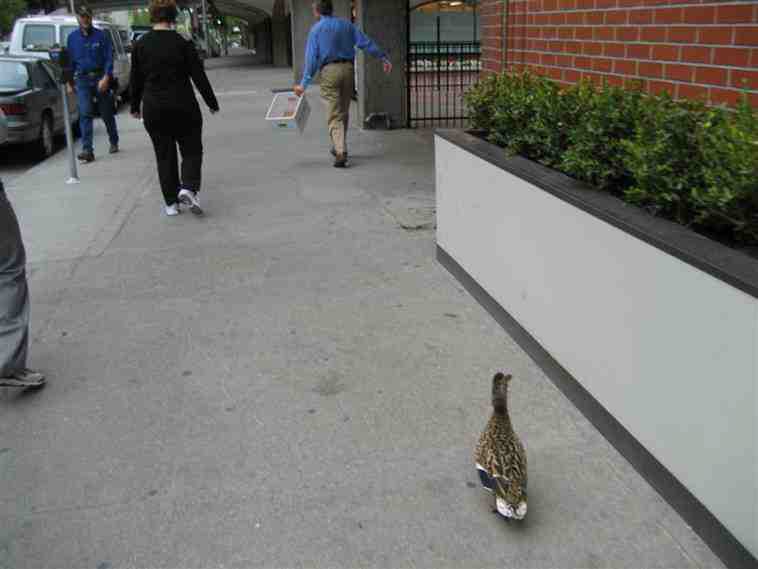
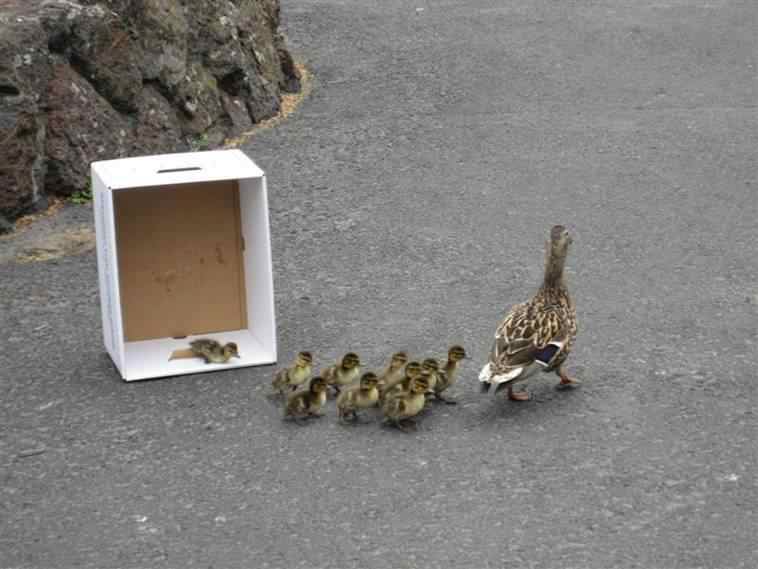
The on-looking office secretaries and several San Antonio police officers joined in. An empty copy-paper box was brought to collect the babies. They carefully corralled them, with the mother’s approval, and loaded them in to the container. Michael held the box low enough for the mom to see her brood. He then slowly navigated through the downtown streets toward the San Antonio River. The mother waddled behind and kept her babies in sight, all the way.
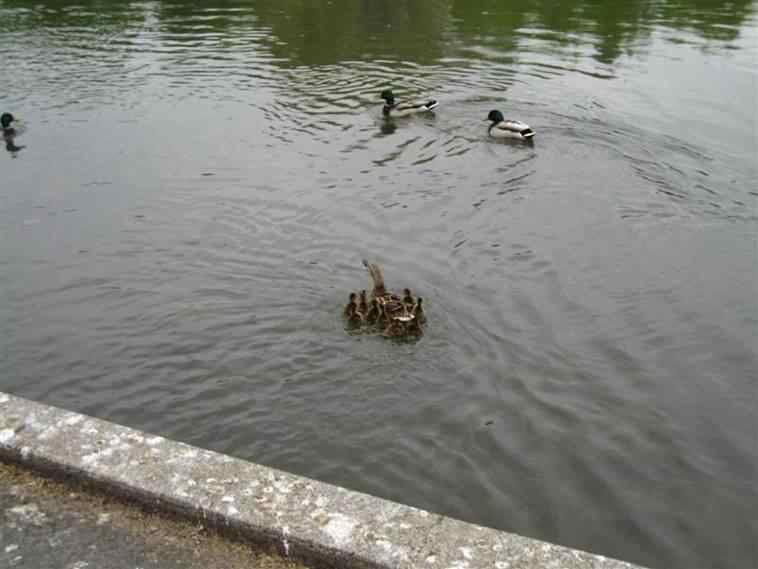
As they reached the river, the mother took over and passed him, jumping in the river and quacking loudly. At the water’s edge, Michael tipped the box and helped shepherd the babies toward the water and to the waiting mother after their adventurous ride.
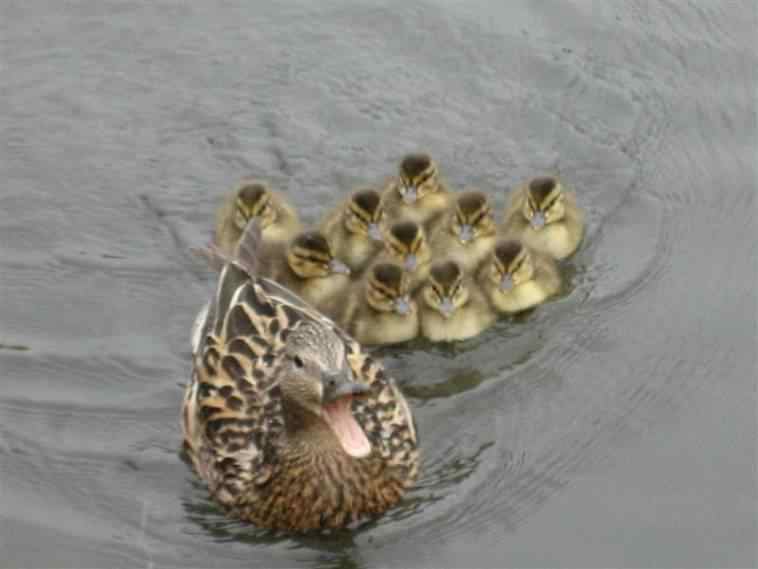
All ten darling ducklings safely made it into the water and paddled up snugly to momma. Michael said the mom swam in circles, looking back toward the beaming bank book-keeper, and proudly quacking.
At last, all present and accounted for: “We’re all together again. We’re here! We’re here!”
And here’s a family portrait before they head outward to further adventures….
Like all of us in the big times of our life, they never could have made it alone without lots of helping hands. I think it gives the name of San Antonio ‘s famous “River Walk” a whole new meaning! Maybe you will want to share this story with others.
And even if you enjoyed the story, do settle down for 3 minutes and watch the YouTube version – it’s something you will treasure, I promise you!
Both versions end with this thought:
Live honestly, Love generously, Care deeply and Speak kindly
With big thanks to Trish for sending me these details.
It may seem entirely irrelevant to the wider world to focus on one homeless dog now taken into care and looking for a loving home but if one ‘raises’ the theme to that of which Learning from Dogs is all about, namely Dogs are integrous animals. We have much to learn from them then not so!
I’m not going to waffle around this for much longer except to ask you to go across to Patrice Ayme’s Blog and read his recent essay, Blood: Appetite Comes With Eating. It’s a very erudite, and deeply upsetting, commentary on something I touched on in a recent Post. Patrice writes, “Today we have just one civilization. If it dies, it will have no replacement.” So go and read the full essay.
So when we wonder why there seems such a departure from integrity within the higher echelons of society, it makes my heart leap to be reminded of the innocence and integrity of dogs (and, of course, all of nature’s animals), and the outstanding beauty of all those who love and care for them.
So forget about the big, wide world for a while and read what Trish emailed me,
Tiny Tinker needs a forever home
Tinker
Found fending for himself on the hot streets of South Phoenix, Tinker is six and a half pounds of pure puppy love! This sweet survivor was in very tough shape when he was rescued from the county shelter and brought to the vet. But while he was being examined, Tinker wouldn’t stop trying to kiss everyone around him, and couldn’t stop wagging his tail! Currently recovering in a foster home, this little trooper desperately needs to find a forever home where he’ll be loved for the rest of his life.
Can you help?
Tinker is a spunky sweetheart who loves to snuggle with people. According to the vet, this 12-year-old Chihuahua is the victim of bad genes and neglect. The poor baby was born with only one good eye, permanently dislocated back knees, and terrible teeth. He’ll have dental work done soon, so he can go to his new home with a healthy smile. But first, he needs to recover completely from kennel cough. His ragged ears are most likely the result of flies biting off the edges.
Despite everything, Tinker is one of the happiest little dogs you’ll ever meet. Extremely affectionate and full of energy, blood tests show he’s in overall good health. He’s already neutered, housetrained and up-to-date on his shots. And once he recovers, all he’ll need is medication for his knees to make him more comfortable. Tinker seems to like other dogs, so would welcome canine companions.
Small Chihuahuas can lead very long lives. And if ever a dog deserved to enjoy many years as someone’s cherished pet, it’s Tinker! If you or someone you know can offer him a good home, please contact Jill at (480) 363-8449 or jill@cdsframing.com. She’d be thrilled to hear from you and delighted to introduce you to the terrific Tinker, who is living in Phoenix.
You can also help Tinker find a home by posting his adoption flyer wherever you work, play or shop.
Thank you for anything you can do to help Tinker and for everything you do for the animals. Each act of kindness brings us one step closer to No More Homeless Pets®.
Breed: Mix Chihuahua Location: Phoenix, Arizona Sex: Male Age: Senior Description: Little Tinker found himself abandoned and left to fend for himself on the rough lonely and HOT streets in Phoenix, Arizona. His previous life, he was not well loved or cared for. When I met this little bugger, I fell in immediate love with him and got him fully vetted. He still needs a couple of teeth extractions but he is in excellent health otherwise – all bloodwork came back negative and normal for any possible under-lying medical conditions.
This is one happy boy! GREAT SELF-ESTEEM, his tail never stops wagging and he only weighs 6 1/2 itty bitty little pounds and yes he is around 12 years old. He is now current on all his vaccinations and is neutered. He has a lot of life and spunk about him despite all he has been thru….very lovable, snuggly, and affectionate little pooch. Tinker would love nothing more than to be your sweet little lap boy and car rides – yes, he loves to go in the car with you.
Pleae consider giving him a loving home – he deserves it!!!!
Contact: Jill Lenz Phone: 480-363-8449 Email: jill@cdsframing.com
So if you know someone who could help, then please follow that up. If you don’t, then circulate these details just as far and wide as possible. And if you are a person who might be interested or know someone who might be, and you are in another US State, then email or call Jill Lenz and say you saw the details on Learning from Dogs and somehow we can all work out how to get little Tinker in to your arms.
A stray dog has completed a 1700km journey across China after joining a cycle race from Sichuan province to Tibet.
The dog, nicknamed “Xiaosa”, joined the cyclists after one of them gave him food.
He ran with them for 20 days, covering up to 60km a day, and climbing 12 mountains.
Cyclist Xiao Yong started a blog about Xiaosa’s adventures, which had attracted around 40,000 fans by the end of the race.
Yong now hopes to adopt Xiaosa.
Luckily, someone smart grabbed the BBC footage and uploaded it to YouTube thus allowing me to include that below:
I did several Google searches for Xiao Yong’s blog but failed to come across it – never mind, it doesn’t detract from a delightful story this Memorial Day week-end here in America.
Back on April 2nd this year, I posted a piece called I am your dog! The item was motivated by coming across a personal reflection of the relationship that I had, and still have, with Pharaoh, my German Shepherd dog, back in 2007 when I was still living in England; I met Jean in Mexico Christmas 2007!
Among the many comments was one from Perfect Stranger who writes the fabulous blog Dogs of Doubt. He said in his comment,
Hi Paul, I do believe this comment belongs on this post … two videos, part of a true story about an Aussie dog, a modern day “Dog on the Tucker Box”, a true blue friend to an entire town who eventually ended up building him a statue … yeah, not “it” but “HIM”.
First video shows you how tough Aussies animals are ,, watch the fight, it’s awesome, I laugh every time I watch it. they say it really happened. 🙂
Second video is the trailer for “Red Dog” – The Pilbara Wanderer! , hope you get to see the movie
I promised to make that comment a post all on it’s own right – then promptly forgot! So apologies and here are those two movies.
The second fascinating contribution from a guest author.
On Monday I mentioned that I had been approached by two authors who wanted to share their articles with the readers of Learning from Dogs and on that day I published a guest post from Dr. Jane Brackman. Today, I’m delighted to share with you the thoughts of the second of those authors, Kylie Dunning, who describes herself as a writer who holds a strong passion for Psychology, especially in the field of Forensics. She is a lover of animals and an avid hiker in her spare time.
Trainer Julio Simuel (left) watches as his student “Walker” gets congratulations from admirers following a graduation ceremony at Nash Correctional Institution last Wednesday.
Here now follows Kylie’s essay,
Psychology of Healing: Dogs and Inmate Rehabilitation
In 1981, Sister Pauline Quinn envisioned a prison pet partnership program where inmates would train dogs for people with disabilities. Designed to benefit unwanted dogs, the inmates, and the future dog owners, the program was initiated in the Washington state prison for women. The success of the program led to dog training programs in prisons all over the country and has since become part of the material in forensic psychology programs and criminal rehabilitation programs.
Male and female inmates train anywhere from three to fifty dogs at a time for adoption into new families, as service animals, and sometimes for specialized purposes such as bomb-sniffing. There are other benefits. The prisoners who worked as trainers hope to find jobs in animal care as soon as they leave prison. Others, serving longer sentences, are given a sense of purpose and an improved outlook. Psychologically, having a dog to care for serves as a form of therapy and decreases depression, and it brings out good qualities in the inmates, even improving their attitude toward each other.
The Nash Correctional Institution in North Carolina has a program called “New Leash on Life,” in partnership with Southern Siberia Rescue, which pays for all the food and medical treatment for the dogs. Three dogs at a time are trained for eight weeks, then offered for adoption. Jerome Peterson, who has served 19 years for a second-degree murder charge, is one of the trainers. He says that teaching the dogs has taught him compassion and made him a better man. “You have to be patient with the dogs,” he explained. “Some have been abused, and some were left stranded.” He says that though only six of the inmates train the dogs, all 980 of the inmates at the medium-security prison benefit from the program. “A lot of guys wake up mad at the world for no reason,” he said. “When they see the dogs, they get happy — excited. Their whole demeanor just changes.”
Lansing Correctional Facility in Kansas, a combined medium- and maximum-security prison, has a population of 2,500 criminals. Their Safe Harbor Prison Dog Program rescues dogs from death row. About 50 of them are trained by about 100 inmates on any given day. So far, about 1,200 dogs of all breeds and ages have found new homes under the program. Inmate Jerry McMullin trains his dogs in 15-minute intervals four times a day, rewarding them with treats he buys for 45 cents a pound at the canteen (out of the dollar a day he earns at his prison job—prisoners aren’t paid for training the dogs). “You don’t want to work with them too long or they stop paying attention. They get bored,” he says. “I use no force or fear, positive reinforcement only.” Inmates like Pete Spencer will go to lengths to help troubled dogs. “I had one who was so physically abused, he had no trust in humans,” Spencer says. “I slept on the floor with him for a month to get his trust and then I taught him commands.”
The inmates can see positive changes from working with dogs. Spencer says of his fellow inmate, “When I first met (McMullin), he was … well, pretty grouchy,” Spencer says. “Now he’s more open and alive and he has a positive outlook.” Other work programs can help prepare inmates for a job after release, but working with dogs may psychologically be a more effective way to rehabilitate them. With prison populations stressing already taxed resources, and the more and more animals in need of homes, the use of dog training programs in prisons is more than a happy accident. It is a creative way of using state resources to do real and lasting change in society.
oooOOOooo
Well what another wonderfully interesting guest post. Thank you, Kylie. More please!
Using details in Kylie’s article, it was very easy to find this video, plus the photograph at the head of the article came from the Southern Siberian Rescue website.
Homeless dogs are getting special help from inmates. The Columbia County Sheriff’s Office has launched their own “New Leash on Life” program that benefits inmates at the Columbia County Jail and the dogs.
Our fate is also wrapped up in the ocean – another cause for tears.
In a very real sense, this Post continues from my writings of yesterday concerning James Hansen.
A year ago, the BBC reported the shocking state of our oceans. It included this:
“The rate of change is vastly exceeding what we were expecting even a couple of years ago,” said Ove Hoegh-Guldberg, a coral specialist from the University of Queensland in Australia.
“So if you look at almost everything, whether it’s fisheries in temperate zones or coral reefs or Arctic sea ice, all of this is undergoing changes, but at a much faster rate than we had thought.”
But more worrying than this, the team noted, are the ways in which different issues act synergistically to increase threats to marine life.
Some pollutants, for example, stick to the surfaces of tiny plastic particles that are now found in the ocean bed.
This increases the amounts of these pollutants that are consumed by bottom-feeding fish.
Plastic particles also assist the transport of algae from place to place, increasing the occurrence of toxic algal blooms – which are also caused by the influx of nutrient-rich pollution from agricultural land.
In a wider sense, ocean acidification, warming, local pollution and overfishing are acting together to increase the threat to coral reefs – so much so that three-quarters of the world’s reefs are at risk of severe decline.
We have always been fish eaters, from the dawn of civilization, but in the last twenty years we have transformed the oceans beyond recognition. Putting our exploitation of the seas into historical context, Roberts offers a devastating account of the impact of modern fishing techniques, pollution, and climate change, and reveals what it would take to steer the right course while there is still time. Like Four Fish and The Omnivore’s Dilemma, The Ocean of Life takes a long view to tell a story in which each one of us has a role to play.
That book was recently reviewed in The Economist, from which I reproduce the following extracts,
The Ocean of Life: The Fate of Man and the Sea. By Callum Roberts.
Traditional attitudes towards the sea, as something immutable and distant to humanity, are hugely out of date. The temperature change that harmed the corals was not caused by human activity; yet it was a foretaste of what man is now doing to the sea. The effects of overfishing, agricultural pollution and anthropogenic climate change, acting in concert, are devastating marine ecosystems. Though corals are returning to many reefs, there is a fair chance that in just a few decades they will all be destroyed, as ocean temperatures rise owing to global warming. The industrial pollution that is cooking the climate could also cause another problem: carbon dioxide, absorbed by the sea from the atmosphere, turns to carbonic acid, which is a threat to coral, mussels, oysters and any creature with a shell of calcium carbonate.
The reviewer explains that, “The enormity of the sea’s troubles, and their implications for mankind, are mind-boggling. Yet it is equally remarkable how little this is recognised by policymakers—let alone the general public.” and then adds, to the author’s credit, ” There is also a dearth of good and comprehensive books on a subject that can seem too complicated and depressing for any single tome. Callum Roberts, a conservation biologist, has now provided one.”
The book review then continues,
He [Callum Roberts] starts with a bold claim: that anthropogenic stresses are changing the oceans faster than at almost any time in the planet’s history. That may be putting it too strongly. Yet there is no quibbling with the evidence of marine horrors that Mr Roberts presents.
Take overfishing. The industrialisation of fishing fleets has massively increased man’s capability to scoop protein from the deep. An estimated area equivalent to half the world’s continental shelves is trawled every year, including by vast factory ships able to put to sea for weeks on end. Yet what they are scraping is the bottom of the barrel: most commercial species have been reduced by over 75% and some, like whitetip sharks and common skate, by 99%. For all the marvellous improvements in technology, British fishermen, mostly using sail-power, caught more than twice as much cod, haddock and plaice in the 1880s as they do today. By one estimate, for every hour of fishing, with electronic sonar fish finders and industrial winches, dredges and nets, they catch 6% of what their forebears caught 120 year ago.
Overfishing is eradicating the primary protein source of one in five people, many of them poor. It also weakens marine ecosystems, making them even more vulnerable to big changes coming downstream.
For example, there is the matter of chemical pollution, mostly from agricultural run-off. This has created over 400 dead-zones, where algal tides turn the sea anoxic for all or part of the year. One of the biggest, at the mouth of the Mississippi Delta in the Gulf of Mexico, covers 20,000 square km (7,700 square miles) of ocean. An annual event, mainly caused by the run-off of agricultural fertilisers from 40% of America’s lower 48 states, it makes the one-off Deepwater Horizon oil-spill look modest by comparison.
Global warming is another problem. Hitherto, the sea has been a buffer against it: because the heat capacity of water is several times that of air, the oceans have sucked up most of the additional heat, sparing the continents further warming. Yet this is now starting to change—faster than almost anyone had dared imagine.
One effect of the warming ocean, for example, is to increase the density difference between the surface and the chilly deep, which in turn decreases mixing of them. That means less oxygen is making it down to the depths, reducing the liveability of the oceans. Off America’s west coast, the upper limit of low-oxygen water is thought to have risen by 100 metres. Where strong winds bring this water nearer to the surface, there are mass die-offs of marine life. Such events will proliferate as the climate warms.
This is a poor lookout for already put-upon fish. “Fish under temperature and oxygen stress will reach smaller sizes, live less long and will have to devote a bigger fraction of their energy to survival at the cost of growth and reproduction,” writes Mr Roberts. And that is before he gets to the effects of ocean acidification, which could be very bad indeed. Without dramatic action to reverse these processes, he predicts a catastrophe comparable to the mass extinctions of the Palaeocene-Eocene Thermal Maximum, when carbon-dioxide levels, temperature and ocean acidity all rocketed. He writes: “Not for 55m years has there been oceanic disruption of comparable severity to the calamity that lies just a hundred years ahead.” That would be hard to prove; it would be better not to try.
So what is to be done? Mr Roberts provides a hundred pages of answers, occupying roughly a third of the book. They range from the obvious—curbing carbon emissions—to technical fixes, like genetic improvements to aquaculture stocks. None is impossible; and Mr Roberts, almost incredibly, describes himself as an optimist. He writes, “We can change. We can turn around our impacts on the biosphere.” We had better do so.
Amen to that!
So want to know where to start? Here’s a snippet of advice in terms of protecting our fish stocks,
It struck me recently that there is no easy journey of change. Must have been like that since time immemorial. Using the phrase ‘no easy journey’, is a safe interpretation! The reality for all thinking, feeling individuals when we look at the madness of where mankind has arrived and the journey ahead must cause us all to weep; not all that infrequently I suspect. Hence my choice of title for today’s Post on Learning from Dogs.
Maybe I am drawn to this reflective mood because I have finished James Hansen’s book, Storms of my Grandchildren. To say it has disturbed me is a massive understatement. But let me not wander off into some emotional haze but come back to the journey.
The road to hell.
Let’s take coal. Here are Hansen’s thoughts on “Old King Coal” going back to 2007. Note: CCS stands for carbon capture and sequestration.
Scientific data reveal that the Earth is close to dangerous climate change, to tipping points that could produce irreversible effects. Global warming of 0.6°C in the past 30 years has brought the Earth’s temperature back to about the peak level of the Holocene, the current period of climate stability, now of nearly 12,000 year duration, and more warming is “in the pipeline” due to human-made greenhouse gases already in the air. The Earth’s history tells us that the world is approaching a dangerous level of greenhouse gases, a level that would produce accelerating sea level rise, extermination of many animal and plant species, and intensification of regional climate extremes, including floods, storms, droughts and forest fires. It is urgent to slow emissions, as another decade of increasing emissions would practically guarantee elimination of Arctic sea ice, accelerating disintegration of the West Antarctic ice sheet, and regional climate deterioration during coming decades.
The most important time-critical action needed to avert climate disasters concerns coal. Consider: 1) one-quarter of fossil fuel CO2 emission remains in the air for more than 500 years, 2) conventional oil and gas reserves are sufficient to take atmospheric CO2 at least to the vicinity of the “dangerous” level, and it is impractical to capture their CO2 emission as it is mostly from small sources (vehicles), 3) coal reserves are far greater than oil and gas reserves, and most coal use is at power plants, where it is feasible to capture and permanently sequester the CO2 underground (CCS = carbon capture and sequestration). Clear implication: the only practical way to keep CO2 below or close to the “dangerous level” is to phase out coal use during the next few decades, except where CO2 is captured and sequestered.
The resulting imperative is an immediate moratorium on additional coal-fired power plants without CCS. A surge in global coal use in the last few years has converted a potential slowdown of CO2 emissions into a more rapid increase. But the main reason for the proposed moratorium is that a CO2 molecule from coal, in effect, is more damaging than a CO2 molecule from oil. CO2 in readily available oil almost surely will end up in the atmosphere, it is only a question of when, and when does not matter much, given its long lifetime. CO2 in coal does not need to be released to the atmosphere, but if it is, it cannot be recovered and will make disastrous climate change a near certainty.
The moratorium must begin in the West, which is responsible for three-quarters of climate change (via 75% of the present atmospheric CO2 excess, above the pre-industrial level), despite large present CO2 emissions in developing countries. The moratorium must extend to developing countries within a decade, but that will not happen unless developed countries fulfill their moral obligation to lead this moratorium. If Britain should initiate this moratorium, there is a strong possibility of positive feedback, a domino effect, with Germany, Europe, and the United States following, and then, probably with technical assistance, developing countries.
A spreading moratorium on construction of dirty (no CCS) coal plants is the sine quo non for stabilizing climate and preserving creation. It would need to be followed by phase-out of existing dirty coal plants in the next few decades, but would that be so difficult? Consider the other benefits: cleanup of local pollution, conditions in China and India now that greatly damage human health and agriculture, and present global export of pollution, including mercury that is accumulating in fish stock throughout the ocean.
There are long lists of things that people can do to help mitigate climate change. But for reasons quantified in my most recent publication, “How Can We Avert Dangerous Climate Change?” a moratorium on coal-fired power plants without CCS is by far the most important action that needs to be pursued. It should be the rallying issue for young people. The future of the planet in their lifetime is at stake. This is not an issue for only Bangladesh and the island nations, but for all humanity and other life on the planet. It seems to me that young people, especially, should be doing whatever is necessary to block construction of dirty (no CCS) coal-fired power plants. No doubt our poor communication of the matter deserves much of the blame. Suggestions for how to improve that communication are needed.
OK, before I finish off, enjoy Hansen’s interview on CBS’s “Late Show with David Letterman” which has found it’s way onto YouTube, (I found the sound level pretty low!)
All of us who embrace this beautiful planet and acknowledge the extraordinary set of circumstances that enabled man to achieve so much must now weep. Weep for what we have unwittingly done to Planet Earth, and hope our tears bring about change.
















 Learning from Dogs