Author: Sherry Jarrell

The Plain Truth about Government Spending

Core differences about how society spends that really need to be understood.

Government spending is fundamentally a different animal than private spending!

Private spending is the essence of the freedom of choice.  When you mull over the decision to purchase an item, you are making a very personal decision based on your current income or resources, the prices of the other goods and services you currently purchase or may purchase, and your personal tastes, risk preferences, needs, and wants.

You make so many mental comparisons and tradeoffs when you consider a purchase that they truly cannot be listed.  And then you live with the consequences of your choice, for better or worse.  If bad, you learn.  If good, you enjoy.  And the process repeats itself every time you make a buying or investing decision, updated with new personal, private information on the circumstances, choices, and preferences of the individual.

Read more about spending

Health Care vs. Health Insurance

Being clear about the terms Care and Insurance when it comes to US health.

The issue for the day is the distinction between health CARE and health INSURANCE.

As we all know, they are not the same thing.  But, as we all have noticed, the two are often confused and the distinctions ignored by many, if not most, in the media, Congress, and the White House.

Health Care and Health Insurance are certainly interdependent. But it helps first to separate the two and take each in turn.

Let’s start with health insurance.  And let’s think of it first as just any “insurance,” like a policy on your house or car.

What is insurance?  It’s a contract that you buy to limit your losses if a bad event happens, even though the likelihood of the bad event occurring is usually very low.

Read more about this important issue

Rationing by Government or the Market?

Rationing.  First of all, what does rationing mean?

It means that there is a finite or limited supply of a good or service, and that not everyone will get all of it that they want.  Rationing can occur through the price that is charged for the good, or through limiting the quantity of the good by some centralized authority.

Yes, it is true that regardless of whether we get our health insurance from private insurers or from a government program, there is rationing.   But there is a huge difference between the type and scope of rationing by the market through price, and rationing by the federal government through control. When the service is rationed by an insurance company, a doctor, or a hospital, if we don’t like the decision, we have a recourse.  We have options. We have choices.  We can go to a different doctor, a different insurer, a different plan; we can report the company, sue the company, fire the company.

When your health care is rationed by government-sponsored single-payer health insurance, that’s it. If you don’t like the rationing decision, you can’t get “another government,” you can’t sue the government, you can’t fire the government, you can’t pay a higher price to get more services out of the government (not legally anyway).  You have no recourse.  The government decision is the end of the road.

So rationing in and of itself is not the point, is not the problem.  Government rationing is the problem.

By Sherry Jarrell

“What does economics mean?” by an economist

Keynes, macro economics and other terms need to be more widely understood.

Macroeconomics as a field is not very impressive, frankly.

In my view, it is more glorified accounting and policy than anything remotely related to testable economic theory!

Keynesian economics — the stuff that most macro courses are made of — smacks of a model created to justify a pre-conceived belief that government can run businesses better than private industry can.  Keynes spoke strictly of demand-side policies, namely fiscal and monetary policies, which create a large role for government intervention, as opposed to supply side policies, which basically get government out of the way by lowering taxes, fees, paperwork, and restrictions, and allow private industry to take risks and create value and manifest economic freedom.

Read more about economics

Chancellor Angela Merkel

Important lessons from former East Germans.

Have you ever noticed how the most ardent supporters of capitalism and free markets are those who’ve experienced a world without them?

How those who speak out most poignantly against health care reform in the U.S. are those who’ve experienced nationalized health care?  No?

Angela Merkel
Angela Merkel

If you can, then, take a moment and think back to the coverage, the news, the sound bites.  Take a look, perhaps a second look, behind the headlines and I venture that you will find endless examples of this phenomenon.    It is those who have done without freedom of choice, free markets, and self-determination who treasure it most, who most understand its value, who’ve lived with the consequences of its absence.

We need look no further than Chancellor Angela Merkel and her recent victory in Germany’s national election.

Chancellor Merkel grew up in communist East Germany and is now leading Germany out of recession with tax cuts and reduced government spending.

We should be listening to what the world is telling us.  Very hard, and very quickly.  We don’t want to have to lose it before we appreciate what we have.

By Sherry Jarrell

Share

The smallest hint of oil surplus leads to a real fall in oil prices

The fragility of the economy shows in many areas.

Last Thursday, the mere hint of a fairly insignificant surplus in U.S. oil reserves pushed down current oil prices and energy-related futures and other speculative plays.

Oil prices have fallen sharply as weak US home sales data and high US oil inventories prompted doubts about a potential recovery in fuel demand. Source: BBC News, 24th September.

Can you imagine the reaction to an announcement of a new source of U.S. oil reserves?  Or of renewed off-shore drilling capacity?  Relaxed EPA standards? Additional refinery capacity?Oil field

Our energy prices would be cut in half and we’d be so much less likely to war with oil-rich nations on whom we now depend for the functioning of our economy and who, indirectly or not, limit our economic and personal freedoms.

By Sherry Jarrell

Unemployment, Part Three

How much is “too much” Unemployment?

How much unemployment “should” our economy have?  How much unemployment is too much, and how much is just right?  How high does the unemployment rate have to go before significant changes are made in government policy and approaches?

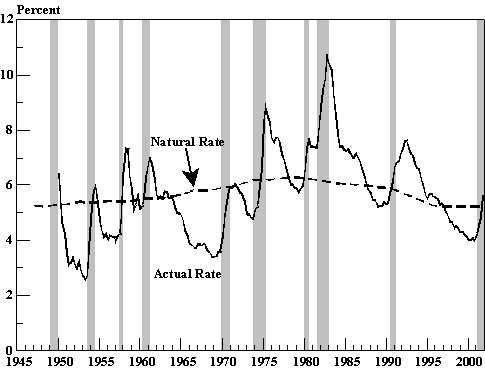
The question of the optimal level of unemployment has generally been answered by reference to the so-called “natural rate” of unemployment.  The natural rate of unemployment is measured as the long-run average rate of actual unemployment in an economy over time; it is a “trend line,” as seen in this graph below:

unemployment3

Read more of this Essay

Understanding unemployment, Part Two

Examining unemployment in more depth.

In an earlier post, I explained how the reported U.S. unemployment rate, which was 9.6% in August of 2009, is unemployedmeasured. This post will explore the reported unemployment rate in more depth, distinguishing between the short-term, temporary sources of unemployment and the long-term, more structural, and troubling aspects of the unemployment rate.


The 9.6% U.S. unemployment rate remains the same next month if no one changes their employment status.  But the rate also remains unchanged if the same number of people hired get fired.  In truth, the U.S. unemployment rate nets out enormous flows of people into and out of the labor force and, for those in the labor force, between being employed and unemployed.

A representative month in the unemployment statistic tells the story.

Read more about unemployment

Understanding unemployment, Part One

The Unemployment Rate: how it’s measured; what it means.

The unemployment rate is often used as a signal of how well an economy uses its resources.

The social costs of involuntary unemployment are evidence of a poorly functioning economy. The unemployment rate

(c) AP Photo
(c) AP Photo

in the U.S. currently stands at about 9.7%, causing deep concern about the overall health and viability of our economy.

Let’s first make sure we know how this reported unemployment statistic is measured.

Read more of this Post

Now this makes sense, not!

US Government Policy encourages next round of foreclosures!

Call me crazy but I thought that the sudden rise in single-family home mortgage foreclosures that began a year or so back was one of the main causes of the current financial crisis.

And that many of these foreclosures resulted from families over-extending themselves, taking on too much debt given debttheir income and other financial obligations, in part because of incentive programs designed to reduce the upfront cost of the home and the monthly mortgage payments during the first several years of home ownership.

So why is Washington pushing to expand and extend the first-time home buyer tax credit?

Read more of this Post