Author: Paul Handover

The mystery of Dark Matter

This very interesting article is worth a read.

Patrice Ayme published a post on Wednesday, 25th June, 2025 that is deeply conected to the following post from The Conversation.

His post was called: ‘How Does The Universe Expand? The Way Cosmologists Decided That It Does, FLRW Metric! A Causal Loop Is At The Heart Of Modern ΛCDM Cosmology!’

Thus I recommend that you read that article and then the one that is republished by me, with permission, from The Conversation.

ooOOoo

The Vera C. Rubin Observatory will help astronomers investigate dark matter, continuing the legacy of its pioneering namesake
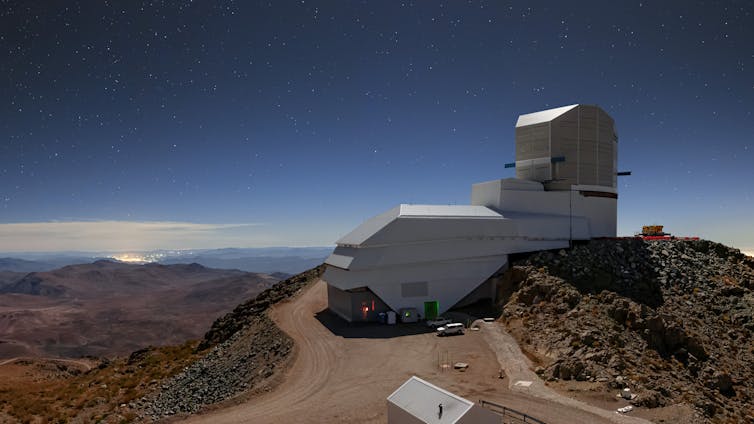
The Rubin Observatory is scheduled to release its first images in 2025. RubinObs/NOIRLab/SLAC/NSF/DOE/AURA/B. Quint

Samantha Thompson, Smithsonian Institution

Everything in space – from the Earth and Sun to black holes – accounts for just 15% of all matter in the universe. The rest of the cosmos seems to be made of an invisible material astronomers call dark matter.

Astronomers know dark matter exists because its gravity affects other things, such as light. But understanding what dark matter is remains an active area of research.

With the release of its first images this month, the Vera C. Rubin Observatory has begun a 10-year mission to help unravel the mystery of dark matter. The observatory will continue the legacy of its namesake, a trailblazing astronomer who advanced our understanding of the other 85% of the universe.

As a historian of astronomy, I’ve studied how Vera Rubin’s contributions have shaped astrophysics. The observatory’s name is fitting, given that its data will soon provide scientists with a way to build on her work and shed more light on dark matter.

Wide view of the universe

From its vantage point in the Chilean Andes mountains, the Rubin Observatory will document everything visible in the southern sky. Every three nights, the observatory and its 3,200 megapixel camera will make a record of the sky.

This camera, about the size of a small car, is the largest digital camera ever built. Images will capture an area of the sky roughly 45 times the size of the full Moon. With a big camera with a wide field of view, Rubin will produce about five petabytes of data every year. That’s roughly 5,000 years’ worth of MP3 songs.

After weeks, months and years of observations, astronomers will have a time-lapse record revealing anything that explodes, flashes or moves – such as supernovas, variable stars or asteroids. They’ll also have the largest survey of galaxies ever made. These galactic views are key to investigating dark matter.

Galaxies are the key

Deep field images from the Hubble Space Telescope, the James Webb Space Telescope and others have visually revealed the abundance of galaxies in the universe. These images are taken with a long exposure time to collect the most light, so that even very faint objects show up.

Researchers now know that those galaxies aren’t randomly distributed. Gravity and dark matter pull and guide them into a structure that resembles a spider’s web or a tub of bubbles. The Rubin Observatory will expand upon these previous galactic surveys, increasing the precision of the data and capturing billions more galaxies.

In addition to helping structure galaxies throughout the universe, dark matter also distorts the appearance of galaxies through an effect referred to as gravitational lensing.

Light travels through space in a straight line − unless it gets close to something massive. Gravity bends light’s path, which distorts the way we see it. This gravitational lensing effect provides clues that could help astronomers locate dark matter. The stronger the gravity, the bigger the bend in light’s path.

Many galaxies, represented as bright dots, some blurred, against a dark background.
The white galaxies seen here are bound in a cluster. The gravity from the galaxies and the dark matter bends the light from the more distant galaxies, creating contorted and magnified images of them. NASA, ESA, CSA and STScI

Discovering dark matter

For centuries, astronomers tracked and measured the motion of planets in the solar system. They found that all the planets followed the path predicted by Newton’s laws of motion, except for Uranus. Astronomers and mathematicians reasoned that if Newton’s laws are true, there must be some missing matter – another massive object – out there tugging on Uranus. From this hypothesis, they discovered Neptune, confirming Newton’s laws.

With the ability to see fainter objects in the 1930s, astronomers began tracking the motions of galaxies.

California Institute of Technology astronomer Fritz Zwicky coined the term dark matter in 1933, after observing galaxies in the Coma Cluster. He calculated the mass of the galaxies based on their speeds, which did not match their mass based on the number of stars he observed.

He suspected that the cluster could contain an invisible, missing matter that kept the galaxies from flying apart. But for several decades he lacked enough observational evidence to support his theory.

A woman adjusting a large piece of equipment.
Vera Rubin operates the Carnegie spectrograph at Kitt Peak National Observatory in Tucson. Carnegie Institution for Science, CC BY

Enter Vera Rubin

In 1965, Vera Rubin became the first women hired onto the scientific staff at the Carnegie Institution’s Department of Terrestrial Magnetism in Washington, D.C.

She worked with Kent Ford, who had built an extremely sensitive spectrograph and was looking to apply it to a scientific research project. Rubin and Ford used the spectrograph to measure how fast stars orbit around the center of their galaxies.

In the solar system, where most of the mass is within the Sun at the center, the closest planet, Mercury, moves faster than the farthest planet, Neptune.

“We had expected that as stars got farther and farther from the center of their galaxy, they would orbit slower and slower,” Rubin said in 1992.

What they found in galaxies surprised them. Stars far from the galaxy’s center were moving just as fast as stars closer in.

“And that really leads to only two possibilities,” Rubin explained. “Either Newton’s laws don’t hold, and physicists and astronomers are woefully afraid of that … (or) stars are responding to the gravitational field of matter which we don’t see.”

Data piled up as Rubin created plot after plot. Her colleagues didn’t doubt her observations, but the interpretation remained a debate. Many people were reluctant to accept that dark matter was necessary to account for the findings in Rubin’s data.

Rubin continued studying galaxies, measuring how fast stars moved within them. She wasn’t interested in investigating dark matter itself, but she carried on with documenting its effects on the motion of galaxies.

A quarter with a woman looking upwards engraved onto it.
A U.S quarter honors Vera Rubin’s contributions to our understanding of dark matter. United States Mint, CC BY

Vera Rubin’s legacy

Today, more people are aware of Rubin’s observations and contributions to our understanding of dark matter. In 2019, a congressional bill was introduced to rename the former Large Synoptic Survey Telescope to the Vera C. Rubin Observatory. In June 2025, the U.S. Mint released a quarter featuring Vera Rubin.

Rubin continued to accumulate data about the motions of galaxies throughout her career. Others picked up where she left off and have helped advance dark matter research over the past 50 years.

In the 1970s, physicist James Peebles and astronomers Jeremiah Ostriker and Amos Yahil created computer simulations of individual galaxies. They concluded, similarly to Zwicky, that there was not enough visible matter in galaxies to keep them from flying apart.

They suggested that whatever dark matter is − be it cold stars, black holes or some unknown particle − there could be as much as 10 times the amount of dark matter than ordinary matter in galaxies.

Throughout its 10-year run, the Rubin Observatory should give even more researchers the opportunity to add to our understanding of dark matter.

Samantha Thompson, Astronomy Curator, National Air and Space Museum, Smithsonian Institution

This article is republished from The Conversation under a Creative Commons license. Read the original article.

ooOOoo

It is difficult to say anything more as my comment will mean practically nothing compared to Patrice Ayme and Samantha Thompson.

I am just grateful that these fine people publish their research with permission for it to be republished elsewhere. Thank you!
Prince William’s new puppy

I had to go to an Australian YouTube source to find this for you:

Enjoy!

The story first came to me from the BBC website.

This strange and beautiful place

Pondering on space.

Like so many people, I am fascinated by the universe. Just our own universe is staggering. Here are some items published on the NASA website.

Solar System Facts

Our solar system includes the Sun, eight planets, five officially named dwarf planets, hundreds of moons, and thousands of asteroids and comets.

Our solar system is located in the Milky Way, a barred spiral galaxy with two major arms, and two minor arms. Our Sun is in a small, partial arm of the Milky Way called the Orion Arm, or Orion Spur, between the Sagittarius and Perseus arms. Our solar system orbits the center of the galaxy at about 515,000 mph (828,000 kph). It takes about 230 million years to complete one orbit around the galactic center.

Now to the centre of our universe. And it give me pleasure to republish this account.

ooOOoo

Where is the center of the universe?

In space, there are four dimensions: length, width, height and time. scaliger/iStock/NASA via Getty Images Plus

Rob Coyne, University of Rhode Island

About a century ago, scientists were struggling to reconcile what seemed a contradiction in Albert Einstein’s theory of general relativity.

Published in 1915, and already widely accepted worldwide by physicists and mathematicians, the theory assumed the universe was static – unchanging, unmoving and immutable. In short, Einstein believed the size and shape of the universe today was, more or less, the same size and shape it had always been.

But when astronomers looked into the night sky at faraway galaxies with powerful telescopes, they saw hints the universe was anything but that. These new observations suggested the opposite – that it was, instead, expanding.

Scientists soon realized Einstein’s theory didn’t actually say the universe had to be static; the theory could support an expanding universe as well. Indeed, by using the same mathematical tools provided by Einstein’s theory, scientists created new models that showed the universe was, in fact, dynamic and evolving.

I’ve spent decades trying to understand general relativity, including in my current job as a physics professor teaching courses on the subject. I know wrapping your head around the idea of an ever-expanding universe can feel daunting – and part of the challenge is overriding your natural intuition about how things work. For instance, it’s hard to imagine something as big as the universe not having a center at all, but physics says that’s the reality.

The universe gets bigger every day.

The space between galaxies

First, let’s define what’s meant by “expansion.” On Earth, “expanding” means something is getting bigger. And in regard to the universe, that’s true, sort of. Expansion might also mean “everything is getting farther from us,” which is also true with regard to the universe. Point a telescope at distant galaxies and they all do appear to be moving away from us.

What’s more, the farther away they are, the faster they appear to be moving. Those galaxies also seem to be moving away from each other. So it’s more accurate to say that everything in the universe is getting farther away from everything else, all at once.

This idea is subtle but critical. It’s easy to think about the creation of the universe like exploding fireworks: Start with a big bang, and then all the galaxies in the universe fly out in all directions from some central point.

But that analogy isn’t correct. Not only does it falsely imply that the expansion of the universe started from a single spot, which it didn’t, but it also suggests that the galaxies are the things that are moving, which isn’t entirely accurate.

It’s not so much the galaxies that are moving away from each other – it’s the space between galaxies, the fabric of the universe itself, that’s ever-expanding as time goes on. In other words, it’s not really the galaxies themselves that are moving through the universe; it’s more that the universe itself is carrying them farther away as it expands.

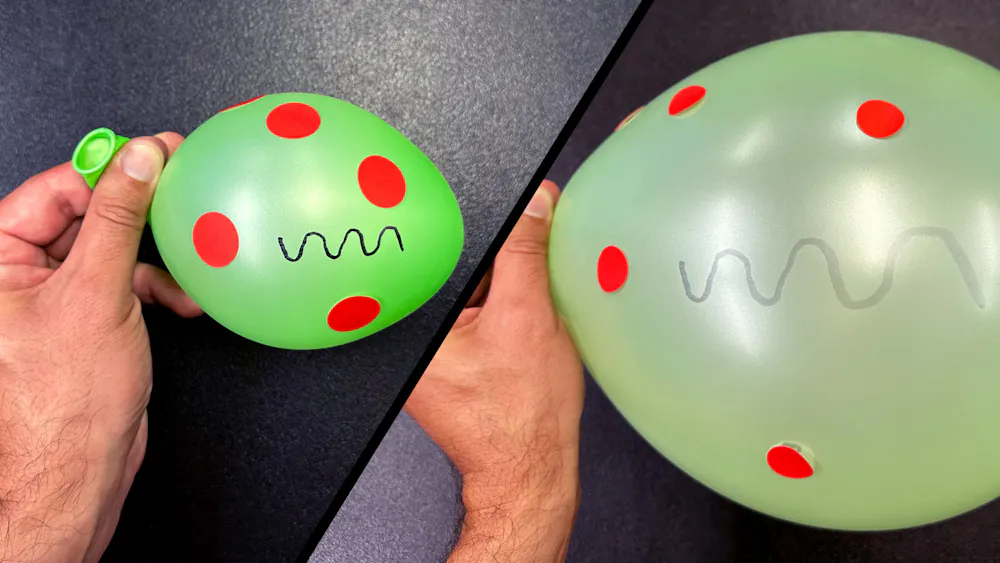
A common analogy is to imagine sticking some dots on the surface of a balloon. As you blow air into the balloon, it expands. Because the dots are stuck on the surface of the balloon, they get farther apart. Though they may appear to move, the dots actually stay exactly where you put them, and the distance between them gets bigger simply by virtue of the balloon’s expansion.

split screen of a green balloon with red dots and a squiggle on the surface, lightly inflated and then much more blown up
It’s the space between the dots that’s growing. NASA/JPL-Caltech, CC BY

Now think of the dots as galaxies and the balloon as the fabric of the universe, and you begin to get the picture.

Unfortunately, while this analogy is a good start, it doesn’t get the details quite right either.

The 4th dimension

Important to any analogy is an understanding of its limitations. Some flaws are obvious: A balloon is small enough to fit in your hand – not so the universe. Another flaw is more subtle. The balloon has two parts: its latex surface and its air-filled interior.

These two parts of the balloon are described differently in the language of mathematics. The balloon’s surface is two-dimensional. If you were walking around on it, you could move forward, backward, left, or right, but you couldn’t move up or down without leaving the surface.

Now it might sound like we’re naming four directions here – forward, backward, left and right – but those are just movements along two basic paths: side to side and front to back. That’s what makes the surface two-dimensional – length and width.

The inside of the balloon, on the other hand, is three-dimensional, so you’d be able to move freely in any direction, including up or down – length, width and height.

This is where the confusion lies. The thing we think of as the “center” of the balloon is a point somewhere in its interior, in the air-filled space beneath the surface.

But in this analogy, the universe is more like the latex surface of the balloon. The balloon’s air-filled interior has no counterpart in our universe, so we can’t use that part of the analogy – only the surface matters.

A blown-up purple balloon on a blue background.
Trying to figure out how the universe works? Start by contemplating a balloon. Kristopher_K/iStock via Getty Images Plus

So asking, “Where’s the center of the universe?” is somewhat like asking, “Where’s the center of the balloon’s surface?” There simply isn’t one. You could travel along the surface of the balloon in any direction, for as long as you like, and you’d never once reach a place you could call its center because you’d never actually leave the surface.

In the same way, you could travel in any direction in the universe and would never find its center because, much like the surface of the balloon, it simply doesn’t have one.

Part of the reason this can be so challenging to comprehend is because of the way the universe is described in the language of mathematics. The surface of the balloon has two dimensions, and the balloon’s interior has three, but the universe exists in four dimensions. Because it’s not just about how things move in space, but how they move in time.

Our brains are wired to think about space and time separately. But in the universe, they’re interwoven into a single fabric, called “space-time.” That unification changes the way the universe works relative to what our intuition expects.

And this explanation doesn’t even begin to answer the question of how something can be expanding indefinitely – scientists are still trying to puzzle out what powers this expansion.

So in asking about the center of the universe, we’re confronting the limits of our intuition. The answer we find – everything, expanding everywhere, all at once – is a glimpse of just how strange and beautiful our universe is.

Rob Coyne, Teaching Professor of Physics, University of Rhode Island

This article is republished from The Conversation under a Creative Commons license. Read the original article.

ooOOoo

That last paragraph says it all: ‘So in asking about the center of the universe, we’re confronting the limits of our intuition.’

Just wonderful!

Picture Parade Four Hundred and Seventy-Eight

Working dogs courtesy of Unsplash.

Photo by Birgitta Roos on Unsplash

oooo

Photo by Alexandru Rotariu on Pexels.com

oooo

Herding dog moves, and guards, the flock of sheep

Westerheide, Hilversum, Netherlands

oooo

Photo by Bella on Unsplash

oooo

Photo by Ankon Roy on Unsplash

oooo

Photo by Clay Banks on Unsplash

That’s all for today!

Alex – The Ghost of the Forest

The second video from Alex and Lisa.

The video was produced on the 14th June, 2025.

Join us on an incredible Wildlife photography adventure through the wilds of Oregon, as we search for and capture stunning images of three iconic raptors: the Great Grey Owl, the Bald Eagle, and the Osprey. What was amazing is that we did not see another photographer whilst photographing these magnificent raptors! From dense forests to riverbanks and high mountain meadows, Oregon is a paradise for birdwatchers and wildlife photographers alike. In this video, we take you behind the scenes of our journey—tracking elusive owls, watching bald eagles, and photographing ospreys.

It makes us extremely proud to be living in this part of America!

The first video shoot by Alex is here.

Keeping one’s garden wild

A great TED Talk.

We live on 13 acres. Even the land near to the house is difficult to keep tidy so when Jean and I saw this TED Talk given by Rebecca McMacin we were overjoyed. For having a tidy garden does much greater harm to wildlife than keeping it wild.

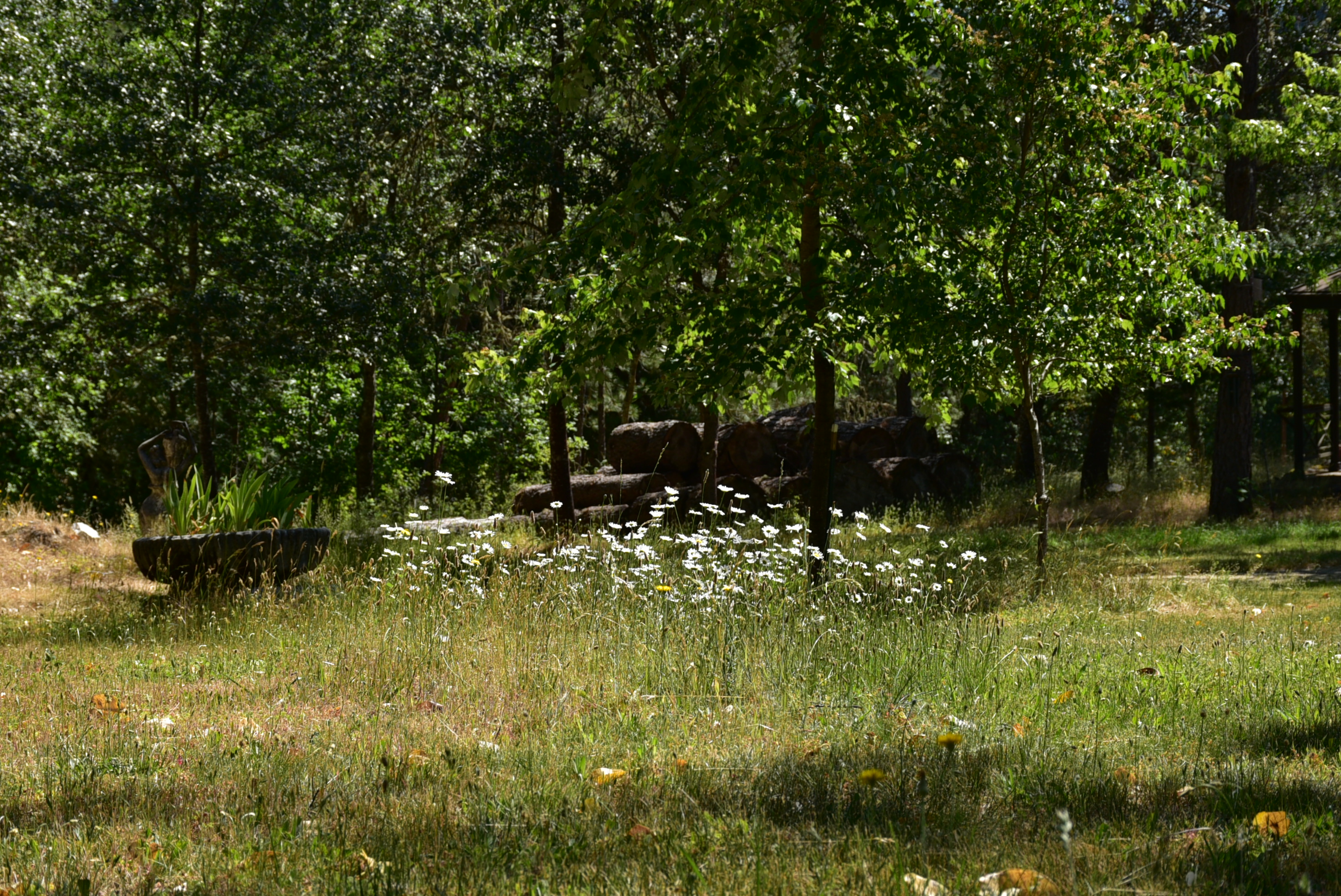
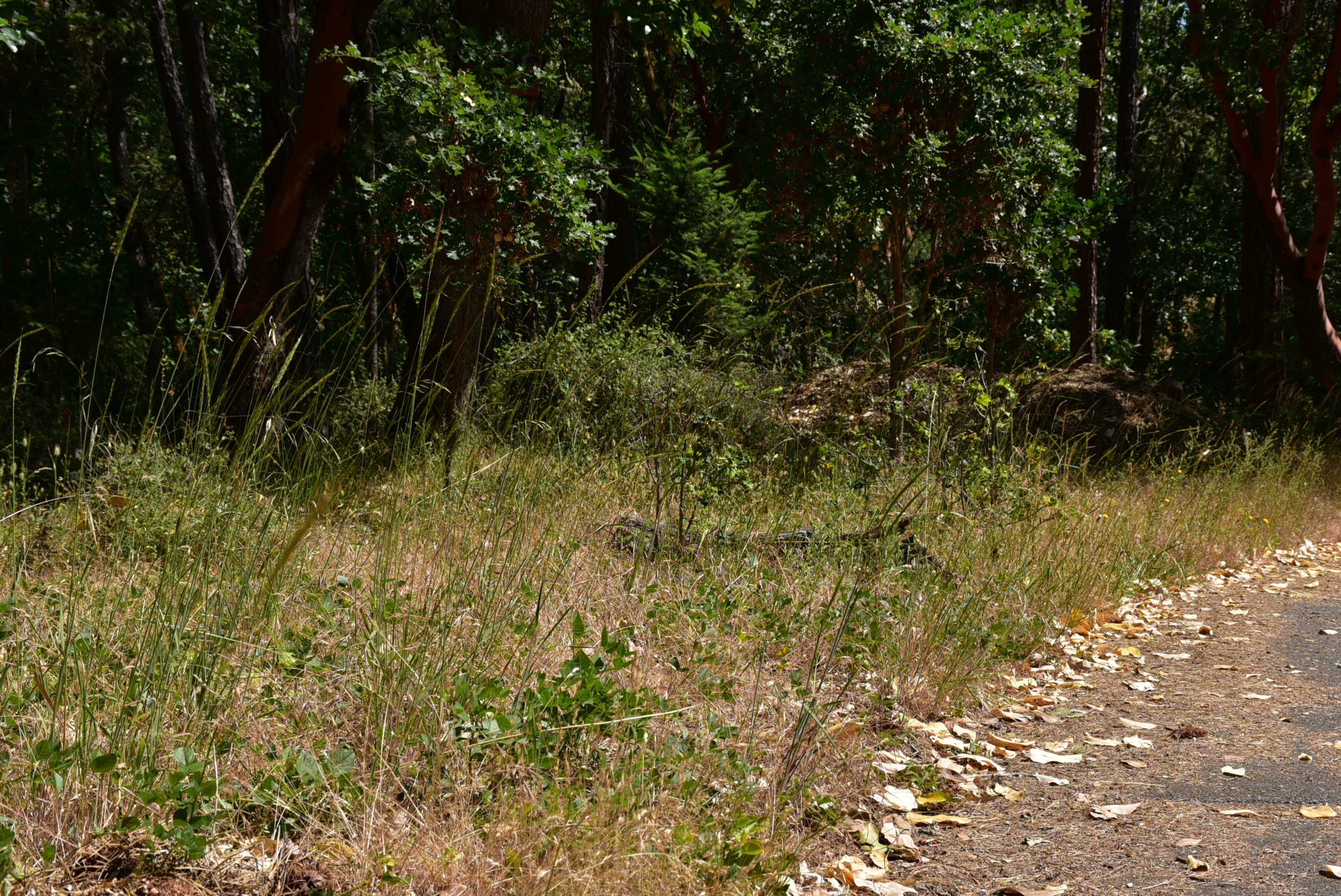
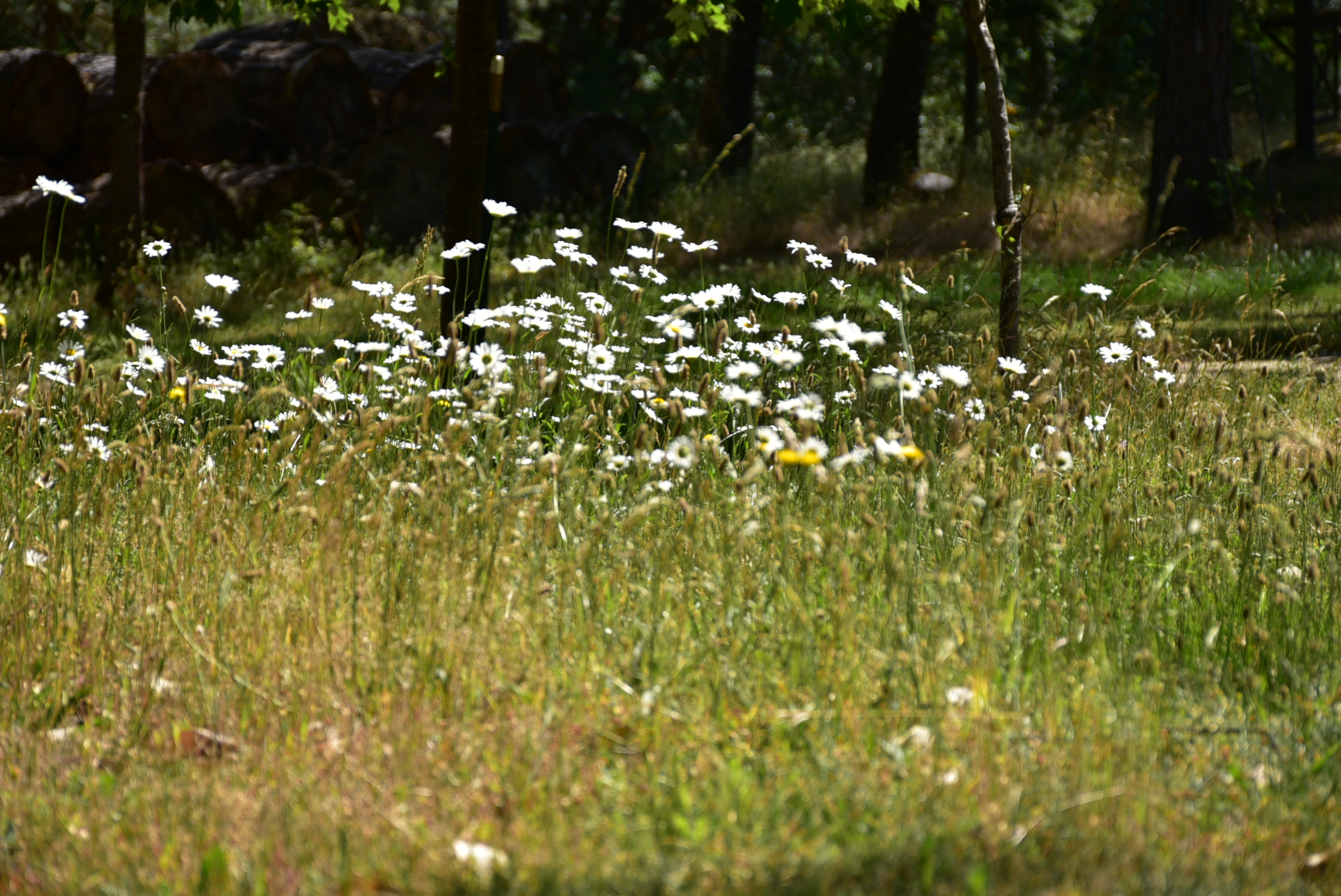
Before I get to the TED video, I just want to show you some photos I took last Saturday.

oooo

oooo

Now to the TED Talk

Here is the description of the talk.

Many gardeners work hard to maintain clean, tidy environments … which is the exact opposite of what wildlife wants, says ecological horticulturist Rebecca McMackin. She shows the beauty of letting your garden run wild, surveying the success she’s had increasing biodiversity even in the middle of New York City — and offers tips for cultivating a garden that can be home to birds, bees, butterflies and more.

Here is Rebecca’s background.

Rebecca McMackin is an ecologically obsessed horticulturist who helps people create and care for beautiful gardens that provide habitat for birds, butterflies and soil microorganisms.

Why you should listen

Rebecca McMackin spent a decade as director of horticulture at Brooklyn Bridge Park, where she employed organic principles to manage 85 acres of diverse parkland. During her time overseeing the park’s ecology, stick bugs, rare mantids, threatened bees and lady bugs all returned to the park. The park’s urban biodiversity and successful use of ethical management strategies influenced thousands of people and other urban parks to adopt similar approaches.

In addition to her work designing public gardens, McMackin writes, lectures and teaches on ecological landscape management and pollination ecology. She recently installed an 8,000-square-foot native wildflower garden for the entrance to the Brooklyn Museum. She was a Loeb Fellow at the Harvard Graduate School of Design, while her work has been published by and featured in The New York Times, the Landscape Institute and on NPR and PBS.

oooo

The video is just 12 minutes long and I encourage you to view it.

Picture Parade Four Hundred and Seventy-Seven

Just one photograph today – but what a photo!

Photo by Philipp Deus on Unsplash

The BBC

A fascinating programme on Radio 4.

As many of you know I was born exactly six months before VE Day on May 8th, 1945.

We soon moved from Acton to 16 Toley Avenue, in Preston Road, Wembley. A short distance down Toley Ave was Ledway Drive that led up to Barn Hill Pond.

A review of Barn Hill Pond by a dog walker, Tara Furlong, in 2020.

It’s a pond on top of a hill, which gets smaller depending on how hot and dry the summer is. It has been known to have sightings of its own grey heron, mallards on occasion, etc. Fish may lurk in its depths, and frogspawn in the spring. There are views of Wembley, and across to central London from the trig point nearby, and aspirations to open up the view to Harrow-on-the-Hill. Take a little wander and you may spy St Paul’s Cathedral. A small number of benches are available, and the bins overflow in fine weather. There’s nothing but green space and houses nearby. It’s accessible via a fairly short, steep uphill walk on uneven ground from the unserviced car park, which can get very busy; or from Wembley Park. Photos on a typical British day – i.e. a bit cloudy and soggy.

Click this link in Google to view the scene.

As a young boy I well remember looking out from Barn Hill and seeing the devastation of the property from the Nazi bombers.

There are twenty programmes on Radio 4 that are about this postwar period in Britain. I have listened to the first three and have found them deeply interesting. Anyone interested in British history is recommended to listen to them. That is the link.

The blue waters

It was World Oceans Day yesterday.

To my mind, nothing beats the sights of the World’s oceans.

In the past, I spent four years living on a yacht, a Tradewind 33, out in Cyprus. During that time I cruised to Turkey, to Greece, to Algiers, and loved it.

Here’s an extract from World Oceans day website.

Why Earth’s oceans are so important

Earth’s oceans are critical to human survival. Indeed, more than half the oxygen in our atmosphere is generated via photosynthesis by phytoplankton and seaweed in oceans. In addition, millions of people depend on fish and other marine animals for food. Research on some marine organisms has led to the development of new medications. Moreover, ocean currents, known as global conveyor belts, help regulate Earth’s climate. 

Sir David Attenborough has produced a film Ocean and the trailer follows:

There is so much more to view on the World Oceans Day website. Please go to it.

Picture Parade Four Hundred and Seventy-Six

Back to Unsplash.

Photo by Oscar Sutton on Unsplash

oooo

Photo by Joe Caione on Unsplash

oooo

Photo by charlesdeluvio on Unsplash

oooo

Photo by Kieran White on Unsplash

Folks, that’s all for today!