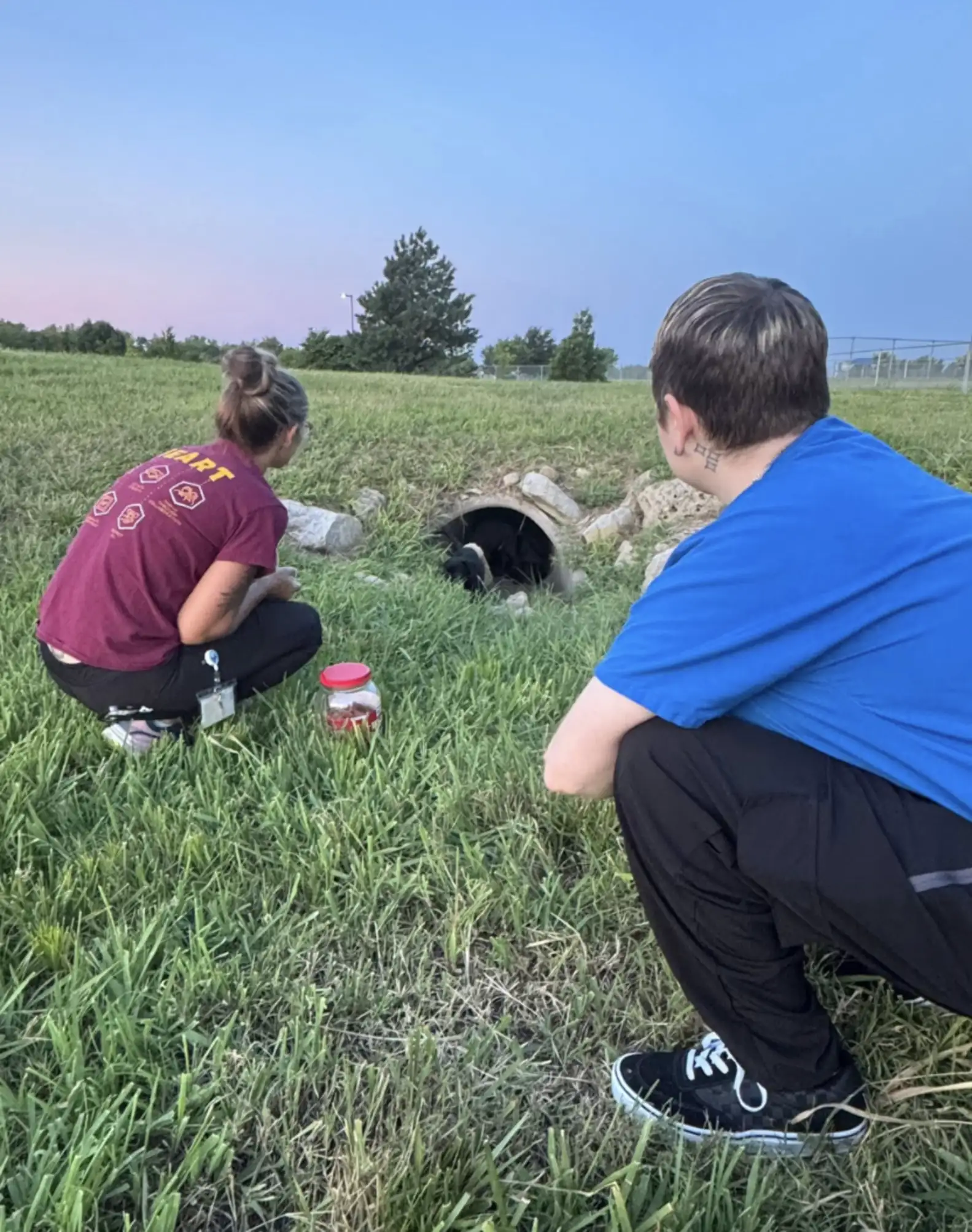
In a field near the Kansas Humane Society’s Murfin Animal Care Campus, a concrete storm drain peeks out of the green grass, its circular opening extending into a black tunnel below. One morning this past July, humane society team members arrived at work and heard a heartbreaking sound echoing from within this drain — the sound of animals crying for help.
Kansas Humane Society
The rescuers hurried over and found the source of the noise. There, cowering inside, were six little puppies left to fend for themselves.
KANSAS HUMANE SOCIETY
Using treats as a tasty incentive, the team coaxed each puppy out from the hole. The pups served a mandatory stray hold at the Wichita Animal Shelter next door. Then they returned to the Kansas Humane Society for further care.
KANSAS HUMANE SOCIETY
Staff members gave the pups a comfortable place to recover. They named the dogs Abby, Ellie, Greg, Lev, Mike and Tommy, and made sure each of them received the necessary vaccines and medical attention needed to grow up healthy and strong.
KANSAS HUMANE SOCIETY
“The puppies were very wiggly, especially Ellie,” a representative from Kansas Humane Society told The Dodo. “All were friendly and very social.”
Local news stations soon began covering the amazing rescue, urging community members to adopt or foster the pups. Within two days, every puppy was either adopted or put on hold for adoption.
KANSAS HUMANE SOCIETY
Today, Abby, Ellie, Greg, Lev, Mike and Tommy are all safe in their forever homes, and rescuers couldn’t be happier.
“We hope their futures are full of love, cuddles and treats,” the representative said.
Bill Watterson of the AHA posted the following yesterday:
I wish people were more like animals. Animals don’t try to change you. Animals like you just the way you are. They listen to your problems, they comfort you when you’re sad, and all they ask in return is a little kindness.
The Sun will someday die. This will happen when it runs out of hydrogen fuel in its core and can no longer produce energy through nuclear fusion as it does now. The death of the Sun is often thought of as the end of the solar system. But in reality, it may be the beginning of a new phase of life for all the objects living in the solar system.
When stars like the Sun die, they go through a phase of rapid expansion called the Red Giant phase: The radius of the star gets bigger, and its color gets redder. Once the gravity on the star’s surface is no longer strong enough for it to hold on to its outer layers, a large fraction – up to about half – of its mass escapes into space, leaving behind a remnant called a white dwarf.
I am a professor of astronomy at the University of Wisconsin-Madison. In 2020, my colleagues and I discovered the first intact planet orbiting around a white dwarf. Since then, I’ve been fascinated by the prospect of life on planets around these, tiny, dense white dwarfs.
Researchers search for signs of life in the universe by waiting until a planet passes between a star and their telescope’s line of sight. With light from the star illuminating the planet from behind, they can use some simple physics principles to determine the types of molecules present in the planet’s atmosphere.
In 2020, researchers realized they could use this technique for planets orbiting white dwarfs. If such a planet had molecules created by living organisms in its atmosphere, the James Webb Space Telescope would probably be able to spot them when the planet passed in front of its star.
In June 2025, I published a paper answering a question that first started bothering me in 2021: Could an ocean – likely needed to sustain life – even survive on a planet orbiting close to a dead star?
Despite its relatively small size, a white dwarf – shown here as a bright dot to the right of our Sun – is quite dense. Kevin Gill/Flickr, CC BY
A universe full of white dwarfs
A white dwarf has about half the mass of the Sun, but that mass is compressed into a volume roughly the size of Earth, with its electrons pressed as close together as the laws of physics will allow. The Sun has a radius 109 times the size of Earth’s – this size difference means that an Earth-like planet orbiting a white dwarf could be about the same size as the star itself.
White dwarfs are extremely common: An estimated 10 billion of them exist in our galaxy. And since every low-mass star is destined to eventually become a white dwarf, countless more have yet to form. If it turns out that life can exist on planets orbiting white dwarfs, these stellar remnants could become promising and plentiful targets in the search for life beyond Earth.
But can life even exist on a planet orbiting a white dwarf? Astronomers have known since 2011 that the habitable zone is extremely close to the white dwarf. This zone is the location in a planetary system where liquid water could exist on a planet’s surface. It can’t be too close to the star that the water would boil, nor so far away that it would freeze.
Planets in the habitable zone aren’t so close that their surface water would boil, but also not so far that it would freeze. NASA
The habitable zone around a white dwarf would be 10 to 100 times closer to the white dwarf than our own habitable zone is to our Sun, since white dwarfs are so much fainter.
The challenge of tidal heating
Being so close to the surface of the white dwarf would bring new challenges to emerging life that more distant planets, like Earth, do not face. One of these is tidal heating.
Tidal forces – the differences in gravitational forces that objects in space exert on different parts of a nearby second object – deform a planet, and the friction causes the material being deformed to heat up. An example of this can be seen on Jupiter’s moon Io.
The forces of gravity exerted by Jupiter’s other moons tug on Io’s orbit, deforming its interior and heating it up, resulting in hundreds of volcanoes erupting constantly across its surface. As a result, no surface water can exist on Io because its surface is too hot.
Of the four major moons of Jupiter, Io is the innermost one. Gravity from Jupiter and the other three moons pulls Io in varying directions, which heats it up. Lsuanli/Wikimedia Commons, CC BY-SA
In contrast, the adjacent moon Europa is also subject to tidal heating, but to a lesser degree, since it’s farther from Jupiter. The heat generated from tidal forces has caused Europa’s ice shell to partially melt, resulting in a subsurface ocean.
Planets in the habitable zone of a white dwarf would have orbits close enough to the star to experience tidal heating, similar to how Io and Europa are heated from their proximity to Jupiter.
This proximity itself can pose a challenge to habitability. If a system has more than one planet, tidal forces from nearby planets could cause the planet’s atmosphere to trap heat until it becomes hotter and hotter, making the planet too hot to have liquid water.
Enduring the red giant phase
Even if there is only one planet in the system, it may not retain its water.
In the process of becoming a white dwarf, a star will expand to 10 to 100 times its original radius during the red giant phase. During that time, anything within that expanded radius will be engulfed and destroyed. In our own solar system, Mercury, Venus and Earth will be destroyed when the Sun eventually becomes a red giant before transitioning into a white dwarf.
For a planet to survive this process, it would have to start out much farther from the star — perhaps at the distance of Jupiter or even beyond.
If a planet starts out that far away, it would need to migrate inward after the white dwarf has formed in order to become habitable. Computer simulations show that this kind of migration is possible, but the process could cause extreme tidal heating that may boil off surface water – similar to how tidal heating causes Io’s volcanism. If the migration generates enough heat, then the planet could lose all its surface water by the time it finally reaches a habitable orbit.
However, if the migration occurs late enough in the white dwarf’s lifetime – after it has cooled and is no longer a hot, bright, newly formed white dwarf – then surface water may not evaporate away.
Under the right conditions, planets orbiting white dwarfs could sustain liquid water and potentially support life.
Search for life on planets orbiting white dwarfs
Astronomers haven’t yet found any Earth-like, habitable exoplanets around white dwarfs. But these planets are difficult to detect.
Traditional detection methods like the transit technique are less effective because white dwarfs are much smaller than typical planet-hosting stars. In the transit technique, astronomers watch for the dips in light that occur when a planet passes in front of its host star from our line of sight. Because white dwarfs are so small, you would have to be very lucky to see a planet passing in front of one.
The transit technique for detecting exoplanets requires watching for the dip in brightness when a planet passes in front of its host star.
If habitable planets are found to exist around white dwarfs, it would significantly broaden the range of environments where life might persist, demonstrating that planetary systems may remain viable hosts for life even long after the death of their host star.
Graham Greene, the Canadian First Nations actor who starred in films including Dances With Wolves, has died aged 73, his manager says.
“It is with deep sadness we announce the peaceful passing of award-winning legendary Canadian actor Graham Greene,” Gerry Jordan said in a statement to CBC News. The outlet reported he died of natural causes.
Greene scored an Academy Award nomination for Best Supporting Actor for his role in Kevin Costner’s 1990 epic western, where he played Kicking Bird.
He was a member of the Oneida Nation, part of the Six Nations Reserve in southern Ontario.
Greene worked as a draftsman, civil technologist, steelworker and rock-band crew member before starting his career in theatre in the UK in the 1970s.
In a 2012 interview with Canadian publication Playback, he credited theatre with giving him a grounding for acting.
“It helps you build a character. When you get into film you don’t have that luxury. The discipline of theatre is what I recommend to all actors.”
In the same interview, he said a key moment for him came when he married his wife Hilary Blackmore, which led to “the best time of my life”.
His breakthrough came in 1990 when he played Kicking Bird, a Lakota medicine man, in Dances With Wolves. Greene won widespread acclaim for the role.
He also appeared in the 1992 western thriller Thunderheart, playing tribal officer Walter Crow Horse.
In the 1999 fantasy drama The Green Mile, Greene played Arlen Bitterbuck, a Native American man on death row in prison.
He also starred in Die Hard With A Vengeance (1995), Maverick (1994), The Twilight Saga: New Moon (2009) and Wind River (2017).
He picked up numerous awards through his storied career, including the Earle Grey Award for Lifetime Achievement by the Academy of Canadian Film and Television in 2004.
In 2016, he was inducted into the Order of Canada, the country’s second highest civilian honour.
First, let me go to the Skeptic website where more details are explained.
Today on the podcast, economist Dean Spears explains the forces driving global population change, from past fears of overpopulation to today’s concerns about declining birth rates.
He contrasts the perspectives of biologists and economists on population growth and highlights the role of human ideas and innovation in sustaining progress. Spears also discusses misconceptions about zero-sum economics, the links between population, health, and economic well-being, and the rise of anti-natalism.
The conversation covers population size and environmental concerns, government policies on family planning, and why cultural attitudes toward reproduction may be as important as policy in addressing the challenges of a shrinking population.
Dean Spears is an economist, demographer, and associate professor at the University of Texas.
His talk is available on YouTube. It is not a short talk, about an hour and a quarter, but it is incredibly interesting.










 Learning from Dogs
