There are a few sayings that I would have loved to have authored! ‘We are what we eat‘, is one of them. ‘The world reflects back what we think about most‘, is another.
But anyway, this article is not about sayings, it’s about food. And to get straight to the point, I’m going to republish something that recently appeared on the Chris Martenson blog.
Joel Salatin, proprietor of Polyface Farms and highly-visible champion of sustainable farming, thinks modern humans have become so far removed from a natural connection to the food they eat that we no longer have a true understanding of what “normal” food is.
The rise of Big Ag and factory farming over the past century has conditioned us to treat food mechanically (as something to be recoded and retooled) vs. biologically. And we don’t realize that for all our industrialization and optimization, we’re actually getting less yield and less nutrition than natural-based processes can offer.
Whether we like it or not, the arrival of Peak Oil is going to force us to realize that our heavily-energy intensive practices can’t continue at their current scale. And with world population still increasing exponentially, we’ll need to find other, more sustainable ways of growing our food.
“What we view today as “normal,” I argue, is simply not normal. Just think about if you wanted to go to town 120 years ago. If you wanted to go to town, you actually had to go out and hook up a horse. That horse had to eat something, which means you had to have a patch of grass somewhere to feed that horse, which meant you had to take care of some perennial in order to feed that horse in order to go to town. And so throughout history, you had these kinds of what I call ‘inherent boundaries,’ or brakes, on how much a single human could abuse the ecology.
And today, during this period of cheap energy, we’ve been able to extricate ourselves from that entire umbilical, if you will, and just run willy-nilly as if there is no constraint or restraint. And now we are starting to see some of the outcome of that boundless, untied progression. And so the chances are, the way to bet, is that in the future we are going to see more food localization, we are going to see more energy localization, we are going to see more personal responsibility in ecological lifestyle decisions, because it’s going to be forced on us to survive economically. We are going to have to start taking some accounting of these ecological principles.”
Joel, his family, and the team at Polyface Farms dedicate themselves to developing environmentally, emotionally, and economically-enhanced food prototypes and advocate for duplicating their production around the world.
In this interview, Chris and Joel explore what constitutes truly sustainable agriculture and the reasons why our current system has departed so far from it, as well as practical steps individuals can take to increase their own personal resiliency around the food they eat (in short: “find your kitchen,” source your food locally, and grow some yourself).
There’s a recording of the interview and a transcript, both of them from here. Want to know more about Joel Salatin? Keep reading!
And if you think this is exciting and a powerful reminder of the speed at which the ‘New World’ is coming to us, then stop by tomorrow and read a recent article from Rob Hopkins from Transition Culture – will blow your mind away!
Reflections on these present times, concluding part.
I closed yesterday with, So maybe there’s a blindness with humans, and then set out the characteristics of that blindness. One of those characteristics being,
Our obsession with how things are now prevents us from reflecting on those signs that indicate changes are under way, even when the likely conclusions are unmistakeable. The ecological and climatic changes being the most obvious example of this strange blindness that mankind possesses.
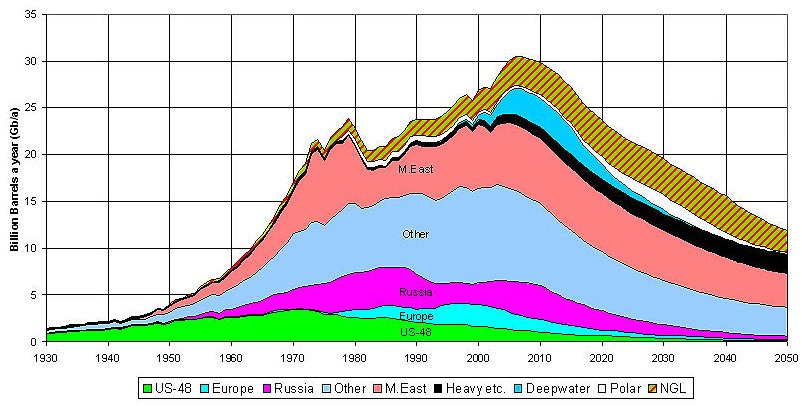
Let’s move this on a little. The arguments from a wide range of scientists are overwhelmingly in favour of the proposition that mankind is using vastly more resources from the planet than the planet can provide. Take oil. This graph show past and projected oil production for the whole Earth out to 2050, less than 40 years away.
Here’s an extract from that website which I encourage you to read in full,
The part before 2007 is historical fact. The part that comes afterward is an ASPO extrapolation.
This graph is worth careful attention as a lot of world history is written into it. Note the steep rise in oil production after World War II. Note that 1971 was the peak in oil production in the United States lower 48. There is a sliver of white labled Arctic oil. That is mostly Alaskan Prudhoe Bay oil, which peaked in 1990. Prudhoe Bay was almost big enough to counteract the lower 48 peak of 1971. The sliver is very narrow now. The OPEC oil embargo of 1973 is very visible. The oil produced by non-OPEC countries stayed nearly constant while OPEC production nearly halved. The embargo caused the world economy to slow. But the high cost of energy spurred the development of energy efficient automobiles and refrigerators and a lot of other things. Note the effect of the collapse of the Russian economy in 1990 on Russian oil production. Note the rapid increase in oil production when the world economy boomed near the end of the twentieth century. Oil was $12 a barrel at that time. Note that European (North Sea) oil peaked in 2000. Note especially what would have happened if the 1973 embargo had not occurred. It is possible that the world would now be on the steep part of the right side of the Hubbert curve.
Take population growth. Here’s a graph that shows that going through seven billion, which is due shortly, is likely to be way short of the eventual peak. Likely peak might be in the range of eight to ten billion! Just take a look at that graph,
Take global warming. Here’s a graph from NASA, from which I quote,
The five warmest years since the late 1880s, according to NASA scientists, are in descending order 2005, 1998, 2002, 2003 and 2006. (reported in the year 2007!)
No apologies for bashing you around the head with these graphs and figures – most people have a good sense about these aspects of our life on this planet. But, in a very real sense, that’s the point.
The point that despite powerful and obvious evidence, mankind has great difficulty accepting obvious trends and understanding that whatever ‘today’ feels like, ‘tomorrow’ is almost certainly not going to be more of the same.
At the risk of hammering this point to death, here are two pictures and some text to show how quickly ‘today’ changes and becomes ‘tomorrow’.
Scientist left speechless as vast glacier turns to water
THESE images show the astonishing rate of break-up of an enormous glacier in north Greenland – from ice to water in just two years.
The before and after photographs, which left a Welsh scientist who led the 24-month project “speechless”, reveal the worrying effects of climate change in an area previously thought too cold to be much affected.
The Petermann glacier pictured August, 5th, 2009Petermann glacier, pictured from same position, July 24th, 2011
Dr Alun Hubbard, a reader at Aberystwyth University’s Centre for Glaciology, returned from the Petermann Glacier in north-west Greenland a month ago, but did not see the stark images documenting the changes until this week.
He said: “Although I knew what to expect in terms of ice loss from satellite imagery, I was still completely unprepared for the gob-smacking scale of the break-up, which rendered me speechless. It was just incredible to see. This glacier is huge, 20km across, 1,000m high.”
“It’s like looking into the Grand Canyon full of ice and coming back two years later to find it’s full of water.”
“It’s quite hard to get your head around the scale of the change. To be able to see that, everything changed in such a short period of time, I was speechless.”
Do read the full article on the Wales Online website here.
Stay with me a little longer, if you will.
Yves Smith in her wonderfully broad and addictive Blog, Naked Capitalism, had the first part of a powerful interview with Satyajit Das published on the 7th. Here are a couple of extracts,
It’s amazing how much money you can make just shuffling paper backwards and forwards. Malcolm Gladwell wrote a piece praising John Paulson who made a killing from the subprime disaster as an entrepreneur. But what did he make? What did he leave behind? Paul Volcker, the former chairman of the Federal Reserve, argued: “I wish someone would give me one shred of neutral evidence that financial innovation has led to economic growth — one shred of evidence. US financial services increased its share of value added from 2% to 6.5% but is that a reflection of your financial innovation, or just a reflection of what you’re paid?”
Just let that quote from Paul Volcker stay with you for a while. Satyajit goes on to say,
Management and directors of financial institutions cannot really understand what is going on – it’s simply not practical. They cannot be across all the products. For example, Robert Rubin, the former head of Goldman Sachs and Treasury Secretary under President Clinton, encouraged increased risk taking at CitiGroup. He was guided by a consultant’s report and famously stated that risk was the only underpriced asset. He encouraged investment in AAA securities assuming that they were ‘money good’. He seemed not to be aware of the liquidity puts that Citi had written which meant that toxic off-balance sheet assets would come back to the mother ship in the case of a crisis. Now, if he didn’t understand, others would find it near impossible. And I’m talking about executive management.
Non executives are even further removed. Upon joining the Salomon Brothers Board, Henry Kaufman, the original Dr. Doom found that most non-executive directors had little experience or understanding of banking. They relied on board reports that were, “neither comprehensive … nor detailed enough … about the diversity and complexity of our operations.” Non-executive directors were reliant “on the veracity and competency of senior managers, who in turn … are beholden to the veracity of middle managers, who are themselves motivated to take risks through a variety of profit compensation formulas.”
Kaufman later joined the board of Lehman Brothers. Nine out of ten members of the Lehman board were retired, four were 75 years or more in age, only two had banking experience, but in a different era. The octogenarian Kaufman sat on the Lehman Risk Committee with a Broadway producer, a former Navy admiral, a former CEO of a Spanish-language TV station and the former chairman of IBM. The Committee only had two meetings in 2006 and 2007. AIG’s board included several heavyweight diplomats and admirals; even though Richard Breeden, former head of the SEC told a reporter, “AIG, as far as I know, didn’t own any aircraft carriers and didn’t have a seat in the United Nations.”
In other words, there is no shortage of information from all corners of the world to show, with very little doubt, that the last few decades have seen unprecedented mistakes by national governments, mistakes in corporate governance, a lack of understanding of economic fundamentals, poor financial and social management, and on and on and on.
But practically all of us, and I mean all of us, didn’t see it at the time, didn’t see where it was heading and only now, when it is full in our faces, do we get it and see it for what it has really been, a long period of over two decades where the ‘me‘ has been more important than the ‘us‘.
That me versus us even being promoted, if that’s the right word, by a British Prime Minister twenty-five years ago. That quote from Margaret Thatcher back in 1987, “And, you know, there is no such thing as society. There are individual men and women, and there are families.” (Margaret Thatcher, talking to Women’s Own magazine, October 31 1987)
Let me draw this all together, yesterday’s part and this concluding part.
There is significant evidence, real hard evidence, that the patterns of mankind’s behaviours of the last few decades cannot continue. Simply because mankind will go over the edge of self-extinction. Darwin’s evidence and all that! We have to accept that humans will see the bleedin’ obvious before it is too late. We have to keep the faith that our species homo sapiens is capable of huge and rapid change when that tipping point is reached, so eloquently written by Paul Gilding in his book, The Great Disruption, reviewed by me here. We have to embrace the fact that just because the world and his wife appears to be living in total denial, the seedlings of change, powerful change, are already sprouting, everywhere, all over the world.
So let’s welcome those changes. Let’s nurture those seedlings, encourage them to grow and engulf our society with a new richness, a new fertile landscape.
Let’s embrace the power of now, the beauty of making today much better and letting go of tomorrow.
For today, I am in charge of my life,
Today, I choose my thoughts,
Today, I choose my attitudes,
Today, I choose my actions and behaviours.
With these, I create my life and my destiny.
It’s very difficult to make predictions, especially when they involve the future!
Want a brilliant idea for tomorrow? Stay in the present!
Dogs do this wonderfully. I am told that followers of Zen Buddhism discover peace and grace from embracing the present. But is there more to this? Is there some deeper psychology involved? Does our species have an intrinsic challenge in terms of staying in the present?
My musings on this arise from a couple of recent conversations.
The first was with Peter McCarthy from the Bristol area of West England. Peter and I go back a few years (at my age, everything goes back a few years!) and at one stage I did some work for Peter’s company, Telecom Potential. Just a quick aside, Peter’s company was based in the magnificent Clevedon Hall, a mansion built in 1853 as a family home for Conrad William Finzel, a German-born businessman. Here’s a picture of one of the rooms,
A room at Clevedon Hall
Peter, like me, is sure that the period in which the world now appears to be, is not some cyclical downturn, not some temporary departure from the national growth and employment ambitions promoted by so many countries. No! This one is different.
Peter is sure that a major transition is under way, as big as any of the great societal upheavals of the past. And, for me, a fascinating comment from Peter was his belief that the key attitude required for the next years would be innovation. Peter reminded me that we tend to think of innovation as applying to things physical, scientific and technical. But Peter sensed that it would be in the area of social innovation where key changes would arise and, from which, these large societal changes would flow.
Then a day later I was chatting with one of the founders of a brilliant new authentication process, Pin Plus. It is a very smart solution to a major global problem, the weaknesses of traditional password user-authentication systems.
On the face of it, Pin Plus is obviously a better and more secure way of authenticating users, and a number of key test customers have borne this out. Jonathan C was speaking of the challenges of convincing companies to have faith in this new process. This is what he said,
More than once, indeed many times, I am told by prospects something along the lines that the IT world has been looking so hard and so long for a password solution that a solution can’t possibly exist.
Let’s ponder that for a moment. Are we saying that a far-sighted approach to the potential for change is not an easy place for some, probably many, human brains?
Indeed, Jonathan and I mused that here we were, both speaking via Skype, an internet telephony service, both of us looking at different web sites in support of many of the points that we were discussing and totally dependent, in terms of our mentoring relationship, on the technology of the internet, a multi-node packet-switched communications system that was a direct result of the American shock of seeing the Russians launch the world’s first artificial satellite, Sputnik 1, into low earth orbit on the 4th October, 1957.
Launch of Sputnik 1
At that time, it would have seemed impossible for anyone on the planet to see that the American response to Sputnik 1 would eventually lead to the vast packet-switched network that is now the modern Internet.
But why do we regard the ability to look into the future so utterly out of reach of the common man? Look at this, the Internet Timeline here. Look how quickly the response to Sputnik1 gathered pace. See how Leonard Kleinrock of MIT way back in May, 1961, presented a paper on the theory of packet-switching in large communications networks.
So maybe there’s a blindness with humans. A blindess that creates the following bizarre characteristics,
Whatever is going on in our lives at present we assume will go on forever. I.e. the boom times will never end, or the period of doom and gloom is endless.
Our obsession with how things are now prevents us from reflecting on those signs that indicate changes are under way, even when the likely conclusions are unmistakeable. The ecological and climatic changes being the most obvious example of this strange blindness that mankind possesses.
Yet, unlike animals and some spiritual groups of humans, truly living in the present appears incredibly difficult for man.
However, the history of mankind shows that our species is capable of huge change, practically living in constant change for the last few millennia, and that a very small proportion of a society, see yesterday’s article, is all that is required to create a ‘tipping point’.
I want to continue with this theme but conscious that there is still much to be written. So, dear reader, I shall pause and pick this up tomorrow.
We must never lose sight of the greater power of positive thoughts.
Indeed, who cannot look at a dog’s wagging tail and not feel better about life. There is so much doom and gloom around that we need constantly to remind ourselves that there is a brighter future ahead, there always is.
And to understand how little it takes for a positive difference to sweep through, take a look at this article from Science Daily,
Scientists at Rensselaer Polytechnic Institute have found that when just 10 percent of the population holds an unshakable belief, their belief will always be adopted by the majority of the society.
The implications of this are profound. Be sure that we are living through a transition period, a period necessary to find a better future. Find another nine people who agree with you, and there’s a hundred on their way! Back to the article,
“When the number of committed opinion holders is below 10 percent, there is no visible progress in the spread of ideas. It would literally take the amount of time comparable to the age of the universe for this size group to reach the majority,” said SCNARC Director Boleslaw Szymanski, the Claire and Roland Schmitt Distinguished Professor at Rensselaer. “Once that number grows above 10 percent, the idea spreads like flame.”
An old one but still made me laugh – yes, I know, there’s no accounting for taste!
And a big thank-you to Cynthia S for passing this on.
MARY’S CRUISE SHIP DIARY
DEAR DIARY – DAY 1
All packed for the cruise ship — all my nicest dresses, swimsuits, short sets. Really, really exciting.
Our local Red Hat chapter – The Late Bloomers decided on this “all-girls” trip. It will be my first one, – and I can’t wait!
————————————————————–
DEAR DIARY – DAY 2
Entire day at sea, beautiful. Saw whales and dolphins. Met the Captain today — seems like a very nice man.
————————————————————–
DEAR DIARY – DAY 3
At the pool today. Did some shuffleboard, hit golf balls off the deck. Captain invited me to join him at his table for dinner. Felt honored and had a wonderful time. He is very attractive and attentive.
———————————————————-
DEAR DIARY – DAY 4
Won $800.00 in the ship’s casino. Captain asked me to have dinner with him in his own cabin. Had a scrumptious meal complete with caviar and champagne. He asked me to stay the night, but I declined. Told him I could not be unfaithful to my husband.
————————————————————–
DEAR DIARY – DAY 5
Pool again today. Got sunburned, and I went inside to drink at piano-bar, stayed there for rest of day. Captain saw me, bought me several large drinks.
Really is quite charming. Again asked me to visit his cabin for the night. Again I declined. He told me, if I did not let him have his way with me, he would sink the ship… I was shocked.
————————————————————–
DEAR DIARY – DAY 6
Today I saved the lives of all 2,600 passengers and crew!
With grateful thanks from Neil K. in Devon for another gem.
Q: Doctor, I’ve heard that cardiovascular exercise can prolong life. Is this true? A: Heart only good for so many beats, and that it… Don’t waste on exercise. Everything wear out eventually. Speeding up heart not make you live longer; it like saying you extend life of car by driving faster. Want to live longer? Take nap.
Q: Should I reduce my alcohol intake?
A: Oh no. Wine made from fruit. Brandy distilled wine, that mean they take water out of fruity bit so you get even more of goodness that way. Beer also made of grain. Bottom up!
Q: How can I calculate my body/fat ratio? A: Well, if you have body and you have fat, your ratio one to one. If you have two body, your ratio two to one.
Q: What are some of the advantages of participating in a regular exercise program? A: Can’t think of single one, sorry. My philosophy: No pain…good!
Q: Aren’t fried foods bad for you?
A: YOU NOT LISTENING! Food fried in vegetable oil. How getting more vegetable be bad?
Q : Will sit-ups help prevent me from getting a little soft around the middle? A: Oh no! When you exercise muscle, it get bigger. You should only be doing sit-up if you want bigger stomach.
Q: Is chocolate bad for me? A: You crazy?!? HEL-LO-O!! Cocoa bean! Another vegetable! It best feel-good food around!
Q: Is swimming good for your figure? A: If swimming good for figure, explain whale to me.
Q: Is getting in shape important for my lifestyle? A: Hey! ‘Round’ is shape!
Well… I hope this has cleared up any misconceptions you may have had about food and diets.
A President with more speech writers than one could imagine.
Got a vested interest or a strong view? Then draft a speech for the President of the United States of America. Many do. Some are clearly very tongue-in-cheek, some are pertinent. The following from CASSE fits into the latter category. Enjoy.
President Obama’s (Hoped for) “Amaze Speech”
Speechwriter: Brian Czech
President Obama’s hoped-for speech first appeared in the Daly News on August 7. We reprint it this week in anticipation of the President’s September 8th speech.
Pres. Obama
Fellow Americans, this evening I have a special message for you. It’s an unprecedented and surprising message, but ultimately it will resonate with your common sense, good will, and patriotic spirit. It turns out that the recessionary cloud we’re under does have an extremely valuable silver lining. I know; it sounds like something only a politician would say, but wait. I think you’ll be surprised to hear my explanation.
Now before I elaborate on the silver lining, I want to make it clear that the cloud has some rain, too. As a nation, we are struggling with debt, credit ratings, and worst of all, the painful experience of unemployment. The last thing I want is to mislead you into thinking these are problems I take lightly, or problems that will be automatically solved by the markets or policy makers. These problems were many years in the making — decades in fact — and it’s going to take years of diligence and readjustment to solve them.
Yet none of these problems can deny us the silver lining, which is this: the economic turmoil we experience today will change the course of history in such a way as to secure the future for American posterity, starting with our children and grandchildren. Let me reiterate, our own kids and grandkids — the most precious American treasure — will have a secure future as a result of the problems we face today. Here’s why…
Far from the trading floors of Wall Street and the policy meetings of the Federal Reserve, crucial discoveries have been made by scientists, economists, anthropologists, historians, and others collaborating under a broad umbrella called “sustainability science.” No, they haven’t discovered an unlimited energy source, a pollution-free car, or a method to stabilize our climate at optimum conditions. They’ve discovered something far more important and exciting: the key to permanent economic security.
For the past few years, as time has allowed, I and my economic advisors, with the assistance of numerous scholars, have studied this key to economic security. The theory and evidence for it is absolutely irrefutable. The only reason this key to security hasn’t broken into public dialog is because it serves no short-term vested interests; no wealthy corporations, think tanks, or political parties that would stand to profit before the next shareholders meeting or election cycle. But that’s also the beauty of it: the key to security is a non-partisan, scientifically sound approach to the long-run interests of all, especially our kids and grandkids. Fortunately for us, it’s surprisingly simple as well.
What is this key to a secure future? We could coin a new phrase to get credit for the idea or to improve its political flavor, but I believe the clearest term is what the scientists already call it: the “steady state economy.” Political advisors think it’s a bit on the dry side, but after what we’ve been through – stock market crashes, insurance crises, banker bailouts, panic over the debt ceiling, having our credit downgraded — doesn’t a “steady state economy” sound like just what the doctor ordered?
In the coming weeks and months, I and my Cabinet will be helping to introduce fellow Americans to the basics of steady state economics, especially what it means for producers, consumers, and public policy. We’ll do this through a series of public announcements, publications, and townhall meetings. Meanwhile, this evening, I’ll provide a brief summary, first by noting what a steady state economy is not.
A steady state economy is not communism, Marxism, or anything at odds with the Constitution of the United States. A steady state economy is not a stagnant, flat-lined economy but is rather continuously dynamic and creative. A steady state economy is not established overnight with draconian policies; instead it evolves as a matter of consumer preference and prudent policy. Most importantly, a steady state economy is in no way opposed to jobs and full employment. To the contrary, a steady state economy is the only economy that can ensure full employment, for your kids and theirs.
The most fundamental feature of the steady state economy is stability. The idea is to stabilize good conditions; stable agriculture, stable manufacturing, stable services, stable production and consumption, stable currency, stable markets, stable international trade, stable impact on the environment, stable air and water, stable climate… You get the picture, and remember, all this stability is at a good level — a level that ensures life, liberty and happiness for us and future generations. At this point in history, the steady state economy is the right goal, and the first step in getting there is recognizing it.
Perhaps you find this amazing. I think you should be amazed. After all, I haven’t said a word about economic growth; in fact I’ve called growth into question. The closest thing to this in presidential history is when President Carter encouraged Americans to consume a little less after the OPEC oil embargo. But President Carter was before his time, and his speech was maligned as the “malaise speech.”
Well, at this point in history, we can no longer afford — literally or figuratively — to pull out all the stops for economic growth. Therefore, tonight you’re hearing the “amaze speech,” the speech that introduces our nation to steady state economics, the alternative to growth.
I understand the adjustment in thinking that this will entail. I’ve gone through it myself. With the exception of President Carter in 1979, my predecessors for over 50 years have prioritized economic growth in their speeches, campaigns, and policies. None even mentioned steady state economics in a speech. Yet with every new president, the pursuit of economic growth has become less realistic, less sustainable, and even less desirable.
Earlier I mentioned the profound developments in sustainability science. Among the sustainability scholars are behavioral scientists and psychologists who have found compelling evidence that economic growth stopped contributing to a happier United States somewhere from the 1950′s to the 1970′s. After that, our gross domestic product continued to rise, but our happiness did not. If you’re like me — meaning old enough to remember — this probably resonates with you. Somewhere along the line the brighter lights, bigger houses and fancier cars stopped making us better off. In fact, all the new “stuff” started working against us. Now we struggle to find enough oil, water, “green space,” solitude, free time, and the peace of mind that comes with a stable climate. It’s all the sign of an economy grown too big.
They say the definition of insanity is doing the same thing over and over again and expecting a different result. I think we’ve all done some crazy things in life, but I don’t want to go down in history as the insane president who kept trying every trick in the book to “stimulate the economy,” when stimulating the economy was neither bound to work nor even desirable by that point in history. I don’t want to oversee more banker bailouts, more stimulus spending, more loosening of environmental protections in a vain attempt to increase GDP growth. That would be insane. Instead, I’m going to tell it like it is: the pursuit of economic growth has become a dangerous obsession that we must overcome. I say this with the backing of sound science, the lessons I’ve learned, and the concern I have for the future of America.
I’m going to test your common sense now. Do you think there is a limit to economic growth? Remember, economic growth is increasing production and consumption of goods and services. It means more and more people, more and more stuff. It takes more energy, water, space to operate in, and places to put out the trash.
Now as a politician, I can assure you that, in the coming days, well-paid pundits will conjure up magical concepts of perpetual growth based on “dematerializing” the economy. Well when they’re ready to dematerialize it, maybe they can beam us up. Meanwhile, the rest of us in the real economy know what perpetual GDP growth would take: evermore people, evermore stuff. And we know we’re running out of evermore room, resources, and patience for unreal notions of evermore growth.
I know that for some, and perhaps for many, this is hard to swallow. For decades we Americans have been encouraged to believe in the notion of continual economic growth. But look at it this way: to think there is no limit to economic growth on Earth is like thinking we could fit a stabilized economy into a perpetually shrinking area. For example, with computers, robots, nanotechnology and the like, we could squish the $70 trillion global economy into North America, then the United States, then Iowa, then into the foyer of the Des Moines Chamber of Commerce, leaving the rest of the world as a designated wilderness area! It’s a ludicrous notion, and it’s precisely as ludicrous as thinking there’s no limit to economic growth in Des Moines, the United States, or Earth.
Now, let’s consider some of the problems we will face if we continue pulling out all the stops for economic growth. The first is inflation. Typically we use monetary policy — such as increasing the money supply — to stimulate growth. But when the real economy isn’t meant to grow as easily as increasing the money supply, the result is inflation. Nothing could be more harmful to our economy at this point than inflation, which is like a devastating tax on the nation.
Another problem is debt. As you know, my Administration injected a major fiscal stimulus into the economy. It helped somewhat and spun off some jobs, but it did not produce the wave of jobs we’d get in an economy with plenty of room to grow. Meanwhile, it added to our deficit and ultimately our debt. Now our credit is coming into question, as with so many nations in a global economy bumping up against the limits to growth.
Of course, there is no shortage of special interests to pounce on the news of faltering fiscal policy. The answer, they say, is to turn over as much as possible to Wall Street. “Take care of national security,” they say, “and let the markets take care of the economy.” The problem with that approach is that national security is about more than having the biggest military. National security starts with a sustainable economy, which requires a stable environment to support the agricultural, fishing, logging, mining, and ranching activities that have always been and always will be the foundation of the American and global economy. Our manufacturing and service sectors — the best in the world — are the best because we have the biggest and best agricultural and extractive sectors. And we have those because we have protected the environment from overuse, pollution, and displacement.
Consider what will happen if we take an unbalanced approach and prioritize economic growth even more over environmental protection. Does anyone really question whether we will have more environmental problems, including devastating problems? More oil spills in the Gulf of Mexico and Gulf of Alaska, more mountaintop mining in the Appalachians, more scraping for shale oil in the Rockies, more nuclear waste, more endangered species, more greenhouse gas emissions, and all the while less water, less fish and wildlife, less wilderness, less nature, less beauty. Does anyone question whether such trends diminish the quality of life for future generations? No, the problems caused by economic growth are unquestionable. It’s just that, for much of American history, the benefits of increasing GDP outweighed the costs. That’s no longer the case, and I’m confident that most of us can sense it.
In fact, the more I thought about this speech, the more amazed I became. Why did it take us so long, in America, to have an open discussion of limits to growth and alternatives to growth? The principles are irrefutable. Neither growth nor recession is sustainable in the long run; a steady state economy is the obvious policy for long-run security. Yet based on the politics of the past 50 years, you’d think economic growth had supplanted apple pie as the companion to motherhood.
Well, now we’re entering a new era of dealing squarely with sustainability. It turns out that economic growth was not a good companion to motherhood, not in the long run. We want apple pie back. We want loving homes for our children, quality time with family and friends, the occasional escape to the great outdoors, and peace. That’s the American dream in a nutshell, and it’s too valuable to sacrifice for economic growth.
So let’s roll up our sleeves and wash our hands of the dirty business of growth at all costs. We know what the right goal is, and malaise won’t get us there. We have work to do to stabilize the economy for our children and grandchildren. Our decisions — what we eat, what we drive, what we build, and frankly how many kids we have — all these will determine the quality of life for the kids that we do have. Meanwhile, those of us privileged to hold public office are responsible for developing the policies to help you thrive in a steady state economy, and for avoiding the policies that force us onto an unsustainable pathway of evermore growth. You could say we are tasked now with “steady statesmanship.”
To conclude, my fellow Americans, do stay tuned. In the coming days and weeks we’ll be discussing the details of transitioning from growth to a steady state. We’ll be talking with you about employment, population growth, stock markets, the banking system, and more. Don’t fear any shocks to the system; you’ve seen most of the shocks already as the policies of economic growth have failed. One by one, we’re going to turn these “failures” into steady state successes.
Today, delighted to offer a guest post from author Garth Stein
Garth Stein and dog!
But first to how this came about. Way back in June, I was contacted by Wiley Saichek who signed off his email, Marketing Director, Authors On The Web. To be frank, I hadn’t heard of the organisation before. Wiley invited me to participate in something he called a Blog Tour on behalf of Garth Stein. It was connected with Garth’s latest book, The Art of Racing in the Rain.
Jeannie had read it some time ago and thoroughly enjoyed it. The book had been next to my side of the bed for weeks but, ironically, the demands of my own writing had just got in the way of me reading it.
Anyway, back to the Blog Tour!
Apparently, the ideal was to have the guest post published on Learning from Dogs during the period July 18th to August 1st but I dragged my heels waiting and hoping that the story from Garth could include a picture of Comet. The picture has not been forthcoming so here it is anyway. I shall be reviewing Garth’s book The Art of Racing in the Rain as soon as I can get around to reading it.
A Game Called Fetch, by Garth Stein
People often ask me about my dog, Comet. They want to know if she was the inspiration for Enzo, the dog narrator in my book, The Art of Racing in the Rain (and the young reader version, Racing in the Rain: My Life as a Dog). And the answer is, flatly, no. Enzo is a singular character, I tell them, and has no predecessor. Comet is goofy and silly, and is very much not Enzo. But she’s still very smart–in her own Comet way–and has taught me much about the world.
When Comet was just a pup, she hated being left at home; she didn’t like the responsibility of having the house to herself. She would always get into some mischief: eat an entire bunch of bananas, for instance (having peeled them first!). Or claw her way into the pantry looking for cookies. But one day, she communicated her anxiety in a way that was so clear, so unmistakable, there was no doubt at all as to her feelings. We went out for a couple of hours, confining her to the kitchen/dining area of our house. And when we came home, there was a perfectly round, undisturbed puddle of urine on the dining room table.
Now that is a statement. Message received. Since that day, whenever we get ready to leave her alone in the house, she willingly–one might saygratefully–finds her crate, curls up, and waits for us to secure the door.
While Comet may not be able to wax eloquently about philosophy and popular culture as Enzo does, she did teach me an important lesson this summer.
Comet loves playing fetch with a tennis ball. She always has. And she will run herself into the ground chasing balls, so that my arm gets sore throwing a ball for her with my Chuck-It, and I find myself neglecting my cooking duties, my lawn mowing, my reading, my writing, and even my children…all to throw a tennis ball for Comet.
This summer I purchased a GoDogGo. It’s a ball launcher with a bucket of tennis balls and a delayed feed, so one can teach one’s dog to play fetch with herself. A brilliant idea! The machine spits the ball, the dog fetches it, drops it in the bucket, the machine spits it again. Ad infinitum.
And so one weekend this summer, I decided to teach Comet how to use this machine so I could do other things that needed doing, like cleaning gutters and grilling chickens.
Well, she got the idea right away. Launch, fetch, drop. She was really quite good. And then I taught her launch, fetch, drop-in-the-bucket, prepare for re-launch. And she got that, too.
“I have the smartest tennis-ball-dog on the planet,” I thought. “She picked this up in ten minutes! Now I can go have an iced tea while she plays fetch with a ball throwing machine.”
But it didn’t work. As soon as I stepped away, she lost the thread. Ball launch, ball fetch, ball dropped in the bucket. Instead, she dropped it next to the bucket and stared at it while the machine ground its ball-throwing wheels in anticipation.
“Come on, Comet,” I said. “Drop it in the bucket!”
I dropped the ball in the bucket, the launcher launched, Comet fetched, and dropped the ball at my feet.
“In the bucket,” I said. She wagged, sat and barked and waited for me to drop the ball in the bucket.
I spent two days teaching her how to drop the ball in the bucket by herself. Sometimes she’d do it for me–so I knew it was possible!–but the moment I stepped away to attend to some other business, she lost her ability to drop the ball in the bucket. She’d stand over the ball and bark until I came to help her. It was a miserable time.
As Sunday evening arrived, my wife came outside to see how our training was going. I expressed to her my frustration. “She knows what to do,” I said. “She just won’t do it.”
My wife watched as I put the ball in the bucket and the launcher clicked, ratcheting up its gears. Comet had gotten to recognize the clicks that meant the ball would soon be launched, and she sunk to her haunches, tail wagging, staring at the launch tube. And then with a thwack! the ball sailed across the yard and she took off after it, recovered it, dropped it at my feet and barked happily.
“She won’t drop it in the bucket,” I said, bewildered. “She wants me to drop it in the bucket.”
My wife smiled at me my sympathetically. “Comet doesn’t want to play fetch with a machine,” she said. “She wants to play fetch withyou.”
And I realized, in my effort to make my life more efficient, in order to multi-task one more thing during a busy day, that playing fetch is not about economy and efficiency. It’s about playing fetch.
The ball launcher sits in the shed gathering dust these days, but the Chuck-It is always in use. And while Comet might like to spend every waking hour of every day playing fetch, she realizes that I have to put the ball down at some point to cook dinner or play with my family or write a book. But she’s okay with that. Because when we do play fetch together, that’s the only thing we’re doing–we are focused on each other, and that’s what the game is all about.
Yesterday, I published a soft little item showing some reflective pictures and rather appropriate words of attachment. Little did I know that some very powerful word forces were planning same day to really thump me around the head. Here’s what happened.
The church that Jean and I go to on a regular basis is very inspiring. Two reasons come to mind. The first is the love and friendship that the congregation offer, both to regulars and visitors alike. The second is the spiritual inspiration gifted to the priest and, boy oh boy, does that come out through his sermons. Indeed, the rest of this article was motivated by yesterday’s sermon.
Take a look at the American railway ticket above. Turn your head and look at the right-hand part. What do you read? ‘This check is not good if detached‘. Now let me quote a little from the sermon,
It is difficult to care for people in the world when we are not a caring community. It is totally absurd to speak of peace in a world when we do not have peace in our community. It is impossible to be an instrument of love in the world if we are not a community of love.
What is true in the Church is of course true in the world as a whole. We do need to learn to live together. Railway tickets used to carry the words, “Not good if detached.” That is true of life in general. Our survival and progress as people on this planet are dependent on our interrelatedness.
See the beautiful spiritual inspiration that comes from those gifted to draw such powerful word pictures. Take that last word ‘interrelatedness’. Jean and I are studying at the local college for a Master Gardener’s Certificate. For the simple reason that we have to find a way to tame our wild garden, comprised mainly of decomposed granite granules, so that we can grown our own vegetables, have some chickens, that sort of thing.
The last session was about botany. To a complete non-gardener like me it was, nonetheless, fascinating. What moved me beyond measure was the detail and complexity of all things botanical; grasses, trees, shrubs, flowering plants, you name it. It was the interconnectedness of it all. Here’s an example.
Not a female wasp, just an orchid.
Certain orchids dupe male wasps into trying to mate with them. Here are a few extracts from a piece in the New Scientist website,
Few can resist the allure of a beautiful rose, but some wasps outdo even the most ardent flower lover. Presented with the right specimen, a male orchid dupe wasp ejaculates right on the petals.
Many insects mistake flowers for femmes, but few go as far as these wasps, says Anne Gaskett, a biologist at Macquarie University in Sydney, Australia, who led a study of the insects’ amorous intentions toward two species of Australian tongue orchids. “It’s just so hard [for the wasps] to resist,” she says.
Now have a quick watch of this video extract from the BBC,
OK, let me get back to that botany class. As our teacher pointed out, lose that particular species of wasp and the planet probably loses that species of orchid. Think about the interconnectedness of that, and much more in the beautiful planet all around us. It is such a marvellous, beautiful, complex and interconnected world. We need constant reminding of that fact. Which is where yesterday’s sermon hit the mark again.
Inspired by the pictures from a flight to the moon in 1968, American poet Archibald MacLeish spoke these beautiful words:
“To see the earth as it truly is, small, blue, beautiful in the eternal silence where it floats, is to see ourselves as riders on the earth together …“
That is a wonderful image, riders on the earth together. It speaks of our togetherness as a human race, brothers and sisters on this fragile island within the vastness of the universe. Brothers and sisters … that really need to know … that we are brothers and sisters.
We need to do all that we can to build bridges, to mend bridges, to stay together as a true community… because we are:
Not good if detached. Amen.
What a powerful sermon. What inspired power in those words. Real words.
Earthrise, from Apollo 8, 1968
Forgive me for holding your attention just a tad longer. This is the full Archibald MacLeish’s quotation, referred to in the sermon above.
To see the earth as it truly is, small and blue and beautiful in that eternal silence where it floats, is to see ourselves as riders on the earth together, brothers on that bright loveliness in the eternal cold—brothers who know now they are truly brothers.
— Archibald MacLeish, American poet, ‘Riders on earth together, Brothers in eternal cold,’ front page of the New York Times, Christmas Day, 25 December 1968
This is what Frank Borman, who was on Apollo 8, had published in Newsweek, 23 December 1968,
When you’re finally up at the moon looking back on earth, all those differences and nationalistic traits are pretty well going to blend, and you’re going to get a concept that maybe this really is one world and why the hell can’t we learn to live together like decent people.
This is what Frank Borman was reported as saying in the press in early 1969,
I think the one overwhelming emotion that we had was when we saw the earth rising in the distance over the lunar landscape . . . . It makes us realize that we all do exist on one small globe. For from 230,000 miles away it really is a small planet.
and this,
The view of the Earth from the Moon fascinated me—a small disk, 240,000 miles away. It was hard to think that that little thing held so many problems, so many frustrations. Raging nationalistic interests, famines, wars, pestilence don’t show from that distance.
The power in those words. The power of the truth about our interconnectedness and the power of Not good if detached.
Let me leave you with a fragment from another Blogsite that I came across quite by chance while researching for this piece.
A blog is a voice, the inner voice, telling, in this case, what is going on, inside and out. And in me, that means it should also be about my spiritual path. My spiritual life is as important to me as breathing. Without connection with the One, what is life? What is it for?










 Learning from Dogs