(A republication of a post first shown on the 15th August, 2009. NB, it was funny then and it is still incredibly funny today!)
One aspect of British culture is their dry sense of humour. In terms of satire, for over a decade three people have held pole positions: Rory Bremner, John Bird and John Fortune. WikiPedia has a very good summary.
Bird and Fortune have also recorded a series of ‘interviews’ focusing on some of the idiocies of life.
Here’s a classic about the sub-prime crisis. Slightly dated but no less funny for that.
More from these incredibly, clever guys from time to time.
Yesterday, I published a Post that I called What it is to be human. It was inspired and based on the compelling film ‘I AM‘ by Tom Shadyac. As so often seems to happen, shortly after completing yesterday’s Post, an item from Chris Martensen’s Blog caught my eye.
Author and social critic James Howard Kunstler has been one of the earliest, most direct, and most articulate voices to warn of the consequences — economic and otherwise — of modern society’s profligate wasting of the resources that underlie its growth.
In his new book, Too Much Magic, Jim attacks the wishful thinking dominant today that with a little more growth, a little more energy, a little more technology — a little more magic — we’ll somehow sail past our current tribulations without having to change our behavior.
Such self-delusion is particularly dangerous because it is preventing us from taking intelligent, constructive action at the national level when the clock is fast ticking out of our favor. In fact, Jim claims that we are past the state where solutions are possible. Instead, we need a response plan to help us best brace for the impact of the coming consequences. And we need it fast.
James Howard Kunstler
Mr. Kunstler is the author of the very successful book The Long Emergency and his latest book, as mentioned above, Too Much Magic expands on his alarming argument that our oil-addicted, technology-dependent society is on the brink of collapse, ergo that the long emergency has already begun. His website is here.
Anyway, back to the Chris Martenson’s piece. Chris goes on to quote Mr. Kunstler, as follows:
[We now live in] this weird, peculiar period in American history when the delusional thinking has risen to astronomical levels — predictably, really — in response to the stress levels that our society feels. And it is expressing itself as sort of “waiting for Santa Claus and the Tooth Fairy” to deliver a set of rescue remedies to us so that we can continue running Wal-Mart, Walt Disney World, Suburbia, the U.S. Army, and the Interstate Highway System by other means. That is the great wish out there. It is kind of understandable, because that is the stuff that we have, and people tend to defend the stuff that they have in any given society and the systems and platforms that they run on. But it is probably a form of collective behavior that is not really going to benefit us very much and really amounts to simply wasting our time, and wasting our dwindling resources, and even our spiritual resources when we could be doing things that are a lot more intelligent.
Here is something I have detected as I travel around the country: There is a clamor for “solutions.” Everywhere I go, people say “Don’t be a doomer; give us solutions.” And I discovered that the subtext to all that is they really want solutions for allowing them to keep on living exactly the way they are living now. To keep on running Wal-Mart, and keep on running Suburbia, and keep on running the highway system, and the whole kit of parts. And what that really means is that they are looking for ways to add on additional complexity to a society that is already suffering from too much complexity.
There is a podcast of the interview with James Kunstler here and also on YouTube, as below.
My own reflection on this item, as with so many other articles, essays and items available to read online, is that the power of the Web is informing and educating millions of people around the world in a way that Governments and the media have failed to so do.
That promises change and, maybe, sooner than we might expect.
I have recently started subscribing to the website of The Permaculture Research Institute of Australia. Information about them is here, from which I offer,
Permaculture (the word, coined by Bill Mollison, is a portmanteau of permanent agriculture and permanent culture) is the conscious design and maintenance of agriculturally productive ecosystems which have the diversity, stability, and resilience of natural ecosystems. It is the harmonious integration of landscape and people — providing their food, energy, shelter, and other material and non-material needs in a sustainable way. Without permanent agriculture there is no possibility of a stable social order.
I think you’ll find this documentary highly watchable. At least, I did. So, be warned — if you click play ten minutes before heading off to work, you may well be late…
I am, written and directed by Tom Shadyac, stands in stark contrast to his previous productions. Tom is well known for hit comedy films, like Ace Ventura: Pet Detective (Jim Carrey), and many others. He was hugely ’successful’ — as judged by the contemporary money-oriented measure of success — with an antique-filled mansion, private jet, etc., but, after a bicycle accident, and the severe physical suffering he experienced for months afterwards, Tom started to think a little more deeply about life and where we’re all headed. His thoughts about consumer society, where it’s taking us and its inability to satisfy us, despite all the damage done, lead him to ask himself two simple, but profound, questions: what’s wrong with the world, and what can we do to make it better?
After Tom’s physical problems finally started to fade, he decided to take a crew of four people and put those questions to some noteworthy individuals around the world — academics, environmentalists, philosophers, spiritual leaders, writers and scientists. It’s an interesting peek at humanity.
I personally like that Tom is trying to get beyond the symptoms of the world’s problems, to look more at the root issues from which they spring. The aspect that becomes central to the movie is whether man (and nature in general, for that matter) is inherently competitive, or inherently cooperative — whether man instinctively wants to live only for his own individualistic advancement, even if he must do so aggressively, or if he is more hard-wired to live for the good of others, collaboratively. My own subjective opinion is that both aspects are part of our makeup, but that one can override the other, depending on the choices we make. I also think these choices can become easier for us, depending on what we make the focus of our attention, and depending on the choices made by others around us — our family, friends, colleagues, etc. (i.e. we all influence each other). But, whatever your own opinion, I think most will find some valuable food for thought with this production.
The video at that URL wasn’t available for copyright reasons but here it is on YouTube. Settle down for an hour and a quarter and be deeply embraced by Tom’s message.
No let me say a little more. The theme of the film is one of immense hope in the face of what, to millions and millions of people, must seem like a scary and bleak future. As I have written before on Learning from Dogs, the truth about change is that it starts with the self: to change the world first change oneself. We can grumble, complain and be outspoken about so many aspects of the societies in which we live but it doesn’t alter the incontrovertible fact that change starts within.
So watch this film!
I AM is an utterly engaging and entertaining non-fiction film that poses two practical and provocative questions: what’s wrong with our world, and what can we do to make it better? The filmmaker behind the inquiry is Tom Shadyac, one of Hollywood’s leading comedy practitioners and the creative force behind such blockbusters as “Ace Ventura,” “Liar Liar,” “The Nutty Professor,” and “Bruce Almighty.” However, in I AM, Shadyac steps in front of the camera to recount what happened to him after a cycling accident left him incapacitated, possibly for good. Though he ultimately recovered, he emerged with a new sense of purpose, determined to share his own awakening to his prior life of excess and greed, and to investigate how he as an individual, and we as a race, could improve the way we live and walk in the world.
Towards a better understanding of this strange species – man!
Dianne was unaware when she contacted me that her timing was exquisite! Why? Because it had recently crossed my mind that many readers must wonder why a blog with the name of Learning from Dogs so infrequently had articles about dogs! Hopefully both the Welcome page and my piece on Dogs and integrity make it clear that it is the qualities of dogs, the examples they set to mankind, that inspire these writings. As I say in Dogs and integrity,
value and cherish the ‘present’ in a way that humans can only dream of achieving
are, by eons of time, a more successful species than man.
So it is a double pleasure to offer Dianne’s guest post today because it reminds us, so clearly, that the qualities of dogs are something very real for mankind.
Dianne Gray
Dianne is a writer. As she explains on her blog site,
I live in Australia, have a sensitive-new-age Rottweiler called Kitty and a German Shepherd (in desperate need for The Dog Whisperer) called Sabre.
I’ve had interesting jobs, including working in a crocodile farm in Far North Queensland.
Sabre came into our lives in November 2004. He was seven weeks old. We were lucky enough to get Sabre from Bob Knight, a German shepherd breeder in Canberra, Australia. For those of you who don’t live in Australia you wouldn’t know that Bob was tragically shot and killed in 2010 while driving his truck through Sydney – the innocent victim of a gang war taking place several blocks away, he was hit by a stray bullet.
Bob was very passionate about his dogs and would interview those who were interested in buying one of the litter. If he didn’t think you were capable of managing a German shepherd he would not sell you one. He also ensured that each and every one of his puppies were brought back to him weekly (if possible) for free puppy training. So for over twelve months we (and the others who had bought one of the litter) met at the lake to take our dogs for a walk and training.
We live in the inner city and have an enormous yard so Sabre loved playing catch and patrolling the borders of our property. We live adjacent to a laneway and had some trouble with junkies shooting up near our fence and threatening to kill him if he barked at them. When he was two years old he became very ill very suddenly (it was Good Friday and near impossible to find a vet). We took him to the out-of-hours vet in the city who just looked at him and ($A800 later) told us not to feed him for the rest of the weekend.
By Saturday morning he could hardly move. We called Bob who told us about a woman called Jan who would be available to see him who lived in a nearby town. She was a country vet and looked after horses and cattle – so we loaded him in the car. This was the best move we ever made because, as it turned out, Jan would save his life a couple of times. When Jan saw him she couldn’t believe another vet would tell us not to feed him. “You don’t feed animals, they die,” she said. She gave us some horse paste (I still don’t know to this day what it was) and told us to put some in his mouth every hour. She said to try and give him his favourite food as often as possible and to call her every hour and tell her if he had eaten anything. She said he had the classic symptoms of having ingested a common bait (I’m not revealing what it was publically) and if we couldn’t get him to eat within four hours we had to bring him straight back to her. Basically he was starving to death.
We put the paste in his mouth as often as possible and tried to tempt him with cheese (his favourite) for three hours. Finally, he took a small mouthful of cheese and we celebrated like it was Christmas! We took him back to Jan for the next three days and he got stronger and stronger and within a week was back to his old playful self.
Twelve months later he began to walk with his head to one side and then he’d shake it and basically seemed very uncomfortable. We took him back to Jan who looked in his ear to find he had a chronic ear infection. She gave him antibiotics and cleaned his ear, but weeks passed and it just didn’t want to budge. We took him back to Jan every weekend and she would clean his ear (he wouldn’t let us touch it) and give him a penicillin injection. I surfed the net trying to find out what I could do to get rid of this damn infection – we were trying everything possible and it still wouldn’t budge. Then I read somewhere that yoghurt in a dog’s diet can be good for this kind of thing. I added yoghurt to his diet and within a week he was looking better. We still had him back to Jan’s every weekend for a few months and I still put yoghurt in his diet!
Six months later he started to change and became obnoxious and aggressive with us. We thought it may have had something to do with the ear infection so we took him back to Jan. She laid him on his back and felt his testies. He was kind of shocked and so were we, but she had definitely done the right thing because at this stage he had testicular cancer in both testies. She operated and found that the cancer was at the advanced stage. She was pretty sure she had got it all, but told us the signs to watch for over the next few months. She put him on ‘girly hormones’ as she called them and he was on those for about twelve months – and what a pleasure he became. He was behaving himself and not cranky or aggressive like before the operation. He was a different boy! If you have a male dog that is not de-sexed and he becomes even the slightest bit aggressive, I strongly suggest you have him checked for testicular cancer!
Because we’d had so much trouble with the junkies I decided to get cameras around the outside of the house. It was such a novelty at first – I’d come home from work and check the cameras to see what had happened during the day, but then I noticed something really sad. Sabre would say goodbye to me at the gate every morning and then just sit there ALL DAY waiting for me to come home. It was heartbreaking, I’d never realised until this time how lonely he was. I’d watch the tape on X30 and it reminded me of one of those television advertisements where someone stands still while everything around them speeds past. So hubby and I decided it was time for another dog. This is where Kitty comes into the picture. From the moment Sabre saw her he absolutely loved her and she loved him. She is obsessed with his tail and when we go anywhere she grips onto his tail and follows him.
First meeting Sabre and Kitty.
Sometimes when they’re playing in the yard she grabs his tail and runs past him so fast he ends up running sideways! Kitty has had her fair share of problems as well. She was spade (by a vet other than Jan because she doesn’t have the capacity or equipment to spade female pups) and three months later she went on heat! I took her back to the other vet and he had only removed one ovary. So she had to be spade again, the poor darling. Meanwhile, Sabre must have had enough male hormones left in him to want to mount her every five minutes. So what I did was rub eucalyptus oil on Kitty’s back and this was enough to keep him away (the smell made him sneeze). Now we find Kitty has arthritis (she’s only fifteen months old) so we’re back to see Jan every other weekend for treatment. We’re kind of like a family now!
Sabre and Kitty today.
Kitty and Sabre are a wonderful pair and now when I watch the cameras when I get home from work all I can see is the two of them playing all day long. It’s a wonderful life!
oooOOOooo
So back to me! Couple of items to close this lovely story from Dianne.
“Writing has nothing to do with publishing. Nothing. People get totally confused about that. You write because you have to – you write because you can’t not write. The rest is show-business. I can’t state that too strongly. Just write – worry about the rest of it later, if you worry at all. What matters is what happens to you while you’re writing the story, the poem, the play. The rest is show-business.” — Peter S. Beagle
Four days ago, there was a post on Learning from Dogs under the heading of We are what we eat! As is often the way, subsequently after writing that article (back on the 8th), there was a flurry of other associated items that I wanted to bring to your attention today.
The first was on the website of The Permaculture Research Institute of Australia. It was a very inspiring two-part article written by Anthea Hudson under the title of Preparing Our Children For a Resilient Future.
Part One was all about recycling and our role as facilitators. Here’s a little challenge for you, lifted from that first part,
Landfill — Our Dirty Legacy
Let’s begin by understanding a bit about how long the things we send to landfill last, before they break down.
Have a look at the list below and see if you can guess the order these items should be placed in, from the things that break down quickest, to those that take the longest. Then have a guess as to how long you think each one will take to break down.
paper bag
plastic jug
cigarette butt
glass bottle or jar
banana
aluminium can (soft drink can)
leather boot or shoe
plastic 6-pack rings
Styrofoam cup
cotton pillowcase
rubber sole of the leather boot (above)
wool sock or scarf
tin can (e.g. baked beans or soup can)
Don’t cheat by looking at the answers below, until you have made your own list.
Think you have worked it out? Now go here and check your answers! You may be suprised.
Part One is very comprehensive and Part Two even more so. Indeed, it serves as a wonderful check-list of all the reasons why and how we can be more responsible for what goes into our stomachs. It really is a most comprehensive review, nay tutorial, on how to grow your own. It includes such gems as this,
This video was created by the 2009 spring plant physiology class at Plymouth State University.
Next to the bad and ugly stuff.
Anyone who was shocked by the revelation of the harm being done to bees highlighted in my recent Post (the full article is on Food Freedom News) and to us humans,
A recent study showed that every human tested had the world’s best-selling pesticide, Roundup, detectable in their urine at concentrations between five and twenty times the level considered safe for drinking water.
will be further shocked, alarmed and (fill in your words) by this two-hour film introduced by Gary Null. We all need to watch it and yet I’m bound to say it will ruin your day! Jean and I have watched it in full and to all my readers, especially American ones, I say this – do watch this video, Please!
Progressive Radio Network presents
A Gary Null Production
WAR ON HEALTH: The FDA’s Cult of Tyranny
Introduced by the director (from his speech at the world premiere in New York City, June 15, 2012)
In the near future, American medical practice may change dramatically for the worse. No longer will maximal dose natural supplements—vitamins, natural compounds, and scientifically proven medicinal herbs—be available over the counter in local health and grocery stores. Holistic practice, which relies upon non-prescription natural treatments instead of Big Pharma drugs prescribed life-long, will diminish. American healthcare will be imprisoned, patients will be forced to abide by a single medical paradigm defined by corporate drug and food executives and dictated by a government enforcement agency, the Food and Drug Administration (FDA). This is the bleak scenario if the FDA succeeds in limiting Americans’ options to prevent and treat diseases.
‘War on Health’ is the first documentary detailing and challenging the FDA agenda and its allegiance with the international Codex Alimentarius, which hopes to establish a monolithic food and health regime. Betraying its founding mandate to assure drug, food and chemical safety in the interests of public health, the FDA today is a repressive bureaucracy serving pharmaceutical and agricultural greed and profits. Vaccines, medical devices, prescription drugs are fast tracked at alarming rates through the FDA at the expense of scientific oversight to assure their efficacy and safety. The
result is hundreds of thousands premature deaths annually from pharmaceutical drugs, vaccines and medical devices and an epidemic of medical incompetence and fraud sanctioned by federal health officials.
Featuring many pioneering American and European attorneys, physicians, medical researchers and advocates of health freedom, War on Health lifts the veil on FDA’s militaristic operations against organic food providers and alternative physicians. The film’s conclusion is perfectly clear: the FDA is a tyrannical cult founded upon the denial of sound medical science with little intention to improve the nation’s health and prevent disease.
Written and Directed by Gary Null
Produced by Valerie Van Cleve
Associate Producer: Richard Gale
Editor: Richie Williamson
Offline Editing: Valerie Van Cleve, L.A. Jones
Camera Operators: Marcello Coppuchino, Peter Bonilla, David Grier, L.A. Jones
Gregory Jason Russ, Jake Hammer Mesmire, Edson Tanakae, Valerie Van Cleve, Richie Williamson
As my dear friend of many, many years, Richard M., has a habit of saying, “Must go now, need to get back to Planet Earth!“
Evidence that supports the notion that deliberation is really rather a good idea!
In the issue of The Economist, the July 7th edition, there was a rather intriguing article from the pen of Schumpeter entitled,
In praise of procrastination
that proposes that the world of speed and instant decisions is much less efficient than giving things a decent ‘coating of thought’.
Here’s an extract from the article that makes this point,
These thoughts have been inspired by two (slowly savoured) works of management theory: an obscure article in the Academy of Management Journal by Brian Gunia of Johns Hopkins University; and a popular new book, “Wait: The Art and Science of Delay”, by Frank Partnoy of University of San Diego. Mr Gunia and his three co-authors demonstrated, in a series of experiments, that slowing down makes us more ethical. When confronted with a clear choice between right and wrong, people are five times more likely to do the right thing if they have time to think about it than if they are forced to make a snap decision. Organisations with a “fast pulse” (such as banks) are more likely to suffer from ethical problems than those that move more slowly. (The current LIBOR scandal engulfing Barclays in Britain supports this idea.) The authors suggest that companies should make greater use of “cooling-off periods” or introduce several levels of approval for important decisions.
Readers who want to read Brian Gunia’s research article may find it in full here. Details of Frank Partnoy’s book are here.
Then the day after reading that copy of The Economist, this came into my ‘inbox’ from the Big Think website,
Philosopher Slavoj Žižek is fundamentally anti-capitalist, and yet, the man who describes himself as a “complicated Marxist” also expresses palpable irritation at the idea that capitalists are nothing more than egomaniacal psychopaths. In a recent interview with Big Think, he told us that although he’s highly critical of capitalism in his work, when asked about it in public, he’s tempted to detail all the things that are great about it.
Political critiques that don’t account for the passion of the individual capitalist are flawed, he says, because capitalism is as much an ethical as it is an economic system. “It’s not true when people attack capitalists as egotists. ‘They don’t care.’ No! An ideal capitalist is someone who is ready, again, to stake his life, to risk everything just so that production grows, profit grows, capital circulates. His personal or her personal happiness is totally subordinate to this. This is what I think Walter Benjamin, the great Frankfurt School thinker, had in mind when he said capitalism is a form of religion.”
There’s a video interview with Slavoj Zizek in that Big Think article that isn’t available on YouTube, so to watch that video and read the full article, do go here and enjoy!
But there are other videos of Slavoj Zizek (anyone know how to pronounce his name??) on YouTube and I selected this one as possibly being of wider interest.
Philosopher Slavoj Zizek argues environmentally conscious consumers are desperate for simple tasks they can perform to alleviate their guilt, so they do things like purchase overpriced organic produce. Zizek also highlights Starbucks, which he suggests attracts customers by appealing to their sense of altruism.
Having completed this Post, I looked for a relevant photograph to head up the article. The one I chose came just by chance from the website of Ideas Champions, innovation consultants. Indeed the photo came from this article Creating Time to Innovate which included this paragraph,
Aspiring innovators don’t need pep talks. They need TIME. Time to think. And time to dream. Time to collaborate. And time to plan. Time to pilot. And time to test. Time to tinker. And time to tinker again.
Fancy that! Think I’ll go and lie down and have a good think!
The amazing development of electronics over 50 years.
(A republication of a post first shown on the 13th August, 2009)
The calendar reliably informs me that this is my 65th year. My brain, of course, lags somewhat in accepting this!
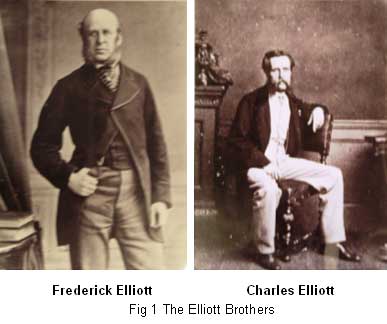
My step-father during my early teenage years worked for Elliott Brothers (the link goes to an interesting history of the firm that started in 1804) in Borehamwood, just north of London. He encouraged me to fiddle with ‘steam’ radios and
try and understand how these basic circuits worked. It was then a small step to deciding to become a radio amateur, popularly known as a radio ham! In those days it was a case of some pretty intensive studying to pass a Theory exam as well as being able to pass an exam in sending and receiving Morse code.
So joining the local radio society seemed like a sensible idea. That was (and still is!) called the Radio Society of Harrow. That it is still in existence after all these years is truly delightful. Those Friday night sessions at the Society and extra-curricular classes on Sunday morning at Ron Ray’s (G2TA) house, an hour’s bicycle ride away from home, ensured that shortly after my 16th birthday I was granted a Licence, G3PUK. It was a very proud moment.
Anyway, once granted a licence it was time to build my own radio transmitter. Most of the details have been lost in the mists of time but what is recalled was that the final amplifier was a pair of 803s driving an 813 (These are radio valve numbers). It sounds like something from the ark! But again ploughing the inexhaustible files of the Web, it’s possible to see what these radio valves looked like. Thanks to the National Valve Museum.
Here are pictures, courtesy of the National Valve Museum of those two radio valves:
803 – The substantial wide glass tube envelope is 58 mm in diameter (2 1/4 in) and, excluding the special five pin base pins, is 216 mm tall (8 1/2 in).
813 The classic envelope is substantial at 60 mm diameter (2 1/3 in) and 170 mm (6 2/3 in) long excluding the special base pins. The anode is 53 mm long and 48 mm wide. The metal is 1 mm thick.
803 radio valve813 radio valve
It’s difficult, today, to imagine devices which are essentially diodes (well, technically the 803 was a pentode and the 813 a tetrode) being between 6 and 8 inches tall!
My own self-build transmitter had not really been successful emitting more heat than light, so to speak. Literally, in the sense that these large radio valves kept me warm in my converted garden shed at the bottom of the garden. They also completely wiped out TV reception for those households with a 1/4 mile range that had invested in early television sets! It was time to move on to the R1155.
Around this era, less than 20 years after the end of the War in Europe in 1945, war-surplus equipment was widely available including ‘compact’ transmitter-receiver units.
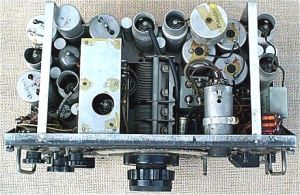
One popular one was the RAF R1155 which had been fitted to RAF Lancaster bombers and RAF marine craft. It was also fitted to the Sunderland flying boat. This information plus the photos below is from this fascinating web site for those wishing to be ‘geeky’ about this.
RAF R1155B transreceiverInternal view of the R1155B
Just compare the view on the right to the inside of your domestic radio or your cell phone.
A lot happens in 50 years!
My personal journey now leaps to 1978 and I have just left IBM UK having had 8 fabulous years with them as an Office Products salesman. My fledging company, Dataview Ltd, has just become the 8th Commodore Computer (CBM) dealer in the UK, based in a small office in Colchester, Essex, about 50 miles north-east of London.
The CBM PET (Personal Electronic Transactor) released in 1977 initially with a calculator type keyboard was useless for any business application but soon came out with a typewriter sized keyboard, making it a more viable business
CBM computer, circa 1978
machine. Today, as this is typed on an ‘old’ laptop with 2GB RAM, it seems unbelievable that these CBMs were sold with between 4k and 96k of RAM (memory) and no hard disk, although one could purchase an add-on that comprised dual 5 1/2 inch floppy disk drives.
YouTube obligingly finds a short video on the Commodore PET for those really wishing to enjoy the nostalgia!
So to turn to the 21st century and to run out of understanding. We appear to live in a world of multi-later printed circuit boards of unimaginable (to me) component density, assuming that the word ‘component’ is even relevant today.
Haven’t a clue what this is but it’s very modern.
What an amazing period it has been!
A long way from yesterday!
Now let me see was it Pin 920 to Pin 140, or Pin14 to Pin 860 connected to Pin 56 ………?
Not quite how you would expect a crocodile to behave!
With thanks to Christine over at 350 or bust who published on Saturday, 30th June.
Then a web search found a more extensive video.
Pocho, the “domesticated” Costa Rican crocodile that gained international attention for a weekly show he performed with owner Gilberto Sheedan, died Tuesday at Finca Las Tilapias in the Caribbean-slope town of Siquirres. Olga Valle, Sheedan’s wife, said the nearly 1,000-pound croc died a natural death at age 50. A funeral will be held for Pocho on Sunday at 1 p.m.
“All of the people in the village have offered their condolences and assistance,” Valle said.
On past Sundays, Pocho and “Chito,” as Sheedan was better known, performed a show for visitors in a 100-square-meter artificial lake at Finca Las Tilapias. Chito, 54, declared the one-eyed crocodile “domesticated.” He could command Pocho to do tricks such as winking its one good eye, lifting its head and tail out of the water, rolling over and permitting Chito to stick his head inside the massive reptile’s maw.
Chito found the 5-meter-long crocodile near death on the shore of the Parismina River, in the Limón province, 17 years ago. The crocodile had been shot in the left eye. Chito and several friends loaded the animal into a boat and took him to Siquirres, where Pocho was nursed back to health. Chito even slept with the crocodile during its recovery.
After an employee saw Chito swimming with Pocho one day, word of the duo’s friendship spread. In July 2000, Costa Rica’s Channel 7 filmed the unusual pair. Chito and Pocho became stars, receiving attention as far as the United States, Chile and the United Kingdom.
The Environment, Energy and Telecommunications Ministry allowed Chito to keep the crocodile as long as they could monitor it. Chito worked with a veterinarian and a biologist and fed Pocho 30 kilograms of fish and chicken a week.
Chito never imagined the fame that would come from the unique friendship. All he wanted was an animal companion. A sign on his ranch emphasized that relationship: “Chito and Pocho are best friends.”
“I just wanted him to feel that someone loved him, that not all humans are bad,” Chito told The Tico Times in 2007. “I love all animals, especially ones that have suffered.”
Love is really the solution to practically every problem in the world!
So why do we insist of manipulating the genetics of food!
I read somewhere recently, and of course now can’t find the reference, that the genetic modification of our food represents as big a danger to the long-term survival of man as does the damage to our biosphere.
So a recent item on the blog Food Freedom News jumped out at me. This was an item that was introduced as, “The author of Seeds of Destruction (about Monsanto) has a new piece out on pesticides and mass animal deaths… very sobering.”
Clicking on the ‘new piece’ link takes one to here, from which I quote the opening paragraphs,
“A recent study showed that every human tested had the world’s best-selling pesticide, Roundup, detectable in their urine at concentrations between five and twenty times the level considered safe for drinking water.”
Birds and bees are something most of us take for granted as part of nature. The expression “teaching about the birds and the bees” to explain the process of human reproduction to young people is not an accidental expression. Bees and birds contribute to the essence of life on our planet. A study by the US Department of Agriculture estimated that “…perhaps one-third of our total diet is dependent, directly or indirectly, upon insect-pollinated plants.”
The honey bee, Apis mellifera, is the most important pollinator of agricultural crops. Honey bees pollinate over 70 out of 100 crops that in turn provide 90% of the world’s food. They pollinate most fruits and vegetables–including apples, oranges, strawberries, onions and carrots. But while managed honey bee populations have increased over the last 50 years, bee colony populations have decreased significantly in many European and North American nations. Simultaneously, crops that are dependent on insects for pollination have increased. The phenomenon has received the curious designation of Colony Collapse Disorder (CCD), implying it could be caused by any number of factors. Serious recent scientific studies however point to a major cause: use of new highly toxic systemic pesticides in agriculture since about 2004.
That first paragraph alone made me sit up, “A recent study showed that every human tested had the world’s best-selling pesticide, Roundup, detectable in their urine at concentrations between five and twenty times the level considered safe for drinking water.” What a strange race we are!
Wlliam F. Engdahl
Then it was easy to find out more information about the author of the book Seeds of Destruction, William F. Engdahl, including his website. Mr. Engdahl is clearly no stranger to controversy as this YouTube video illustrates,
Back to that Food Freedom article. Further on, there is evidence of the size of the problem in the UK,
Alarming UK results
A private UK research organization, Buglife and the Soil Association, undertook tests to try to determine cause of the bee death. They found that the decline was caused in part by a group of pesticides called neonicotinoids. Neonicotinoids are “systemic” chemicals that kill insects by getting into the cell of the plant. In Britain it’s widely used for crops like oilseed rape and for production of potted plants.
The neonicotinoids are found in the UK in products including Chinook, used on oilseed rape and Bayer UK 720, used in the production of potted plants which then ends up in gardens and homes around the country. The new study examined in detail the most comprehensive array of peer-reviewed research into possible long-term effects of neonicotinoid use. Their conclusion was that neonicotinoid pesticides damage the health and life cycle of bees over the long term by affecting the nervous system. The report noted, “Neonicotinoids may be a significant factor contributing to current bee declines and could also contribute to declines in other non-target invertebrate species.” The organization called for a total ban on pesticides containing any neonicotinoids.
The president of the UK Soil Association, Peter Melchett, told the press that pesticides were causing a continued decline in pollinating insects, risking a multimillion pound farming industry. “The UK is notorious for taking the most relaxed approach to pesticide safety in the EU; Buglife’s report shows that this puts at risk pollination services vital for UK agriculture,” he said.
Indeed in March 2012 Sir Robert Watson, Chief Scientist at the British Government’s Department of Environment announced that his government was reconsidering its allowance of neonicotinoid use in the UK. Watson told a British newspaper, “We will absolutely look at the University of Stirling work, the French work, and the American work that came out a couple of months ago. We must look at this in real detail to see whether or not the current British position is correct or is incorrect. I want this all reassessed, very, very carefully.” To date no policy change has ensued however. Given the seriousness of the scientific studies and of the claims of danger, a prudent policy would have been to provisionally suspend further uise of neonicotinoids pending further research. No such luck.
And if the harm to bees wasn’t serious enough, try this extract,
Effect on Human Brain?
But most alarming of all is the evidence that exposure to neonicotinides has horrific possible effects on humans as well as on birds and bees.
Professor Henk Tennekes describes the effects:
“Today the major illnesses confronting children in the United States include a number of psychosocial and behavioral conditions. Neurodevelopmental disorders, including learning disabilities, dyslexia, mental retardation, attention deficit disorder, and autism – occurrence is more prevalent than previously thought, affecting 5 percent to 10 percent of the 4 million children born in the United States annually. Beyond childhood, incidence rates of chronic neurodegenerative diseases of adult life such as Parkinson’s disease and dementia have increased markedly. These trends raise the possibility that exposures in early life act as triggers of later illness, perhaps by reducing the numbers of cells in essential regions of the brain to below the level needed to maintain function in the face of advancing age. Prenatal and childhood exposures to pesticides have emerged as a significant risk factor explaining impacts on brain structure and health that can increase the risk of neurological disease later in life.”
There is also growing evidence suggesting persistent exposure to plants sprayed with neonicotinoids could be responsible for damage to the human brain, including the recent sharp rise in incidents of autism in children.
This really is an article that you should read in full, which also includes a full bibliography and notes section. Plus you can leave your responses as a comment – go for it!
While going through previously published Posts, I came across two, first shown on the 17th & 18th August, 2009, that seemed a better fit being rolled into one.
So here they are.
oooOOOooo
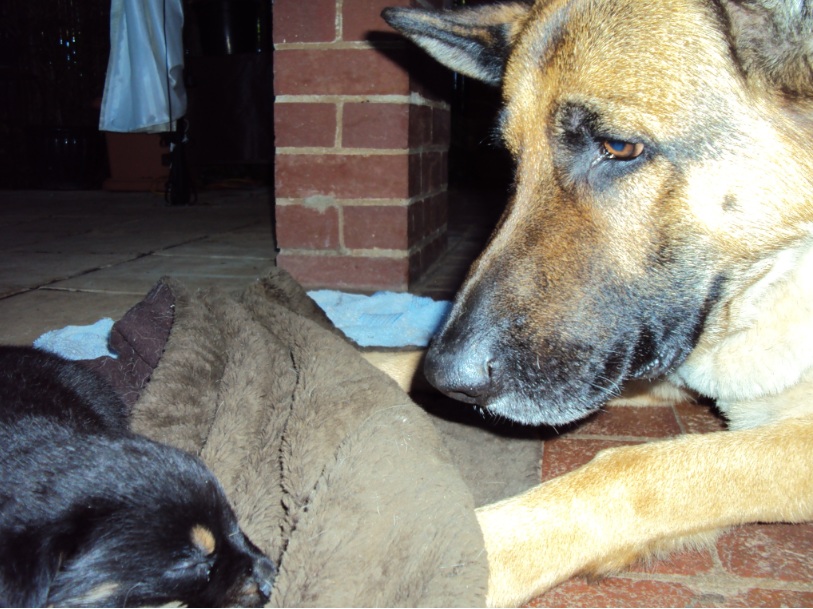
This is not my dog but it brings out the same feelings in me as if I was looking at my German Shepherd.
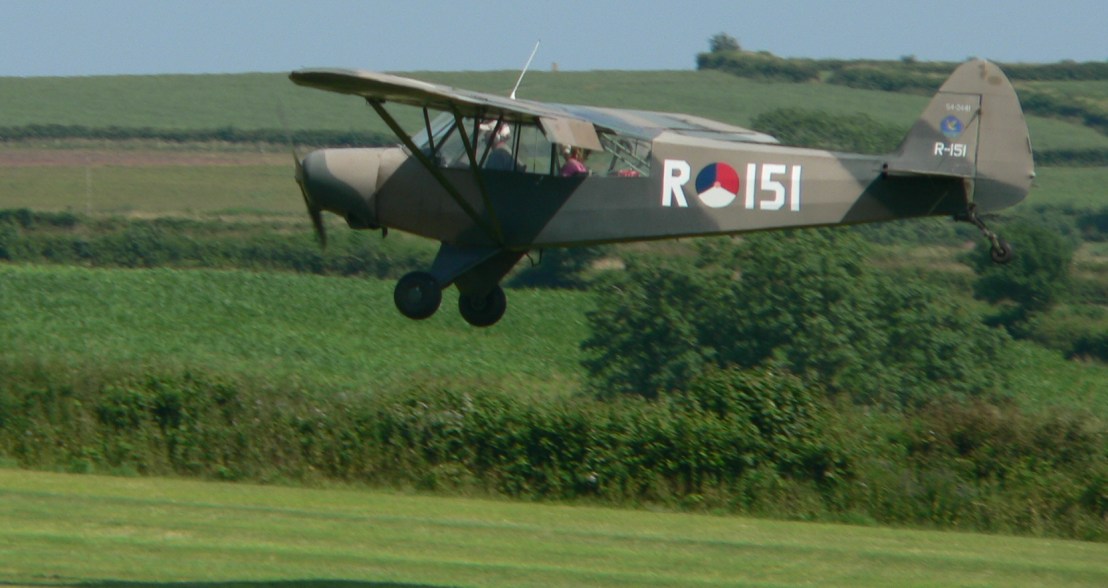
And this is my German Shepherd! The photograph was taken in 2006 when Pharaoh was 3 years old. The aircraft, by the way, is an L21B, the military variant of the Piper Super Cub. The aircraft was originally delivered to the Dutch Air Force in 1954 and has dispensation from the UK CAA to retain the original registration and callsign of R151.
oooOOOooo
More on the aircraft.
Originally when the first half of today’s Post was published separately readers asked for more information on the aircraft.
So here it is.
Piper Super Cub, L-21B, R-151
A/C Construction No. 18-3841, Frame No. 18-3843
Original Engine, Lycoming 135 Type 0-290-D2, 54/2441
Romeo 151 was one of a batch of 298 L-21’s delivered in 1954. There were 584 L-21B’s produced by Piper for military use, the ‘L’ standing for Liaison. The L-21B’s were PA-18-135’s with civil Lycoming 0-290-D2 engines, glasswork as most L-21A’s and L-18’s and a gross weight of 1760 lbs.
This aircraft was delivered to Koninklijke Luchtmacht, Dutch Air Force, on the 1st July, 1954 and registered R-151. After various homes R-151 transferred to the Dutch civil register as PH-GER, 1st April 1976 with 4,458 hours and shortly thereafter was registered to Vlieclub Hoogeveen, Certificate Number 2380.
On the 27th March, 1981 the aircraft was delivered to the UK with a total time of 5,043 hours and in September, 1981 became G-BIYR. In April, 1983 YR was the first of type to be given a Public Transport CofA and was used for training at Tollaton. YR reverted to a Private CofA in January, 1984 when purchased by Mike and Barbara Fairclough at 5,120 hours.
In 1992 YR was re-engined with a Lycoming 150HP, 0320-A2B No. L49809-27A (zero hours). Finally on the 2nd June, 1995 the a/c was repainted in original Dutch insignia and given CAA (UK Civil Aviation Authority) permission to use the original call-sign, Romeo 151.
The aircraft is based in South Devon, England and owned by the five members of the Delta Foxtrot Flying Group.
A few photos of the aircraft.
Approaching home airfield in South Devon, EnglandFlying in the French Alps, Mt Blanc in sight9,300 ft up in the French Alps
















 Learning from Dogs