I was doing some research for another writing project about the history of the domestication of the dog and came across a peer-reviewed article on The National Center for Biotechnology Information website, here in the USA. The article was entitled: Genome-wide SNP and haplotype analyses reveal a rich history underlying dog domestication. The website link is here. (As an aside, if you drop in here and look at the NCBI sitemap it may well serve as an excellent resource.)
Anyway, the dog domestication article is, of necessity, highly scientific but nonetheless worth the read. Here’s a taste from the Abstract.
Advances in genome technology have facilitated a new understanding of the historical and genetic processes crucial to rapid phenotypic evolution under domestication 1,2. To understand the process of dog diversification better, we conducted an extensive genome-wide survey of more than 48,000 single nucleotide polymorphisms in dogs and their wild progenitor, the grey wolf. Here we show that dog breeds share a higher proportion of multi-locus haplotypes unique to grey wolves from the Middle East, indicating that they are a dominant source of genetic diversity for dogs rather than wolves from east Asia, as suggested by mitochondrial DNA sequence data 3
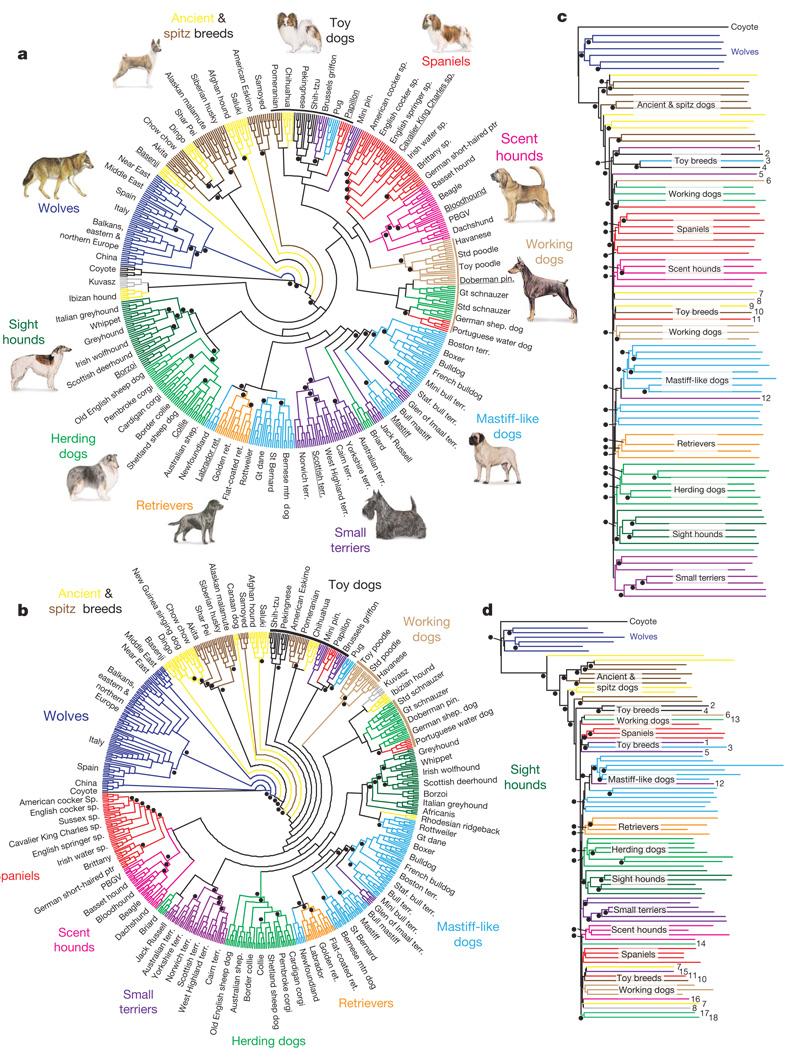
But what really caught my eye was Figure 1, a wonderful illustration of the links between all the breeds of dogs and the grey wolf.
Neighbour-joining trees of domestic dogs and grey wolves.
Branch colour indicates the phenotypic/functional designation used by dog breeders 8,9. A dot indicates ≥95% bootstrap support from 1,000 replicates. a, Haplotype-sharing cladogram for 10-SNP windows (n = 6 for each breed and wolf population). b, Allele-sharing cladogram of individuals based on individual SNP loci. c, Haplotype-sharing phylogram based on 10-SNP windows of breeds and wolf populations. d, Allele-sharing phylogram of individual SNPs for breeds and wolf populations. For c and d, we note breeds where genetic assignments conflict with phenotypic/functional designations as follows: 1, Brussels griffon; 2, Pekingese; 3, pug; 4, Shih-tzu; 5, miniature pinscher; 6, Doberman pinscher; 7, Kuvasz; 8, Ibizian hound; 9, chihuahua; 10, Pomeranian; 11, papillon; 12, Glen of Imaal; 13, German shepherd; 14, Briard; 15, Jack Russell; 16, dachshund; 17, great schnauzer; and 18, standard schnauzer. Gt, great; mtn, mountain; PBGV, petit basset griffon vendeen; pin., pinscher; ptr, pointer; ret., retriever; shep., shepherd; sp., spaniel; Staf., Staffordshire; std, standard; terr., terrier. Canine images not drawn to scale. Wolf image adapted from ref. 31; dog images from the American Kennel Club (http://www.akc.org).
The diagram on its own was a bit of a struggle but looked at in conjunction with the research paper was much better understood. Another reason for going to the original article on the NCBI website is the interesting range of links to other scientific papers that may be seen to the right-hand side of the screen. For example:
The mean sequence distance to ancestral haplotypes indicates an origin 5,400-16,300 years ago (ya) from at least 51 female wolf founders. These results indicate that the domestic dog originated in southern China less than 16,300 ya, from several hundred wolves. The place and time coincide approximately with the origin of rice agriculture, suggesting that the dogs may have originated among sedentary hunter-gatherers or early farmers, and the numerous founders indicate that wolf taming was an important culture trait.
Mitochondrial DNA sequences isolated from ancient dog remains from Latin America and Alaska showed that native American dogs originated from multiple Old World lineages of dogs that accompanied late Pleistocene humans across the Bering Strait. One clade of dog sequences was unique to the New World, which is consistent with a period of geographic isolation. This unique clade was absent from a large sample of modern dogs, which implies that European colonists systematically discouraged the breeding of native American dogs.
If you needed a reminder of the Pleistocene period, as I did, there’s a helpful Wikipedia entry here.
The final link that I wanted to highlight was this one, for all dog owners who worry about the health of our dogs.
Dogs exhibit more phenotypic variation than any other mammal and are affected by a wide variety of genetic diseases. However, the origin and genetic basis of this variation is still poorly understood. We examined the effect of domestication on the dog genome by comparison with its wild ancestor, the gray wolf. We compared variation in dog and wolf genes using whole-genome single nucleotide polymorphism (SNP) data. The d(N)/d(S) ratio (omega) was around 50% greater for SNPs found in dogs than in wolves, indicating that a higher proportion of nonsynonymous alleles segregate in dogs compared with nonfunctional genetic variation. We suggest that the majority of these alleles are slightly deleterious and that two main factors may have contributed to their increase. The first is a relaxation of selective constraint due to a population bottleneck and altered breeding patterns accompanying domestication. The second is a reduction of effective population size at loci linked to those under positive selection due to Hill-Robertson interference. An increase in slightly deleterious genetic variation could contribute to the prevalence of disease in modern dog breeds.
Have to say that there are some fabulous learning opportunities from the enormous range of websites available nowadays.
Last week was set four of the Perfect timing pictures.
From now on, well at least for several weeks or more, a general selection of photographs that have grabbed my attention will be presented every Sunday. Today, photographs sent to me by Neil Kelly in Devon.
In the wake of yesterday’s post about the power of meditation, this recent TED Talk seemed a perfect way to end the week.
Published on Jul 16, 2013
You don’t need to plan an exotic trip to find creative inspiration. Just look up, says Gavin Pretor-Pinney, founder of the Cloud Appreciation Society. As he shares charming photos of nature’s finest aerial architecture, Pretor-Pinney calls for us all to take a step off the digital treadmill, lie back and admire the beauty in the sky above.
Want to learn a little more about the different types of cloud? Then go here. Want to learn more about the Cloud Appreciation Society? More details here.
And who knows, you may even see your dog in those clouds!
The healing power of meditation and self-reflection.
Yesterday, I wrote about two seemingly disconnected events that appeared to resonate together. One of those was a comment left by reader Patrice Ayme.
But that harmony didn’t stop with those two events. Here’s how it continued to flow.
Patrice has a recently published post called Consciousness I. To be honest, some of the concepts have been a bit of a struggle for me to understand. However, at one point in that essay, Patrice wrote:
Meditation is a most precious, most human state of consciousness. Whereas sentience is shared with many animals on this planet, obviously, not so with the capacity for meditation. meditation allows to shut down most (over-) used neuronal circuitry, and engage more strategically important parts of the brain.
Action without meditation is as slavedom without wisdom.
That really struck a chord with me because, once again, the power of meditation has been brought into focus. Regular readers of Learning from Dogs may recall that just six days ago, I wrote a piece called Maybe home is found in our quietness. There were three references to meditation in that post that I will take the liberty of repeating today.
The first was:
A few weeks ago when meeting our local doctor for the first time since we moved to Oregon, I had grumbled about bouts of terrible short-term memory recall and more or less had shrugged my shoulders in resignation that there was nothing one could do: it was just part of getting older, I guessed!
“On the contrary”, responded Dr. Hurd, continuing, “There’s growing evidence that our information-crowded lives: cell phones; email; constant TV; constant news, is pumping too much for our brains to manage.”
Dr. Hurd continued, “Think about it! Our brains have to process every single sensory stimulus. The research is suggesting that our brains are being over-loaded and then the brain just dumps the excess data. If that is the case, and the evidence is pointing in that direction, then try thirty minutes of meditation each day; give your brain a chance to rest.”
Then later on in that post came:
The second was a recent science programme on the BBC under the Horizon series. The programme was called,The Truth About Personality.
…….
Within the programme came the astounding fact that even ten minutes a day meditation can help the brain achieve a more balanced personality (balance in terms of not being overly negative in one’s thoughts).
The last one was in a short talk by writer Pico Iyer meditating on the meaning of home, the joy of traveling and the serenity of standing still.
Now come forward just three days to last Tuesday evening. Jean and I sat down and more or less randomly wondered if there was something of interest to watch on the website Top Documentary Films. Just by chance, we came across a film by filmmaker Isabelle Raynauld with the title of Mystical Brain.
Here’s a tiny snippet from the film:
Filmmaker Isabelle Raynauld offers up scientific research that suggests that mystical ecstasy is a transformative experience.
It could contribute to people’s psychic and physical health, treat depression and speed up the healing process when combined with conventional medicine.
This documentary reveals the exploratory work of a team from the University of Montreal who seek to understand the states of grace experienced by mystics and those who meditate. In French with English subtitles.
However, as interesting as this snippet is, the power of the film is in the area of spirituality and the way that meditation can open up the brain to an incredible range of mystical experiences, as well as the impressive health benefits of slowing the mind. Maybe, just maybe, the power of religious and spiritual experience is being understood, with some very surprising results.
To underscore why the film should be watched, there is much about the nature of the theta rhythms in the brain. The relevance of these? Simply that when the brain is generating these regular slow oscillations the human condition is one of great peace.
Dhalia showing us humans how easy it is to meditate!
Call it prayer, meditation, relaxation, building internal energy or life force, compassion, love, patience, generosity or forgiveness; what does it matter. It’s what it is doing to you that matters!
So when you bury your face in the warm fur of your beautiful dog and both you and your dog appear to be transported to some beautiful, magical place you have entered that indestructible sense of well-being.
Actually, let me make one small correction. Both you and your dog have entered that indestructible sense of well-being.
Only one way to finish today’s post: “I think, therefore I am!” René Descartes.
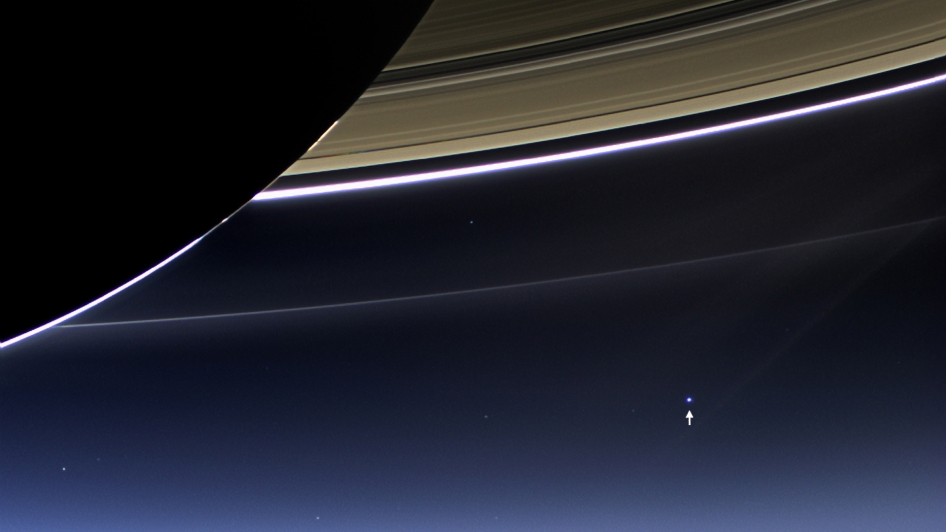
The full description may be read here, but I have taken the liberty of republishing this extract:
Earth, which is 898 million miles (1.44 billion kilometers) away in this image, appears as a blue dot at center right; the moon can be seen as a fainter protrusion off its right side. An arrow indicates their location in the annotated version. The other bright dots nearby are stars.
Now it doesn’t take too much imagination to put that minute speck of light, our Planet Earth, into its scale of meaning and importance vis-a-vis the universe. You get my message, I’m sure.
The second event was a comment left by long-term reader and supporter of Learning from Dogs, Patrice Ayme. The comment was on yesterday’s post, The meaning of wildness, and I quote:
Excellent article. Clearly primary temperate rain forest, nearly gone everywhere except in the American North west, has to be reintroduced.
Sheep ought not to be removed by man, but be removed by wolf, bear, felids. Cows would feel whole, having to fight off lions. And man’s sense of what nature means, vital to insure our survival, would blossom in this hour of need, when we have arisen as the planet’s gods. gods of evil, or gods of wisdom? That is the most important question.
“gods of evil, or gods of wisdom?”
To everybody I say this. (And I am most certainly not excluding me.) When you next look at yourself in the mirror will you make a decision? Will you be a god of evil or a god of wisdom?
“Reality is merely an illusion, albeit a very persistent one.”
So said Albert Einstein.
The reason I went searching for a quotation on reality was that our, as in humans, ability to see the world in grossly distorted ways jumped ‘off the page’ at me when I was reading a recent essay from George Monbiot. Followers of Learning from Dogs will know that Mr. Monbiot has featured before; most recently just under a month ago in a post Returning to Nature. Before then in April when George gave permission for the full republishing of his essay The Great Unmentionable.
“Comfort the afflicted, afflict the comfortable.”
Why the notion of humans seeing reality in grossly distorted ways? Simply because in George Monbiot‘s following essay he challenges what we mean by the word ‘wildness’ and I immediately realised that my own idea of wildness was badly corrupted.
See if you react the same way as you read The Naturalists Who Are Terrified of Nature by George Monbiot, republished in full with the kind permission of George.
oooOOOooo
The Naturalists Who Are Terrified of Nature
July 16, 2013
A radical challenge to British conservation and its bizarre priorities.
I’m writing this on the train home, after visiting two places in the north of England celebrated for their “wildness”. One of them is Ennerdale in the Lake District, now officially known as Wild Ennerdale, a valley in which the river has been allowed to move freely once more, and in which native trees are succeeding naturally up the hillsides(1).
The other is the Sheffield Moors (in the Peak District), from which most of the sheep have been removed and where the structure of the vegetation has been allowed to change a little. I found both visits fascinating, not least because of the eruditon and enthusiasm of the people who walked me through these places.
But sitting on the train, watching the chemical deserts of the English lowlands flash past, I’m struck by how pathetically grateful I feel. For what? For the fact that, in two small conservation areas, located in national parks, a few natural processes have been allowed to resume.
Were I to explain to a foreigner that these places are now celebrated by conservationists in Britain for their radical approach, he or she would think I had gone mad. “What?,” they would say, “you are telling me that this is the cutting edge of nature conservation in your country? Where have you been for the past 50 years?”
I don’t know if there is any other country in which people – including conservationists – are as afraid of nature as they are in Britain. I don’t know if there is anywhere else in which conservationists are so convinced that if they relax their intensive management of the natural world, something dreadful will happen.
Nowhere else do conservationists subscribe more enthusiastically to the biblical doctrine of dominion: that we have a holy duty to control and corral nature, in case it gets out of hand. Nowhere else does conservation look more like a slightly modified version of the farming which trashed the land in the first place.
In my view most of our conservation areas aren’t nature reserves at all. They are museums of former farming practices, weeded and tended to prevent the wilds from encroaching. The ecosystem’s dynamic interactions are banned. Animals and plants are preserved as if they were a jar of pickles, kept in a state of arrested development, in which little is allowed to change.
But nature is not just a fixed assemblage of species, maintained as if it were a collection in a museum. It is also the ever-changing relationships between them, the successional processes, the shifting communities: all of which, in many of our reserves, are prohibited.
The problem begins with designation. The “interest features” of a site of special scientific interest – its species and habitats – must be kept in “favourable condition”. Often this means the condition in which they happened to be when the reserve was created. In most cases that’s a condition of dire impoverishment and depletion: ecosystems missing almost their entire trophic structure, most of their large herbivores, all their large predators, in many cases even the trees. They have to be kept like this by extreme and intrusive management, in order to sustain the impacts which reduced them to this woeful state.
In Wild-ish Ennerdale and on the Sheffield Moors, there has been a partial relaxation of this draconian regime. But even in these places, there is much that I question.
On the Sheffield Moors, for example, cattle are kept: at much higher densities and for far longer periods than large herbivores would exist in a self-willed ecosystem. In many parts of the moors, trees, if they have the temerity to return, are cleared. The effort, even here, is to ensure that the landscape remains farmed, open and bare.
This is done partly to favour breeding populations of wading birds(2). It’s likely that these species are being maintained at artificially high populations(3). A tendency I’ve noticed among some groups is to try to make all their target species common, even if they were naturally rare. Perhaps some species ought to be rare. Those which lived in open habitats – which would have been small and occasional before people started cutting and burning the forests – are likely to have been rarest of all.
Think of the varying fortunes of grouse populations in Britain. The palaeontological evidence is extremely sparse, so this is guesswork, but during the Boreal and Atlantic phases, 9,000-5,000 years ago, when closed-canopy forest covered most of Britain, the commonent grouse species in this country might have been hazel hen. Perhaps the second commonest would have been capercaillie, followed by black grouse, followed by red grouse, which are likely to have been very scarce.
That likely sequence has now been reversed. Hazel hen is extinct, capercaillie extremely rare, black grouse are sparse and in severe decline and red grouse are bloody everywhere. The red grouse is the magpie of the uplands: it benefits from human intervention, which in this case means the clearing of land.
Arbitrarily, conservation groups in the uplands of England and Wales have decided that their priorities are, for example, dunlin and curlew, rather than capercaillie and pine martens. I’m not insisting that this is always the wrong decision. But it’s a decision that should be rigorously questioned, especially if this intensive management means the destruction of habitats which would have sheltered a much wider range of species.
Spend a couple of hours in an open upland nature reserve, and count the diversity and abundance of the birds you see. Then spend a couple of hours in a bushy suburban garden and do the same thing. In my experience you’re likely to see more birds of more species in the garden. That’s hardly surprising: most birds – indeed most wildlife – require cover to survive. Am I the only one who thinks that something has gone badly wrong here?
It’s not just common species I’m talking about. Many of those excluded by our brutal upland management are not just rare in Britain; they are extinct.
Whenever I meet a conservation manager, I find myself acting like a 3-year old: I keep asking “why?”. Why are you preserving this and not that? Why is this site designated for moorland flea beetle and pearl-bordered fritillary, rather than blue stag beetle and lynx? Why are you protecting the wretched scrapings of life that remain here, rather than reintroducing the species which would once have lived here, but have been excluded by the kind of interventions that you – the conservationists – have sustained?
When I worked in the Amazon, the conservationists I met were fighting to defend the rainforest against cattle ranching. In Britain the conservationists are – literally – defending cattle ranching against the rainforest. Britain was once covered by rainforest: woodland wet enough for epiphytes to grow. (Epiphytes are plants which root in the bark of trees). Our closed-canopy rainforest was likely to have been richer in species than any of our remaining habitats. Given half a chance, it would return. But it isn’t given half a chance, even in conservation sites, because conservationists keep clearing the land and running cattle on it, in case the wayward and irresponsible ecosystem does something that isn’t listed in the rules. In doing so, they preserve a burnt, blasted and largely empty land with the delightful ambience of a nuclear winter.
Conservation groups in this country are obsessed by heather. Heather is typical of the vegetation that colonises land which has been repeatedly deforested. You can see similar vegetation – low, scrubby, tough, thriving on burnt ground and depleted soils – covering deforested land all over the tropics. There, the dominance of these plants is lamented by ecologists, for it is rightly seen as a symptom of ecological destruction. Here it is fetishised and preserved.
Even in the Eastern Sheffield Moors management plan, published by the RSPB and the National Trust, “cutting and burning” are listed as the requisite tasks for managing heather(4). Imagine what a tropical ecologist would say if she saw that. “You people have been telling us for decades that we should stop cutting and burning. You’ve been sending us money and lobbying our governments to discourage us from doing it. And all the while you’ve been telling yourselves that cutting and burning are necessary for the protection of wildlife.” If she concluded that we are hypocrites, that we are unambitious, irrational, anally retentive and ecologically illiterate, she would not be far wrong.
The same plan reveals that these two august conservation bodies will maintain cattle on the moors at their current level, but keep them there for longer. “Their grazing and trampling will manage the vegetation in a way which should improve the condition of the habitats and benefit wildlife.”(5) What does this mean? Yes, it might benefit some wildlife, but only at the expense of other species. Yes, it might “improve the condition” of a habitat, if by improvement you mean a better representation of the state of arrested development you’ve chosen. It sounds uncomfortably close to the 19th Century agricultural meaning of “improvement”: which means draining and clearing land to make it more suitable for farming.
It astonishes me to see statements like this left unpacked. Asserted without qualification, they create the impression that all wildlife benefits from management of this kind. Of course, all interventions (including a complete cessation of management), are better for some species than for others. But in my view, the losses inflicted by cattle ranching – here, as in the Amazon – outweigh any gains.
An even starker example is provided by a report commissioned by the RSPB on changing livestock numbers. It contends that “undergrazing and loss of vegetation structure is now occurring in some areas, with adverse impacts for some species such as golden plover and other waders.”(6)
“Undergrazing” is an interesting concept. The report seems to be referring to “undergrazing” by sheep. How can a native ecosystem be undergrazed by an invasive ruminant from Mesopotamia? Is our wildlife underhunted by American mink? Are our verges underinfested by Japanese knotweed?
I would question what undergrazing by any domestic animal means. “Not farmed enough” is what the term appears to signify, “or not sufficiently damaged”. Sure, the golden plover is among a small group of species that benefit from scorched-earth policies, but a far greater number are harmed by them. So why is the golden plover the priority? And how can a report for a conservation organisation blithely use the term undergrazing without qualification or explanation?
Another RSPB report advocates “the eradication of invasive tree species” from the bare uplands of Wales and claims, without citing any evidence or explaining what this means, that “extensive grazing, ideally mixed grazing, is important in maintaining upland pastures in a state that benefits upland birds and other wildlife.”(7)
A document published by the Welsh government revealed something I have never seen in the RSPB’s literature: that the society advises farmers “to cut down trees to discourage buzzards which kill other birds.”(8)
I checked with the RSPB in Wales and it confirmed that it does “at times provide advice to landowners on the management of trees to reduce available vantage points and nest sites for some avian predators.”(9)
Isn’t that more or less what the British government wanted to do to protect pheasant shoots? And didn’t the society contest those efforts?(10)
I wonder whether, in their arbitrary choice of target species and target habitats, British conservationists are influenced by the legacy of hunting. Many of the birds on behalf of which this extreme and brutal simplification of the ecosystem takes place are those which, in the 19th Century, were pursued by gentlemen with guns. Perhaps we should see conservation efforts in Britain as a form of gamekeeping, which regards some of our native species as good and worthy of preservation, and others (such as trees and buzzards) as bad and in need of control.
Sometimes I receive coherent answers from the conservation managers I speak to, which are debatable but at least consistent. Sometimes the only answer I receive is “that’s what the rules say.” But isn’t it time we began to challenge the rules? Isn’t it time we began to question the way sites are designated, and to challenge the ecological blitzkreig required to maintain them in what is laughably called “favourable condition”? Isn’t it time we began asking why we have decided to privilege certain species over others? Isn’t it time we started wondering whether the collateral damage required to support them is worth it?
After all, how did nature cope before we came along? To judge by the actions of British conservation groups, it must have been in a pretty dismal state for the three billion years before humans arrived to look after it.
2. National Trust and RSPB, 2012. The Eastern Moors Management Plan summary, page 15. Eastern Moors Partnership, Curbar.
3. This, of course, is speculative, as palaeontology gives us few indications of numbers. But the circumstantial evidence seems powerful: the habitat required for breeding populations of these birds, many of which need to nest several hundred metres from the nearest woodland edge to avoid predation, was in short supply. See for example:
NJ Whitehouse and D Smith, 2010. How fragmented was the British Holocene wildwood? Perspectives on the ‘‘Vera’’ grazing debate from the fossil beetle record. Quaternary Science Reviews Vol. 29, nos. 3-4, pp539–553. doi.org/10.1016/j.quascirev.2009.10.010
FJG Mitchell, 2005. How open were European primeval forests? Hypothesis testing using palaeoecological data. Journal of Ecology Vol. 93, 168–177
JHB Birks, 2005. Mind the gap: how open were European primeval forests? Trends in Ecology & Evolution Vol. 20, pp154-156.
R Fyfe, 2007. The importance of local-scale openness within regions dominated by closed woodland. Journal of Quaternary Science, Vol.22, no. 6, pp571–578. doi: 10.1002/jqs.1078
JC Svenning, 2002. A review of natural vegetation openness in northwestern Europe. Biological Conservation Vol 104: 133-148.
RHW Bradshaw, GE Hannon, AM Lister, 2003. A long-term perspective on ungulate-vegetation interactions. Forest Ecology and Management, Vol. 181: 267–280.
8. Welsh Government, 2010. Glastir: frequently asked questions, Section 13. This document is no longer available on the government site, but you can read it here: http://www.fuw.org.uk/glastir-faq-miscellaneous.html
9. Emma Roberts, RSPB Wales, 10th August 2011. By email.
Jean and I have been involved in a research programme involving our own dogs here at home. So far, without much success. But it occurred to me that there may be readers who would like to participate. So here’s an email in response to my offer to post something in this place.
Companion Animal Research Group
Pam Smart and I are setting up a Companion Animal Research Group for people who would like to do research with their dogs, cats or other animals. If you have an animal that knows when you are coming home or who seems to respond to your thoughts and intentions telepathically, and if you would like to take part in a simple research project, please get in touch with Pam by email: p.e.smart (at) btinternet (dot) com She will send you further details.
Of course, if you do have such a telepathic animal then they will know about this post before you do! 😉
John Hurlburt writing as ‘an old lamplighter‘ has been a regular contributor to Learning from Dogs. Indeed, just last Friday in my rather introspective post, Maybe home is found in our quietness, I included John’s beautiful Evening Meditation. The day before that post, John sent me the following (the picture below is my contribution to John’s essay!) It’s a reflection on both the absurdity of modern times and the simplicity of the answers.
oooOOOOoo
Our interconnected world.
Bird Seed!
In return for a local pet store patronage, today’s cost savings included free bird seed. Meanwhile, our economic system squanders our common wealth.
The agendas of rich and powerful people who don’t want anything to change are reflected by FAUX News. What we have on our hands is an absurd interpretation of reality, which is made up as they go along. Politics has become a game of “Can You Top This”; with no limits. There’s a question about our collective level of sanity.
Our shared crisis mounts as our demographic increases and our natural resources are depleted accordingly. The fact is that we’re beyond the carbon limits the atmosphere requires to maintain the inclusive well-being of life on earth. And we’re damaging the surface layer of the planet that sustains us all in the process.
The answers are simple and natural. Here are five quick examples and a conclusion of sorts.
1. Diesel fuels run the majority of the world’s heavy machinery. Switching from carbon-based diesel fuels to natural bio-fuels, as per the original design by Rudolf Diesel, would have a profound effect on carbon pollution as well as fostering green innovation and industry. No modification of any on-line diesel engines would be required. As a matter of fact, they’d probably run more efficiently.
Solution: Economic advantage of using bio-fuels.
2. Re-establishing human rights may be best accomplished through increased awareness of our fragile unity as a species. The openness, honesty and integrity of Creation lights the way each day and lends serenity to our reflections.
Solution: Accept that deliberate human war and related destruction of the earth is empty, has no future, and is contrary to the purpose of human life.
Incidentally, when we put a natural floor under the global economy we’ll save our collective bacon in the process. Transitioning military forces to support green economic development opportunities might be a possibility if we decide to take life seriously enough to make a real difference.
3. Re-establishing a realistic base for a global economy that’s swollen 25 times beyond any material planetary resource foundation may best be accomplished by transitioning to green industries that benefit our planet, nations, communities and the sanctity of life in general. A modification to our technically driven financial system is needed.
Solution: Isaac Asimov; “I Robot” (the laws of robotics)
4. Re-establishing common law with inclusive equality and justice may be best accomplished by an in-depth examination of personal beliefs values, motives and actions in terms of respect for whatever Higher Power we may believe there to Be, compassion for Creation and the realization that we’re all living in and on the same life boat.
Solution: Education, formation and transformation based upon the facts of reality that we know in our present state of development and the far greater Reality which transcends our being and our current understanding based upon reason alone.
For example, Einstein’s General and Special Theories of Relativity tell us that we are in the process of turning inside out without breaking. A phrase that comes to mind is “transrational reality”. When we step beyond “self” we see the world through new eyes.
5. Agreeing on an equitably interactive and enforceable world-wide corporate, government, labor, and service organization wage scale may best be accomplished by listening to the voices of economic reason which tell us that money is only a symbol.
Rationale: Everything fits together. Change is constant. Life needs to adapt to survive. In Unity there is strength. At our best, we care for the earth and each other.
Inclusive solution: Surrender to Reality. The global system is broken, Resources are limited. It’s time to wake up. It’s time to change. A sustainable and growing green economy benefits everyone on earth.
Bottom Line
Love lights the way
Faith is stronger than fear
Hope springs Eternal













 Learning from Dogs