My last post was about an accident that I had on the 17th November, last.
Jean is now back home; she came home on Friday, 13th December. However, every day we have a caregiver at home for part of the time. Jean is getting slowly better. I would estimate that at about one percent a day.
I am unsure as to the pattern of my posts. Whether I should go back to scheduling posts three times a week or publish posts on an ad-hoc basis. That will become clearer over the next few weeks.
I am going to start with publishing posts on an ad-hoc basis.
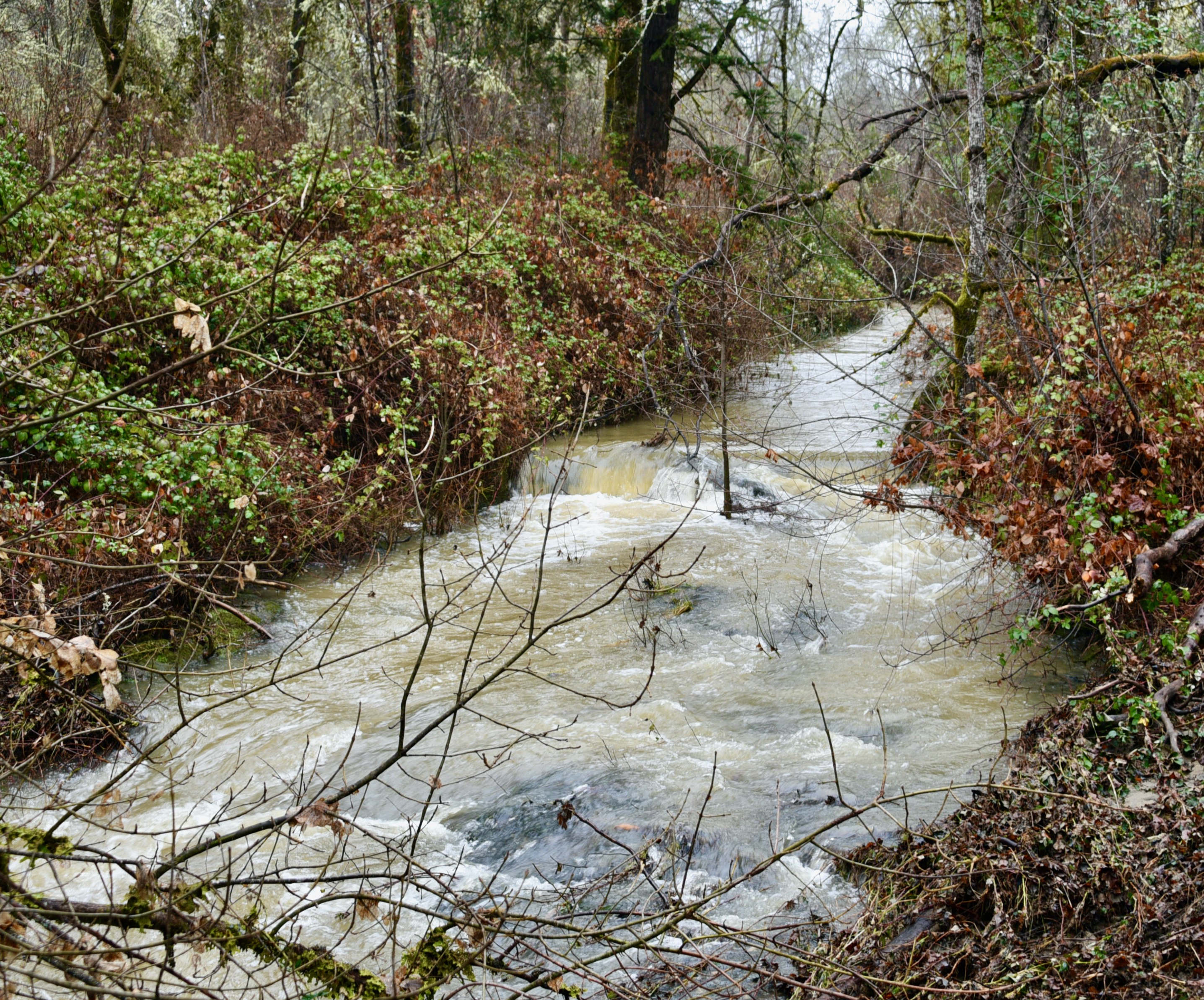
Meanwhile here in Merlin we have had loads of rain.
Bummer Creek
This is the creek that flows across the lower part of the property.
I had a blackout while driving back from the shops last Saturday week, the 17th, swerved and hit an oak tree. Jean and I were both taken to hospital but I was discharged at the end of the day; Jean is still in hospital, the Asante Regional at Medford. Plus the DMV cancelled my driver’s license and the car was declared written off.
Jean is getting better all the time but until she is back home and we can put our heads together about a variety of things I shall not be blogging.
I’m very sorry but that is the way it is at the moment.
Thinking it through thanks to a recent issue of Skeptical Inquirer.
Melanie Trecer-King is the creator of Thinking is Power and the associate professor of biology at the Massasoit Community College, where she teaches a science course designed to equip her students with essential critical thinking, information literacy, and science literacy skills.
The article was published in the November/December, 2024 issue of the magazine. I believe it is free to share.
ooOOoo
Most people agree that critical thinking is an important skill that should be taught in schools. And most educators think they teach critical thinking. I know I did. After all, I was a science educator, and science is critical thinking. Isn’t it?
For years, I taught general-education biology, a course commonly taken by undergraduates who aren’t science majors. And while I love biology, I grew more and more frustrated with the content. I asked myself: If I had one semester to teach the average student what they need to know about the process of science and critical thinking, what would it look like?
Thankfully, my college allowed me to replace my traditional introductory biology course with a course titled Science for Life, designed to teach critical thinking, information literacy, and science literacy skills (Trecek-King 2022). Since my conversion, I’ve been sharing my new path with anyone who will listen about the value of teaching critical thinking.
Yet conversations with Bertha Vazquez, director of education for the Center for Inquiry, gave me pause. In a recent podcast conversation with the two of us and Daniel Reed (of the West Virginia Skeptics Society), Vazquez was adamant. Educators do teach critical thinking: the Next Generation Science Standards (NGSS) require students to ask questions, plan and carry out investigations, analyze and interpret data, construct explanations, and engage in arguments from evidence.
As a science communicator, I constantly fight misconceptions around certain terms. Theory and skepticism are prime examples. So imagine my surprise (and embarrassment) when I realized that, as a critical thinking educator, I had overlooked an important first step in critical thinking: defining terms. The irony.
What Is Critical Thinking?
While we can all agree that it’s important to teach critical thinking, there’s not always agreement on what we mean by the term.
In his book Critical Thinking, Jonathan Haber (2020) explains how the concept emerged and some of the ways it’s currently defined. John Dewey, in his 1910 work How We Think, proposed one of the first modern definitions of reflective thinking, describing it as an “active, persistent, and careful consideration of any belief” (Dewey 1910, 6).
In his 1941 dissertation, Edward Glaser identified three components of critical thinking: “(1) an attitude of being disposed to consider in a thoughtful way the problems and subjects that come within the range of one’s experiences, (2) knowledge of the methods of logical inquiry and reasoning, and (3) some skill in applying those methods” (Glaser 1941, 5–6). That same year, Glaser and Goodwin Watson published the Watson-Glaser Tests of Critical Thinking (now the Watson-Glaser Critical Thinking Appraisal), a widely used standardized test for assessing critical thinking skills.
Critical thinking’s “big bang” moment, according to Haber, came in the early 1980s when the state of California (Harmon 1980, 3) mandated that all students in its university system complete a course that teaches “an understanding of the relationship of language to logic, leading to the ability to analyze, criticize and advocate ideas, reason inductively and deductively, and reach factual or judgmental conclusions based on sound inferences drawn from unambiguous statements of knowledge or belief.”
And the Delphi Report (Facione 1990, 2), in which Peter Facione worked with critical thinking experts to create a consensus definition, concludes that critical thinking is a “purposeful, self-regulatory judgment which results in interpretation, analysis, evaluation, and inference, as well as explanation of the evidential, conceptual, methodological, criteriological, or contextual considerations upon which that judgment is based.”
From these (and many other) definitions, Haber identifies three interconnected parts of critical thinking: knowledge of critical thinking components, such as logic and argumentation; the skills to put the knowledge to use in real-world situations; and the dispositions needed to prioritize critical thinking honestly and ethically.
This problem-solving view of critical thinking forms the basis of many of the current educational standards, including the NGSS and Common Core, which ask students to think deeply within a specific domain. And it is one scientists themselves use when trying to understand issues.
These are worthy educational goals to be sure. However, in my experience teaching general-education biology, I’ve come to realize that this approach is incomplete.
If critical thinking requires deep knowledge, then our ability to analyze topics is limited to areas in which we possess sufficient expertise. Pedagogy that encourages “independent” thinking outside these areas can have the unintended consequence of teaching students to overestimate their abilities. The best minds know they can’t know everything. Even experts rely on other experts and sources.
Additionally, in the classroom, students are provided with reliable content from which to critically analyze. In the “real world,” these guardrails are nonexistent. Not only is misinformation ubiquitous, disinformation purveyors exploit our biases and emotions to manipulate our reasoning.
And finally, we can’t address science misinformation, from evolution to vaccines to climate change, by giving students more content knowledge. We don’t fall for science denial and pseudoscience because we don’t have the facts but because of our emotions, desires, identities, and biases.
I now have a better understanding of what my colleague and friend Andy Norman means when he says that critical thinking suffers from a branding problem.
Yes, And …?
Using the above definition(s), I was teaching my biology students how to think critically. For example, I didn’t just ask them to memorize the stages of mitosis but to explore the mutations that could disrupt the cell cycle and lead to cancer. But to what end? If (or when) my former students are touched by cancer, will they remember how proto-oncogenes and tumor suppressor genes can lead to unregulated cell growth? Is that even what they need to know? I argue that, especially for students who aren’t going to be scientists, it’s far more important to teach students how and why the process of science results in reliable knowledge … and how to find it.
My Science for Life course and my Thinking Is Power resource are both based on the same premise. Knowledge may be power, but there’s too much to know. Even more, knowledge is a process; it’s not just what we know but how we know. It’s not just a noun but a verb. When we need reliable knowledge, can we find it and use it to make wiser decisions? And how do we know what information to ignore?
As a science educator, I want my students to understand how the process of science produces knowledge and why it’s reliable. Why aren’t comments such as “it worked for me” or “I know what I saw” sufficient evidence? I’ve come to realize that an essential—and often overlooked—ingredient is why we need science in the first place.
Richard Feynman famously said, “The first principle is that you must not fool yourself, and you are the easiest person to fool.” Science is how we correct for this tendency toward self-deception. That’s why I spend the first third of the semester exploring how we come to our beliefs, the limits of our perception and memory, the importance of skepticism, the cognitive biases that can lead our thinking astray, and the logical fallacies we use to convince ourselves (and others) that our conclusions are justified.
Influential voices in the skeptical community played a crucial role in shaping the ingredients of critical thinking I use in Science for Life and Thinking Is Power, which include the following:
Being aware of our limitations: Understanding that our perception and memory are flawed, and the biases and heuristics our brains rely on to make fast and easy decisions can lead us astray.
Arguing with evidence and logic: Using arguments that are well-structured and supported by evidence. This includes understanding how the different types of arguments work (i.e., deductive, inductive, and abductive) and avoiding logical fallacies.
Thinking about our thinking (metacognition): Actively examining and questioning our own thought processes—including the source of our knowledge, assumptions, intuitions, motivations, emotions, and biases—and how they might influence our judgments.
Embracing nuance and uncertainty: Avoiding the black-or-white thinking that can lead to oversimplified conclusions and accepting that our knowledge is never perfect or complete.
Seeking objectivity: Actively working to counter the limitations that prevent us from accurately understanding the world. This includes seeking diverse perspectives, separating our identity from our beliefs, and prioritizing accuracy over ego.
Having curiosity and open-mindedness: Possessing a desire to learn and understand by asking questions and seeking out information, even if it contradicts what we want to believe.
Maintaining healthy skepticism: Balancing gullibility and doubt and proportioning our beliefs to the available evidence. And remembering that claims made without evidence can be dismissed without evidence and extraordinary claims require extraordinary evidence.
Exhibiting intellectual humility: Recognizing the limitations of our knowledge, being open to the expertise of others, and being willing to change our minds with evidence.
In my experience, giving students this foundation is essential for helping them become better consumers of information and science. Without an awareness that our emotions and existing beliefs can drive our reasoning, search engines and low-quality sources become tools to confirm our biases. And without an understanding of how our identities and worldviews can alter our standards of evidence, pseudoscience and science denial provide cover for what we want or don’t want to believe.
The logic of science’s practices, from carefully controlling experimental variables to making the findings available to other experts for scrutiny and replication, falls into place once students understand the problems it’s addressing. Simply put, science is our shield against self-deception.
Now instead of asking students to think critically about the biology of cancer, I teach them how to evaluate sources to find reliable information, how to recognize pseudoscientific “treatments,” and how their need for hope and answers makes them vulnerable to misinformation.
The Take-Home Message
I have no doubt that most educators teach critical thinking. But for pedagogical and communication purposes, it would be beneficial to clarify what we mean—and just as importantly to ask ourselves what we want our students to learn.
The dominant view of critical thinking in education is problem-solving in specific domains, which is absolutely a valuable skill. However, many skeptics view critical thinking as good thinking in a broader sense. My own teaching shifted toward this latter framework after I realized that problem-solving skills are insufficient without a foundation in better thinking. We may be born with the ability to think, but we must be taught to think well, and our primate brains aren’t adapted to today’s tidal wave of misinformation.
I’m grateful to the skeptical community for challenging my assumptions about critical thinking and my friend Bertha Vazquez for encouraging me to think more deeply about the good work science educators do in their classrooms every day. This article is the result of my attempt to reconcile what critical thinking means to educators and what it means to skeptics, and my hope is that it opens a conversation about how we can better serve our students. Maybe it will even start a critical thinking revolution, especially in science education.
Let the critical thinking revolution begin!
Acknowledgments
My thanks go to those on this brief list of skeptical thinkers/authors who’ve influenced my understanding of critical thinking: James Alcock, Timothy Caulfield, John Cook, Brian Dunning, Julia Galef, Adam Grant, David Robert Grimes, Jon Guy, Harriet Hall, Guy Harrison, Daniel Kahneman, David McRaney, Steven Novella, Carl Sagan, Michael Shermer, and Carol Tavris.
Special thanks to Bertha Vazquez, Daniel Pimentel, Andy Norman, Daniel Reed, and Jon Guy for their helpful feedback on this article.
References
Dewey, John. 1910. How We Think. Lexington, MA: D.C. Heath and Company.
Facione, Peter A. 1990. Critical Thinking: A Statement of Expert Consensus for Purposes of Educational Assessment and Instruction—The Delphi Report. Millbrae, CA: California Academic Press.
Glaser, Edward M. 1941. An Experiment in the Development of Critical Thinking. New York, NY: Teachers College, Columbia University.
Haber, Jonathan. 2020. Critical Thinking. Cambridge, MA: The MIT Press.
Harmon, Harry. 1980. Executive Order No. 338: General Education-Breadth Requirements. The California State University and Colleges.
I hope others have read this fascinating article and repeat the statement: ‘While we can all agree that it’s important to teach critical thinking, there’s not always agreement on what we mean by the term.’
We live on a profoundly ancient and beautiful planet.
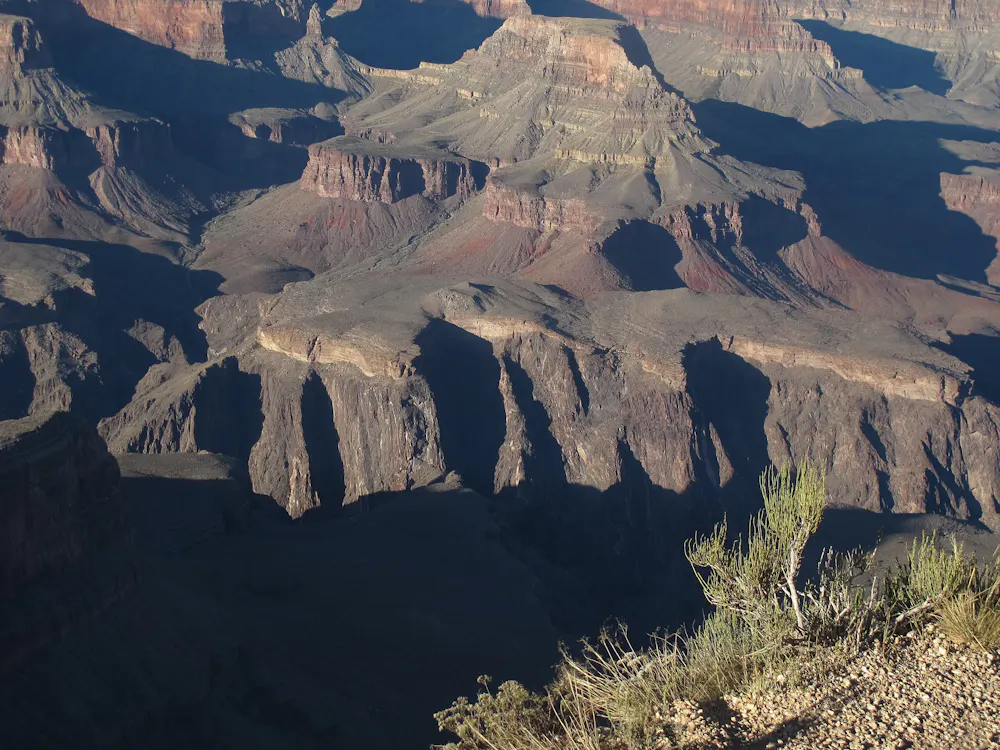
I follow the photographic website Ugly Hedgehog and have been doing for some time. There has been a post recently from the section Photo Gallery and ‘greymule’ from Colorado called his entry ‘A Couple of Desert Scenes’ and I will display just one of his images from that post.
It makes a wonderful connection to today’s post which is from The Conversation.
ooOOoo
Evidence from Snowball Earth found in ancient rocks on Colorado’s Pikes Peak – it’s a missing link
Rocks can hold clues to history dating back hundreds of millions of years. Christine S. Siddoway
Around 700 million years ago, the Earth cooled so much that scientists believe massive ice sheets encased the entire planet like a giant snowball. This global deep freeze, known as Snowball Earth, endured for tens of millions of years.
The Snowball Earth hypothesis has been largely based on evidence from sedimentary rocks exposed in areas that once were along coastlines and shallow seas, as well as climate modeling. Physical evidence that ice sheets covered the interior of continents in warm equatorial regions had eluded scientists – until now.
In new research published in the Proceedings of the National Academy of Sciences, our team of geologists describes the missing link, found in an unusual pebbly sandstone encapsulated within the granite that forms Colorado’s Pikes Peak.
Earth iced over during the Cryogenian Period, but life on the planet survived. NASA illustration
Solving a Snowball Earth mystery on a mountain
Pikes Peak, originally named Tavá Kaa-vi by the Ute people, lends its ancestral name, Tava, to these notable rocks. They are composed of solidified sand injectites, which formed in a similar manner to a medical injection when sand-rich fluid was forced into underlying rock.
A possible explanation for what created these enigmatic sandstones is the immense pressure of an overlying Snowball Earth ice sheet forcing sediment mixed with meltwater into weakened rock below.
Dark red to purple bands of Tava sandstone dissect pink and white granite. The Tava is also cross-cut by silvery-gray veins of iron oxide. Liam Courtney-Davies
An obstacle for testing this idea, however, has been the lack of an age for the rocks to reveal when the right geological circumstances existed for sand injection.
We found a way to solve that mystery, using veins of iron found alongside the Tava injectites, near Pikes Peak and elsewhere in Colorado.
A 5-meter-tall, almost vertical Tava dike is evident in this section of Pikes Peak granite. Liam Courtney-Davies
Iron minerals contain very low amounts of naturally occurring radioactive elements, including uranium, which slowly decays to the element lead at a known rate. Recent advancements in laser-based radiometric dating allowed us to measure the ratio of uranium to lead isotopes in the iron oxide mineral hematite to reveal how long ago the individual crystals formed.
The iron veins appear to have formed both before and after the sand was injected into the Colorado bedrock: We found veins of hematite and quartz that both cut through Tava dikes and were crosscut by Tava dikes. That allowed us to figure out an age bracket for the sand injectites, which must have formed between 690 million and 660 million years ago.
So, what happened?
The time frame means these sandstones formed during the Cryogenian Period, from 720 million to 635 million years ago. The name is derived from “cold birth” in ancient Greek and is synonymous with climate upheaval and disruption of life on our planet – including Snowball Earth.
University of Exeter professor Timothy Lenton explains why the Earth was able to freeze over.
The Tava found on Pikes Peak would have formed close to the equator within the heart of an ancient continent named Laurentia, which gradually over time and long tectonic cycles moved into its current northerly position in North America today.
The origin of Tava rocks has been debated for over 125 years, but the new technology allowed us to conclusively link them to the Cryogenian Snowball Earth period for the first time.
The scenario we envision for how the sand injection happened looks something like this:
A giant ice sheet with areas of geothermal heating at its base produced meltwater, which mixed with quartz-rich sediment below. The weight of the ice sheet created immense pressures that forced this sandy fluid into bedrock that had already been weakened over millions of years. Similar to fracking for natural gas or oil today, the pressure cracked the rocks and pushed the sandy meltwater in, eventually creating the injectites we see today.
Clues to another geologic puzzle
Not only do the new findings further cement the global Snowball Earth hypothesis, but the presence of Tava injectites within weak, fractured rocks once overridden by ice sheets provides clues about other geologic phenomena.
Time gaps in the rock record created through erosion and referred to as unconformities can be seen today across the United States, most famously at the Grand Canyon, where in places, over a billion years of time is missing. Unconformities occur when a sustained period of erosion removes and prevents newer layers of rock from forming, leaving an unconformable contact.
Unconformity in the Grand Canyon is evident here where horizontal layers of 500-million-year-old rock sit on top of a mass of 1,800-million-year-old rocks. The unconformity, or ‘time gap,’ demonstrates that years of history are missing. Mike Norton via Wikimedia, CC BY-SA
Our results support that a Great Unconformity near Pikes Peak must have been formed prior to Cryogenian Snowball Earth. That’s at odds with hypotheses that attribute the formation of the Great Unconformity to large-scale erosion by Snowball Earth ice sheets themselves.
We hope the secrets of these elusive Cryogenian rocks in Colorado will lead to the discovery of further terrestrial records of Snowball Earth. Such findings can help develop a clearer picture of our planet during climate extremes and the processes that led to the habitable planet we live on today.
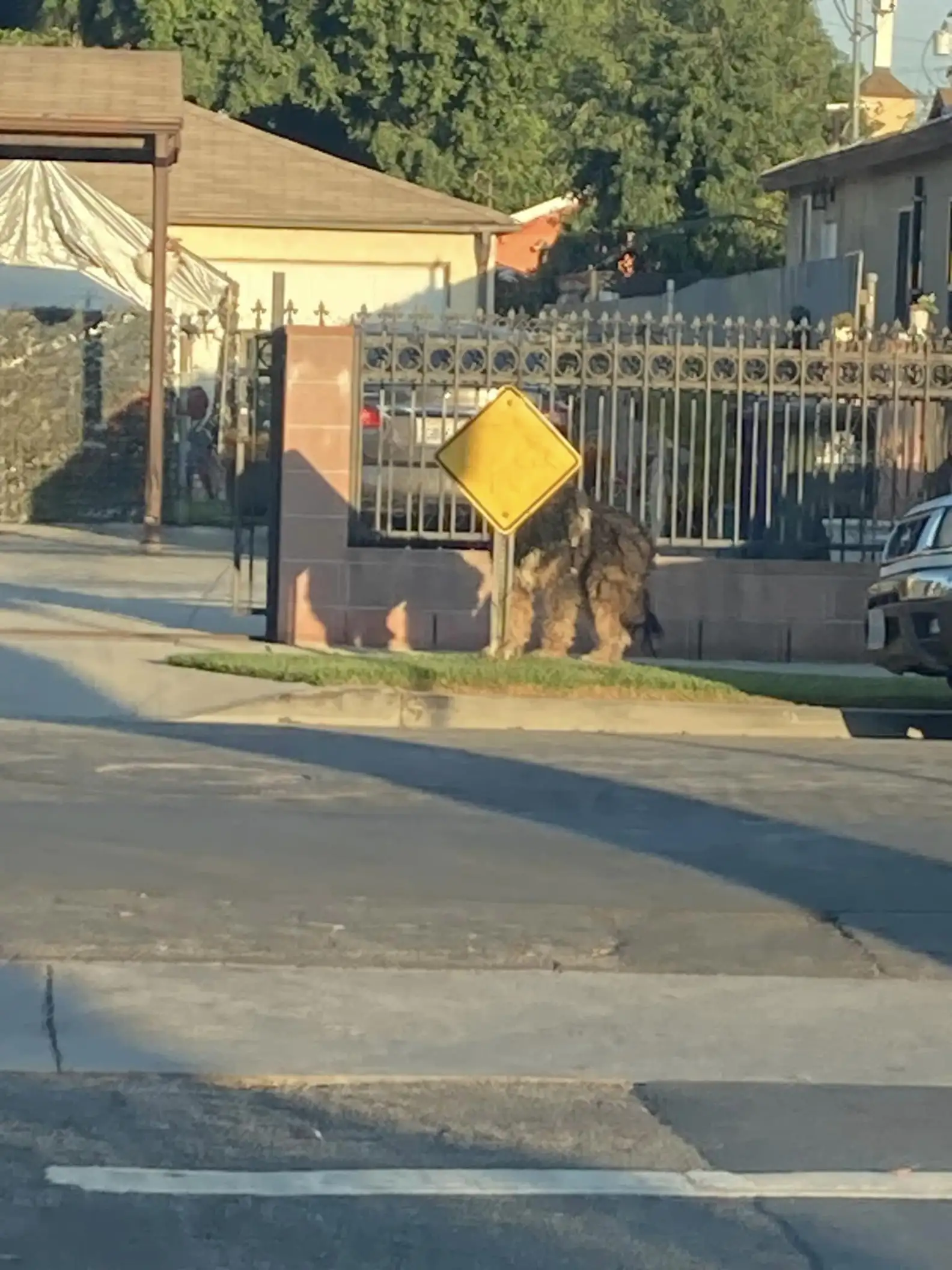
The other day, volunteer dog rescuer Mary Nakiso was driving through California’s Orange County when she passed someone cowering on the side of the street. The creature was large, hairy and alone. With a sinking feeling in her stomach, Nakiso slammed on her brakes to investigate.
As she approached the animal, Nakiso realized just how massive and afraid he was.
“He is literally 75 pounds and so big but so scared,” Suzette Hall, founder of Logan’s Legacy 29, wrote on Facebook.
Suzette Hall
The giant dog was petrified, which Nakiso soon learned was the result of being “thrown out” by his family a few minutes earlier.
“When he first got thrown out, he was so confused [and] running in circles in traffic,” Hall wrote. “A huge jeep with huge tires literally went over him …”
Suzette Hall
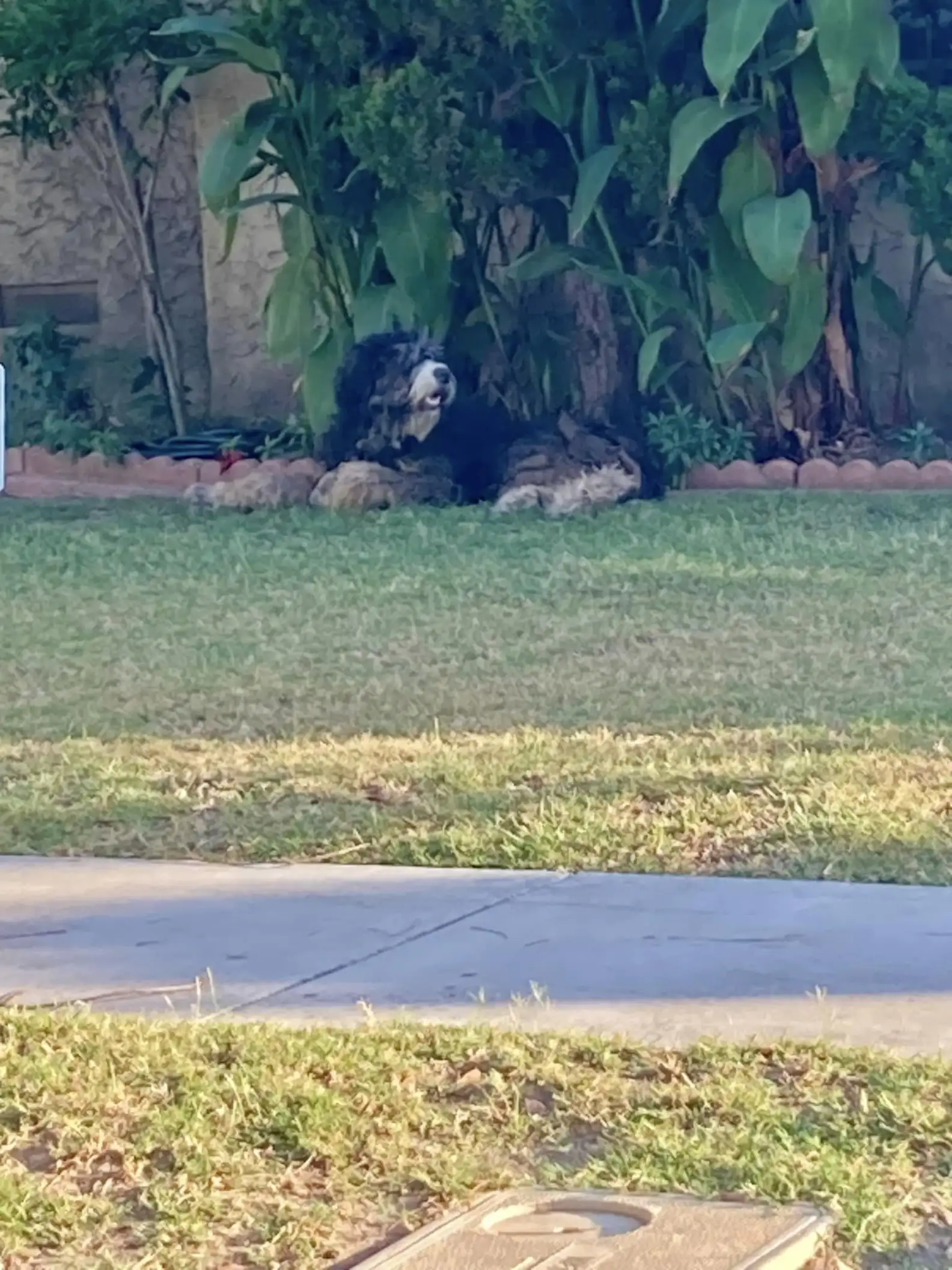
The pup, later named Benji, had no idea where his family had gone. He roamed the busy streets frantically, hoping to find his way home. After a while of running around in circles and dodging cars, Benji eventually disappeared.
Nakiso called Hall to notify her about Benji, and the two started monitoring local social media groups for any sightings of him. Later that day, someone posted about seeing a giant matted dog in their neighborhood.
Suzette Hall
Hall couldn’t make it back to the neighborhood fast enough due to traffic, so she messaged three more of her trusted friends who lived nearby.
The group of volunteers immediately agreed to help.
“I sent a message to Nuñez Aky, Yamileth and Karla,” Hall wrote. “When they got there, he was running back and forth so fast. So they waited for him to settle down.”
Suzette Hall
Hall stayed glued to her phone for updates while the team of volunteer rescuers hatched a plan to corner the flighty dog once and for all.
Then, she finally received the news she’d been hoping to hear all day.
“[B]ecause they are so amazing, they got him into a yard and shut the gate,” Hall wrote. “My heart was so happy. The fear and terror he had been through was over, and this big hunk of pure love was finally safe.”
Suzette Hall
The rescuers showered Benji with love and praise before carrying him to their car. They drove him straight to Camino Pet Hospital, where the shaggy pup received a long-overdue makeover.
“All the layers of his past [have] been shaved away,” Hall wrote in a Facebook update. “He literally had dreadlocks.”
Suzette Hall
Benji’s makeover was just the first of many steps to get him the home of his dreams. He’s since been neutered, and after a few more days of healing, he’ll finally be able to meet his new foster family next week.
It’s hard to know what Benji’s life was like before he was rescued, but his future is certain thanks to Hall and her team of volunteers. As Hall sees it, Benji will soon receive all the love and attention he’s always deserved.
“Benji is the sweetest, most loving dog I have ever met,” Hall told The Dodo. “[He’s] truly a miracle.”
—-
You can inquire about adopting Benji by emailing Suzette Hall at Info@loganslegacy29.com.
To help pups like Benji get the care they need, you can donate to Logan’s Legacy 29 here.
ooOOoo
That is a most beautiful story and one that should inspire many readers to look after, and care for, dogs where ever they are.
Many congratulations to Suzette for rescuing Benji.
Back in the late 1950s when my mother remarried after my father’s death, ‘Dad’, as he was called when he came to live at Toley Avenue, Preston Road, London, taught me how to construct a radio receiver made from a crystal, a crystal set. I have this memory of listening to Quincy Jones on my crystal set and loving the rhythm.
“Music is sacred to me,” Quincy Jones once said. “Melody is God’s voice.”
He certainly had the divine touch.
Jones, who had died at the age of 91, was the right-hand man to both Frank Sinatra and Michael Jackson, and helped to shape the sound of jazz and pop over more than 60 years.
His recordings revolutionised music by crossing genres, promoting unlikely collaborations and shaping modern production techniques.















 Learning from Dogs
