Author: Paul Handover

Nutrition advice

An article on educating us on avoiding misinformation.

Many articles on nutrition are full of errors and for the lay person there’s no easy way to understand what is correct, or not.

That’s why a recent article appealed to me and I thought it worth sharing.

ooOOoo

Nutrition advice is rife with misinformation − a medical education specialist explains how to tell valid health information from pseudoscience

If a health claim about a dietary intervention sounds too good to be true, it probably is. Mizina/iStock via Getty Images Plus

Aimee Pugh Bernard, University of Colorado Anschutz Medical Campus

The COVID-19 pandemic illuminated a vast landscape of misinformation about many topics, science and health chief among them.

Since then, information overload continues unabated, and many people are rightfully confused by an onslaught of conflicting health information. Even expert advice is often contradictory.

On top of that, people sometimes deliberately distort research findings to promote a certain agenda. For example, trisodium phosphate is a common food additive in cakes and cookies that is used to improve texture and prevent spoilage, but wellness influencers exploit the fact that a similarly named substance is used in paint and cleaning products to suggest it’s dangerous to your health.

Such claims can proliferate quickly, creating widespread misconceptions and undermining trust in legitimate scientific research and medical advice. Social media’s rise as a news and information source further fuels the spread of pseudoscientific views.

Misinformation is rampant in the realm of health and nutrition. Findings from nutrition research is rarely clear-cut because diet is just one of many behaviors and lifestyle factors affecting health, but the simplicity of using food and supplements as a cure-all is especially seductive.

I am an assistant professor specializing in medical education and science communication. I also train scientists and future health care professionals how to communicate their science to the general public.

In my view, countering the voices of social media influencers and health activists promoting pseudoscientific health claims requires leaning into the science of disease prevention. Extensive research has produced a body of evidence-based practices and public health measures that have consistently been shown to improve the health of millions of people around the world. Evaluating popular health claims against the yardstick of this work can help distinguish which ones are based on sound science.

A white person's hands holding a smartphone with screen showing a health app, next to a cup of coffee.
To parse pseudoscientific claims from sound advice about health and nutrition, it’s crucial to evaluate the information’s source. tadamichi/Getty Images

Navigating the terrain of tangled information

Conflicting information can be found on just about everything we eat and drink.

That’s because a food or beverage is rarely just good or bad. Instead, its health effects can depend on everything from the quantity a person consumes to their genetic makeup. Hundreds of scientific studies describe coffee’s health benefits and, on the flip side, its health risks. A bird’s-eye view can point in one direction or another, but news articles and social media posts often make claims based on a single study.

Things can get even more confusing with dietary supplements because people who promote them often make big claims about their health benefits. Take apple cider vinegar, for example – or ACV, if you’re in the know.

Apple cider vinegar has been touted as an all-natural remedy for a variety of ailments, including digestive issues, urinary health and weight management. Indeed, some studies have shown that it might help lower cholesterol, in addition to having other health benefits, but overall those studies have small sample sizes and are inconclusive.

Advocates of this substance often claim that one particular component of it – the cloudy sediment at the bottom of the bottle termed “the mother” – is especially beneficial because of the bacteria and yeast it contains. But there is no research that backs the claim that it offers any health benefits.

One good rule of thumb is that health hacks that promise quick fixes are almost always too good to be true. And even when supplements do offer some health benefits under specific circumstances, it’s important to remember that they are largely exempt from Food and Drug Administration regulations. That means the ingredients on their labels might contain more or less of the ingredients promised or other ingredients not listed, which can potentially cause harms such as liver toxicity.

It’s also important to keep in mind that the global dietary supplements industry is worth more than US$150 billion per year, so companies – and wellness influencers – selling supplements have a financial stake in convincing the public of their value.

Misinformation about nutrition is nothing new, but that doesn’t make it any less confusing.

How nutrition science gets twisted

There’s no doubt that good nutrition is fundamental for your health. Studies consistently show that a balanced diet containing a variety of essential nutrients can help prevent chronic diseases and promote overall well-being.

For instance, minerals such as calcium and iron support bone health and oxygen circulation in the blood, respectively. Proteins are essential for muscle repair and growth, and healthy fats, like those found in avocados and nuts, are vital for brain health.

However, pseudoscientific claims often twist such basic facts to promote the idea that specific diets or supplements can prevent or treat illness. For example, vitamin C is known to play a role in supporting the immune system and can help reduce the duration and severity of colds.

But despite assertions to the contrary, consuming large quantities of vitamin C does not prevent colds. In fact, the body needs only a certain amount of vitamin C to function properly, and any excess is simply excreted.

Companies sometimes claim their supplement is “scientifically proven” to cure illness or boost brain function, with no credible research to back it up.

Some companies overstate the benefits while underplaying the hazards.

For example, wellness influencers have promoted raw milk over pasteurized milk as a more natural and nutritious choice, but consuming it is risky. Unpasteurized milk can contain harmful bacteria that leads to gastrointestinal illness and, in some cases, much more serious and potentially life-threatening diseases such as avian influenza, or bird flu.

Such dietary myths aren’t harmless. Reliance on nutrition alone can lead to neglecting other critical aspects of health, such as regular medical checkups and lifesaving vaccinations.

The lure of dietary myths has led people with cancer to replace proven science-backed treatments, such as chemotherapy or radiation, with unproven and misleading nutrition programs.

How to spot less-than-solid science

Pseudoscience exploits your insecurities and emotions, taking advantage of your desire to live the healthiest life possible.

While the world around you may be uncertain and out of your control, you want to believe that at the very least, you have control over your own health. This is where the wellness industry steps in.

What makes pseudoscientific claims so confusing is that they use just enough scientific jargon to sound believable. Supplements or powders that claim to “boost immunity” often list ingredients such as adaptogens and superfoods. While these words sound real and convincing, they actually don’t mean anything in science. They are terms created by the wellness industry to sell products.

I’ve researched and written about reliable ways to distinguish science facts from false health claims. To stay alert and find credible information, I’d suggest you follow a few key steps.

First, check your emotions – strong emotional reactions, such as fear and anger, can be a red flag.

Next, check that the author has experience or expertise in the field of the topic. If they’re not an expert, they might not know what they are talking about. It’s always a good idea to make sure the source is reputable – ask yourself, would this source be trusted by scientists?

Finally, search for references that back up the information. If very little or nothing else exists in the science world to back up the claims, you may want to put your trust in a different source.

Following these steps will separate the facts from fake news and empower you to make evidence-based decisions.

Aimee Pugh Bernard, Assistant Professor of Immunology and Microbiology, University of Colorado Anschutz Medical Campus

This article is republished from The Conversation under a Creative Commons license. Read the original article.

ooOOoo

Sound advice for the majority of us!

Winter is here!

A lovely guest post from Pratyush S.

Pratyush has been very patient with me. He first contacted me regarding sending in a guest post many months ago. At first I thought it was a spam email and then realised that was a mistake. Then stuff my end got in the way, and so on.

But I’m delighted to publish this today, and should add that Pratyush is based in India!

ooOOoo

Winter is here — When you have a golden retriever at home.

Golden Retrievers are great family dogs with a lovely personality, good intelligence, and adaptability. Golden Retrievers are built for colder climates and have plenty of thick, insulating double coats to keep them warm; however, special considerations should still be taken in winter weather to promote the health, comfort, and happiness of your Golden. Below is a complete guide outlining things to be aware of when looking after Golden Retrievers in winter.

Keep Their Paw Pads Safe From Cold and Salt

Although Golden Retrievers enjoy an outdoor adventure, winter can be tough on the pads of their sensitive paws. Winter storms bring snow and ice, which lead to dry skin, cracking and irritation — not to mention the damage from road salt. When they return from walks, be sure to wash their paws properly to get rid of salt or other chemicals. You can apply a paw balm to protect and moisturize your puppy’s paws, make sure you opt for a non-toxic product. Depending on how cold it gets where you live, you may resort to dog booties for their feet when they go outside.

Change Their Diet with the Seasons

Golden Retrievers are energetic, active dogs, and if they’re out in the cold playing during winter, they might need a boost in energy levels. This additional energy expenditure may require you to make minor adjustments in their calorie intake. Over feeding allows them to gain weight, so, consult your Veterinarian to make any alternate diet plan. And they have free fresh water forever, as well during chills when dehydration is possible.

Keep Them Warm Indoors

Golden Retrievers do have a thick double coat which insulates them against the cold but they still need an indoor space to feel warm and comfortable. Give them a warm bed in a wind-free part of your home. If your floors are tiled or wooden, place a blanket or mat under them when they sleep for additional warmth. Do not shave or trim coats too short in winter, it is their natural protection against the cold.

Limit Bathing During Winter

Now, bathing your Golden Retriever too often in winter will remove the natural oils on your dog’s skin which can cause drying of the skin and irritations. Rather, give them a bath only when needed and use a conditioning dog shampoo that helps restore their skin. If your kitty has a bath, be sure to dry them off well so that they don’t catch a chill. Until they are allowed to roam free, blow them dry using a pet safe hair dryer on low or towel drying set properly.

Monitor Their Time Outdoors

Golden Retrievers love to romp and play in the snow, however too much time spent out in freezing conditions can cause hypothermia or frostbite. Do not leave them outside too long and keep an eye on them for signs that they may be feeling cold like shivering or lifting their feet off the ground. On very cold days, keep them busy with something indoors, puzzle toys or activities.

Regular Grooming is Essential

The thick coat of a Golden Retriever can mat and tangle in winter weather. Grooming is also a great way to keep the insulation quality of their coat intact and helps to avoid skin problems. Groom at least three times a week to minimize loose fur, matting,and spread natural oils. Look for any possible drying or skin irritation and when in doubt contact your vet.

Ensure Proper Exercise

Golden Retrievers are energetic dogs that enjoy getting out, and they still need exercise in the winter. On the flip side — snowy or slick conditions may elevate the risk of injuries. Keep them on a leash so they cannot run onto frozen surfaces and only walk in safe areas. If you cannot take them outdoors for exercise, make opportunities indoors to play– fetch or hide-and-seek can help expend some energy.

Watch for Signs of Illness

Cold climates could contribute to Golden Retrievers developing a cold or respiratory infection. Look out for any coughing, sneezing or lethargy. If you observe unusual behavior or signs of illness, take action and contact your veterinarian. Make sure they are vaccinated against seasonal diseases.

Offer Enrichment and Mental Stimulation

When the weather grows chilly, it can restrain outdoor actions that need to be carried out in the hot sun so exercise for a Golden Retriever should be maintained indoor as well. Keep their mind active with interactive toys, treat-dispensing puzzles or by teaching them new tricks. Physical exercise is very important, especially during the colder season when outdoor playtime becomes scarce, but so does mental stimulation.

Watch Over Older Dogs

For older Golden Retrievers, the cold can aggravate any existing joint problems e.g. arthritis. Keep them a warm, cozy resting space and try orthopedic beds to relieve them of joint problems. Consider discussing with your vet promoting joint health, supplements that help in the cold months or medications.

Conclusion

Taking care of a Golden Retriever in winter is all about comfort, health and happiness. However, though their double coat does provide some protection against the cold, they need you to help them get through winter safely and comfortably. With the right protection for their paws, some diet changes, and keeping them warm and active, your golden retriever can enjoy the winter just like humans. Take good care of them and they will love the winter season as much as you do!

ooOOoo

There is great advice in this guest post and for anyone with Golden Retrievers this post is spot on. To be honest, the advice presented is applicable to all breeds of dogs.

Thank you, Pratyush

This article is so beautiful!

I subscribe to The Dodo and read this article last Wednesday!

This may be Columbia and a long way from where a great number of people live but it is still a most beautiful story.

ooOOoo

Kind Man Living On Streets Adopts Every Stray Dog He Comes Across

“They’re everything to me” 💕

By Ashley Ortiz, Published on Dec 27, 2024.

They say that home is where the heart is, and that couldn’t be more true for a man named Rubén and his pack of rescued dogs.

Despite not having a home of his own, Rubén, who goes by Noé, is dedicated to sharing his space and resources with every homeless dog in his Colombian city. Whether they’ve been left behind at a stop light or abandoned in an apartment, Noé believes in giving each dog he meets a second chance at love.

“They are living beings,” Noé said in an interview with IguanaTV. “They are everything to me.”

Noé’s pack is ever-growing, as he readily collects abandoned dogs of all ages and sizes. While it all started with just one dog, his furry family is now large enough to require a double-decker push cart.

Each dog has their own unique backstory, but they’re all loved by Noé just the same.

“This is Rocky. They left him tied up there at that traffic light,” Noé said. “These two girls are named Ears and Cheeks. I’ve had them since they were little. They were also abandoned.”

Rocky, Ears and Cheeks ride on the top level of the push cart with their siblings, a pit bull named Tyson and a German shepherd named Shakira. Below them, senior pups Tembleque, Parkinson and Morochito happily take in the world around them.

“These dogs down below are the oldest,” Noé said. “Little Morochito here was left for me while I was sleeping outside of [the store].”

The pups may have heartbreaking pasts, but their sadness has faded since being adopted by Noé. When they’re not actively traveling around the city with their beloved dad, the pack of dogs can usually be found enjoying a fresh meal made by Noé.

“I buy them milk, carrots and oats, and I combine them with ground meat and seeds,” Noé said. “I make them a hearty meal so that they eat well.”

Seeing the pups lap up their meals brings joy to Noé, even when he hasn’t eaten yet.

“They eat first,” Noé said. “My food is less important to me.”

Once the pups have finished eating, Noé usually snacks on an arepa and some coffee before heading off with his pack again. With his dogs by his side, Noé feels a sense of purpose and peace.

“The dogs keep me busy and give me a reason to wake up every day,” Noé said. “They don’t care if I’m bearded, toothless, dirty or clean. They only care that I’m by their side.”

This growing companionship is beyond fulfilling for Noé. Even on his most challenging days, Noé knows he can always lean on his beloved pack of rescued dogs for unconditional support.

“A dog’s love is the best there is,” Noé said.

ooOOoo

The two photographs are presented by INSTAGRAM/@IGUANATV. (And the article is published with the kind permission of The Dodo.)

One can’t do better than repeat that last sentence: “A dog’s love is the best there is,”.

Well said, Rubén!

The Edwin Hubble Great Debate

The following is more than fascinating; it is an example of how far science has reached; both figuratively and literally.

ooOOoo

One large Milky Way galaxy or many galaxies? 100 years ago, a young Edwin Hubble settled astronomy’s ‘Great Debate’

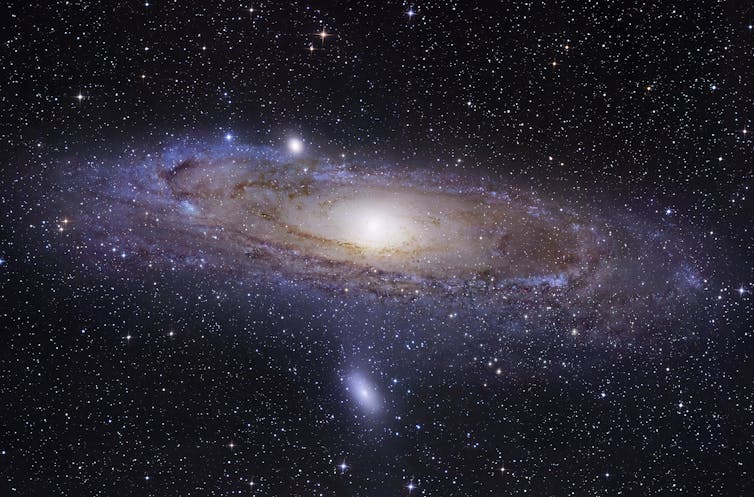
The Andromeda galaxy helped Edwin Hubble settle a great debate in astronomy. Stocktrek Images via Getty Images

Chris Impey, University of Arizona

A hundred years ago, astronomer Edwin Hubble dramatically expanded the size of the known universe. At a meeting of the American Astronomical Society in January 1925, a paper read by one of his colleagues on his behalf reported that the Andromeda nebula, also called M31, was nearly a million light years away – too remote to be a part of the Milky Way.

Hubble’s work opened the door to the study of the universe beyond our galaxy. In the century since Hubble’s pioneering work, astronomers like me have learned that the universe is vast and contains trillions of galaxies.

Nature of the nebulae

In 1610, astronomer Galileo Galilei used the newly invented telescope to show that the Milky Way was composed of a huge number of faint stars. For the next 300 years, astronomers assumed that the Milky Way was the entire universe.

As astronomers scanned the night sky with larger telescopes, they were intrigued by fuzzy patches of light called nebulae. Toward the end of the 18th century, astronomer William Herschel used star counts to map out the Milky Way. He cataloged a thousand new nebulae and clusters of stars. He believed that the nebulae were objects within the Milky Way.

Charles Messier also produced a catalog of over 100 prominent nebulae in 1781. Messier was interested in comets, so his list was a set of fuzzy objects that might be mistaken for comets. He intended for comet hunters to avoid them since they did not move across the sky.

As more data piled up, 19th century astronomers started to see that the nebulae were a mixed bag. Some were gaseous, star-forming regions, such as the Orion nebula, or M42 – the 42nd object in Messier’s catalog – while others were star clusters such as the Pleiades, or M45.

A third category – nebulae with spiral structure – particularly intrigued astronomers. The Andromeda nebula, M31, was a prominent example. It’s visible to the naked eye from a dark site.

The Andromeda galaxy, then known as the Andromeda nebula, is a bright spot in the sky that intrigued early astronomers.

Astronomers as far back as the mid-18th century had speculated that some nebulae might be remote systems of stars or “island universes,” but there was no data to support this hypothesis. Island universes referred to the idea that there could be enormous stellar systems outside the Milky Way – but astronomers now just call these systems galaxies.

In 1920, astronomers Harlow Shapley and Heber Curtis held a Great Debate. Shapley argued that the spiral nebulae were small and in the Milky Way, while Curtis took a more radical position that they were independent galaxies, extremely large and distant.

At the time, the debate was inconclusive. Astronomers now know that galaxies are isolated systems of stars, much smaller than the space between them.

Hubble makes his mark

Edwin Hubble was young and ambitious. At the of age 30, he arrived at Mount Wilson Observatory in Southern California just in time to use the new Hooker 100-inch telescope, at the time the largest in the world.

A black and white photo of a man looking through the lens of a large telescope.
Edwin Hubble uses the telescope at the Mount Wilson Observatory. Hulton Archives via Getty Images

He began taking photographic plates of the spiral nebulae. These glass plates recorded images of the night sky using a light-sensitive emulsion covering their surface. The telescope’s size let it make images of very faint objects, and its high-quality mirror allowed it to distinguish individual stars in some of the nebulae.

Estimating distances in astronomy is challenging. Think of how hard it is to estimate the distance of someone pointing a flashlight at you on a dark night. Galaxies come in a very wide range of sizes and masses. Measuring a galaxy’s brightness or apparent size is not a good guide to its distance.

Hubble leveraged a discovery made by Henrietta Swan Leavitt 10 years earlier. She worked at the Harvard College Observatory as a “human computer,” laboriously measuring the positions and brightness of thousands of stars on photographic plates.

She was particularly interested in Cepheid variables, which are stars whose brightness pulses regularly, so they get brighter and dimmer with a particular period. She found a relationship between their variation period, or pulse, and their intrinsic brightness or luminosity.

Once you measure a Cepheid’s period, you can calculate its distance from how bright it appears using the inverse square law. The more distant the star is, the fainter it appears.

Hubble worked hard, taking images of spiral nebulae every clear night and looking for the telltale variations of Cepheid variables. By the end of 1924, he had found 12 Cepheids in M31. He calculated M31’s distance as a prodigious 900,000 light years away, though he underestimated its true distance – about 2.5 million light years – by not realizing there were two different types of Cepheid variables.

His measurements marked the end of the Great Debate about the Milky Way’s size and the nature of the nebulae. Hubble wrote about his discovery to Harlow Shapley, who had argued that the Milky Way encompassed the entire universe.

“Here is the letter that destroyed my universe,” Shapley remarked.

Always eager for publicity, Hubble leaked his discovery to The New York Times five weeks before a colleague presented his paper at the astronomers’ annual meeting in Washington, D.C.

An expanding universe of galaxies

But Hubble wasn’t done. His second major discovery also transformed astronomers’ understanding of the universe. As he dispersed the light from dozens of galaxies into a spectrum, which recorded the amount of light at each wavelength, he noticed that the light was always shifted to longer or redder wavelengths.

Light from the galaxy passes through a prism or reflects off a diffraction grating in a telescope, which captures the intensity of light from blue to red.

Astronomers call a shift to longer wavelengths a redshift.

It seemed that these redshifted galaxies were all moving away from the Milky Way.

Hubble’s results suggested the farther away a galaxy was, the faster it was moving away from Earth. Hubble got the lion’s share of the credit for this discovery, but Lowell Observatory astronomer Vesto Slipher, who noticed the same phenomenon but didn’t publish his data, also anticipated that result.

Hubble referred to galaxies having recession velocities, or speeds of moving away from the Earth, but he never figured out that they were moving away from Earth because the universe is getting bigger.

Belgian cosmologist and Catholic priest Georges Lemaitre made that connection by realizing that the theory of general relativity described an expanding universe. He recognized that space expanding in between the galaxies could cause the redshifts, making it seem like they were moving farther away from each other and from Earth.

Lemaitre was the first to argue that the expansion must have begun during the big bang.

The Hubble telescope, which looks like a metal cylinder, floating in space.
Edwin Hubble is the namesake for NASA’s Hubble Space Telescope, which has spent decades observing faraway galaxies. NASA via AP

NASA named its flagship space observatory after Hubble, and it has been used to study galaxies for 35 years. Astronomers routinely observe galaxies that are thousands of times fainter and more distant than galaxies observed in the 1920s. The James Webb Space Telescope has pushed the envelope even farther.

The current record holder is a galaxy a staggering 34 billion light years away, seen just 200 million years after the big bang, when the universe was 20 times smaller than it is now. Edwin Hubble would be amazed to see such progress.

Chris Impey, University Distinguished Professor of Astronomy, University of Arizona

This article is republished from The Conversation under a Creative Commons license. Read the original article.

ooOOoo

So wonderful that in this modern era we can read articles from distinguished scientists in the comfort of our own homes.

That blue sky!

A fascinating article from The Conversation.

I am sorting out tax documents so no time for long introductions. But although this was written for young people I thought it worthy of sharing.

ooOOoo

Why is the sky blue?

Light at the blue end of the rainbow is scattered more efficiently than the other colors. shomos uddin/Moment via Getty Images

Daniel Freedman, University of Wisconsin-Stout

Curious Kids is a series for children of all ages. If you have a question you’d like an expert to answer, send it to CuriousKidsUS@theconversation.com.


Why is the sky blue? – Mariana A-E., age 11, Tucson, Arizona


You might think that explaining why the sky is blue would be kind of simple. But even a brief explanation of it requires a lot of science. The colors of everything you see are produced in different ways. Some of those colors are explained with physics, others by my own field of chemistry.

The nitrogen and oxygen that you are breathing right now are made up of very small particles called molecules. A molecule of nitrogen or oxygen is really, really small. Each molecule is only about 0.4 nanometers, or 16 billionths of an inch. It would take 250,000 nitrogen molecules to equal the width of one strand of your hair. You can think of the molecules as behaving like very tiny balls that constantly bounce around.

When sunlight travels through the atmosphere, it passes between lots of those teensy nitrogen and oxygen molecules. Sometimes the light runs right into one of them.

In short, the sky looks blue because the blue portion of sunlight is much more likely to bounce off the molecules in the atmosphere than the other colors of light.

Tennis balls and marbles

Now, picture the nitrogen and oxygen molecules as tennis balls and the light as heaps of marbles.

When one of those light marbles hits a nitrogen or oxygen tennis ball, the tennis ball “eats” the marble and then very quickly spits it back out again, but in a random direction. That process is what physicists call scattering.

It was around 1870 when the British physicist John William Strutt, better known as Lord Rayleigh, first found an explanation for why the sky is blue: Blue light from the Sun is scattered the most when it passes through the atmosphere. His discovery is why the scientific term for this effect is called Rayleigh scattering.

The other gases in the atmosphere can be really important too, such as the effects of carbon dioxide or methane on the global climate. But they have only a very small effect on the color of the sky.

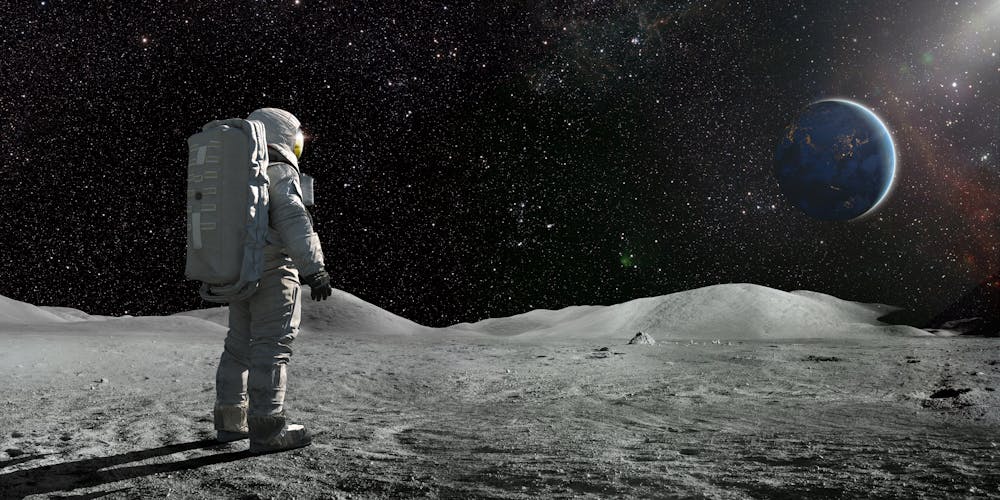
If there were no scattering, the sky would be dark like it is on the Moon, which does not have an atmosphere.

A lone astronaut standing facing away from the camera dressed in full space suit with backpack, stands still looking towards a distant planet Earth. The sun illuminates a side of Earth and hundreds of stars are visible in deep space.
The Moon’s sky isn’t blue. peepo/E+ via Getty Images

A rainbow represents all the different components that make up sunlight. As that light passes through the water droplets suspended in the air, it is broken up into the component colors called the visible spectrum – red, orange, yellow, green, blue, indigo and violet, more easily remembered as ROY G. BIV.

Light at the blue end of the rainbow is scattered more efficiently than the other colors. It is as if the tennis balls are very selective in terms of which marbles they eat, and they prefer the blue ones over the other colors.

The result is that the blue light is scattered across the sky so you see blue everywhere on sunny days. The rest of the colors mainly travel straight through the atmosphere.

Redder when the Sun sets and rises

Of course, the sky is not always blue.

And Rayleigh scattering also explains why the sky tends to be reddish when the Sun is close to the horizon – at sunrise and sunset.

Beautiful landscape - beach on sunset -red and orange sky and sunlight reflecting on sea water.
There’s a scientific explanation for why red and orange streaks stretch aross the sky at dawn or twilight. Elenakirey/iStock via Getty Images Plus

When the Sun is near the horizon, its light passes through a lot more of the atmosphere to reach the Earth’s surface than when it is directly overhead. The blue and green light is scattered so well that you can hardly see it. The sky is colored, instead, with red and orange light.

Colors mean a lot to us in so many different ways. Understanding the science behind colors and expressing ourselves through art with colors have been important for humans for our entire recorded history. That’s something to keep in mind as you decide what color shirt to wear tomorrow morning. https://www.youtube.com/embed/ehUIlhKhzDA?wmode=transparent&start=0 NASA’s Space Place explains why the sky is blue.


Hello, curious kids! Do you have a question you’d like an expert to answer? Ask an adult to send your question to CuriousKidsUS@theconversation.com. Please tell us your name, age and the city where you live.

And since curiosity has no age limit – adults, let us know what you’re wondering, too. We won’t be able to answer every question, but we will do our best.

Daniel Freedman, Dean of the College of Science, Technology, Engineering, Mathematics & Management, University of Wisconsin-Stout

This article is republished from The Conversation under a Creative Commons license. Read the original article.

ooOOoo

As the article says: ‘And since curiosity has no age limit …’

Rillette, a wild boar, saved!

Saw this on the BBC and wanted to share it!

Here is a part of the BBC story:

Animal rights campaigners in France are celebrating after a wild boar facing the threat of death was allowed to stay with its owner.

The boar, named Rillette, was found in 2023 as a piglet by Elodie Cappé on her horse-breeding smallholding in Chaource, central France, after apparently being abandoned by its mother.

The Full Moon

The first one of 2025.

The following photograph was taken by yours truly on the 12th January at 17.19 Oregon time.

It was a stunning combination of the moon and the hills and the evening sky.

Picture Parade Four Hundred and Sixty

The balance of the photos taken on the property.

oooo

oooo

oooo

oooo

oooo

oooo

Three Dog Bites

A guest post from Lisa.

One of the caregivers that recently came to the house wrote a guest post for the blog.

Here it is:

ooOOoo

A tale about three dog bites.

The first was many years ago, when I was just seven years old. A close neighbour lived just around the corner and practically every day I would go and play with the daughter who was just about my age.

The family included an Australian Shepard named Tipsy. It was my habit to give Tipsy a big hug around her neck each day when I arrived. Then I gave Tipsy another hug before I left to go home. This went on for many months and I was very fond of Tipsy.

Then one day, just as I was getting ready to leave, something strange, and upsetting, happened.

My friend had gone inside the home and I was heading to the gate and, as usual, I went to give Tipsy her hug around her neck.

I turned for the gate.

Tipsy without any warning hit me from behind and immediately knocked me down. Then Tipsy used her paws to roll me over.

With a face contorted in anger she attacked me. Tipsy then vigorously mauled my face and head. Then just as suddenly she stopped.

I remember then most clearly Tipsy’s entire face changing to a look of shame and remorse. She proceeded to lick all my wounds clean, and then laid down and put her head on my chest. Tipsy then stayed with me until the door of her home opened at which point she ran to hide in the corner of the yard.

Even at that young age I understood that Tipsy had not wanted to hurt me. I was convinced then, and still am, that somehow me hugging Tipsy had caused her pain resulting in the attack.

It took two plastic surgeons three hours and 136 stitches to rebuild my face.

But I was convinced that the incident was my fault and not Tipsy’s. I felt no fear or anger, only sadness and compassion for what I had done.

The second bite.

This happened thirty-five years later when I was forty-two.

My great love for dogs led me into a career in dog grooming.

I was running a grooming business from my home in Guadalajara in Mexico.

On this particular day I had only one appointment. It was a new client who came with a big Old English Sheepdog. He was very sweet and well behaved but he was badly matted so I shaved him before giving him a bath. Afterwards I brought him over to the grooming table. He was soaking wet and to my discredit I forgot to down a towel for him and me to stand on. As I said, he was very well behaved and let me lift his front feet onto the table. Unfortunately, when I started to life his hind quarters my feet slipped on the wet floor and I fell with my full weight across his extended spine.

In the dog’s surprise, and pain, he turned towards me and took one single snap at me.

It was not my lucky day because that snap broke two of my teeth and perforated my lower lip in two places.

When the dog saw that I was bleeding he let out a mournful whine and lent his forehead against my hip as an apology.

I could not stop the bleeding, and could barely speak enough to call a cab. A friend helped me explain to the cabbie that I needed to go to the hospital. The friend also called the owner of the dog to have him picked up, still very wet and with the grooming unfinished.

Again, at the hospital, it took twenty-five stitches to close up the two wounds, and all I could think of was how bad I felt for that sweet Old English Sheepdog.

The Third Bite.

I am now fifty-five years old.

I had taken on a 130-pound Cane Corso Mastiff who, as a puppy, had been attacked and traumatised by an aggressive adult dog.

I put him through a boarding and training program, costing $4,000, in an attempt to socialise him. He did very well at the training facility and it appeared that his fear issues were starting to come under control.

My son has a very sweet and submissive nine-year-old American bulldog. It was decided to try a weekend visit to see how my Mastiff would behave in a real-world setting. We allowed the dogs to socialise but they were supervised at various times over the next two days. Then on the last night of my visit my Mastiff attacked my son’s bulldog.

I grabbed the Mastiff and forced him to let go of my son’s dog. I then began pushing him out of the back door. He was fighting to get at my son’s bulldog and I was in between them.

Then I felt pressure on my calf. One moment of extreme pressure and then a release. I am not sure which dog bit me but I am certain that neither one was attacking me. My instinct was that each dog was trying to protect me from the other one.

Either way it was another twenty-five more stitches and six weeks rehabilitation for my leg.

Conclusion.

In thirty-five years as a groomer and these three dog bites, it is my opinion what when a dog bites a human it is almost never the dog’s fault!

ooOOoo

Only way to finish this post from Lisa is with a photo, of a dog!

Photo by Kieran White on Unsplash

Picture Parade Four Hundred and Fifty-Nine

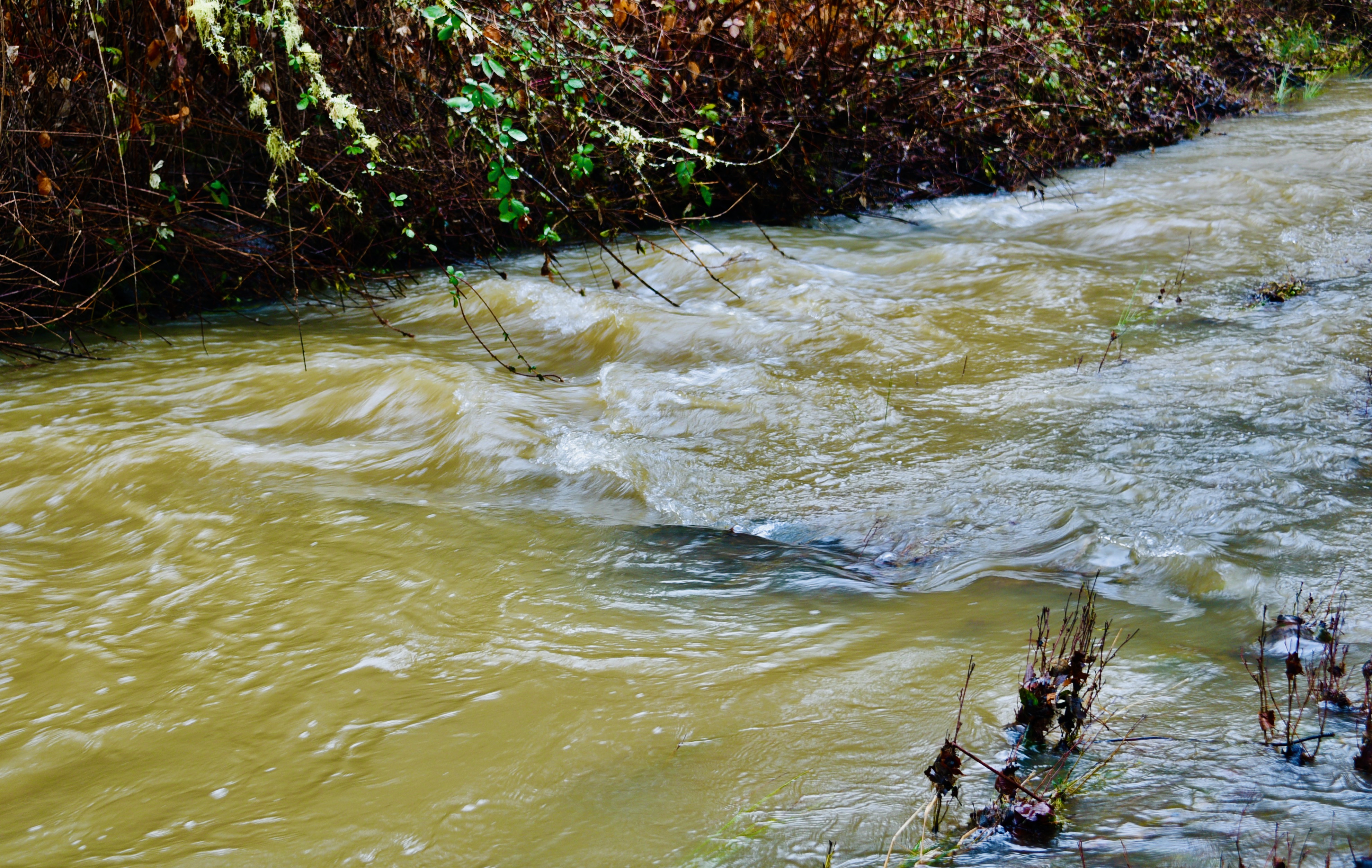
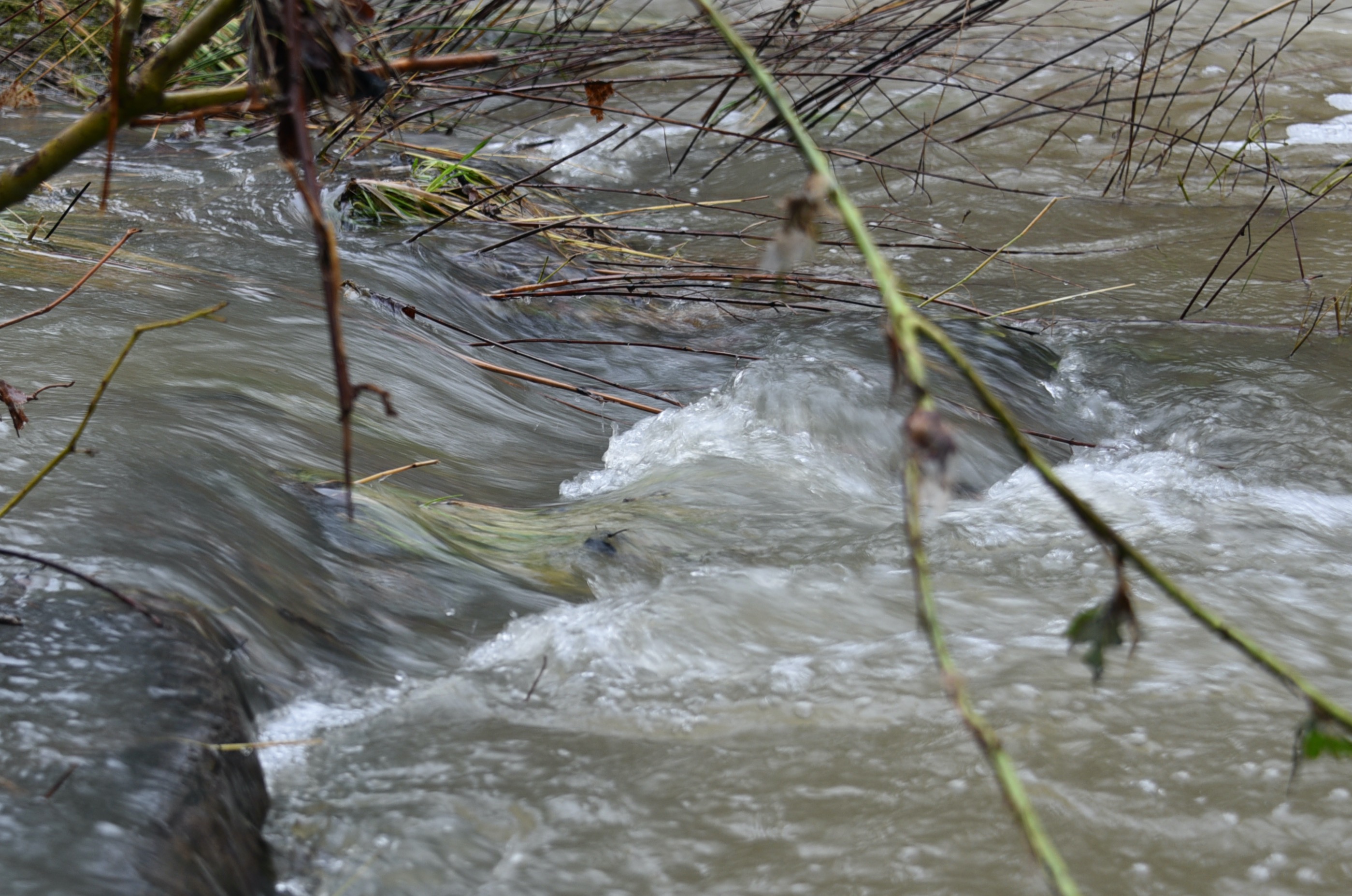
A few more photographs of the swollen Bummer Creek.

Firstly, the photo I shared on January 2nd.

oooo

oooo

oooo

oooo

oooo

oooo

oooo

This last one shows how the water, which was up to the bottom of the tree, had the force to hollow out the ground beneath that fine tree!