Author: John W Lewis

Consumer ‘safety’ for financial products

Are we missing a lesson that has been applied for years?

I have resisted any temptation to comment on the economic situation on Learning from Dogs. The contributions from others are based on far more knowledge and understanding of the subject then I will ever have.

However, I feel obliged to ask humbly for some clarification about something that bothers me. Are we putting the cart before the horse? Are we ignoring the relationship between provider and consumer in finance?

The regulatory regime applied to the vast majority of products which are allowed to be sold to the public is such that toasterthere are probably more stringent safety standards for an electric toaster than for most, if not all, financial products!

Much of the talk of regulation and restraint, in the current climate, seems to relate to remuneration of people working for financial organisations. But, why does it matter what they receive? In other fields, success is rewarded and the shareholders, admittedly fairly indirectly, have some say on the policy in that area. Why should they not pay what they wish?

On the other hand (to coin an economic phrase!),  the minimum standards of the products are set by regulators.

In other fields, if a supplier cannot demonstrate, to the satisfaction of the regulators, that its product meets specified safety standards, then that product is not allowed to be offered.

It is very simple! I am not referring to contracts, customer service, compensation and so on; I am referring to a threshold level of safety below which the product is not allowed to be sold or operated. Think: “cars”, “aeroplanes”, “electrical appliances”, “children’s toys”, and … well anything else!

To be even clearer, this is not about “perfect safety” which is, of course, not available at any price. This is not about blame. This is not about guarantees. It IS about inspection, testing, certification, regulation … oh and policing!

Can anyone explain why this approach cannot be applied to financial products? (Sherry attempts to here.)

By John Lewis

p.s. as chance would have it the image of the toaster at the head of this Post was taken from an article talking about a recall of the Viking Toaster – point made rather well, don’t you think?

Carts and horses!

“Don’t chase the money! Chase personal development and let the money chase you!”

This was the parting shot that came to my mind a couple of years ago, at the end of delivering a one week training course to a group of new graduates.

In general, my approach to training is less well suited to people at their stage than it is to people who are motivated by the need to get a job done. However, that is, of course, my “problem”.

Nevertheless, at the end of that particular course, I felt the need to pass on something from my years of supposed experience, however irrelevant that experience might seem to a group of young, newly minted, investment banking people.

Cause and effect

Although I do not remember the source of the quote, it seemed quite apt. I liked the way in which the opening exhortation seemed completely opposed to their motivation. That woke them up! Then the second part gave them a different entry point and restored the connection with that original motivation.

Perhaps the strongest aspect of the quote is, of course, that it attempts to clarify the direction of causation between money and personal development.

It seemed neat at the time, and it still does!

By John Lewis

Against “Daylight Saving”!

An ancient idea may have run it’s course?

What is the purpose of “Daylight Saving”? [Interesting history of Daylight Saving on Wikipedia. Ed.]

clock faceThis week we are in a particularly interesting situation as we are in the middle of a one week separation between the dates when Europe and US change their clocks back to “normal” winter time. I.e. Europe changed their clocks back at 2am last Sunday and most, but not all, US States change their clocks back at 2am this coming Sunday.

This is even more confusing than normal. But why are we doing this at all?

Is it to save fuel, to save lives, to save time or to save something else?

In my humble opinion it is all nonsense!

“Time management” is a myth

Time is time! People say that they do not have enough time to do this or that, as if they have ways to make some more; and, of course, there is much talk about “time management”. Yet we all have the same amount of time and no amount of management will change that!

We are certainly able to manage the things that we try to fit into the available time.  That is, we can manage tasks, effort and so on. But, in everyday (Newtonian rather than Einsteinian) regimes, time is an inelastic independent variable. Fiddling about with the clocks and trying to “manage time” have no effect on the stuff whatsoever. Let it be!

There must be a better way!

Yes, I know! Some people make claims of wasted daylight or of the dangers to schoolchildren walking to or from school in the dark. These are valid areas of concern. If adjusting the times of business operations or schooling helps to deal with them, then by all means do so. But, for goodness, let’s not pretend the time is different.

By John Lewis

Use of words – correctness matters!

An opinion survey that generated a very strong opinion!

Most incoming emails that ask me to complete a survey move fairly speedily to the “trash” folder. But, this one seemed networking_professionalsto be worth looking at. So I did and completed the survey called “Networking and the Sexes” in a few minutes.
But, then I felt compelled to write to the surveyors. I’d be interested to know whether you think that my stance makes sense.

I wrote to them as follows:
Read more about this Post

Integrity of explorers

Achievements and integrity

What do the achievements of explorers like Sir Ranulph Fiennes and Ann Daniels have to do with “integrity”? It certainly is about directing a huge effort towards something larger than oneself, while exposing oneself to considerable risk. It is also about taking single steps and trusting that they add up to something. However, there is perhaps another aspect.

It is my understanding, without being a psychologist, that it is all in the mind; and one can detect this in their interviews. For example, Ann Daniels clearly loves being “on the ice”, especially floating ice that is moving, sometimes in the wrong direction! Her references to phoning her children very occasionally while away also indicate that she is not concerned about being away from them.

Take your own baggage

It is also my understanding that there is one aspect that psychologists have discovered is required for this kind of activity. It is a characteristic that they have found in people who are remarkably successful at it. Perhaps it was spotted in Ann Daniels by the people who selected her for her first expedition.

It is not easy to describe, but it is the characteristic that, psychologically, these people “take themselves with them” when they travel. When they are in all sorts of very demanding situations, they are not wishing that were back at home in a cosy environment. They are completely “present”, as others have described it (including on this blog). They have all their feelings, psychological baggage and all, “with them”.

Perhaps there is something that we can all learn from this.

More on remarkable people …

By John Lewis

Remarkable people: Guy Watson

Down to earth integrity!

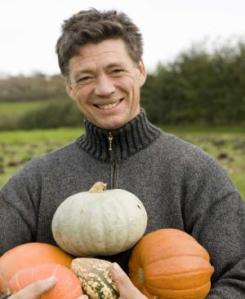
GUY-WATSONBrought up on a farm, working as a management consultant and returning to farming, Guy Watson brought something from outside and applied it to a “field” in which he had a passion.

After starting an organic farming business from nothing, and after many trials and tribulations, he latched onto distribution by delivering food boxes directly to customers. The business grew until he was personally delivering boxes weekly to 800 customers; nowadays the business serves 40,000 customers weekly through a network of co-operating growers and franchised distributors and has revenues over £30 million ($45m) per year.

Read more about Guy Watson

Sunflowers in the desert

Stop doing what you are doing and watch Jacqueline Novogratz!

Small things add up to make larger things! This concept of “integration” is seen everywhere that we look.

The subject and content of this presentation are fundamental to the future of the world. And the presenter is showing what can be done.

I found this presentation particularly poignant.

By John Lewis

Hire the attitude, train the skill!

Alex Cheatle
Alex Cheatle

How can we help you?

In a reversal of business models which are all too common, Ten UK sets out to help customers: what a novel idea!!

The following video describes the need to recruit and train staff who understand the real value and expectation behind asking:

What do you want in the context of … ?


Alex Cheatle describes what they do and how they do it.

Read the article on Real Business here.

By John Lewis

Remarkable people: Ann Daniels

Continuing the theme that extraordinary people are just ….. ordinary.

Another explorer …. who began polar exploration a little later than most of them, has a staggering story of “mind over matter”.

Ann Daniels is the only woman to have become a polar guide for groups walking to both the North and the South Poles. The stories on her web site are quite extraordinary and are told in such a disarmingly easy style that one needs to think Ann-Danielscarefully about what she is actually saying when recounting stories of:

  • considerable pain and amazing stamina
  • huddling for days beneath a tent which could not be pitched
  • carbon monoxide poisoning
  • winds lifting a person and 200lb sledge bodily from the ground and throwing them against a wall of ice.

Read more about Ann Daniels

Remarkable people: Mary King

Mary King, another example of quiet achievement.

More on people who add up to something …

Through my young son’s school, we meet some of the other parents, as you might expect. As with any individuals, we are frequently learning of interesting aspects to their life stories. No doubt, there are many more private achievement and challenges which they have overcome; but then there are the public achievements.

Read more about Mary King