I’m not sure exactly what the political leanings are of the Learning From Dogs readership — I would hope that a variety of viewpoints are represented — but I know that often communitarian philosophies are held in contempt in libertarian or free market circles because of their association with historical attempts at socialism and communism.
Regardless, I’d love to hear your thoughts, as it’s a philosophy I’ve been thinking about a lot recently. I write:
…I have to admit that one of the key flaws I see in communitarian political philosophies is not so much the non-cohesive nature of the doctrines themselves, but rather the level at which they are prescribed. If communitarianism was only applied at the local level, could it really survive without an element of voluntarism? I feel that capitalist leaning nation-states are begging the question in saying that ideologies like socialism don’t work, because they are assuming that they must be applied at the nation-state level.
This involves the idea that the strictness of economic laws tends to lessen as they move further away from large-scale application, so anti-communitarian claims like the lack of an adequate price mechanism and lack of adequate information tends to become less of a problem for local communities because the nature of economic communication changes as the distance between actors closes. It also involves the idea put forth by such philosophers as David Hume that human beings are naturally sociable creatures, and a communitarian system at the local level would be able to use this sociability to its advantage.
Wake Forest University has an interesting program at our fitness center where students can be trained by certified personal trainers at an extremely discounted rate. I have been doing this program for several months with a trainer named Antonina Whaples. Aside from being a full time student at the university, “Nina,” as her friends call her, has just launched her career as a a figure competitor. The whole process has exposed to me a side of the fitness world that I was not even really aware existed, but have found to be quite interesting.
Fitness world
Antonina recently competed in the National Physique Committee North Carolina State Championships, where she placed fifth — a very impressive feat for a first time competitor. However, the real story is not just the competition itself, but also the work that went in to prepare for such an event. Antonina’s diet, workouts, and lifestyle were all completely centered around this competition; it was dedication like I have rarely seen. Antonina talked about this in an April 12 interview with the blog Promoting Real Women:
My trainers Jill Coleman (diet), and Kimberley Coronel (weight training) were essential to my process. The quality of my diet came out on stage and I trust Jill 100%. I never cheated on her plan and I was super pleased with my results. I know that this next show I will come in even leaner and fuller. I wouldn’t be where I am at all without the creative genius of Kim. She has built my body rep by rep and is my rock. I am proud to say that she is both my trainer and friend, and one of my greatest inspirations. One of the biggest things that mattered to me show day was making her proud!
Antonina (Don't try this at home! Ed.)
Before the show, Nina also did a photoshoot. The pictures are really creative, and the fact that one of her majors is studio art really comes out. My personal favorite is the photo featuring black leather boots and a chainsaw as the accessories of choice.
There’s a saying among Antonina’s friends that she is “intense.” And if anyone has ever embodied the word “intense,” it certainly is Antonina Whaples.
Freedom as something one must endeavor to gain and maintain!
The power of a cup of tea!
There is a quiet self-contradiction developing in the Tea Party movement that needs addressing, for it is a contradiction that, if left uncorrected, could turn a force with truly revolutionary potential into one more element of an oligarchic political stasis.
This movement, which as a culture attempts in many ways to be an imitation of the founders, is steering away from its origins and failing to take hold of perhaps the single most important insight of the entire American Revolution – that national change is the result of local change, not its cause.
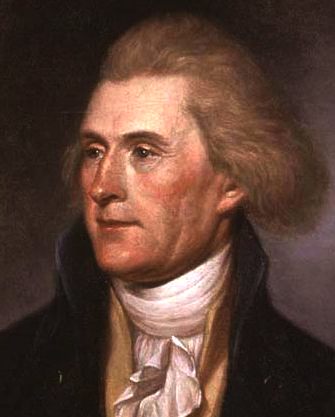
It was not homesickness that led Thomas Jefferson to return to his home state of Virginia and decline a re-election to
Thomas Jeffersen
Congress after penning the Declaration of Independence. At the forefront in Jefferson’s mind on July 5, 1776, was not the welfare of the new nation as a whole, but rather the welfare of his home state of Virginia.
For Jefferson, Virginia was not simply one part of the ultimate goal of the United States, but in fact an ultimate goal in itself. It was at the local level that Jefferson knew provisions for the future freedom of his fellow Virginians had to be made.
Voltairine de Cleyre, an anarchist who lived in the late 19th and early 20th centuries, greatly admired the founding generation and Jefferson in particular.
In her essay “Anarchism and American Traditions,” she wrote that one of the greatest traits of the American revolutionaries was their recognition “that the little must precede the great; that the local must be the basis of the general; that there can be a free federation only when there are free communities to federate; that the spirit of the latter is carried into the councils of the former.”
“Anarchism” today is often employed as a pejorative term rather than as a description of the political and economic philosophy taken seriously by such great minds as J.R.R. Tolkien, Henry David Thoreau, Thomas Jefferson and William Lloyd Garrison. In fact, de Cleyre’s political philosophy had many similarities with modern libertarianism and traditional conservatism.
Author Update – the Learning from Dogs author team are delighted to welcome Elliot to their ranks.
On April 1st I set the scene for the essays that I wanted to write for Learning from Dogs as follows:
I often ask myself just how effective the modern US schooling system is as a tool of education, and whether or not its costs outweigh its benefits. I hope to have at least a rough answer to this question in the final post of this series.
I intend to examine three topics:
– In what ways does the modern schooling system function as a positive tool for education?
– What costs involved in modern schooling hinder its ability as an educative tool, and even make it a negative influence on students?
– Considering the analyses put forth in the first two posts, do the costs or benefits or this system outweigh the other? On the whole, are school and education complements or antagonists?
The author
On April 15th, I looked at the positive aspects of the American educational system. Now I look at the other side of the coin, so to speak.
Intellectual failure
While in my last post I attempted to put a positive spin on the United States education system, I must here admit that I personally tend to view it in a much more negative light. There are several reasons for this, three of which I will try to elaborate on here.
My first major concern about education in the United States is its lack of critical thinking skills, which produces students who do not know how to question the “system” for what is truly is, but rather constantly take the context of things presented as fact (the two-party political system is a perfect example of this.)
I am not necessarily arguing that the specific curriculum is being chosen to suit this purpose, though I think this argument could be made (it would, however, require quite a bit of research.)
Rather, consider the required courses – very rarely do you see courses on economics or logic. While some schools offer these as electives, they are almost never required. This is quite sad, as a sound ability to question the established authorities and the nature of the world as a whole requires a strong background in these two fields in particular.
The history of economics is a history of government policies that have failed because of their disregard for this very topic.
The economist Ludwig von Mises wrote that “the unpopularity of economics is the result of its analysis of the effects of privileges. It is impossible to invalidate the economists’ demonstration that all privileges hurt the interests of the rest of the nation or at least a great part of it.”
A second negative aspect of the American education system is what it does to the human mind. It essentially takes the mind and makes it into a factory that is able to take in information and then spit it back out. I think there is a direct relationship between the formerly mentioned lack of classes on logic and economics and this production of human beings who are essentially taught to be cogs in a machine.
Economically, the schooling system can, in this light, be seen as a massive subsidy to corporations, who are handed people already trained in how to listen then do and repeat.
Finally, I must admit that I am skeptical as to the true purpose of compulsory education. I have rarely in history seen it as a tool for true learning, as it seems to tend to rather be a system of control. I see no reason why our school system would be any different.
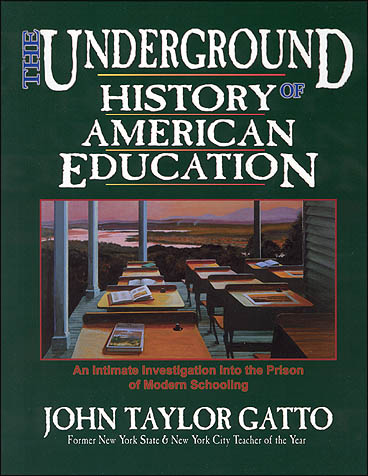
J T Gatto's book
John Taylor Gatto, a former school teacher and avid critic of mandatory schooling, has written that the purpose of modern schooling is a combination of six different functions:
The adaptive function – Establish a fixed reaction to authority.
The integrating function – People taught to conform are predictable, and are easier to use in a large labor force.
The directive function – School determines each student’s social role.The differentiating function – Children are trained as far as they need to go according to their prescribed social role
The selective function – Tag the unfit with poor grades and disciplinary actions clearly enough that their peers will see them as unsuitable for reproduction, helping along natural selection.
The propaedeutic function – A small fraction is quietly taught how to manage the rest.
I am not sure if I completely agree with Gatto, but he makes some interesting points. In my final article, I’ll attempt to weight the costs against the benefits, and see which comes out on top.





 Learning from Dogs