Californian law change means pet shops can sell only rescued animals
December 30th, 2018.
It is hoped the law will encourage pet adoptions.
California is set to become the first state in the US to ban the sale of non-rescue animals in pet shops.
The new law, known as AB 485, takes effect on 1 January. Any businesses violating it face a $500 (£400) fine.
The change means cats, dogs and rabbits sold by retailers cannot be sourced from breeders, only from animal shelters.
Animal rights groups have heralded it as a step forward against so-called “kitten factories” and “puppy mills”.
They say the current “high-volume” industries, where pets are bred for profit, can lead to inhumane treatment and long-term emotional and physical health problems in some animals.
The new state-wide law, approved in late 2017, will now require shops to maintain sufficient records of where they sourced each animal, for periodic checks by authorities.
It does not, however, affect sales from private breeders or owner-to-owner sales.
Some Californian shop owners have raised concern the law could put them out of business. The measure has also seen resistance from the American Kennel Club, which said it limits pet owners.
It is estimated that more than than 860,000 cats are euthanised in the US every year
The California assembly member who introduced the legislation, Patrick O’Donnell, has insisted the legislation is not just “a big win” for “four-legged friends”, but for California taxpayers too, as they spend hundreds of millions on sheltering animals across the state.
“It takes the emphasis off the profit of animals and puts the emphasis back on caring for and getting these cats and dogs a good home,” prospective owner Mitch Kentdotson said.
AB 485 is the first state-wide law of its kind, although other places have enacted similar regulations on pet sales on a local level.
This is both an unlikely story and a beautiful one.
For a hawk had ‘grabbed’ a puppy but then, for whatever reason, chose to let it go. But that’s enough from me, here’s the story.
ooOOoo
This puppy literally fell from the sky
From the clutches of despair to the most compassionate hands.
By CHRISTIAN COTRONEO, January 15, 2019.
The aptly named Tony Hawk is recovering from his high-flying adventure with a foster family. (Photo: Austin Animal Center)
Not much is known about the tiny chihuahua who suddenly appeared at a construction site near Austin, Texas, last week.
In fact, he literally fell from the sky.
Workers at the project heard his cries long before they saw him. They figured a puppy was trapped somewhere among the debris.
“They were going around the construction site trying to figure out where these cries were coming from,” Jennifer Olohan, communications director for the Austin Animal Center, tells MNN.
“And then they realized it was actually coming from the sky.”
High above their heads, a puppy was flying through the air — in the clutches of a hawk.
At that very moment, the bird suddenly let go and a tiny screaming puppy — no older than 6 weeks — fell into their midst.
Aside from a few superficial wounds on his head, the chihuahua was surprisingly unhurt. But terrified.
The puppy only suffered a few superficial cuts form his fall. (Photo: Austin Animal Center)
But that didn’t last long, as the workers quickly brought him to a medical clinic, and from there, the puppy found his way into the care of the Austin Animal Center.
“We don’t know where he came from — whether he was born as a stray or whether he was in a home and got out,” Olohan explains.
The unlikely paratrooper’s new name, however, came naturally: He would be called Tony Hawk.
Tony Hawk will be ready for his forever home in about four weeks. (Photo: Austin Animal Center)
Considering his sheer tininess — not much bigger than a mouse — Tony Hawk probably seemed like a good idea to a hungry hawk.
But maybe he wasn’t ready to deal with all that crying. In any case, Tony Hawk’s fears subsided soon after he found some traction on terra firma.
Mostly because he found a living foster home to ease him into his new life. In a month or so, Tony Hawk will be looking for a forever home.
But Olohan suspects he won’t wait long.
“We’ve had plenty of interest, tons of applications for him,” she says. “He’s certainly not going to have a problem finding a home.”
And so a tiny puppy without a past found himself free from the clutches of despair — thanks to the warm, caring hands that will help him shape a brand new future.
Tony Hawk is guaranteed nothing but soft landings from here on in. (Photo: Austin Animal Center)
ooOOoo
In a world that sometimes seems a little strange this is a heck of a good news story.
Well done all involved especially the crew at Austin Animal Center.
January 14, 2019 — The U.S. Food and Drug Administration is warning pet owners not to feed one specific lot of A+ Answers Straight Beef Formula for Dogs after the Nebraska Department of Agriculture discovered Salmonella in the food.
Which Products?
The following product is affected:
A+ Answers Straight Beef Formula for Dogs
Lot # 2018 20/08 20
Why FDA Issuing This Warning
The FDA is issuing this warning because the affected product represents a serious threat to human and animal health and is adulterated under the Federal Food, Drug, and Cosmetic Act.
Lystn LLC (doing business as Answers Pet Food) recalled the affected product from distribution and retail locations in the state of Nebraska on December 20, 2018, but has not yet recalled the product nationwide.
The FDA is still working with Lystn to gather comprehensive distribution information and is issuing this warning to alert consumers about this public health risk.
About Salmonella
Salmonella is a bacterium that can cause illness and death in humans and animals, especially those who are very young, very old, or have weak immune systems.
People infected with Salmonella can develop diarrhea, fever and abdominal cramps.
Most people recover without treatment, but in some people, the diarrhea may be so severe that they need to be hospitalized.
In these patients, the Salmonella infection may spread from the intestines to the blood stream and then to other body sites unless the person is treated promptly with antibiotics.
Consult your health care provider if you have symptoms of Salmonella infection.
Pets do not always display symptoms when infected with Salmonella, but signs can include vomiting, diarrhea (which may be bloody), fever, loss of appetite and/or decreased activity level.
If your pet has these symptoms, consult a veterinarian promptly.
Why FDA Concerned About Salmonella in Pet Food
Pet foods contaminated with pathogens such as Salmonella are of particular public health importance because they can affect both human and animal health.
Pets can get sick from Salmonella, and may also be carriers of the bacteria and pass it onto their human companions without appearing to be ill.
Once Salmonella gets established in the pet’s gastrointestinal tract, the animal can shed the bacteria when it has a bowel movement, and the contamination will continue to spread.
Because animals can shed the bacteria when they have bowel movements, it’s particularly important to clean up the animal’s feces in yards or parks where people or other animals may become exposed, in addition to cleaning items in the home.
Federal law requires all pet food to be free of pathogens, including Salmonella.
Pet food manufacturers must effectively manage sourcing of ingredients, processing and packing to control pathogens.
Without an effective control, such as cooking, raw pet food is more likely than other types of pet food to contain pathogens such as Salmonella.
Pet owners who choose to feed raw pet food should be aware of the risks associated with these products.
What to Do?
Pet owners who have this lot of A+ Answers Straight Beef Formula for Dogs should discard it in a secure container where other animals, including wildlife, cannot access it.
Consumers who have had this product in their homes should clean refrigerators/freezers where the food was stored and clean and disinfect all bowls, utensils, food prep surfaces, pet bedding, toys, floors, and any other surfaces that the food or pet may have had contact with.
Clean up the pet’s feces in yards or parks where people or other animals may become exposed.
U.S. citizens can report complaints about FDA-regulated pet food products by calling the consumer complaint coordinator in your area.
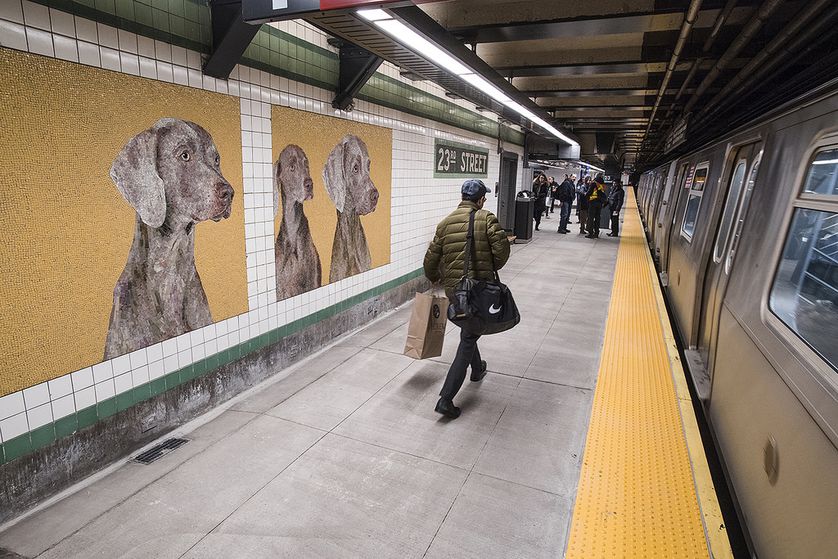
In my travels around for items about dogs I came across this one. It’s not your usual item. For it features dog art at the 23rd Street station on the IND Sixth Avenue Line in Manhattan’s Chelsea neighbourhood.
ooOOoo
This NYC subway station has gone to the dogs
With more than a little help from William Wegman’s Weimaraners
By MATT HICKMAN
December 24, 2018.
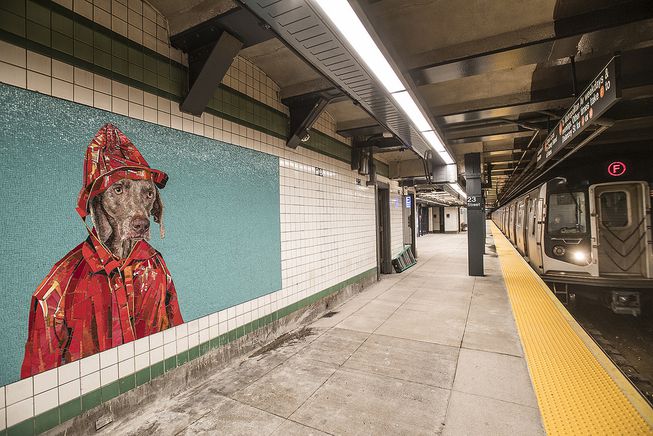
William Wegman’s iconic Weimaraner portraits have been rendered into stunning mosaic art in a somewhat unlikely Manhattan venue. (Photo: Patrick J. Cashin / Metropolitan Transportation Authority/Flickr)
Dogs aren’t that unusual of a sight in the bowels of the New York City subway system.
There are service dogs and law enforcement dogs; dogs being transported in tote bags, baskets, backpacks and baby carriages; dogs swaddled beneath heavy winter jackets; very small dogs that come scurrying from the darkest corners of the platform towards … oh wait.
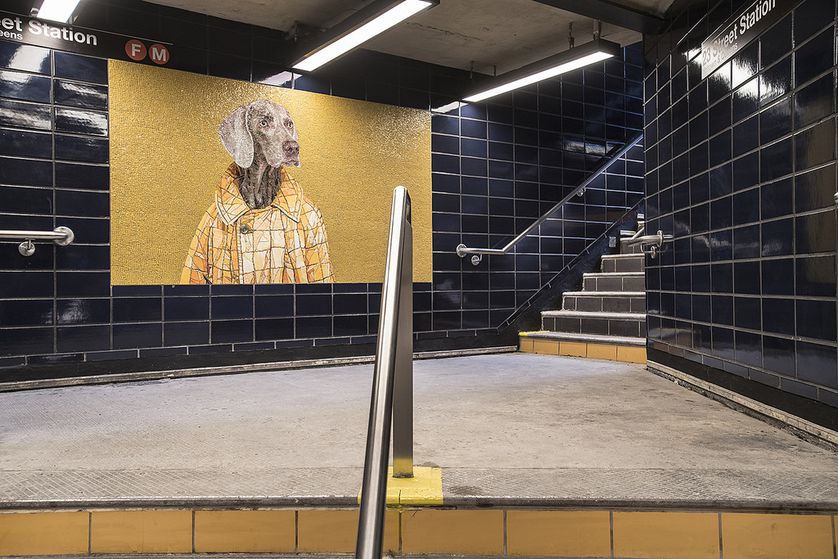
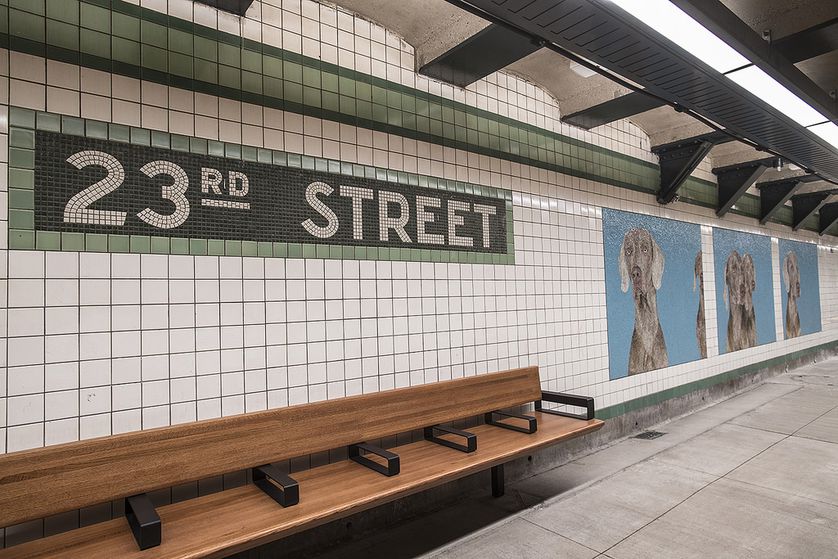
What you don’t see beneath the streets of New York are dogs depicted in public art. This has all changed with the unveiling of “Stationary Figures,” a collection of 11 glass mosaic pooch portraits now on permanent display at the 23rd Street station on the IND Sixth Avenue Line in Manhattan’s Chelsea neighborhood.
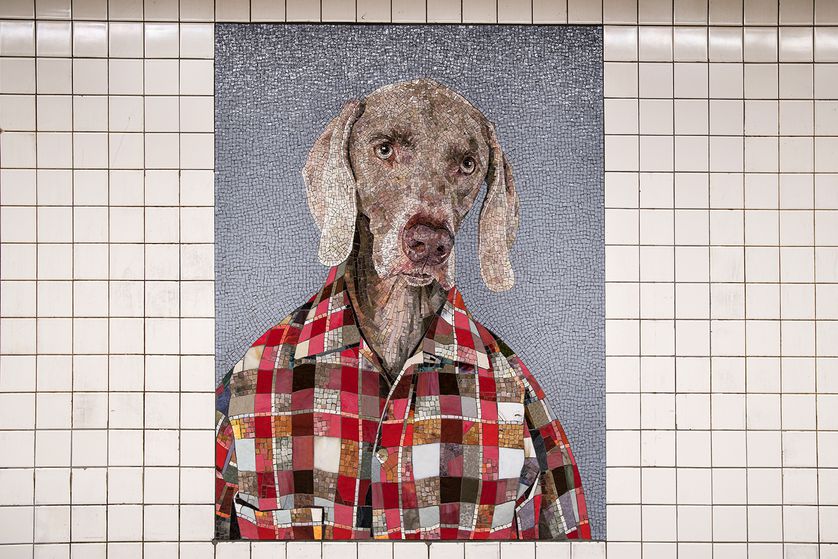
No doubt a number of straphangers passing through 23rd Street station, which services the F and M trains and was closed for several months earlier this year while undergoing a major revamping, will find that the pooches in question look familiar — maybe a bit like the average New York commuter: stoic, alert, borderline restless. But it’s mostly because the mosaics, fabricated in stunning detail by Mayer of Munich, are based on images created by none other than Mr. Weimaraner himself, William Wegman.
That’s one nattily attired Weimaraner. (Photo: Patrick J. Cashin / Metropolitan Transportation Authority/Flickr)
Although Wegman’s subjects have varied over his lauded career as a photographer, painter and video artist, he’s best known for whimsical compositions that depict his beloved pet Weimaraners in humanlike poses (and sometimes donning wigs and costumes). It all began in the 1970s with Wegman’s first true four-legged muse, the leggy and camera-loving Man Ray. It wasn’t until the mid-1980s, however, that Wegman’s second Weimaraner, Fay Ray, achieved true art world stardom. Fay’s descendants — they include Battina, Crooky, Chundo, Chip, Bobbin, Candy and Penny — have all also modeled for their human.
Wegman’s pet Weimaraners — a German hunting breed dating back to the early 19th century — have the distinction of appearing in the permanent collections of numerous top art museums and being a regular feature on “Sesame Street.” That’s no small feat for an extended family of very good boys and girls.
The dogs depicted in “Stationary Figures” are Flo and her brother, Topper — Wegman’s ninth and 10th Weimaraners, respectively. As the Metropolitan Transportation Authority (MTA), which commissioned the portraits as part of its MTA Arts & Design program, explains: “The portraits highlight Wegman’s deadpan humor by juxtaposing Flo and Topper in poses that suggest the way customers group themselves with waiting for a train at the platform. In some portraits, they’re dressed in human clothes and others they’re in their natural state.”
The floppy-eared Grey Ghosts of 23rd Street. (Photo: Patrick J. Cashin / Metropolitan Transportation Authority/Flickr)
In addition to showcasing the work of a world-renowned artist (and local Chelsea resident) in an unexpected venue, “Stationary Figures” is meant to bring joy to — and lower the blood pressure of — harried commuters passing through 23rd Street station, which ranks amongst the 50th busiest in the Big Apple. After all, who wouldn’t crack a smile when chancing across a mosaic portrait of a handsome pooch, especially when said handsome pooch is gussied up in a bright red rain slicker and matching cap?
As Mark Byrnes points out for CityLab, this isn’t the first time Wegman’s dogs have brightened up an American subway station. In 2005, two Weimaraners, both outfitted in NASA spacesuits, became permanent fixtures as circular murals above exits at L’Enfant Plaza Metro station in Washington, D.C.
Very good dogs, very poor service
It goes without saying that New York City subway stations, while teeming with various forms of microbial life, have never exactly been known as hotbeds of contemporary art and design.
That, however, began to change with the long-anticipated January 2017 opening of the first phase of the Second Avenue subway line, which features eye-catching new works by Chuck Close, Vik Muniz, Sarah Sze and Jean Shin spread out across four different stations on Manhattan’s Upper East Side. Gov. Andrew Cuomo heralded the Second Avenue line’s secondary function as subterranean contemporary gallery (price tag: $4.5 million) as the “the largest permanent public art installation in New York history.”
A very good boy in plaId. (Photo: Patrick J. Cashin / Metropolitan Transportation Authority/Flickr)
And this is all fine and good — great in fact. The more public art in the subways, the better — especially when it involves local artists of international renown, dapper-looking dogs and an ample dose of wit. Flo and Topper are the best thing to hit the 23rd Station since, well, forever.
Critics, however, have been left wondering as to when significant, tangible improvements to the MTA’s declining service will finally be instituted. And this is especially true with new fare hikes on the horizon.
As is the case with the 23rd Street station, which also received new benches, lighting, tile work, countdown clocks and digital screens as part of its extensive overhaul, what does it matter if the platforms and other public areas look fantastic but the trains aren’t running efficiently? (Byrnes points out that accessibility, or a lack thereof, also remains a major issue at 23rd Street station.)
Next stop Herald Square. (Photo: Patrick J. Cashin / Metropolitan Transportation Authority/Flickr)
The MTA needs to do more than outfit stations with delightful distractions to keep straphangers — who mainly just want to get from point A to point B in a minimal amount of time with minimal headache — happy. While mosaics, murals and the like do act as a sort of soothing balm and improve the user experience, public art is ultimately best enjoyed while also not on the verges of tears because three completely packed F trains have gone by and you’re running 30 minutes late.
As for Wegman, described by the New York Post as a “frequent subway commuter,” he doesn’t offer any specific thoughts as to how the MTA can also improve its service.
“I really like what they’re doing as far as making it look better,” he tells the Post. “But how to make them run better, that’s out of my area.”
ooOOoo
Now I can’t really comment any more as the odds of me being on the New York Subway are slim to none. Plus, it’s many years since I travelled on the British Underground.
But that doesn’t stop me from applauding this. Both the authorities for permitting it to happen and especially to William Wegman for such beautiful and outstanding work.













 Learning from Dogs