(Please note that I am letting this post run until Sunday, 15th Oct.)
For many years I have both read George Monbiot’s writings, especially those published by The Guardian newspaper, and deeply respected his insight, intelligence and analysis of the world in which we now live.
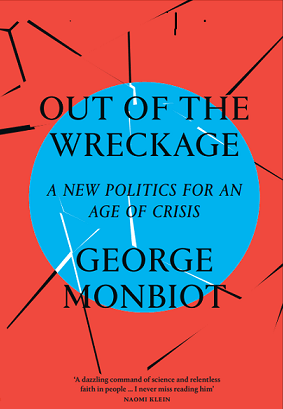
So when I heard of his latest book, published by Verso Books both sides of the ‘pond’, it was ordered immediately. It was a book I badly wanted to read. I was not disappointed.
So what is Mr. Monbiot’s message?
To answer that question let me lean on a forthcoming talk being given by him in Edinburgh in eight days time. For he is speaking at a Scottish Green Party event on October 20th.
Here’s the thrust of what is to be covered at that meeting:
What does the good life—and the good society—look like in the twenty-first century?
A toxic ideology rules the world – of extreme competition and individualism. It misrepresents human nature, destroying hope and common purpose. Only a positive vision can replace it, a new story that re-engages people in politics and lights a path to a better world.
Join us for an evening of discussion with George Monbiot as he talks about his new book: ‘Out of the wreckage: a new politics in an age of crisis‘. New findings in psychology, neuroscience and evolutionary biology cast human nature in a radically different light: as the supreme altruists and cooperators. George argues that we can build on these findings to create a new politics: a ‘politics of belonging’.
So what does this mean for social and environmental justice campaigning in Edinburgh? How do we create a politics of belongings here in Scotland? There will be plenty of opportunity for George Monbiot and the audience to share their insights.
Doors open: 6pm
George Monbiot will speak from 7-7.30pm and there will then be a Q&A, plus a chance buy books, mingle and browse stalls.
This event is jointly hosted by Global Justice Now and the Scottish Green party.
To my mind, this book not only addresses, full on, the madness (my word) of these present times but also offers strong, positive recommendations as to how we, as in the societies of all the major nations, can turn it around and offer a decent future for future generations. That’s why I am so strongly recommending it.
For George Monbiot, neoliberalism should best be understood as a “story”, one that was conveniently on offer at precisely the moment when the previous “story” – namely Keynesianism – fell to pieces in the mid-1970s. The power of stories is overwhelming, as they are “the means by which we navigate the world. They allow us to interpret its complex and contradictory signals”. The particular story of neoliberalism “defines us as competitors, guided above all other impulses by the urge to get ahead of our fellows”.
It should be said at once that we are desperately in need of new ideas for a society and a democracy where trust in all established institutions is at a record low and even a Tory prime minister admits the country doesn’t work for everyone. Monbiot’s ideas are clear, well-reasoned and sometimes compelling. Many will mock his attempt at a “story of hope and restoration”; even some of his Guardian colleagues call him “George Moonshine”. Human beings, his critics will say, are inherently selfish and self-maximising. Give them the opportunity to freeload off others’ efforts and they will take it.
Such objections are easily dismissed. Yes, there’s a self-interested streak in all of us but, as Monbiot observes, we also have instincts for co-operation and sensitivity to others’ needs. Think of the hundreds who volunteer to run food banks and of the thousands more who donate to them. Think of those Europeans who, at great risk to themselves, sheltered Jews from the Nazis during the Second World War. The altruistic instinct can be kindled in almost anybody. It is suppressed, however, in a society that rewards the selfish but penalises – and brands as “mugs” – those who are more mindful of our needs, and the planet’s. That society has led to loneliness, high levels of mental illness and increasingly discordant political discourse. Shouldn’t we at least try developing a society that does more to nurture the better angels of our nature?
Better still, settle down with a cup of tea, put your feet up for fifteen minutes and listen to this:
This book struck me as the most important book I have ever read in my lifetime. Why? Because it gets to the heart of what is happening today. But it offers even more than that. For instead of a shrug of the shoulders or eyes turned skywards from a friend when one mutters about the fact that we are living in ‘interesting times’, George Monbiot offers hope and guidance.
Take the very last two paragraphs from the final chapter of his book.
Coming Home to Ourselves
Through restoring community, renewing civic life and claiming our place in the world, we build a society in which our extraordinary nature – our altruism, empathy and deep connection – is released.
When we emerge from the age of loneliness and alienation, from an obsession with competition and extreme individualism, from the worship of image and celebrity and power and wealth, we will find a person waiting for us. It is a person better than we might have imagined, whose real character has been suppressed. It is one who lives inside us, who has been there all along.
“- our altruism, empathy and deep connection -”
I see these persons every day of my life. Via the pages of this blog.
Yes, I am referring to all of you who wander in and out of this place, who demonstrate your compassion, your love and your dedication to the dogs and all the other animals of this world.
Not that long ago I received an email out-of-the-blue from Linley Achtenhagen. Linley wanted to tell me, and all of you, what having a dog had meant to her.
ooOOoo
How It All Started
by Linley Achtenhagen
Before I start talking about all of the things I have learned from having a dog, I should probably tell the story of how this crazy journey started.
My sophomore year of college was probably one of the most difficult years I’ve had. I was struggling with anxiety issues and I had just quit basketball, which was the hardest decision I’ve ever made. Why? Well, I had been playing basketball from the time I could walk and the day that I decided I was done was a very difficult, yet relieving day.
Me playing basketball had become unhealthy for me and caused me so much stress and anxiety that it was hurting me more than it was helping me, but that’s a different story.
Anyways, once I was done playing college basketball I felt relieved, but also empty. All I had really ever known was basketball, so now I felt like I wasn’t doing anything with my life other than going to school and studying things that I didn’t care about. I knew that something was missing!
I have always been an animal lover. Growing up we had everything from cats, to dogs, to horses and even a pet bird. Dogs were my favorite though (sorry cat lovers) and I thought, “why not see if there’s a dog that needs a home”.
So I went online and of course, I found, literally, thousands of dogs that needed homes. After months of searching and convincing my parents that I could do this, I adopted Luna.
Luna came from a high-kill shelter in Missouri, meaning that if she wasn’t adopted in a certain time frame she was going to be put to sleep. Lucky for me, Tiny Paws Small Dog Rescue in Milwaukee, Wi transported her and about 10 other dogs from the shelter up to Wisconsin.
Luna was about 15 pounds underweight and for a 40-pound dog that’s dangerously skinny. When I would pet her I could feel every single bone on her body. She was skinny, shy, and had patches of fur missing, yet the trust this animal gave me right from the start was amazing. This animal had gone through only God knows what, and trusted me immediately. It was an eye-opening thing to watch.
Now, I’m not going to lie and say that it was all butterflies and rainbows when I adopted Luna. The first few days I was panicked and thought, “what on earth did I get myself into”. But I knew that I had made a commitment to this dog and I couldn’t give her away. I have always hated change, in fact, it is one of the things that gives me pretty bad anxiety, and I knew that giving Luna back would be the easy way out. Sure enough, in about a week, this dog became my best friend and it’s like we had a mutual understanding that we were in this together.
Since getting Luna I went from not knowing what I wanted to do with my life to declaring my major as entrepreneurship and knowing that one day I want to open my own pet supply store.
I want to share all of the knowledge that I have gained about dogs from having Luna with other pet and dog lovers. I have found that big, franchise pet stores just don’t have the same knowledge that small, local pet stores do. I am also not saying that I know everything there is to know about dogs because I still learn new things every single day. But I want to share everything I have learned with dog owners and help them give their pet the best life possible. I also hope to learn new things from all the people that (hopefully) come in and out of my store every day.
In the posts to come, I will share everything I have learned about life, love, animals, and everything in between from my life with Luna.
ooOOoo
If only all decisions in life were as easy as me wanting to publish Linley’s account of her meeting Luna!
All we now need is a photograph of the happy couple!
A plea to choose a shelter dog before other sources!
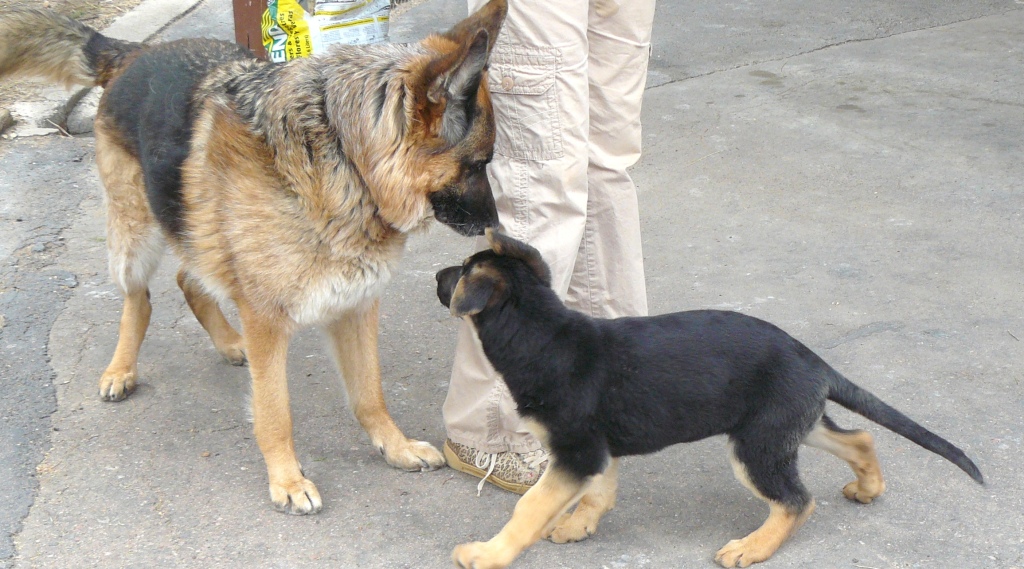
Of the six dogs that we have here at home only one, Cleo, came to us from a breeder. That was because we specifically wanted a GSD puppy to be a playmate for Pharaoh as he was getting into his final years.
Pharaoh demonstrating his benevolent status with puppy Cleo. April 2012.
The other five are all dogs that we took from rescue shelters or, in the case of Brandy, from a couple that couldn’t handle such a big dog despite him being the most placid and loving dog one could ever come across.
The Care2 blogsite recently published an article that hammered home the reasons why everyone should (nay, must!) consider a shelter dog first.
Please read and share this. For the sake of those thousands of dogs that never have the joy of loving owners in their lives.
ooOOoo
6 Common Myths About Shelter Animals (and the Truth About Them)
Adopting a dog doesn’t mean you’re inheriting someone else’s problem. Learn the truth and some common myths about shelter animals.
It’s a sad fact that each year approximately 670,000 dogs are euthanized in animal shelters across the United States. It happens because too many dogs enter the shelter and too few people consider adoption when it comes to getting a new pet. Many buy into one of the most common myths that when you adopt a dog from a shelter you are inheriting someone else’s problem.
The truth is that shelters and rescues are brimming with happy, healthy pets just waiting for someone to take them home. Most shelter pets are surrendered because of a human problem like a move or a divorce, not because the animals did anything wrong. Many are already housetrained and used to living with families.
“When you adopt a shelter dog you are most likely bringing home a dog who has good manners, is leash trained and knows some commands,” said Ellen Ribitzki, kennel manager for the Bloomingdale Regional Animal Shelter Society (B.A.S.S.) in New Jersey. “In addition, shelter dogs are temperament tested so adopters will have an idea of a pet’s personality―whether he/she gets along with other dogs or with cats and young children.”
In late August the Herrera family visited B.A.S.S. to find a companion for their rescue dog, Charlie. The family had just lost their beloved Roxy, a 12-year-old boxer, and all of them―including Charlie―were mourning the loss.
“We started visiting our local shelters because we know what love rescue dogs can give,” Robin Herrera said. “We knew that we didn’t want a puppy but we were looking for a dog young enough to be playful. We also knew that Charlie had to approve of the new dog.”
At B.A.S.S. they fell in love with Sophia, an 18-month-old German shorthair pointer mix, an energetic fun-loving and playful dog. Luckily Charlie approved and Sophia is now a much-loved addition to the family.
The Herrera family fell in love with Sophia, a German shorthaired pointer mix, for adoption at the Bloomingdale Regional Animal Shelter in NJ. Image courtesy of the Robin Herrera
“Sophia and Charlie are constantly hunting for chipmunks in our yard,” Herrera said. “They love long walks together and enjoy snuggling with us at night.”
Ribitzki said that dogs are rarely returned to B.A.S.S., and when it does happens it’s because of health or life changes―for example, allergies or a job change―and not behavioral issues.
“The majority of dogs and cats are surrendered to B.A.S.S. by heartbroken owners in tears because they can no longer care for their beloved pet,” Ribitzki said. “Unfortunately, with the recent catastrophic hurricanes, there will be a lot more animals impacted and more demands on rescues and shelters.”
Shelter dog Sophia (standing) was recently adopted by the Herrera family in New Jersey and has become a loving member of the household. Image courtesy: Bloomingdale Regional Animal Shelter
October is Adopt a Shelter Dog Month and a perfect time to help dogs in shelters across the country find loving forever homes. If you’re thinking of adding a dog to the family, please consider adopting your next animal companion.
6 Common Myths about Shelter Animals
Myth #1: Dogs only end up in shelters because they have behavior problems or are sick.
Truth: Some dogs do end up in shelters and rescue groups because their owners can’t handle their perceived behavior problems (which may be as easy to fix as an older puppy reluctant to housebreaking), but most of them end up in shelters because of a combination of these reasons:
They were strays―either they never had a home or they ran away and their owners didn’t reclaim them.
The owner moved and couldn’t take his/her pet along.
Owners were too busy to take care of their pets, or couldn’t afford to due to job loss or medical emergencies.
Owners didn’t know how to train their pet to behave appropriately.
Owners got rid of their pet when their baby was born.
Owner or family members developed allergies to the pet.
The pet required a medical procedure that the owner couldn’t afford.
Owners and their family simply lost interest in the pet, this is especially true for older puppies.
Myth #2: You never know what you’re getting with a shelter or rescue pet.
Truth: When you deal with a reputable shelter or rescue group that gets all vetting done―spay/neuter, vaccinations, deworming and heartworm preventative―and temperament tests all of their adoptable pets, you do know what you’re getting!
Myth #3: You have to start the bonding process when your pet is a baby.
Truth: Rescued pets are often noted as being “grateful” for their new lease on life. Forming a bond with an animal whose life you saved comes naturally for most people. Dogs become attached to the people who take care of their basic needs, no matter when those people came into their lives.
Forming a bond with an animal whose life you saved comes naturally for most people. Image credit: Thinkstock
Myth #4: Shelter animals are not as clean as pet store animals.
Truth: Not only is this untrue, but the conditions of many breeding facilities or puppy mills (which supply pet stores that sell dogs) are nothing short of horrific. Puppies born in puppy mills are usually removed from their mothers at just 6 weeks old and are housed in overcrowded and unsanitary wire-floored cages, without adequate veterinary care, food or water.
Myth #5: Adopting big or very strong dogs is a bad idea if you have little children.
Truth: There’s no evidence that big dogs are more likely than small dogs to harm children. A dog’s behavior is a function of many factors including breeding, socialization, training, environment and treatment by owners.
Myth #6: Getting animals from breeders is safer because the breeders know the animal’s bloodline and family history.
Truth: As a result of their breeding, purebred dogs very often have genetic disorders and medical issue predispositions, certainly no less often than shelter dogs. Also, while bloodlines and histories are useful tools to assess an animal’s value, they are limited in terms of predicting behavior. On the other hand, shelters are motivated to save lives and make strong matches. Some use science and sophisticated tools to appropriately pair up animals and owners and are happy to share everything they know about each animal.
The Humane Society of the United States offers the top reasons to adopt a pet.
ooOOoo
Did you notice that link on the very last line of this article, the one regarding The Humane Society offering the reasons why everyone should adopt? If that link was followed then one would read the most important reason to adopt a pet (my emphasis):
Because you’ll save a life.
Each year, 2.7 million adoptable dogs and cats are euthanized in the United States, simply because too many pets come into shelters and too few people consider adoption when looking for a pet.
The number of euthanized animals could be reduced dramatically if more people adopted pets instead of buying them. When you adopt, you save a loving animal by making them part of your family and open up shelter space for another animal who might desperately need it.








 Learning from Dogs