A reflection of the future year; this last day of 2014
I struggled for some time, wondering what to write for this day: December 31st, 2014. Part of me wanted to be light and cheerful. Yet, nothing came to mind in terms of what to write that wouldn’t be pointless or inane. Then dear Colin who writes the blog Wibble – just another glitch in the matrix posted yesterday: Are we ready for 2015? Here’s that post:
Are we ready for 2015?
I’m not sorry for sounding somewhat melodramatic, here: what we face is nothing less than the archetypical existential threat. You may well
Graph (hand-drawn in 2008) showing that carbon emissions must peak by 2015 to keep global warming to the internationally agreed upper limit of 2°C (the point beyond which we risk runaway climate change).
dismiss me as ‘alarmist’: but if you were in a crowded theatre and you were to hear me shout “FIRE!” — what would you do then?
When, in late 2009, I first saw The Age of Stupid, I was struck by one scene in which ‘a man in a shed’ stated, quite categorically, that humanity’s carbon emissions had to peak by around 2015 in order for us to avoid the risks of passing beyond 2°C above the average pre-industrial global temperature. Almost everyone agrees that two degrees centigrade of warming is the threshold beyond which we will face serious risk of uncontrollable planet-wide climate change effects of potentially catastrophic proportions. And I do mean ‘civilisation-ending’.
This is not histrionics; it’s based upon very solid science. The ‘man in the shed’ is Mark Lynas, author of ‘Six Degrees: Our Future on a Hotter Planet,’ which won the Royal Society’s science book of the year award in 2008. In the short video clip below he speaks from that same year, and his message is blunt: he says we have “seven years” to stabilise global carbon emissions to avoid the risk of climate change accelerating beyond our ability to control it.
The problem is that 2008 + 7 = 2015. Those seven years are up: we’ve squandered them.
Now, I don’t know if you’ve been paying attention — perhaps you’re more focused upon the fortunes of your favourite football team, or the latest antics on ‘Strictly’ or Eastenders; maybe your mind is firmly on your house or job move, or where your children are going to school next year, or any one of the myriad of (relative) trivia such as the ‘immigrant problem’, or the ‘war on terror’ — so in case you’re not familiar with the current situation:
Global carbon emissions are not slowing towards a peak in this coming year. On the contrary, emissions are soaring beyond anything humans have ever previously managed. I’m talking BIG numbers. Yay, us: we’re beating all records.
So… What are your new year resolutions?
On reading the blog post I found myself leaving a comment that seemed to encapsulate my inner fears, explaining why I was struggling to find a light and cheerful tone for today’s post. Here is that comment that I left for Colin:
I hesitate to offer a view. Not because I don’t agree with your article, agree totally, but because I’m afraid that I can’t offer any original thoughts. There is a growing awareness of the need to change, even some quasi-political ambitions that the world ‘needs to talk about climate change’, but no sign that we are anywhere close to a global response of emergency proportions.
Despite being a person with a naturally positive view of life, for reasons I can’t articulate, I have a profound sense of gloom about the New Year. Maybe a result of recently becoming aware of my own mortality. Maybe, an unspoken fear of some huge global catastrophe, natural or otherwise, just around the corner. I hope that I am wrong. Then if I am wrong, it is suggesting that 2015 will be more of the same and, as you so acutely point out, more of the same is the last thing this natural world of ours requires.
So make of that what you will! (And apologies for rambling on a tad!)
Happy New Year to you and all your loved ones.
Then something struck me. It’s no good just giving up and having a moan. Each and every one of us has to find a motivation for changing. Or, if the scale of global change required is just too overwhelming a prospect, then embrace these times as just one of the planet’s natural thresholds; global changes that have been going on for billions of years.
As we come to the end of 2014, it’s natural to reflect on the year that has gone by, as well as to look forward to the new year ahead. This is a time for “kind sight”.
Below are two journalling exercises to explore, now that the rush of the Holidays is over. I like to think of this as a Middle Ground pause. A time for being present, reflecting and allowing your inner wisdom to inspire you for whatever comes next.
Take a few moments to let yourself get settled and comfortable. Start by reflecting with “kind sight” on the past year. “Kind sight” means being kind to yourself, instead of being critical or judging. With “kind sight” we are able to see mistakes as lessons, and life’s challenges as times of resiliency and personal growth.
Ask yourself the following questions and write down your answers:
What happened during 2014…
What was a highlight?
What was a lowlight?
What was a surprise?
What do I feel proud of?
What do I feel grateful for?
What did I learn (or am still learning) from either the highlights or lowlights?
Some people do a month by month reflection, while others evaluate important areas in their lives. (For example – career, family, health, hobbies, learning, contribution, spirituality, travel, environment, self-care, personal growth).
Once you’ve reflected on 2014, write a Future Gratitude Letter:
This is a letter to yourself written a year in advance, describing all the things that you are grateful for during the year. Start with the date December 31st, 2015 and address it to yourself.
Include who you’ve become and what you now have or are moving towards. Be careful not to include anything that feels like a “have to” goal or something that you “should” achieve.
This is a letter of “kind sight” for the year ahead. The key is in the energy. If your energy feels uplifted when you think about the things you’re grateful for in a year’s time, then you are tapping into your own passion and inner wisdom.
This can be a revealing and inspiring process, letting the creative juices and intention begin it’s journey.
ooOOoo
Val’s recommendation is fabulous. Maybe, just maybe, I’ll have a go myself. And if I do write the letter, it will be published in this place.
So!
However you feel about yourself and about the future, whether you are gloomy and downcast, or upbeat and hopeful, never forget that you are a valid human being, a unique individual, and capable of amazing things.
So go and hug a dog and wish yourself the very best for 2015!
A Happy New Year to all – and thank you for your wonderful support of this blog these past years!
Not only to the aircraft but to all the many individuals who made it happen!
As I mentioned in yesterday’s post Nostalgia with wings, today I was going to write about a particular aircraft: The Avro Vulcan.
I chose the image above because it resonated so strongly with the comment left by Hariod Brawn that I included in yesterday’s post. Namely:
I took my father [who test-piloted the Vulcan and Victor. PH] to see Vulcan XH558 fly what was then thought to be its final flight (it subsequently was overhauled and took to the skies again). It flew along the length of the runway at a 45 degree angle with its bomb bay doors open. On the inside of the doors in huge letters was the single word ‘farewell’. It was really quite an emotional experience both for my father and myself.
There’s a lengthy item on WikiPedia about this aircraft. I will repost a couple of parts of that article.
Avro Vulcan XH558 (civil aircraft registration G-VLCN) The Spirit Of Great Britain is the only airworthy example of the 134 Avro Vulcan V bombers that were operated by the Royal Air Force from 1953 until 1985. Vulcan XH558 served with the RAF between 1960 and 1985 in the bomber, maritime reconnaissance and air-to-air refuelling roles. The RAF operated XH558 as a display aircraft from 1986 until 1992, when budget cuts forced its retirement.
It is operated by the Vulcan to the Sky Trust as a display aircraft, funded entirely by charitable donations and the UK Heritage Lottery Fund. It is registered with the United Kingdom Civil Aviation Authority as G-VLCN but has an exemption to fly in Royal Air Force markings as XH558.
Restoration to flight
The engineering staff of the Vulcan Operating Company (the engineering arm of Vulcan to the Sky Trust, owners of XH558) worked to return Vulcan XH558 to flight, with the first test flight taking place on 18 October 2007. They were supported by the “Vulcan to the Sky” club, a supporters and fundraising organisation. Though the website carried an announcement on 1 August 2006 that the project was in danger of being abandoned due to lack of finance, the target of raising the remaining £1.2m was achieved on 31 August 2006, thanks to a high-profile publicity campaign orchestrated by the supporters club, Vulcan to the Sky Club (formerly Vulcan 558 Club).
Time had almost run out for XH558 when Sir Jack Hayward, a British philanthropist, donated £500,000, which topped off the £860,000 already raised by Vulcan to the Sky Club and Friends. Although the aircraft restoration was nearly complete, the aircraft was not ready for the flypast down The Mall in London for the 25th Anniversary of the Falklands conflict on 17 June 2007 or the RAF Waddington Airshow and the Royal International Air Tattoo (RIAT).
It was intended that the Vulcan would fly during at least one UK airshow during the 2007 season, but due to delays in returning the aircraft to flight, mainly down to delays in the return of refurbished flight-critical components, the aircraft was not ready for the display season.
On 16 August 2007, the aircraft started engine testing on the airfield at Bruntingthorpe. On the next day, XH558’s No.3 Rolls-Royce Olympus 202 jet engine was run for the first time in over 20 years. This is a different engine from that used by XH558 during its final season with the RAF’s Vulcan Display Flight in 1992, with all four of the Vulcan’s original Olympus 202 engines having been replaced by zero-hour units which had been stored since 1982. The VTS Team also has another four fully inhibited engines in stock. The removed engines were either scrapped, sectioned for display or passed on to VRT’s XL426 at Southend. Another milestone in the restoration project was achieved on 22 August 2007, when all four of XH558’s Olympus engines were run at nearly full power settings, for short intervals.
The first post-restoration flight, which lasted 34 minutes, took place on 18 October 2007.
What a great project!
Now to a couple of videos. (There are many to chose from on YouTube, by the way.)
The first is a 45-minute documentary that I have only watched for the first few minutes, but it looks a good one.
and the second is much shorter but reveals to great effect the wonderful sound of the Vulcan’s engines.
Published on Oct 28, 2012
When the engines exceed 92% power, the Vulcan makes this cool howl sound.
He [my father] was an RAF pilot during the war and through to the early 1960’s. He test-piloted the Vulcan and Victor, though started on what he called ‘string bags’, by which he meant Tiger Moths. In between he flew the Spitfire, Lancaster, Meteor and specialised in flying in electrical storms, about which he wrote a manual for the RAF.
……
I took my father to see Vulcan XH558 fly what was then thought to be its final flight (it subsequently was overhauled and took to the skies again). It flew along the length of the runway at a 45 degree angle with its bomb bay doors open. On the inside of the doors in huge letters was the single word ‘farewell’. It was really quite an emotional experience both for my father and myself.
I thought it would be nice to include some video of XH558; that will be tomorrow’s post. For today, I wanted to reminisce from my own private flying days.
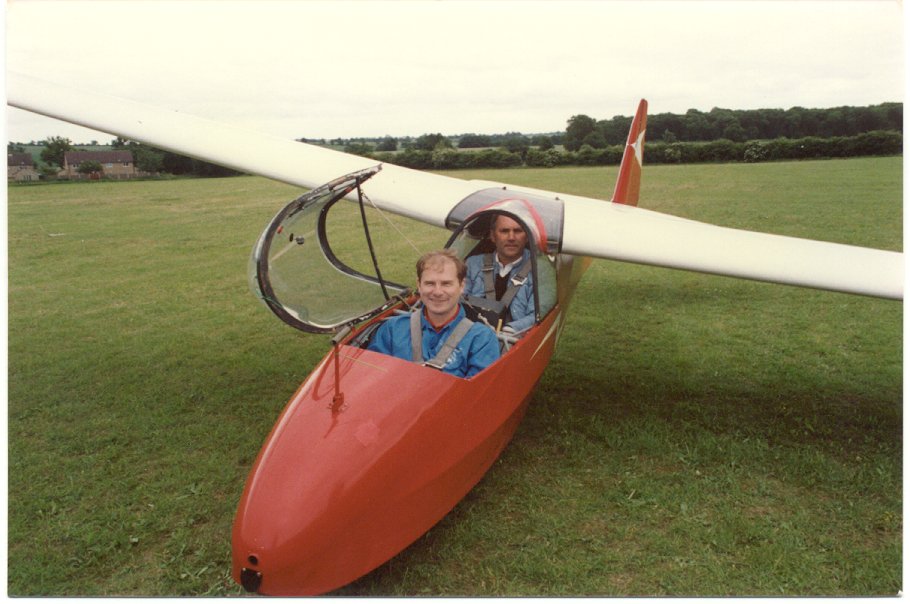
A K-7 two-seat glider.
My first exposure to private flying was on the 7th June, 1981 when, at Rattlesden Gliding Club in Suffolk, I was taken up for two air-experience circuits in a two-seater glider known as a ‘K7’. I was immediately hooked! Those experience flights leading to a 4-minute flight (flight number 46) on the 6th September, 1981 that has the remark in my pilot’s log book: Solo! Now fast forward to October, 1984 and my log book shows me attending a gliding instructor’s course at Lasham, resulting in me being issued with a British Gliding Association (BGA) Assistant Instructor Rating on the 14th October. (105/84).
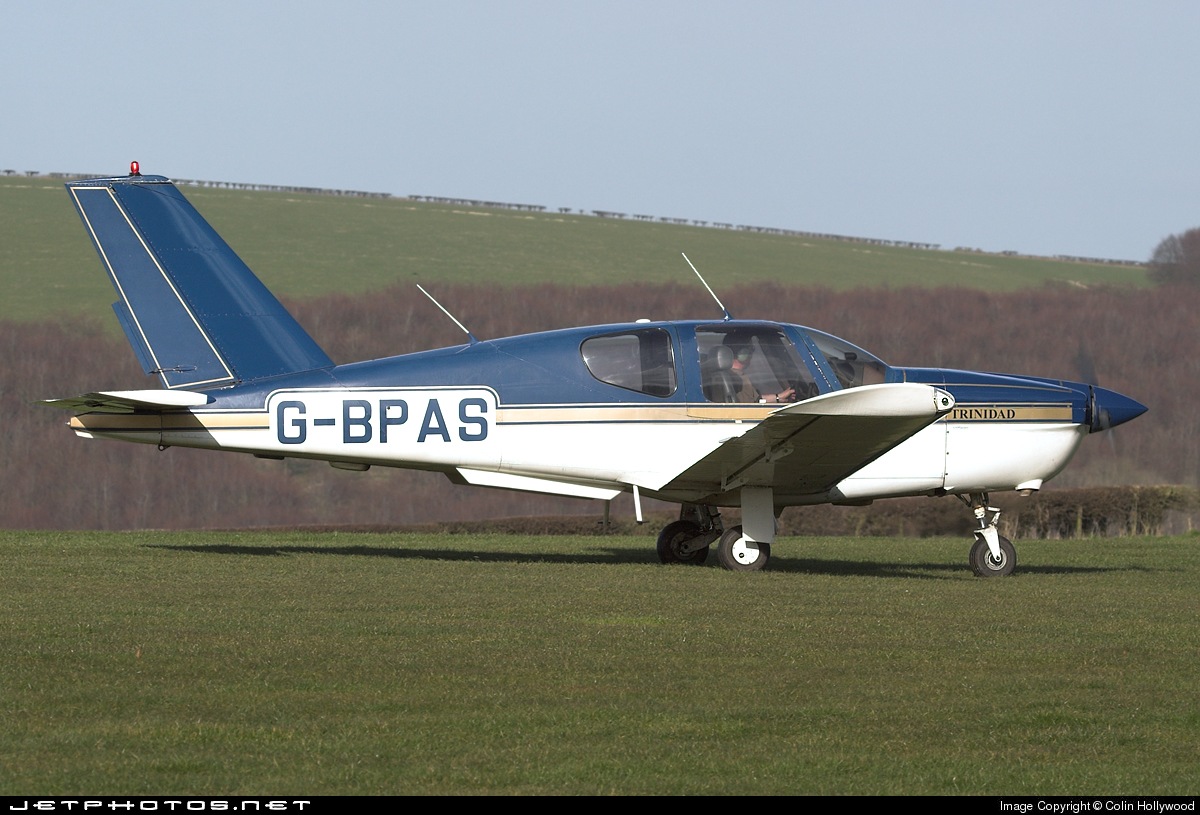
Over on the power side of things, in March, 1984, I started Private Pilot training at the Suffolk Aero Club at Ipswich Airport and gained my PPL on the 9th November, 1984. Subsequently, gaining my Instrument Rating in July, 1999 when I was then operating from Exeter Airport and flying frequently for business purposes. For that ‘serious’ flying I used a Socata TB20, a French retractable, single-engined aircraft, based at Exeter. A very fine, long-distance aircraft.
TB20, G-BPAS, photographed at Compton Abbas airfield (EGHA).
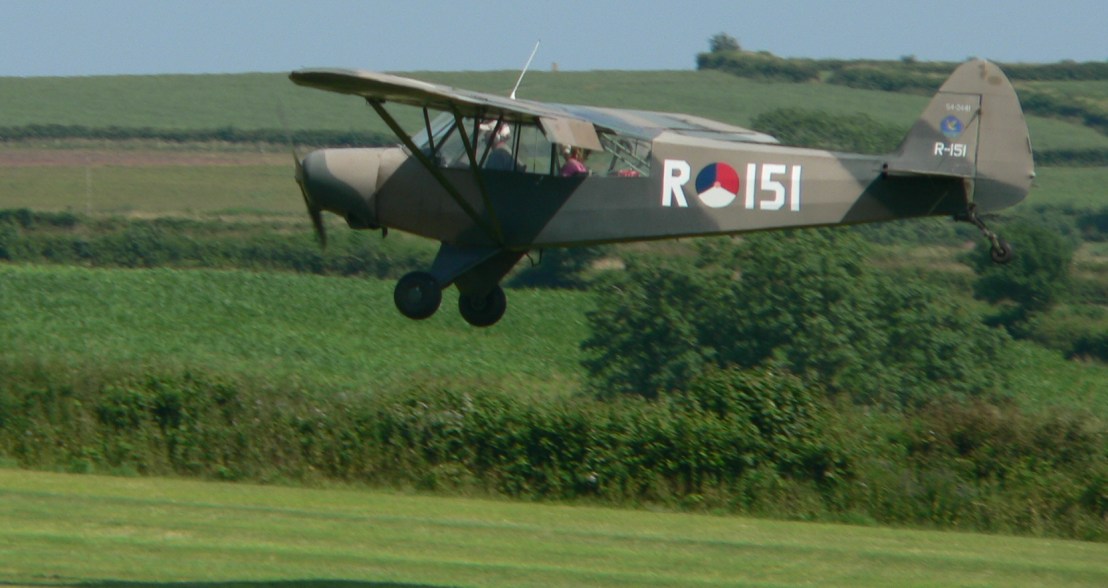
But the aircraft that I had the most fun flying was a dear old Piper Super Cub. Here’s the background to the aircraft.
Piper Super Cub, L-21B, R-151
A/C Construction No. 18-3841, Frame No. 18-3843
Original Engine, Lycoming 135 Type 0-290-D2, 54/2441
Romeo 151 was one of a batch of 298 L-21’s delivered in 1954. There were 584 L-21B’s produced by Piper for military use, the ‘L’ standing for Liaison. The L-21B’s were PA-18-135’s with civil Lycoming 0-290-D2 engines, glasswork as most L-21A’s and L-18’s and a gross weight of 1760 lbs.
This aircraft was delivered to Koninklijke Luchtmacht, Dutch Air Force, on the 1st July, 1954 and registered R-151. After various homes R-151 transferred to the Dutch civil register as PH-GER, 1st April 1976 with 4,458 hours and shortly thereafter was registered to Vlieclub Hoogeveen, Certificate Number 2380.
On the 27th March, 1981 the aircraft was delivered to the UK with a total time of 5,043 hours and in September, 1981 became G-BIYR; ‘YR’. In April, 1983 YR was the first of type to be given a Public Transport CofA (Certificate of Airworthiness) and was used for training at Tollaton. YR reverted to a Private CofA in January, 1984 when purchased by Mike and Barbara Fairclough. The aircraft had by then accumulated 5,120 hours.
In 1992, YR was re-engined with a Lycoming 150HP, 0320-A2B No. L49809-27A (zero hours). Finally on the 2nd June, 1995 the aircraft was repainted in her original Dutch insignia and given CAA (UK Civil Aviation Authority) permission to use the original call-sign: Romeo 151.
The aircraft was based at and flown from Watchford Farm airstrip in South Devon, England.
Now forgive the nostalgic photographic memories!
Yours truly approaching Watchford Farm airstrip in South Devon, EnglandFlying in the French Alps with Mont Blanc in sight9,300 ft up in the French Alps!
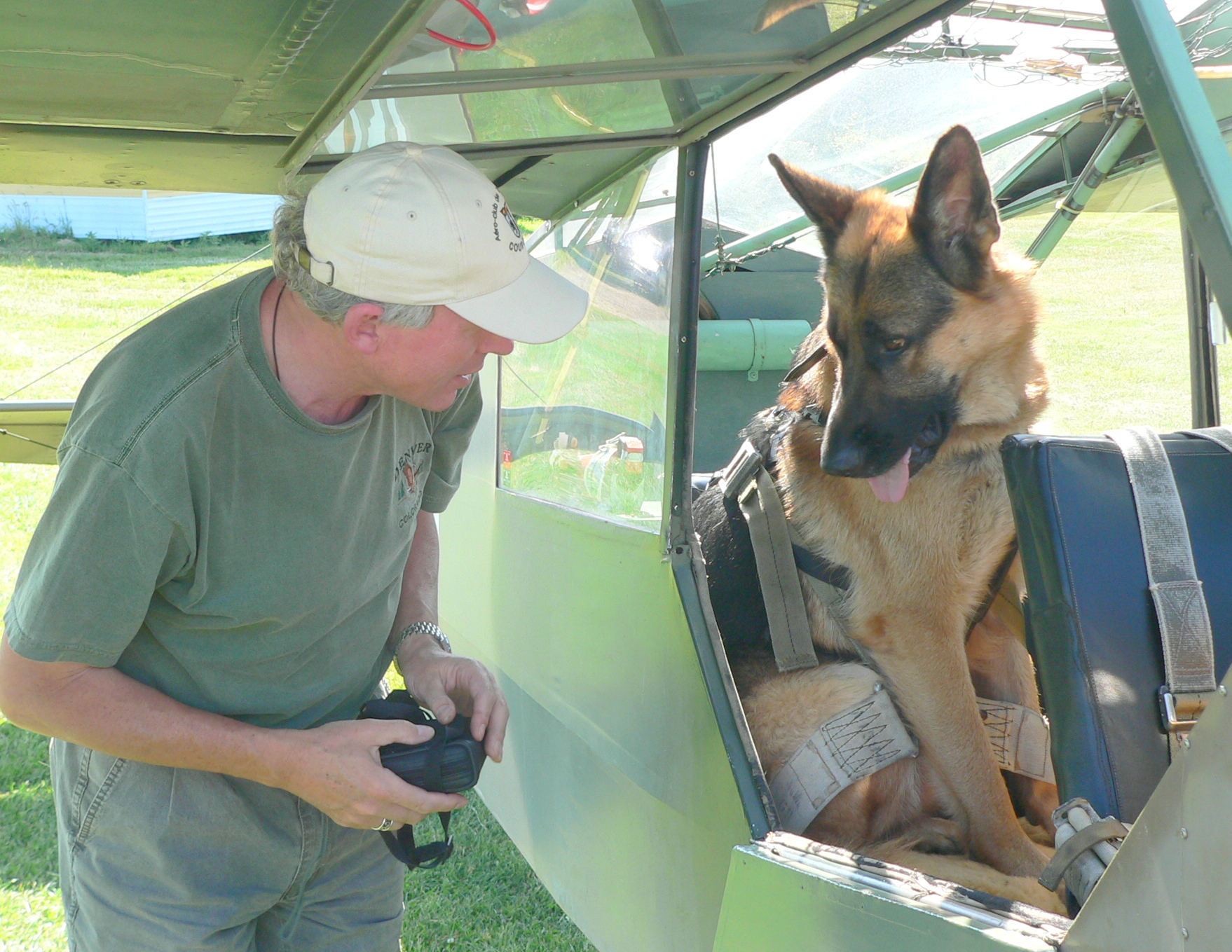
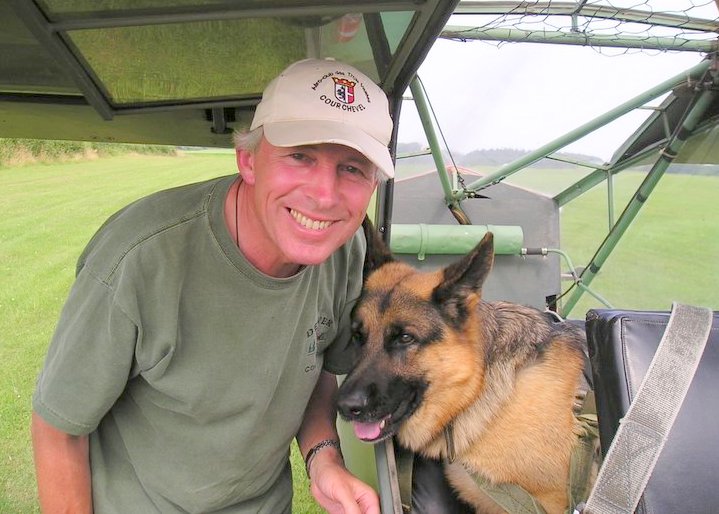
Every time I went to the airfield with Pharaoh he always tried to climb into the cockpit. So one day, I decided to see if he would sit in the rear seat and be strapped in. As the next picture shows, there was absolutely no problem with that!
Come on Dad, let’s get this thing off the ground!
My idea had been to fly a gentle circuit in the aircraft. First, I did some taxying around Watchford’s large grass airfield to see how Pharaoh reacted. He was perfectly behaved.
But then I thought long and hard about taking Pharaoh for a flight. In the Piper Cub there is no autopilot so if Pharaoh struggled or became agitated it would have been almost impossible to fly the aircraft and cope with Pharaoh sitting in the seat behind me. So, in the end, I abandoned the idea. The chances are that it would have been fine. But if something had gone wrong, the outcome just didn’t bear thinking about.
Thus we elected for taxying all around the airfield which, as the next picture shows, met with full doggie approval. The date was July 2006.
That was fun!
So enough of my recollections for today – tomorrow the Vulcan XH558.



 This is a letter to yourself written a year in advance, describing all the things that you are grateful for during the year. Start with the date December 31st, 2015 and address it to yourself.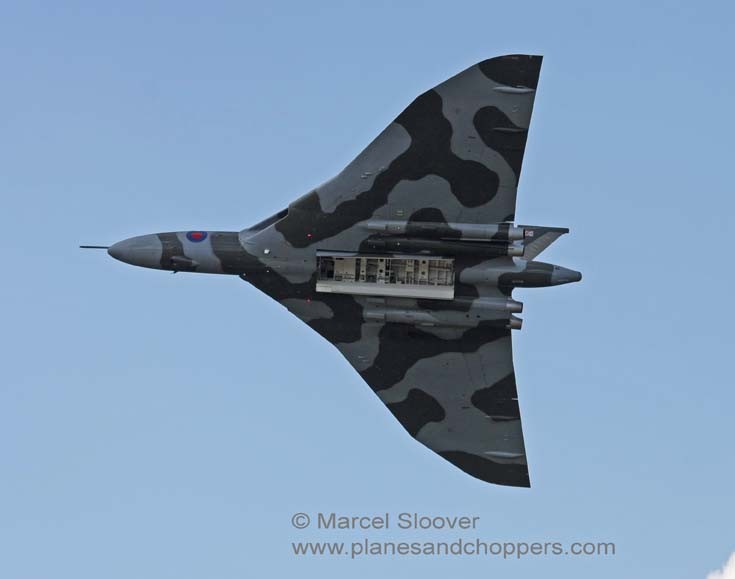


 Learning from Dogs