I published a wonderfully funny piece yesterday sent to me by Lindy C. from Devon. Today, another precious senior’s tale sent to me by Richard Maugham, he of the Understanding Europe post.
oooOOOooo
An elderly man is stopped by the police around 2 a.m. and is asked where he is going at this time of night.
He replies, “I’m on my way to a lecture about alcohol abuse and the effects it has on the human body, as well as smoking and staying out late.”
The police officer asks, “Really? Who’s giving that lecture at this time of night?”
“You don’t stop laughing when you grow old, you grow old when you stop laughing.” George Bernard Shaw.
Recently sent to me by Lindy C. from Devon, England.
This is dedicated to all of us who are seniors, to all of you who know seniors, and to all of you who will become seniors.
“WHERE is my SUNDAY paper?” The irate customer calling the newspaper office, loudly demanded to know where her Sunday edition was.
“Madam“, said the newspaper employee, “today is Saturday. The Sunday paper is not delivered until tomorrow, on SUNDAY.”
There was quite a long pause on the other end of the phone, followed by a ray of recognition as Madam was heard to mutter under her breath, “Well, shit, that explains why there was no one at church either!”
oooOOOooo
As British comedian Bob Monkhouse is reputed to have said, “Growing old is compulsory; growing up is optional.” (NB. More fabulous quotations from this naturally very funny man may be found here.)
On the subject of Bob Monkhouse, let me close with this video of Norman Wisdom appearing on the Bob Monkhouse Show back in 1983. As one of the YouTube commentators put it, “Two of Britains funniest men; we will never seek their likes again.“
I admit to being too free with my silly clichés including, “I can predict anything unless it involves the future!” So now that millions of informed people have the benefit of “20:20 hindsight“, why is it years since the banking crisis first erupted and we are still without a root and branch overhaul of the governance of the industry?
Did you see Per Kurowski’s interview with a leading regulator on Learning from Dogs yesterday? Aren’t we so slow to learn!
Anyway, I waffle on! Let me get to the point of today’s post.
Back on the 1st September, there was a post called Understanding Europe. One of the resulting commentators was Pendantry who is author of a blog called Wibble. He included a link to a poem that he wrote on the 28th February, 2009! The fact that the poem is still so relevant (and when we see what’s happening in Europe perhaps even more relevant now!) is truly shocking. I wanted to republish it which I do with the kind permission of Pendantry. Here it is.
oooOOOooo
House of cards
When the inevitable strikes,
when the house falls down,
do you patch up the walls,
fix the holes in the roof,
shore it all up,
splash it with paint?
No.
You learn from the mistakes.
You start from scratch.
You call in the architects.
You rebuild the foundations.
You use new materials;
replace wattle and daub
with a sounder design.
Unless:
Because you’re lost outside the box,
and your mates demand
to regain their riches (and, now!):
You set up the same as before,
perhaps with a few bells and whistles
(spun to persuade that they’ll work).
And… in the end, we’ll believe
that your clothing is not invisible.
“Who is more foolish?
The fool, or the fool who follows him?”
oooOOOooo
Written over three years and five months ago. Shame on us all!
A few days ago, I published a delightful story sent to me by Richard Maugham about Helga’s Bar. It was a tongue-in-cheek look at the crazy world of finance and banking that we seem to be living in at present.
One of the regular readers of Learning from Dogs is Per Kurowski and he left a couple of comments. The first being,
As a former ED at the World Bank, 2002-2004, living close to Washington, writing articles and being an assiduous blogger, I’ve been in the middle of many discussions about those many of the challenges our world faces. And my friend, I am sorry to say, our prospects to solve these problems, do not seem good.
One of the main reasons for that negative outlook, is that I have been able to witness how the discussion of many of these problems, no matter how urgent these are, so often get hijacked by a political agenda, or by a group that decides making a business, or a living, out of it.
If we cannot break out of this mold, unfortunately, the world is toast, and this, not only from a global warming perspective.
which was then followed up by,
By the way, I managed to sit down a prominent and important bank regulator in my chair yesterday, though he was invisible and quite silent!
I then replied,
Per, just love that. Any chance of you penning a guest post that could set the background to that video in terms that make it easy for the punter to understand?
So here is Per’s interview (sound volume is a little low) and his views.
oooOOOooo
Paul… well here is “a brief summary of my thoughts on banks and risks”
Capital requirements for banks which are lower when the perceived risk of default of the borrower is low, and higher when the perceived risk is high, distort the economic resource allocation process. This is so because those perceptions of risk have already been cleared for, by bankers and markets, by means of interest rates and amounts of exposures.
All the current dangerous and obese bank exposures are to be found in areas recently considered as safe and which therefore required these banks to hold little capital. What was considered as “risky” is not, as usual, causing any problems. This is not a crisis caused by excessive risk taking by the banks, but by excessive regulatory interference by naïve and nanny type regulators.
And, if that distortion is not urgently eliminated, all our banks are doomed to end up gasping for oxygen and capital on the last officially perceived safe beach… like the US Treasury or the Bundesbank.
Bank regulators have no business regulating based on risk perceptions being right, their role is to prepare for when these perceptions turn out to be wrong.
A nation that cares more for history, what it has got, the haves, the “not-risky”, the AAA rated or the “infallible” sovereigns, than for the future, what it can get, the not-haves, the risky, the small businesses or the entrepreneurs, is a nation on its way down.
Per.
oooOOOooo
You may read more from Per on his blog here, and also read Per’s Tea with FT blog! So let me close by saying that Per’s summary seems like a blast of sanity in an otherwise crazy world!
An afterthought about the adventurous spirit of man.
While the focus on the manned exploration of space has declined significantly since those days of the Apollo missions, the spirit to explore has not diminished. This was underlined in spades by a recent post from the British blog Earth & Solar System that I have been subscribing to since a few weeks ago.
This blog reflects the research interests of the Isotope Cosmochemistry and Geochemistry Group at the University of Manchester. In our laboratories we study samples from comets, interstellar dust, interplanetary dust, Mars, the moon and asteroids to understand how the Earth and the Solar System were formed, how they evolved and became what we see today. We study the Earth and its chemistry to understand how it works, its mantle, crust, oceans and how we change it. We want to share and discuss what we find with everyone.
The blog is for sharing science and what we and other research groups discover as we do science in real time. Discussion, questioning and enquiry are good, but politics, and opinion that can’t be backed up by published scientific work are strictly off-limits and will be removed.
Yet another example of why integrity is the only way forward.
Anyway, the recent post that was published came into my ‘in-box’ on Monday and I wanted to share it with you. Primarily because the mainstream media have moved on and there is little ‘news’ about NASA’s Curiosity rover. That’s why this post is so fascinating and it’s reproduced on Learning from Dogs with the permission of Ashley King, the author.
The past week has seen NASAs Curiosity rover return more amazing images of the Gale crater, fire up its DAN and SAM instruments, and take its first steps towards Mt. Sharp.
Mastcam view south-west from the Bradbury landing site. The foreground is boulder-strewn and contains the edge of an impact crater. The layered rocks in the background form the base of Mt. Sharp (NASA/JPL-Caltech/MSSS).
The new images, captured using the 100mm telephoto lens of the Mastcam, provide a glimpse of the geological treats that await scientists at the base of Mt. Sharp. Of particular interest has been the identification of an unconformity, where two rocks in contact but of different ages indicate a break in the geological record. Satellite data suggests that the rocks lying below the unconformity contain hydrous minerals whilst those above are “dry”. It appears these rock units formed under very different environmental conditions.
Unconformity (marked by white dots) at Mt. Sharp (NASA/JPL-Caltech/MSSS).
Next, Curiosity had another driving lesson, this time positioning itself over one of the scour marks created during landing. This allowed the rover to continue testing the ChemCam and turn on the Dynamic Albedo of Neutrons (DAN) instrument, which will be used to search for water below the Martian surface. The Sample Analysis at Mars (SAM) instrument, comprising of a mass spectrometer, gas chromatograph and tunable laser spectrometer, was also gently woken up. SAM can measure the abundance of C compounds, H, N and O, elements associated with life, in atmospheric and powdered rock samples. A quick test of some Earth air trapped in the instrument since launch confirmed that it is working well and should soon be ready for Martian samples.
Curiosity has now completed four drives and is heading for Mt. Sharp. However, the first target is Glenelg, a rock outcrop 400m to the east of the Bradbury landing site, where it’s hoped Curiosity will start using its drill. Although the journey will take several weeks, Glenelg contains at least three different rock types that will help scientists piece together the geological history of Gale crater.
Leaving the Bradbury landing site. This Navcam image shows the tracks left in the Martian soil by Curiosity (NASA/JPL-Caltech).
oooOOOooo
Makes a nice change to forget about the goings-on here on Planet Earth!
Like millions of others on this planet, I was held spellbound by the historic and epic moment of man placing his mark on another heavenly body, the Moon. I had been so wrapped up in NASA’s space missions that I took a holiday from work (I was working at the time for ICIANZ in Sydney, Australia) for the week of July 16th, 1969.
It was, of course, July 16th when the Apollo 11 Mission launched from the Kennedy Space Center culminating at precisely 20:17:39 UTC on July 20, 1969, the moment when the Lunar Module made lunar contact.
But in terms of me writing my own obituary for Neil, what could I offer?
Then a couple of items changed my mind.
Neil Armstrong (August 5, 1930 – August 25, 2012)
The first was reading the obituary printed in The Economist. I have long admired the many, many beautiful obituaries that have been published by this newspaper and this one was no exception. Take this extract from the Neil Armstrong obituary,
He had an engineer’s reserve, mixed with a natural shyness. Even among the other astronauts, not renowned for their excitability, he was known as the “Ice Commander”. Mike Collins, one of his crew-mates on the moon mission, mused that “Neil never transmits anything but the surface layer, and that only sparingly.” He once lost control of an unwieldy contraption nicknamed the Flying Bedstead that was designed to help astronauts train for the lunar landing. Ejecting only seconds before his craft hit the ground and exploded, he dusted himself off and coolly went back to his office for the rest of the day. There was work to be done.
Then the beautiful words that bring the obituary to a close,
Earth’s beauty
Over half a century, the man who never admitted surprise was surprised to observe the fading of America’s space programme. The Apollo project was one of the mightiest achievements of the potent combination of big government and big science, but such enterprises came to seem alien as well as unaffordable. Mr Armstrong, who after his flight imagined bases all over the moon, sadly supposed that the public had lost interest when there was no more cold-war competition.
Yet the flights had one huge unintended consequence: they transformed attitudes towards Earth itself. He too had been astonished to see his own planet, “quite beautiful”, remote and very blue, covered with a white lace of clouds. His reserve, after all, was not limitless. One photograph showed him in the module after he and Buzz Aldrin had completed their moon-walk, kicking and jumping their way across the vast, sandy, silver surface towards the strangely close horizon. He is dressed in his spacesuit, sports a three-day beard, and is clearly exhausted. On his face is a grin of purest exhilaration.
” … they transformed attitudes towards Earth itself. He too had been astonished to see his own planet, “quite beautiful”, remote and very blue, covered with a white lace of clouds.” For that reason alone, we need to celebrate the achievement of the Apollo 11 mission for putting our own planet into perspective within the enormity of the universe.
The second item that persuaded me to write this was a wonderful historic insight into how a potential catastrophy on the surface of the Moon would have been handled by President Nixon. This historic item was published on Carl Milner’s blog the other day, the specific item being What if the Moon Landing Failed? Republished with the very kind permission of Carl.
When Richard Nixon was the President of the United States, they had a speech ready for him to deliver to the world just in case the 1969 moon landing had ended in disaster. In fact many experts believed there was a big chance that Neil Armstrong and Edwin ‘Buzz’ Aldrin could have really gotten stuck on the moon. It’s something we don’t really think about now because we all know it was such a success. American Archives have unearthed the speech that would have been delivered if the late great Armstrong and Aldrin had never made it back to earth. This is such a great piece of history that I thought I might never see.
Give it a read, It’s such a moving and well prepared speech, and such a good thing that President Nixon never had to delivered it.
So, as with millions of others, I am delighted that this speech remained unspoken and instead we experienced: “At 5:35 p.m. (US EDT), Armstrong and Aldrin successfully docked and rejoined Collins, and at 12:56 a.m. on July 22 Apollo 11 began its journey home, safely splashing down in the Pacific Ocean at 12:50 p.m. on July 24.”
Neil Armstrong’s legacy is not only being part of the wonderful team that allowed man to make the first footprint on the Moon but also bringing into our human consciousness that this blue, wonderful planet we all live on is the only home we have.
First Full-View Photo of Earth Photograph courtesy NASA Johnson Space Center This famous “Blue Marble” shot represents the first photograph in which Earth is in full view. The picture was taken on December 7, 1972, as the Apollo 17 crew left Earth’s orbit for the moon. With the sun at their backs, the crew had a perfectly lit view of the blue planet.
Strikes me that celebrating July 20th each year as Blue Planet Day might not be a bad idea! Any takers? Now that would be a legacy for Neil!
Regular readers will know that I subscribe to the blog Naked Capitalism masterminded by Yves Smith. Some time ago, there was a link on NK to a story about how a tiny Chihuahua dog rescued some missing girls. It seemed like a good opportunity to take a closer look at this most magical aspect of a dog’s qualities.
First to that story.
I saw it on the Care2 website, from which I quote the following:
A 3-year-old chihuahua named Bell is an unexpected hero after finding three young girls who became lost for hours in the woods in Newnan, Georgia, on Monday.
CBS Atlanta reports that, on Monday, 8-year-old Carlie and 5-year-old Lacey Parga went for a walk with their dog Lucy down a cul-de-sac on trails near their neighborhood.
What started as a casual stroll became an unintended, and at times frightening, experience. As Carlie tells CBS, ‘”We tried to find our way out of the woods. We kept following paths and stuff and we got lost.” Indeed, they became scared that they were only to get more and more lost.
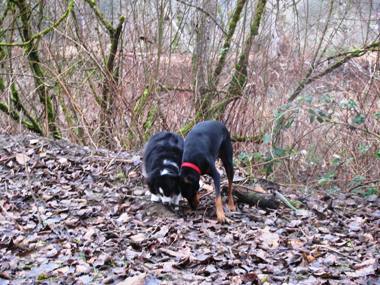
Carlie’s father, David Parga, noted that it wasn’t characteristic of them to wander off and, after searching for them but not hearing them respond, he contacted police and firefighters. Neighbors joined them including Carvin Young who thought to take Bell, who plays with the girls every day and knew their scent. Bell was able to lead searchers to the girls.
The full story on the Care2 website is here and on the CBS website here.
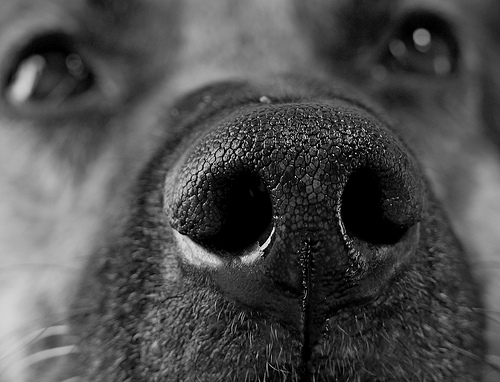
So what is it about the nose of the dog? A dog has more than 220 million olfactory receptors in its nose, while humans have only five million, making dogs’ sense of smell a thousand times greater. Frankly, trying to get one’s intellect around precisely what having a sense of smell one thousand times greater than a human means is tough! So on to another story.
17 Dogs, 3 Generations, 70 Years. There’s one constant… …the family dog.
After moving to Wellesley, Massachusetts for an anchor job with a major television sports network, Kevin began taking his German Shepherd, Beverly, for walks in the surrounding neighborhoods. They developed a route that included historic Atwood Street. Beverly kept veering toward one house in particular that had also caught Kevin’s eye previously, thinking it looked familiar but not knowing the reason.
After talking to a close family relative who had also once lived in Wellesley, Kevin was shocked to discover that the memorable house had once been a childhood home to his father, Bob Walsh, before WWII. After digging through old family photos that had been tucked away for years, Kevin uncovered a picture of his father as a toddler with his family on the house’s front porch, complete with their first family dog, Dee Dee.
Kevin’s father had been writing short stories about all of their family dogs through the years, but never knew about the photo. Its discovery was the pivotal moment that offered proof that the Walsh family’s journey with dogs had come back to the exact place where it started.
They’ve turned this story, along with other dog tales, into a book called Follow the Dog Home: How a Simple Walk Unleashed an Incredible Family Journey.
Dog’s nose leads family to back long lost old home, site unseen. German Shepherd, Beverly, is chronicled on WCVB TV’s news magazine show Chronicle. 70 years later, the family goes back “home” for stunning reunion and photograph.




 Learning from Dogs