Year: 2012

Slightly late on duty!

A stirring set of pictures from the Queen’s Jubilee

At the end of June, pilot friend Bob Derham sent me an email which contained all of what follows.  I ‘filed’ it away and then forgot I had received it!  My apologies.  But as Europe was the subject of yesterday’s post, then maybe this can be seen as remaining on theme.  Enjoy.

oooOOOooo

One last look back at those amazing Jubilee celebrations . . . as seen by the ‘Tail-end Charlie’ in Britain’s last airworthy Lancaster

Incredible footage has been released showing the bird’s eye view enjoyed by the crew aboard a Lancaster bomber flying over London for the Queen’s Diamond Jubilee celebrations.

The aeroplane, which is part of the RAF’s Battle of Britain Memorial Flight (BBMF), flew in formation with aircraft including a Spitfire, Hurricane and Dakota transport aircraft down The Mall, followed by the Red Arrows aerobatic team – to the delight of crowds and the Royal Family at Buckingham Palace below.

As well as preserving a fleet of priceless aircraft and keeping them in tip-top flying condition, the BBMF reminds the nation of the sacrifices made during World War Two.

Spectacular: The tail gunner’s view from the Lancaster bomber, as it completed the Diamond Jubilee flypast. Buckingham Palace Gardens can be seen behind the tail of a Hurricane fighter, also of the Battle of Britain Memorial Flight, which flew in formation with the Lancaster
Final approach: Having lined up on The Mall, the RAF Battle of Britain Memorial Flight Lancaster flies towards Buckingham Palace with St James’ Park on the left and Birdcage Walk beyond.
The nose of the Lancaster passes over the Memorial to Queen Victoria in front of Buckingham Palace.

The BBMF is based at RAF Coningsby in Lincolnshire with many of its personnel, including pilots, acting as volunteers; the flight costs about £3m a year to run.

Squadron Leader Ian Smith, who is in charge of the BBMF, is the only permanent member, with all of the remaining pilots, navigators, air engineers and other crew coming from different airbases and ordinarily flying several different types of aircraft; from Typhoon fighters to the huge Hercules transport plane.
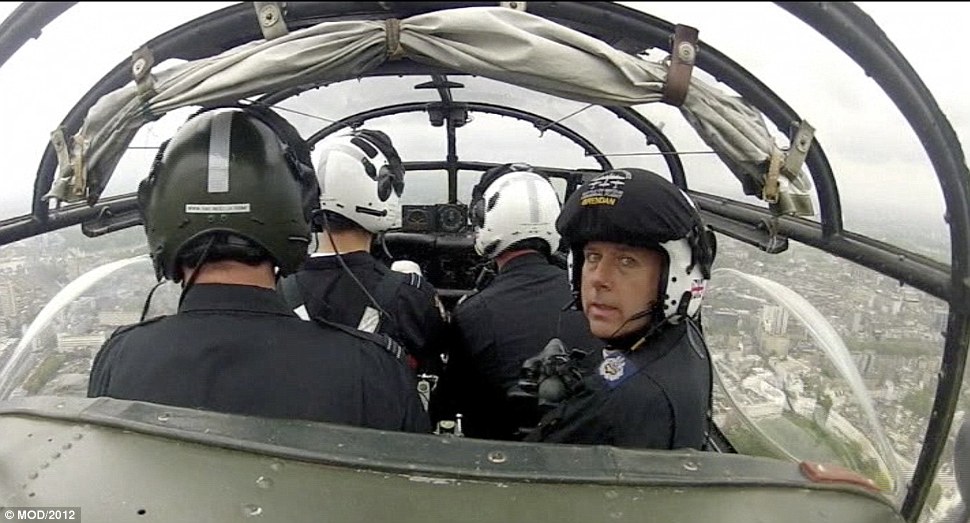
Cramped: The footage shows just how tight a fit it can be aboard a vintage aircraft and what a tight squeeze it is for the crew aboard the Lancaster bomber.

The aircrew give up three out of every four weekends from May to the end of September in order to fly and display the historic aircraft.

The footage, released by the Ministry of Defence, shows just how tight a fit it can be aboard a vintage aircraft, with the crew – clearly eager to catch a glimpse of the Queen – taking up most of the available space.

The historic flight includes the Lancaster, which first saw service in 1942. The ‘Lanc’ was the most famous of the Second World War bombers and gained renown for its starring role in the momentous ‘Dambuster’ raid on Germany’s Ruhr Valley in 1943.

Carrying a payload of 22,000lb and with a 1,500-mile range, the RAF bomber wreaked havoc on Germany. Some 3,500 were lost in action during the war.

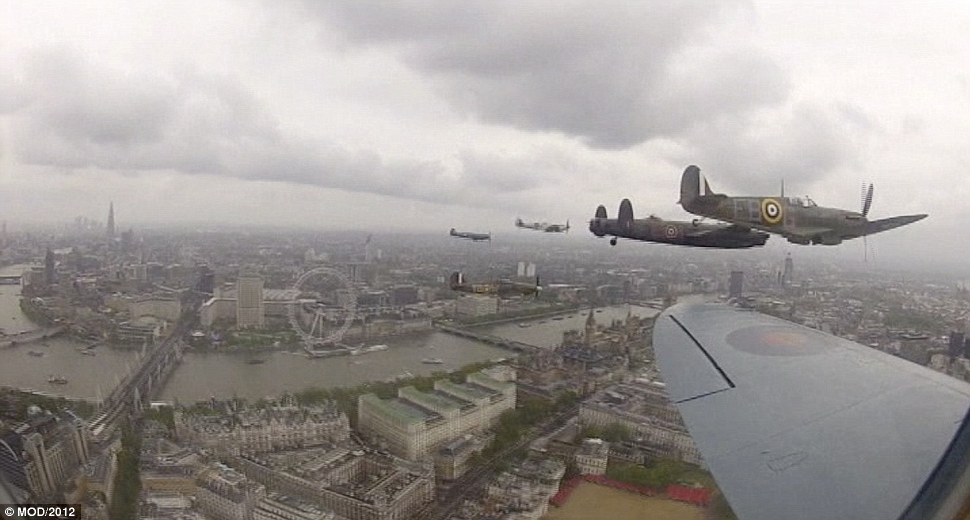
The view of Buckingham Palace and The Mall beyond from the Lancaster bomber.
In formation: Incredible footage has been released showing the view enjoyed by crew aboard a Lancaster bomber flying over London for the Queen’s Diamond Jubilee celebrations.

Hurricane single-seater fighters played a crucial role in the Battle of Britain. Heavier and slower than the Spitfire, it was considered the RAF’s ‘workhorse’ against the Luftwaffe.

A remarkable total of 14,533 Hurricanes were built and served operationally on every day and in every theatre during the war. Only 12 are still airworthy worldwide.

The Spitfire is the iconic fighter that won legendary status against the Luftwaffe in the Battle of Britain. It possessed a top speed of 378mph, an altitude of 35,000ft and armed with two 20mm cannons, four Browning machine guns and two 250lb bombs.

One of the four that flew yesterday was P7350 – the oldest airworthy Spitfire in the world and the only one which actually fought in the Battle of Britain. It was shot up by a Messerschmitt 109 during combat in October 1940 but its wounded Polish pilot Ludwik Martel managed to crash-land it, wheels up, near Hastings.

The pride of Britain: The vintage planes – all powered by classic World War Two Merlin engines – roar across the London sky.
Flypast: The Duchess of Cornwall, the Prince of Wales, the Queen, the Duke and Duchess of Cambridge and Prince Harry watch the aerial action.
Aerobatic aces: The Red Arrows display team fly in formation over Buckingham Palace.
Stirring image: The Lancaster, centre, was accompanied by two Spitfires on both flanks and tailed by a Hurricane.

oooOOOooo

A wonderful and incredibly nostalgic set of photographs.  Finally, let me close with a short piece of video of that Lancaster Bomber in flight.

Understanding Europe!

A delightful tale sent to me by Richard Maugham.

Richard and I go back too many years!  He has been a dear friend despite the obvious hurdle that when we first met, he declared that he was a typewriter salesman for Olivetti in the UK with me admitting that I was a typewriter salesman for IBM UK!  Here’s the story.

oooOOOooo

WHAT WENT WRONG IN EUROPE – SIMPLY EXPLAINED!

Not Helga’s Bar!!

Helga is the proprietor of a bar. She realizes that virtually all of her customers are unemployed alcoholics and, as such, can no longer afford to patronize her bar. To solve this problem she comes up with a new marketing plan that allows her customers to drink now, but pay later.

Helga keeps track of the drinks consumed on a ledger (thereby granting the customers’ loans).

Word gets around about Helga’s “drink now, pay later” marketing strategy and, as a result, increasing numbers of customers flood into Helga’s bar. Soon she has the largest sales volume for any bar in town.

By providing her customers freedom from immediate payment demands, Helga gets no resistance when, at regular intervals, she substantially increases her prices for wine and beer – the most consumed beverages.

Consequently, Helga’s gross sales volumes and paper profits increase massively. A young and dynamic vice-president at the local bank recognises that these customer debts constitute valuable future assets and increases Helga’s borrowing limit. He sees no reason for any undue concern, since he has the debts of the unemployed alcoholics as collateral.

He is rewarded with a six figure bonus.

At the bank’s corporate headquarters, expert traders figure a way to make huge commissions, and transform these customer loans into DRINKBONDS. These “securities” are then bundled and traded on international securities markets.

Naive investors don’t really understand that the securities being sold to them as “AA Secured Bonds” are really debts of unemployed alcoholics. Nevertheless, the bond prices continue to climb and the securities soon become the hottest-selling items for some of the nation’s leading brokerage houses.

The traders all receive six figure bonuses.

One day, even though the bond prices are still climbing, a risk manager at the original local bank decides that the time has come to demand payment on the debts incurred by the drinkers at Helga’s bar. He so informs Helga. Helga then demands payment from her alcoholic patrons but, being unemployed alcoholics, they cannot pay back their drinking debts. Since Helga cannot fulfil her loan obligations she is forced into bankruptcy. The bar closes and Helga’s 11 employees lose their jobs.

Overnight, DRINKBOND prices drop by 90%. The collapsed bond asset value destroys the bank’s liquidity and prevents it from issuing new loans, thus freezing credit and economic activity in the community.

The suppliers of Helga’s bar had granted her generous payment extensions and had invested their firms’ pension funds in the BOND securities. They find they are now faced with having to write off her bad debt and with losing over 90% of the presumed value of the bonds. Her wine supplier also claims bankruptcy, closing the doors on a family business that had endured for three generations; her beer supplier is taken over by a competitor, who immediately closes the local plant and lays off 150 workers.

Fortunately though, the bank, the brokerage houses and their respective executives are saved and bailed out by a multibillion dollar no-strings attached cash infusion from the government.

They all receive a six figure bonus.

The funds required for this bailout are obtained by new taxes levied on employed, middle-class, non-drinkers who’ve never been in Helga’s bar……………………….!

oooOOOooo

I can add not a single word to this!

Let’s risk it for animals!

Looking at the human-animal relationship, from the perspective of the animal.

This is a guest post from Virginia Ingram.  Virginia is becoming more involved in the animal rescue movement.  As such, she knows only too well how vital it is to give so many precious animals a second chance.

In a very real sense we, as in mankind, owe our humanity to dogs and other animals.  As I wrote here in the essay What is love?

“But understanding animals and empathizing with them also triggered other changes in humanity’s evolution, Shipman said.

All those things allow people to live with people. Once people have domesticated animals, they start to live in stable groups. They have fields, crops and more permanent dwellings.”

We owe so much!

So with that in mind, here is Virginia’s guest post.

oooOOOooo

WE CAN MAKE A DIFFERENCE

Recently I started to question the time I spend on the internet reading articles, essays and recommendations of books about all things concerned with animals. I receive animal stories from friends, acquaintances and business associates from all corners of the globe. I love to get them because, well….. hey, I really enjoy them!

After I read them I forward them to others who I think will also enjoy them. They make me feel warm and fuzzy. They are enlightening, poignant, humorous, inspiring and sometimes heart-rending. I find I cannot ignore any cute email containing animal pictures even though I may have already seen it a dozen times before. Give me a story about a dog who ate a popsicle and to me ‘that’s entertainment’ as they say. We human beings love to feel moved by great stories and these communications are full of it. I am such a sap when it comes to animal stories; so many of us are.

But here is the rub. What do the animals get out of it?

We chuckle and get our jollies from these incredible beings from a distance on the World Wide Web but the fact of the matter is that so many of these wonderful creatures end up unwanted, uncared for or even starved and beaten in shelters across the world.

Unknown and uncared for!

What gives? Why is there such a disconnect? How can we love animals from a distance and not be concerned with the abuses that go on in our own environment?

We know that there are those who don’t understand that animals have feelings and emotions, that they experience deep loss and sadness as well as happiness and joy. What can we do raise to the consciousness of human beings who don’t get it?

I think it involves sticking our collective necks out. I think that we need to be ready to risk some things. It might involve changing or damaging a relationship with someone who is acting in irresponsible ways towards animals. We need to be ready to risk it.

Do you see it on your own street? Maybe it’s a neighbor who leaves their dog on a chain in the yard on weekends regardless of weather or exposure to other animals. Maybe it’s the guy next door who ‘forgets’ to feed his animal.

Let’s stand up for these animals who have no voice. Let’s be advocates for these amazing creatures who cannot be their own advocate. Let’s hold humans accountable. Let’s risk a friendship and say something, make that difficult phone call on behalf of a animal. Let’s talk to people about animal issues and problems. Let’s try to change the weak laws that do not properly address animal cruelty. Let’s summon our courage and do the unpopular things which will enhance the quality of life for these precious beings.

Can you imagine how animals feel when they have been turned over to an animal shelter by the person whom they loved more than themselves?  Trust me, the sense of abandonment and fear, the bewilderment in their eye is excruciating to observe. I have seen it not from the distance of my computer but in person. Let’s DO something to change all this. It’s time to get involved.

By all means keep the cute emails going but for every minute we spend on the internet, reading the books and enjoying the emails let’s put the same amount of time into getting something done to improve the lives of animals. Stand up, walk out the door, volunteer or donate money. We can help the suffering. We can make a difference.

oooOOOooo

Powerful words indeed.  Don’t know about you but I read a strength of feeling that was very moving.  A clear message that we must never turn the head, never just ‘tut tut’ but do something.  Even if only befriending a stray animal.  Because one might argue that even that feral dog without a home is demonstrating something all of us on this green planet need to understand; living a sustainable life!

Finally, living proof of what we can give an animal when we care and love it.  The dog in the picture below is Loopy, a dog that Jean rescued in Mexico many years ago.  She was so badly hurt by humans that it took Jean six months before Loopy would let Jean touch and hug her.

When I came on the scene, my gender was against me.  It took me twelve months before Loopy trusted me.  Now she will come to me and let me place my face against hers in the most loving, caring embrace that one can imagine.

So why the fearful look on Loopy’s face as she turns away from the camera?  Somehow the camera is reminding Loopy of some sort of weapon that was used to beat her!

Loopy

As Virginia so lovingly wrote, “We can help the suffering. We can make a difference.

A new NEON light beckons.

A wonderful investment in studying America’s ecology is just starting.

I am indebted to The Economist for including in their issue of the 25th August a story about NEON, something I had previously not heard about.

It was then an easy step to locate the main website for the National Ecological Observatory Network, or NEON.  (Just an aside that I can’t resist – NEON is such a fabulous acronym that one wonders how much push and shove there was to come up with the full name that also fitted the word ‘NEON’!  Sorry, it’s just me!)

Anyway, back to the plot.  The following video gives a very good idea of the projects aims.  When I watched it, I found it inspiring because it seemed a solid example of how the nation, that is the USA, is starting to recognise that evolving to a new, sustainable way of life has to be  built on good science.  NEON strikes me as excellent science.  You watch the video and see if you come to the same conclusion.

There’s also a comprehensive introduction to the project from which I will republish this,

In an era of dramatic changes in land use and other human activities, we must understand how the biosphere – the living part of earth – is changing in response to human activities. Humans depend on a diverse set of biosphere services and products, including air, water, food, fiber, and fuel. Enhancements or disruptions of these services could alter the quality of human life in many parts of the world.

To help us understand how we can maintain our quality of life on this planet, we must develop a more holistic understanding of how biosphere services and products are interlinked with human impacts. This cannot be investigated using disconnected studies on individual sites or over short periods of observation. Further, existing monitoring programs that collect data to meet natural resource management objectives are not designed to address climate change and other new, complex environmental challenges.

NEON, the first continental-scale ecological observatory, will provide comprehensive data that will allow scientists to address these issues.

Later on there’s more detail, as follows,

NEON has partitioned the U. S. into 20 eco-climatic domains, each of which represents different regions of vegetation, landforms, climate, and ecosystem performance. In those domains, NEON will collect site-based data about climate and atmospheresoils and streams and ponds, and a variety of organisms. Additionally, NEON will provide a wealth of regional and national-scale data from airborne observationsand geographical data collected by Federal agencies and processed by NEON to be accessible and useful to the ecological research community. NEON will also manage a long-term multi-site stream experiment and provide a platform for future observations and experiments proposed by the scientific community.

The data collected and generated across NEON’s network – all day, every day, over a period of 30 years — will be synthesized into information products that can be used to describe changes in the nation’s ecosystem through space and time. It will be readily available in many formats to scientists, educators, students, decision makers and the general public.

For some reason I couldn’t find on the NEON website the informative map that was included in The Economist so I grabbed that one, and offer it below:

These eco-climatic domains are fully described here on the NEON website.

The benefits of this fabulous project are described thus, “The data NEON collects and provides will focus on how land use change, climate change and invasive species affect the structure and function of our ecosystems. Obtaining this kind of data over a long-term period is crucial to improving ecological forecast models. The Observatory will enable a virtual network of researchers and environmental managers to collaborate, coordinate research, and address ecological challenges at regional, national and continental scales by providing comparable information across sites and regions.

As they say in business, if you can’t measure it, you can’t manage it!  So reading in the above the sentence, ‘Obtaining this kind of data over a long-term period is crucial to improving ecological forecast models.‘ is cheering to the soul.

The United States quite rightly gets a huge bashing over it CO2 emissions but to condemn the USA for that and not to applaud this sort of wonderful research is utterly unjustified.  As I have hinted before, America has, more than any other country in the world, the energy to make things better over the coming years.

As Professor Sir Robert Watson highlighted here recently said, ‘… deep cuts in CO2 emissions are possible using innovative technologies without harming economic recovery.’

Amen to that!

YOU are responsible

An intriguing guest post from Schalk Cloete.

Introduction

Schalk is the author of the Blog One in a Billion which describes itself as ‘A DIY guide to saving our world while building a happy, healthy and wealthy life.‘  The Billion in the title refers to ‘the billion wealthiest world citizens, are creating serious global problems through our unsustainable consumption habits.’

As the Blog’s About page explains,

My name is Schalk Cloete, a South African research scientist currently living and working in Norway. Officially, my research is centered around the mathematical modelling of fluidized bed reactors; something which makes nice pictures, but which is not exactly the most brilliant blog material. I will therefore not bore you with further details about the kinetic theory of granular flows.

Nope, the material I write about here; building a happy, healthy, wealthy and sustainable life within our affluent modern society, should be much more interesting. I use the word “building” quite a lot because that is exactly what needs to be done. One literally needs to build the environment within which one functions from day to day with the same level of diligence and attention to detail one would use to build a house.

Anyway, with no further ado, let me go to Schalk’s guest post.

oooOOOooo

YOU are responsible

Not so long ago, Paul left a very thought-provoking comment on my blog: the One in a Billion project, and suggested that my response to that comment was worth publishing as a guest post on Learning from Dogs. Needless to say, I gratefully accepted this generous offer!  Before we go any further though, I’d just like briefly to describe my blog so that the comment can be seen in perspective.

The principle objective of my blog is to advocate personal lifestyle change as a lasting solution to the pressing sustainability problems we are facing today.

The rationale behind this overall theme is threefold:

  1. Our current systems are fundamentally guaranteed to collapse (more about this here)
  2. A personal lifestyle change is the one and only sustainable solution to this impending crisis (further detail can be found here)
  3. Such personal lifestyle changes towards sustainable living are the one and only road to lasting health, wealth and happiness.

So, on that backdrop, here was Paul’s comment:

Any successful attempt at reversing and correcting the perilous journey humanity is on has to focus on the nature of change, how humans change, why the change required in this case is psychologically complex, and how the reward feedback process has to work. In my opinion these are the core issues to be tackled.

And my response:

Change is driven by a complex set of internal and external triggers that influence our consciousness every second of every day. If these triggers collectively indicate to a person (based on his or her unique subjective interpretations and subconscious filters) that some alternative is more attractive or that the current reality is unacceptable, motivation for change is granted. The exact nature of the change that this project requests is a change in day-to-day lifestyle choices which stems from shaping a person’s interpretation and filtering of the various internal and external triggers to accurately represent the reality that a lifestyle aimed at sustainable happiness is infinitely more attractive than one focused on consumerism.

This project tries to motivate people to take action by strongly emphasizing on the immediate personal benefits of making these lifestyle changes, the ease with which these changes can be made (and made permanent), the short and long term hazards of not making these changes and the moral obligation we have to the poor and to future generations to make these changes.

The change is psychologically complex because the entire environment we live in today just begs us to consume at ever increasing rates. This is the reason why this project repeatedly emphasizes on the construction of micro-environments to protect against this toxic macro-environment and make the correct actions natural and automatic. On a higher level, change is psychologically complex because we now have to abandon a system that has raised our standard of living tremendously while we still had abundant cheap fossil fuels and a limitless planet. Our most powerful weapon has turned into our greatest threat and it should come as no surprise that we seem totally unable to handle that.

The reward-feedback process in the One in a Billion initiative is actually quite interesting. As stated before, a lot of emphasis is placed on the immediate rewards of making certain lifestyle choices, but the thing that makes it really interesting is the holistic and complementary nature of this plan. Because it covers such a broad spectrum of areas, one quickly finds that gains in one area start to enhance gains in other areas. From personal experience, this truly is an extremely exciting journey and even becomes addictive, thereby all but guaranteeing further lifestyle changes. As soon as this spiral is started, the mind becomes a lot more open to the wealth of information on sustainability out there and this understanding then stimulates further action. In the end, you end up with a completely self-sustaining upwards spiral towards happy, healthy, wealthy and sustainable living.

In closing, the change that is needed within the developed world today can basically be summarized as follows: hundreds of millions of people must be reconditioned away from a debilitating and self-destructive culture of consumerism and entitlement towards a healthy and fulfilling culture of contribution and personal responsibility. It is my sincere hope that the One in a Billion project can contribute to this change and help overcome the great challenges discussed above.

This really is a dream of mine which I have recently described in more detail under my Dream heading for anyone who might be interested. Please spend a minute or two to think about this philosophy and whether you might consider developing a similar dream of your own.

oooOOOooo

Trust me, Schalk’s blog is full of very interesting propositions.  Yet another sign that opinions are changing across this great interconnected world.

Future of the car?

The mistake we all make is to look behind us and think the future will be the same.

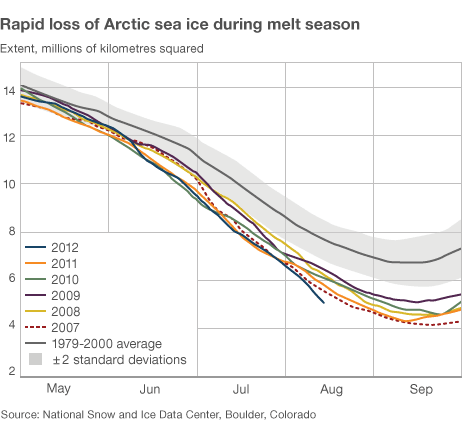
Let me start with something that is not really news.  Not news in the sense that it has been very widely reported.  I’m speaking of the probability, the high probability, that this year’s summer ice area in the Arctic will be a record low, with all the implications that this carries.  Let me refer to a recent BBC news item that included a stunningly powerful chart.

Scientists at the US National Snow and Ice Data Center said data showed that the sea ice extent was tracking below the previous record low, set in 2007.

Latest figures show that on 13 August ice extent was 483,000 sq km (186,000 sq miles) below the previous record low for the same date five years ago.

The ice is expected to continue melting until mid- to late September.

“A new daily record… would be likely by the end of August,” the centre’s lead scientist, Ted Scambos, told Reuters.

“Chances are it will cross the previous record while we are still in ice retreat.”

The US National Snow and Ice Data Center may be found here.

So to the piece that generated the title of this post, the future of the car.

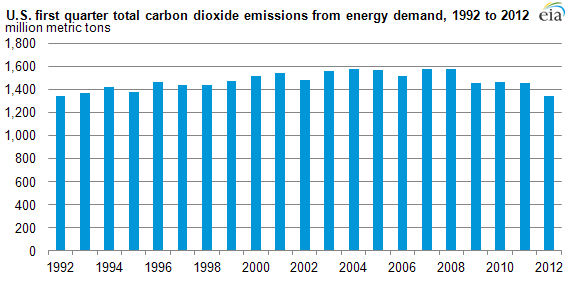
On the 17th August, I wrote an article highlighting the fact that the U.S. leads the world in cutting CO2 emissions.  That was endorsed by an item published on the U.S. Energy Information Administration’s (EIA) website, that said,

U.S. carbon dioxide (CO2) emissions resulting from energy use during the first quarter of 2012 were the lowest in two decades for any January-March period. Normally, CO2 emissions during the year are highest in the first quarter because of strong demand for heat produced by fossil fuels. However, CO2 emissions during January-March 2012 were low due to a combination of three factors:

  • A mild winter that reduced household heating demand and therefore energy use
  • A decline in coal-fired electricity generation, due largely to historically low natural gas prices
  • Reduced gasoline demand

It was the last item that caught my eye.  Because it resonated with an article on Chris Martensen’s Peak Prosperity blog just over a week ago.  That article, written by Gregor Macdonald, was called The Demise of the Car.

About a third of the way into the article, Gregor writes,

But it’s not just India that has incorrectly invested in automobile transport. The other giant of Asia, China, has also placed large resources into auto-highway infrastructure.

It appears that at least a decade ago, the developing world made the same assumption about future oil prices as was made in Western countries. The now infamous 1999 Economist cover, Drowning in Oil, reflected the pervasive, status-quo view that the global adoption of the car could continue indefinitely. A decade later, however, we find that after oil’s extraordinary price revolution, the global automobile industry is now starved for growth.

Then a little further down in this interesting article there is this,

More broadly, however, global governments are captured by sunk-cost decision making as the past 60-70 years of highway infrastructure investment is now a legacy just too painful to leave behind. Interestingly, whether citizens and governments want to face this reality or not, features of the oil economy are already going away as infrastructure is increasingly stranded. Moreover, there are cultural shifts now coming into play as young people are no longer buying cars – in the first instance because they can’t afford them, and in the second instance because it’s increasingly no longer necessary to own a car to be part of one’s group. See this piece from Atlantic Cities:

Young People Aren’t Buying Cars Because They’re Buying Smart Phones Instead

Youth culture was once car culture. Teens cruised their Thunderbirds to the local drive-in, Springsteen fantasized about racing down Thunder Road, and Ferris Bueller staged a jailbreak from the ‘burbs in a red Ferrari. Cars were Friday night. Cars were Hollywood. Yet these days, they can’t even compete with an iPhone – or so car makers, and the people who analyze them for a living, seem to fear. As Bloomberg reported this morning, many in the auto industry “are concerned that financially pressed young people who connect online instead of in person could hold down peak demand by 2 million units each year.” In other words, Generation Y may be happy to give up their wheels as long as they have the web. And in the long term, that could mean Americans will buy just 15 million cars and trucks each year, instead of around 17 million.

If future car sales in the US will be limited by the loss of 2 million purchases just from young people alone, then the US can hardly expect to return to even 15 million car and truck sales per year. US sales have only recovered to 14 million. (And that looks very much like the peak for the reflationary 2009-2012 period)

Indeed, the migration from suburbs back to the cities, the resurrection of rail, and the fact that oil will never be cheap again puts economies – and culture – on a newly defined path to other forms of transport and other ways of working.

It’s a long and interesting article that demonstrates an old truth, no better put than in this quotation reputed to have been said by John F. Kennedy,

Change is the law of life. And those who look only to the past or present are certain to miss the future.

Back to fasting!

A closer look at the excellent work undertaken by Dr. Krista Varady.

Back on the 16th I wrote a post that was a follow-up to the previous day’s post about living a long life.  My follow-up was called, hardly surprisingly, Postscript to Long Life post.

In that follow-up post, I wrote this,

Over on the Healthy Fellow blogsite, there’s an interview with Dr. Varady.  The web link of that interview is here and crossing over and reading the full interview is much recommended.  Here’s a taste, pardon the pun, of that interview:

JP: Can you help explain the distinctions between alternate day fasting and caloric restriction?

Dr. Varady: Caloric restriction is basically daily calorie restriction where an individual would restrict themselves by about 15% to 40% of their energy needs daily. So basically every single day you’re undergoing the same amount of restriction, whereas alternate day fasting involves a fast day wherein the individual would only eat 25% of their energy needs. So about 500 calories or so and that’s alternated with something called a “feed day” where the individual would eat ad libitum – so as much as they want. However in our studies we show that people end up losing weight because they can’t fully make up for the lack of food on the fast day on the feed day.

I’ve been in touch with JP wondering if I might have permission to republish the full interview.  Unfortunately that wasn’t possible.  However JP did say that republishing a couple of paragraphs would be fine and I’m going to be cheeky in adding a couple to the one I already published above!

Anyway, before inserting those paragraphs, let me set the scene.  A very quick web search comes across the fact that Dr. Varady is an Assistant Professor at the UIC College of Applied Health Sciences.  Her research work is described thus,

Research Interests

Dr. Varady, PhD

My research investigates the ability of novel dietary restriction strategies to facilitate weight loss and decrease cardiovascular risk in obese subjects. The most common dietary restriction protocol implemented is daily calorie restriction (CR), which involves reducing energy intake by 15 to 40% of needs daily. Another dietary restriction regimen employed, although far less commonly, is alternate day fasting (ADF). ADF regimens include a “feed day” where food is consumed ad-libitum over 24-h, alternated with a “fast day”, where food intake is partially or completely reduced for 24-h. ADF regimens were created to increase adherence to dietary restriction protocols since these regimens only require energy restriction every other day, rather than every day, as with CR. Recent findings from our lab demonstrate that ADF is an effective means of facilitating weight loss and improving several indicators of cardiovascular disease risk in overweight and obese subjects. Our findings also show that changes in adipose tissue physiology during weight loss may mediate these improvements in vascular health.

Current research activities

Developing novel diet and exercise regimens to facilitate weight loss and decrease cardiovascular disease risk in humans; Examining the intermediate role of adipose tissue in mediating the cardio-protective effects of diet and exercise; Investigating the behavioral factors that influence adherence to dietary restriction strategies.

So this is one lady that ought to understand the effects of what we shovel down our mouths.  OK, on to that interview.  From Part One, I selected this exchange,

JP: How long does it generally take for people to adapt to this new way of eating?

Dr. Varady: A lot of the subjects were saying that for the first two weeks it was pretty tough to basically change from a 3 meal a day eating pattern to just eating 1 meal a day and then 3 slightly bigger meals the next day. But they said that about after two weeks they totally got used to it and weren’t that hungry on the fast day anymore. They could undergo these really long periods of fasting without really feeling deprived. The other interesting thing that they were telling us was with regard to the feed day. The people didn’t binge. They only ate about 100% to 110% of their calorie needs.

Then from the second part of the interview, JP underlines an important point, “The truth of the matter is that research into ADF is still in its infancy and Dr. Varady is the first person to admit it. ”  I then went on to select this exchange between JP and Dr. Varady,

JP: It seems as though ADF provides a very broad array of health benefits. Do you have a theory about why this is possible?

Dr. Varady: In the human data the main thing you see is weight loss. Even if it’s done in normal weight people. The minute you start losing weight you all of a sudden see an improvement in the majority of these factors. A lot of the effects of alternate day fasting are mediated through weight loss. Losing weight is so tightly correlated with your blood pressure, your cholesterol levels and heart rate, etc.

Fasting May Reduce Age-Related Disease Risk Factors

Source: J Appl Physiol 103: 547-551, 2007 (link)

So this is not something of trivial interest, it’s serious research that could have a remarkable effect on the huge problems of obesity and poor diet that affect millions.  Do yourself a favour and read the interview now.  Part One and Part Two.

Finally, in that post on the 16th, I owned up to having got my weight down to 161.6 lbs (73.30 kgs).  Now here we are having completed my third week of 5:2 fasting and last Saturday morning my weight was 159.0 lbs (72.12 kgs).  The routine is very comfortable and as Dr. Varady mentioned, there is no sense of wanting to binge after the two days of fasting.