Except to thank Tom M. for sending me the details, which I reproduce as Tom sent them.
Every once in a while an opportunity comes by to do a “really good thing for little effort or cost. What I call “click for critters” is one of those rare opportunities you should take advantage of.
For the effort involved to perform “two mouse clicks on your computer”, you can be responsible for providing critters in shelters 6/10 of a bowl of food daily. That is over 200 bowls of food to critters in need per year! And get this … the sponsors will even send you an automatic reminder e-mail every day with a link to click. Couldn’t be any easier and you’ll feel so good helping those in need.
Once you click that button, you will be taken to a sponsor’s page. (That is, click the button on the Animal Rescue website, not on this Blog page!) The sponsor’s on that next page will donate 6/10 of a bowl of food just because you clicked your mouse! Actually visit a sponsor page and more will be given!
But there’s still more you can do for our animals in need!
Simply click on “Free Ways to Help” located on the left hand side of the page!
Have a wonderful 2012, enjoy feeling good with click for critters, spread the word and please remember the wise words of Mahatma Gandhi – “The greatness of a nation and its moral progress can be judged by the way its animals are treated.”
That’s Life was a very long-running programme on BBC TV in the UK. As Wikipedia writes, “That’s Life! was a magazine-style television series on BBC1 between 26 May 1973 and 19 June 1994, presented by Esther Rantzen throughout the entire run, with various changes of co-presenters.”
I had just about forgotten this silly item presented on That’s Life back in 1986 but thanks to fellow Brit, Dusty M. living here in Payson, it has re-surfaced.
Still fun to watch some 25 years later. (Can’t explain why this YouTube video has Dutch subtitling!)
And for those that enjoy sentimental recollections, the video below is the last few minutes from the very last programme on the 19th June, 1994.
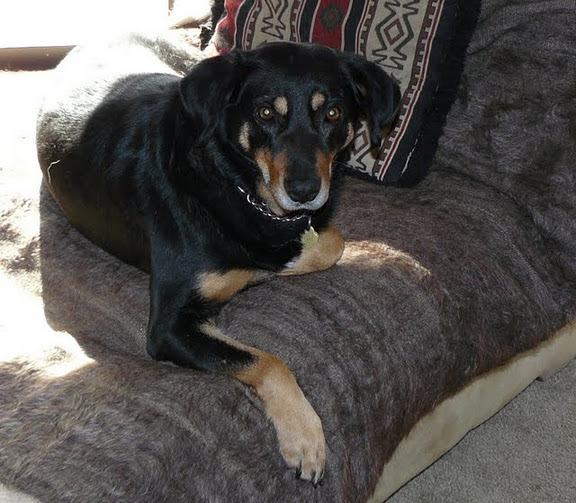
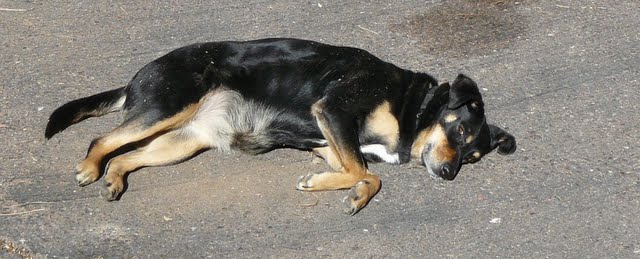
This is Hazel. She is one of three dogs that ‘belong’ to Pharaoh.
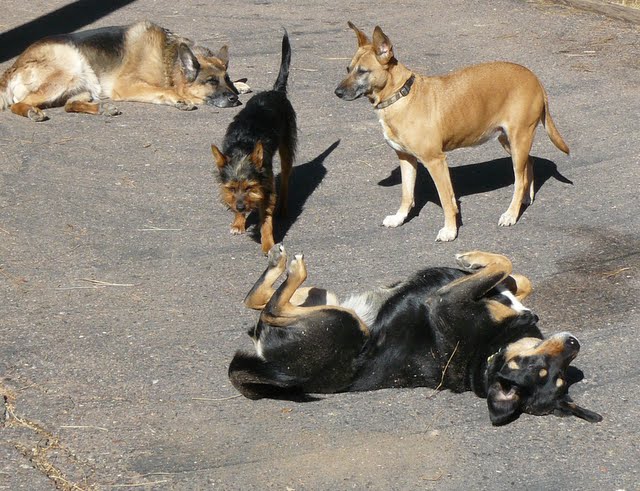
Last Tuesday, we took Pharaoh and his mini-pack of 3 dogs out for our usual afternoon walk at the very end of Granite Dells Rd, out where the forest road ends and soon becomes the relative wilderness of the Tonto National Forest.
Pharaoh, and Hazel, Dhalia and little Sweeny.
However, on this occasion Hazel decided to leave us and link up with a stranger who was hiking the forest. That was the last we saw of Hazel for many hours. Miracle of miracles, the stranger, Joanie, was a dog-lover so when Hazel had followed Joanie and her dog all the way to Joanie’s car, the next stop for her, Hazel that is, was our local Payson Humane Center. Hazel’s tag very quickly linked her to Jean (a great reminder of the importance of tagging your dogs!) who is well-known as a volunteer assistant at the Humane Society Thrift store and the scare was over.
But during the hours of tramping those miles along challenging forest tracks, calling out Hazel’s name, both Jeannie and I had plenty of time to hurt. Here’s a small insight, that millions of pet owners will resonate with, that demonstrates the way that dogs offer us so much love which, in turn, opens our human hearts to the purity of unconditional love. (And I know it’s not just dogs but many animals in our lives that offer us such love!)
Pharaoh and his ‘team’ sleep in our bedroom. During the Winter months Hazel will often lay stretched out on the bed-cover alongside the back of my legs. If I need a trip to the bathroom during the night, not unknown at my age, I can almost guarantee that Hazel will shift her cuddly body up to the warm sheets just below my pillow.
Thus it was this last Tuesday morning when I returned from my bathroom run about 3am; Hazel asleep with her head on my pillow! I didn’t have the heart to push her off the bed, so just slipped in beside her and moments later back asleep, my head nestled against Hazel’s warm head. Sleeping so close to a dog is more than just nice, it seems to stir very ancient memories deep in the subconscious, perhaps back all those thousands of years to when domesticated dogs were an integral part of early man’s security.
So you can imagine the anguish that, in our own separate minds, Jeannie and I were experiencing. I just couldn’t go to the place where never again would I feel the warmth of Hazel’s body against mine. Jean was desperately hoping this wasn’t a tragic repeat of losing Poppy. Thus when I went round to the Humane Center just as they were closing up and Hazel came out to me, I dissolved in sobs of relief.
That’s the heart-felt closeness of dogs and humans.
Join the One In A Million Movement to End Puppy Mills!
Take another quick look at the emotions that dogs bring out in so many of us. I’m referring to the piece I posted last Sunday under the title of The logic of dogs. However, there’s a darker side to owning a dog, or more accurately, a puppy.
A quick search for ‘puppy mills’ on Google or YouTube will come up with more anguish than I suspect you can handle. Here’s just one website that offers some facts about the commercial breeding of puppies.
Here’s a 2-minute video to underline the importance of this cause.
But thanks to an email sent to me from Diane M, here in Payson, there’s something that can be done.
Here’s the email that was sent.
Dear Friends and Family,
I’m sending this to you because of your concern for pets. Dan Morrison, my friend and ex-husband, has been an advocate for years for animals. I received the information below regarding another way to protect those animals who cannot speak for themselves.
Please take a minute and read the important message below. Please know that Dan Morrison along with Marlene Walsh are the co-founders of Pet Connections. Dan is also the President of the Board. Check out the website!
In addition, do you have friends who love animals and are understanding and empathize with the message below? If so, please take a couple minutes and forward this message to them. Dan, Marlene and I will greatly appreciate your effort.
Happy New Year, Everyone!
Diane
And now what follows is the information that Diane received and then circulated,
Sent: Friday, December 09, 2011 6:14 AM Subject: Join the One In A Million Movement to End Puppy Mills!
There is a new movement underway to permanently put an end to the puppy mill industry by ending all demand for these puppies. And Pet Connections, Inc. believes in the power of people to do this, one person at a time.
Just this week, the Pet Connections’ website (www.pet-connections.org) went live with its new “One In A Million” campaign, where the public is being asked to sign a pledge stating that they will not purchase or supportthe purchase of puppies, dogs, cats or kittens that come from “puppy mills” or indiscriminate breeders.
A puppy mill or kitten mill, sometimes known as a farm, is a commercial breeding facility that is operated with an emphasis upon profits above animal welfare and often hundreds of animals are kept in substandard conditions with little regard to the well-being of animals under their control.
Instead, the pledge asks the public to patronize animal shelters, humane societies, or “humane” pet stores who offer only shelter/rescue puppies, dogs, cats or kittens. Pet Connections’ goal is to collect one million names to present to the governors and legislators of states who harbor puppy or kitten mills because of lax or unenforced laws and to our congressmen and senators telling them that the people have spoken! This cruel and inhumane industry must end.
Pet Connections will work with any pet store who believes that their only source of animals are mills or farms and “convert” them to using animal shelters, humane societies or rescue groups as a source for their animals.
I am hoping that you will go to our pledge page (www.pet-connections.org/pledge/pledge.php) and sign the pledge, and then share it with your family, friends, colleagues, other organizations, newsletters – everything you can think of to help us get the word out and make a big enough impact to make a difference.
Pet Connections believes people can make a difference . . . one person at a time. I know that with your help we will make a difference.
So it’s just a moment to go here and sign the pledge – PLEASE! Why? Well, I can’t put it better than as conveyed in the thank-you email response you will receive,
Change will happen because you took the Pledge. Thank you for becoming ONE IN A MILLION and supporting the efforts of Pet Connections, Inc. We are dedicated to ending the practice of selling puppies bred in puppy mills and sold in pet shops. This is an intolerable practice and must end. By Pledging, you join a cause whereby numbers create the power for change.
Would you like to help Pet Connections, Inc., reach our goal of ONE IN A MILLION? Share the message by any means you can. Tell your friends, family and neighbors about the importance of Pledging. Convince your Facebook and Twitter friends to Pledge to become ONE IN A MILLION athttp://www.pet-connections.org/pledge/pledge.php. Watch the tote board change with each Pledge you influence.
Pet Connections, Inc., is grateful for contributions to help in our goal of ONE IN A MILLION. It is up to each and every one of us to take responsibility to end the practice of breeding and selling puppy mill puppies. It is the humane thing to do.
Now let me close with this video that shows the power that can flow from love as opposed to greed.
NEVER BUY A PUPPY FROM A PET STORE!!!
All three parts combined into one! Created in 2002, “I’m Alive For The Very First Time” tells the story of how two puppy mill rescue dogs forever changed the lives of their adoptive parents, Kathleen and Scottie.
Money must be guided by morality. – A powerful essay courtesy of Resurgence Magazine
(Because the essay, by Satish Kumar, is so well-worth reading, let me postpone my background chit-chat until later!)
Here it is.
If we take care of people and Nature, then the economy will take care of itself.
Money was a clever and convenient invention; it was designed as a means of exchange and a measure of wealth. But somehow that has changed; what was once solely a means to an end has become the end itself, and what was a measure of wealth has become wealth itself.
Take for example agriculture, the purpose of which was to produce nutritious food whilst ensuring that the land remained in good heart for all future generations and for the good health of biotic communities. Agriculture was a way of life that gave farmers their dignity, and in turn they cultivated the crops with tender loving care and considered their work intrinsically good.
Then came money, which changed everything: agriculture turned into agribusiness and the paramount purpose of it became the making of money. Food became a commodity and yet another means of making large profits. As a result British farmers – even those with 2,000 acres of land – cannot make a living, and farm labourers are paid £10 an hour whilst bankers are paid £1,000 an hour.
The example of agriculture turned to agribusiness is only one illustration of how our society has lost sight of right and wrong. We can cut down the rainforest to make money, we can pollute the rivers and over-fish the oceans for profit, we can destroy the local economy in search of cheaper goods, no matter how much CO2 is omitted in the process. The bottom line always comes first. We can hire and fire people at will for the sake of boosting the economy; people have become little more than the instruments of making money. GM crops, nuclear energy, cloning and animal experimentation – nothing is forbidden, just as long as it adds to GDP and increases the share value of corporations and companies.
Ethics, morals and human dignity are all secondary and subservient to the profit margin. Bankrupt bankers have to be bailed out even though we can all see that they and other business leaders are utterly incapable of solving the economic crisis. Politicians and policymakers have to obey their desires. No wonder then that our governments are completely incapable of creating conditions for the stability and wellbeing of people – because all social, political, educational and communal values exist solely to serve economic growth, which simply means growth in money supply, in GDP and in consumption.
As long as we are wedded to this financial paradigm and its money model, the strong will exploit the weak, and our social and environmental fabric (and morals) will continue to fall apart.
The current economic crisis gives us an opportunity to look deeper and examine the consequences of confusing the means with the ends. Money has a place, of course, but we must keep it in its place and not allow it to dominate our lives in such a manner that we lose all our bearings and become its slaves. Money was made to serve people, not the other way around. Unfortunately, we have allowed money to become the master and override all other moral, ethical and ecological values. There is more to life than an endless pursuit of money and profit.
Money is not wealth; real wealth is land, forest, rivers, animals and people. Wealth is created by the imagination, creativity and skill. Bankers and business leaders in search of ever-increasing profit are not the wealth creators; at best they are wealth counters and at worst wealth destroyers. So let’s honour the true wealth creators: skilled workers, architects and artists, craftsmen and women, teachers and doctors, builders and farmers; the economy is safe in their hands. Let us respect the generous Earth and wild Nature, the eternal source of wellbeing and prosperity. If we take care of people and Nature, then the economy will take care of itself.
Some people might say that this is too idealistic; but what have the realists done? They have made a complete mess of the world economy. Normally, we need idealism and realism in equal measure, but for the time being a little extra idealism will be helpful. We have had far too much realism.
Money must be guided by morality. And we are delighted to present this ideal in this issue of Resurgence, the first of a brand-new year.
Satish Kumar is Editor-in-Chief at Resurgence magazine.
with written permission from Resurgence magazine – at the heart of earth, art and spirit
published by The Resurgence Trust, Ford House, Hartland, Bideford, Devon EX39 6EE
oooOOOooo
OK, back to me!
I hope you enjoyed the essay, it certainly jumped off the page, as it were, for me hence my email to Emma Cocker, Picture Researcher & Assistant Editor at Resurgence Magazine which resulted in a very prompt approval for re-publishing on Learning from Dogs.
Satish Kumar
Satish Kumar is an extraordinary person as a dip into his biographical details here will underline. Please do read about Satish; you will be amazed by his background! It includes this fact,
During this time, he has been the guiding spirit behind a number of now internationally-respected ecological and educational ventures including Schumacher College in South Devon where he is still a Visiting Fellow.
Schumacher College was well-know to me, 2006 and before, as I lived in the small village of Harberton, just outside Totnes in South Devon, England and Schumacher College at Dartington was less than 5 miles away. The College description includes,
People from all over the world, of all ages and backgrounds, have been informed, inspired and encouraged to act, by our 20 years of transformative courses for sustainable living.
Then later, this,
It is precisely at this time of global upheaval that we want you to come to the College to share with us the ways in which you are moved to live and act differently.
No wonder that Bill McKibben of 350.org fame and often quoted on this Blog is quoted on the Schumacher website,
Schumacher is a very special place. As we try and figure out what on earth we’re going to do with this unraveling planet, it’s become a thinktank for hope, a battery for positive vision!
Bill McKibben, founder of 350.org
Finally, there are a number of videos presented by Satish that I propose to include in subsequent Posts on Learning from Dogs.
As I implied when I introduced Part 2 last Thursday, Why Are We Here?, these are deeply interesting films. Do find time to watch them both (Part 1 Are We Aloneis here ) if you can. So here is the concluding part, Are We Real? You can either go to it via this link, or watch the YouTube elements below.
There is a fundamental chasm in our understanding of ourselves, the universe, and everything. To solve this, Sir Martin takes us on a mind-boggling journey through multiple universes to post-biological life.
On the way we learn of the disturbing possibility that we could be the product of someone else’s experiment.
I do hope you all found these three films as stimulating and thought-provoking as Jean and I did.
Powerful prose, stunning pictures and an insight into the last 1.8 billion years of our planet.
The Payson Roundup is the local newspaper for Payson. To be frank, most weeks it’s a fairly quick read. That’s not a reflection of the quality of the newspaper, just an acknowledgement that Payson is a small American city some 80 miles NE of Phoenix up in the high desert. Indeed, the Roundup has a good record of winning awards.
However on the 6th January, there was a stunning article about the Grand Canyon, less than 4 hours driving from Payson. It was written by Pete Aleshire, a Staff Reporter with the Roundup. I can vouch for Pete’s literary skills as he teaches the creative writing course at the local college that Jean and I attended last term (semester) and will be restarting tomorrow.
I am very grateful to the Payson Roundup for their permission to republish this wonderful work. So here it is.
Woe and beauty on an ancient edge
by Pete Aleshire
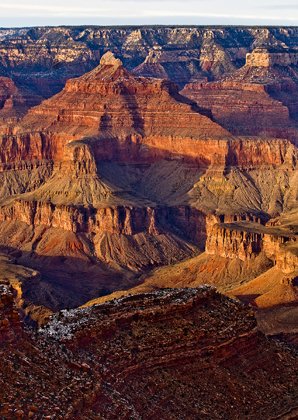
This view of the canyon reveals the layers of limestones and sandstones that testify to vanished seas and deserts. Note the strong, narrow white layer of Coconino Sandstone near the top, composed of 260-million year-old sand dunes. Also note in the center of the photo the 500-foot-tall cliff of Redwall Limestone formed on a seabottom 300-400 million years ago. Photo Tom Brossart/Roundup
I took a step — a long step — a million years step. Then I stopped, turned and faced north. Perched on the jagged edge of my life, I looked down deep into the shadowed layers of lost worlds — terrible deaths, fractured continents, vanished seas, mass extinctions.
Taking a breath, I took another step — a long step — another million years.
Curiously, I felt better — my troubles for the moment shrunk to no more than a ledge of Tapeats Sandstone in the wall of the Grand Canyon opposite. A layer of fossilized beach sand laid down 570 million years ago, the Tapeats Sandstone lies atop a mystery of missing stone — dubbed the “Great Unconformity.”
I studied that light, crumbling layer of sandstone in the canyon wall just across the way, knowing that all the great, riotous thrust of life that took us from pond scum to troubled writers has taken place since the lapping waves of a vanished sea left that layer of crumbling gray stone on a barren beach.
Perched on the wind-tormented branch of a twisted juniper nearby, a glossy black raven croaked at me.
“Nevermore,” he gurgled in my mind’s ear.
“You raise a good point,” I said to the raven and the wind that rose up out of the canyon’s 1.8-billion-year gash of time. I let loose a breath, a sigh, a puff of steam — frail and fleeting as life in the shadow of so much time. It should have depressed me, to stand so mite-like on the edge of such immensity. All I had dreamed or hoped or failed to do would not amount to a swirl of dust on this crumbling edge. I ought to have felt insignificant. Instead, I felt obscurely better.
So I took another step. A long step — a million years.
They had not built the Trail Through Time along the edge of the Grand Canyon between the El Tovar and Yaqui Point the last time I lingered on this edge. Now, it offers the most exciting crash course in geology I’ve ever encountered, although I’ve sought after rocks and unconformities all my life — and have even written geology books for confused people.
The 1.2-mile-long trail presents sliced and polished rocks representing almost all of the 24 major rock layers laid bare in the canyon wall from the 240-million-year-old limestone, siltstone, gypsum and chert layers of the Kaibab Formation to the 1.8-billion-year-old Vishnu Schist in the canyon bottom, among the oldest exposed rock’s on the planet’s surface.
Each step along the 1.2-mile path represents a million years, starting in the present and ending up at the 1.8-billion-year-old start of everything.
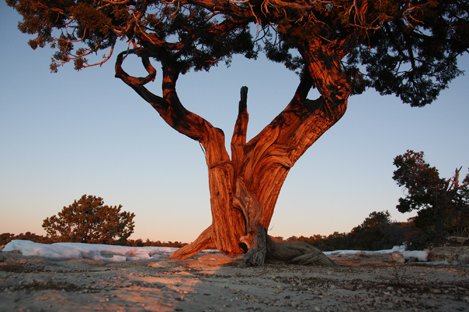
The Grand Canyon reveals a 1.8-billion year glimpse into Earth’s past from views like these along the 1.2-mile-long Trail of Time, with displays of rocks from each of the two dozen rock layers in the mile-deep canyon. A juniper catches the last light. Photo by Pete Aleshire
The Grand Canyon represents the most vividly revealed slice of Earth’s history anywhere on the planet. That makes the canyon one of the few places a person can grasp both the astonishing violence and the tormented timescale of the planet that sustains us all. This unique cross-section of time comes as a result of the relatively level uplift of the Colorado Plateau in the past 5 million to 8 million years. In most places, such a vast uplift would jumble the buried rock layers. But much of the 130,000 square miles of the Colorado Plateau rose at the rate your fingernails grow without deforming the miles-deep layers of sandstones, limestones and shales laid down on the bottoms of long-vanished seas and deserts.
As the Colorado Plateau rose, the northern edge crumpled into the Rocky Mountains. The southern edge dropped away along a 200-mile-long chain of 1,500-foot cliffs — which north of Payson forms the Mogollon Rim. Oak Creek cut back into that rising edge of the plateau to uncover the striking red rock formations of Sedona.
The Colorado River did the same thing, but on a grand scale. Many geologists believe the Colorado River originally ran north into a vast, interior sea. But as the Colorado Plateau rose, another river that ran south cut backward until it captured the north-flowing ancestral Colorado River, reversing the flow so that it now ran south into the Gulf of California.
This capture some 6 million years ago began the process of carving out the Grand Canyon. As the plateau rose, the flood-prone Colorado River cut down through it, like pressing a log up against a chain saw. Meanwhile, the steep tributaries widened the canyon by carrying those soft layers of sedimentary rock down to the main stem of the Colorado.
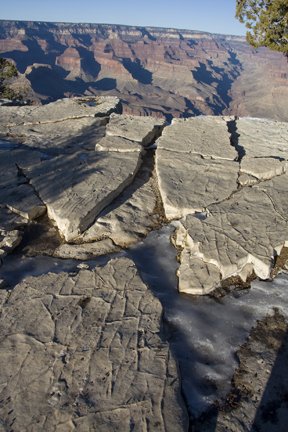
A layer of 230-million year old Kaibab Limestone caps the rim. The Grand Canyon reveals a 1.8-billion year glimpse into Earth’s past from views like these along the 1.2-mile-long Trail of Time, with displays of rocks from each of the two dozen rock layers in the mile-deep canyon. Photo by Pete Aleshire
That process started at about the time the genetic evidence suggests humans, chimps and gorillas last shared a common ancestor and continues to this day.
As a result of this vast uplift, the relatively young Colorado River has revealed in the walls of the Grand Canyon the long buried history of the Earth going back nearly halfway to its creation. That encompassed the entire period in which life progressed from single celled organisms in the ocean to its present, dazzling complexity.
The meander down that Trail Through Time reveals much of that history, preserved in the rock layers and the fossils they contain. Of course, erosion has already removed more than 200 million years of that history, so that the youngest rocks on the rim of the canyon are older than the dinosaurs.
A few dominant layers stand out.
Near the top, the fossilized desert sand dunes of the light Coconino Sandstone bear witness to a vast desert that covered the Southwest some 260 million years ago. At that time, what would become North America was part of a “supercontinent” that gathered almost all the dry land on the planet into a single mass.
In the middle of the canyon, lies the great, blood-red wall of Redwall Limestone, formed on the bottom of a shallow sea between 300 million and 400 million years ago. Today, the fused layers of microscopic skeletons of ancient sea creatures forms a sheer 500-foot-tall band of cliffs that pose the greatest single barrier to reaching the canyon bottom from the rim. All of the trails to the bottom must pass through fault lines in the Redwall Limestone, stained red by iron oxides leaching out of the layers above.
Farther down, the easily eroded Bright Angel Shale forms the shelf above the 1,800-foot-deep inner gorge. Shales form on shallow sea bottoms, compared to the deeper marine environments that create limestones. Most of the trails in the canyon run along its wide shelf. Formed 530 million years ago, the Bright Angel Shale represents the era when trilobites ruled the world.
Just below the Bright Angel Shale lies the Great Unconformity, where erosion in the inconceivably distant past removed 1.2 billion years worth of rock. This records another period of uplift, when erosion carried off layers of rock many times higher than Mt. Everest.
Below that unconformity, the story continues — down through a dozen more layers in the inner gorge, each one mounted alongside the trail and polished smooth. The Grand Canyon Supergroup spans the period between 570 million and 1.2 billion years ago, again recording the meanderings of the continents and the ebb and flow of oceans, as the planet breathes in, breathes out.
After another, smaller unconformity, the river finally reveals the inconceivably ancient Vishnu Schist and Zoraster Granite. The schists started as sandstone, limestone and shale, before they were buried, reheated and fused into this dense, primordial rock. The Zoraster Granite ooze up from the molten depths of the Earth, forming veins revealed finally by the relentlessly downcutting river.
I could not see the metamorphosed Vishnu Schist from my perch atop the rim, but I have seen it on raft trips in the dark heart of the canyon where it has been fluted and carved and sandblasted by eons of floods.
Finally I stood stock still, my breath coming still in moist, warm, puffs as the planet spun so that the dust of the atmosphere gave the sun’s long light a warm red glow, reflected off the ancient worlds across the way.
My raven friend — or one of his kin — flew past with an audible whoosh of his wings, then banked to consider the possibilities. He croaked, that guttural warble that only ravens dare.
Odds are, he noted my proximity to the edge and so paused to ponder my potential as carrion.
But I prefer to think that he felt our shared pulse of life and caught the updraft of my yearning.
In either case, he settled on the branch of a weirdly stunted ponderosa pine nearby and we shared the sunset.
The shadows rose up out of the canyon, swallowing continents and oceans.
I kept my gaze on the glow of the Redwall Limestone until the shadow took it, then shifted to the luminous yellow of the Coconino Sandstone.
For I came to the canyon full of woe holding my life in my fingernails, my heart in the shadows. But now my troubles seemed fleeting, the world full of marvels, my life aglow like that desert turned to sandstone in the last light of day.
My breath came in a puff, transparent but warm in the still, cold air.
“Nevermore,” quoth the raven, “nevermore.”
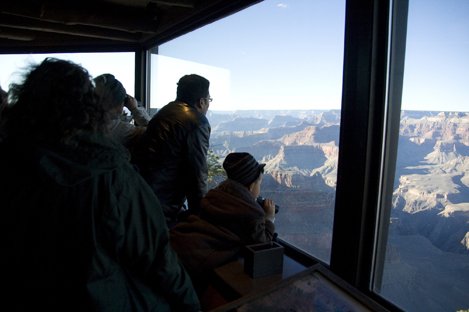
Visitors study the colorful layers of the Grand Canyon from the observation window in the geology museum at Yaqui Point. Photo by Pete Aleshire
oooOOOooo
Such beautiful words. Any additional thoughts from yours truly are utterly superfluous.


 Learning from Dogs